

The Christmas after Grandma died, I almost didn’t look out the kitchen window.
I was standing at the same old counter where she had poured coffee for me years earlier. The house smelled different now. It was still warm. Still familiar. But without her voice coming from the other room, every little sound seemed too loud.
The crooked cabinet above the refrigerator was still crooked.
The old wooden shelves my grandfather had built were still there.
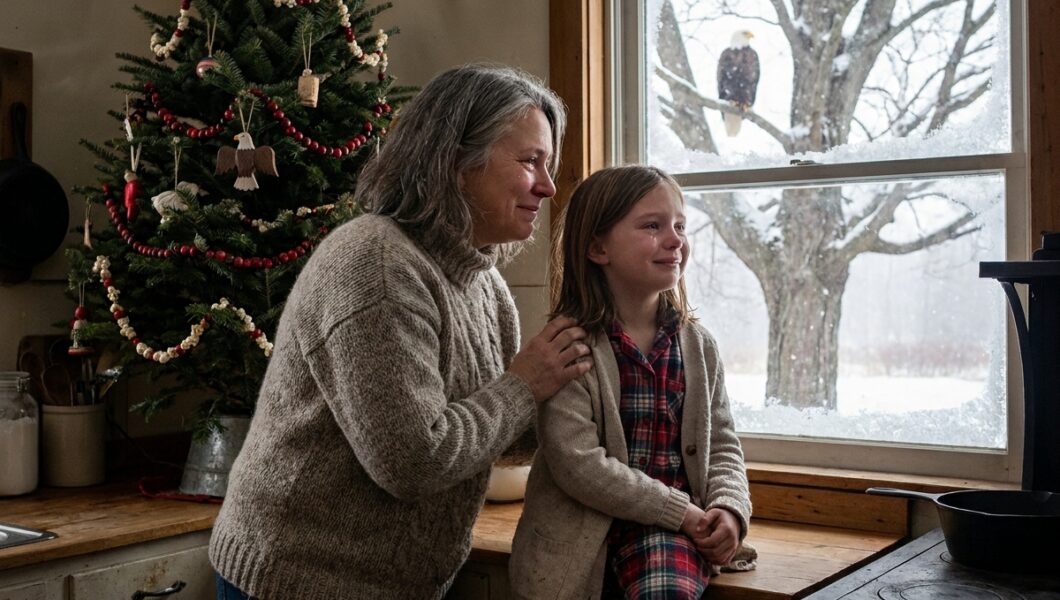
Even the little bald eagle ornament from 1979 was hanging near the bottom of the Christmas tree.
I reached up and touched it.
For a moment, I could hear Grandma’s voice again.
“I’ll be here.”
She had said those words the Christmas morning she gave me the wooden box.
At the time, I thought she meant she would be there the following Christmas.
I didn’t understand that she was talking about something bigger.
She meant the house.
The memories.
The stories.
The part of Grandpa that she had carried with her for so many years.
I looked toward the backyard.
The maple tree stood exactly where it always had.
Bare branches.
Fresh snow.
Gray December sky.
And then I saw something move.
I froze.
A bald eagle landed on one of the upper branches.
I didn’t breathe.
It sat there quietly, looking toward the house.
I whispered the same words Grandma had said years before.
“There he is.”
My daughter was sitting at the kitchen table drawing pictures.
She looked up.
“Who?”
I pointed toward the window.
She ran over.
“Oh!”
She pressed both hands against the glass.
“It’s the eagle.”
I nodded.
For a few seconds, neither of us said anything.
Then she asked the question I had been expecting.
“Is it the one Grandpa saved?”
I smiled.
“I don’t know.”
She looked disappointed.
“Can’t we find out?”
That question stayed with me.
Because for the first time, I realized that maybe we could.
I had spent years treating the story like a family memory.
Something that belonged to Grandma.
Something that didn’t need proof.
But now she was gone.
And suddenly, I wanted to know.
Not because I needed to prove the eagle was the same one.
I simply wanted to know what had happened after my grandfather carried that story home.
So after Christmas, I started looking.
I searched through old boxes in the basement.
I found my grandfather’s fishing licenses.
Old tax records.
Receipts from hardware stores.
A faded newspaper clipping about a snowstorm.
Photographs from family vacations.
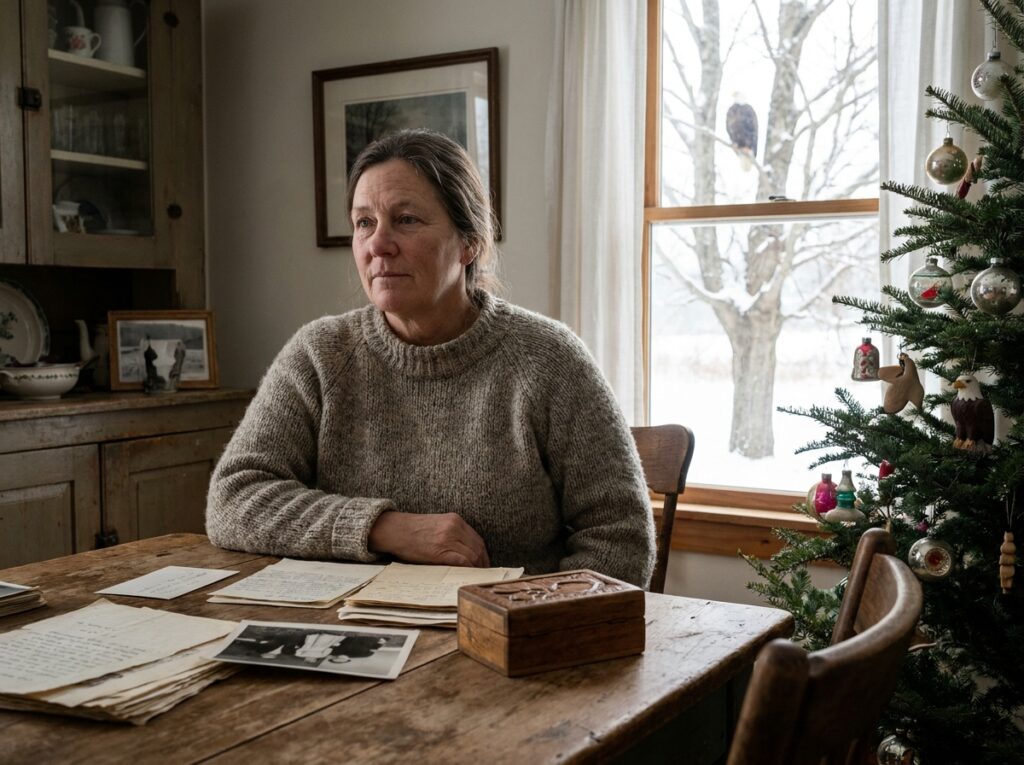
Then, tucked inside a folder beneath some old insurance papers, I found something I had never seen before.
A handwritten note.
The paper was yellow with age.
At the top was a date.
December 24, 1979.
I recognized my grandfather’s handwriting immediately.
The note described the eagle he had found near the fallen tree.
He had written down the time.
The weather.
Where the bird had been trapped.
Even the number he called for the wildlife rescue center.
But there was one line that made me stop.
He had written:
“I don’t know if he’ll make it through the night. I’ll stay where I can see him.”
I sat on the basement floor holding the paper.
That sounded exactly like him.
Grandma had told me the same thing.
But then I noticed another sheet underneath it.
This one wasn’t written by Grandpa.
It was from the wildlife rehabilitation center.
There was a case number.
A date.
And a note saying the eagle had been successfully treated and released.
I read it twice.
Then I noticed something else.
The release location.
It was less than two miles from my grandparents’ home.
I called the wildlife center.
It no longer operated under the same name.
But after several phone calls, I eventually reached a retired volunteer who had worked there around the time my grandfather found the eagle.
I explained who I was.
There was silence on the other end.
Then she said something I didn’t expect.
“I remember that bird.”
My heart started beating faster.
“You do?”
“I remember the case.”
She told me she couldn’t guarantee that she remembered every detail after so many years.
But the story sounded familiar.
A man had found an injured bald eagle on Christmas Eve.
He had stayed nearby through the night.
The roads had been difficult.
The rescue team had arrived Christmas morning.
The bird had a leg injury and damage from the wire.
It was treated and eventually released.
I asked the question I had been afraid to ask.
“Was the eagle banded?”
She said she wasn’t sure.
Then she paused.
“Wait.”
I heard papers moving in the background.
She came back a few minutes later.
“There was a band number.”
I grabbed a pen.
She read it to me.
I wrote it down.
Then she said something that made my hand stop.
“The bird was an adult.”
I looked toward the window.
The eagle was still sitting in the maple tree.
“If it survived,” she continued, “there’s a chance it could have lived for decades.”
I thanked her.
After we hung up, I stood there for a long time.
My daughter looked at me.
“What did she say?”
I smiled.
“She said Grandpa’s eagle might have lived a very long time.”
“Like the same eagle?”
“Maybe.”
Her eyes widened.
“Then it could be him!”
I laughed.
“Maybe it could.”
She ran toward the window.
The eagle was gone.
For some reason, that didn’t bother me.
I had spent years thinking the most important part of the story was whether the eagle returned.
Now I was beginning to understand that the real story had started much earlier.
It had started with my grandfather seeing something vulnerable in the snow and deciding not to walk away.
That was what Grandma remembered.
That was what she had wanted me to remember.
And maybe that was why the eagle mattered so much to her.
A few weeks later, I took the old band number to a wildlife researcher.
He explained that records from that era were incomplete.
There was no way to prove where the eagle had gone after its release.
But he told me something else.
Bald eagles can live for decades in the wild.
An adult bird in 1979 could, under the right circumstances, have still been alive years later.
That wasn’t proof.
It wasn’t even close.
But it was enough to make me wonder.
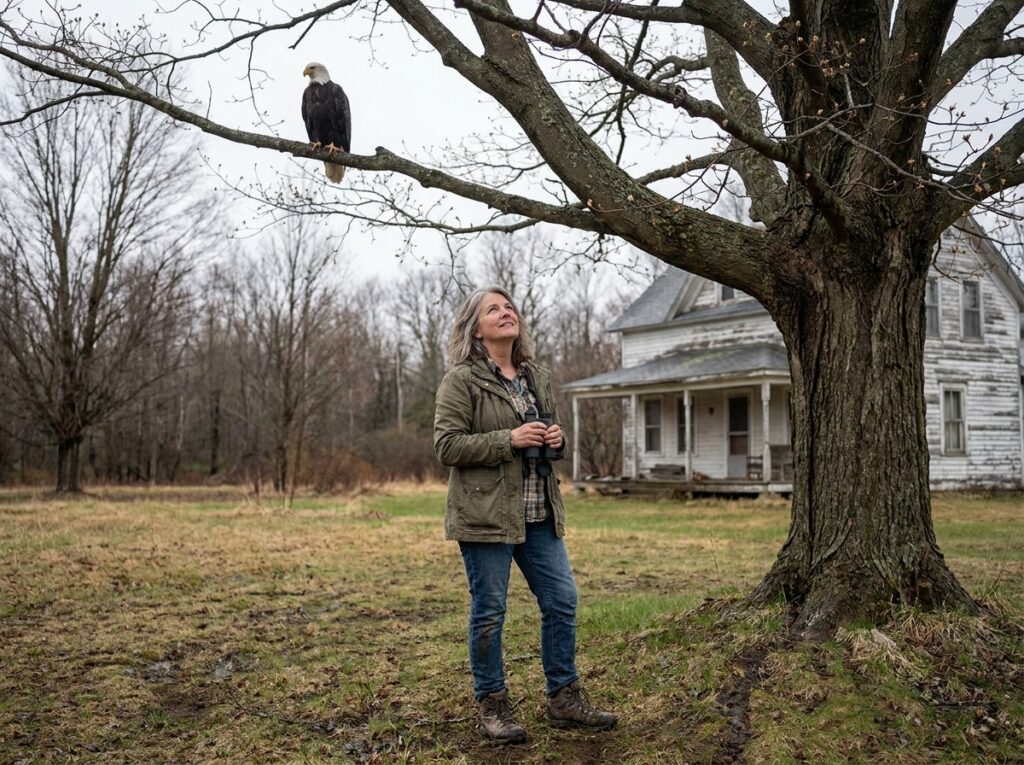
I went back to Michigan that spring.
The snow had disappeared.
The maple tree was beginning to grow small green leaves.
I stood beneath it and looked up.
I imagined my grandfather standing in the same place in 1979.
He would have been younger than I was now.
He had probably been annoyed about being outside in the cold.
He probably complained about the snow.
And yet he stayed.
He had no idea that decades later, his granddaughter would be standing under the same tree wondering about that night.
I found myself wishing I could ask him one question.
“Why did you stay?”
I already knew the answer.
Because he couldn’t leave an injured animal alone.
That was simply who he was.
That summer, I found one more photograph.
It was inside a box my mother had kept for years.
The photograph showed Grandpa sitting on the porch.
He was holding a cup of coffee.
The maple tree was behind him.
At first, I didn’t notice anything unusual.
Then I saw the upper branches.
There was an eagle.
I turned the photograph over.
On the back, Grandpa had written:
“Same visitor?”
Underneath was a question mark.
That little question mark meant more to me than anything else I had found.
Because it proved something.
My grandfather had wondered too.
He had never claimed that the eagle he saw later was the same bird.
He had simply wondered.
Just like Grandma.
Just like me.
Maybe that was the reason the story survived.
Nobody ever needed certainty.
They only needed the possibility.
A possibility that something beautiful had returned.
A possibility that kindness could somehow echo through time.
A possibility that the world occasionally gives us little reminders of people we miss.
Years after Grandma’s Christmas tradition began, I started one of my own.
Every Christmas morning, I make cinnamon rolls.
I use Grandma’s recipe.
I make coffee the way she did.
I put the little wooden eagle ornament on the tree.
And at 8:14, I look toward the maple tree.
Some years, nothing happens.
The tree is empty.
Other years, a hawk passes overhead.
Once, a flock of crows landed in the branches and made enough noise to wake the whole house.
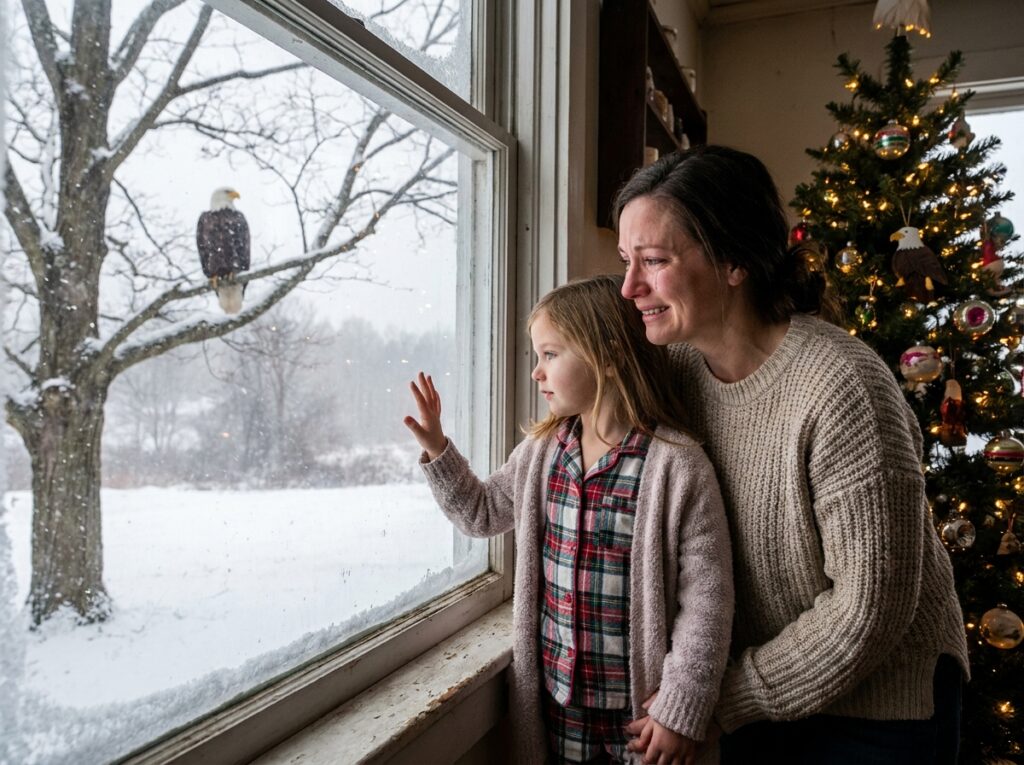
And then, one Christmas morning, my daughter screamed from the kitchen.
“Mom!”
I ran into the room.
She was pointing toward the window.
The eagle was back.
Same tree.
Same quiet posture.
Snow falling lightly around it.
I stood beside her.
Neither of us moved.
“Do you think it’s him?” she whispered.
I looked at the eagle.
Then I looked at the wooden ornament hanging on the Christmas tree.
“I don’t know.”
She smiled.
“I think it is.”
I smiled too.
“Maybe.”
The eagle remained there for almost half an hour.
Then it opened its wings and flew toward the lake.
My daughter watched until it disappeared.
“Will it come back next year?”
I put my arm around her.
“I don’t know.”
She looked at me.
“But you’ll look?”
“Yes.”
“Every year?”
I smiled.
“Every year.”
That was when I finally understood Grandma’s words.
She had never needed the eagle to prove anything.
She had never needed anyone to believe that it was connected to Grandpa.
She simply wanted someone to stand beside her and look.
That was all.
Years earlier, I had thought she was telling me a story about an eagle.
She wasn’t.
She was telling me a story about my grandfather.
About a man who saw something in trouble and refused to leave.
About a man who sat in the snow because he didn’t want an injured creature to spend Christmas Eve alone.
About a woman who remembered that kindness for the rest of her life.
And about how that memory eventually became part of our family.
I still don’t know whether the eagle that visits the maple tree is the same one my grandfather helped in 1979.
There is no way for me to prove it.
Maybe it is.
Maybe it isn’t.
But I no longer think that is the important question.
The important thing is that my grandfather stopped.
My grandmother remembered.
And now I remember too.
Every Christmas morning, I look toward that tree.
Sometimes I see an eagle.
Sometimes I don’t.
But I always think about him.
And when my daughter grows older, I’ll tell her the story.
I’ll tell her about the night Grandpa went outside for firewood and heard something in the snow.
I’ll tell her how he sat there for hours because he didn’t want the bird to be alone.
I’ll show her the photograph.
I’ll show her the old handwritten note.
I’ll show her the little wooden eagle ornament.
And I’ll tell her that we don’t have to know whether the eagle came back all those years later.
Some stories aren’t meant to be solved.
They’re meant to be remembered.
Because sometimes the greatest gift someone leaves behind isn’t something they bought or built.
It’s the example they gave us.
My grandfather taught us to stop.
Grandma taught us to remember.
And that Christmas morning, the eagle reminded me that love can survive in ways we don’t always recognize.
It can live in an old photograph.
In a crooked kitchen cabinet.
In a recipe written on a stained piece of paper.
In a story told at the Christmas table.
In a child’s question.
And sometimes, it can sit quietly in a maple tree while snow falls around it.
I still look for him every Christmas.
I still don’t know if it’s really the same eagle.
But whenever one appears, I smile.
And I always say the same thing.
“Good morning.”
Then I think of Grandma.
I think of Grandpa.
And I remember what she told me that first Christmas.
“I don’t need it to be a sign.”
“I just like having something that remembers him with me.”
Now I understand.
She never needed the eagle to bring Grandpa back.
She only needed someone to remember why it mattered.
And I do.
Every Christmas.
Every year.
Every time I look toward that old maple tree.
And maybe that’s why I still pause every Christmas morning at exactly 8:14.
Not because I expect a bird to appear.
Not because I need a miracle.
But because for a few quiet minutes, I can imagine my grandmother standing beside me.
I can imagine her pointing toward the window.
“There he is.”
And I can imagine my grandfather somewhere in that old memory, sitting in the snow beside an injured eagle, refusing to leave until help arrived.
Maybe the eagle remembered him.
Maybe it didn’t.
Maybe it was simply another bald eagle following the same winter path its kind had followed for generations.
I don’t know.
But I know this.
My grandfather’s kindness became my grandmother’s favorite memory.
Her memory became my story.
And now that story belongs to my daughter too.
That’s how some things survive.
Not because we can prove them.
Because we keep telling them.
So every Christmas, I make Grandma’s cinnamon rolls.
I hang Grandpa’s wooden eagle on the tree.
And before anyone starts opening presents, I look through the kitchen window.
Sometimes the maple tree is empty.
Sometimes it isn’t.
But either way, I smile.
Because the people we love don’t disappear completely.
Sometimes they leave behind a recipe.
A photograph.
A story.
A lesson.
Or simply a reason to look outside on Christmas morning.
And sometimes, if you’re very lucky, something with white feathers lands in the tree and reminds you that the story is still being carried forward.
Maybe that’s what Grandma meant all along.
Maybe the eagle wasn’t there to bring anyone back.
Maybe it was there to remind us that kindness never really leaves.
It just finds another place to live.


No Comments