

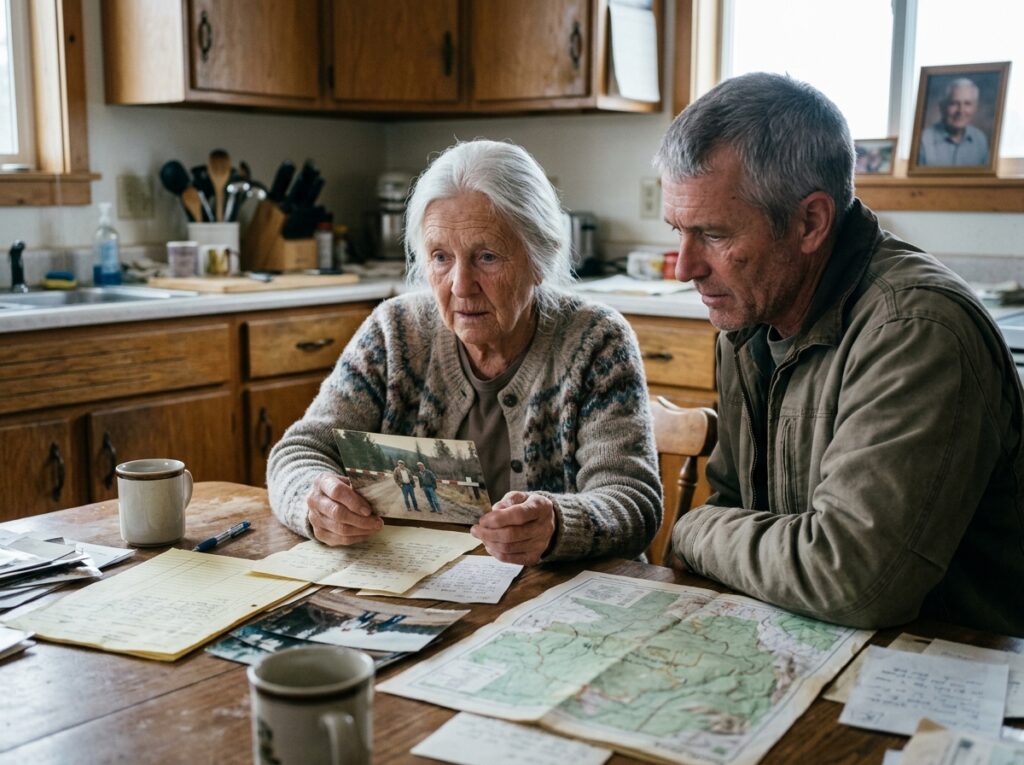
Margaret Wilson stared at the photograph lying on her kitchen table.
The man standing beside the roadside barrier was unmistakable.
He had the same broad shoulders, dark raincoat, and weathered face as the stranger captured by her trail camera at 3:19 AM.
But the photograph was nearly twenty years old.
And beside him stood her late husband, Henry.
Margaret turned the photograph over.
Written in Henry’s familiar handwriting were four words and a date.
“Robert Hayes. October 2007.”
She looked at Daniel Mercer.
“Who is Robert Hayes?”
Daniel’s expression changed immediately.
For several seconds, he said nothing.
Then he pulled out the chair opposite Margaret and sat down.
“Robert worked with my father on the old logging road,” he explained. “He was responsible for maintaining the barriers and drainage crossings.”
Margaret looked again at the photograph.
“Then why would he be putting that cable back?”
Daniel lowered his eyes.
“I don’t know. But I think Henry was worried about that road long before he died.”
The wildlife officer had promised to call again when investigators had more information. Margaret knew the photograph was not proof of wrongdoing, but she could not ignore the questions it raised.
She carefully placed it beside Henry’s letter.
For eighteen months, she had believed she knew every important part of her husband’s life.
Now his old desk seemed to contain an entire history she had never heard.
Daniel asked whether he could examine the remaining documents.
Margaret nodded.
Together, they spread the contents of the yellowed envelopes across the kitchen table.
There were faded county maps, maintenance reports, handwritten notes, and several photographs of the logging road before the landslide.
One document was dated November 2007.
It described concerns about loose cable barriers near a wildlife crossing.
Another included a handwritten observation from Henry.
“Animals moving through lower crossing after heavy rainfall. Cable must not be left loose.”
Margaret read the sentence twice.
Then she noticed a second note beneath it.
“Follow up with Robert.”
Her hands tightened around the paper.
Henry had spent years worrying about that crossing.
And now, nearly two decades later, an injured bald eagle had been discovered beside the same damaged barrier.
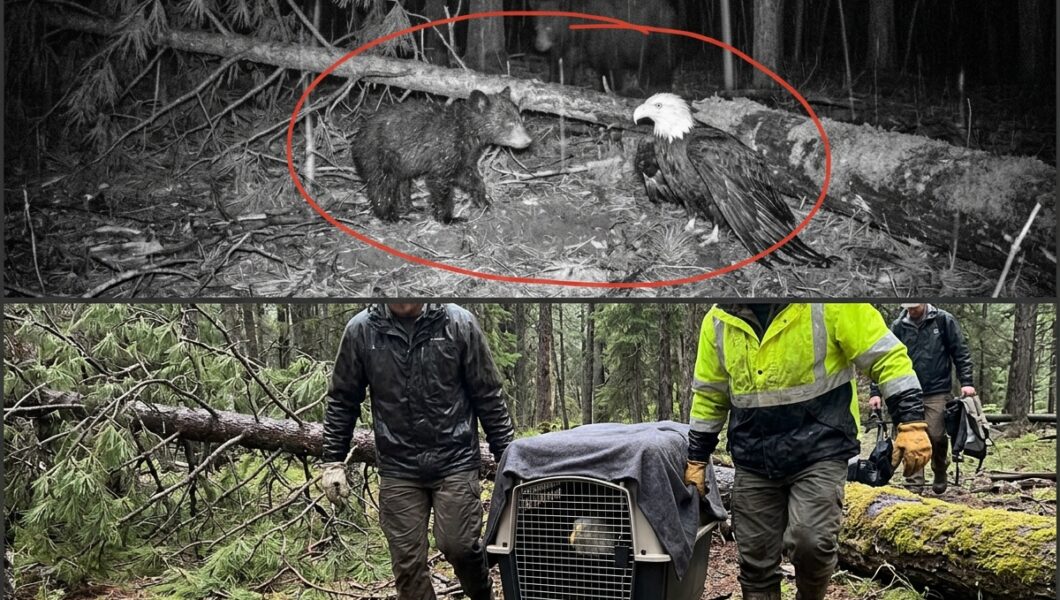
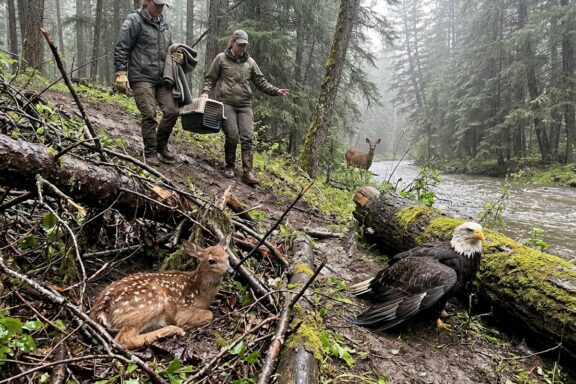
Margaret thought about the little black bear cub standing in the rain.
She remembered its tiny paws slipping on the fallen tree, and the mother bear appearing from the darkness to lead it away.
The animals had survived that night.
But what about the next storm?
What about the next deer, fox, or eagle passing through the crossing?
She looked at Daniel.
“We need to find out what happened.”
Daniel nodded.
“And we need to do it properly.”
That afternoon, the investigating wildlife officer called again.
His name was Andrew Collins.
He explained that Robert Hayes had been contacted and had agreed to provide an account of his visit to the closed logging road.
“Has he told you why he was there?” Margaret asked.
“He says he was checking an old barrier after hearing that part of the road had been damaged by heavy rain.”
“And the cable?”
Andrew paused.
“Mr. Hayes acknowledges moving a length of cable back across part of the barrier. He says he believed he was preventing vehicles from entering an unsafe section.”
Margaret stared toward the kitchen window.
“But animals use that crossing.”
“That’s one of our concerns. We’re examining whether the cable was secured appropriately and whether the work was authorized.”
“Did it hurt the eagle?”
“We don’t have evidence establishing that. The veterinarian is still assessing the bird’s injury, and we’re reviewing the condition of the barrier.”
Margaret appreciated his careful answer.
She did not want to accuse an innocent person.
But she wanted the forest made safe.
Andrew told her that county personnel would inspect the closed road and its remaining barriers.
Until then, she should stay away from the crossing and continue sending any relevant camera recordings.
After the call, Margaret sat quietly beside Henry’s empty chair.
She could almost hear him telling her not to confuse suspicion with certainty.
Henry had always believed that a person’s actions deserved to be understood before they were judged.
She hoped she could honor that.
Two days later, Robert Hayes came to the farmhouse.
He did not arrive unannounced. Andrew had contacted Margaret first, and she had agreed to speak with Robert while Daniel was present.
Robert was sixty-eight now, with thinning gray hair and rough hands that looked as though they had spent a lifetime working outdoors.
He stood awkwardly on the porch, holding an old brown folder.
“Mrs. Wilson,” he said quietly. “I’m sorry to come under these circumstances.”
Margaret invited him inside.
Robert noticed Henry’s photograph above the fireplace.
For a moment, his face softened.
“He was a good man.”
“Then tell me what happened out there,” Margaret replied.
Robert sat down.
He explained that he had worked on the logging road for decades before retiring.
When the county closed it after the landslide, several old barriers remained in place. Over time, some deteriorated, and responsibility for particular sections became unclear.
Robert had occasionally checked the area because he worried someone might drive onto the unstable road.
During the storm, a former coworker had told him that one of the barriers appeared damaged.
Robert drove out to inspect it.
“I found the cable lying loose beside the road,” he said. “I thought putting it back would keep someone from driving through.”
Daniel leaned forward.
“Did you know animals were crossing there?”
Robert nodded slowly.
“Henry told me years ago.”
“Then why didn’t you leave the cable down and report it?”
Robert stared at his hands.
“I should have called the county. I thought I was helping. I didn’t think about how the cable might affect wildlife in the dark.”
Margaret looked at him carefully.
“Did you see the injured eagle?”
“No, ma’am. Not that night. I didn’t go into the clearing.”
She could not know whether every detail of Robert’s account was correct.
That was for investigators to examine.
But his regret appeared genuine.
Robert opened the folder.
Inside was an old photograph of Henry standing beside a newly marked wildlife crossing.
He handed it to Margaret.
“Your husband spent weekends helping us make that place safer. He never wanted the road to become a danger to the animals.”
Margaret touched Henry’s face in the photograph.
“Why didn’t he tell me how much work he’d done?”
Robert smiled sadly.
“Because he never thought helping was something worth boasting about.”
Then Robert said something Margaret had not expected.
“After Daniel’s father died, Henry was the one who insisted we review the road’s safety. He wanted to make sure nobody else got hurt.”
Daniel lowered his head.
Robert continued.
“Henry never blamed Daniel for that accident. Not once.”
Margaret looked toward the younger man.
His eyes were wet.
For twenty years, Daniel had carried a burden Henry had tried to lift.
And now, sitting in Henry’s kitchen, he was finally hearing the same truth from someone else.
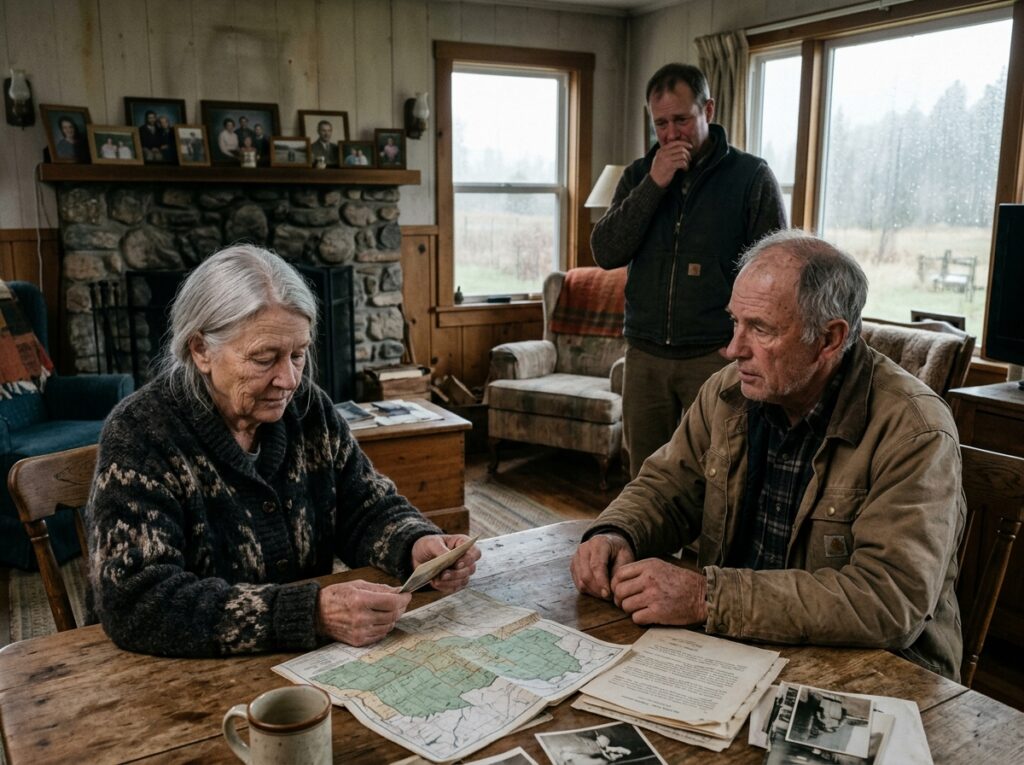
After Robert left, Daniel remained at the farmhouse.
He helped Margaret put the old documents into folders.
For a long time, neither spoke.
Finally, Daniel picked up Henry’s letter.
“Margaret, if anything ever happens to me, please make sure Daniel knows I never blamed him.”
He read it aloud.
His voice broke on the final words.
“I spent so many years thinking that accident was my fault.”
Margaret sat beside him.
“Henry knew you were hurting.”
Daniel wiped his eyes.
“He paid for my wildlife training. I thought it was because he felt sorry for me.”
Margaret shook her head.
“He believed in you.”
Daniel looked down at the photograph of the forest crossing.
“I wish I’d thanked him properly.”
Margaret placed her hand over his.
“You still can.”
Daniel looked confused.
She smiled gently.
“Help finish what he started.”
The following week, county road personnel and wildlife officers completed an initial inspection of the old logging road.
Several sections of deteriorated fencing and cable were documented.
Some material had become tangled among fallen branches, while other pieces remained attached to damaged posts.
The team arranged for hazardous debris to be removed or secured where access and ownership permissions allowed.
Robert provided his old maintenance records.
Daniel helped explain how the original wildlife crossing had been intended to function.
Margaret contributed Henry’s maps and observations.
The investigation had not established that the loose cable caused the eagle’s wing injury.
Nor had it determined that Robert intended to endanger wildlife.
But the inspection revealed maintenance problems that needed attention regardless of the eagle’s accident.
Margaret was relieved that something useful was finally being done.
She began making sandwiches for the workers and volunteers.
Every afternoon, she placed a thermos of coffee on her porch.
Daniel often stopped by after his shift at the rehabilitation center.
He brought updates about the eagle.
At first, the news was cautious.
The bird was eating but remained unable to fly.
The injured wing needed rest, careful monitoring, and additional veterinary assessment.
Margaret listened closely.
“Do they think it’ll recover?”
“They’re hopeful,” Daniel said. “But we can’t rush it.”
She understood.
Some things could not be repaired in a day.
A damaged wing.
An old road.
Or a heart that had carried guilt for twenty years.
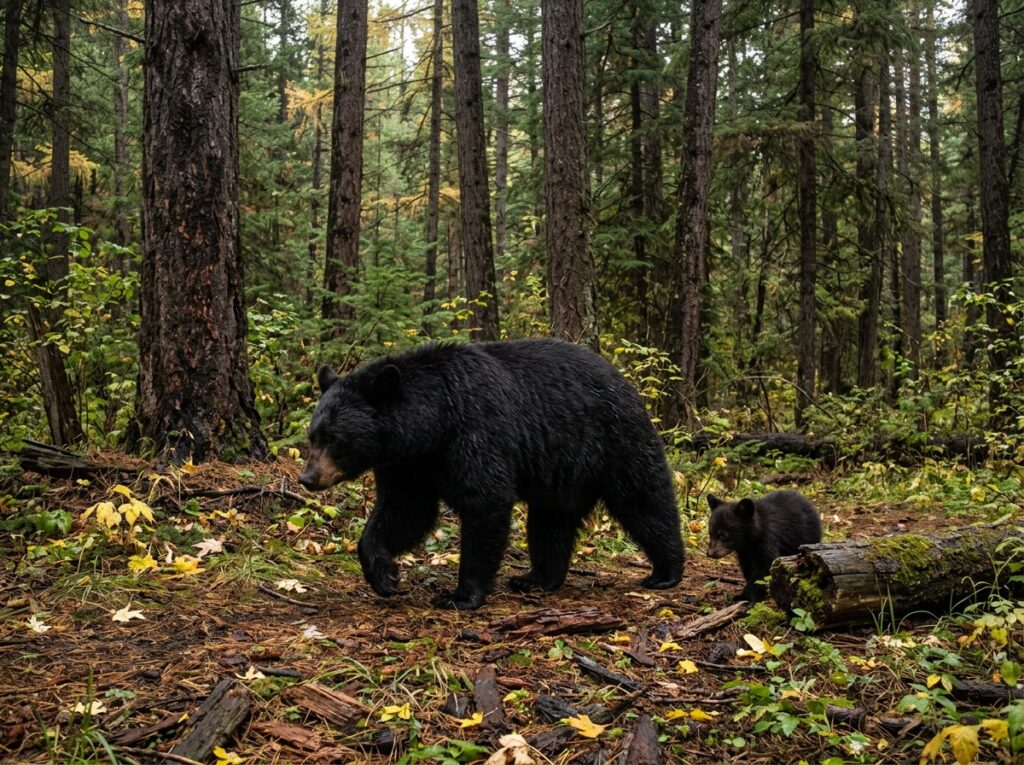
Three weeks after the storm, Margaret received another trail-camera alert.
This time, it was shortly after sunset.
She opened the recording.
A large black bear moved slowly along the edge of the forest.
Behind her came a smaller bear.
The cub.
Margaret leaned closer.
The little animal appeared healthy and energetic, pausing to sniff a fallen branch before hurrying after the larger bear.
There was no way to prove they were the same bears from the storm.
But the timing and location gave Margaret hope.
She watched the pair disappear into the trees.
Then she laughed through her tears.
“Henry, you would have loved that.”
She saved the recording in a folder named Forest Visitors.
It was the same name Henry had used for his wildlife photographs.
A few days later, Daniel arrived with another update.
The eagle’s condition had improved enough for the rehabilitation team to begin carefully assessing its movement and wing function.
There was still a long road ahead.
But the bird was stronger.
Margaret closed her eyes.
“That’s all I wanted to hear.”
Daniel smiled.
“Henry would have been happy.”
Margaret looked at him.
“I think he’d be happy you’re here, too.”
By early winter, the old crossing looked different.
The damaged cable had been addressed by the responsible road crew, and warning signs had been placed near unsafe sections of the closed road.
The wildlife team continued evaluating the area for longer-term improvements.
Daniel helped organize a small community meeting about wildlife hazards, abandoned fencing, and safe reporting procedures.
Margaret attended with Henry’s notebook tucked beneath her arm.
She had never enjoyed speaking in front of people.
But when Daniel asked whether she wanted to say a few words, she stood.
“My husband loved this forest,” she began.
Her voice trembled.
“He used to tell me that being kind didn’t always mean rushing in to save the day. Sometimes it meant noticing a problem and making sure the right people knew.”
She paused.
“That night, I couldn’t go outside and help the eagle. I couldn’t touch the bear cub. All I could do was make a phone call and keep watching.”
She looked around the room.
“But because people listened, those animals were given a chance.”
Several people nodded.
Margaret opened Henry’s notebook.
“Henry wrote about that crossing almost twenty years ago. He wanted it to be safe for people and animals. I think he’d be glad we’re still trying.”
When she finished, Daniel stood and quietly embraced her.
For the first time since Henry’s death, Margaret felt that something of his work was continuing beyond the walls of their farmhouse.
Winter settled over Montana.
Snow gathered along the porch railing.
The creek slowed beneath thin sheets of ice.
Margaret continued checking the trail camera every morning.
Sometimes it showed deer.
Sometimes a fox.
Often nothing at all.
The eagle remained at the rehabilitation center through the colder months, receiving professional care.
Its recovery was gradual.
The veterinary team avoided promising a release until the bird could demonstrate the strength, coordination, and flight ability needed to survive in the wild.
Margaret waited patiently.
Then, one morning in early spring, Daniel called.
“Margaret, are you sitting down?”
She gripped the telephone.
“Is something wrong?”
“No,” he said, laughing softly. “Something good.”
The eagle had progressed through its rehabilitation assessments and had successfully completed the flight testing required by the center.
The veterinary team had approved its release.
Margaret sat down slowly.
For a moment, she couldn’t speak.
She remembered the black-and-white camera image.
The pouring rain.
The injured wing.
The tiny bear cub shivering beside the fallen pine.
And the terrible fear that neither animal would survive.
Now the eagle was going home.
The release took place several days later at a suitable location selected by the wildlife professionals.
Margaret watched from a designated viewing area beside Daniel and a small group of authorized observers.
The rehabilitator carefully positioned the transport carrier.
When the door opened, the eagle hesitated.
Then it stepped forward.
Its wings spread wide.
With several powerful beats, it lifted into the cold spring air.
Margaret held her breath.
The bird climbed above the clearing, turned toward the distant trees, and continued flying until it disappeared beyond the ridge.
Margaret began to cry.
Daniel stood quietly beside her.
Neither spoke for several minutes.
Finally, Margaret whispered, “Henry would have wanted to see that.”
Daniel looked toward the mountains.
“I think he’d be proud of what you did.”
Margaret shook her head gently.
“What we all did.”
That evening, she returned home and placed the photograph of Henry, Daniel, and the old wildlife crossing on the mantel.
Beside it, she put Henry’s letter.
The words that had once seemed mysterious now carried a different meaning.
They were not about blame.
They were about forgiveness.
About a man who had quietly helped a grieving boy find a future.
And about a forest he had tried to protect long before anyone noticed.
At 8:17 PM, Margaret’s trail camera sent another notification.
She opened it.
The image showed an empty woodland path beneath the evening sky.
Nothing remarkable.
Just the trees, the damp earth, and the quiet forest Henry had loved.
Margaret smiled.
She saved the photograph anyway.
Then she turned toward his empty chair.
“You were right, Henry,” she whispered.
“Sometimes the smallest things we do are the ones that matter most.”
And for the first time in eighteen months, the silence inside the farmhouse no longer felt quite so lonely.
The End.
This is a fictional wildlife rescue and kindness story. The characters and events are created for storytelling purposes.
No Comments