

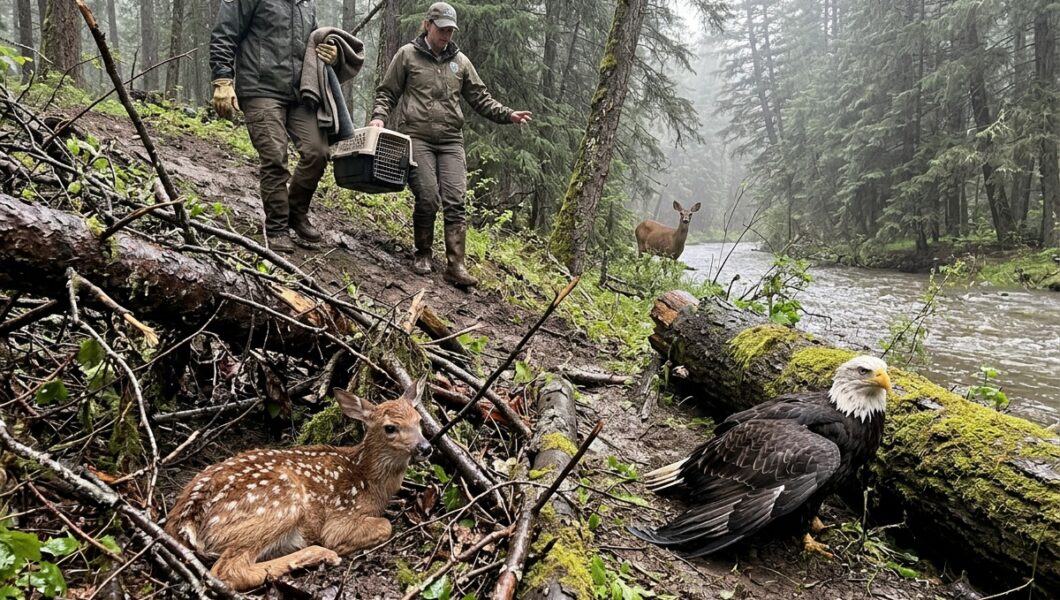
The photograph arrived on Eleanor Brooks’s phone at 9:26 on Saturday morning.
She was standing beside the kitchen sink when it appeared.
At first, she saw only wet leaves, broken branches, and a muddy patch of ground beside the creek.
Then she enlarged the image.
A thin blue cord was tangled around a wooden stake.
It looked almost identical to the cord she had noticed in the trail camera recording.
But this photograph had been taken nearly half a mile downstream.
And beside the stake was a small patch of disturbed earth.
Eleanor felt a chill.
The county investigator, Mark Collins, had told her another injured animal had been found nearby. Now she understood why he wanted to speak with her.
She called him immediately.
“What happened to the other animal?” she asked.
“It was a young fox,” Mark explained. “A wildlife officer found it struggling near some tangled material beside the creek. It’s receiving treatment now.”
“Was it caught in that blue cord?”
“We’re still examining what happened. The cord was nearby, but we haven’t established exactly how the fox was injured.”
Eleanor looked toward the window.
Beyond her backyard, the woods stood quiet beneath the pale morning sky.
For forty-two years, those trees had been part of her home.
Now she was beginning to wonder what had been happening beneath them when nobody was watching.
Mark asked whether he could visit that afternoon.
He also wanted to know if Eleanor remembered anyone using the old logging road before the storm.
She thought carefully.
There had been hunters in the area years ago. Occasionally, utility workers inspected the creek crossings. And during the summer, she sometimes saw unfamiliar vehicles near the abandoned footbridge.
But nothing had seemed unusual.
Until now.
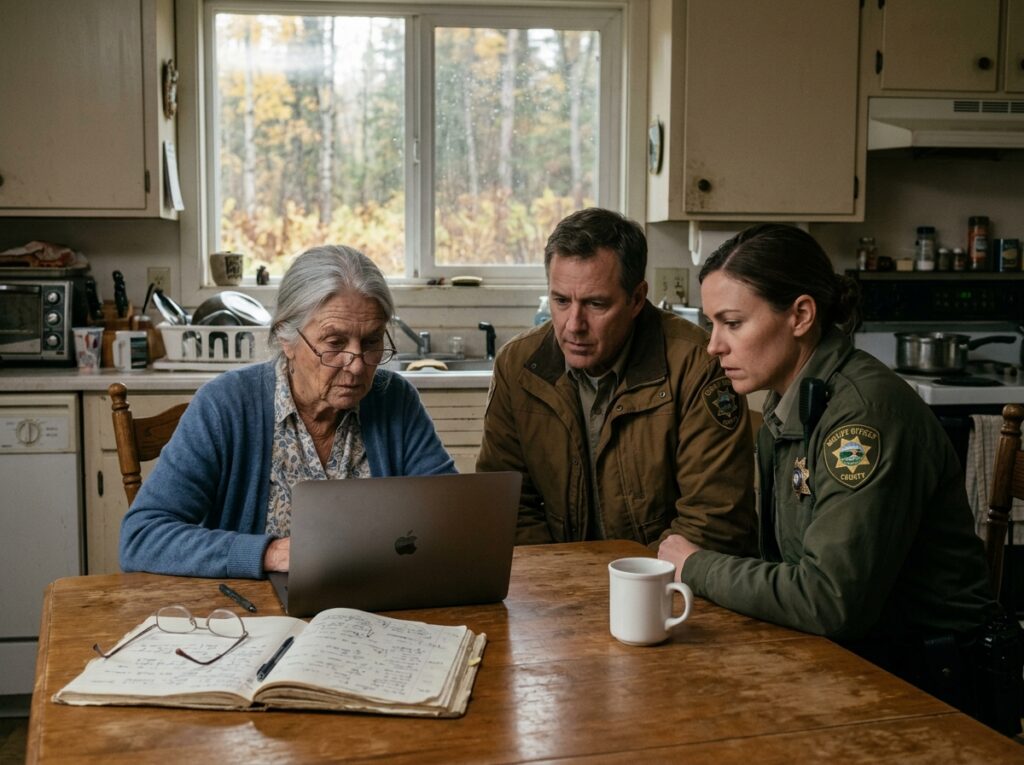
At 1:15 PM, Mark arrived with wildlife officer Sarah Bennett.
Eleanor invited them into the kitchen.
Thomas’s old trail camera notebook still rested on the shelf beside the refrigerator. He had used it to record deer sightings, weather conditions, and the occasional bald eagle flying above the creek.
Sarah noticed the notebook.
“Your husband kept records?”
Eleanor smiled faintly.
“Every animal he saw. He said the woods had stories, even when nobody was there to hear them.”
Mark asked permission to review the camera footage.
Eleanor opened her laptop.
They watched the recording from 2:54 AM.
A person in a light-colored jacket appeared near the footbridge.
The figure carried what looked like a metal container, stopped beside a wooden post, then disappeared behind the trees.
Mark replayed the clip.
“Do you recognize this person?”
“No.”
“Have you seen that container before?”
Eleanor shook her head.
Then she hesitated.
“Thomas used to keep metal feed buckets in the old barn. But I don’t think this is one of them.”
Sarah leaned closer.
“Can you pause it there?”
Eleanor stopped the video.
The person had turned slightly toward the camera.
A pale reflective strip was visible across the back of the jacket.
It was a small detail.
But Sarah wrote it down.
Mark explained that the footage was useful, although it did not prove the person had placed the wire or cord.
“We need to be careful about connecting things too quickly,” he said. “The storm moved debris a considerable distance. Some of what we’re finding could have been there for years.”
Eleanor understood.
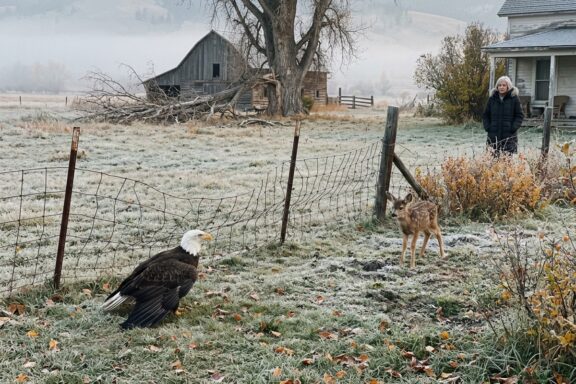
Still, she couldn’t forget the frightened fawn lying beneath the fallen tree.
Or the injured eagle struggling against the rain.
“What about them?” she asked. “Could the cord have hurt them?”
Sarah answered gently.
“We don’t know yet. The eagle has a wing injury, but the veterinarian hasn’t identified the cause. The fawn’s leg was trapped by branches. We have no evidence that the cord caused either injury.”
Eleanor nodded.
She wanted answers.
But she wanted the truth more.
That evening, Eleanor received an unexpected phone call.
It was Daniel Mercer.
The road maintenance worker who had helped rescuers reach the trapped animals wanted to check whether they had survived.
“They’re both alive,” Eleanor told him.
She heard him exhale.
“That’s good news, ma’am. I’ve been thinking about them all day.”
Eleanor thanked him for what he had done.
Daniel was quiet for a moment.
“Actually, there’s something else I wanted to mention.”
Her fingers tightened around the telephone.
“When I was checking that logging road, I saw some blue plastic line caught around a fence post. I figured the flood had washed it down from somewhere upstream.”
“Blue cord?”
“Yes, ma’am.”
“Did you touch it?”
“No. The creek was already rising, and I didn’t want to get any closer.”
Eleanor told him about the investigator.
Daniel agreed to speak with Mark and describe exactly where he had seen the material.
Before hanging up, he asked one more question.
“That old footbridge, is it still used?”
“Not for years,” Eleanor replied. “Thomas stopped crossing it when the boards started rotting.”
Daniel paused.
“Someone’s been driving down there lately. I’ve seen fresh tire marks on the logging road more than once this month.”
Eleanor stared at the telephone after the call ended.
She remembered the lighter jacket.
The metal container.
The strange cord.
And the dark pickup Daniel had driven through the rain.
Two different people.
Two different times.
But one isolated stretch of creek.
The following morning, Mark returned with two wildlife officers to inspect the area.
Eleanor remained near the farmhouse while the team worked.
The creek had dropped considerably, but the ground was still unstable.
They photographed the posts, documented several lengths of blue cord, and checked the damaged fencing along the old path.
Farther downstream, they found additional plastic line tangled among flood debris.
Some pieces were brittle and weathered.
Others looked newer.
Mark arranged for the material to be collected and examined.
There was no immediate evidence of a deliberate trap.
But the amount of discarded material concerned the wildlife officers.
A fox had already been found injured nearby.
And the storm had scattered the debris through an area frequently used by deer and other wildlife.
Sarah told Eleanor that the team would work with the landowners to identify and remove dangerous material where it could be done safely.
“Even if nobody intended to hurt anything,” she explained, “loose wire and cord can become a serious hazard.”
Eleanor thought about Thomas.
He had always carried a pair of work gloves in his truck.
Whenever he found discarded fishing line or wire near the creek, he would carefully collect it when conditions were safe.
“Animals don’t understand what we leave behind,” he used to say.
She hadn’t thought about those words in years.
Now they returned with painful clarity.
At 4:40 that afternoon, the wildlife rehabilitation center called.
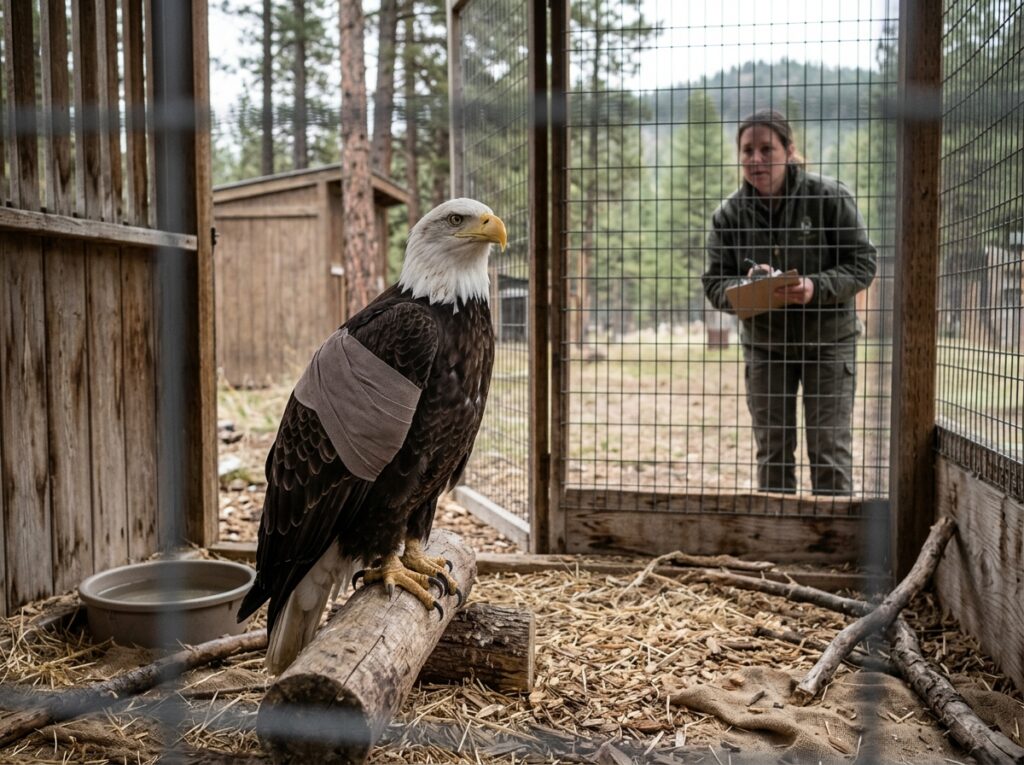
The bald eagle was still weak, but it had begun eating.
The veterinarian had stabilized its injured wing and was monitoring its recovery.
Eleanor sat down before asking about the fawn.
There was a pause.
Then the wildlife specialist said, “We have some encouraging news.”
The fawn’s leg showed swelling and bruising, but no obvious fracture had been found during its examination.
The team had been concerned about prolonged exposure to cold water and the stress of being trapped.
After monitoring the little deer, they believed a carefully managed return near its original location might be possible.
“But only if conditions are right,” the specialist explained. “We also need to avoid unnecessary human contact.”
Eleanor looked through the window toward the woods.
“And its mother?”
“We can’t promise anything. But the mother was seen nearby on your camera before the rescue. That’s useful information.”
Eleanor closed her eyes.
She remembered the doe standing beside the fallen tree at 3:28 AM.
The way she had lowered her head.
The way she had remained close despite the rain.
Perhaps she had not gone far.
Perhaps she was still searching.
Three days later, Eleanor received the news she had been hoping for.
The fawn had recovered enough for the wildlife team to attempt a return to the area near the creek.
The weather had improved.
The water level had fallen.
And the damaged section of fencing had been made safer.
Sarah called Eleanor early that morning.
“We’ll be bringing the fawn back today. We need you to stay inside and give the area plenty of space.”
“Of course,” Eleanor said.
She spent the morning watching the woods from her kitchen window.
At 10:20 AM, the wildlife vehicle arrived.
Eleanor saw the team disappear along the upper path.
She did not follow.
She knew the little animal’s best chance depended on being left undisturbed.
After a careful assessment of the location, the team placed the fawn in suitable cover near where it had been found.
Then they withdrew.
Eleanor waited.
One hour passed.
Then another.
The woods remained still.
At 2:36 PM, her trail camera sent a notification.
She opened it immediately.
The image showed the little fawn standing beneath a cluster of young trees.
Its spotted coat was damp from the grass.
One hind leg appeared slightly stiff, but it was standing and alert.
Eleanor covered her mouth.
“Oh, sweetheart.”
Then another notification arrived.
A larger deer appeared at the edge of the frame.
Eleanor leaned forward.
The doe stepped slowly into the clearing.
She stopped.
The fawn lifted its head.
For several seconds, neither animal moved.
Then the little deer took a few careful steps toward her.
The doe lowered her nose.
The fawn moved closer.
Eleanor began crying.
She watched as the two deer remained together briefly before moving beyond the camera’s view.
She knew a short recording couldn’t guarantee the fawn’s long-term survival.
But the sight of the doe approaching the little deer was the most hopeful thing she had seen all week.
She sent the footage to Sarah.
The reply came several minutes later.
“That’s very encouraging, Eleanor. Thank you for giving them space.”
For the first time since the storm, Eleanor slept through the night.
But the mystery near the creek had not disappeared.
On Thursday morning, Mark called with an update.
Investigators had identified the person wearing the light-colored jacket.
His name was Peter Lawson.
He was sixty-one years old and had worked on neighboring properties for years.
Eleanor recognized the name immediately.
“Peter? Thomas knew him.”
Mark explained that Peter had been inspecting an old drainage crossing before the storm became severe.
The metal container was a small galvanized bucket holding tools.
The reflective strip belonged to his rain jacket.
Peter had stopped near the footbridge to check a drainage pipe and had left before the worst flooding began.
He had voluntarily spoken with investigators.
“And the blue cord?” Eleanor asked.
Mark’s voice became more serious.
“That’s the part we’re still looking into.”
Some of the material appeared consistent with old utility or fencing line that had been left around the creek over time.
Other sections had been moved by the flood.
Investigators had not established who originally left the material there, or when.
They also had not found evidence linking Peter to the injured animals.
Eleanor felt both relieved and unsettled.
She had spent days imagining what the stranger might have been doing.
Now she realized how easily a frightening recording could make an ordinary person appear suspicious.
“I’m glad you found him,” she said.
“So are we,” Mark replied. “But we’re continuing to document the hazards along that stretch of creek.”
Eleanor thanked him.
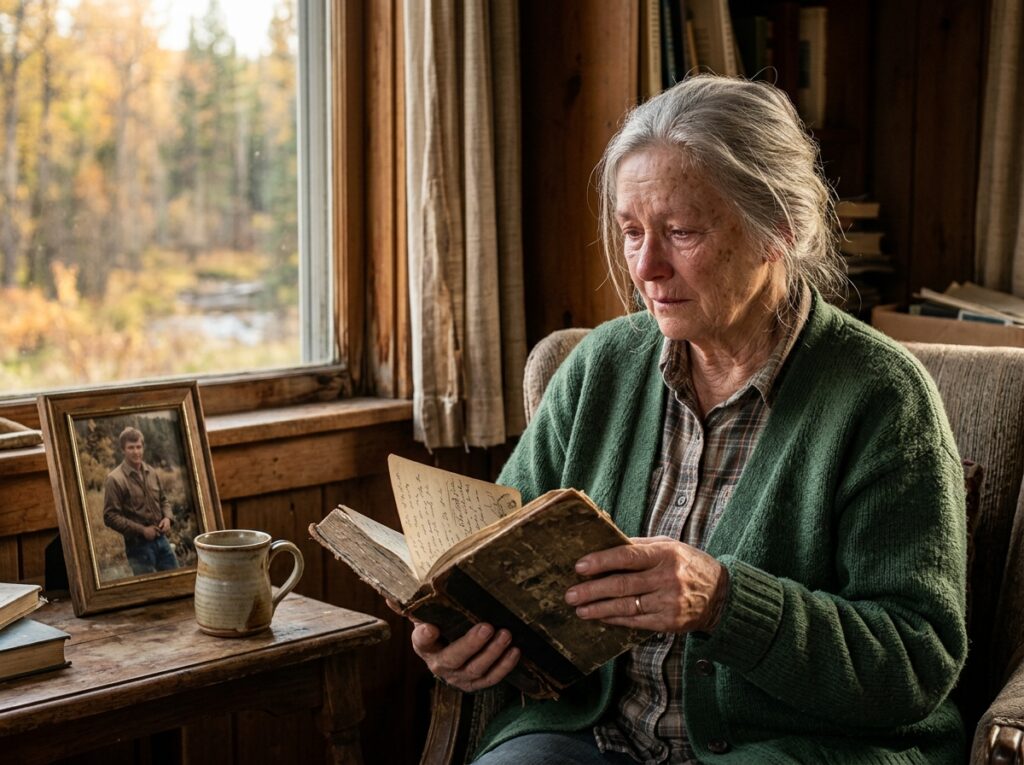
Then she opened Thomas’s old notebook.
She turned through pages of careful handwriting.
There were dates, weather observations, sketches of deer tracks, and notes about eagle sightings.
Near the back, she found an entry from seventeen years earlier.
Thomas had written about discarded fencing wire near the old logging road.
He had reported it to the property owner and helped remove some of the material.
Below the entry was a short sentence.
“Check again after heavy rain. More may wash down.”
Eleanor read it twice.
Then she placed her hand over the page.
Thomas had noticed the danger long before this storm.
Perhaps the cord was unrelated to the old wire.
Perhaps it had come from somewhere else entirely.
But his warning had been worth remembering.
She photographed the page and sent it to Mark.
Over the following two weeks, the county and wildlife personnel coordinated a cleanup of accessible sections of the old logging road.
Property owners were contacted.
Volunteers helped collect discarded fencing material from safe, approved areas.
Damaged posts were removed or repaired where permission had been obtained.
Nobody entered the creek during unsafe conditions.
Eleanor could not do the heavy work herself.
Instead, she made sandwiches and hot coffee for the volunteers.
Daniel Mercer returned on his day off.
He helped move debris from an approved cleanup area and checked the drainage route with the road maintenance crew.
When he arrived at Eleanor’s porch, she finally had the chance to thank him in person.
“You helped save those animals,” she said.
Daniel shook his head.
“The rescue team did the hard part.”
“You helped them get there.”
He looked toward the woods.
“I just happened to be on that road.”
Eleanor smiled.
“Sometimes that’s enough.”
A few days later, another update arrived from the rehabilitation center.
The young fox was improving.
It had been treated for injuries and would remain under professional care until specialists determined whether release was appropriate.
The bald eagle was also making progress, although its recovery would take longer.
The injured wing still needed rest and further evaluation.
There was no release date.
Eleanor understood.
She had learned that caring for wildlife meant accepting uncertainty.
Not every animal recovered quickly.
Not every mystery had a dramatic answer.
And sometimes, the most important thing people could do was simply give injured animals a chance.
One cool evening in late October, Eleanor sat at the kitchen table with Thomas’s notebook open beside her.
The trail camera sent another notification.
She almost smiled.
For a moment, she remembered the terrible night when that same sound had awakened her at 3:07 AM.
She opened the recording.
The clearing was quiet.
The creek flowed gently between the stones.
The fallen tree had been removed from the dangerous crossing, and the damaged fencing no longer stretched across the path.
Near the edge of the frame stood a doe.
Beside her was a spotted fawn.
Eleanor leaned closer.
She could not prove it was the same pair.
But she hoped.
The little deer lowered its head toward the grass.
The doe stood nearby, watching the woods.
Then both disappeared into the trees.
Eleanor sat quietly for a long time.
She thought about the storm, the stranger, the rescuers, the injured fox, and the bald eagle still recovering under veterinary care.
She thought about how many people had come together because of one small camera alert.
And she thought about Thomas.
His chair was still empty.
His coffee mug still rested on the shelf.
But something he had loved had brought people back into Eleanor’s life.
She closed the notebook and looked toward the darkening woods.
“You were right, Thomas,” she whispered.
“There’s always something worth seeing out there.”
And this time, she understood that watching was only the beginning.
Sometimes, what mattered most was what people chose to do after they saw someone, or something, in need.
The End.
This is a fictional wildlife rescue story. The characters, investigation, and events are created for storytelling purposes.
No Comments