

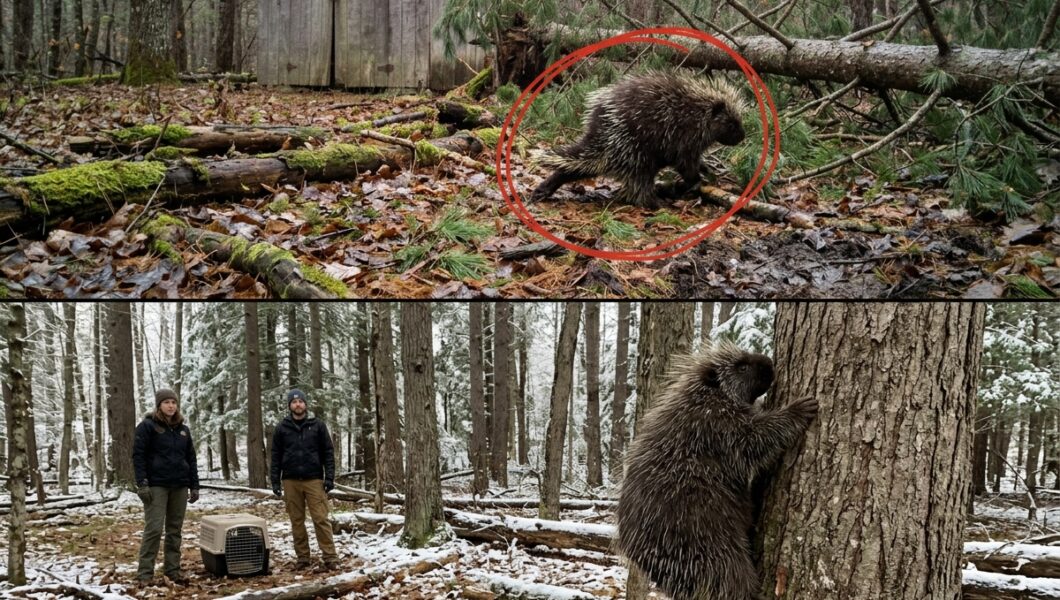
At 5:19 PM, Hannah Miller stared at the woodland trail-camera recording, unable to believe what she was seeing.
A small porcupine lay beneath a fallen pine tree outside an abandoned equipment shed in northern Wisconsin.
It had tried to climb the trunk.
Its front paws had gripped the bark.
But its hindquarters slipped.
And when it struggled to stand, one hind leg dragged through the wet leaves.
The same leg that had been troubling Thistle.
Hannah replayed the recording.
Once.
Twice.
Then a third time.
“Oh, no. Not you too.”
That morning, wildlife responders had rescued a larger porcupine named Thistle from a rusted roll of abandoned wire fencing.
Thistle had been monitored by Hannah’s trail cameras since spring.
The animal had a distinctive patch of pale fur above its left shoulder and a persistent limp.
Veterinarians were now investigating swelling near its hind-leg joint.
But the newest recording had revealed something nobody expected.
A second, smaller porcupine was experiencing similar difficulty walking.
And months of forgotten footage suggested the two animals had once traveled together.
Hannah called wildlife rehabilitator Sarah Collins.
“Sarah, the smaller one just fell trying to climb.”
“Is it still moving?”
“Yes, but it’s dragging a hind leg.”
“Send me the latest footage. Don’t approach it.”
Hannah immediately forwarded the recording.
Sarah studied the images with wildlife technician Marcus Reed.
The smaller porcupine was alert.
It could move its front legs.
But its hindquarters appeared weak.
The animal had stopped beneath the fallen tree and was slowly nosing through the leaves.
Sarah called Hannah back.
“We’re coming to assess it.”
“Do you think it’s Thistle’s baby?”
“We can’t tell from the camera alone. Porcupines can share habitat without being closely related.”
Hannah swallowed.
“But they were together in May.”
“That makes the history worth investigating. Right now, we need to find out whether this animal is injured.”
At 5:47 PM, Sarah and Marcus returned to the woodland clearing.
Cold rain had begun falling again.
The abandoned equipment shed stood beside a narrow forest trail, its roof covered in wet pine needles.
The rusted wire roll had already been removed after Thistle’s rescue.
But the smaller porcupine remained near the fallen tree.
Sarah stopped several yards away.
The animal raised its head.
Its quills lifted slightly.
Then it attempted to walk.
Its left hind leg dragged.
Marcus studied its movement.
“That doesn’t look like a simple stumble.”
Sarah nodded.
“There’s definite difficulty bearing weight.”
The team observed the animal without crowding it.
They checked for obvious external injuries and hazards.
The porcupine appeared alert, but its movement remained abnormal.
Sarah contacted the licensed wildlife rehabilitation facility and coordinated a controlled capture.
Using appropriate protective equipment and wildlife handling techniques, the trained responders secured the animal without unnecessary struggle.
Hannah watched from the designated safe area.
The smaller porcupine made a soft defensive sound.
Its quills rose.
Then the team transferred it into a suitable ventilated transport carrier.
Hannah approached only after the carrier was secured.
“Is it going to be okay?”
Sarah answered carefully.
“We’ve found it alive and responsive. Now we need to understand what’s happening to that leg.”
Hannah looked toward the empty clearing.
Thistle had been rescued there that morning.
Now another porcupine was leaving for the same rehabilitation center.
She whispered:
“Please don’t let this happen twice.”
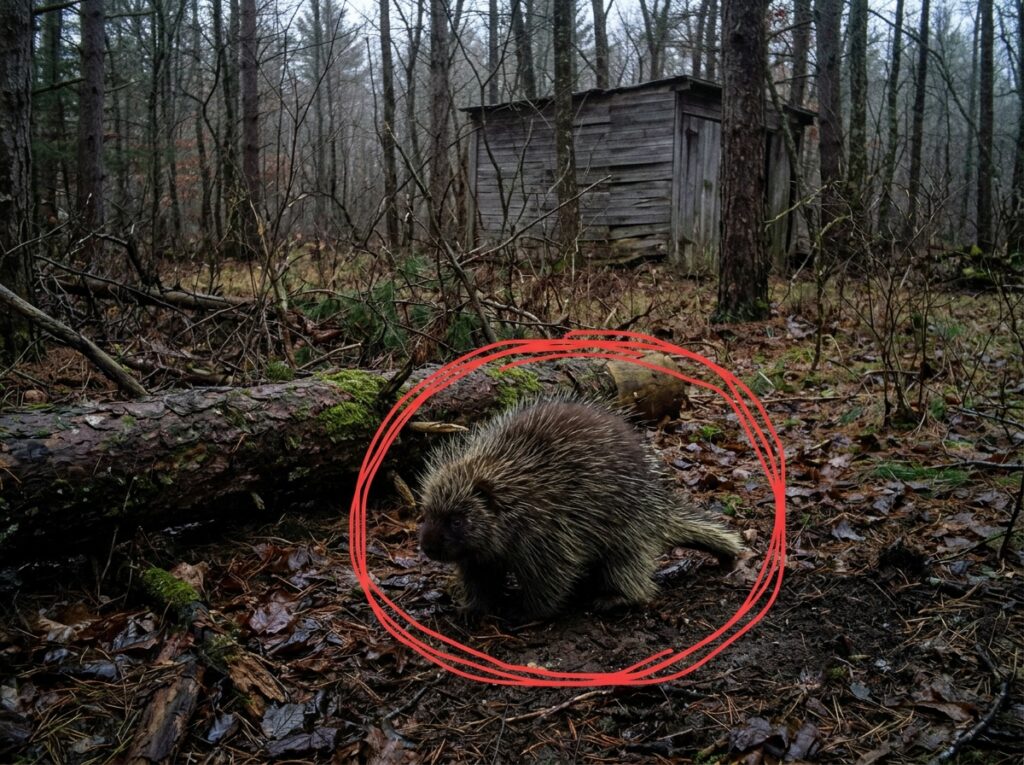
At 7:26 PM, the second porcupine arrived at the rehabilitation facility.
Dr. Olivia Bennett, the attending wildlife veterinarian, began the examination.
The smaller animal was underweight.
Its left hind leg showed reduced strength.
And there was mild swelling near the joint.
But there were no obvious external wounds.
Olivia reviewed the earlier trail-camera recordings.
Then she compared them with Thistle’s medical notes.
Both animals had shown difficulty using a hind leg.
Both had been observed in the same woodland clearing.
And both had experienced problems before their respective rescues.
But those similarities did not establish a shared diagnosis.
Olivia explained the situation to Sarah.
“Thistle’s wire entanglement clearly aggravated its condition. But the earlier limp suggests something was already wrong.”
“And the smaller one?”
“We need imaging and a full examination. The causes may be completely different.”
Sarah nodded.
Hannah received the update by telephone.
She sat beside her computer, surrounded by old trail-camera photographs.
“Can they recover?”
Olivia answered carefully.
“That depends on the underlying problems. We’re investigating both animals separately.”
Hannah stared at the screen.
The photograph from May showed Thistle walking beneath a maple tree.
Behind it, a tiny porcupine followed through the leaves.
She had overlooked that image for months.
Now it seemed impossible to stop looking at it.
The next morning, Olivia called again.
The smaller porcupine’s imaging showed no obvious major fracture.
There were changes around the affected joint that required further evaluation.
Thistle’s additional imaging also suggested a longstanding joint abnormality, along with inflammation from the recent entanglement.
Hannah leaned forward.
“Are they suffering from the same thing?”
“Not necessarily. Similar symptoms can have different causes.”
“But both have the same leg problem.”
“I understand why that concerns you. We need to avoid drawing conclusions from appearances alone.”
Olivia explained that older injuries, joint disease, inflammation, and developmental abnormalities could all affect mobility.
The team would use examination findings, imaging, and the animals’ progress to guide treatment.
Hannah nodded.
“Whatever they need.”
At 11:08 AM, Hannah returned to the trail-camera archive.
She wanted to understand the smaller porcupine’s history.
She searched recordings from May through November.
The first footage showed Thistle moving through the forest with the smaller animal nearby.
During June, both appeared occasionally along the same trail.
In July, the smaller porcupine was recorded climbing a low branch.
Its movements appeared more coordinated then.
By September, the two animals were rarely captured together.
And by late October, the smaller porcupine was moving through the clearing alone.
Hannah studied the sequence.
Something had changed.
But she could not determine exactly when or why.
Then she found a recording from October 23.
The smaller porcupine crossed the trail near a fallen maple branch.
It paused.
Raised one hind foot.
And continued walking.
Hannah enlarged the image.
The leg was already bothering it.
She checked another recording.
October 28.
The animal climbed a short distance up a tree, stopped, and slowly backed down.
Then another.
November 2.
It moved across the ground with a noticeable limp.
Hannah sat back.
The problem had developed before Thistle became trapped in the wire fencing.
And before the smaller animal fell beside the shed.
She sent the recordings to Olivia.
A few minutes later, the veterinarian replied.
“These are useful observations. They help establish the timeline.”
Hannah stared at the message.
For months, she had thought of the trail cameras as a way to capture interesting wildlife moments.
Now she understood something deeper.
The recordings could reveal changes too gradual for a person to notice during a single encounter.
A limp.
A failed climb.
A shift in movement.
Small details that might matter when an animal needed help.
That afternoon, Samuel Price, an experienced local wildlife biologist, visited the rehabilitation center to review the field history.
He examined the trail-camera photographs with Sarah and Olivia.
The May footage caught his attention.
“That smaller animal looks very young here.”
Sarah nodded.
“Could Thistle be its mother?”
Samuel studied the images.
“It’s possible, particularly if the smaller animal was a dependent young porcupine at the time. But we don’t have enough evidence to confirm their relationship.”
Hannah listened through a scheduled telephone update.
“So they might be family?”
“They might,” Samuel answered. “But we should treat that as a possibility, not a fact.”
Hannah looked at the old photographs.
She wanted a simple answer.
A mother.
A baby.
Two animals struggling with the same problem.
But wildlife rarely offered stories as neatly as people wanted.
What mattered was understanding each animal’s condition.
And giving both the best possible chance of recovery.
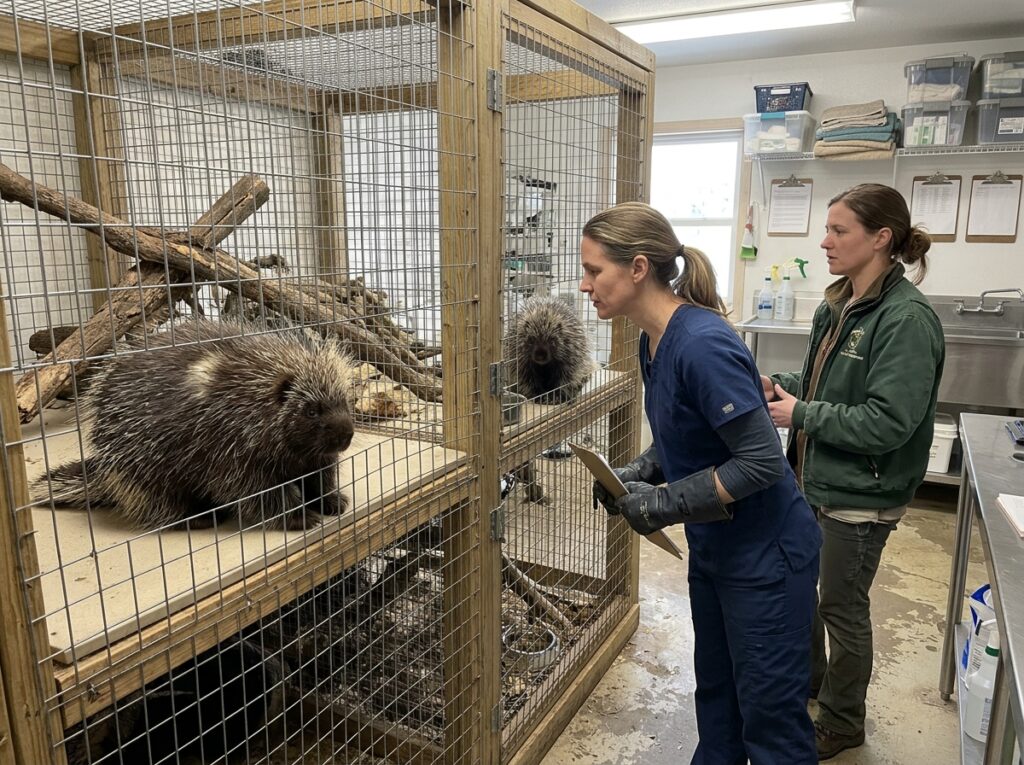
Over the following week, Thistle and the smaller porcupine received individualized treatment.
Thistle’s swelling gradually decreased.
The abrasions caused by the fencing began healing.
And its appetite remained good.
The smaller porcupine also began showing improvement.
It became more active.
Its appetite increased.
And it started placing more weight on the affected hind leg.
But Olivia remained cautious.
A porcupine that could walk across an enclosure was not necessarily ready to survive in the forest.
Wild porcupines relied on climbing for access to food and shelter.
Their legs and feet needed to support them on rough bark, branches, and uneven ground.
The team would need to assess those abilities before considering release.
Hannah called every few days for authorized updates.
She never asked to handle the animals.
She never requested unnecessary visits.
And she understood that minimizing human disturbance was part of good rehabilitation.
Instead, she continued her monitoring work.
The abandoned equipment shed had become a priority.
Hannah contacted the property owner through the regional conservation program.
The owner agreed to cooperate with an inspection and removal of hazardous materials.
A qualified cleanup crew began documenting the abandoned equipment.
Old fencing.
Rusting metal.
Broken wire.
Discarded containers.
And loose materials that could trap or injure wildlife.
The crew worked carefully, avoiding unnecessary disturbance to active wildlife habitat.
By the end of the first cleanup day, several dangerous wire rolls had been removed.
Hannah stood beside the forest access road as workers loaded the material.
Marcus joined her.
“That’s a lot of old fencing.”
She nodded.
“I walked past this place for months.”
“You weren’t responsible for what was abandoned here.”
“I know. But I wish we’d noticed it sooner.”
Marcus looked toward the clearing.
“Now it’s being dealt with.”
Hannah watched the truck pull away.
For the first time since Thistle’s rescue, the equipment shed looked less threatening.
But she knew cleanup was only one part of the story.
The two porcupines still had to recover.
On November 24, Olivia called with an important update.
“Thistle is making good progress.”
Hannah smiled.
“Is it walking?”
“Yes. It’s using the affected leg more consistently.”
“And the smaller one?”
“Improving too, although it still needs rehabilitation.”
Hannah hesitated.
“Did you figure out why both had trouble with their legs?”
Olivia answered carefully.
“Thistle appears to have a longstanding joint problem that was aggravated by the entanglement. The smaller animal’s condition is more consistent with a separate injury or inflammatory process. We haven’t found evidence that they share a single underlying disease.”
Hannah exhaled.
“So it was a coincidence?”
“Possibly. We can’t establish a common cause from the information available.”
She looked at the May photograph.
Two porcupines.
One woodland clearing.
Two different medical histories.
She had imagined one explanation connecting everything.
But the truth was more complicated.
And somehow, that made the rescue work feel even more important.
The animals had needed help for their own individual reasons.
Their relationship did not change that.
As December approached, the forest around Pine Hollow became colder.
Snow settled along the fallen logs.
The equipment shed stood empty of the most hazardous discarded fencing.
And Hannah’s trail cameras continued recording ordinary wildlife activity.
A white-tailed deer crossed the clearing.
A raccoon investigated a stump.
A red fox passed through at dawn.
And one afternoon, a bald eagle landed briefly on the fallen pine tree.
Hannah smiled when she saw the recording.
The same type of bird whose movement had triggered the camera on the morning Thistle was discovered.
She knew the eagle had not intentionally summoned help.
It had simply landed in the clearing while searching for food or a resting place.
But that ordinary wildlife movement had helped reveal an animal in trouble.
The camera had done what it was designed to do.
It recorded what people could not watch continuously.
And Hannah had been paying attention.
At the rehabilitation center, Thistle reached another milestone.
It climbed onto a low wooden platform.
Paused.
Shifted its weight.
And continued upward.
Olivia observed from outside the enclosure.
The porcupine moved slowly.
But it used all four limbs.
Its injured leg supported its weight.
And it maintained balance.
The team documented the behavior.
Over the following days, Thistle climbed increasingly challenging structures designed to assess its readiness for life in the forest.
It moved across branches.
Descended safely.
And demonstrated appropriate feeding behavior.
The smaller porcupine also improved.
Its leg strength increased.
It climbed low wooden structures.
And it began moving more confidently across uneven surfaces.
But its progress remained slower than Thistle’s.
The veterinary team continued monitoring.
They would not release either animal until it met appropriate health and functional criteria.
On December 18, Sarah called Hannah.
“Thistle has passed the latest mobility assessments.”
Hannah stood beside her desk.
“Really?”
“Yes. The veterinarian is considering release once the final evaluations and suitable conditions are confirmed.”
Hannah covered her mouth.
For months, she had watched Thistle moving through the forest.
Climbing trees.
Feeding.
Crossing the trail.
Then she had watched it become trapped inside abandoned fencing.
She remembered the quills rising against the rusted metal.
The hind leg caught between wire loops.
The moment the responders cut the final strand.
And the frightening stumble when the porcupine tried to walk.
Now it was climbing again.
She whispered:
“That’s amazing.”
Sarah smiled.
“It has worked hard to recover.”
Hannah laughed softly.
“I know it’s wild, but I’m proud of it.”
“I understand.”
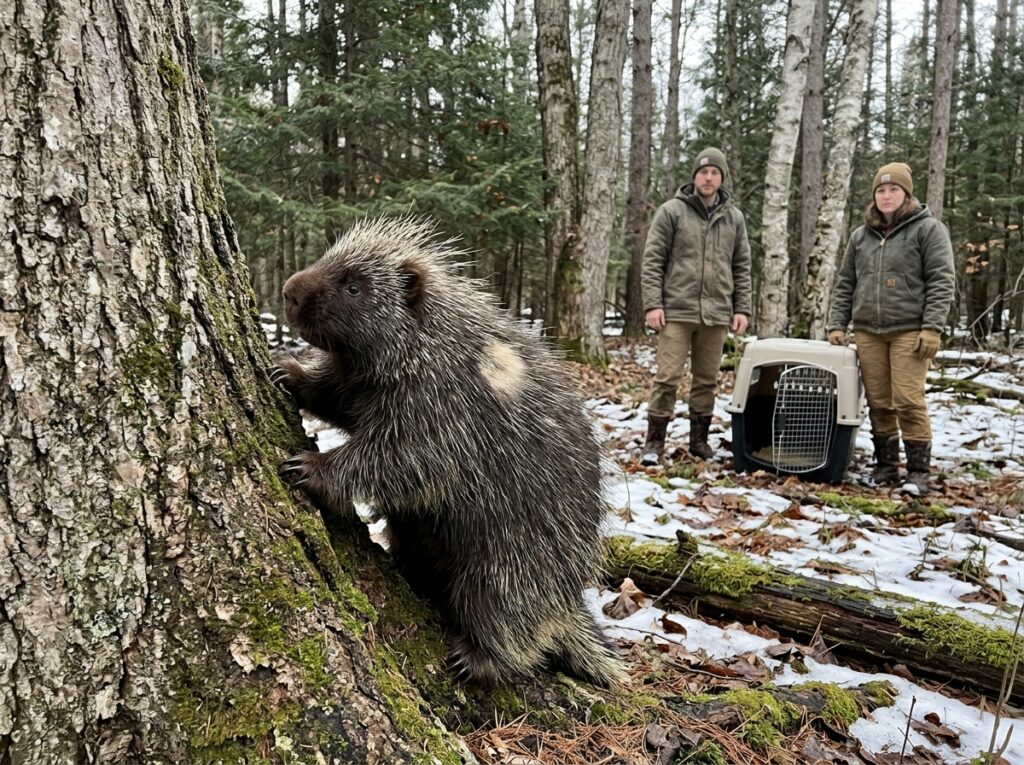
In early January 2027, Thistle received final veterinary clearance.
The team selected suitable habitat near its original woodland range, away from the abandoned equipment hazards.
Release conditions were evaluated carefully.
The porcupine had demonstrated adequate mobility.
Its wounds had healed.
And it was feeding normally.
Hannah was allowed to observe from an appropriate distance during the authorized release.
She stood beside Sarah and Marcus near the forest access trail.
The transport carrier was positioned according to the rehabilitation team’s release plan.
For several seconds, nothing happened.
Then Thistle appeared at the opening.
Its brown nose moved.
Its whiskers twitched.
And its quills shifted gently across its back.
The porcupine stepped onto the forest floor.
One paw.
Then another.
It paused beside a fallen branch.
Hannah held her breath.
Thistle moved forward.
Its left hind leg supported its weight.
Then it approached a large maple tree.
Hannah whispered:
“Come on.”
The porcupine placed its front paws against the bark.
Its hind feet followed.
Slowly, it began climbing.
Higher.
Then higher again.
Its quills brushed against the rough trunk.
And within moments, the animal disappeared behind a thick branch.
Hannah wiped her eyes.
Sarah smiled.
“That’s a good start.”
Hannah looked toward the tree.
For months, she had worried that Thistle would never climb again.
Now the porcupine was exactly where it belonged.
In the forest.
Free.
Wild.
And moving on its own.
But the story wasn’t finished.
The smaller porcupine remained in rehabilitation.
Its mobility had improved, but it still needed additional assessment before release.
Hannah continued receiving updates.
The animal climbed more confidently.
Its appetite remained stable.
And the swelling around its leg had resolved.
In late January, Olivia called.
“The smaller porcupine has passed its latest climbing and mobility assessments.”
Hannah smiled.
“Does that mean it’s ready?”
“We’re preparing for release, pending final clearance and suitable conditions.”
Hannah looked at the old May photograph.
The smaller animal following Thistle through the leaves.
She had wondered whether they were mother and offspring.
Whether they remembered each other.
Whether their shared history meant something.
But she had learned not to force an answer where the evidence was incomplete.
The smaller porcupine had its own life.
Its own recovery.
And its own chance to return to the forest.
In February, the rehabilitation team released the smaller animal into appropriate habitat after final veterinary clearance.
The release was quiet.
There were no crowds.
No dramatic reunion.
And no attempt to force contact between the two porcupines.
The smaller animal stepped out of its carrier.
Paused beside a fallen log.
Then climbed onto the wood.
Its hind legs gripped the bark.
It moved forward steadily.
And disappeared into the undergrowth.
Hannah watched from a distance.
She smiled.
“Good luck, little one.”
Sarah stood beside her.
“That’s what we hoped for.”
Hannah nodded.
Two porcupines had arrived at the rehabilitation center with mobility problems.
Both had needed professional care.
Both had recovered sufficiently to return to the wild.
And the dangerous fencing that had trapped Thistle was gone.
The following spring, Hannah continued monitoring the Pine Hollow woodland.
The trail cameras recorded deer, raccoons, foxes, and countless ordinary moments.
The abandoned equipment shed remained quiet.
The most dangerous discarded materials had been removed.
And the forest floor was slowly disappearing beneath fresh green growth.
On May 14, 2027, exactly one year after the earliest recording of Thistle, Hannah opened a new trail-camera file.
A porcupine appeared beneath the same large maple tree.
It moved slowly through the leaves.
Its dark brown body was covered in pale-tipped quills.
And above its left shoulder was a distinctive patch of lighter fur.
Hannah leaned toward the screen.
“Thistle?”
She replayed the footage.
The animal approached the tree.
Placed its front paws against the trunk.
And began climbing.
Its hind legs moved steadily.
There was no obvious stumble.
No dragging foot.
No hesitation like the one she remembered from the autumn recordings.
Hannah smiled.
The lighter shoulder patch strongly suggested the animal was Thistle, although the camera image alone could not establish identity with absolute certainty.
She watched it disappear into the branches.
Then she opened another recording.
A smaller porcupine had crossed the same clearing several nights earlier.
It appeared to be moving normally.
Hannah studied the footage.
Could it be the second rescued animal?
Perhaps.
But there was no identification mark visible that could confirm it.
She saved both recordings in the monitoring database.
Possible resighting of Thistle.
Unidentified smaller porcupine, normal observed movement.
She refused to write more than the evidence supported.
But she couldn’t stop smiling.
Later that morning, Sarah called.
“Any interesting recordings?”
Hannah laughed.
“You might want to see these.”
She sent the videos.
Sarah watched them.
Then replied:
“That’s encouraging.”
Hannah nodded.
“It really is.”
They talked about the cleanup.
The rehabilitation.
The importance of reporting injured wildlife.
And how much could be learned from careful observation.
Then Hannah asked the question she had carried for months.
“Do you think the two porcupines were related?”
Sarah paused.
“It’s possible.”
“Will we ever know?”
“Maybe not.”
Hannah looked toward the forest outside her window.
She thought about the first May recording.
Thistle moving beneath the maple tree.
The smaller porcupine following.
The old limp.
The wire fencing.
The rescue.
And the long recovery.
For months, she had wanted to solve the mystery.
To discover why both animals had struggled with their hind legs.
To prove they were family.
To give the story a perfect explanation.
But now she understood something.
The animals didn’t need to be related for both rescues to matter.
Their suffering had been real.
Their recoveries had been real.
And their return to the forest was enough.
That afternoon, Hannah walked the monitoring trail with Marcus.
The woodland was bright with spring sunlight.
Birdsong filled the trees.
Fresh leaves covered the branches.
And the abandoned equipment shed stood beside a clearing that was finally free of rusted fencing.
Marcus stopped near the fallen pine tree.
“Remember what this place looked like in November?”
Hannah nodded.
“I don’t think I’ll ever forget.”
He looked toward the old shed.
“Quite a difference.”
She smiled.
“Yeah.”
A bald eagle passed high above the clearing.
Its white head flashed briefly against the blue sky.
Hannah watched it glide toward the distant forest.
She remembered the eagle that had landed on the fallen pine tree the morning Thistle was discovered.
Its movement had triggered the trail camera.
That ordinary event had revealed the trapped porcupine.
And the rescue had led Hannah to review months of recordings.
Those recordings helped the veterinary team understand the animals’ histories.
They also drew attention to abandoned equipment that had become a danger to wildlife.
One camera.
One unexpected recording.
And a series of decisions made by people willing to pay attention.
Hannah looked toward the large maple tree.
Somewhere in the forest, Thistle might still be climbing.
The smaller porcupine might be exploring its own territory.
They might cross paths again.
Or they might never meet.
Nobody could know.
And that was all right.
Wild animals didn’t owe people a reunion.
They didn’t need to recognize their rescuers.
They didn’t need to return to the camera and prove that everything had worked out.
They simply needed the freedom to live.
Hannah adjusted the trail camera beside the path.
Then she stepped back.
Marcus smiled.
“Ready?”
She nodded.
“Ready.”
They walked toward the access road.
Behind them, the forest continued moving.
Leaves rustled.
A squirrel climbed a pine tree.
And somewhere beyond the clearing, a porcupine moved through the branches.
Hannah never saw it.
But the camera kept watching.
And this time, the dangerous wire was gone.
THE END
No Comments