

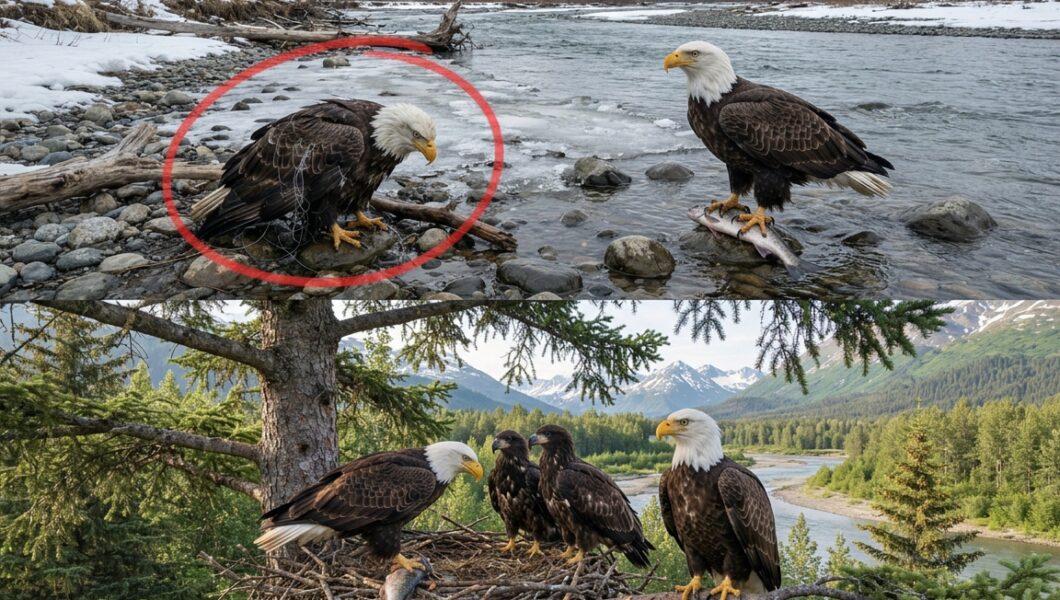
AS A VIOLENT ALASKAN STORM DESTROYED A BALD EAGLE’S NEST SIXTY FEET ABOVE A FREEZING RIVER, WILDLIFE RESCUERS FOUGHT TO SAVE TWO TRAPPED EAGLETS WHILE THEIR INJURED PARENT STRUGGLED TO SURVIVE, BUT WHAT HAPPENED WHEN THE FAMILY WAS FINALLY REUNITED MONTHS LATER LEFT A 74-YEAR-OLD RETIRED FISHERMAN IN TEARS.
Robert Anderson had never felt so helpless.
He stood beside his riverside cabin, gripping his binoculars as freezing rain struck his face.
Across the river, the enormous spruce tree swayed violently.
The nest that had sheltered two young eaglets was almost completely destroyed.
Broken branches covered the hillside.
The healthy adult eagle circled above the forest, calling repeatedly.
Then Robert heard Sarah’s voice through Daniel’s radio.
“We’ve located both eaglets!”
Robert closed his eyes.
“Thank goodness.”
But the danger was far from over.
One eaglet was trapped beneath a fallen branch.
The other lay among broken nesting materials only a few feet from the rising river.
Neither could fly.
Neither could escape without help.
And the storm was getting worse.
At 3:42 PM, Daniel Brooks and two additional wildlife rescuers reached the fallen nest.
Sarah had already located the first eaglet.
Its gray feathers were soaked.
Its small body was trembling.
The young bird attempted to move whenever the rescuers approached, but it appeared too exhausted to travel far.
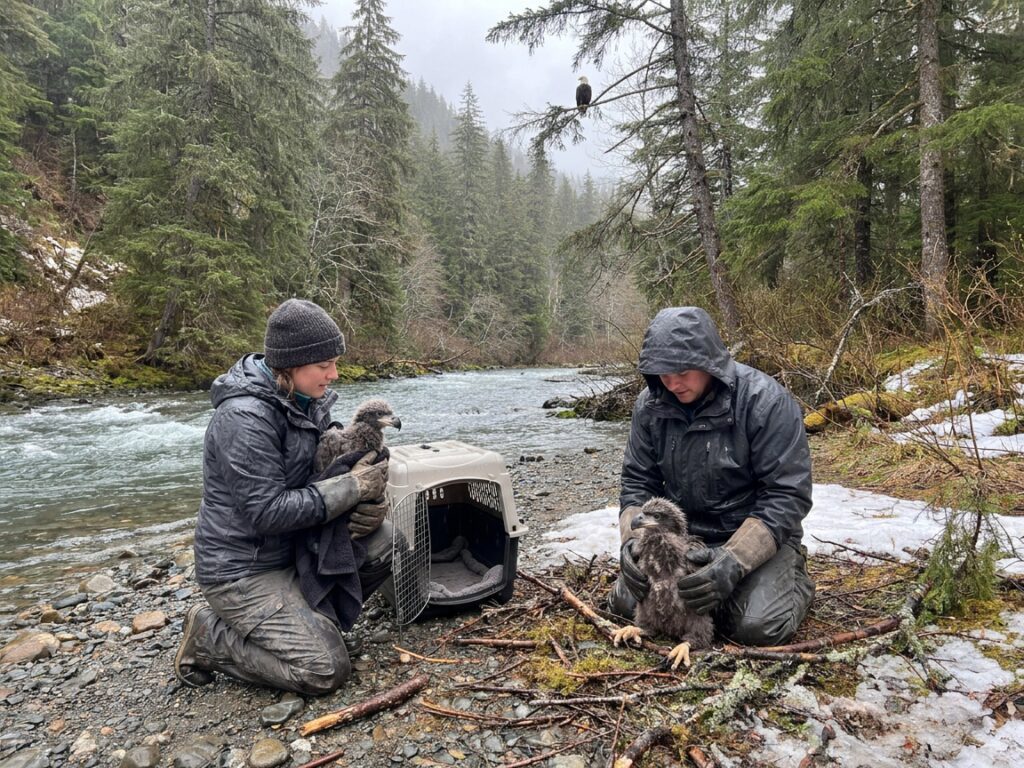
Sarah carefully secured it using appropriate protective equipment.
A second rescuer prepared a padded wildlife transport carrier.
Then Daniel noticed movement beneath a tangled collection of branches.
“There’s the other one.”
The second eaglet was partially covered by nesting material.
Fortunately, a fallen limb had created a small protective space beneath the debris.
The team carefully removed the surrounding branches without placing additional pressure on the bird.
After several difficult minutes, Daniel reached the eaglet.
It was breathing.
But barely moving.
“We need to get them warm.”
Both eaglets were placed in separate transport carriers and moved away from the unstable hillside.
Above them, the healthy adult eagle continued calling.
It flew toward a nearby spruce tree and remained there, watching the activity below.
Robert lowered his binoculars.
Tears filled his eyes.
“They got them.”
For the first time since the nest collapsed, he allowed himself to feel hopeful.
At 4:18 PM, both eaglets arrived at the wildlife rehabilitation center.
Veterinarian Emily Carter immediately examined them.
The first eaglet had suffered cold exposure, dehydration, and several superficial injuries.
The second was considerably weaker.
It had bruising around its chest and an injured leg.
Fortunately, initial examinations revealed no obvious life-threatening fractures.
The veterinary team placed both birds in temperature-controlled recovery enclosures.
They provided appropriate supportive treatment and closely monitored their breathing.
But Emily was particularly concerned about the smaller eaglet.
“It’s exhausted. We need to give it time.”
Meanwhile, the injured adult eagle was receiving emergency treatment in another room.
Its condition had deteriorated unexpectedly.
The bird had become increasingly weak following its initial examination.
Veterinarians suspected that prolonged exposure, dehydration, and the stress associated with its injuries had contributed to the decline.
The eagle received oxygen support, carefully managed fluids, and continued monitoring.
Robert arrived at the rehabilitation center shortly before five.
He stood outside the treatment area.
“How are they doing?”
Emily removed her gloves.
“The eaglets are alive. Their parent is still in critical condition.”
Robert looked toward the closed door.
“All three of them?”
Emily nodded.
“We’re doing everything we can.”
Robert slowly sat down.
He had spent most of his life watching bald eagles along Alaska’s rivers.
But he had never imagined becoming so emotionally attached to a single eagle family.
That evening, Robert returned to his cabin.
The storm continued throughout the night.
Wind rattled the windows.
Rain struck the roof.
Robert barely slept.
Every few hours, he walked toward his kitchen window and looked across the river.
He wondered where the healthy adult eagle had gone.
Its nest was destroyed.
Its mate was receiving emergency treatment.
Its young had disappeared.
Robert knew he couldn’t understand exactly what the bird was experiencing.
But he had watched its repeated efforts to bring food to the riverbank and the nest.
He hoped it would remain nearby.
At sunrise, the storm finally began weakening.
Robert stepped outside with his binoculars.
He searched the distant spruce trees.
For nearly twenty minutes, he saw nothing.
Then a familiar white head appeared above the branches.
The healthy adult eagle was perched near the remains of its nest.
A fish lay across the branch beneath its talons.
Robert watched quietly.
The eagle eventually flew toward the damaged nesting area.
It landed briefly on a surviving limb before returning to its perch.
Robert immediately contacted Sarah.
“It’s still here.”
Sarah was encouraged by the news.
The adult eagle’s continued presence suggested that returning the eaglets to parental care might still be possible.
But first, they needed to survive.
And they needed a safe place to return to.
At 8:37 AM, Robert received a telephone call from Emily.
“The adult eagle made it through the night.”
Robert stood beside his kitchen table.
“Really?”
“Yes. Its breathing has improved, and it’s responding better.”
Robert smiled.
“And the little ones?”
“The larger eaglet is doing well. The smaller one is still weak, but its condition is improving.”
Robert looked toward the river.
“That’s the best news I’ve heard in a long time.”
Over the following days, the veterinary team continued treating all three birds.
The injured adult eagle underwent appropriate treatment to stabilize its fractured wing.
The eaglets received carefully managed nutrition and veterinary care.
Their handlers minimized unnecessary human contact.
The goal was not to make the young birds comfortable around people.
It was to preserve their natural behavior so they could eventually return to the wild.
By the third day, the smaller eaglet was standing more steadily.
By the fourth day, both were feeding successfully.
Their condition had improved enough for wildlife specialists to begin seriously considering reunification with their healthy parent.
Meanwhile, Daniel and Sarah returned to the original nesting site with a wildlife biologist and experienced tree specialists.
The damaged spruce tree was no longer safe.
Its supporting branches had suffered extensive structural damage.
Rebuilding the nest in the same location would place both the eaglets and rescuers at unnecessary risk.
But approximately forty yards away stood another large spruce tree.
It overlooked the same stretch of river.
The tree appeared healthy, with several strong supporting limbs.
Most importantly, the healthy adult eagle continued using nearby perches.
After a professional assessment and the necessary wildlife authorizations, specialists prepared a replacement nesting platform.
The structure would support a carefully constructed artificial nest using suitable natural branches and nesting materials.
Robert watched the preparations from his property.
“Do you think the eagle will accept it?”
The biologist answered cautiously.
“We can’t guarantee that. But the parent is still here, and the replacement nest will be close to the original.”
Robert nodded.
“Then it’s worth trying.”
The team worked carefully.
They selected a location that provided adequate support, protection from the weather, and reasonable access for future monitoring.
Once the replacement nest was completed, wildlife specialists installed a remote monitoring camera.
They wanted to observe the family without repeatedly disturbing the birds.
Everything was ready.
Now they needed the eaglets.
Six days after the collapse, Emily examined both young birds again.
The larger eaglet was alert and active.
The smaller eaglet’s leg injury had improved considerably.
Both were maintaining their body temperatures and feeding normally.
After reviewing their condition with the wildlife specialists, Emily approved the carefully monitored reunification attempt.
Robert stood outside his cabin as the rescue team arrived.
Two specialized wildlife carriers were transported toward the replacement nesting site.
Experienced climbers carefully transferred the eaglets into the prepared nest.
The young birds settled among the natural nesting materials.
Then the entire team withdrew.
They watched remotely.
Ten minutes passed.
Then twenty.
The eaglets occasionally lifted their heads.
Robert scanned the surrounding trees.
“Where is it?”
Sarah reminded him that the adult might need time to approach after the disturbance.
Nearly an hour passed.
Then Daniel noticed movement above the river.
A bald eagle was approaching.
Its broad wings carried it toward the spruce trees.
Robert raised his binoculars.
The bird circled the area once.
Then landed on a branch near the replacement nest.
It remained there for several minutes.
The eaglets began calling.
The adult turned toward the sound.
Then it moved closer.
Robert held his breath.
The eagle stepped onto the edge of the replacement nest.
One eaglet immediately lifted its head.
The other shifted toward the adult.
The bird remained beside them briefly before flying away.
Robert looked worried.
“Why’s it leaving?”
Sarah smiled.
“Let’s give it some time.”
Twenty-three minutes later, the adult returned.
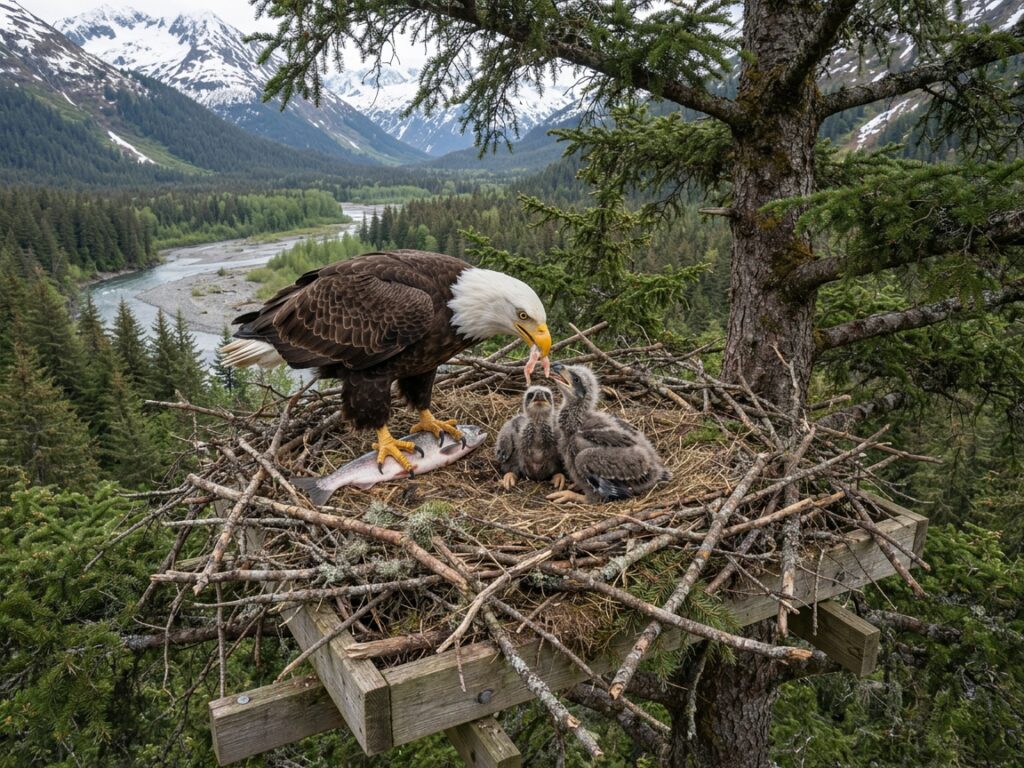
It was carrying a fish.
The eagle landed inside the replacement nest and began tearing small pieces from its catch.
Both eaglets reached toward the food.
Robert lowered his binoculars.
His eyes filled with tears.
“It’s feeding them.”
Daniel smiled.
“That’s exactly what we wanted to see.”
The healthy parent had accepted the replacement nest.
And its two young eaglets were back under its care.
Over the following weeks, Robert developed a new morning routine.
He still carried his thermos of coffee.
He still brought his binoculars.
But now he watched the replacement nest.
The healthy adult eagle continued bringing fish.
Both eaglets grew stronger.
Their soft down gradually gave way to developing dark feathers.
They became increasingly active.
Sometimes they stood near the edge of the nest, stretching their wings.
Robert recorded their progress in a small notebook.
Both eaglets fed this morning.
Smaller one standing much better.
Adult returned with another fish.
Both practicing wing movements.
He sent occasional updates to the wildlife rehabilitation center.
Emily enjoyed hearing about their progress.
But another member of the eagle family still had a long recovery ahead.
The injured adult eagle remained at the rehabilitation center.
Its fractured wing was healing.
However, surviving the injury was only the first step.
The bird needed to regain enough strength, coordination, and flight endurance to survive independently.
Several weeks passed before veterinarians determined that its fracture had healed sufficiently for controlled flight rehabilitation.
The eagle was transferred into a specialized flight enclosure.
At first, its movements were cautious.
It flew short distances between low perches.
Its landing coordination gradually improved.
Over time, the bird began making longer flights.
Its wing movements became stronger and more symmetrical.
Veterinarians continued monitoring its progress.
The eagle also needed to demonstrate appropriate feeding behavior and the ability to maintain a healthy condition without intensive support.
Robert frequently asked about its recovery.
“Do you think it’ll go back to its family?”
Emily explained that nobody could predict that outcome.
Wild bald eagles make their own movements after release.
The healthy parent might remain near the nesting territory.
The young birds might already be learning to fly.
The recovered eagle could return to the area or travel elsewhere.
The rehabilitation team could provide the best possible opportunity.
But nature would decide what happened afterward.
Robert understood.
“I just want it to have another chance.”
Nearly eleven weeks after the original rescue, Emily contacted Robert again.
“The eagle has passed its flight assessments.”
Robert smiled.
“Does that mean what I think it means?”
“Yes. We’re preparing for release.”
Robert slowly sat down.
He remembered the injured bird lying among the freezing rocks.
Its wet feathers.
Its damaged wing.
The healthy eagle repeatedly returning with fish.
And the terrible evening when the nest collapsed.
Now the injured eagle was finally ready to return to the wild.
The wildlife team selected a suitable release location within its original territory.
Robert was invited to observe from a designated safe distance.
He barely slept the night before.
The following morning, the Alaskan sky was clear.
Sunlight reflected across the river.
The surrounding mountains remained capped with snow, although the lower hillsides had turned green.
Daniel and Emily arrived with the eagle inside a specialized transport enclosure.
Sarah checked the release area.
Robert stood quietly behind the viewing boundary.
He held his old fishing hat against his chest.
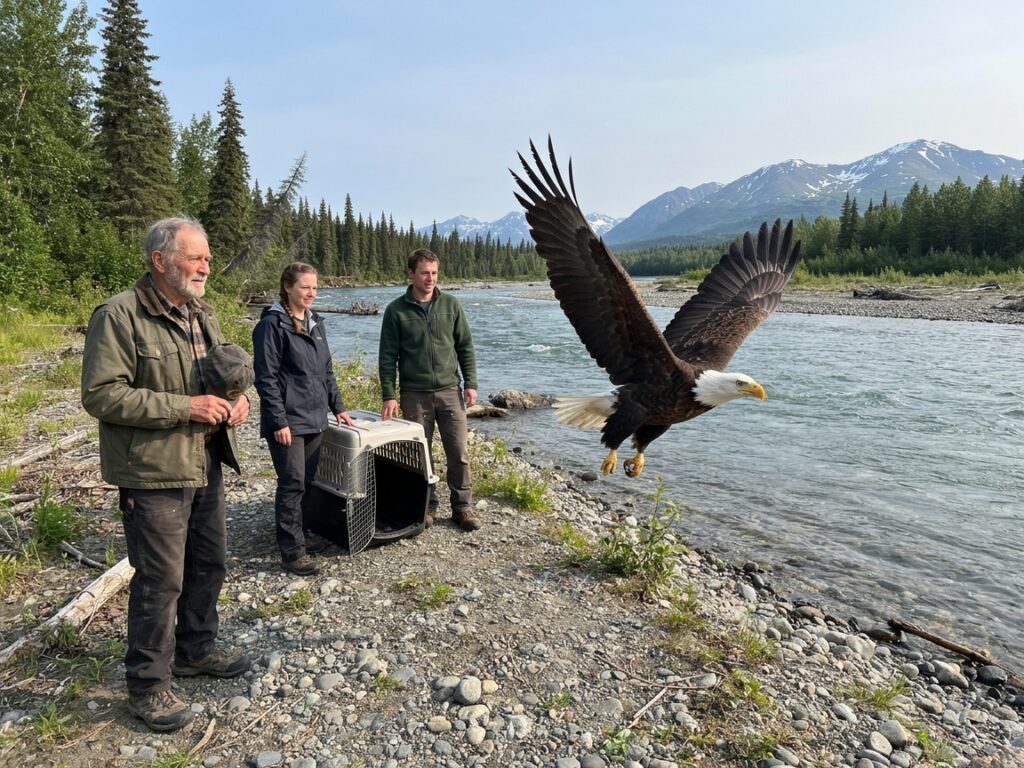
Emily opened the enclosure.
For several seconds, nothing happened.
Then the bald eagle stepped forward.
Its white head turned toward the river.
Its yellow talons gripped the ground.
Robert could hardly breathe.
The bird spread both wings.
With several powerful wingbeats, it lifted into the air.
Robert immediately noticed how evenly its wings moved.
The injured wing no longer hung awkwardly.
The eagle gained altitude.
It flew above the river before turning toward the spruce forest.
Robert began crying.
“Look at it go.”
Emily smiled.
“That’s what we’ve been working toward.”
The eagle disappeared beyond the trees.
Robert watched the empty sky.
For months, he had hoped to see that moment.
And now he had.
The bird was free.
For the next two days, Robert searched the skies whenever he went outside.
The eaglets had grown considerably during the adult eagle’s rehabilitation.
One had already completed its first successful flight from the replacement nest.
The other was making short flights between nearby branches.
Both remained dependent on parental care.
The healthy adult continued bringing food.
But Robert had not seen the recovered eagle since its release.
He reminded himself that the bird was free to travel wherever it wanted.
Even if it never returned, its survival was already a success.
Then, on the third morning, Robert noticed something unusual.
Two adult bald eagles were flying above the river.
One carried a fish.
The other followed several yards behind.
Robert hurried inside and retrieved his binoculars.
The birds landed in neighboring spruce trees near the replacement nest.
Two dark-feathered juvenile eagles were perched nearby.
Robert watched in disbelief.
Four eagles.
Two adults.
Two juveniles.
He immediately called Daniel.
“You need to see this.”
Daniel and the wildlife biologist arrived later that morning.
Using a high-powered spotting scope, the biologist examined the adult birds.
One carried a leg band.
The rehabilitated eagle had been fitted with an identification band before release by authorized personnel.
After obtaining several clear photographs and confirming the band details, the team established that the recovered adult had returned to its original nesting territory.
Robert removed his hat.
“That’s really the same bird?”
The biologist nodded.
“The identification matches.”
Robert wiped his eyes.
The eagle had survived.
It had returned.
And although the team could not determine every detail of the birds’ relationship from a single observation, the recovered adult was once again occupying the same territory as its former nesting family.
Over the following days, monitoring provided even more encouraging evidence.
Both adults were observed bringing fish to the young birds.
The juveniles remained close to the nesting area.
The recovered eagle was flying normally.
The family was together again.
Several weeks later, both young eagles had become increasingly confident flyers.
Robert watched them practice landing on branches.
Sometimes they missed their intended perches.
Sometimes they made awkward adjustments in the air.
But every day, their movements improved.
One afternoon, Robert observed a juvenile attempting to retrieve a fish near the river’s edge.
It was unsuccessful.
The young eagle returned to a nearby branch.
An adult later arrived carrying food.
Robert smiled.
“They’re learning.”
The wildlife team gradually reduced its monitoring visits as the young birds developed normally.
The replacement nest remained secure.
Both adults continued using the territory.
The extraordinary rescue was finally reaching its conclusion.
At the end of summer, Robert received a package from the rehabilitation center.
Inside was a framed collection of four photographs.
The first showed the injured adult eagle during its initial recovery.
The second showed the two eaglets inside their temporary rehabilitation enclosures.
The third showed the healthy parent feeding both young birds in the replacement nest.
The final photograph showed the recovered eagle flying freely above the river.
Beneath the photographs was a small handwritten card.
Thank you for noticing.
Thank you for calling.
Four wild lives were given another chance because you cared enough to ask for help.
Robert read the message several times.
Then he placed the frame beside a photograph of his late wife.
He sat quietly in his favorite chair.
For years, his mornings had followed the same familiar pattern.
Coffee.
Binoculars.
The river.
He had never expected that an ordinary morning would lead to something he would remember for the rest of his life.
One crisp September morning, Robert walked down to the riverbank.
Mist drifted above the water.
The first signs of autumn appeared among the surrounding trees.
He sat on an old wooden bench and opened his thermos.
For several minutes, the river was quiet.
Then a familiar call echoed from the forest.
Robert raised his binoculars.
An adult bald eagle emerged above the spruce trees.
A second adult followed.
Behind them flew two dark-feathered juvenile eagles.
The four birds traveled along the river before gradually separating into different flight paths.
Robert watched until they disappeared.
He knew the young eagles would eventually become independent.
They would explore new territories.
They might travel hundreds of miles.
And one day, if they survived to maturity, they might raise eaglets of their own.
Robert smiled.
“Good luck out there.”
He lowered his binoculars.
There was no dramatic farewell.
No wild eagle landed beside him.
No bird approached to thank him.
They were wild animals.
And their freedom was the greatest reward he could have received.
Robert remained beside the river for another hour.
He thought about the discarded fishing line that had injured the adult eagle.
He thought about the damaged nest.
The freezing storm.
The two helpless eaglets.
And the wildlife professionals who had worked tirelessly to give them another chance.
In the following months, Robert began helping organize local riverbank cleanup efforts.
Volunteers collected discarded fishing line, plastic waste, and other debris that could endanger wildlife.
He also encouraged local residents to report injured wild animals to licensed professionals rather than attempting dangerous rescues themselves.
Whenever someone asked why he cared so deeply, Robert told them about the eagle family.
He told them how one adult had continued caring for its young while its injured mate remained stranded.
How two eaglets had survived the destruction of their nest.
And how months of professional rehabilitation had allowed an injured eagle to fly again.
Then he always finished with the same words.
“Sometimes the most important thing you can do is notice that something needs help.”
The healthy bald eagle had continued returning to its injured mate while caring for two helpless eaglets.
The wildlife rescuers had refused to give up when the nest collapsed.
And an elderly fisherman had cared enough to make a telephone call that changed everything.
Three lives had been in immediate danger.
Three lives had been saved.
And four bald eagles were once again living freely beneath the enormous Alaskan sky.
Robert looked toward the distant mountains.
A smile crossed his weathered face.
After forty-three years of fishing Alaska’s rivers, he thought he had already witnessed nature’s greatest wonders.
But he had been wrong.
The most beautiful thing he had ever seen was not an eagle catching a fish, spreading its wings, or soaring above the mountains.
It was an eagle that had been unable to fly finally returning to the family it had left behind.
And somewhere beyond the spruce trees, four sets of wings carried that extraordinary story into the wilderness.
THE END. ❤️🦅
No Comments