

Frank Miller arrived at Eleanor Brooks’s farmhouse shortly after eight the next morning.
He was carrying an old photograph inside a clear plastic sleeve.
Eleanor opened the door and immediately noticed the expression on his face. Frank was usually cheerful, even when the weather was miserable or a fence repair took longer than expected. This morning, however, he looked troubled.
“Eleanor, I think you should see this.”
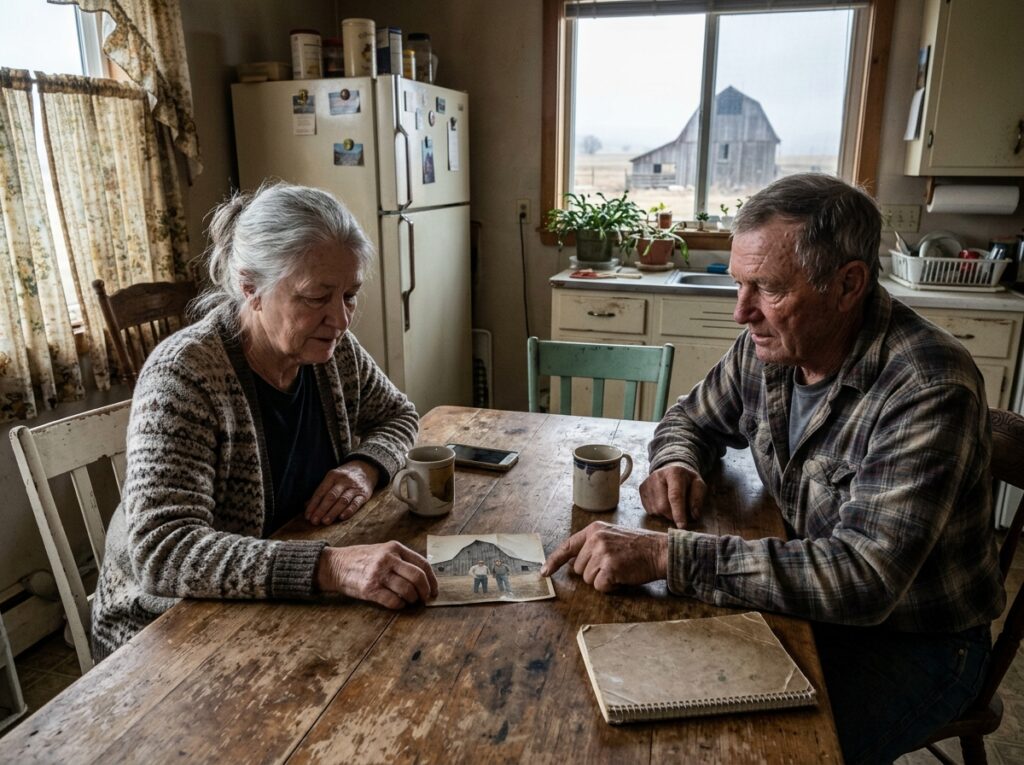
She invited him into the kitchen and placed the photograph on the table.
It showed a younger man standing beside Thomas, Eleanor’s late husband, in front of the old barn. Both men wore work jackets, and behind them stood a wooden crate containing several pieces of equipment.
Eleanor recognized Thomas immediately.
But she did not recognize the other man.
“Where did you get this?” she asked.
Frank sat down slowly.
“I found it in a box of old farm records my wife kept after her father passed away. I was looking through the pictures last night, trying to remember who had helped Thomas with the fencing years ago.”
He pointed to the man beside Thomas.
“This is Michael Turner. He used to work with a local wildlife monitoring group. He helped landowners identify hazards around their properties and recorded wildlife movements near the creek.”
Eleanor studied the photograph again.
“Thomas never mentioned him.”
“He might have. It was a long time ago. Michael was around here quite often for a while, especially when they were studying the eagles near the river.”
Frank hesitated before continuing.
“I saw a dark pickup near your barn three nights before the eagle was found. I didn’t think much of it at the time. I assumed someone had permission to be on the neighboring land.”
Eleanor felt a knot tighten in her stomach.
“Do you think Michael was the person on my camera?”
“I don’t know. The vehicle looked similar, but I never saw the driver clearly. That’s why I brought you the photograph instead of making assumptions.”
Eleanor appreciated that.
She had already learned how easily a few unexplained details could become a story that outran the facts. The photograph gave them a possible lead, not an answer.
Before she could ask another question, her phone rang.
It was the wildlife rehabilitator.
“Eleanor, thank you for calling us back,” the woman said. “The eagle is stable this morning, and we have some additional information from its examination.”
Eleanor sat down.
“Is its wing getting better?”
“The bird is responding to care, although recovery will take time. We also found a small identification band on its leg. We’ve recorded the number and are checking the relevant wildlife records.”
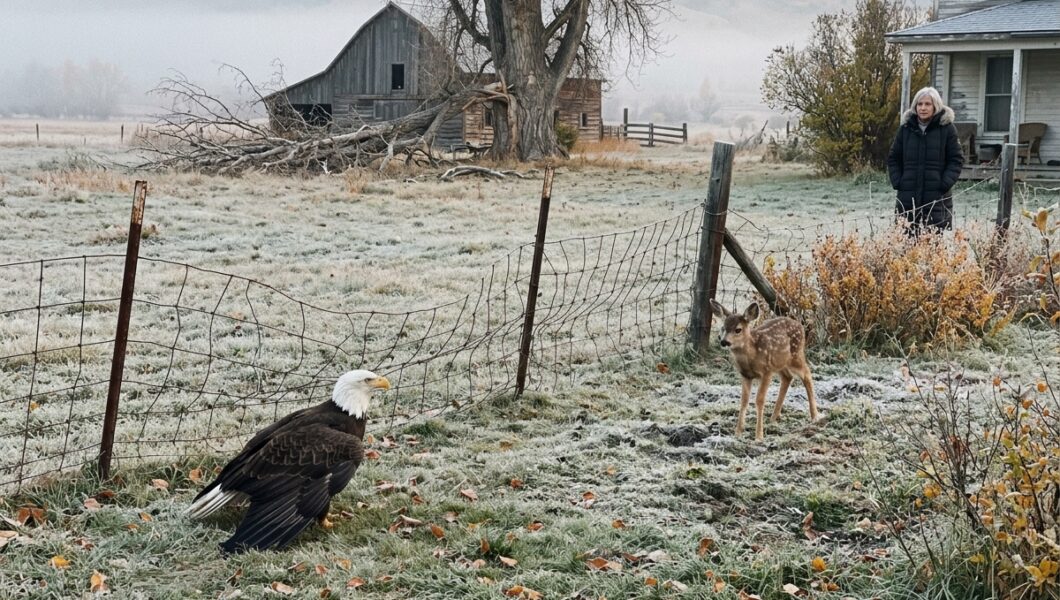
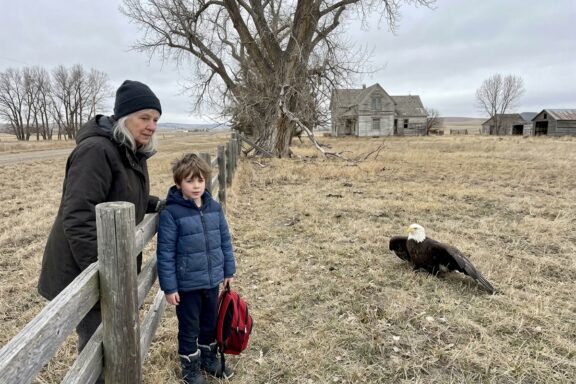
Eleanor remembered seeing the bird standing in the meadow, its white head lowered and one wing hanging awkwardly.
“Does the band tell you who owns it?”
“Not necessarily. Identification bands can be used for research and monitoring. We’re trying to establish when and where this bird was last recorded.”
The rehabilitator paused.
“We also documented the blue plastic cord you mentioned. It was caught near some of the feathers, but we can’t determine from that alone how it became entangled or whether it contributed to the injury.”
Eleanor glanced at Frank’s photograph.
“Someone may have been working near my barn recently. My neighbor thinks he recognizes the truck.”
“Please share that information with the local authorities. Don’t try to approach anyone or investigate the barn yourself. We’ll continue examining the eagle and follow up through the appropriate wildlife records.”
Eleanor thanked her and ended the call.
Frank looked at the photograph.
“So the bird has a band?”
“Yes. They’re checking its history.”
Frank leaned back in his chair.
“Then perhaps we should find out what Thomas was doing with that monitoring group.”
Eleanor looked toward the window.
The old barn stood at the edge of the property, its weathered boards darkened by years of rain. Thomas had built it when they first moved to Montana. After his death, she had locked the doors and left most of his old equipment where it was.
She had never felt ready to sort through everything.
Now, for the first time in years, she wondered whether something inside might help explain what had happened.
But she would not enter the barn alone or disturb anything that might be relevant to the investigation.
She called the local authorities, explained Frank’s recollection, and offered to provide the photograph and the original security footage. An officer arranged to visit the property and assess the situation before anyone entered the building.
While they waited, Eleanor remembered something Thomas used to say whenever he returned from working near the creek.
“Wild animals don’t read our plans,” he would tell her with a smile. “We have to make room for them to live beside us.”
She had always thought he meant keeping the garden fence secure and avoiding unnecessary disturbance to the wildlife.
Perhaps he had been involved in more than she realized.
At 10:15, an officer arrived and examined the security footage with Eleanor.
He watched the recording of the vehicle stopping near the meadow, the person walking toward the barn, and the figure returning to the truck several minutes later.
“Unfortunately, the image isn’t clear enough to identify the driver,” he explained. “We’ll compare the vehicle’s appearance with the information your neighbor provided.”
Eleanor handed him a copy of the old photograph.
The officer studied it and wrote down Michael Turner’s name.
“We’ll see whether we can confirm his connection to the property. Until then, we shouldn’t assume he was involved in the fence damage or the eagle’s injury.”
Eleanor nodded.
The officer also documented the damaged fencing and the blue cord found near the post. He advised her to preserve the original recordings and leave any remaining materials undisturbed until the inspection was complete.
Once he finished, Eleanor stood beside the kitchen window, watching the clouds move slowly across the meadow.
The fence had been repaired, but the morning had changed the way she looked at it. A small length of wire, left loose or damaged, could become a serious hazard to an animal moving through the grass. The blue cord raised questions, but it did not yet explain how the eagle had been injured.
She hoped the investigation would provide answers.
That afternoon, Frank returned with a second photograph.
This one showed Thomas standing beside the creek, holding a clipboard while a bald eagle perched on a distant branch.
On the back, Thomas had written a date and a short note.
“North meadow observation. Late autumn.”
Eleanor stared at the handwriting.
She remembered that autumn. Thomas had spent several weekends outside with binoculars, recording birds near the creek. He had told her he was helping a small group document eagle movements before winter.
She had never asked many questions because she trusted him and knew how much he loved the land.
Frank pointed to the date.
“It matches the period when Michael was working with the monitoring group.”
Eleanor looked at the photograph again.
“Do you think this is the same eagle?”
“We can’t tell from a photograph taken at that distance,” Frank replied. “But it might help the researchers understand which area Thomas was observing.”
Eleanor placed both photographs beside each other.
For the first time, she began to see how Thomas’s old notes, the unfamiliar vehicle, the band on the eagle’s leg, and the damaged fence might intersect.
But the pieces did not yet form a complete picture.
She called the wildlife rehabilitator again and offered to share the historical photographs with the research coordinator. The rehabilitator said they could be useful if the dates and locations were clear, but warned that an old photograph alone could not identify the injured eagle.
Eleanor agreed to send copies.
That evening, she sat in Thomas’s old chair and looked at the photographs spread across her lap.
She missed him.
Not just his voice or his laugh, but the ordinary way he had made the farmhouse feel as though everything had a place. He had known which gate needed oiling, which roof board would loosen in a strong wind, and which corner of the meadow flooded after heavy rain.
After he died, she had learned to manage most of those things herself.
Yet some jobs had remained unfinished.
The fence was one of them.
She wondered whether Thomas would have been disappointed to see it damaged, or whether he would simply have taken his tools outside and repaired it before breakfast.
The thought made her smile faintly.
Then she remembered the eagle.
She hoped the bird would recover enough to fly again. She hoped the fawn would remain safe with its mother. And she hoped the mystery around the barn would be resolved without anyone being unfairly blamed.
The next morning, the wildlife rehabilitator called with another update.
The eagle’s identification number had been matched to an archived research record. The record indicated that the bird had been observed in the wider region before, although the team was still verifying the details and comparing the information with its current condition.
“There is no evidence at this stage that the bird was privately owned,” the rehabilitator explained. “The band appears consistent with research monitoring. We are continuing to assess the injury.”
Eleanor felt relieved.
“Does the record say anything about the blue cord?”
“No. We can’t determine where the cord came from or how long it had been caught in the feathers. The identification record helps us understand the bird’s history, but it doesn’t establish what happened in your meadow.”
Eleanor thanked her.
She was beginning to understand that the mystery might have several separate parts. The eagle’s band could have a straightforward research explanation. The cord and fence damage required their own examination. And the truck near the barn might have been connected to the old monitoring work, or it might not have been.
She decided to let the evidence guide the next steps.
Two days later, an officer returned to Eleanor’s property with news.
They had contacted the local wildlife monitoring coordinator, who confirmed that Michael Turner had worked with the group years earlier. He had helped document eagle sightings and inspect selected areas near the creek.
However, the coordinator could not immediately confirm whether Michael had visited Eleanor’s property recently.
The officer explained that they were trying to contact him and establish why the truck had been near the barn.
“Did he have permission to come here?” Eleanor asked.
“We haven’t established that. We’ll speak with him before drawing any conclusions.”
The officer also explained that the research coordinator was reviewing the old records to see whether the band number matched the dates in Thomas’s photographs.
Eleanor offered to provide the originals for examination, but the officer suggested keeping them safe and supplying clear copies unless the investigators needed to inspect the originals.
After he left, Frank helped Eleanor check the fence line from the cleared path. They found no new damage, and the repaired section appeared secure.
“Whatever happened,” Frank said, “at least the fence won’t trap another animal the same way.”
Eleanor nodded.
They walked back toward the farmhouse, stopping beneath the old cottonwood tree where the fawn had struggled.
There were faint hoofprints in the soft ground, but no sign of the young deer itself.
Frank looked toward the tree line.
“If its mother has taken it back into the woods, that’s a good sign.”
“Let’s hope so,” Eleanor replied.
That afternoon, she received a call from the wildlife rehabilitator.
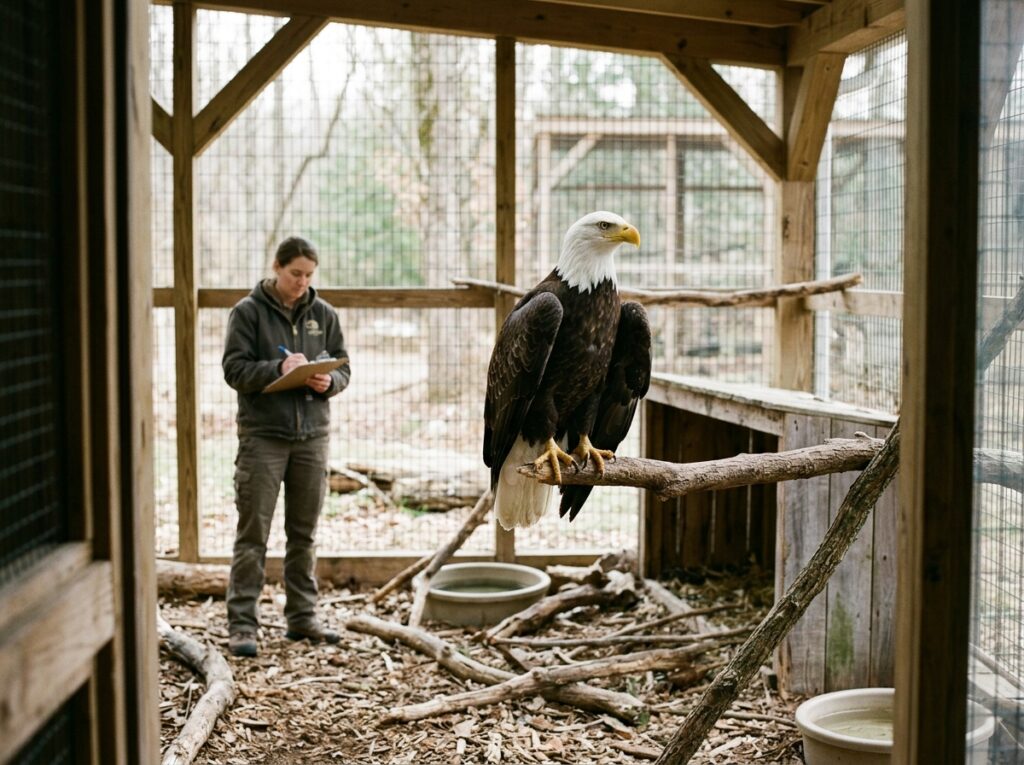
The eagle had made progress. Its condition was stable, and the veterinary team was monitoring its ability to use the injured wing. They still could not promise a release date, but the bird was receiving the care it needed.
Eleanor felt a quiet sense of relief.
She had begun the week worrying that the eagle might not survive. Now there was reason to hope.
Then the rehabilitator mentioned one final detail.
“The research coordinator has found a note associated with the bird’s earlier observations,” she said. “It records a sighting near your creek during the period your husband was helping with the monitoring work.”
Eleanor sat up.
“Does it mention Thomas?”
“It mentions the observation location and the date, but we’re still checking who made the entry. It doesn’t tell us how the eagle was injured this time.”
Eleanor thanked her and wrote down the date.
When she compared it with Thomas’s photograph, the two dates appeared to be close.
It was an interesting connection, but not proof that the same bird had returned to the meadow years later. The researchers would need to establish what the old record actually meant.
Eleanor placed the note beside the photograph.
For the first time since Thomas died, she felt that a small part of his old life might be coming into focus again. His work near the creek had not been a mystery to him, but it had remained a largely unexplored part of his life for her.
She wondered what else he had written down.
The following weekend, she organized another small community gathering, this time to discuss wildlife safety around the surrounding properties. Frank invited two neighboring landowners, and the wildlife coordinator offered to share general advice about maintaining fences and avoiding hazards for animals.
They discussed checking wire for loose loops, removing discarded cord and plastic, and keeping access routes clear for emergency responders.
Eleanor listened carefully.
She had thought of the fence repair as a simple maintenance job. Now she saw it as part of a larger responsibility shared by everyone who lived alongside wildlife.
Before the gathering ended, Frank raised his cup.
“To Thomas,” he said. “He always believed this land was worth looking after.”
Eleanor smiled, feeling the familiar ache of missing him, but also a sense of gratitude.
“To Thomas,” she replied.
Later that evening, she stood on the porch and looked across the meadow.
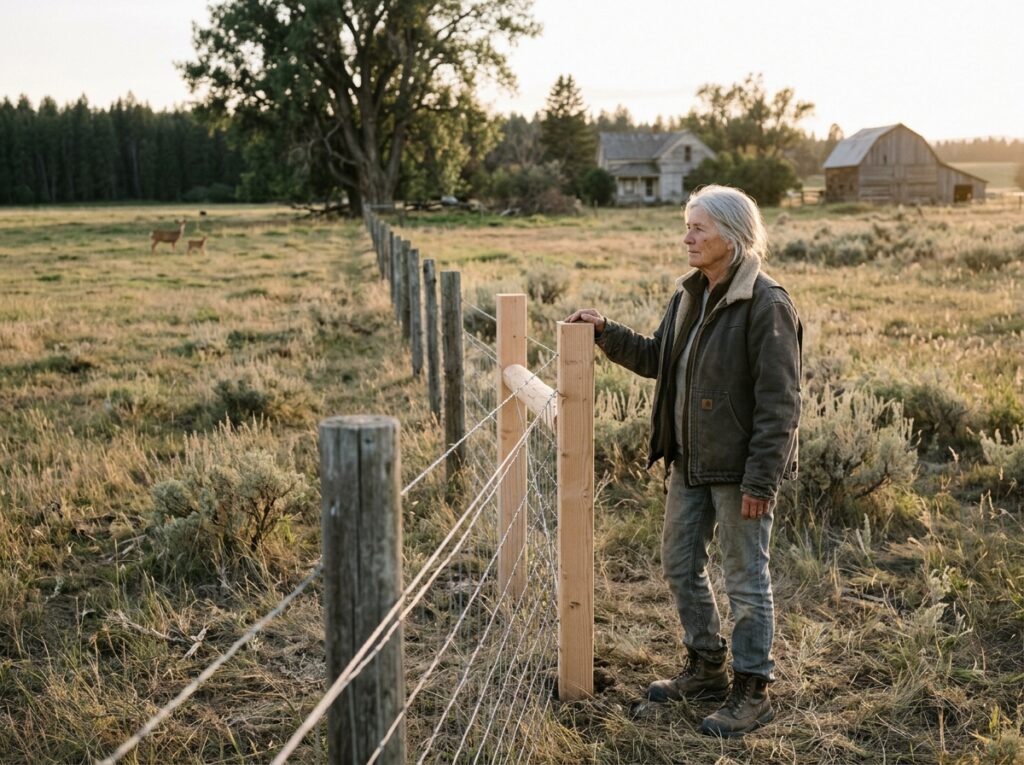
The grass moved in the cold wind. The repaired fence followed the edge of the property, and the cottonwood tree stood dark against the fading sky.
She thought about the fawn returning to its mother, the eagle receiving treatment, and the old photographs that had brought Thomas’s wildlife work back into her thoughts.
She still did not know who had visited the barn.
She did not know whether the truck belonged to Michael Turner, why the blue cord had been found near the eagle, or whether the recent activity was connected to the old monitoring project.
Those questions remained open.
But she had learned something important.
The right response to uncertainty was not to invent a story or blame someone without evidence. It was to notice what was happening, protect the animals, preserve the records, and allow people with the right skills to investigate.
As she turned toward the house, her phone buzzed with a new message from the wildlife rehabilitator.
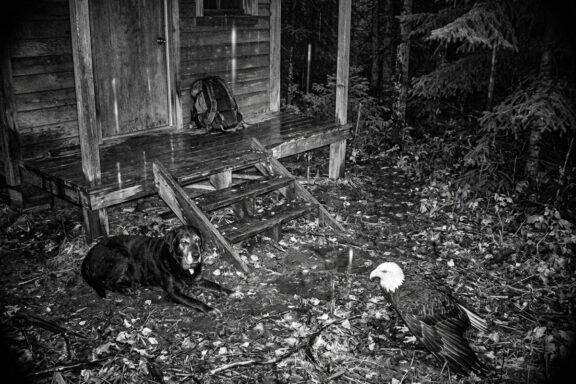
A photograph showed the eagle standing upright in its enclosure, its white head held high and its wings folded close to its body.
The message read:
“Progress is encouraging. We will continue monitoring its flight ability before making any release decision.”
Eleanor smiled.
She saved the photograph beside the picture of Thomas and the old meadow.
She hoped that one day the eagle would rise above the cottonwood tree and disappear into the Montana sky.
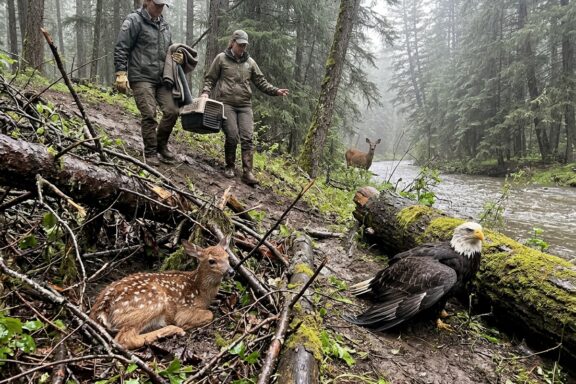
And when that day came, she would remember the morning she first saw it lying in the grass beside a frightened fawn.
She would remember the people who had come to help, the neighbors who repaired the fence, and the old photographs that reminded her how much care Thomas had given to the land.
Most of all, she would remember that kindness did not require knowing every answer.
Sometimes, it simply required noticing a problem and choosing not to look away.
No Comments