

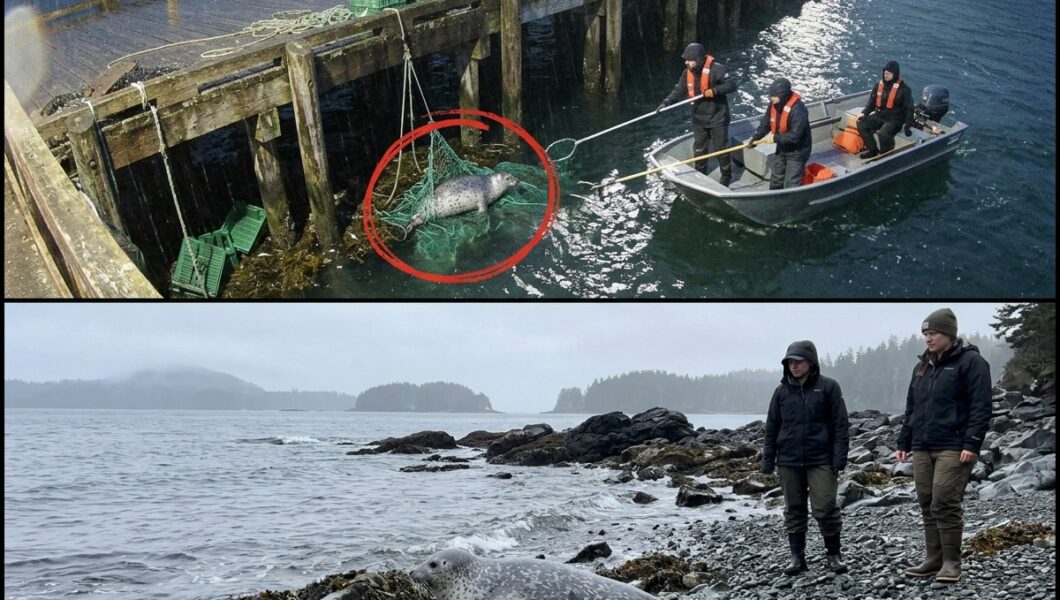
At 5:23 PM, Michael Dawson stared at the security monitor inside the Coldwater Bay harbor office.
The small gray flipper had disappeared.
Only dark water remained beneath the abandoned loading dock.
“Rachel, I can’t see it anymore!”
Dr. Rachel Foster, the marine mammal response coordinator, was already contacting her team.
“Michael, keep the camera on that area. Nobody goes onto the dock.”
“The netting is tightening around the pilings.”
“I understand. We’re arranging a water approach.”
Michael leaned closer to the screen.
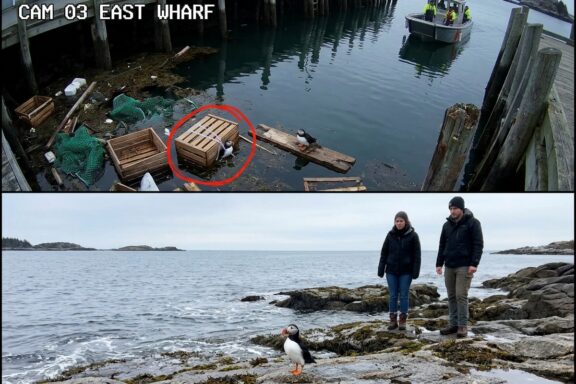
A broken green fish crate floated against the wooden supports.
Loose rope moved with the rising tide.
And beneath the surface, somewhere inside the tangled debris, a young harbor seal was trapped.
His seventeen-year-old daughter, Hannah, stood beside him.
“Dad, what if it can’t breathe?”
Michael couldn’t answer.
That morning, a bald eagle landing on a harbor piling had drawn his attention to another young seal trapped inside a floating fish crate.
Professional responders had freed that animal and transported it to a rehabilitation facility.
Now, while reviewing footage from an abandoned seafood storage facility, Michael had discovered another seal struggling beneath the loading dock.
The first animal had been saved.
But the second might already be running out of time.
At 5:28 PM, the underwater shadow moved.
Michael pointed.
“There!”
A gray muzzle briefly appeared between two floating crates.
The seal took a breath.
Then disappeared beneath the dock again.
Hannah grabbed her father’s arm.
“It’s alive!”
Michael radioed Rachel.
“The seal surfaced. It’s still alive!”
“Good. Keep monitoring. The team is almost there.”
The fictional fishing community of Coldwater Bay, Alaska, had been battered by powerful coastal winds for two days.
Broken fish crates, discarded rope, and damaged fishing equipment had washed into the harbor.
Much of the debris had originated near an abandoned seafood storage facility along the eastern shoreline.
Its wooden loading dock had deteriorated after years without maintenance.
Several support pilings leaned toward the water.
Loose netting hung beneath the structure.
And the rising tide was pushing floating debris into the narrow gaps.
At 5:41 PM, Rachel arrived with marine mammal response technician Daniel Mercer and two trained boat operators.
Michael met them beside the harbor office.
“The camera’s still recording.”
Rachel studied the monitor.
The seal surfaced again.
Its head appeared briefly beside a piling.
Then a wave pushed a broken crate against the opening.
The animal vanished.
Daniel examined the footage.
“That net is anchored to something below the dock.”
Rachel nodded.
“And the structure isn’t safe enough to approach from above.”
Harbor master James Walker joined them.
“We can temporarily restrict boat traffic and provide a workboat.”
Rachel contacted the appropriate authorized marine mammal response personnel to coordinate the intervention.
The team agreed on a controlled approach from the water.
Nobody would enter the damaged structure.
Nobody would attempt to swim beneath the dock.
And the responders would stop if conditions became too dangerous.
At 6:03 PM, the response boat moved slowly toward the eastern loading dock.
Michael remained at the harbor office, watching the security cameras.
Hannah stood beside him.
The sky was darkening.
Cold rain had begun falling.
And the tide continued rising.
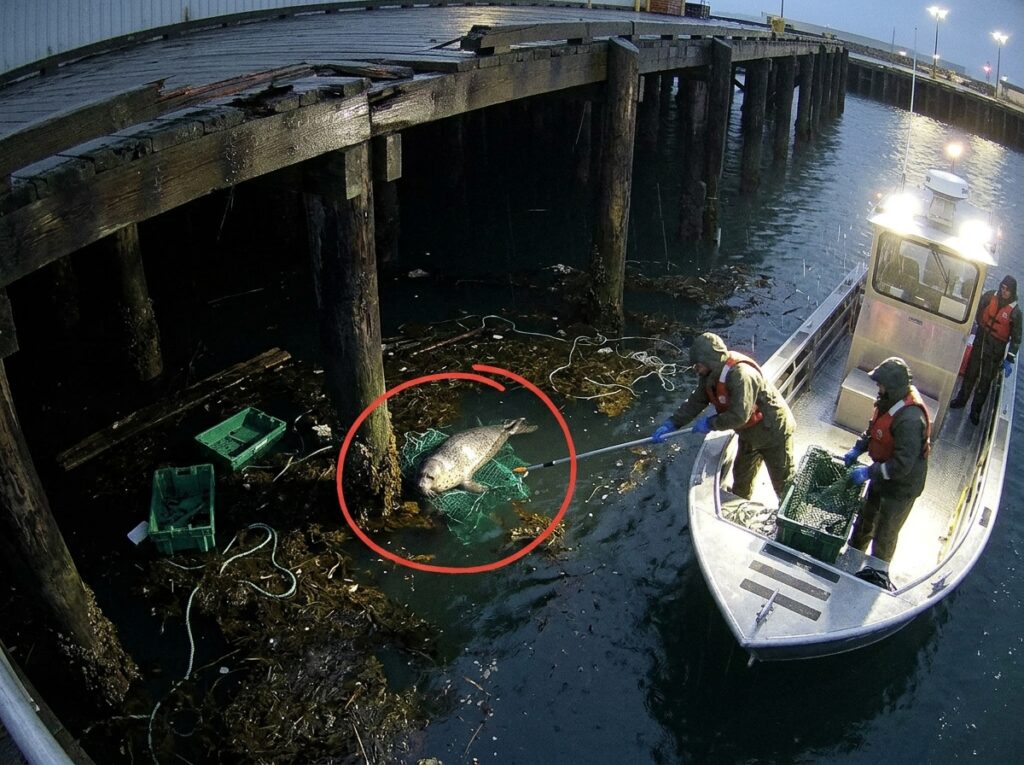
Daniel used a portable light to examine the floating debris.
“Netting on the right!”
Rachel leaned forward.
A length of green fishing net stretched between two submerged pilings.
One section moved unnaturally against the current.
Then a small gray head appeared.
“There it is,” Daniel said.
The seal surfaced inside a narrow pocket of water.
Its whiskers pressed against the broken plastic.
Its breathing appeared rapid.
Rachel studied the position.
“The animal may have a loop around its body. We need to avoid pulling the net tighter.”
The boat operators maintained a safe position.
Using suitable long-reach equipment, the trained responders carefully stabilized loose floating debris without forcing it toward the seal.
Daniel identified the section of netting attached to the nearest piling.
Rachel directed the team to release the outer obstruction first.
A wave moved through the harbor.
The crate shifted.
The seal disappeared.
Michael watched from the office.
“Come on,” he whispered.
For several seconds, nothing moved.
Then the animal surfaced again.
Daniel adjusted the equipment.
The first section of loose netting separated from the piling.
The seal moved forward.
But it could not swim away.
A second loop remained around its body.
Rachel prepared the authorized capture equipment.
With the seal accessible at the surface, the trained responders carefully contained it while maintaining access to air.
Daniel removed the remaining loose netting under Rachel’s direction.
The seal struggled briefly.
Then its body came free.
At 6:19 PM, Rachel confirmed the animal was breathing and responsive.
“It’s free.”
Michael heard the words over the radio.
He closed his eyes.
Hannah began crying.
But Rachel’s next message reminded them that the danger wasn’t over.
“We’re bringing the animal in for assessment. It’s exhausted.”
The responders transferred the young seal into a suitable ventilated transport carrier.
Its gray coat was wet.
A shallow abrasion marked one side of its neck.
And the skin beneath one flipper showed irritation from the netting.
The seal lifted its head.
Then settled quietly.
Rachel looked toward the damaged dock.
“That was a very dangerous place for an animal to become trapped.”
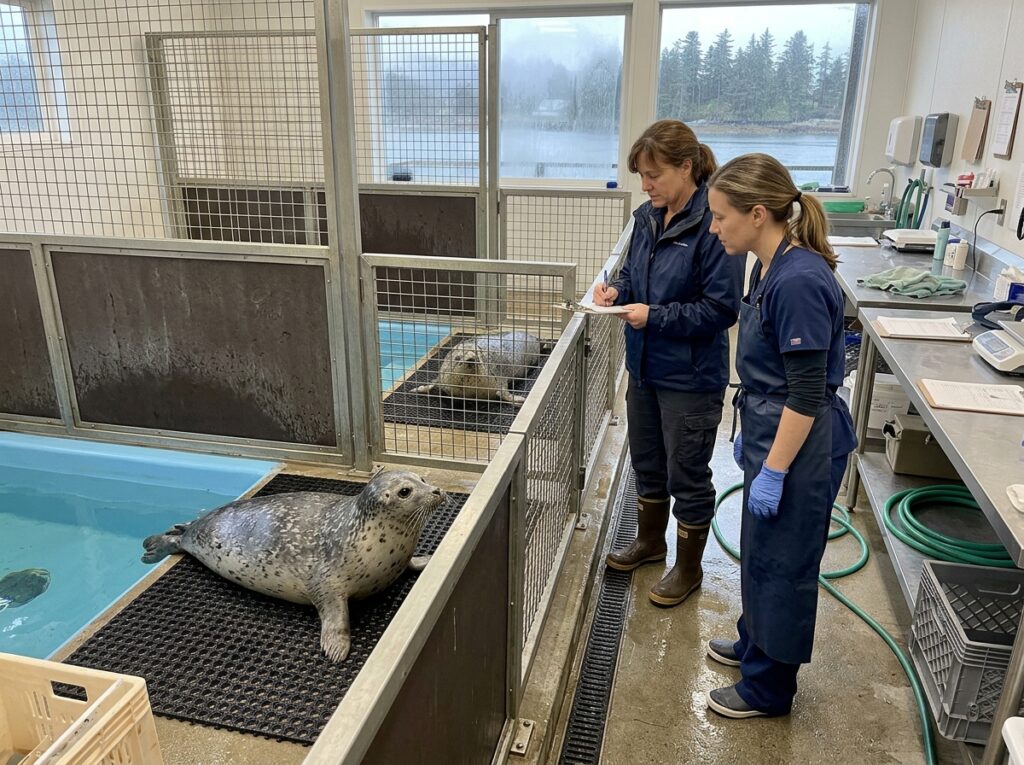
At 7:06 PM, Rachel arrived at the marine mammal rehabilitation facility with the second seal.
The first seal, rescued earlier from the floating fish crate, was already receiving treatment.
Dr. Olivia Bennett, the attending veterinarian, examined the newly rescued animal.
Its body temperature was within an acceptable range.
But it was dehydrated and exhausted.
The netting had caused superficial abrasions around its neck and flipper.
Olivia examined the injuries carefully.
“No obvious major external trauma, but we’ll need to monitor for complications.”
Rachel nodded.
“What about the first pup?”
“Stable. It’s responding to supportive care.”
Rachel exhaled.
Two young seals.
Both rescued from abandoned plastic debris.
Both alive.
But neither was ready to return to the ocean.
At 7:38 PM, Michael received the update.
He placed the phone on speaker so Hannah could listen.
“Both seals are stable,” Rachel explained. “They’ll need further veterinary assessment and rehabilitation.”
Hannah smiled through tears.
“Do you think they’re related?”
Rachel paused.
“We don’t know. They were found in the same harbor, but that doesn’t establish a family relationship.”
“What about the larger seal we saw following the crate?”
“It may have been an adult using the area. We can’t determine whether it was the first pup’s mother from the recording.”
Michael nodded.
He appreciated her caution.
The footage had raised questions.
But the animals’ survival mattered more than finding a dramatic explanation.
The next morning, Michael returned to the abandoned storage facility with the harbor inspection team.
The damaged dock remained closed.
Qualified contractors had been asked to assess the structure and organize removal of hazardous marine debris.
Hannah documented the shoreline from an authorized safe observation area.
She photographed broken crates.
Loose netting.
Discarded rope.
And piles of plastic packaging caught among the rocks.
Michael studied the debris.
“All this was sitting here before the storm.”
Hannah nodded.
“And now it’s in the water.”
The inspection team traced much of the material to unsecured outdoor storage areas.
The storm had scattered the abandoned equipment across the shoreline and into the harbor.
Some items floated.
Others became trapped beneath docks.
And some remained underwater, nearly invisible from shore.
James Walker, the harbor master, looked toward the damaged loading dock.
“We need to get this cleaned up before more animals get caught.”
The contractors developed a plan to remove the material safely.
The work required proper equipment and careful coordination because unstable pilings and submerged debris created hazards for workers.
By late morning, the first cleanup crews had begun operating in designated safe areas.
Michael watched as workers recovered damaged fish crates and loose rope from the shoreline.
Hannah helped document the recovered material.
She noticed several containers with the same faded white markings as the crate that had trapped the first seal.
“Dad, look.”
Michael approached.
The markings matched the old seafood storage facility.
He shook his head.
“These things have probably been sitting here for years.”
Hannah looked toward the water.
“And the seals paid the price.”
Michael didn’t answer immediately.
He had worked at the harbor for nearly thirty years.
He had always thought about floating debris as a navigation hazard.
Something that could damage boats.
Something that could block channels.
But now he understood that abandoned equipment could remain dangerous long after people stopped using it.
At 2:17 PM, the cleanup crew recovered a large section of tangled green fishing net from beneath the damaged dock.
It was wrapped around broken boards, rope, and submerged supports.
Michael recognized the same type of material that had trapped the second seal.
He stared at it.
“That could have caught another animal.”
James nodded.
“That’s why we’re removing it.”
The crew continued documenting the area.
They found no additional trapped seals during the authorized inspection.
But they identified several locations where floating debris could accumulate after storms.
The harbor began planning more frequent inspections of those areas.
Meanwhile, Rachel called with another update.
The first seal was becoming more alert.
The second was resting comfortably and responding to treatment.
Both required continued observation.
Hannah listened beside her father.
“Can we name them?”
Rachel laughed softly.
“The medical team uses identification numbers.”
Michael smiled.
“Not very memorable.”
Hannah thought for a moment.
“What about Harbor and Tide?”
Michael looked at her.
“Harbor and Tide?”
“Harbor for the first one. Tide for the second.”
Rachel smiled.
“Those are nice nicknames.”
Michael nodded.
“They fit.”
Over the following weeks, Coldwater Bay began changing.
The harbor office introduced a system for reporting dangerous floating debris.
Fishing crews were encouraged to secure equipment before severe weather.
The abandoned seafood storage facility remained under inspection while cleanup contractors removed hazardous materials.
Hannah’s marine conservation group helped organize educational information about discarded fishing gear.
They explained how loose netting, rope, and plastic containers could entangle marine animals.
Michael supported the effort.
But he refused to turn the rescued seals into a spectacle.
“They’re wild animals,” he reminded Hannah. “They don’t need crowds watching them recover.”
She nodded.
“I know.”
Instead, the group focused on practical prevention.
Proper storage.
Safe disposal.
Storm preparation.
And reporting dangerous debris to harbor authorities.
The cleanup continued.
At the rehabilitation center, Harbor and Tide recovered at different rates.
Harbor, the first seal, began eating independently under specialist care.
Its abrasions healed.
It gained weight.
And it became more active in the rehabilitation pool.
Tide needed additional time.
The second seal had suffered greater exhaustion and required careful monitoring of its flipper injuries.
Olivia explained that a seal could appear healthy while still lacking the strength and condition needed for survival at sea.
Both animals would need to demonstrate appropriate feeding, swimming, diving, and general health before release.
Michael understood.
He wanted them back in the ocean.
But he didn’t want anyone to rush.
In December, Rachel called with encouraging news.
“Harbor is progressing very well.”
Michael smiled.
“And Tide?”
“Improving. The flipper abrasions are healing, and it’s becoming more active.”
Hannah leaned toward the phone.
“Will they be released together?”
Rachel answered carefully.
“Not necessarily. Each animal will be evaluated individually.”
Michael nodded.
“Whatever gives them the best chance.”
The following week, Rachel sent a photograph approved for educational use.
It showed Harbor resting beside a rehabilitation pool.
The young seal’s gray coat was clean.
Its eyes were alert.
And its posture was relaxed.
Hannah stared at the photograph.
“That’s the little seal from the crate.”
Michael smiled.
“Hard to believe.”
He remembered the animal pushing its flipper through the broken plastic.
The crate drifting toward the boat channel.
The desperate uncertainty as responders approached.
Now the seal was recovering.
He placed the photograph beside his desk.
A reminder of how much could change when someone noticed an animal in danger and contacted the right people.
By January 2027, Harbor had met most of its rehabilitation goals.
The veterinary team continued assessing its feeding behavior, swimming ability, diving performance, and overall condition.
Tide was progressing more slowly but steadily.
Hannah called Rachel one afternoon.
“Do you think they’ll remember the harbor?”
Rachel smiled.
“We can’t know what they’ll remember. What matters is that they can survive independently.”
Hannah nodded.
“I just hope they never get trapped again.”
“So do I.”
In late January, Harbor passed its final veterinary assessments.
The rehabilitation team selected an appropriate coastal release site and suitable weather conditions.
The release was carried out by authorized personnel, away from crowds and unnecessary disturbance.
Michael and Hannah did not attend.
They understood that the seal’s return to the ocean was not meant to be a public event.
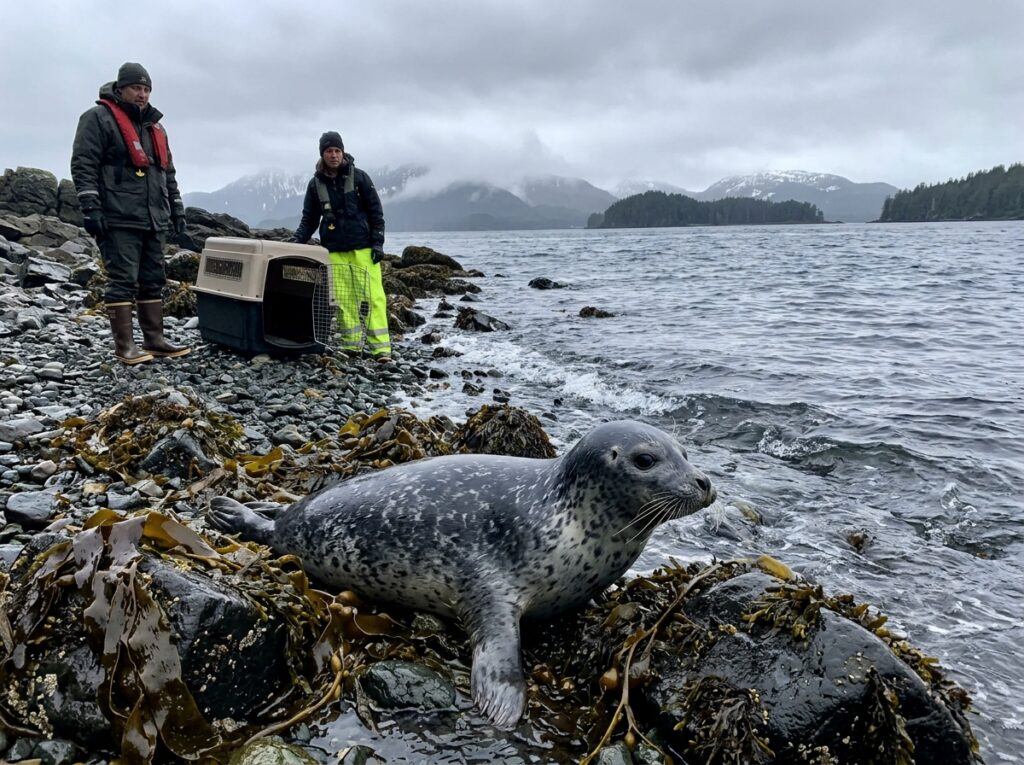
But afterward, Rachel sent them a photograph.
Harbor stood at the edge of a quiet rocky shoreline.
Its spotted gray coat was clean.
Its body looked strong.
And the cold Pacific Ocean stretched behind it.
In the next photograph, the seal had entered the water.
Michael stared at the images.
His eyes filled.
Hannah smiled.
“He’s home.”
Michael nodded.
“Back where he belongs.”
They could not know what would happen to Harbor afterward.
Wildlife rehabilitation could never guarantee long-term survival.
But the young seal had been given another chance.
And that was enough to make the moment meaningful.
Tide remained in care for several more weeks.
Its flipper injuries continued healing.
It gained strength.
And its swimming performance improved.
Rachel’s team monitored its progress closely.
Then, in February, Olivia made the decision everyone had been hoping for.
“Tide is ready.”
Rachel called Michael.
“Both seals have now met the criteria for release.”
Michael sat down.
For a moment, he couldn’t speak.
Then he asked:
“Both?”
“Both.”
Hannah covered her mouth.
Rachel continued.
“Tide will be released at a suitable coastal location when conditions allow.”
Michael looked toward the harbor.
The place where the second seal had disappeared beneath the dock.
Where a small gray flipper had reached through the tangled netting.
Where he had feared they were too late.
Now the animal was ready to return to the ocean.
He whispered:
“That’s wonderful.”
On November 9, 2027, Michael Dawson arrived at Coldwater Bay Harbor before sunrise.
The damaged loading dock had been repaired or removed where necessary.
The abandoned seafood storage area had undergone cleanup.
Broken fish crates were no longer scattered along the shoreline.
And the harbor had established a routine for documenting dangerous debris after major storms.
Michael walked toward Pier Four.
The same pier where he had first seen the young seal trapped inside a floating green crate.
The water was calm.
Fishing boats rocked gently at their moorings.
And a pale orange glow appeared beyond the mountains.
Hannah joined him carrying two cups of coffee.
“Morning, Dad.”
Michael smiled.
“Morning.”
She handed him a cup.
“One year.”
He nodded.
“Hard to believe.”
They stood together watching the harbor.
Hannah looked toward the water.
“Do you ever wonder where Harbor and Tide are now?”
Michael smiled.
“All the time.”
“Think they’re still out there?”
“I hope so.”
There was no way to know.
Harbor seals can travel across coastal waters, and the two rescued animals might have moved far from Coldwater Bay.
They might never return to the harbor.
And Michael understood that was exactly how it should be.
Wild animals belonged in the wild.
Not in transport crates.
Not in rehabilitation pools.
And certainly not trapped inside discarded fishing equipment.
They belonged in the ocean.
Hannah took a sip of coffee.
“Remember the eagle?”
Michael laughed softly.
“How could I forget?”
She looked toward the wooden piling where the bird had landed.
“Do you think it knew the seal was trapped?”
Michael shook his head.
“No.”
The eagle had simply been using the harbor as a resting and hunting area.
Its landing had drawn Michael’s attention to the security monitor.
That was all.
But that moment had changed the day.
Because Michael looked at the camera, he noticed the floating crate.
Because responders rescued the first seal, they began investigating the dangerous debris.
Because Michael and Hannah reviewed the recordings, they discovered the second seal trapped beneath the abandoned dock.
And because the community recognized the danger, the harbor began removing abandoned materials that could injure wildlife.
Michael looked toward the eastern shoreline.
“Funny how one little animal can make you see a place differently.”
Hannah nodded.
“It wasn’t just one.”
He smiled.
“No. It wasn’t.”
At 7:23 AM, a bald eagle landed on a wooden piling near the harbor entrance.
Michael noticed it immediately.
The bird folded its enormous wings.
Turned its white head toward the water.
And watched the harbor.
Hannah smiled.
“Another eagle.”
Michael nodded.
“Maybe the same one.”
Neither could know.
The bird remained for several minutes.
Then spread its wings and lifted into the cold Alaska air.
Michael watched it disappear toward the shoreline.
He thought about the first seal’s tiny flipper pushing through the broken crate.
The second seal struggling beneath the netting.
The responders working carefully in the rising tide.
And the photographs showing both animals returning to the ocean.
He smiled.
Because the most important part of the story wasn’t the eagle.
It wasn’t the security camera.
And it wasn’t even the dramatic rescue.
It was what happened afterward.
The inspections.
The cleanup.
The safer storage practices.
And the people who began paying attention to dangers they had once overlooked.
Michael had worked at Coldwater Bay Harbor for nearly thirty years.
He had always believed his job was to keep boats moving safely.
Now he understood that caring for a harbor also meant caring for the wildlife that depended on its waters.
Hannah finished her coffee.
“Ready to get to work?”
Michael looked toward the docks.
He smiled.
“Always.”
They walked back toward the harbor office.
Behind them, the tide continued rising.
Fishing boats prepared to leave.
Gulls circled above the water.
And the Pacific Ocean stretched beyond the harbor entrance.
Somewhere out there, two young seals had been given another chance.
They would never know Michael’s name.
They would never understand how many people had helped them.
And they would never know how much their struggle had changed Coldwater Bay.
But they didn’t need to.
They only needed clean water.
Safe places to rest.
And the freedom to swim without becoming trapped in what people left behind.
Michael opened the harbor office door.
Before going inside, he glanced toward Pier Four one final time.
The wooden piling stood empty.
The eagle was gone.
And the water was clear.
He smiled softly.
“Stay safe out there, little ones.”
Then he went inside to begin another ordinary morning.
THE END
No Comments