

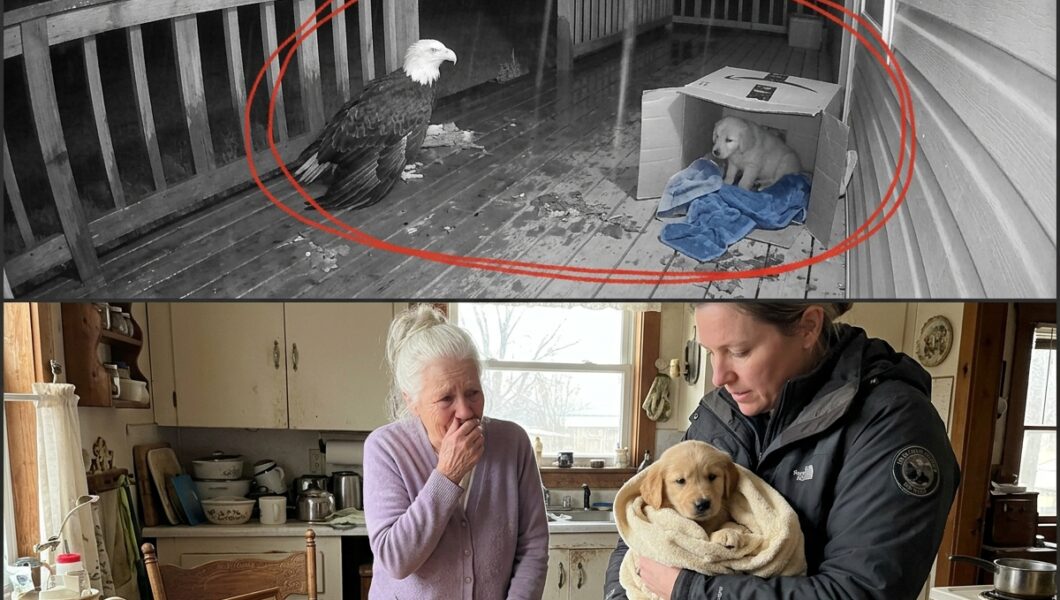
Margaret Wilson stared at the five words written on the back of her husband’s photograph.
“Tell Margaret when it’s safe.”
For several seconds, she could hear nothing except the ticking kitchen clock.
Henry had written those words only weeks before his death.
Now, two winters later, a frightened man stood in her kitchen holding a map of the forest, while an abandoned golden puppy and an injured bald eagle fought to recover at separate veterinary facilities.
Margaret looked at Daniel Mercer.
“What was Henry afraid of?”
Daniel lowered himself into the wooden chair beside the window.
“I don’t think he was afraid for himself,” he answered. “He was afraid somebody would get hurt if the old logging road wasn’t made safe.”
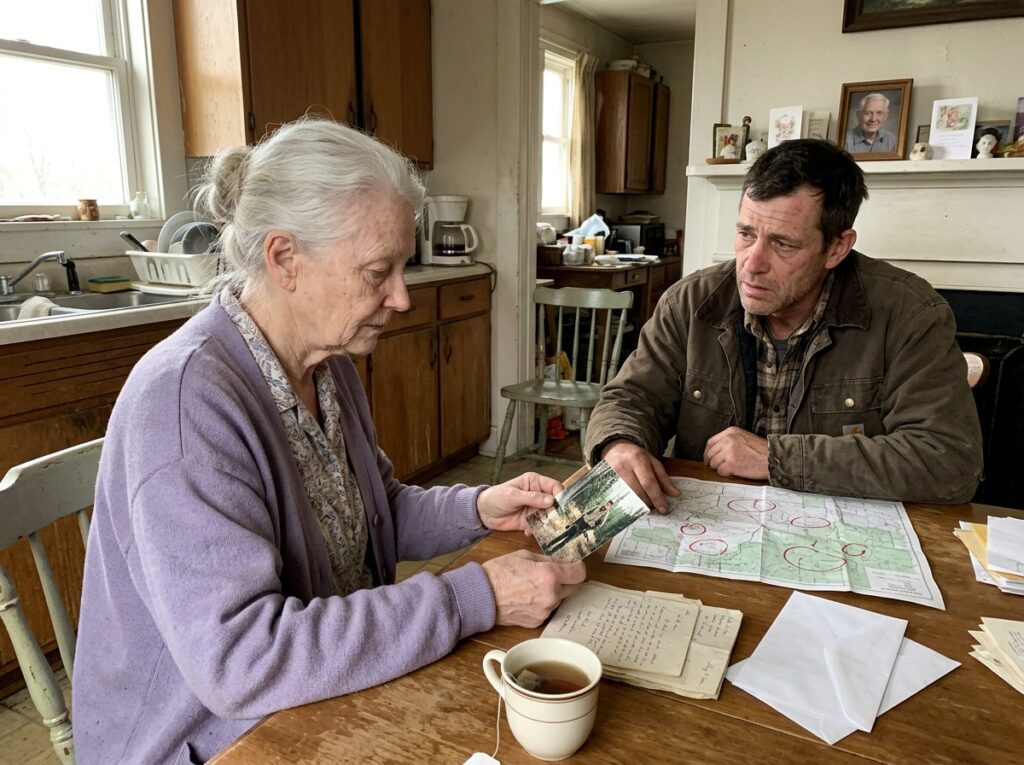
Margaret unfolded the map.
Three locations had been circled in red ink. One marked the abandoned cabin where Daniel had lived with his mother. Another showed a narrow creek crossing. The third was farther uphill, near an area Henry had photographed during his final winter.
Daniel pointed to the creek.
“Years ago, Henry noticed animals getting tangled in old fencing and discarded cable near the road. He kept reporting it because the barriers were deteriorating.”
“Who was responsible for them?”
“That’s what he was trying to establish. Some sections belonged to private property owners. Others were part of an abandoned road maintenance system.”
Margaret studied the photograph.
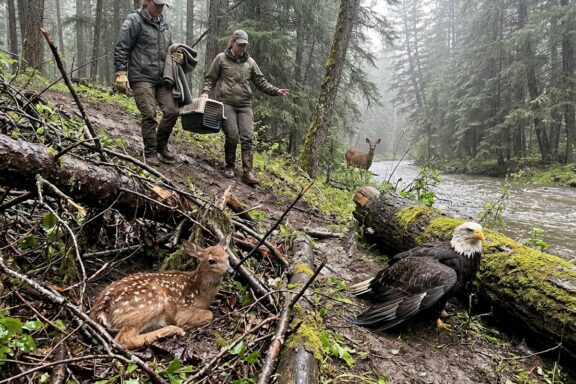
A bald eagle perched in a tall pine tree above the creek. Henry stood beneath it, holding a camera.
“Is this the same eagle?”
“We can’t know,” Daniel admitted. “But it’s near where I saw the injured bird during the storm.”
Margaret turned the photograph over again.
“Then why did Henry tell you not to tell me?”
Daniel hesitated.
“Because you were caring for him while he was sick. He didn’t want you worrying about the cabin or the road. He thought he could finish sorting everything out.”
Margaret looked toward Henry’s empty chair.
She remembered those final months.
The hospital appointments. The sleepless nights. The way Henry had sometimes returned from the woods looking exhausted, insisting he had only been checking on an old friend.
She had believed him.
Now she understood that he had been trying to protect more than one person.
But she also knew something else.
Henry would never have wanted Daniel to leave a helpless puppy outside in freezing rain.
“Before we talk about the forest,” she said firmly, “we need to talk about that little dog.”
Daniel looked down.
“I know.”
“She could have died.”
His eyes filled.
“I didn’t think the weather would get that bad. I thought you’d hear me knock right away.”
“But you drove away.”
Daniel nodded.
“I was ashamed. I thought if you saw me, you’d ask why I hadn’t taken better care of the puppy. And I didn’t have an answer.”
Margaret remained quiet.
Daniel explained that his mother had adopted the puppy shortly before her final illness. She had named her Daisy.
After his mother’s death, Daniel struggled to maintain the cabin. A damaged roof had allowed rainwater into the bedroom, and the heating system had stopped working.
He had contacted a few shelters but had not arranged a confirmed placement before bringing Daisy to Margaret.
“She deserved better than what I gave her,” he whispered.
Margaret looked at him.
“Then start by making sure she gets better.”
Daniel nodded.
For the first time that morning, Margaret saw something familiar in his expression.
Not Henry’s face.
But the same quiet determination her husband had always tried to encourage in people who had lost their way.
That afternoon, Margaret called the wildlife officer who had helped rescue the eagle.
She explained Daniel’s account and offered to provide copies of Henry’s maps, photographs, and correspondence.
The officer, Sarah Bennett, listened carefully.
“We can review the information,” Sarah said. “But we need to distinguish the old maintenance concerns from what happened to this particular eagle.”
Margaret understood.
The bird might have injured its wing in a collision, during the storm, or somewhere else entirely.
Nothing yet proved that abandoned cable had caused the injury.
Sarah arranged for the appropriate land managers and county officials to inspect the locations Daniel had identified.
She also advised Margaret not to visit the damaged logging road herself.
“There may still be unstable ground and exposed wire,” Sarah explained.
Margaret promised to stay away.
She had already learned that helping wildlife sometimes meant allowing trained people to do dangerous work.
Two days later, the veterinarian caring for Daisy called.
The puppy had recovered from the worst of her chilling and dehydration.
She was eating small meals, gaining strength, and becoming more alert.
Margaret pressed the phone close to her ear.
“Can I visit her?”
“Yes,” the veterinarian replied. “We can arrange that with the rescue organization.”
Margaret drove to the animal shelter that afternoon.
Daniel came with her.
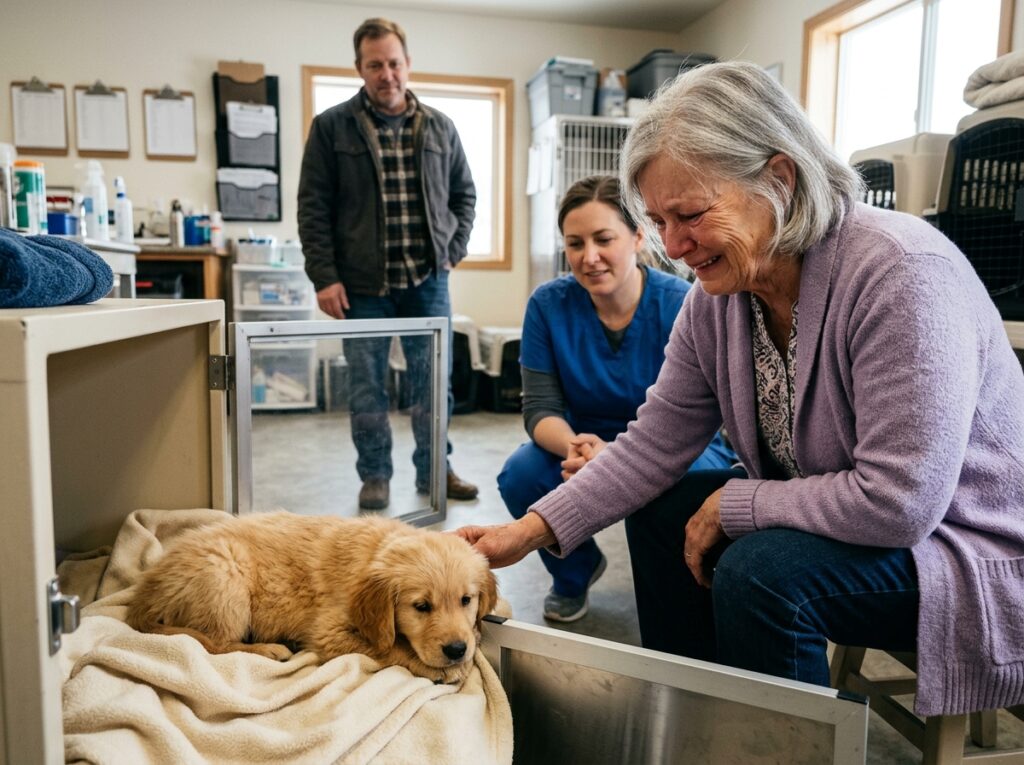
Inside a quiet recovery room, Daisy rested in a clean kennel lined with soft blankets.
Her golden fur was dry now.
Her little ears folded gently beside her face, and her dark eyes followed the shelter worker who approached with food.
When Margaret sat nearby, Daisy lifted her head.
The puppy gave a small, uncertain wag of her tail.
Margaret’s eyes filled with tears.
“Oh, Daisy.”
The shelter worker explained that the puppy would remain under veterinary supervision until she was healthy enough for adoption.
Margaret asked whether she could apply to give Daisy a permanent home.
The worker smiled.
“We can discuss the adoption process once she’s medically cleared.”
Daniel stood quietly beside the doorway.
Margaret turned toward him.
“You know, Henry and I had a golden retriever named Buddy.”
Daniel nodded.
“Henry told me about him.”
“He lived fourteen wonderful years. After we lost him, I couldn’t imagine having another dog.”
She looked back at Daisy.
“But maybe loving another one doesn’t mean forgetting the first.”
Daniel wiped his eyes.
“No, ma’am. I don’t think it does.”
The following week, county personnel inspected the old logging road.
They documented damaged fencing, loose metal cable, and several deteriorated barriers near the creek.
Some material appeared to have been abandoned for years.
Other pieces had shifted during recent storms.
The team began coordinating repairs and removal with the responsible property owners.
Henry’s old records helped identify locations that required closer examination.
Margaret felt proud of him.
But the inspection brought another discovery.
Inside a small storage box near the abandoned cabin, Daniel found a folder Henry had left with his mother.
It contained copies of maintenance requests, photographs of damaged fencing, and a handwritten list of wildlife sightings.
One page carried a date from Henry’s final winter.
Below it, he had written:
“Daniel deserves a fresh start. The forest deserves one too.”
Daniel brought the folder to Margaret.
He stood in her kitchen holding the page as though it were something fragile.
“He was still thinking about me,” he said.
Margaret read the sentence.
Then she looked at the man her husband had helped nearly twenty-six years earlier.
“He never stopped.”
Several days later, Daniel asked Margaret whether he could tell her more about his mother.
Her name had been Evelyn Mercer.
When Henry first met them, Daniel was seventeen, and Evelyn had been struggling to recover from a serious illness.
They had lost their apartment after falling behind on rent.
For several weeks, they slept in their car.
Henry discovered them one freezing evening outside a grocery store.
He bought them dinner, then arranged for them to stay in the small cabin while they looked for stable housing.
“He told my mother she could stay until she got back on her feet,” Daniel remembered. “But when she tried to repay him, he wouldn’t accept the money.”
Margaret smiled faintly.
“That sounds like Henry.”
“He helped me finish school. He even drove me to job interviews.”
Daniel paused.
“When my mother died, I felt like I’d failed both of them.”
Margaret reached across the table.
“You were grieving. And you were struggling. But you still have choices about what happens next.”
Daniel nodded.
He had already contacted a housing assistance organization and begun looking for work.
A former employer had offered him temporary maintenance work while he searched for something permanent.
Margaret was relieved.
She could not solve every problem in Daniel’s life.
But she could encourage him to accept help and take responsibility for Daisy.
That evening, Daniel returned to the cabin to begin sorting his mother’s belongings.
Margaret stayed home.
At 8:36 PM, her porch camera sent a notification.
She opened the recording.
The porch was empty.
Rainwater still stained the boards where Daisy’s cardboard box had collapsed.
Margaret stared at the spot.
She remembered the tiny puppy crying beneath the blue towel.
The injured eagle standing beside the railing.
And the stranger running back toward the dark pickup.
It had been one of the most frightening nights of her life.
Yet somehow, it had led her back to a part of Henry’s heart she had never known.
She saved the recording.
Then she went to Henry’s desk and opened the bottom drawer.
Inside was Buddy’s old leather collar.
Margaret held it for a long time.
“Maybe it’s time,” she whispered.
Three weeks after the rescue, Daisy was medically cleared for adoption.
Margaret completed the shelter’s application and care arrangements.
When the adoption was approved, she arrived with a small blanket, a puppy harness, and a new collar.
Daniel accompanied her.
Daisy was much stronger now.
She bounced awkwardly across the shelter floor, stopped to sniff Margaret’s shoes, then sat down as though she had forgotten what she was doing.
Margaret laughed.
It was a sound Daniel had rarely heard from her.
When Daisy was placed safely in her travel carrier, Margaret leaned close.
“You’re coming home, sweetheart.”
Daniel stood beside the car.
“Henry would have loved her.”
Margaret smiled.
“I think he would have spoiled her terribly.”
At the farmhouse, Daisy explored the kitchen under Margaret’s watchful eye.
She sniffed the legs of Henry’s old chair.
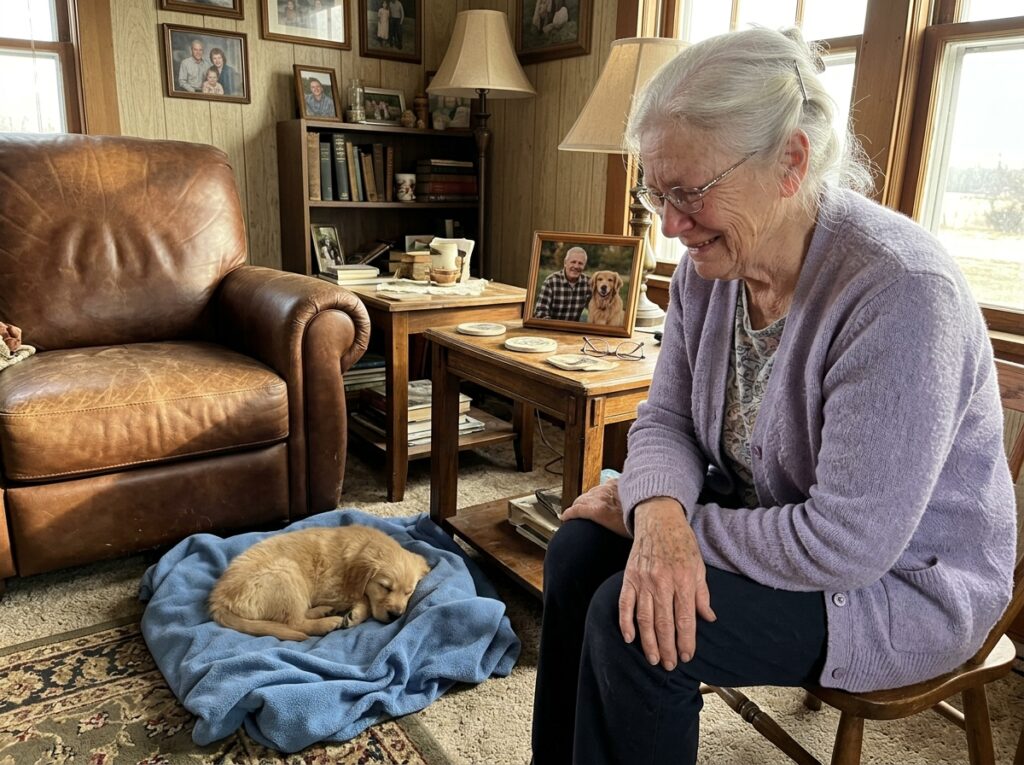
Then she curled up on a soft blanket beside it and fell asleep.
Margaret stood in the doorway, watching.
For two winters, that corner had been empty.
Now a tiny golden puppy was breathing softly where Buddy once slept.
Margaret wiped her eyes.
The house felt different.
Not because Henry had returned.
But because love had found another way to enter.
As autumn gave way to winter, Margaret continued receiving updates about the injured bald eagle.
Its recovery was slower than Daisy’s.
Veterinarians had stabilized the wing injury, but the bird still needed specialized rehabilitation.
Margaret understood that recovery was never guaranteed.
She asked for updates when they were available and donated supplies through the rehabilitation center’s approved program.
Meanwhile, work continued near the old logging road.
The responsible agencies and landowners arranged to address the hazardous fencing and cable identified during the inspection.
Some sections were removed.
Others were repaired or secured.
The team also reviewed how wildlife moved through the creek corridor.
Henry’s photographs helped document how the area had changed over the years.
No one could establish that the abandoned material had caused the eagle’s injury.
But the safety problems were real.
And they were finally receiving attention.
Daniel volunteered during an approved community cleanup along accessible parts of the road.
He also began working regularly again.
On weekends, he visited Margaret and Daisy.
Sometimes he brought groceries.
Sometimes he repaired a loose step or helped carry firewood.
Margaret always insisted he stay for coffee.
Gradually, their conversations became easier.
They talked about Evelyn.
They talked about Henry.
And sometimes, they simply watched Daisy chase a soft toy across the living room.
One afternoon, Daniel arrived carrying a small wooden box.
“I found this while cleaning the cabin,” he explained.
Inside was an old brass key and a folded letter.
The letter was addressed to Margaret.
She recognized Henry’s handwriting immediately.
Her hands trembled as she opened it.
“My dearest Ellie,
If you’re reading this, I probably didn’t get the chance to explain everything properly.
I know you sometimes wondered why I spent so much time helping Daniel and his mother.
The truth is simple. Years ago, when I was struggling, someone helped me without asking for anything in return.
I never forgot what that felt like.
Daniel reminded me of the young man I used to be.
I wanted him to know that one difficult chapter didn’t have to become his whole story.
And I wanted the forest behind our home to remain a safe place for the animals we loved watching together.
If I leave anything unfinished, please don’t feel you have to carry it alone.
You’ve already given me more love than one lifetime could hold.
All my love,
Henry.”
Margaret pressed the letter against her chest.
For a long time, she couldn’t speak.
Daniel sat quietly across from her.
Finally, Margaret looked up.
“He never told me someone helped him when he was young.”
Daniel smiled sadly.
“Maybe that’s why he understood us.”
Margaret nodded.
She thought about the porch light Henry had insisted they leave on every night.
A small gesture.
A simple light.
Something she had once considered nothing more than an old habit.
Now she understood.
Henry had spent his life trying to make sure people who felt lost could find somewhere safe.
And somehow, even after his death, that light had brought Daniel and Daisy to her door.
In early spring, the wildlife rehabilitation center called with encouraging news.
The eagle had made substantial progress.
Its wing function had improved, and it was completing supervised flight assessments.
Margaret listened carefully.
“Will it be released?”
“We’re hopeful,” the rehabilitator said. “But we still need to confirm it can fly and hunt well enough to survive.”
Several weeks later, the center contacted her again.
The eagle had passed its final rehabilitation assessments.
It was ready for release.
Margaret was invited to observe from a safe distance at a suitable location chosen by the wildlife team.
Daniel drove her.
The morning was clear and cold.
Pine trees stood against the pale Montana sky.
Margaret wore Henry’s old wool scarf.
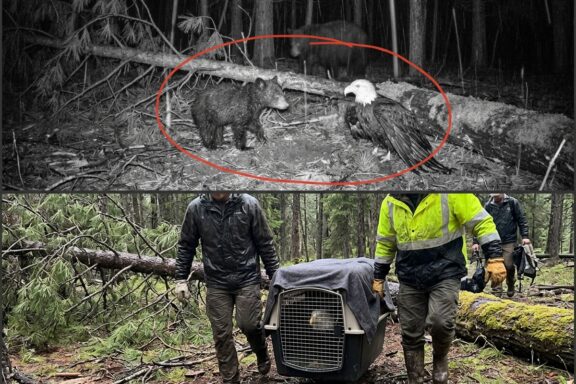
When the rehabilitator opened the transport carrier, the eagle remained still for a moment.
Then it stepped forward.
Its enormous wings opened.
Margaret held her breath.
With several powerful beats, the bird lifted into the air.
It climbed above the clearing, circled once, and flew toward the distant ridge.
Margaret began crying.
Daniel placed a hand gently on her shoulder.
Neither spoke until the eagle disappeared.
Then Margaret whispered, “Henry would have loved this.”
Daniel looked toward the mountains.
“He would have been proud of you.”
Margaret shook her head.
“He would have been proud of everyone who helped.”
That evening, Margaret returned home to find Daisy waiting behind the safety gate in the kitchen.
The little puppy wagged her tail so hard that her whole body seemed to move.
Margaret laughed and bent down to greet her.
Outside, the porch light glowed against the gathering darkness.
The same light Henry had kept burning for forty-three years.
Margaret looked toward his photograph on the mantel.
She thought about the frightened puppy, the injured eagle, the young man who had carried guilt and grief for years, and the secret kindness her husband had quietly given to another family.
Then she looked at Daisy.
The puppy had already curled up beside Henry’s chair.
Margaret smiled through her tears.
“Well, Henry,” she whispered, “I think we’ve finally finished what you started.”
She switched off the kitchen light.
But she left the porch light burning.
Because somewhere beyond those windows, someone might still be searching for a safe place to begin again.
The End.
This is a fictional kindness and wildlife rescue story created for emotional storytelling.
No Comments