

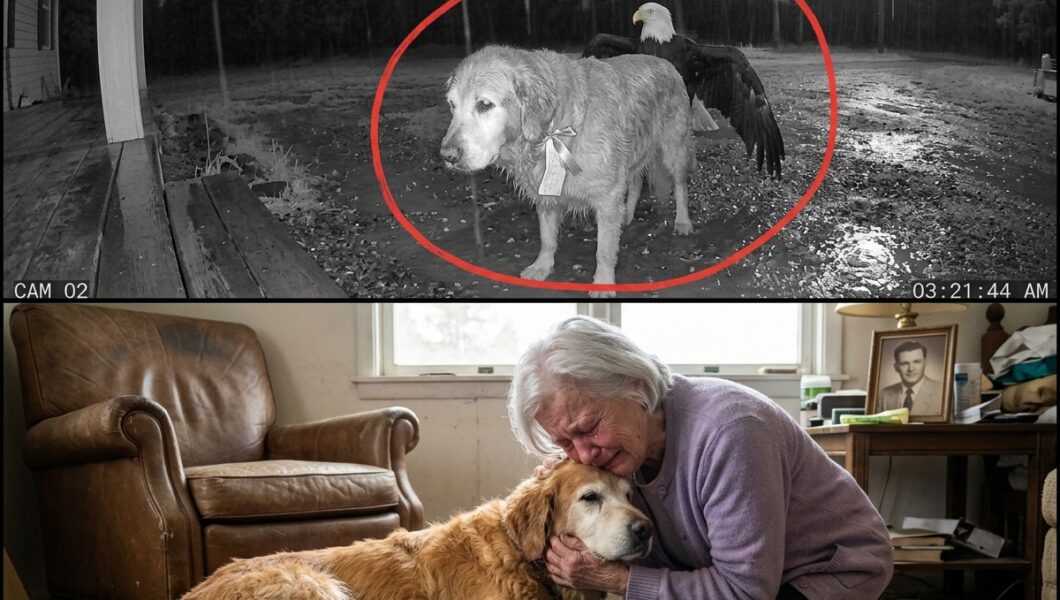
Margaret Wilson stared at the security camera screen, unable to move.
The dark pickup truck stood at the end of her driveway, its engine running beneath the gray Montana sky. A broad-shouldered man stepped out, removed his cap, and looked toward the farmhouse.
Beside her, Daniel Mercer gripped the back of a kitchen chair.
“That’s Robert Hayes,” he whispered. “He worked on the north crossing with Henry.”
Margaret looked at him.
“What do you mean Henry was trying to stop him?”
Daniel swallowed.
“Robert wanted to reopen part of the old logging road. Henry believed the bridge and its barriers were too dangerous. They argued about it for years.”
On the camera, Robert took several steps toward the farmhouse, then stopped near the mailbox.
Margaret felt a sudden rush of fear.
She was seventy-eight years old, alone except for Daniel, and the man outside appeared connected to the final mysterious words her husband had written before his death.
She reached for her telephone.
Daniel gently stepped away from the window.
“Don’t go outside,” he said. “We don’t know why he’s here.”
Margaret called the sheriff’s office and explained that a man connected to an ongoing inquiry had appeared at her property. She provided the vehicle description and told the dispatcher that she was remaining indoors.
A few minutes later, Robert returned to his truck.
But before leaving, he placed a large brown envelope inside Margaret’s mailbox.
Then he drove away.
Margaret watched until the taillights disappeared.
“Why would he come here?” she asked.
Daniel shook his head.
“I don’t know.”
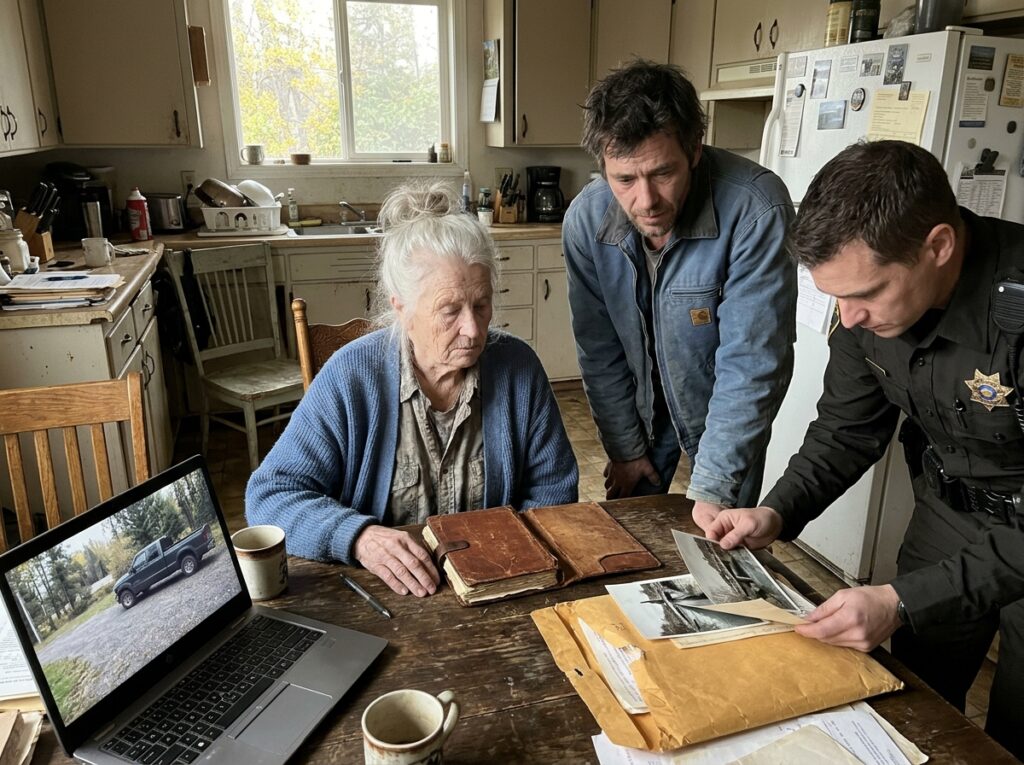
He looked toward Henry’s leather notebook lying open on the table.
“But I think that envelope has something to do with the bridge.”
An officer arrived later that morning and spoke with Margaret and Daniel. After documenting their account, he collected the envelope with Margaret’s permission.
Inside were photocopies of old road maintenance reports, photographs of the north crossing, and a handwritten letter addressed to Margaret.
The officer explained that the documents would need to be reviewed before anyone could draw conclusions.
Margaret understood.
But one sentence in the letter immediately caught her attention.
“Henry was right about the bridge. I should have listened before someone got hurt.”
Margaret read it twice.
Her husband’s name.
The old crossing.
And a confession that sounded like regret.
She looked toward Daniel.
“What happened out there?”
Daniel sat down slowly.
“Twenty years ago, the north crossing was used by maintenance vehicles and a few local landowners. Robert supervised repairs. Henry volunteered to help because he knew animals used the creek corridor.”
He paused.
“Then one winter, part of the bridge decking failed.”
Margaret remembered that winter.
Henry had come home with mud on his coat and a deep scratch across his cheek. He told her he had slipped while helping repair a fence.
She had never questioned him.
“Was Henry hurt?” she asked.
“Not badly. But a young maintenance worker fell through the damaged decking and broke his leg. Henry helped get him out.”
Margaret covered her mouth.
“He never told me.”
“Afterward, Henry kept asking for the crossing to be closed until it could be properly inspected. Robert thought the damage could be repaired without shutting down the road.”
Daniel lowered his voice.
“Henry didn’t trust the temporary barriers. He worried somebody would move them, and that animals could become tangled in the loose cable.”
Margaret looked down at the notebook.
The final entry suddenly made more sense.
I tried to make it right.
But why had Henry written those words only three days before he died?
And what was hidden beneath the bridge?
That afternoon, Margaret received an update from Buddy’s veterinarian.
Her thirteen-year-old golden retriever had responded well to fluids and treatment. His dehydration was improving, and the swelling in his arthritic joints was beginning to settle.
He still needed rest and careful monitoring.
But he had eaten a small meal.
Margaret closed her eyes.
For fourteen days, she had imagined finding Buddy lifeless somewhere in the woods.
Now he was warm, receiving treatment, and slowly recovering.
“Can I see him?” she asked.
The veterinarian arranged a visit.
Daniel drove her to the clinic.
Buddy lay on a thick blanket inside a quiet recovery room. His golden muzzle had turned almost white with age, and his eyes looked tired.
But when Margaret spoke, his ears moved.
“Buddy, sweetheart. It’s Grandma.”
The old dog lifted his head.
His tail thumped once against the blanket.
Margaret knelt carefully beside him while the veterinary nurse supervised.
Buddy pressed his nose into her palm.
“Oh, my beautiful boy,” she whispered. “You came back to me.”
For a long time, Margaret simply stroked his head.
She didn’t ask where he had been.
She didn’t care how muddy his coat looked or how many gray hairs covered his face.
He was alive.
That was enough.
Daniel stood quietly near the doorway.
Margaret looked up at him.
“You kept him safe for those last three nights.”
Daniel nodded.
“I wish I’d found him sooner.”
“You found him when he needed you.”
Daniel looked away.
“I nearly lost him again when he slipped away during the storm.”
Margaret reached for his hand.
“But you kept searching.”
The young man swallowed hard.
“Henry would have done the same.”
Margaret smiled through her tears.
“Yes,” she whispered. “He would have.”
The next morning, wildlife officer Sarah Bennett called with news about the bald eagle.
The bird remained under veterinary care. Radiographs had revealed a serious wing injury, and the rehabilitation team was assessing whether the damage could heal well enough for flight.
Sarah explained that the exact cause remained uncertain.
The eagle had been found near the old crossing, but there was no confirmed evidence that the bridge or cable had caused its injury.
Margaret appreciated the distinction.
She wanted answers, not accusations.
Sarah also told her that county personnel would inspect the north crossing.
The bridge had been closed for years, but recent flooding might have exposed old debris or shifted damaged barriers.
Henry’s notebook and Robert’s maintenance records could help identify areas needing attention.
Margaret asked about the instruction to check beneath the bridge.
“We’ll pass that along to the inspection team,” Sarah said. “Please don’t go there yourself. The structure may be unstable.”
Margaret promised.
She had already spent too many nights worrying about injured animals.
She would not risk becoming another person who needed rescuing.
Three days later, the inspection team reached the crossing.
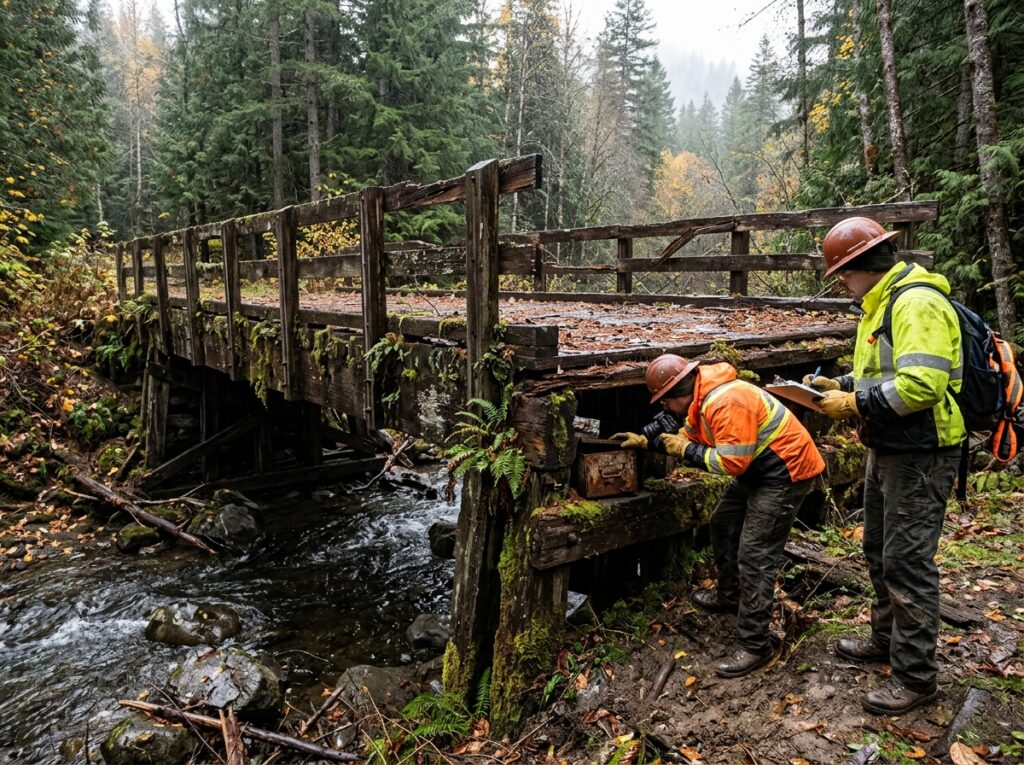
The wooden bridge stood above a narrow creek surrounded by pine trees and wet autumn leaves.
Several boards were missing.
A rusted cable hung from one side of the old barrier.
Beneath the bridge, workers discovered a small metal container wedged inside a protected recess near an old support beam.
It was badly weathered.
But it remained closed.
The team documented its location and arranged for it to be examined.
Margaret received a call that evening.
“We found something beneath the bridge,” the officer told her.
Her heart began pounding.
“What was it?”
“A metal document box. We’re checking its contents and how it got there.”
Margaret looked toward Henry’s photograph.
She remembered the final words in his notebook.
Check beneath it.
For three years, she had wondered whether her husband had left something unfinished.
Now she was beginning to understand.
The box contained old photographs, copies of maintenance reports, and several pages written in Henry’s handwriting.
One page described the accident involving the young road worker.
Another documented Henry’s concerns about the temporary barriers.
But the final letter was different.
It was addressed to Daniel.
Margaret recognized her husband’s careful handwriting.
“Daniel,
I know you’ve always blamed yourself for what happened at the north crossing. But you were a boy trying to help, and the adults responsible for that road should have made sure it was safe.
You did not cause the accident.
You were the one who ran for help.
I have kept these records because I want the truth to be available if anyone ever needs it.
Please don’t spend your life carrying a burden that was never yours.
And if Margaret ever finds this, tell her I wasn’t trying to hide anything from her. I only wanted to finish the work before she had another reason to worry.
Take care of the forest.
Take care of the animals.
And remember that kindness is worth more than any mistake you’ve ever made.
Henry.”
Margaret couldn’t finish reading aloud.
Daniel sat across from her, his face pale.
For twenty years, he had believed the accident was somehow his fault.
He had been sixteen when it happened.
He had helped carry tools to the crossing that morning.
When the worker fell through the damaged decking, Daniel had frozen in terror before running to get help.
The memory had followed him into adulthood.
Now Henry’s letter revealed something Daniel had never allowed himself to believe.
He had not caused the accident.
He had helped save a life.
Daniel covered his face.
“I thought Henry blamed me,” he whispered.
Margaret reached across the table.
“He never did.”
Daniel began crying.
For several minutes, neither spoke.
Then Margaret moved her chair beside him.
She placed one hand on his shoulder.
“Henry believed in you when you were sixteen,” she said softly. “And he still believed in you at the end of his life.”
Daniel looked toward the window.
“I wish I’d known.”
Margaret held the letter gently.
“Now you do.”
The investigation continued over the following weeks.
County officials reviewed the old bridge records and documented the deteriorated barriers.
Robert Hayes provided additional information about the maintenance decisions made years earlier.
He acknowledged that Henry had repeatedly warned him about the crossing.
Robert also explained that he had recently returned to the area because he believed someone had been using the closed road.
He had wanted to inspect the barriers.
Investigators found no evidence that Robert had deliberately injured Buddy or the eagle.
Nor could they establish that the animals’ injuries had resulted from the bridge.
But the inspection confirmed that damaged fencing and cable posed hazards.
The responsible agencies arranged to secure the area and remove accessible dangerous debris.
Margaret was relieved.
She had not wanted revenge.
She wanted the forest to be safer.
And she wanted Henry’s concerns finally taken seriously.
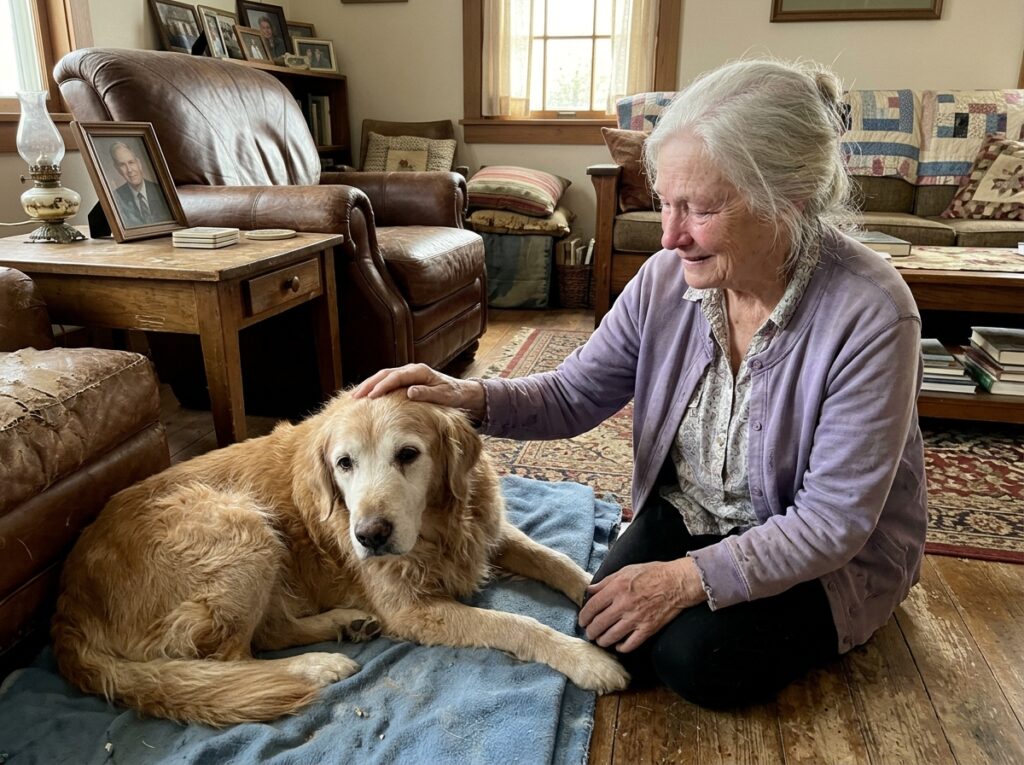
Two weeks later, Buddy was well enough to return home.
The veterinarian gave Margaret instructions for his arthritis medication, gentle activity, and follow-up care.
Daniel helped carry the old dog’s bedding into the farmhouse.
When Buddy stepped into the kitchen, he stopped beside Henry’s empty chair.
He sniffed the worn leather cushion.
Then he lowered himself onto his favorite blanket.
Margaret watched him settle.
For fourteen days, that blanket had waited beside the back door.
Now Buddy was lying on it again.
Margaret sat beside him.
“You’re home, old boy.”
Buddy closed his eyes.
His tail moved slowly against the floor.
Margaret smiled.
The house no longer felt quite so empty.
Winter arrived slowly in Montana.
Snow gathered along the porch railing.
The old logging road became quiet beneath the frost.
Margaret continued checking her security camera recordings each morning.
Sometimes she saw deer near the barn.
Sometimes a fox crossed the driveway.
And occasionally, Buddy appeared on the camera, standing near the porch while Margaret watched from the doorway.
She no longer allowed him to wander alone.
His hearing had deteriorated, and his arthritis made long walks difficult.
Instead, she kept him within a safely enclosed area and accompanied him outside.
Daniel visited regularly.
He helped repair the garden gate and installed a secure latch so Buddy could not slip through again.
Margaret thanked him.
Daniel smiled.
“Henry would have fixed it the first day.”
Margaret laughed.
“He probably would have complained about the old hinges while he did.”
They both smiled.
For the first time in years, talking about Henry did not always end in tears.
Sometimes it brought laughter.
Sometimes it brought stories Margaret had never heard.
And sometimes it simply made the silence easier to bear.
The bald eagle remained in professional rehabilitation through the colder months.
Its recovery was slow.
The veterinary team worked carefully to restore strength and assess whether it could fly safely.
Margaret knew not every injured eagle could return to the wild.
She tried not to hope too much.
But every encouraging update meant something.
Then, one morning in early spring, Sarah called.
“Margaret, I have some good news.”
Margaret sat down.
“The eagle?”
“Yes. It’s completed its flight assessments and has been cleared for release.”
Margaret pressed her hand against her mouth.
“Oh, thank goodness.”
Sarah explained that the bird would be released at a suitable location selected by wildlife professionals.
Margaret was invited to observe from a designated safe distance.
She asked whether Daniel could accompany her.
“Of course.”
On the morning of the release, Daniel drove Margaret through the Montana countryside.
The snow had begun melting along the roadsides.
Pine trees stood dark against the pale blue sky.
Margaret wore Henry’s old wool scarf.
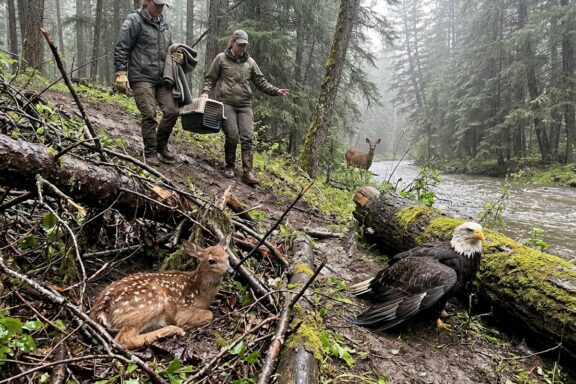
When they reached the release site, the wildlife team was preparing the transport carrier.
Margaret stood quietly beside Daniel.
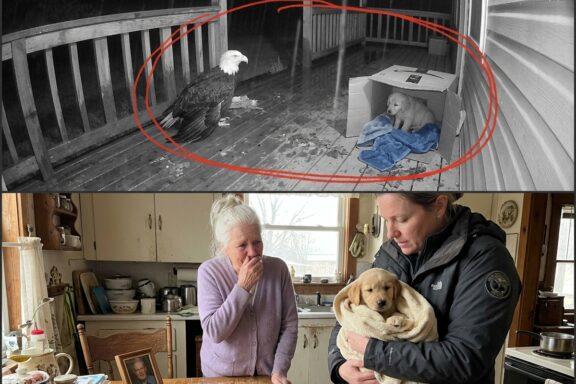
She remembered the night Buddy had returned.
The rain.
The mud.
The eagle struggling beneath the porch light.
She remembered believing she might lose both animals before sunrise.
Now Buddy was sleeping safely at home.
And the eagle was about to return to the sky.
The rehabilitator opened the carrier.
For several seconds, the bird remained still.
Then it stepped forward.
Its wings spread wide.
Margaret held her breath.
With several powerful beats, the eagle lifted into the air.
It climbed above the clearing, turned toward the distant trees, and continued flying until it disappeared beyond the ridge.
Margaret began crying.
Daniel stood beside her.
Neither spoke for a long time.
Finally, Margaret whispered, “Henry would have loved that.”
Daniel nodded.
“He would have.”
Then he looked at her.
“Mrs. Wilson, I never thanked him properly for what he did for me.”
Margaret smiled through her tears.
“You don’t have to thank him anymore.”
Daniel looked confused.
She continued.
“Just keep doing what he taught you.”
Daniel turned toward the mountains.
“I will.”
That evening, Margaret returned home to find Buddy sleeping beside Henry’s chair.
She sat down carefully and opened the old leather notebook.
On the final page, beneath the drawing of the north crossing, she wrote a new entry.
“Buddy came home. The eagle flew again. Daniel finally knows the truth.”
She paused.
Then added one more sentence.
“Henry, we finished what you started.”
Margaret closed the notebook.
Outside, the porch light glowed against the darkening sky.
For forty-three years, Henry had insisted on keeping that light burning.
He said a person who was lost should always have somewhere bright to look toward.
Margaret glanced down at Buddy.
The old dog lifted his head and rested it gently against her knee.
She stroked his gray muzzle.
“You’re home, sweetheart.”
Then she looked toward Henry’s photograph.
“And so is a little piece of him.”
For the first time since his death, Margaret understood that her husband’s kindness had never truly disappeared.
It lived in Daniel.
It lived in the people who had helped Buddy.
It lived in the rescuers who had given the injured eagle another chance.
And it lived in the small, ordinary choices people made when someone needed help.
Margaret switched off the kitchen light.
But she left the porch light burning.
Because somewhere in the darkness, another lost soul might still be searching for the way home.
The End.
This is a fictional kindness and wildlife rescue story created for emotional storytelling.
No Comments