

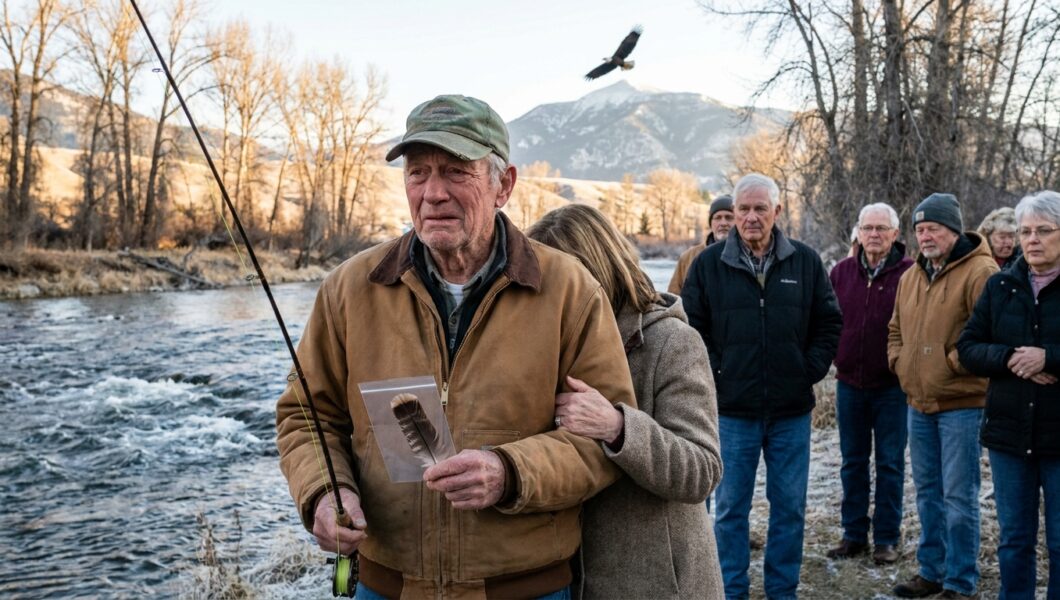
A week after twelve of us stood beside the Montana river and watched a bald eagle circle above Walter Hayes, he called me at 6:12 in the morning.
I knew it was him because almost nobody else I knew considered six in the morning an appropriate time to begin a conversation.
“Daniel?”
“Yeah?”
“You busy?”
I looked at the clock.
“I was asleep.”
“Good. Means you weren’t busy.”
That was Walter.
By then, I had known him long enough to understand that tenderness usually arrived disguised as irritation.
“What happened?”
There was a pause.
Then he said, “I found the box.”
I sat up.
“What box?”
“Sam’s.”
That woke me.
Twenty minutes later, I was standing in Walter’s kitchen wearing yesterday’s jeans and holding a cup of coffee so strong it could probably strip paint.
Walter sat at the table with an old cardboard box in front of him.
The corners were soft from age.
Across the top, written in black marker, were two words:
SAM CARTER.
Walter hadn’t opened it in years.
“I kept telling myself there wasn’t anything important in here,” he said.
“Was there?”
He looked at the box.
“That’s what scares me.”
His wife Margaret had apparently packed it during one of their moves decades earlier. After she died, Walter found it in the basement and pushed it behind some Christmas decorations.
He hadn’t been ready.
That morning, for reasons he couldn’t explain, he was.
Walter opened the lid.
Inside were old photographs.
Letters.
Military papers.
A faded map.
A small black notebook.
And one photograph that made Walter stop breathing for a second.
He lifted it carefully.
Sam stood in the picture.
Young.
Thin.
Smiling.
Twenty years old forever.
He was leaning against something outside a barracks, one hand in his pocket and the other holding the cheap camera Walter had told me about.
Walter stared at the photograph.
“I forgot his smile looked like that.”
There are sentences that sound harmless until you understand the years behind them.
That was one.
I sat across from him.
Walter turned the photograph over.
Something had been written on the back.
He read it silently.
Then his mouth opened slightly.
“What?”
He handed it to me.
The handwriting was faded, but readable.
Walter — Montana better have eagles.
Underneath it:
You owe me a fishing trip.
I looked up.
Walter was crying.
Not the quiet tears I’d seen by the river.
These were different.
He pressed both palms against his eyes.
“Fifty-seven years.”
I didn’t know what to say.
He laughed once through the tears.
“Son of a gun was still reminding me.”
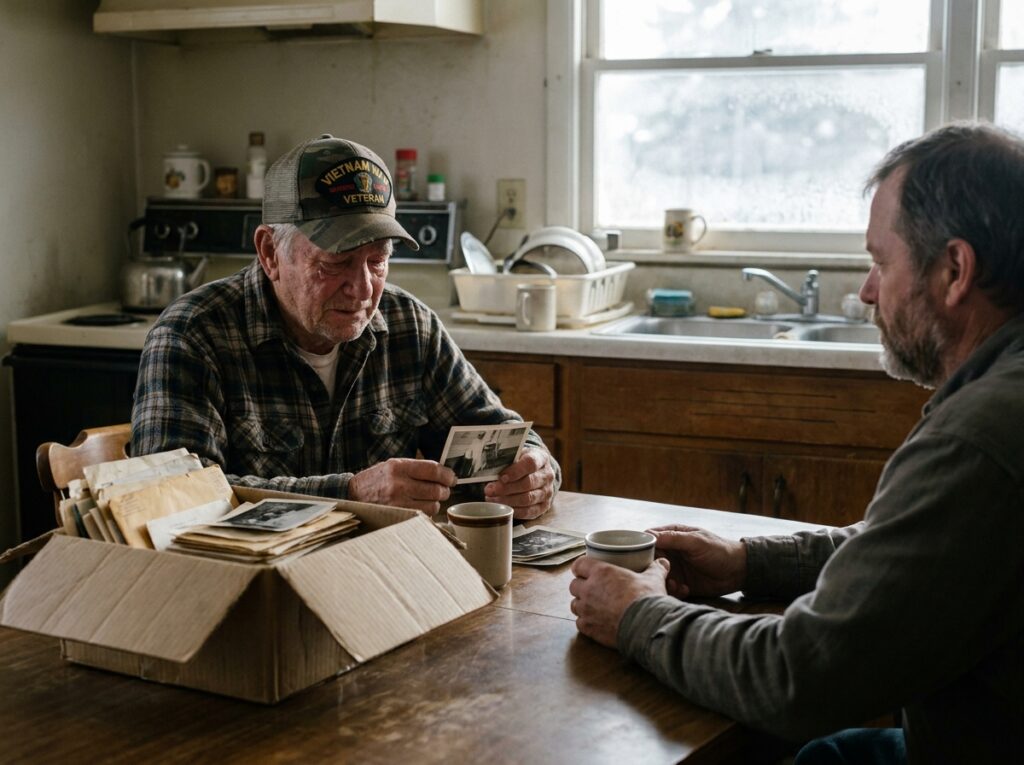
For the next hour, Walter went through the box one piece at a time.
He told me stories.
Some were familiar.
Most weren’t.
There was a photograph of Sam holding one boot because he’d apparently lost the other in mud and refused to admit it for two days.
There was a letter from Sam’s mother asking whether he was eating enough.
Walter laughed at that.
“None of us were.”
There was another picture of five young soldiers sitting together.
Walter pointed at each one.
He knew every name.
Three had come home.
Two hadn’t.
Then we found the notebook.
It belonged to Sam.
Most of it was ordinary.
Names.
Addresses.
Camera settings.
Short notes about birds he had seen.
A sketch of something that might have been a hawk.
A list titled THINGS TO DO WHEN I GET HOME.
Walter read it aloud.
“Buy a decent camera.”
He smiled.
“Eat my mother’s biscuits until I regret it.”
Then his voice slowed.
“Go to Montana.”
He stopped.
The next line said:
See a bald eagle.
Neither of us moved.
Then came:
Fish with Walter.
Walter closed the notebook.
For a long time, he just rested his hand on the cover.
“I always thought the promise was mine.”
“What do you mean?”
“I thought I was the one who promised him Montana.”
He tapped the notebook.
“Turns out he was planning on showing up.”
That changed something.
Until then, Walter had carried the river ritual as a memorial.
A duty.
Almost a debt.
Every March 14, he returned to keep the part of the promise he could still keep.
But now he saw the other side.
Sam hadn’t imagined himself as somebody Walter needed to mourn.
He had imagined himself alive.
Eating biscuits.
Buying a better camera.
Seeing an eagle.
Going fishing.
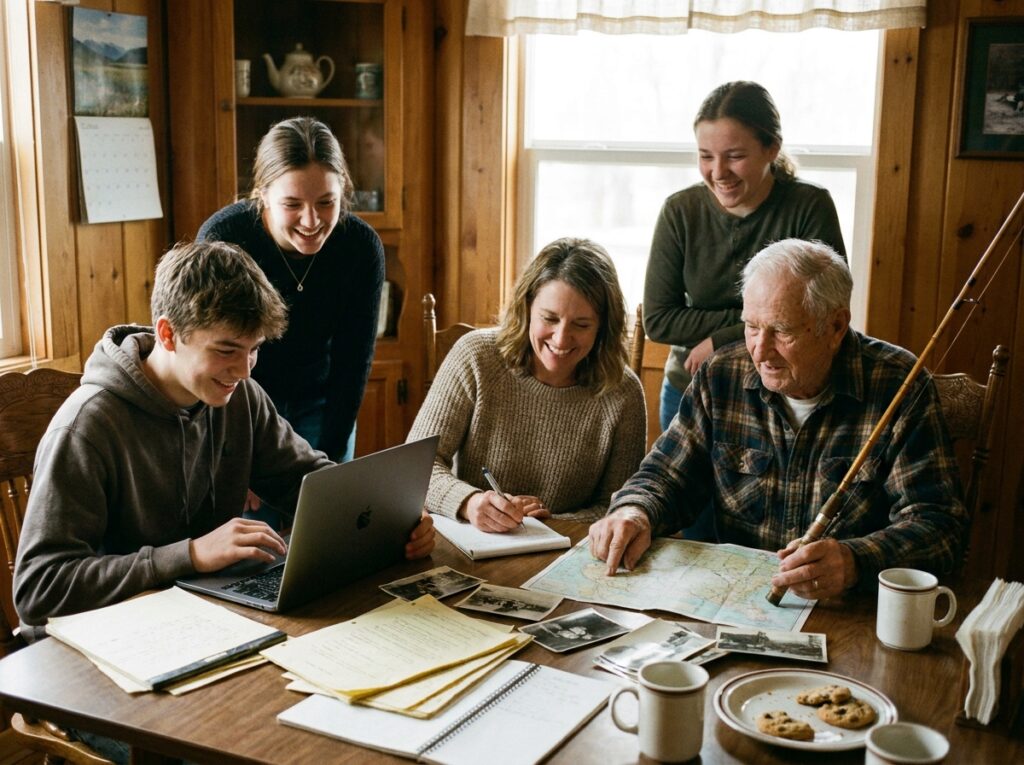
That afternoon, Walter called the Sunday group.
Not all of us.
Just me, Tom, Linda and Mason.
He put Sam’s notebook on the table.
“We’re going fishing.”
Tom looked confused.
“When?”
“March fourteenth.”
Linda smiled.
“You already go to the river March fourteenth.”
“No.”
Walter shook his head.
“I sit there.”
He tapped the notebook.
“Sam wanted to fish.”
Mason looked at him.
“So we’re finishing the list?”
Walter pointed at him.
“Don’t make it sentimental.”
Mason smiled.
“Wouldn’t dream of it.”
Of course, it became sentimental immediately.
Tom found an old fishing rod and restored it.
Linda tracked down information about Sam’s hometown in Kentucky.
Mason scanned the old photographs so Walter wouldn’t have to keep handling the originals.
I did the least impressive job.
Coffee.
Walter had spent years making coffee so bad that it had become part of his personality.
I considered it a public service.
But something else happened while we prepared.
Walter started talking about Sam differently.
Before, every story eventually arrived at March 14, 1970.
At what happened.
At the loss.
Now the stories wandered.
Sam cheating at cards.
Sam writing terrible poetry.
Sam trying to photograph birds with a cheap camera.
Sam telling everyone he would someday own a truck he couldn’t afford.
The dead stopped swallowing the living version of him.
That mattered more than I knew.
March 14 arrived cold and clear.
Walter reached the river at 8:06.
This time he wasn’t carrying only his thermos.
He had a fishing rod over one shoulder.
Sam’s turkey feather remained tucked safely inside the clear sleeve in his jacket.
Twelve people came again.
Then fifteen.
Then a few more.
Word had traveled.
Not online in some grand viral way.
Just neighbor to neighbor.
The bait shop heard.
The library heard.
A man from Walter’s veterans group heard.
Someone brought breakfast sandwiches.
Someone else brought chairs.
Mrs. Keller brought enough muffins to feed an infantry unit.
Walter looked around.
“You people have got to stop doing this.”
Tom handed him a coffee.
“Drink.”
Walter took a sip.
He frowned.
“This is actually good.”
“That’s because Daniel made it.”
Walter looked offended.
At 8:32, we walked toward the water.
Nobody made a speech.
Walter didn’t want one.
He baited the hook himself.
His hands weren’t as steady as they used to be, so Mason quietly held the line for him.
Walter cast.
The line landed badly.
Tom immediately said, “Sam waited fifty-seven years for that?”
Walter told him where he could put his opinion.
Everyone laughed.
And something about that laughter made the morning feel right.
This wasn’t a funeral.
It wasn’t meant to be.
It was the fishing trip two young men had once imagined taking together.
One of them had simply arrived very late.
Walter cast again.
Better this time.
Then we waited.
The river moved steadily in front of us.
Ice clung to the shaded edges.
Cottonwood branches rattled in the wind.
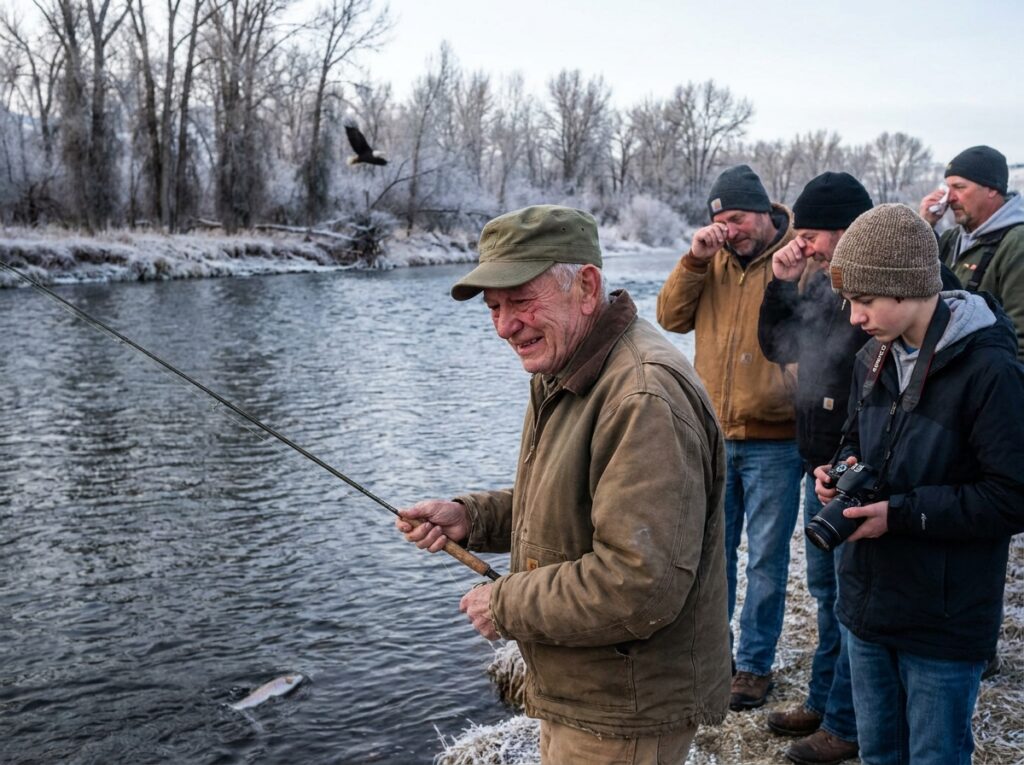
After about twenty minutes, Walter suddenly pulled back on the rod.
“Got one.”
Everybody stood.
It wasn’t enormous.
It wasn’t even impressive.
A small trout.
Maybe twelve inches.
Walter reeled it in while Tom gave far too much advice.
Mason took photographs.
When Walter finally held the fish, he looked at it.
Then he looked up at the sky.
“You happy now, Carter?”
His voice cracked.
He released the trout back into the river.
It disappeared immediately.
Walter stood there with the empty line.
Then Mason pointed.
“Eagle.”
We all looked.
A bald eagle was coming upriver.
Low enough that we could clearly see the white tail against the dark wings.
It crossed above the water.
Walter didn’t wave this time.
He smiled.
Just smiled.
Then he pulled the turkey feather from his pocket.
“Okay,” he said quietly.
“You win.”
I heard Linda sniff beside me.
Tom stared very hard at the river.
Mason kept his camera lowered.
Later I asked him why he didn’t take the picture.
He shrugged.
“Some things don’t need one.”
For a seventeen-year-old, he understood a lot.
Afterward, we went back to Walter’s house.
He had one more thing he wanted to do.
On his table was Sam’s notebook.
Beside it was an envelope.
“I found his sister.”
We all looked at him.
Linda had helped track her down.
Her name was Rebecca.
She was eighty-three and still lived in Kentucky.
Walter hadn’t spoken to anyone in Sam’s family for decades.
Back then, he had written to Sam’s parents.
They exchanged letters for a few years.
Then time did what time does.
People moved.
Parents died.
Addresses changed.
Lives separated.
Walter had called Rebecca two nights earlier.
He said he almost hung up before she answered.
“What did you say?” I asked.
“The truth.”
Rebecca remembered him.
Not personally.
But by name.
Sam had written about Walter in his letters home.
Walter had been terrified that calling would reopen something painful.
Instead, Rebecca cried and said:
“I’ve wondered about you my whole life.”
That stunned him.
Walter had spent fifty-seven years believing he was the keeper of Sam’s memory.
He had never considered that somewhere in Kentucky, another family had been keeping Walter’s name too.
Rebecca told him something else.
Sam’s mother had received Walter’s letter after his death.
The one explaining as much as he could.
She had kept it until she died.
“She never blamed you,” Rebecca told him.
Walter couldn’t speak when he repeated that part.
I understood why.
Grief and guilt had been tangled together inside him for most of his life.
He knew logically that Sam made his own decision.
He knew Sam had gone back because they were brothers in everything but blood.
But guilt doesn’t always care about logic.
For decades, some part of Walter had been asking the same question.
Why did I get to keep getting older?
Rebecca gave him an answer he hadn’t known he needed.
Because Sam wanted you to.
A month later, she came to Montana.
Her son drove her.
Walter waited at the airport wearing the green cap.
I went with him because he said he needed “someone who knows when to shut up.”
Rebecca walked slowly through the arrivals area.
Small woman.
White hair.
Blue coat.
When she saw Walter, she stopped.
He did too.
Fifty-seven years stood between them.
Then she walked toward him.
Walter removed his cap.
“Rebecca?”
She nodded.
Walter opened his mouth.
Nothing came out.
Rebecca hugged him.
He folded around her like something inside him had finally given way.
She whispered something into his shoulder.
I was close enough to hear it.
“Thank you for remembering him.”
Walter shook his head.
“He saved my life.”
“I know.”
“No, I mean everything.”
She pulled back and looked at him.
Then she touched his face.
“Then live it.”
Four words.
Walter cried right there beside baggage claim.
So did Rebecca.
So did I.
I have developed a troubling habit of crying around Walter Hayes.
The following morning, we took Rebecca to the river.
She sat on the same bench where I had first found Walter alone.
He gave her the turkey feather.
She laughed immediately.
“Oh my God.”
Walter looked surprised.
“You know about this?”
“Of course I know about it.”
Apparently Sam had written home about finding what he insisted was an eagle feather.
Rebecca shook her head.
“He knew it was a turkey feather.”
Walter stared at her.
“What?”
“He was messing with you.”
For the first time in fifty-seven years, Walter learned the truth.
Sam had known.
Walter leaned back on the bench and laughed so hard he started coughing.
“That little liar.”
Rebecca was laughing too.
“He said you got so worked up correcting him that he decided never to admit it.”
Walter looked at the feather.
Then toward the river.
“You hear that, Carter?”
He shook his head.
“You had fifty-seven years to tell me.”
That morning, no eagle appeared.
Nobody cared.
We sat there anyway.
Rebecca told stories Walter had never heard.
Sam as a little boy climbing trees.
Sam getting into trouble at school.
Sam bringing injured birds home despite his mother’s objections.
Walter told her stories from the Army.
The funny ones.
The ordinary ones.
The stories that proved her brother had been more than the worst thing that happened to him.
And I watched two people give pieces of a twenty-year-old man back to each other.
That is what memory can do when it’s shared.
Walter had carried Sam’s final day.
Rebecca had carried his childhood.
Together, they had more of him.
Our Sunday river group still meets.
Walter still complains about the coffee, even though I make it now.
Mason is studying photography.
Linda brings too much food.
Tom insists every bird he can’t identify is “probably some kind of duck.”
Rebecca calls Walter every Sunday evening.
And once every March, we fish.
Not because sadness disappeared.
It didn’t.
Walter still misses Sam.
Rebecca still misses her brother.
I still miss mine.
That’s not the lesson.
The lesson is that grief changes when other people help you carry the memory attached to it.
That morning when I first saw Walter crying alone on the bench, I almost walked past him.
Sometimes I still think about those twenty feet.
How easy it would have been to keep going.
I wouldn’t have known Walter.
I wouldn’t have known Sam.
Walter might still have opened that old box eventually.
Maybe he would have called Rebecca.
Maybe not.
But I know this much.
Most people don’t need strangers to solve their grief.
They need room.
A bench.
Someone willing to listen.
Someone who will come back next Sunday.
Someone who will remember the name.
Walter once told me that missing someone isn’t something you finish.
You learn how to carry it without dropping everything else.
I understand that better now.
Sometimes we carry it ourselves.
Sometimes somebody grabs the other side.
And sometimes, if we’re lucky, a whole group of people shows up beside a river with coffee, fishing rods and enough kindness to make the weight feel lighter.
Sam Carter never got the fishing trip he planned.
But fifty-seven years later, his best friend finally took him anyway.
And somewhere above that Montana river, an eagle crossed the morning sky.
This time, Walter didn’t cry because the promise still hurt.
He smiled because he had finally understood.
Keeping a promise to someone you’ve lost doesn’t always mean staying in the past.
Sometimes it means taking them with you while you keep living.
No Comments