

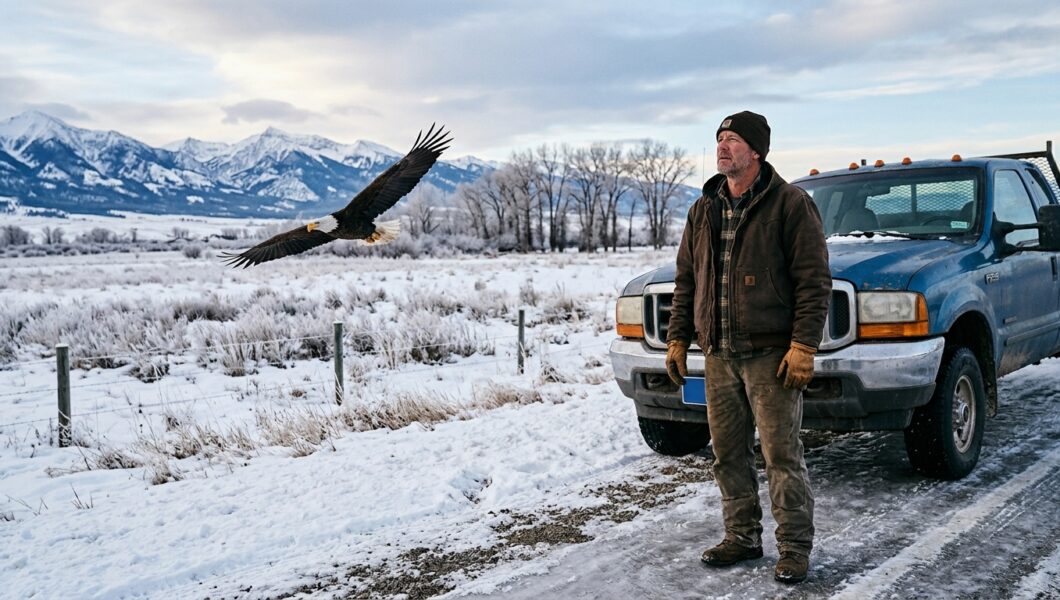
The first time I told someone what happened on that Montana highway, they asked me the same question everyone asks.
“What happened next?”
I usually smiled and gave them the short version.
Caleb survived. His leg healed. His family and I stayed in touch. And, every now and then, I saw a bald eagle near that stretch of road.
But there was something I never talked about.
Not because it was a secret.
I just wasn’t sure what it meant.
It happened several months after Caleb’s Christmas dinner, when I thought the strange chapter of my life had finally come to an end.
I was sitting at my kitchen table early one Saturday morning, drinking coffee and looking through the mail. Most of it was bills and advertisements.
Then I saw an envelope with my name handwritten across the front.
I recognized the handwriting immediately.
“Eagle’s Driver.”
I smiled before I even opened it.
Inside was a short letter from Caleb.
He had written that school was going well. His leg was stronger, although his mother still made him take it easy. He had started helping at the wildlife rehabilitation center his family had begun volunteering with.
Then the letter took a different turn.
Caleb wrote that one of the volunteers had recently brought in an injured bald eagle.
The bird had been found near a rural road several miles from where I’d found him.
It had a damaged wing.
The volunteer couldn’t tell Caleb much about where it came from.
But Caleb had been fascinated.
He spent several afternoons helping clean the bird’s enclosure and carrying food to the rehabilitation area.
Then he wrote something that made me stop reading.
“I keep wondering if it’s the same eagle.”
I sat back in my chair.
Of course it probably wasn’t.
There are bald eagles all over Montana. There was no reasonable way to know.
I continued reading.
“Dad says I’m being ridiculous.”
I laughed.
Then the next sentence made me smile.
“But he also checks every eagle now.”
At the bottom of the page, Caleb had written one final question.
“Do you think animals remember people?”
I stared at those words for a long time.
I didn’t know.
So I wrote back.
I told him I wasn’t sure animals remembered things the way people did.
But I told him I believed they noticed more than we gave them credit for.
I also told him something else.
“If that bird meant something to you, don’t worry too much about proving it was the same one.”
A few weeks later, I received another letter.
This one was different.
There was no joke at the beginning.
No teasing about being the Eagle’s Driver.
Caleb wrote that the injured eagle had gotten worse.
The rehabilitation center had been doing everything they could, but the bird wasn’t eating properly.
He said everyone was worried.
Then he asked if I would come see it.
I almost said no.
Not because I didn’t want to go.
I just didn’t know what I could possibly do.
I wasn’t a wildlife expert.
I wasn’t a veterinarian.
I was a truck driver who happened to stop on a cold morning.
Still, something about the letter stayed with me.
So the following Saturday, I drove to the rehabilitation center.
It was a small place tucked behind a line of trees outside town. There were several enclosures, a little office, and a weathered wooden sign near the entrance.
Caleb was waiting for me.
When he saw my truck, he grinned.
“Eagle’s Driver!”
“Here we go again.”
“You came.”
“Of course I came.”
He nodded toward the building.
“I want you to see something.”
We walked inside.
The smell was a mixture of hay, disinfectant and wet earth. Somewhere in the back, I could hear birds calling.
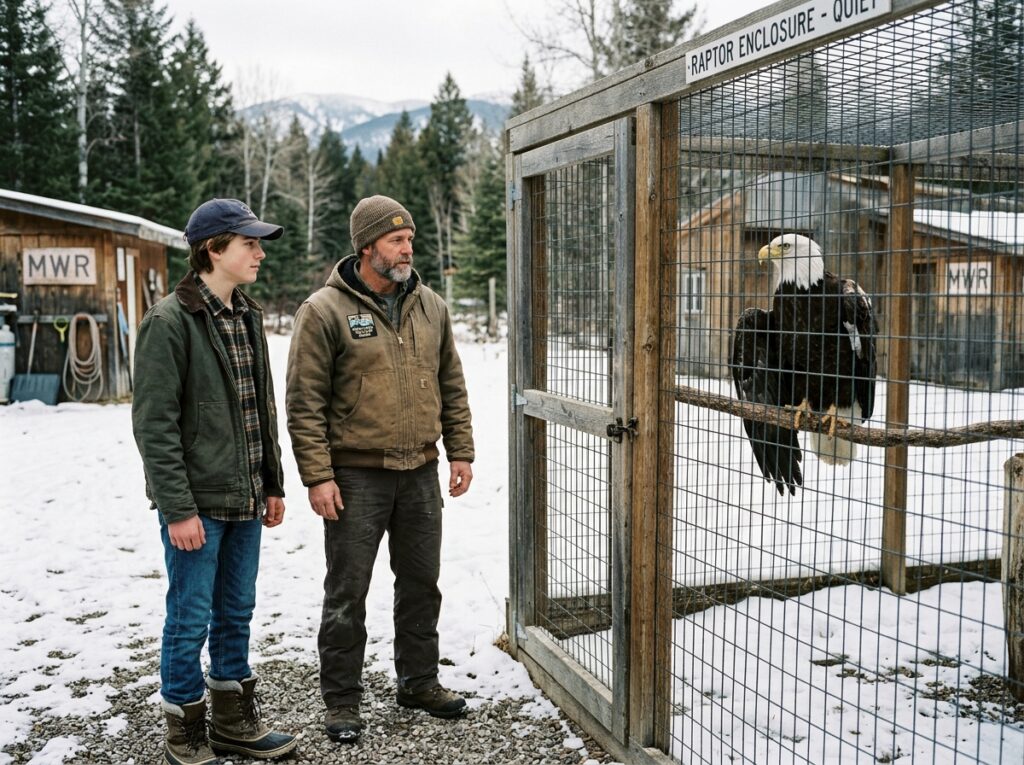
A volunteer led us toward one of the larger outdoor enclosures.
Then I saw the eagle.
It was standing quietly on a wooden perch.
One wing hung slightly lower than the other.
Caleb stopped beside me.
“That’s him.”
I looked at the bird.
“You don’t know that.”
“I know.”
“You just said that’s him.”
“I know.”
I laughed.
He didn’t.
He was staring at the eagle.
The bird looked back.
For several seconds, neither of us moved.
Then the eagle turned its head.
I felt something strange in my chest.
Not recognition.
Not exactly.
Just a feeling I couldn’t explain.
I stepped closer to the enclosure.
The eagle watched me.
Then it moved toward the side of the pen.
Caleb whispered, “See?”
“What?”
“He does that when I come over.”
I crouched down.
The eagle kept watching.
There was nothing magical about it.
No dramatic movement.
No sudden flight.
Just a wild animal standing quietly behind a fence.
Still, I couldn’t stop thinking about that January morning.
The highway.
The cold.
The red glove.
The boy in the ditch.
And those eyes looking through my windshield.
The rehabilitation center kept the eagle for several more weeks.
Its condition improved slowly.
Caleb visited whenever he could.
I went back once.
Then again.
Somehow, I became part of the routine.
We never discussed whether the eagle was the one from the highway.
Maybe we were both afraid of the answer.
One afternoon, the center director told us the bird had improved enough to be released.
Caleb looked at me.
“You should come.”
I told him I would.
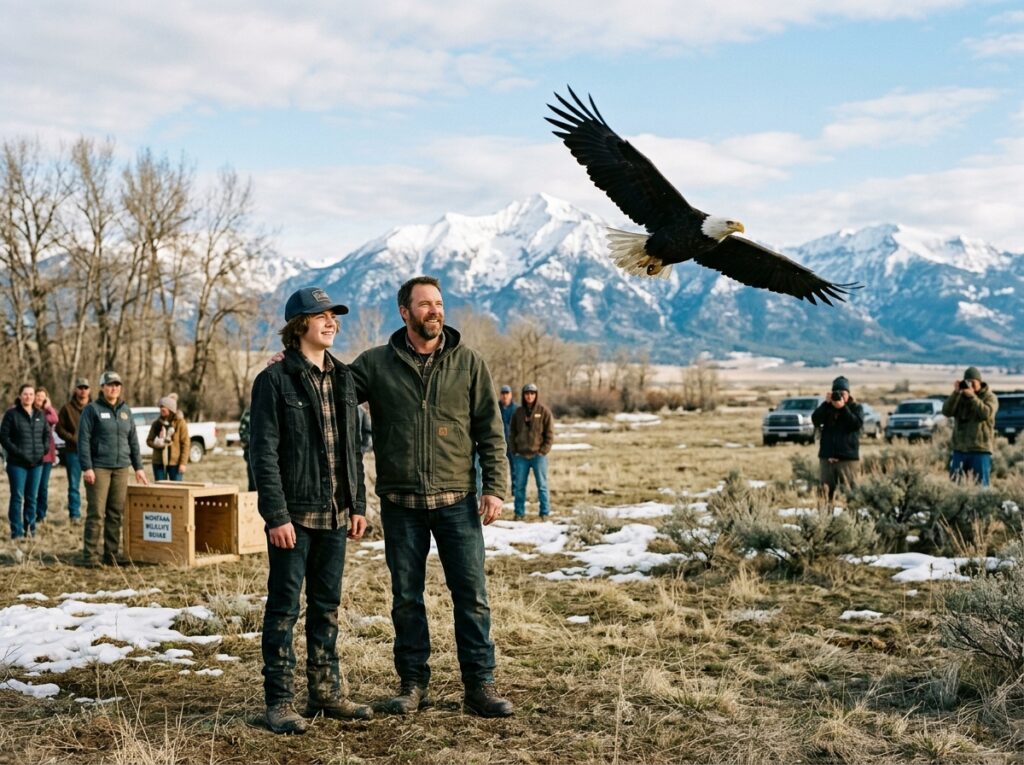
The release was scheduled for a clear morning in early spring.
A small group gathered in a field several miles outside town.
The mountains were still covered with patches of snow, but the air was warmer than it had been on that January morning.
The eagle was inside a large transport crate.
Caleb stood beside his father.
His mother was there too.
Nobody talked much.
There was something strangely quiet about the whole moment.
The director checked the crate one last time.
Then she opened the door.
The eagle didn’t move.
Everyone waited.
A few seconds passed.
Then it stepped forward.
It looked around.
Its wings opened.
For a moment, it seemed uncertain.
Then it pushed off the ground.
The wings beat once.
Twice.
And suddenly it was flying.
Caleb laughed.
His mother covered her mouth.
His father put an arm around her.
The eagle climbed higher.
It circled over the field.
Then it turned toward the mountains.
Caleb looked at me.
“That’s him.”
I smiled.
“Maybe.”
He shook his head.
“No. I know.”
I didn’t argue.
We watched until the eagle became a small dark shape against the sky.
Then it disappeared.
For the first time since the rescue, I felt like something had finally come full circle.
But it wasn’t the eagle that changed me.
It was Caleb.
Because I had always thought the important part of that January morning was that I had stopped.
Over time, I realized I was wrong.
Stopping was only the beginning.
The harder part was what happened afterward.
Caleb could have spent the rest of his life thinking of himself as the kid who got trapped in a ditch.
His parents could have spent every winter remembering the worst night of their lives.
I could have remembered that morning as the strange day an eagle blocked my truck.
Instead, something good came out of it.
Caleb started helping injured wildlife.
His family began volunteering.
I started paying more attention to the people and places around me.
And somehow, a frightened fifteen-year-old boy taught an older man something I should have understood years earlier.
You don’t always get to know why something happens.
Sometimes you only get to decide what you do when it does.
A few months after the eagle’s release, Caleb sent me one more letter.
It was much shorter than the others.
He wrote:
“I saw two eagles today.”
Then:
“I stopped the car.”
I laughed when I read that.
But the last sentence stayed with me.
“I guess I learned that from you.”
I folded the letter and put it beside the first one.
I still drive that Montana highway.
The road hasn’t changed much.
The cottonwoods are still there.
The mountains still sit in the distance.
There are still long stretches where you can drive for miles without seeing another vehicle.
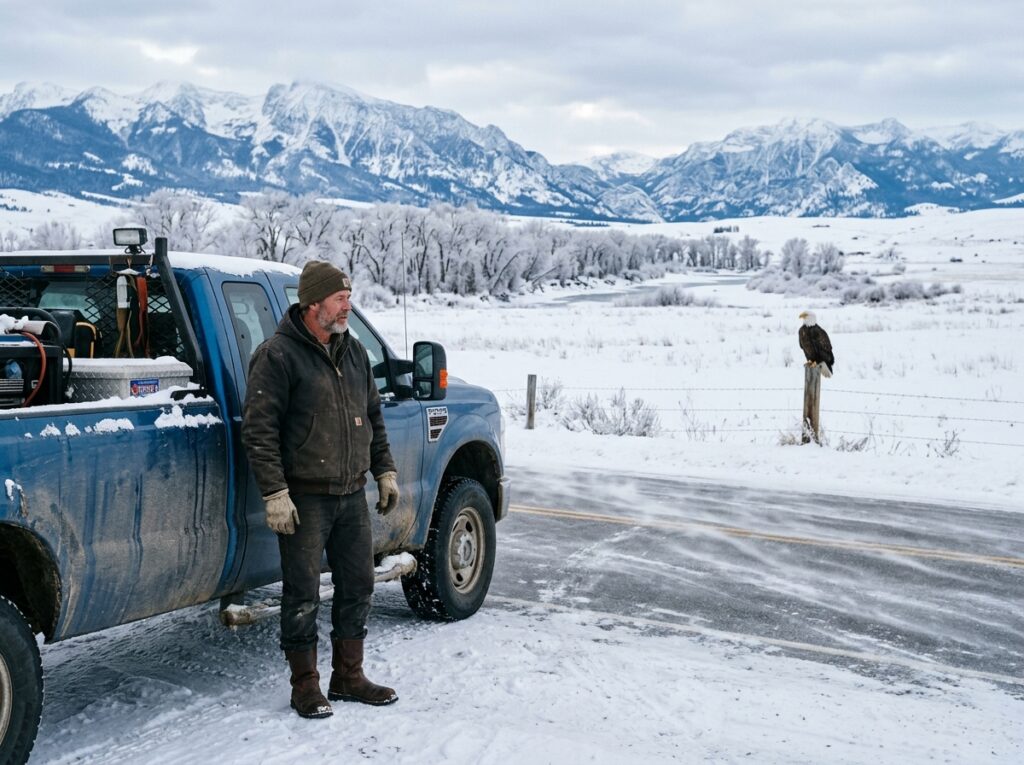
Every January, when the temperature drops and snow starts blowing across the pavement, I think about that morning.
Sometimes I slow down.
Sometimes I look toward the field.
And sometimes I see a bald eagle.
I never know if it’s the same bird.
I never will.
But I’ve stopped needing to know.
Because the truth is, that eagle gave me something more valuable than an answer.
It gave me a reason to pay attention.
A reason to stop.
A reason to remember that there can be an entire human life just beyond the edge of what we’re looking at.
Caleb once told me he thought the eagle had been protecting him.
Maybe he was right.
Maybe the bird simply reacted to something it noticed.
Maybe it was all coincidence.
I’ve thought about that question many times.
And these days, I don’t think the answer matters as much as I once believed.
What matters is that an eagle landed in front of a truck.
A driver stopped.
A glove was found.
A voice was heard.
A boy went home.
And years later, that boy was standing in a field watching an eagle return to the sky.
Sometimes we spend too much time looking for miracles.
Maybe they’re not always miracles.
Maybe they’re moments.
Small moments that ask us to slow down long enough to notice what everyone else is passing by.
I still have Caleb’s letters.
They’re tucked inside a drawer in my kitchen.
The paper has softened around the edges from being opened so many times.
The first one still begins with the words, “Dear Eagle’s Driver.”
I still laugh when I see it.
But I keep reading the last line.
“Thank you for listening.”
I used to think he was thanking me for hearing him that morning.
Now I think he was teaching me something.
Sometimes listening doesn’t mean hearing words.
Sometimes it means noticing when something feels wrong.
Sometimes it means looking twice.
Sometimes it means stopping when everything around you is telling you to keep moving.
And sometimes, if you’re lucky, stopping for just a few minutes can change the direction of several lives.
I don’t know where that eagle is today.
I don’t know if it remembers me.
I don’t even know if it was the same bird Caleb believed it was.
But every time I see one flying over Montana, I look up.
And for a few seconds, I stop.
Because I remember a fifteen-year-old boy who thought nobody was coming.
I remember a red glove lying in frozen grass.
And I remember an eagle that refused to let me drive past.
Maybe that is the part I will carry with me for the rest of my life.
Not the question of whether the eagle saved Caleb.
But the simple truth that, on one freezing morning, something made me stop.
And sometimes, that’s all it takes.
There is one more thing I never told Caleb.
I still have the red glove.
I found it in the pocket of my old winter jacket a few months after the rescue.
I had completely forgotten that I had picked it up from the ditch.
I almost threw it away.
Instead, I washed it and put it in a small box with his letters.
It’s nothing special.
A child’s winter glove.
Faded red.
A little worn around the fingertips.
But whenever I see it, I remember how easy it would have been to keep driving.
The road was icy.
I was working.
I was cold.
I had places to be.
There were a hundred reasons to keep moving.
The eagle gave me one reason to stop.
And that was enough.
So now, whenever I see someone standing alone on the side of the road, whenever I notice a neighbor struggling with something, whenever I hear a voice that sounds like it needs another person to listen, I try to remember that morning.
I don’t always get it right.
None of us do.
But I try.
Because I’ve learned that the moments we remember most aren’t always the ones we planned.
Sometimes they’re the interruptions.
The delays.
The strange things that don’t make sense at first.
The bird standing in the road.
The glove in the grass.
The faint voice carried through the cold.
You never know what might be waiting just beyond the moment when you decide whether to stop or keep going.
And if there’s one thing Caleb and I both learned that winter, it’s this:
Sometimes the person who needs help isn’t asking loudly.
Sometimes you have to notice.
Sometimes you have to listen.
And sometimes, when something unexpectedly stands in your way, it may be worth stopping long enough to find out why.

No Comments