

Three weeks after the eagle disappeared over the cottonwoods, I found Lily standing in Tom’s barn with a black permanent marker in her hand.
That sentence alone should have worried me.
Nine-year-olds and permanent markers rarely produce anything a parent wants to discover.
But Lily wasn’t drawing on the walls.
She was labeling the shallow livestock pans we had cleaned and stacked after the heat finally broke.
EMERGENCY WATER.
Underneath that, she had added:
DO NOT USE FOR MUD PIES.
“Important rule?” I asked.
“Very.”
Tom laughed from behind his workbench.
By then, the brutal stretch of July heat felt almost unreal. Evening temperatures had dropped. We’d finally gotten rain. The grass was beginning to show small patches of green again.
The temporary wildlife water stations were no longer necessary, so following the advice we’d received, we had removed them, scrubbed everything and stored the pans.
I assumed that would be the end of it.
I was wrong.
Because although the water stations disappeared, the people who had started checking them didn’t disappear with them.
Tom and Mason still went down toward the river most mornings.
Denise still brought lemonade over in the afternoons.
Mrs. Keller still sat outside around six because someone almost always stopped to talk.
And Lily still carried that ridiculous little notebook everywhere.
The eagle had flown away.
Somehow, the neighborhood had stayed.
The biggest change was Mason.
Before that summer, I knew him mostly as the quiet teenager who lived down the road.
Now he was at our place several evenings a week.
Usually with his camera.
Sometimes with Tom.
Sometimes alone.
He never talked much about Caleb, his older brother who had died the year before. Nobody pushed him.
But he started taking photographs again.
Birds mostly.
A red-tailed hawk on a fence post.
A great blue heron standing in shallow water.
A pair of magpies fighting over something in Tom’s field.
And, of course, eagles.
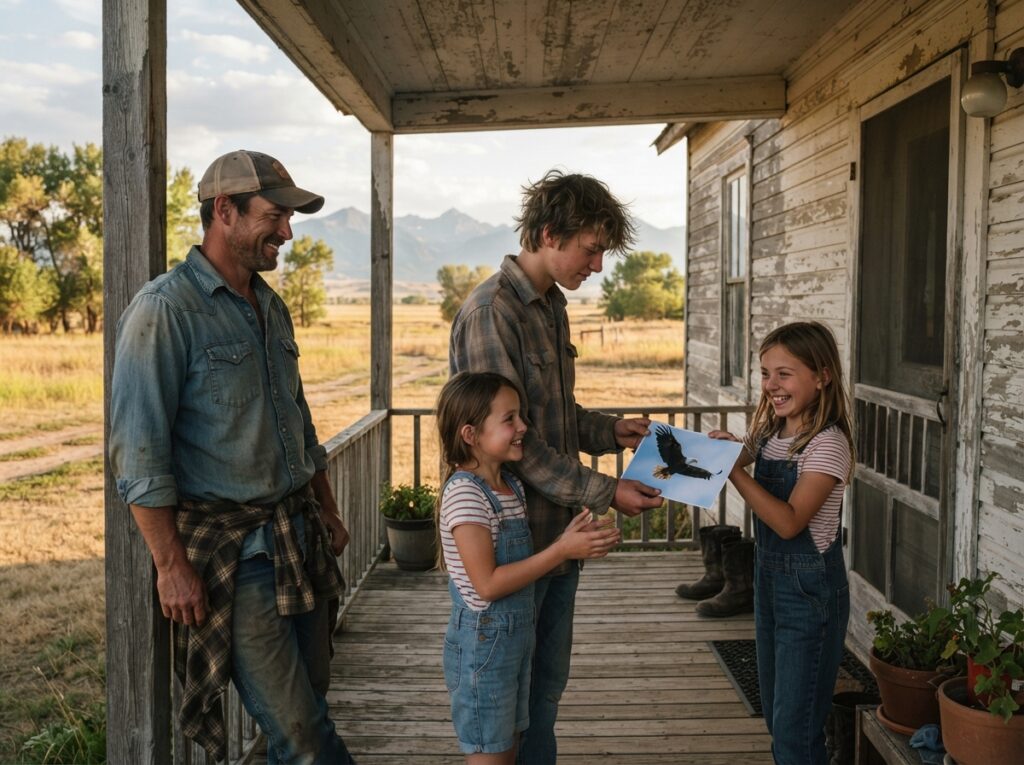
One evening in late August, he came through our gate carrying an envelope.
“I printed something for Lily.”
She came running.
Inside was a photograph of a bald eagle perched in a cottonwood above the river.
In the bottom corner, Mason had written:
For Lily — Keep noticing.
She stared at it for a long time.
“Is this our eagle?”
Mason smiled.
“I don’t know.”
Lily nodded seriously.
“Dad says that’s okay.”
Apparently, I had become a philosopher without realizing it.
She carried the photograph inside and taped it above the blue dog bowl, which now sat cleaned and dry on a shelf in our mudroom.
I thought that would be the keepsake from that summer.
It wasn’t.
September arrived.
School started.
The mornings cooled enough that Lily needed a sweatshirt at the bus stop.
Life began returning to normal.
Then one Saturday morning, Mason knocked on our door.
He looked nervous.
Not bad-news nervous.
More like someone trying to convince himself not to change his mind.
“Can I show you something?”
He opened his camera bag.
Inside were dozens of printed photographs.
Some I recognized.
The eagle in the cottonwood.
The heron.
The hawk.
But there were others.
Tom kneeling beside one of the water pans with a hose.
Denise carrying lemonade.
Mrs. Keller laughing on her porch.
Lily crouched beside her notebook, apparently recording something of enormous importance.
Even me, carrying two empty containers across a field with sweat soaking through the back of my shirt.
“When did you take these?”
“All summer.”
I looked through them again.
They weren’t really wildlife photographs.
Not all of them.
They were photographs of us.
Mason sat at our kitchen table.
“I was thinking maybe we could put them somewhere.”
“Where?”
He shrugged.
“The library? Community center? I don’t know.”
Lily immediately said, “Tom’s barn.”
Mason laughed.
“I was thinking somewhere people actually go.”
Our town library eventually agreed to give him one wall near the entrance for a small display.
Mason almost backed out twice.
The night before we put the pictures up, his mother called me.
“He thinks nobody’s going to care.”
“What do you think?”
“I think he’s scared people will.”
I understood what she meant.
The photographs were personal.
Especially one.
It showed Mason sitting beside the river holding Caleb’s old camera.
Tom was beside him.
Neither was looking toward the lens.
Mason’s mother had taken it with his phone.
Underneath the photograph, Mason had written:
First day back at the river.
Nothing else.
When we hung that picture, he stood staring at it.
“You sure?” I asked.
He swallowed.
“Yeah.”
Then he added one more photograph at the beginning of the display.
It wasn’t one he’d taken.
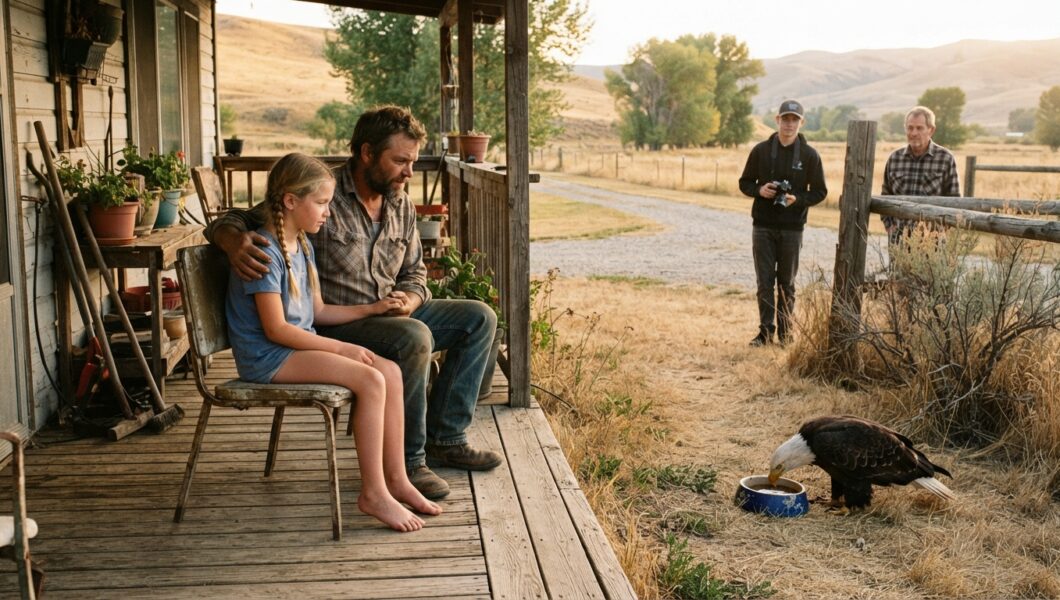
It was the blurry phone picture I’d snapped through our back window on that first evening.
A bald eagle standing beside an old blue dog bowl.
The image wasn’t good.
The eagle was too far away.
The lighting was terrible.
Part of our fence was crooked in the foreground.
But Mason insisted it belonged there.
“That’s where everything started,” he said.
He titled the display:
KEEP NOTICING.
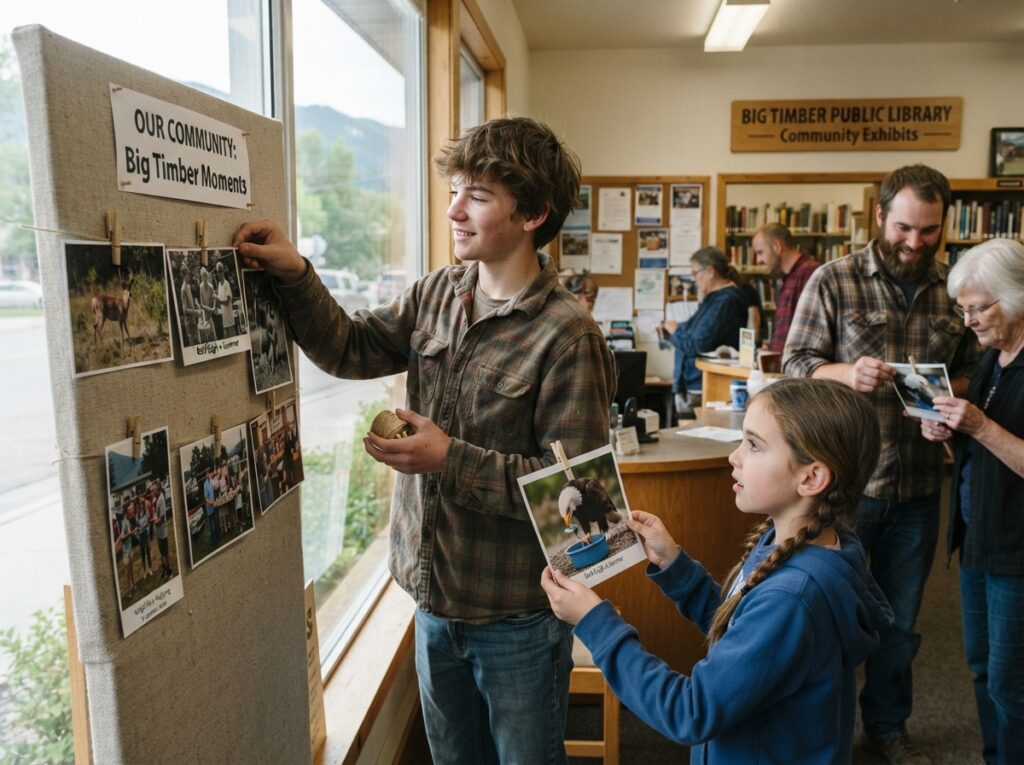
We expected the pictures to stay up for two weeks.
They stayed for nearly two months.
People began leaving notes.
Not dramatic ones.
Just scraps of paper.
“My husband used to photograph birds too.”
“Thank you to whoever checked on my mom during the heat.”
“Tom fixed my gate and wouldn’t take money.”
“My daughter saw this and asked if we could help next summer.”
One note simply said:
I forgot neighbors could still be like this.
Tom read that one three times.
Then he folded his arms.
“People are getting sentimental.”
“You’re the one reading all the notes.”
“I’m supervising.”
Of course.
Then I noticed something else.
Mason changed.
He began talking about Caleb without looking like saying his brother’s name might break something open inside him.
Not constantly.
But naturally.
Caleb liked this trail.
Caleb hated instant coffee.
Caleb once waited four hours to photograph an osprey and discovered afterward that he’d forgotten his memory card.
The stories became funny again.
That felt important.
Grief hadn’t disappeared.
Nobody expected it to.
But it no longer seemed like Mason was carrying it completely alone.
Then, in early October, his mother came to our house.
She was holding a cardboard box.
Inside was camera equipment.
Caleb’s.
A tripod.
Two lenses.
A weathered camera strap.
Several memory cards.
And an old field guide filled with handwritten notes.
“I haven’t been able to open this since the funeral,” she said.
Mason stood completely still.
His mother handed him the camera strap.
“You should have it.”
He shook his head immediately.
“Mom—”
“He’d want you using it.”
Mason’s eyes filled.
Nobody said anything.
He ran his thumb over the worn strap.
Then Lily, who possessed neither adult timing nor fear of emotional moments, asked:
“Can we go find an eagle?”
Mason laughed while crying.
His mother laughed too.
Tom looked at the ceiling like he had suddenly become extremely interested in rafters.
Twenty minutes later, we were heading toward the river.
Not to chase wildlife.
Not to lure anything closer.
Just to walk.
And look.
And notice.
We didn’t see an eagle that afternoon.
Lily considered this deeply unfair.
But Mason photographed a mule deer in the distance and some geese crossing the sky.
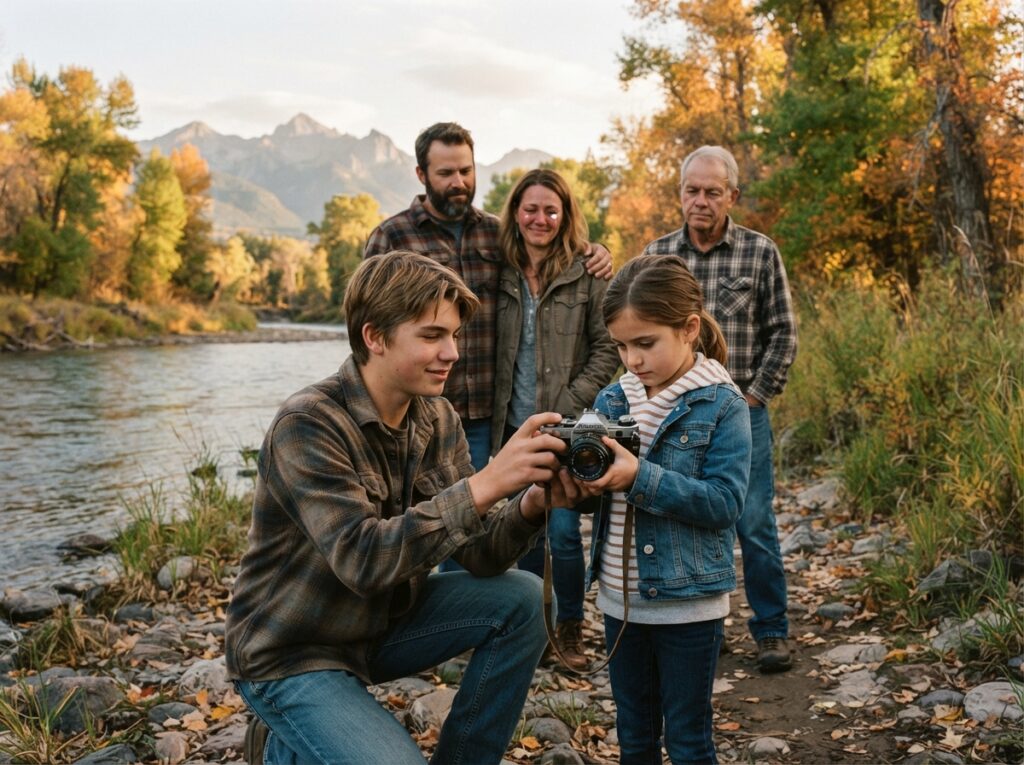
Then he handed Lily the camera.
“Want to try?”
Her eyes widened.
“Really?”
“Put the strap around your neck first.”
She did.
Mason showed her where to place her hands.
She aimed toward the river and pressed the shutter.
The picture was crooked.
Half of it was sky.
The other half was Tom’s shoulder.
Lily examined the screen.
“Perfect.”
Mason laughed.
“Definitely.”
Winter eventually came.
The first real snow arrived overnight.
When Lily saw it, she ran to the mudroom.
I knew exactly what she was checking.
The blue bowl.
“No,” I said.
She turned.
“I didn’t even ask.”
“You were going to.”
She had learned enough by then to understand that helping wildlife didn’t mean putting things outside whenever we felt like it. Conditions changed. Needs changed. What was useful during an unusual heat emergency wasn’t automatically useful year-round.
She put the bowl back.
“Next summer?”
“If there’s another extreme heat situation, we’ll ask the wildlife people what makes sense.”
She accepted that.
Mostly.
Then she looked at Mason’s photograph hanging above it.
Keep noticing.
“Dad?”
“Yeah?”
“Do you think the eagle remembers us?”
I almost gave her an adult answer about wild animals.
Instead, I said, “Probably not.”
She frowned.
Then I added, “But we remember him.”
She smiled.
That was enough.
The following July was warm, but nothing like the year before.
Still, before summer began, Tom called everyone over.
Inside his barn were those shallow livestock pans, stacked exactly where we’d left them.
Lily’s permanent-marker warning was still visible.
EMERGENCY WATER.
DO NOT USE FOR MUD PIES.
We checked in again with local wildlife professionals about what was appropriate if extreme heat returned.
Then we made a simple plan.
Not because we wanted wildlife coming into our yards.
Not because we believed we were rescuers.
Because preparation was better than panic.
But the strangest part was that our “water meeting” lasted about fifteen minutes.
Everyone stayed for two hours.
Someone brought burgers.
Denise brought lemonade.
Mrs. Keller brought potato salad.
Mason brought his camera.
Tom complained that nobody knew how to cook burgers correctly while eating two of them.
At some point, I looked around that barn and realized nearly a year had passed since Lily came running through our back door.
Before that night, I knew these people mostly by their mailboxes.
Tom was the older guy two properties down.
Denise was the woman across the road.
Mrs. Keller lived at the end.
Mason was somebody’s quiet teenage son.
We waved.
We nodded.
We occasionally borrowed tools.
That was about it.
Now Tom had a key to my shed.
Denise knew how Lily liked her lemonade.
Someone checked on Mrs. Keller every day.
Mason came over without knocking.
His mother had dinner with us at least twice a month.
And Lily had appointed herself keeper of emergency water equipment.
Later that evening, Mason called us outside.
He pointed upward.
High above Tom’s field, an eagle was moving toward the river.
Maybe it was the same bird.
Probably not.
There was no way to know.
And this time, nobody needed it to be.
Mason lifted Caleb’s camera.
He followed the bird through the lens.
Click.
Click.
Then he lowered the camera.
“Get it?” I asked.
He checked the screen.
“Yeah.”
Lily leaned against me.
Nobody ran toward the eagle.
Nobody called it.
Nobody tried to make the moment bigger than it was.
We simply watched until it disappeared.
And standing there, I finally understood something I’d been trying to put into words for almost a year.
We hadn’t saved that first eagle.
We gave an exhausted wild bird space, water that happened to be available, and contacted people who understood wildlife better than we did.
The eagle did the rest.
Then it flew away.
What happened afterward was about us.
A thirsty bird made my daughter notice.
My daughter made me notice.
Then neighbors began noticing one another.
We noticed a teenager who missed his brother.
An older man who had gotten used to eating alone.
A widow struggling with groceries.
A mother carrying her own grief while trying to help her surviving son carry his.
None of those problems disappeared.
Tom still misses his wife.
Mason still misses Caleb.
Mrs. Keller is still stubborn about accepting help.
And Lily still leaves things in places where I trip over them.
Kindness didn’t magically repair anyone.
It simply made sure they weren’t carrying everything alone.
That’s what I misunderstood for years.
I thought being a good neighbor meant being available when someone asked.
Now I think the most important part comes before that.
You have to notice.
Because people don’t always ask.
Neither do animals.
Sometimes the signal is obvious.
Sometimes it’s a teenager who stopped visiting the river.
Sometimes it’s an elderly neighbor taking too long to carry groceries from her car.
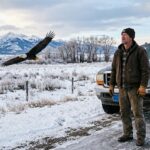
And sometimes it’s an exhausted bald eagle standing beside a blue plastic bowl on a 96-degree evening.
Nearly a year after that first night, Lily’s old bowl still sits in our mudroom.
I don’t think I’ll ever throw it away.
Not because an eagle drank from it.
Because whenever I see it, I remember what happened next.
Fourteen water stations.
A neighborhood checking on wildlife responsibly during a brutal heat wave.
Tom and Mason walking to the river.
Mrs. Keller finding groceries on her porch.
A teenager picking up his late brother’s camera again.
Neighbors becoming friends.
And a nine-year-old learning something most adults spend years forgetting.
You don’t have to change the whole world to make something better.
Sometimes you just notice what’s directly in front of you.
Then you do the small thing you can do safely and responsibly.
And occasionally, that small thing travels farther than you ever expected.
Our story began with an eagle that needed a drink.
But the eagle eventually flew away.
The kindness stayed.
No Comments