

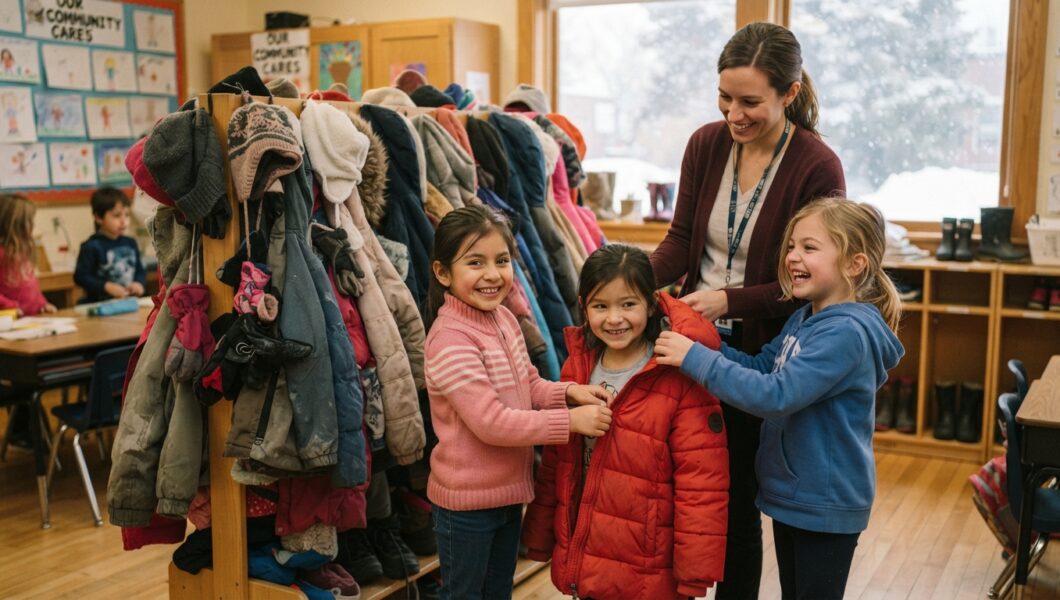
By the middle of January, I had stopped counting the coats.
There were too many.
They hung from the rack near our classroom library, spilled onto the second stand the PTA had brought in, and filled three plastic bins underneath. There were puffer jackets, wool coats, fleece zip-ups, snow pants, scarves, mittens, boots, and enough hats to cover an entire first-grade reading circle.
Every morning, I would glance at the shelf before the children arrived.
Not because I was worried we would run out.
I was worried we would forget why it existed.
The Coat Shelf had started with Andre and three coats I bought at a thrift store. Somehow, it had become a quiet promise between an entire neighborhood and the children of Room 14.
Borrow when you’re cold.
No questions.
No names.
That rule mattered more than I understood when I first taped it to the wall.
Because children notice everything.
They notice who gets picked up in a new SUV and who waits for the late bus. They notice whose lunchbox comes back empty and whose comes home untouched. They notice which shoes are getting tight, which coats have broken zippers, and which children suddenly stop bringing gloves when the weather gets colder.
They also notice embarrassment.
And I never wanted the Coat Shelf to become another place where a child had to stand in front of everyone and admit they needed something.
So I made sure it worked differently.
You could simply walk over.
You could choose something.
You could put it on.
Then you could return to being a six-year-old.
That distinction became important during the coldest week of the winter.
The temperature dropped overnight, and by morning the windows in Room 14 had frosted around the edges. The school had kept the heat running, but the building was old, and some classrooms were warmer than others.
The children came in bundled up like tiny snow explorers.
Most of them.
One boy named Marcus arrived wearing a thin sweatshirt beneath his backpack straps.
He walked straight to his desk and kept his arms folded tightly across his chest.
I knew that posture.
It meant cold.
It also meant, “Please don’t ask me about it.”
So I didn’t.
During morning reading, I noticed him rubbing his fingers together beneath the desk.
I quietly walked toward the Coat Shelf and began straightening hangers.
A few seconds later, Marcus appeared beside me.
He looked at the coats.
Then he looked at me.
“Can I get one?”
“Of course.”
He picked a black one.
Then he changed his mind.
He picked a green one.
Then he found a blue coat with a broken-looking zipper.
“That one.”
I handed it to him.
He slipped it on.
The sleeves were a little long.
He looked down at himself.
Then he smiled.
Not the brave smile Andre had worn months earlier.
A real smile.
“Feels like my dad’s,” he said.
I smiled back.
“Then it sounds like you picked the right one.”
He nodded and returned to his desk.
That was all.
No announcement.
No applause.
No lesson about charity.
Just a child who was cold and was warm again.
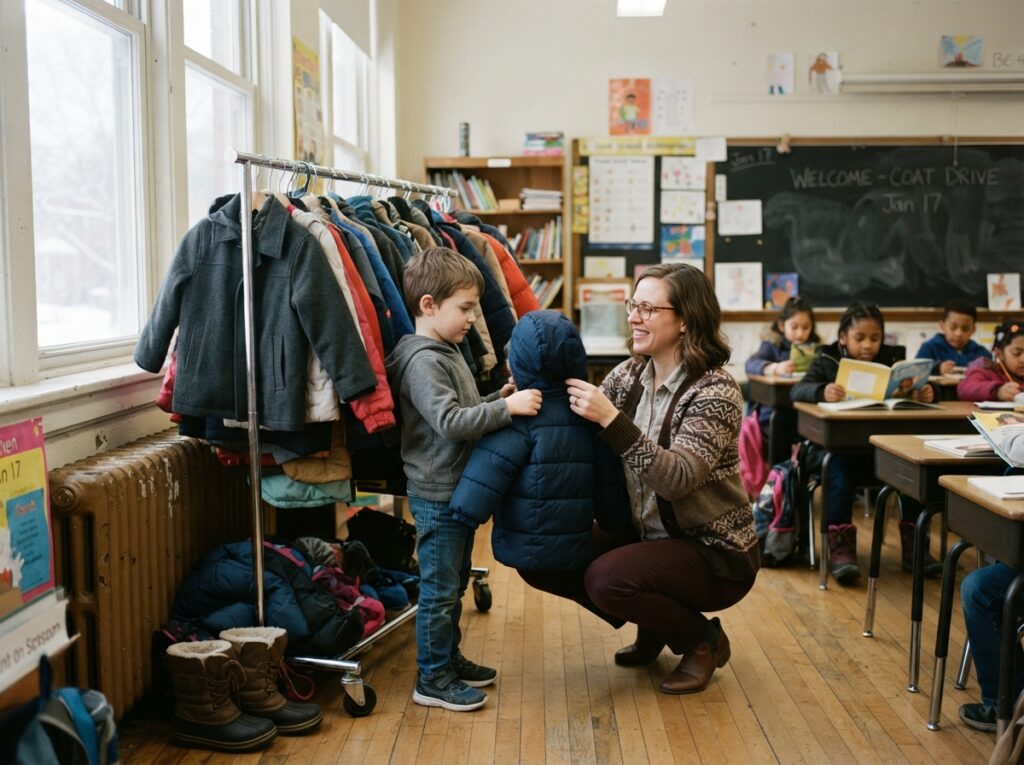
A week later, something happened that made me realize the Coat Shelf was teaching a lesson I hadn’t planned.
Sofia was standing beside the rack when another new student came into the classroom.
His name was Eli.
He was quiet.
Very quiet.
His mother had brought him to school that morning, and I could tell from the way she kept adjusting his backpack straps that she was nervous.
She whispered something to him before leaving.
Eli nodded.
Then she walked away.
He watched her through the classroom window until she disappeared.
I gave him the usual first-day tour.
Desk.
Bathroom.
Pencil box.
Reading corner.
Coat Shelf.
When I showed him the rack, he immediately shook his head.
“I have one.”
He pointed toward his chair.
His coat was hanging there.
It was much too small.
The sleeves stopped several inches above his wrists.
I didn’t say anything.
Neither did Sofia.
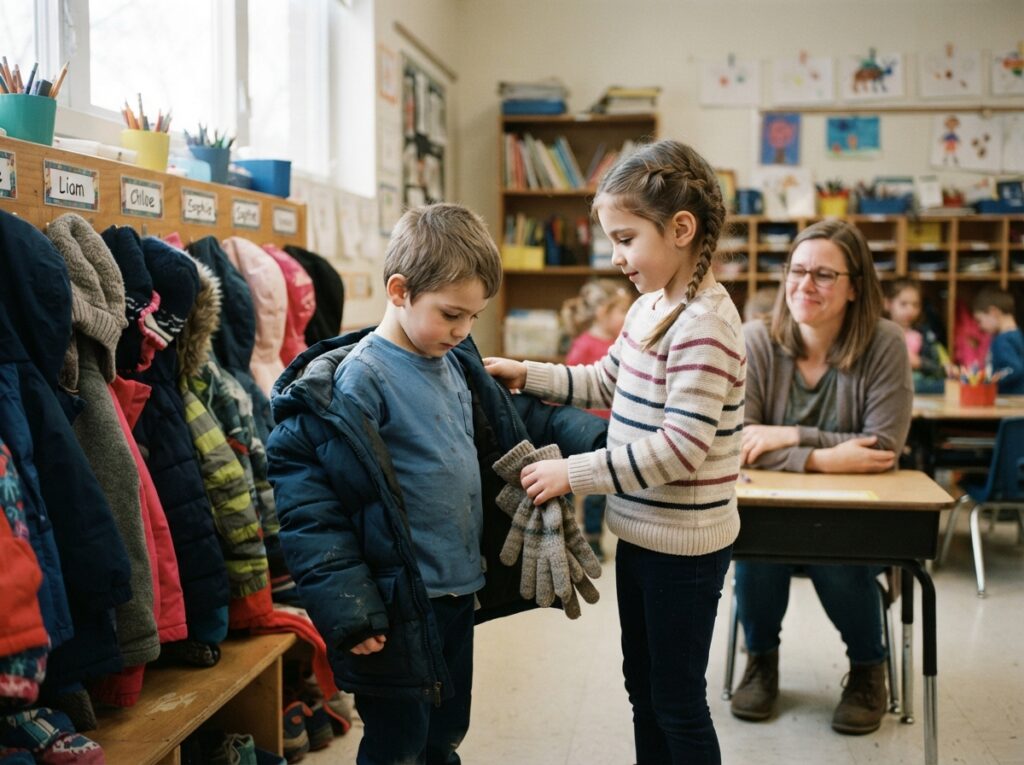
Instead, she walked over to the shelf, pulled out a dark gray coat, and carried it to him.
“You can try this.”
Eli looked at me.
Then at Sofia.
“It’s okay,” she said. “You don’t have to ask.”
He put it on.
It fit perfectly.
He zipped it slowly.
Then Sofia reached into the pocket and pulled out a pair of gloves.
“These too.”
Eli looked at her.
“Are they yours?”
“No.”
“Whose are they?”
She shrugged.
“The shelf’s.”
I had to turn away for a second.
Because Sofia had once been the child standing uncertainly in front of that same rack.
She had once asked me if she needed a card to borrow a coat.
Now she was the one making sure someone else didn’t feel embarrassed.
That was when I understood.
The Coat Shelf wasn’t really about coats anymore.
It was about passing something forward.
By February, the community had started doing something I never expected.
They stopped waiting for us to ask.
A mechanic dropped off several pairs of children’s boots.
The barber on Maple Street brought winter hats.
The nail salon owner sent a box of gloves.
Someone left a stack of new socks in the school office.
A grandmother I had never met brought homemade scarves.
Even the grocery store down the road started keeping a small donation box near the entrance.
There was no campaign.
No fundraiser.
No big meeting where everyone stood around taking credit.
People simply saw a need and decided to answer it.
One afternoon, our custodian, Mr. Lewis, came into my classroom carrying another rack.
“Where do you want this?”
I laughed.
“I don’t know anymore.”
He looked around at the coats covering every available surface.
“Guess you better figure it out.”
So we made room.
Not because we believed we could fix every problem.
We couldn’t.
Some families were still choosing between groceries and electricity. Some children still came to school tired because they had slept somewhere unfamiliar. Some parents were working two jobs and still falling behind.
A coat couldn’t change any of that.
But it could change one morning.
One walk to school.
One recess.
One child’s ability to sit at a desk without thinking about how cold their fingers were.
And sometimes one small change is enough to make room for something bigger.
Then came the storm.
The forecast had warned us for days, but forecasts are abstract until you look outside and see the world covered in white.
Snow came down hard overnight.
The buses were delayed.
Several were eventually canceled.
By 8:30 that morning, only about half the students had arrived.
Those who did were bundled tightly.
The principal announced that recess would remain indoors.
No one complained.
The children built forts from classroom cushions, read books, played quiet games, and argued over who got to be the teacher.
Then I noticed Sofia standing beside the Coat Shelf.
She was holding a small red jacket.
“Mrs. Ramirez?”
“Yes?”
“Can I put this here?”
She pointed to an empty hook.
“What is it?”
“My old coat.”
I looked at her.
“You’re donating it?”
She nodded.
“My mom got me a bigger one.”
She hung the red coat carefully.
Then she stepped back.
“It still works.”
I smiled.
“It sure does.”
A few minutes later, Andre came over.
He looked at the coat.
“That’s the one you used to wear, right?”
Sofia nodded.
Andre touched the sleeve.
“Someone’s going to like it.”
“I hope so,” she said.
Then he smiled.
“That’s the point.”
I stood behind my desk and watched them.
Those two children had been among the first kids who needed the shelf.
Now they were helping maintain it.
That was the moment I finally stopped seeing the Coat Shelf as a teacher’s little project.
It belonged to them.
It belonged to everyone.
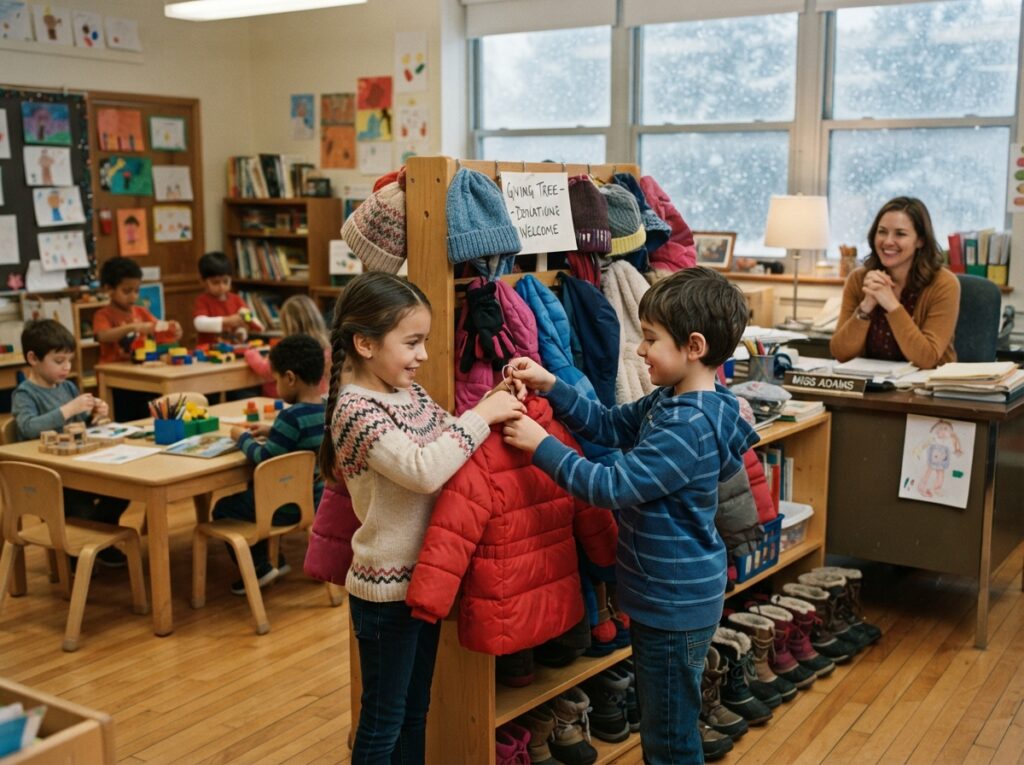
At the end of the school year, I took down the original sign.
The tape had begun to curl at the corners.
The words were faded.
The cardboard was bent.
The Coat Shelf had outgrown it.
I thought about replacing it with something more polished.
Maybe something printed.
Something official.
But Sofia stopped me.
“Can we keep it?”
“The sign?”
She nodded.
“Why?”
“Because that’s how it started.”
So I left it there.
The old handwritten sign stayed above the rack.
The Coat Shelf.
Borrow when you’re cold.
No questions.
No names.
By then, the rack held more than winter clothing.
There were backpacks.
School supplies.
Socks.
Hand warmers.
Snack bags.
Umbrellas.
Children’s books.
Someone had even added a little basket labeled “Things You Might Need.”
There were no rules about who could use it.
And there were no rules about who could contribute.
That became the part I loved most.
One child could bring a coat.
Another could bring three pairs of socks.
A parent could donate a bag of groceries.
A neighbor could bring gloves.
A teacher could buy a few jackets after work.
Everyone had something they could give.
And nobody had to be wealthy to participate.
On the final Friday before summer break, I found Marcus standing beside the shelf.
He was holding the black coat he had borrowed months earlier.
He had washed it.
He had folded it.
He was returning it.
“You don’t have to,” I told him.
“I know.”
He put it on the hanger.
Then he looked at me.
“Someone else might need it.”
I nodded.
“Yes, they might.”
He walked away.
I watched him join his friends.
Then I looked at the rack.
The coat he had once needed was waiting for someone else.
That simple sight stayed with me.
Because teaching first grade is usually described as letters, numbers, phonics, handwriting, and learning how to sit still long enough to listen.
But children learn other things too.
They learn what adults do when someone is struggling.
They learn whether asking for help makes you weak.
They learn whether kindness comes with conditions.
They learn whether a community means people who live near you or people who actually notice you.
I couldn’t change the weather.
I couldn’t fix every family’s finances.
I couldn’t make rent cheaper or groceries less expensive.
I couldn’t promise that every child would go home to a warm house.
But inside Room 14, I could make one thing clear.
You don’t have to be ashamed of needing something.
And if you have something someone else needs, you don’t have to wait until you’re asked to give it.
That’s what the children taught me.
The Coat Shelf began because one little boy came into school wearing a hoodie that wasn’t warm enough.
It grew because one teacher couldn’t stop thinking about him after she went home.
It became something bigger because parents, neighbors, workers, children, and strangers decided that helping didn’t need to be complicated.
And eventually, the children took over.
Maybe that’s the part I’ll remember longest.
Not the hundreds of coats.
Not the donations.
Not the photographs or the notes.
I’ll remember Sofia helping Eli.
I’ll remember Marcus returning the coat he once needed.
I’ll remember Andre straightening hangers that were taller than he was.
I’ll remember a little girl leaving hand warmers in a basket because she knew what a long walk felt like.
I’ll remember the crooked signs taped to the wall.
And I’ll remember that children were watching all of us.
They were learning.
Not from a worksheet.
Not from a lecture.
From what we chose to do.
The last afternoon before summer, I closed the classroom door and looked back one more time.
The Coat Shelf was quiet.
Empty hooks waited beside full ones.
A few coats hung there for the next winter.
The old sign was still crooked.
I smiled.
Perfection had never been the point.
Warmth was.
And maybe that’s the lesson I wish every child could carry with them long after they leave Room 14:
You may not be able to solve every problem in the world.
But if someone is cold, you can help them find a coat.
If someone is hungry, you can share what you have.
If someone is scared, you can sit beside them.
And if someone is embarrassed to ask for help, you can make sure they never have to ask in the first place.
The Coat Shelf started with one teacher buying three coats at a thrift store.
It ended with an entire community understanding something much bigger.
Warmth doesn’t belong to the person who gives it.
Once you share it, it belongs to everyone.


No Comments