

For the next few days, I expected the story to fade.
That is usually how these things work. Someone takes a photograph, people make assumptions, strangers argue in the comments, and a week later everyone has moved on to something else.
I figured Sophie would forget about it, too.
She didn’t.
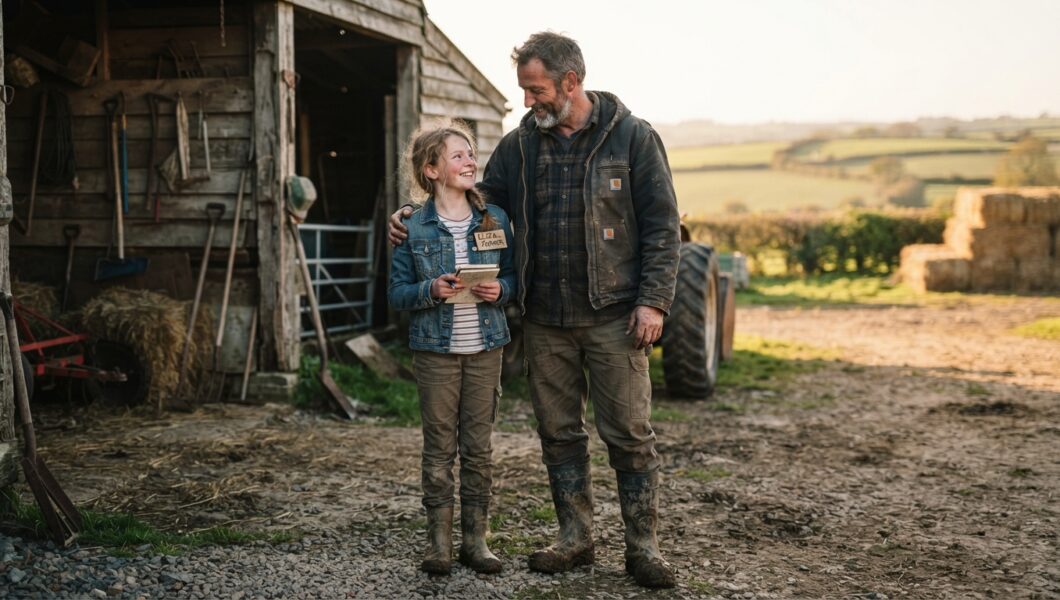
She kept wearing that little name tag she had made for herself. The words “Farm CFO” were still stuck across her chest, although the edges had started peeling up from being handled so much. Every morning before school, she’d check the hens, look over the calves, and ask me what needed doing after she got home.
She never once asked me whether people online were still talking about us.
I was the one checking.
A few comments were still there. Some people had apologized after hearing the whole story. Others doubled down. One person said I was making excuses because I didn’t want to do the work myself.
That one bothered me more than I wanted to admit.
Not because a stranger’s opinion could change the way I raised my daughter, but because there is something uncomfortable about having people judge a family from one photograph. They didn’t know Sophie. They didn’t know our farm. They didn’t know how many times I’d offered to take over a job only to have her tell me, “Dad, I can do it.”
And they definitely didn’t know what had happened with the feed.
A few weeks after the original post, I found Sophie sitting at the kitchen table with a stack of receipts spread in front of her.
“What are you doing?” I asked.
“Fixing my mistake.”
She said it so casually that I almost laughed.
The wrong feed had become a subject she couldn’t let go of. She had learned what the numbers on the bags meant. She had compared different blends. She had calculated how much the mistake actually cost us, how much the manager at the co-op had saved us by taking back the unopened bags, and how much the correct ration would cost going forward.
Then she had done something that surprised me.
She started tracking everything.
Feed. Eggs. Produce. Fuel. Market fees. Packaging.
She created columns in an old notebook and began writing down numbers after chores.
At first, I thought it was just another twelve-year-old project that would last two weeks.
Then I noticed she was still doing it a month later.
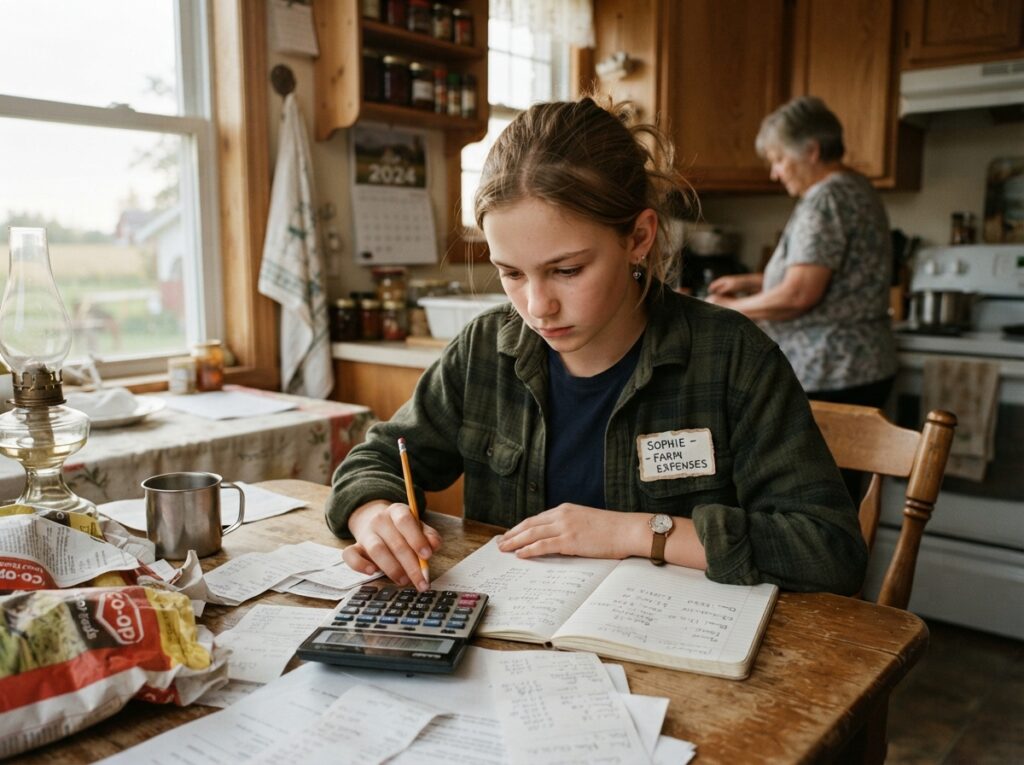
One evening, she pushed the notebook across the table toward me.
“I think we’re losing money on the eggs.”
I looked at her.
“Excuse me?”
She pointed at the page.
She had calculated the cost of feed, cartons, transportation, and the time we spent taking everything to market. She had even separated the costs that changed from week to week from the ones that stayed the same.
Her numbers weren’t perfect.
Some of them were missing.
A couple were definitely wrong.
But the basic idea was there.
She had started thinking like a business owner.
I pulled up a chair.
“Okay,” I said. “Show me.”
We spent nearly an hour going through her calculations.
I corrected a few things, but I made a point not to take the notebook away from her. Every time she got stuck, I asked another question instead of giving her the answer.
By the end, she’d figured out that we weren’t actually losing money on eggs.
We were just making less than she thought.
That distinction mattered to her.
It mattered to me, too.
The following Saturday, something happened that I hadn’t expected.
A man came to our farm stand and recognized Sophie.
He had seen the photograph.
For a second, I prepared myself for another lecture.
Instead, he smiled.
“You’re the Farm CFO, right?”
Sophie’s face lit up.
“Yeah.”
He bought two dozen eggs and a basket of tomatoes. Before he left, he told her something I’ll probably remember for the rest of my life.
“Keep learning,” he said. “Most adults never learn how to own a mistake.”
Sophie watched his truck pull away.
Then she looked at me.
“Was he talking about the feed?”
“I think so.”
She nodded.
“I guess it wasn’t completely terrible.”
“No,” I said. “It wasn’t.”
That was when I realized something.
The mistake had changed her.
Not in some dramatic, movie-style way. She wasn’t suddenly an adult, and she certainly wasn’t ready to run 110 acres by herself.
But she had learned that mistakes don’t have to be hidden.
They can be examined.
They can be admitted.
They can cost you something.
And they can teach you something if you’re willing to stay in the room long enough to learn the lesson.
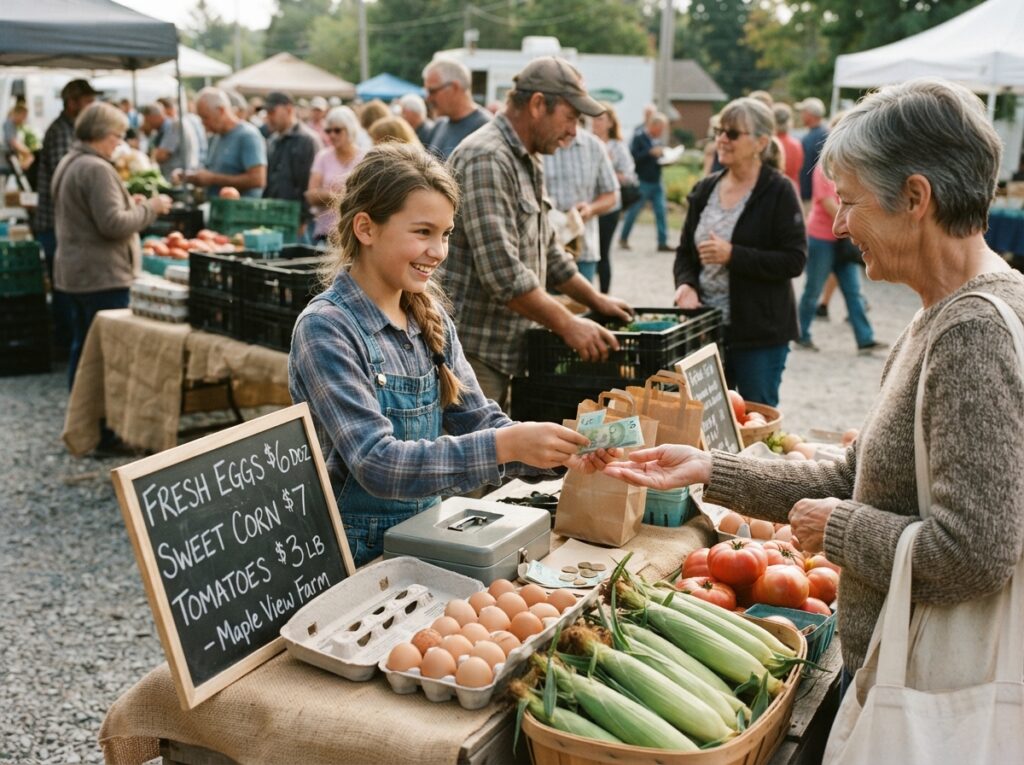
A few weeks later, we had another busy Saturday at the county market.
The weather was warm, the parking lot was full, and customers were moving between the stands with bags over their arms.
Sophie was at our table again.
This time, she wasn’t just counting change.
She had made a small handwritten sign showing customers where their eggs came from, how we priced them, and what went into caring for the hens.
Nobody had asked her to make it.
She simply decided customers might want to know.
At one point, an older farmer from three stalls down stopped to read it.
“You charging for that consulting service yet?” he joked.
Sophie looked at him seriously.
“Not yet.”
He laughed.
I did too.
Then he looked at me.
“You’ve got a good one there.”
I already knew.
That afternoon, after we packed the truck, Sophie climbed into the passenger seat and was quiet for a while.
Then she said, “Dad?”
“Yeah?”
“Do you ever worry you’re going to mess everything up?”
I looked over at her.
“All the time.”
She seemed surprised.
“You do?”
“Of course.”
“But you’re Dad.”
I laughed.
“Being Dad doesn’t mean I know everything.”
She looked out the window.
“I thought grown-ups knew what to do.”
“Some of us are just better at pretending.”
She laughed at that.
Then she got serious again.
“I think I like figuring things out.”
“I know.”
“Even when I mess up.”
“I know that too.”
We drove the rest of the way home without talking much.
The fields were dry in places, the hay needed cutting, and there were three repairs waiting for me before Monday.
It wasn’t an easy life.
People sometimes see a farm and imagine the quiet part. They see the rows, the old barn, the animals, the roadside stand.
They don’t see the bills.
They don’t see the weather forecasts checked before sunrise.
They don’t see the machinery that breaks at the worst possible time or the price of diesel climbing while the price you get for your crop barely moves.
And they certainly don’t see the years when you work harder than ever and still wonder whether you’ve made the right decision.
But Sophie sees more of it now.
Not because I want her to carry my burdens.
I don’t.
She’s twelve.
She should have time to be a kid.
But I also don’t want to protect her so completely that she reaches adulthood believing the world will always fix her mistakes for her.
There is a difference between making a child work because you don’t want to work and teaching a child that they are capable of contributing.
I hope Sophie always knows the difference.
A few days later, I found the old photograph on my phone.
The one that started everything.
Sophie was standing at the cash box, counting change while I stacked crates behind her.
The photograph still looked exactly the same.
Nothing about it had changed.
But I had.
I knew what happened before it was taken.
I knew what happened afterward.
I knew about the feed order, the wrong numbers, the sick calf, the phone call, the trip to the co-op, the notebook, the market stand, and the countless little conversations nobody online had ever seen.
A photograph had captured one second.
It hadn’t captured a childhood.
It hadn’t captured a father.
And it certainly hadn’t captured a daughter who was slowly learning how to stand on her own feet.
I still think about the people who called me lazy.
Some of them probably still believe it.
That’s okay.
I don’t need to convince every stranger on the internet that I’m a good father.
Sophie will decide that for herself someday.
Maybe she’ll remember the times I taught her how to fix a fence.
Maybe she’ll remember sitting beside me at the market.
Maybe she’ll remember the sick calf and the wrong feed and the terrible feeling of admitting she’d made a mistake.
Maybe she’ll remember that I didn’t take the phone from her hand.
I didn’t make the call for her.
I didn’t tell her what to say.
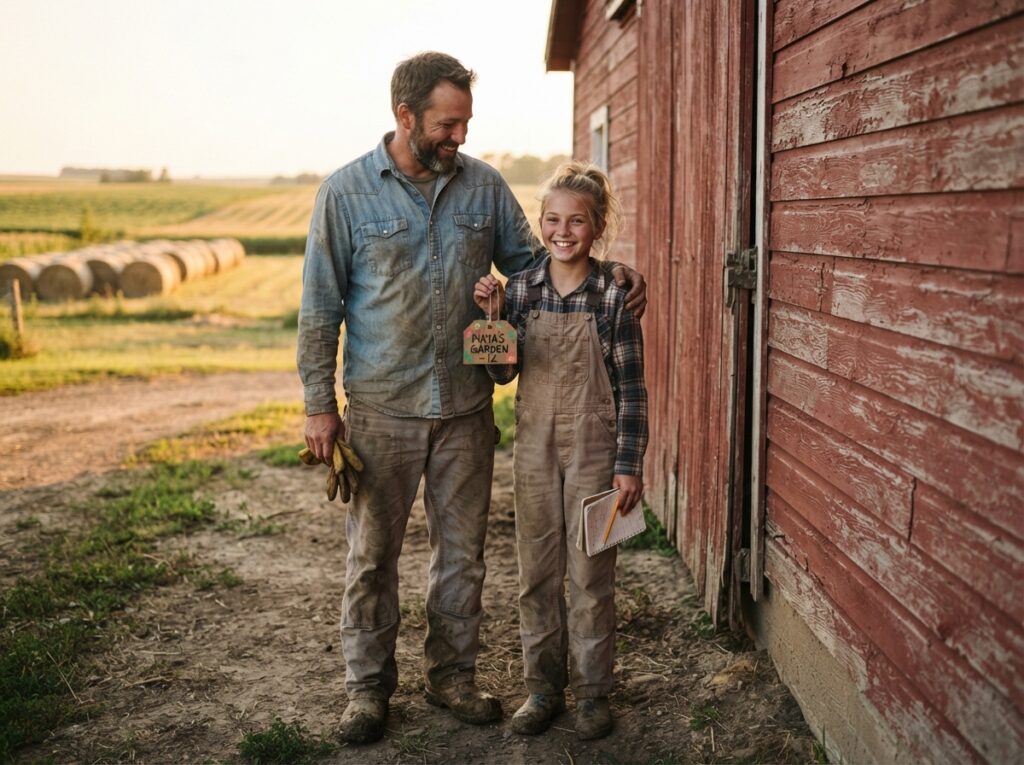
I stood beside her.
That’s the part people missed.
Standing back doesn’t mean walking away.
Sometimes the hardest thing a parent can do is remain close enough to catch a child if they fall without grabbing them before they ever get the chance to balance.
Sophie doesn’t need me to make every problem disappear.
She needs to know I’m there while she learns how to solve them.
And I know there will be more mistakes.
There will be bigger ones, too.
Some day she might make a decision that costs more than $87.50. She might choose the wrong business idea, trust the wrong person, or make a decision that leaves her sitting at a kitchen table wondering what she’s going to do next.
When that happens, I hope she remembers the feed bags.
I hope she remembers making the call.
I hope she remembers walking into the co-op with her shoulders straight, admitting what she’d done and asking for help.
Most of all, I hope she remembers that making a mistake never made her a failure.
It made her responsible for what came next.
That’s what I was trying to teach her all along.
Not how to count change.
Not how to carry crates.
Not even how to run a farm.
I was trying to teach her how to become someone who can look at a problem, take a breath, and say, “Okay. What do we do now?”
The internet saw a picture of a father who appeared to be letting his daughter do his work.
I saw a twelve-year-old girl learning how to do work that mattered.
There’s a difference.
And if I’m lucky, one day Sophie will take over more of this farm than I ever imagined.
Maybe she’ll change everything.
Maybe she’ll sell the place and move somewhere I’ve never heard of.
Maybe she’ll decide farming isn’t for her at all.
Whatever she chooses, I’ll be proud.
Because the goal was never to make her dependent on this land.
The goal was to make sure she could stand anywhere in the world and know what to do when things went wrong.
That is the harvest I’m working toward.
Not another perfect crop.
Not another good market day.
A daughter who knows how to think, how to work, how to admit when she’s wrong, and how to try again.
And when that day comes, I won’t feel like I’ve lost my little girl.
I’ll know I’ve done my job.

No Comments