

The farmer thought the story had ended when the fox disappeared into the trees.
After weeks of treatment, the young red fox had finally been returned to the wild. It had stood at the edge of the carrier, hesitated for a few seconds, and then suddenly sprinted into the forest.
That should have been the final moment.
The fox was free.
Its injured leg had healed enough for it to run.
The wildlife rehabilitator was satisfied.
And the farmer had no reason to expect anything unusual when he returned home.
But that evening, he checked the trail camera.
The footage began normally.
A deer crossed the clearing.
A raccoon appeared near the woodland edge.
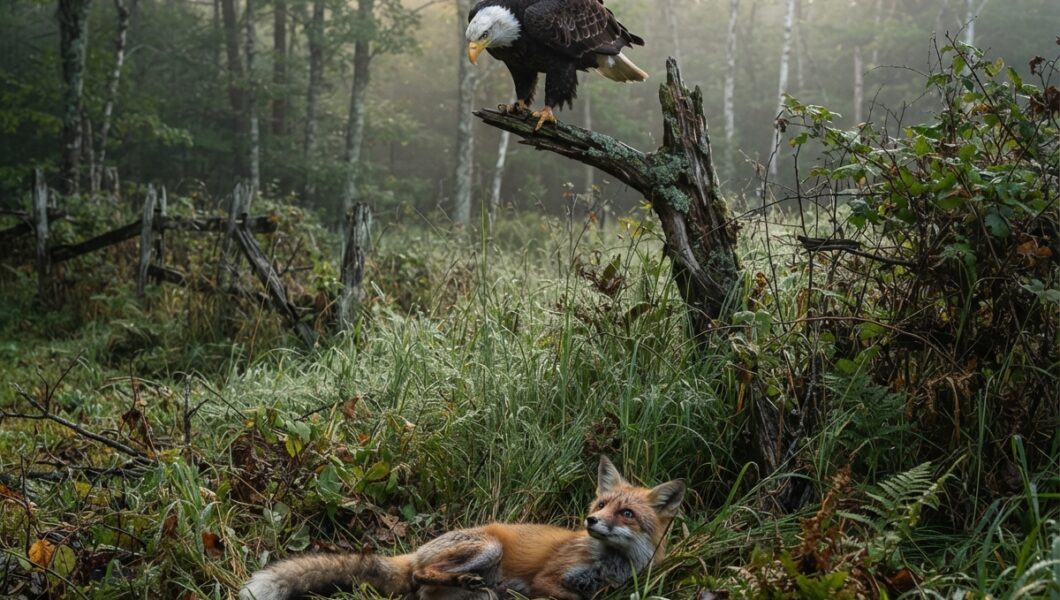
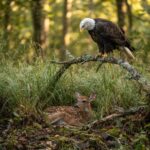
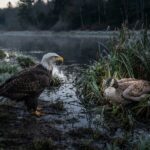
Then, at 6:11 the following morning, the bald eagle returned.
The farmer recognized the tree immediately.
The same dead tree.
The same branch.
The same clearing.
The eagle landed and settled its talons around the weathered wood.
Then it looked down.
Not toward the entire clearing.
Toward the exact patch of grass where the injured fox had been found.
The farmer watched the recording without moving.
The fox was gone.
There was nothing visible in the grass.
No movement.
No sound.
Nothing that should have attracted the eagle’s attention.
Yet the bird remained.
For nearly fourteen minutes.
Then it flew away.
The farmer replayed the footage.
Once.
Twice.
A third time.
He had already learned not to assume he knew what an animal was thinking.
Still, he couldn’t help wondering whether the eagle remembered the place.
Or whether it was simply following the same pattern it had followed before.
There was no way to know.
Three days later, the eagle returned again.
This time, something else was in the clearing.
A red fox.
The farmer’s heart jumped when he saw it.
He immediately checked the footage.
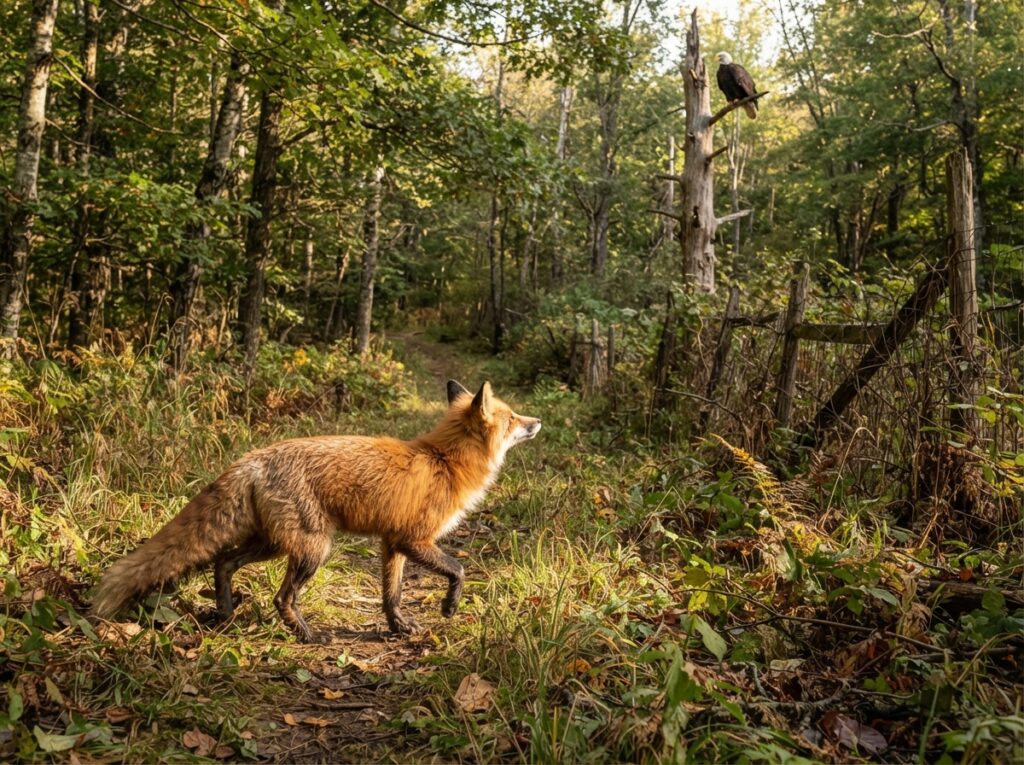
The fox moved cautiously through the grass.
It stopped beside the old fence.
Then it lowered its head and sniffed the ground.
The farmer watched closely.
The fox was using all four legs.
It took several steps.
Then it trotted.
The injured hind leg moved normally.
He couldn’t prove it was the same fox.
But there was something familiar about the way it moved.
The size.
The coloring.
The narrow white patch beneath its chin.
The farmer leaned closer to the screen.
Then the fox walked directly beneath the dead tree.
The eagle was not there that morning.
For several seconds, the fox stood in the clearing.
Then it disappeared into the woods.
The farmer saved the footage.
He knew what he wanted to believe.
But he also knew the difference between hope and proof.
It could have been another fox.
The woods contained several.
There was no reliable way to identify an individual red fox from such distant trail-camera footage.
So he kept the recording without giving it a name.
A few mornings later, the eagle returned.
Again, it landed on the dead tree.
Again, it looked down.
But this time, the camera captured something different.
The eagle suddenly turned its head.
A fox had entered the far side of the clearing.
The fox stopped.
The eagle remained still.
For several seconds, the two animals faced the same direction.
The fox continued walking.
The eagle watched.
Then the fox disappeared behind a group of trees.
The eagle stayed on the branch for another five minutes before flying away.
That was all.
No chase.
No attack.
No dramatic interaction.
Just two wild animals occupying the same clearing at different levels of the woodland.
Yet the footage made the farmer stop.
He had spent weeks trying to understand the eagle’s behavior.
Now he wondered whether he had been asking the wrong question.
Maybe the story was never about whether the eagle had been trying to help.
Maybe it was simply about what happened when one animal noticed something unusual and a human happened to notice the animal noticing it.
That distinction mattered.
The farmer had seen enough wildlife to know that nature did not always behave according to human expectations.
A predator could watch another animal without attacking it.
A bird could return to a place for reasons that had nothing to do with what a person imagined.
And an animal could appear to respond to another animal without there being any human-like intention behind the behavior.
Still, something had happened.
The eagle had repeatedly appeared above the clearing.
The fox had been trapped below.
The farmer had investigated.
And the fox had survived.
Sometimes that was enough.
The farmer eventually stopped checking the footage every few hours.
Life returned to its normal rhythm.
The deer continued moving through the clearing.
Turkeys appeared in groups.
Raccoons wandered near the fence.
Foxes came and went.
And the eagle remained an occasional visitor.
But the dead tree had become different in the farmer’s mind.
Before the incident, it was simply an old tree.
Now it was the place where an unusual sequence of events had unfolded.
One morning, several weeks after the release, the farmer walked toward the clearing without the camera footage in his mind.
He wanted to see the place for himself.
The grass had grown taller.
The leaves had changed color.
The fallen branch beneath which the fox had been trapped had been moved farther into the woods.
He stopped where the fox had been found.
There was almost nothing left to indicate that an injured animal had once been lying there.
No blanket.
No carrier.
No footprints.
No signs of the rescue.
Just grass.
The farmer stood quietly.
Then he noticed something near the edge of the clearing.
Small tracks.
Fox tracks.
They crossed the damp soil and continued toward the trees.
He followed them for several yards.
Then stopped.
The tracks disappeared beneath thicker vegetation.
The farmer smiled.
He didn’t need to know whether they belonged to the same fox.
The tracks meant that foxes were still using the area.
The woodland was still doing what it had always done.
Animals were moving.
Hunting.
Resting.
Growing.
Surviving.
The farmer turned toward the dead tree.
The eagle wasn’t there.
But somehow, he expected it to be.
Later that afternoon, the trail camera proved him right.
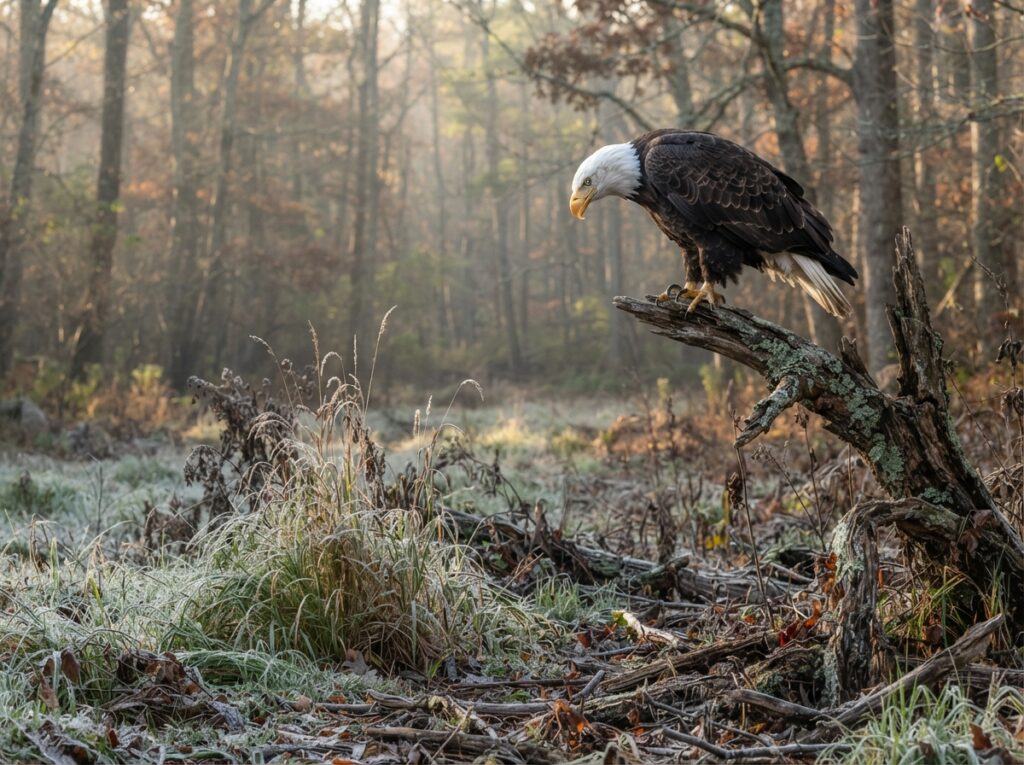
At 3:42 PM, the bald eagle landed on the branch.
It stayed for several minutes.
Then a red fox appeared at the edge of the frame.
The eagle looked down.
The fox looked toward the tree.
Neither moved.
The fox continued across the clearing.
The eagle remained above.
Then, unexpectedly, the fox stopped.
It looked back.
For a moment, the two animals were perfectly framed in the same shot.
The farmer watched the footage over and over.
It looked almost like a reunion.
But he refused to call it one.
He knew better.
There was no evidence that the fox recognized the eagle.
There was no evidence that the eagle recognized the fox.
There was no evidence that either animal remembered the rescue.
What the camera showed was enough.
A fox.
An eagle.
The same clearing.
And a moment that looked meaningful even though its meaning could not be known.
The farmer showed the footage to the rehabilitator when she visited the property again.
She watched the clip carefully.
Then she smiled.
“That fox looks healthy.”
“Do you think it’s the same one?”
She looked at the screen.
“I wouldn’t say for certain.”
The farmer nodded.
“That’s what I thought.”
She continued watching.
“What about the eagle?” he asked.
She smiled.
“Still no way to know.”
He laughed.
“I figured.”
There was something comforting about that answer.
Not knowing did not make the story less meaningful.
In fact, it made the story more honest.
The eagle might have noticed the fox because it was injured.
It might have seen an opportunity for food.
It might have been responding to movement in the grass.
It might have been doing something completely unrelated.
The farmer would never know.
But he did know what the eagle’s presence had caused him to do.
It had made him stop.
It had made him question what he was seeing.
It had made him walk toward the clearing.
And that decision had changed the outcome for a young animal that might otherwise have remained hidden.
That was the part he kept returning to.
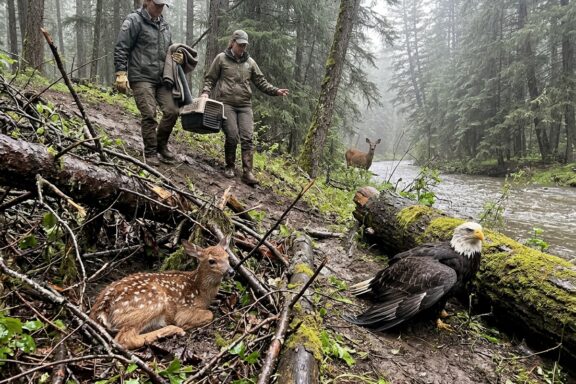
The rescue had not begun when the rehabilitator arrived.
It had begun when somebody noticed that something was unusual.
The eagle’s behavior was the clue.
The farmer’s curiosity was the next step.
The rehabilitator’s experience completed the rescue.
And the fox did the rest.
It healed.
It learned to run again.
And eventually, it returned to the woods.
A few months later, the farmer received another surprise.
The trail camera captured the fox again.
This time, it wasn’t alone.
Two other foxes appeared near the edge of the woodland shortly after sunset.
The recovered fox moved between them.
They disappeared together into the trees.
The farmer watched the footage quietly.
He didn’t know whether the fox had found a mate.
He didn’t know whether it belonged to a family group.
He didn’t know whether the other foxes were related.
There were still countless things the camera could not tell him.
But one thing was obvious.
The animal was living.
And it was living freely.
That mattered more than any explanation.
The eagle also continued to visit.
Sometimes it used the dead tree.
Sometimes it landed farther away.
Sometimes it didn’t appear for weeks.
The farmer stopped expecting a pattern.
He simply watched.
One winter morning, months after the rescue, the camera recorded another familiar scene.
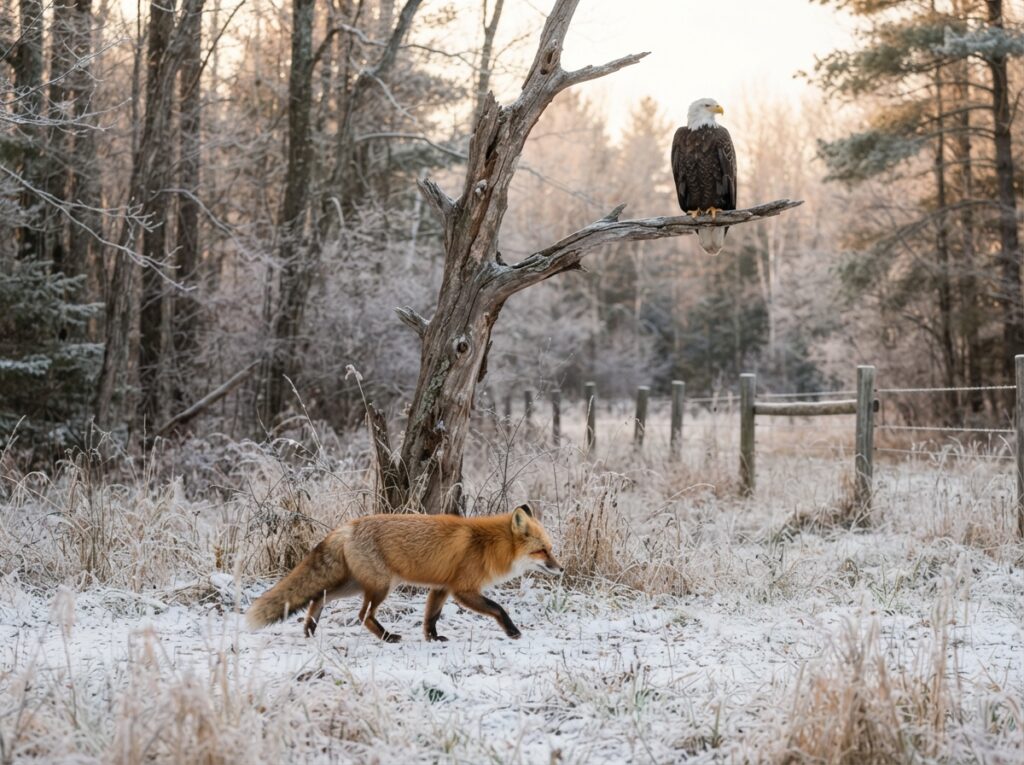
At 6:11 AM, the bald eagle landed on the dead tree.
Snow covered the ground.
The clearing was quiet.
The eagle looked down.
Then a red fox emerged from the woodland.
The farmer recognized the animal’s size and markings immediately, although he still couldn’t say with absolute certainty that it was the same fox.
The fox walked across the snow.
Its hind legs moved perfectly.
It stopped beneath the tree.
The eagle remained above.
The fox looked toward the branch.
The eagle looked toward the ground.
Then the fox continued walking.
The eagle stayed.
No rescue happened.
No emergency existed.
Nothing needed to be fixed.
The fox was simply passing through.
And perhaps that was the most beautiful ending the story could have had.
The animal that had once been unable to stand was now walking through the same woodland on its own.
The bird that had once kept watch over the clearing was still using the same tree.
Neither needed the other.
Neither needed a human.
Life had moved forward.
The farmer saved that recording too.
He eventually had an entire folder of footage from the clearing.
Some clips showed the eagle.
Some showed the fox.
Some showed both.
None explained what had happened that first week.
But together, they told him something he hadn’t understood before.
Not every meaningful moment in nature comes with a clear explanation.
Sometimes we see a behavior and want to assign a reason.
We want to believe the eagle knew the fox was in trouble.
We want to believe it stayed because it cared.
Maybe it did.
Maybe it didn’t.
The truth is that nobody can know from the footage.
And the farmer no longer needed to decide.
Because whatever the eagle’s reason had been, its repeated visits caused a human to pay attention.
That was real.
The fox’s injury was real.
The rescue was real.
The recovery was real.
And the animal running through the woods months later was real.
Those facts were enough.
One evening, the farmer stood outside near the clearing as the sun disappeared behind the trees.
The dead tree was silhouetted against the fading sky.
He looked toward the branch where the eagle had spent so many mornings.
For a moment, he imagined the fox moving somewhere beyond the grass.
Then he smiled.
He knew he would probably never understand what the eagle had been doing.
But perhaps wildlife wasn’t asking him to understand.
Perhaps it was simply asking him to notice.
A bird returning to the same tree.
A patch of grass moving when there was no wind.
A faint sound beneath the leaves.
An injured animal waiting quietly for someone to find it.
Sometimes that is how a rescue begins.
Not with a dramatic cry.
Not with someone knowing exactly what to do.
Just with a person stopping long enough to ask a simple question.
Why does that bird keep coming back?
And sometimes, when you follow that question, you discover that something small and vulnerable has been waiting nearby all along.
The farmer never called the eagle a hero.
He never claimed it had rescued the fox.
He simply kept the footage.
Because somewhere between the first landing at 6:11 in the morning and the final sighting months later, an ordinary clearing had become the setting for an extraordinary chain of events.
An eagle noticed something.
A farmer noticed the eagle.
A fox was found.
A rescue happened.
And eventually, the fox returned to the woods.
Maybe the eagle had been watching.
Maybe it had been hunting.
Maybe it had simply been curious.
Nobody knew.
But the next time the farmer saw an eagle sitting unusually still, he didn’t immediately look away.
He stopped.
He watched.
And he remembered the fox.
Sometimes you don’t need to know exactly what nature is trying to tell you.
Sometimes you only need to be willing to look twice.
No Comments