

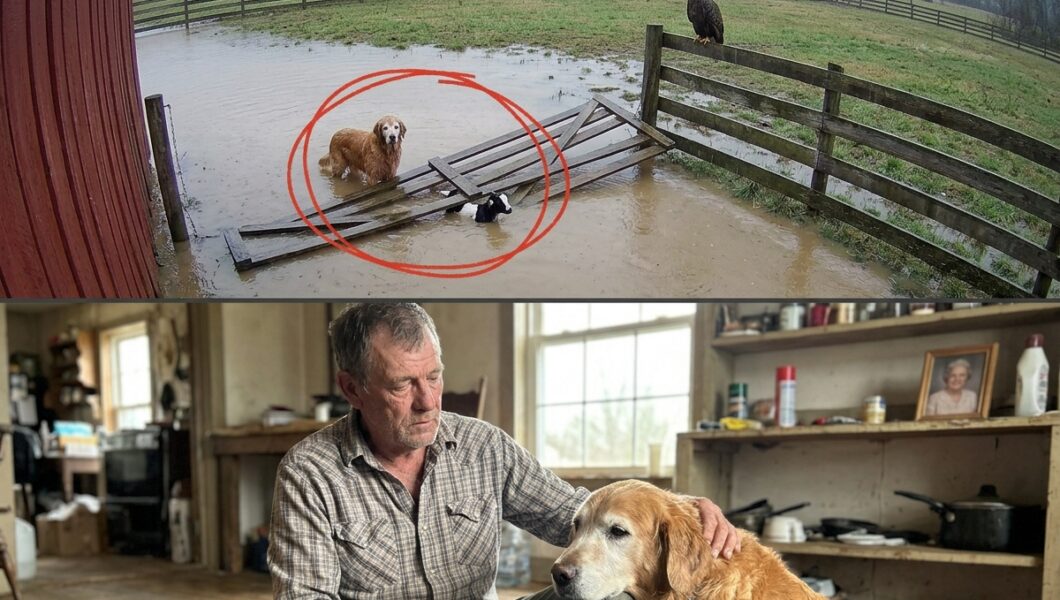
At 3:46 PM, Thomas Bennett stood inside his farmhouse near Greeneville, Tennessee, listening to the rain strike the kitchen windows.
His thirteen-year-old golden retriever, Cooper, was finally safe.
The old dog had spent hours standing chest-deep in muddy floodwater beside a collapsed cattle gate.
Rescuers had discovered why he refused to leave.
A tiny black-and-white goat kid had been trapped beneath the broken gate.
Both animals had survived.
But now Thomas’s neighbor, volunteer firefighter Daniel Mercer, had called with news that made the morning’s rescue seem like only the beginning.
“We found fresh tire tracks leading into the flooded mill property. And Thomas, there’s something moving inside that livestock crate.”
Thomas gripped the phone.
“Are you telling me there are more animals out there?”
“We believe there may be. We haven’t confirmed how many.”
“Then somebody needs to get them.”
“Emergency responders are already assessing the site. The bridge approach is unstable, and the creek is still rising.”
Thomas looked toward the empty dog bed beside his kitchen table.
Cooper was receiving veterinary care.
For the first time in thirteen years, the house felt completely silent.
“Daniel, that little goat nearly drowned this morning.”
“I know.”
“What if the others are trapped?”
Daniel paused.
“That’s why we’re going in with a proper rescue plan.”
Thomas closed his eyes.
He thought about his late wife, Ellen.
She had always stopped to help injured animals along the farm roads.
Once, during a thunderstorm, she had spent two hours helping a neighbor recover three frightened calves from a broken pasture fence.
Thomas remembered teasing her afterward.
“You’d rescue every animal in Tennessee if you could.”
Ellen had smiled.
“Not every one. Just the ones that need us.”
Now, eighteen months after her death, Thomas could almost hear her voice.
He looked toward the rain-darkened pasture.
“Call me when you know something.”
“I will,” Daniel promised.
At 4:02 PM, Daniel arrived at the abandoned mill with county emergency responders, a trained swiftwater rescue crew, and an animal control officer.
The old mill stood beside a narrow creek that had overflowed during the storm.
Its lower storage building was partially submerged.
Water rushed around the foundation.
Broken branches and pieces of fencing had collected against the walls.
The wooden bridge leading to the property had suffered serious damage.
Nobody could safely drive across it.
The white pickup truck seen in the earlier security recordings was nowhere in sight.
But fresh tire marks were visible on the higher gravel access road.
The responders could not determine whether the truck had entered the flooded area or simply turned around.
Daniel studied the tracks.
“Whoever came through here was taking a risk.”
County rescue coordinator Rebecca Hayes examined the mill from higher ground.
“We’re not sending anyone into that building until we know the structure is stable.”
Daniel nodded.
A collapsed floor, hidden debris, or sudden surge of water could endanger rescuers.
The team used binoculars and a pole-mounted inspection camera to examine the lower storage area from a safe position.
At first, they saw only floating wood.
Then a dark shape moved behind a broken doorway.
Rebecca leaned closer.
“Hold that camera steady.”
The image sharpened.
A wooden livestock crate stood against the interior wall.
Its lower boards were wet.
Water had reached the bottom slats.
And inside, something small shifted.
Daniel felt his stomach tighten.
“There’s an animal in there.”
The camera moved slightly.
A narrow face appeared between the slats.
Then another.
Rebecca counted carefully.
“At least two visible.”
A faint bleating sound carried through the rain.
Daniel turned toward the rescue crew.
“We’ve got live goats inside.”
But the camera revealed something else.
A length of rope had become tangled around the crate’s upper corner.
The other end disappeared beneath a pile of broken shelving.
The crate was wedged against the wall.
And the rising water was beginning to lift one side.
Rebecca studied the scene.
“If that crate overturns, the animals could be trapped underwater.”
Daniel looked toward the creek.
The rain was getting heavier.
They needed to act.
But they needed to act safely.
At 4:28 PM, the rescue coordinator approved a controlled approach using trained personnel and appropriate water-rescue equipment.
The crew secured access from a sheltered side of the property.
A small rescue boat was positioned where the current was manageable.
Other responders monitored the water and building conditions.
Nobody entered the flooded structure without authorization.
Daniel remained with the support team on higher ground.
He watched as the rescuers approached the storage building.
The wooden crate shifted.
A small black-and-white head appeared between the slats.
Then disappeared.
Daniel whispered:
“Hang on, little ones.”
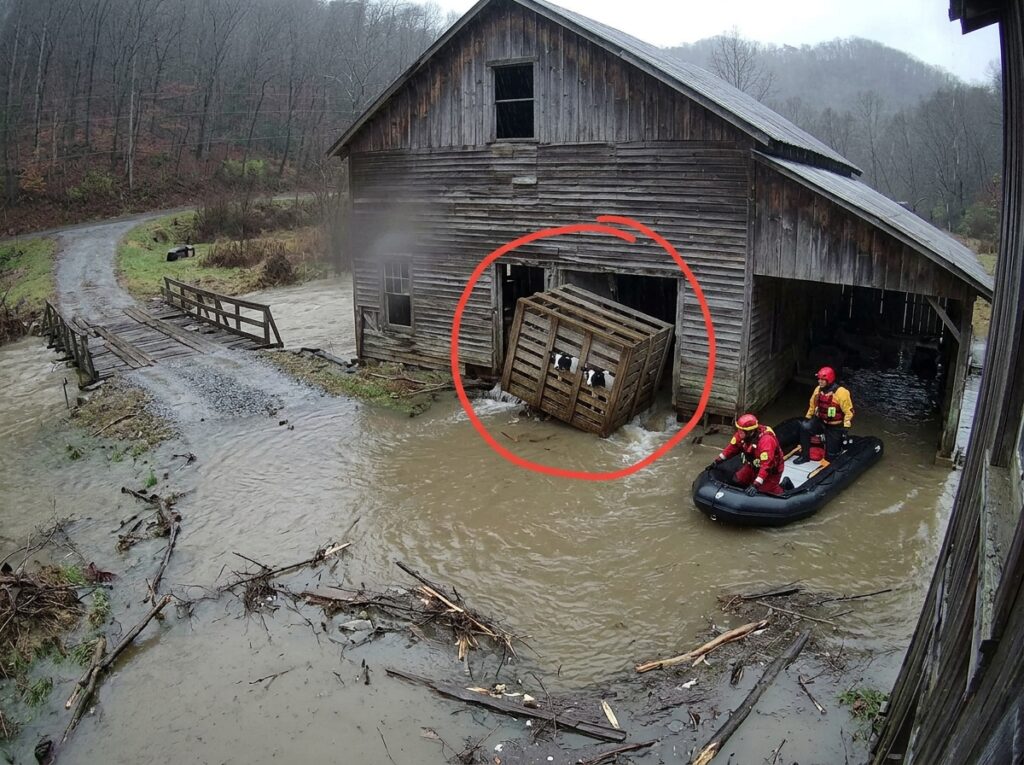
At 4:43 PM, the rescue crew reached the storage doorway.
One responder stabilized the crate while another examined the damaged boards.
The water was moving slowly inside the sheltered section, but the structure remained hazardous.
The crew worked carefully.
They secured the crate to prevent it from overturning.
Then they opened an accessible section without allowing the animals to escape into the floodwater.
The first goat kid was small.
Its coat was mostly black, with a white patch across its forehead.
The second was brown and white.
Both were wet.
Both were trembling.
But both were alive.
The responders transferred them into suitable secure containers and moved them toward the rescue boat.
Daniel watched from the bank.
“Two,” he whispered.
“Two more.”
Then Rebecca’s radio crackled.
“Hold position. We have another sound inside.”
Daniel turned.
“What?”
A responder pointed toward the rear of the storage building.
Beyond the broken shelving, a faint bleat echoed from the darkness.
Rebecca checked the inspection camera.
A small shape moved behind an overturned feed bin.
The camera angle was poor.
The team could see part of a pale muzzle.
And one dark ear.
Another animal.
But the narrow opening was blocked by debris.
Rebecca assessed the situation.
“We’re not going to force our way through unstable material.”
The crew repositioned the inspection camera and examined the obstruction.
A broken shelf had fallen across the rear passage.
Behind it was a raised concrete platform.
A small goat kid stood on the platform, surrounded by shallow water.
Its front legs were braced against the wall.
It was frightened.
But it appeared able to stand.
The responders evaluated whether the debris could be moved safely from their current position.
At 5:06 PM, they began removing loose material with appropriate tools.
One board came free.
Then another.
The goat retreated toward the rear wall.
A responder used a protective barrier to guide it away from the moving debris.
Finally, the opening was large enough for the trained crew to secure the animal.
The kid was lifted into a transport container.
It was cream-colored, with brown markings around its ears.
And it was barely larger than the goat Cooper had protected that morning.
Daniel exhaled.
“Three.”
Rebecca nodded.
“Three confirmed alive.”
The team conducted another limited visual inspection of accessible areas.
No additional animals were visible.
But they did not declare the entire property clear until the appropriate follow-up assessment could be completed.
At 5:24 PM, the rescue boat returned to higher ground.
The three goat kids were transferred to waiting animal care personnel.
Their body temperatures were low.
They were exhausted.
And all three required veterinary evaluation.
Daniel watched the smallest kid settle inside its carrier.
He thought about Cooper standing in the flooded pasture.
The old dog’s white muzzle.
His trembling legs.
And the tiny goat trapped beneath the gate.
Now three more animals had been found.
Daniel called Thomas.
“We got them.”
Thomas stood up.
“How many?”
“Three goat kids. All alive.”
Thomas covered his mouth.
“Thank God.”
“They’re going for veterinary care now.”
Thomas sat down slowly.
“Daniel, do they belong to someone?”
“We’re still trying to establish that.”
He hesitated.
“And the truck?”
“No confirmed location yet.”
Thomas looked toward the rain outside.
“Do you think somebody abandoned them?”
“We don’t have enough evidence to say that.”
Daniel explained that investigators were reviewing the available recordings and contacting local livestock owners.
The white pickup might have been transporting animals.
It might have stopped because of the storm.
And the crate at the mill might have been moved there before the flooding.
The camera footage did not establish what happened.
Thomas understood.
But the uncertainty troubled him.
Somewhere, four young goats had nearly drowned.
And nobody had reported them missing.
That evening, the county animal control office began contacting farms and livestock transport operators in the surrounding area.
They checked recent reports of missing animals.
They reviewed the available camera footage.
And they asked the public for information without making accusations.
By 8:16 PM, investigators had received a possible lead.
A livestock hauler from a neighboring county reported that a white pickup matching the general description had been used earlier that week to move animals from a small farm being evacuated because of flooding.
The hauler’s name was Michael Carter.
He had been helping an elderly farmer named Ruth Walker relocate several goats.
But Michael had not returned home after the storm.
His family had been trying to reach him since morning.
Daniel listened carefully.
“Was he driving toward the mill?”
“That’s one of the routes he may have taken,” the investigator answered.
“Then we need to find him.”
The next morning, county officials located Michael’s white pickup on a gravel road above the flooded creek.
The vehicle was damaged but not submerged.
Michael was alive.
He had taken shelter overnight at a nearby farmhouse after his truck became stuck in mud and his phone stopped working.
He explained that he had been transporting several young goats when the storm intensified.
The road toward the main highway had flooded.
He turned toward the old mill, hoping to find higher ground.
But rising water made the route impassable.
Michael said he had moved a livestock crate into the raised storage area to protect the animals temporarily while he sought help.
He had not expected the building to flood so quickly.
Then he attempted to return to the truck.
But the road had become unsafe.
He walked toward a nearby farmhouse and remained there until conditions improved.
Investigators documented his account and compared it with the available evidence.
The footage did not prove every detail.
But the explanation was consistent with the reported livestock evacuation and the location of the recovered animals.
Thomas received the update from Daniel.
“So he didn’t just leave them?”
“According to his account, he was trying to get them out of the flood. The authorities are still documenting what happened.”
Thomas exhaled.
He had spent the previous evening imagining the worst.
Now the situation looked different.
A man trying to move livestock away from danger.
A storm that overwhelmed the roads.
A crate left in what seemed like temporary shelter.
And floodwater that rose faster than anyone expected.
Thomas shook his head.
“That storm caught everybody off guard.”
Daniel nodded.
“It did.”
Then Thomas asked the question that mattered most.
“Does Ruth know her goats are alive?”
Daniel smiled.
“She’s on her way to the veterinary facility.”
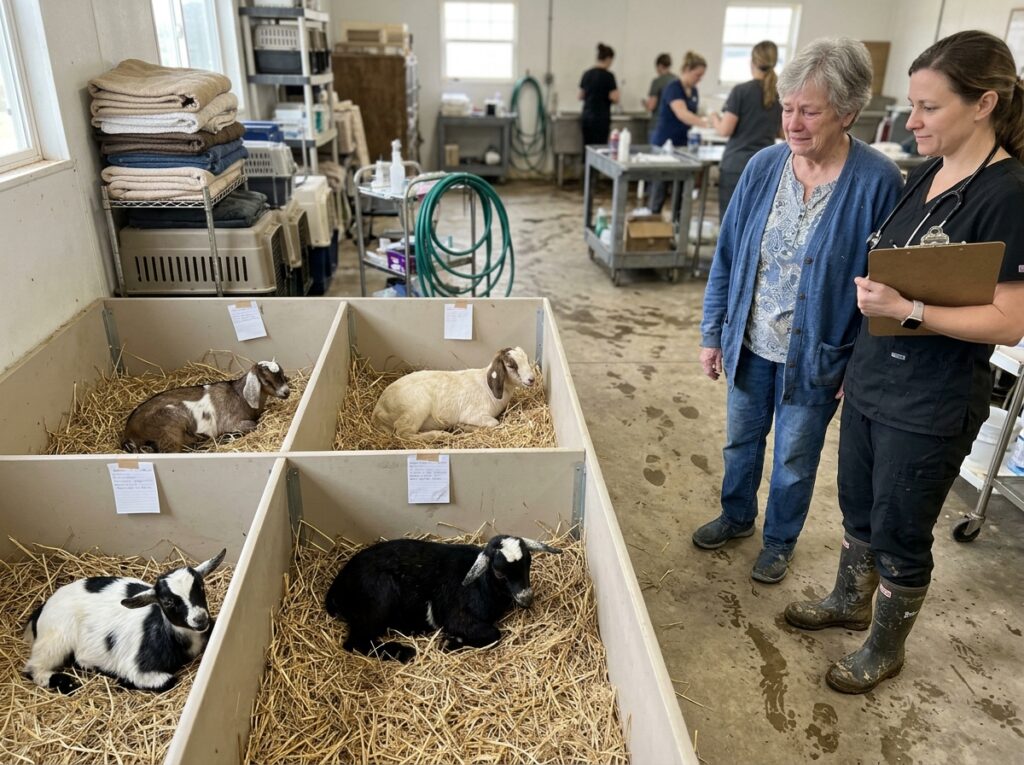
At 11:32 AM, Ruth Walker arrived at the veterinary facility.
She was seventy-six years old.
Her small farm sat in a low valley outside Greeneville.
She had raised goats for nearly twenty years.
Some were sold to neighboring farms.
Others remained on her property for breeding and herd management.
But the four young kids rescued from the flood had been born during the previous weeks.
Ruth had worried about them constantly.
When the storm warnings intensified, she arranged for Michael to help move the animals to safer ground.
Then the roads flooded.
Michael disappeared from contact.
And the goats never arrived.
Ruth had spent the night wondering whether they had survived.
Now she stood beside the recovery pens.
The veterinarian explained that all four kids were stable.
They had been cold and dehydrated.
But their body temperatures were improving.
They were receiving appropriate feeding and supportive care.
Ruth pressed a hand against her chest.
“All four?”
The veterinarian nodded.
“All four are alive.”
Ruth began crying.
She approached the pens only as permitted by the veterinary staff.
The smallest black-and-white kid lifted its head.
Ruth smiled through tears.
“There you are.”
She looked toward the others.
“You little troublemakers.”
The veterinarian explained that the animals would need continued observation before returning to normal housing.
Ruth nodded.
“Whatever they need.”
Then she asked about the dog.
“The man told me an old golden retriever found one of them.”
The veterinarian smiled.
“Yes. The dog was rescued from the flooded pasture along with the first kid.”
Ruth wiped her eyes.
“Is he all right?”
“He’s stable and recovering.”
Ruth looked toward the window.
“I’d like to thank his owner.”
That afternoon, Thomas received a call from the veterinary clinic caring for Cooper.
The old retriever had improved.
His body temperature was normal.
His breathing was stable.
And he was eating small meals.
But the veterinarian remained concerned about his exhaustion and stiffness.
At nearly thirteen years old, Cooper needed additional rest and monitoring.
Thomas listened carefully.
“Can I bring him home?”
“If his progress continues, we expect he can go home soon.”
Thomas smiled.
“That’s the best news I’ve heard all day.”
The following morning, Cooper was cleared to return home with instructions for rest, warmth, and follow-up care.
Thomas drove to the clinic.
When the staff brought Cooper into the examination room, the old dog lifted his head.
His tail moved.
Slowly.
Then faster.
Thomas knelt beside him.
“Hey, buddy.”
Cooper pressed his gray muzzle against Thomas’s hand.
Thomas swallowed.
“You scared me.”
The dog leaned closer.
Thomas wrapped his arms around him carefully.
For a moment, he couldn’t speak.
He remembered the morning Ellen died.
The empty bedroom.
The silence that followed.
And Cooper waiting beside the door, confused by the absence of the person who had always greeted him.
Thomas had spent eighteen months learning how to live in a house that felt too large for one person.
Cooper had been there every day.
Every quiet breakfast.
Every lonely evening.
Every time Thomas sat beside Ellen’s photograph.
Now, after nearly losing the dog too, Thomas realized how frightened he had been.
He rested his forehead against Cooper’s.
“Not ready to say goodbye to you yet, old boy.”
Cooper’s tail tapped against the floor.
Thomas laughed through tears.
“Yeah. I know.”
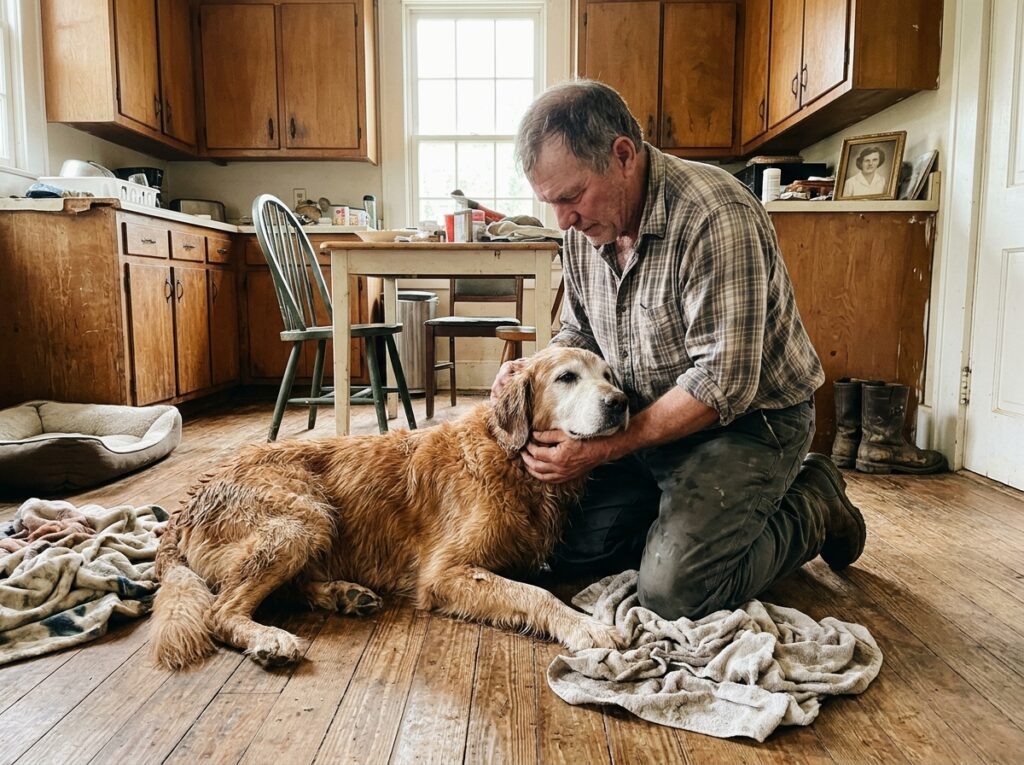
Over the following weeks, the floodwaters receded.
The damaged cattle gate on Bennett Family Farm was replaced.
The lower pasture was cleared of debris.
And the creek gradually returned to its normal course.
Thomas repaired fences.
Checked his cattle.
And continued caring for Cooper.
The old dog spent most mornings resting beside the kitchen door.
He no longer followed Thomas across the entire farm.
His joints were stiff.
And the veterinarian had recommended limiting strenuous activity while he recovered.
But Cooper still lifted his head whenever Thomas reached for his boots.
Thomas smiled every time.
“Not today, buddy.”
Cooper would sigh.
Then settle back onto his bed.
Thomas laughed softly.
“You’ve earned a little retirement.”
Meanwhile, Ruth’s four goat kids continued recovering.
The veterinary team monitored their feeding, body condition, and mobility.
All four gradually returned to normal behavior.
Once they were medically cleared, Ruth arranged appropriate transport to a safe livestock facility away from the flood-prone area.
She contacted Thomas through Daniel.
“I wanted to thank you,” she said.
Thomas shook his head.
“Cooper deserves most of the credit.”
Ruth smiled.
“Then I’d like to meet him.”
A week later, Ruth visited Bennett Family Farm.
She brought a small basket of homemade biscuits.
Thomas welcomed her into the kitchen.
Cooper was resting beside the table.
When Ruth entered, the old dog lifted his head.
His tail moved gently.
Ruth knelt a comfortable distance away.
“Well, hello there.”
Cooper looked at her.
Then slowly stood.
Thomas watched carefully.
The dog walked toward Ruth.
She held out her hand.
Cooper sniffed it.
Then rested his gray muzzle against her palm.
Ruth began crying.
“Oh, sweetheart.”
Thomas smiled.
“He’s always liked visitors.”
Ruth stroked the dog’s head gently.
“One of those little goats is alive because you were out there.”
Thomas looked down.
“We can’t know exactly what Cooper understood.”
Ruth nodded.
“But he stayed beside that gate.”
“He did.”
She looked at the old dog.
“Whatever made him stay, I’m grateful.”
Thomas swallowed.
“So am I.”
They sat at the kitchen table for nearly an hour.
Ruth told Thomas about her farm.
Her goats.
And the frightening night when the roads flooded.
Thomas told her about Ellen.
How she had loved animals.
How she used to keep a jar of dog treats beside the kitchen sink.
And how Cooper had slept near her chair every evening.
Ruth listened quietly.
Then she said:
“Your wife sounds like she was a wonderful woman.”
Thomas looked toward Ellen’s photograph.
“She was.”
For a moment, the kitchen fell silent.
Then Ruth smiled.
“I think she would’ve loved this story.”
Thomas laughed softly.
“She would’ve been the first one out there trying to rescue those goats.”
Ruth nodded.
“Then perhaps she’d be proud of all of you.”
Thomas looked down at Cooper.
The old dog was sleeping beside the table.
His paws twitched slightly.
And his gray muzzle rested against the floor.
Thomas smiled.
“Maybe she would.”
By spring 2027, Bennett Family Farm had returned to its familiar rhythm.
The pastures were green.
The creek ran clear.
And cattle grazed beneath the wooded hills.
The broken gate had been replaced with a stronger structure.
Drainage channels were inspected.
And Thomas worked with neighbors to improve flood preparedness around low-lying livestock areas.
Ruth’s goats were healthy.
Michael Carter had recovered from his ordeal.
And the county had documented the rescue and the circumstances surrounding the livestock transport.
The white pickup truck had not been part of a deliberate abandonment.
It had been involved in an attempted evacuation that went wrong during severe flooding.
The final review found no evidence that the animals had been intentionally left to die.
Thomas was relieved.
The story had begun with suspicion.
But the truth was more complicated.
A dangerous storm.
A failed route.
A frightened livestock hauler.
And animals caught in the consequences.
Then one morning, Thomas received a photograph from Ruth.
Four young goats stood in a grassy paddock.
They were larger now.
Their coats were clean.
And they appeared healthy.
Ruth had written:
“All four are doing well. Thought Cooper might like to know.”
Thomas laughed.
He looked toward the old dog sleeping beside the porch door.
“Hey, buddy.”
Cooper opened one eye.
“Your little friends are growing up.”
The dog’s tail moved once.
Thomas smiled.
“Yeah. I thought you’d be happy.”
He placed the photograph beside Ellen’s picture on the kitchen shelf.
Then he stepped outside.
The morning was cool.
The pasture was green.
And a bald eagle circled high above the creek.
Thomas watched it glide toward the distant trees.
He remembered the security footage from that terrible November morning.
The eagle landing on the fence.
Cooper standing chest-deep in floodwater.
The broken cattle gate.
And the tiny goat trapped beneath the debris.
The eagle hadn’t been trying to rescue anyone.
It had simply landed near a flooded pasture while searching for food or a resting place.
But its movement had drawn Thomas’s attention to the camera.
And that had led to Cooper’s rescue.
Then the discovery of the goat.
Then the investigation at the abandoned mill.
And finally, three more young animals brought to safety.
Thomas looked toward the lower pasture.
The new gate stood firmly in place.
The creek flowed quietly beyond it.
He heard footsteps behind him.
Cooper had walked onto the porch.
The old dog stood beside the door, his white muzzle lifted toward the morning air.
Thomas smiled.
“Morning, buddy.”
Cooper wagged his tail.
Thomas sat on the porch step.
The dog moved closer and rested his head against Thomas’s knee.
For a long time, neither moved.
Thomas thought about Ellen.
The years they had spent together.
The life they had built on the farm.
And the old dog who had remained beside him through everything.
He stroked Cooper’s gray head.
“You know something?”
Cooper looked up.
Thomas smiled.
“I think you’ve done enough rescuing for one lifetime.”
The dog sighed and settled beside him.
Thomas laughed softly.
“Yeah. Me too.”
A breeze moved through the pasture.
Birds called from the trees.
And the morning sunlight spread across the valley.
Somewhere on another farm, four young goats were growing stronger.
Somewhere along the creek, the flood debris had been cleared.
And on the porch of Bennett Family Farm, an old golden retriever rested beside the man who loved him.
Thomas looked down at Cooper.
Then toward Ellen’s photograph through the kitchen window.
His eyes filled.
But this time, he was smiling.
The world would never know exactly why Cooper refused to leave that flooded gate. But Thomas knew one thing: his old friend had stayed beside a helpless animal when walking away might have been easier. And because people noticed, four young goats and one beloved dog had been given another chance.
Thomas rested his hand on Cooper’s shoulder.
“Good boy.”
The old retriever closed his eyes.
And together, they watched the quiet Tennessee morning.
THE END
No Comments