

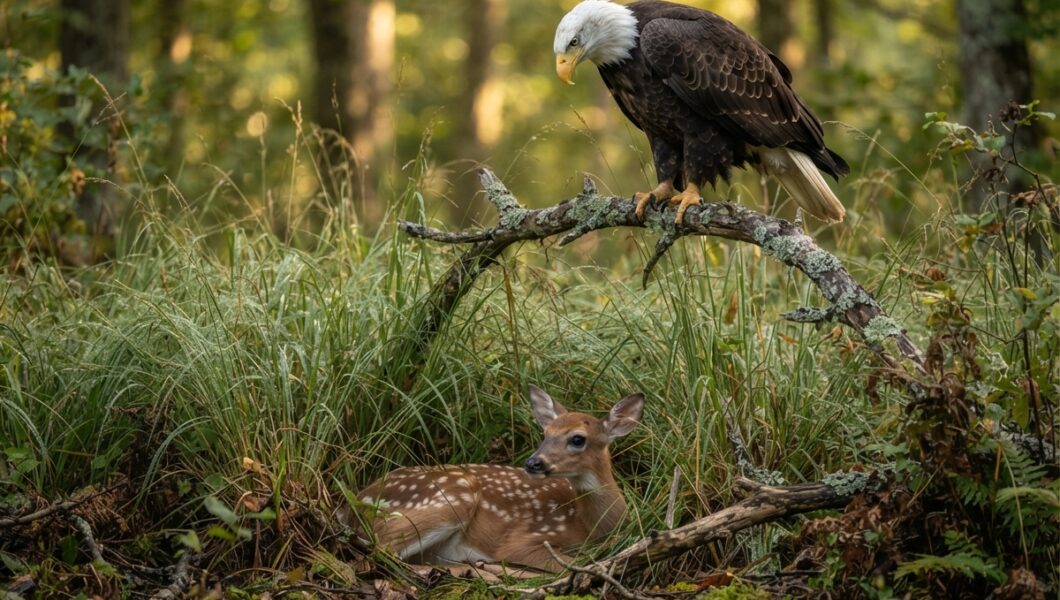
The farmer thought the story was over when the fawn disappeared into the trees.
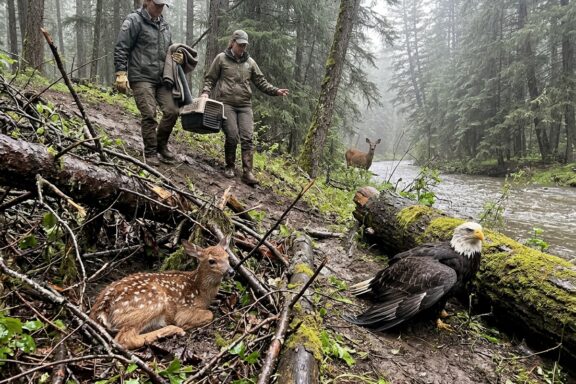
The young deer had been trapped beneath a fallen branch for who knew how long. Its hind leg had been pinned against the ground, hidden beneath dried leaves and tall grass so effectively that a person could have walked past without ever noticing.
But the eagle had noticed.
Or at least, it had noticed something.
That was the question the farmer kept returning to.
When he checked the trail camera again that evening, he expected to see ordinary wildlife moving through the clearing. Perhaps a raccoon. Maybe a fox. A deer crossing in the distance.
Instead, at 4:38 PM, the bald eagle returned.
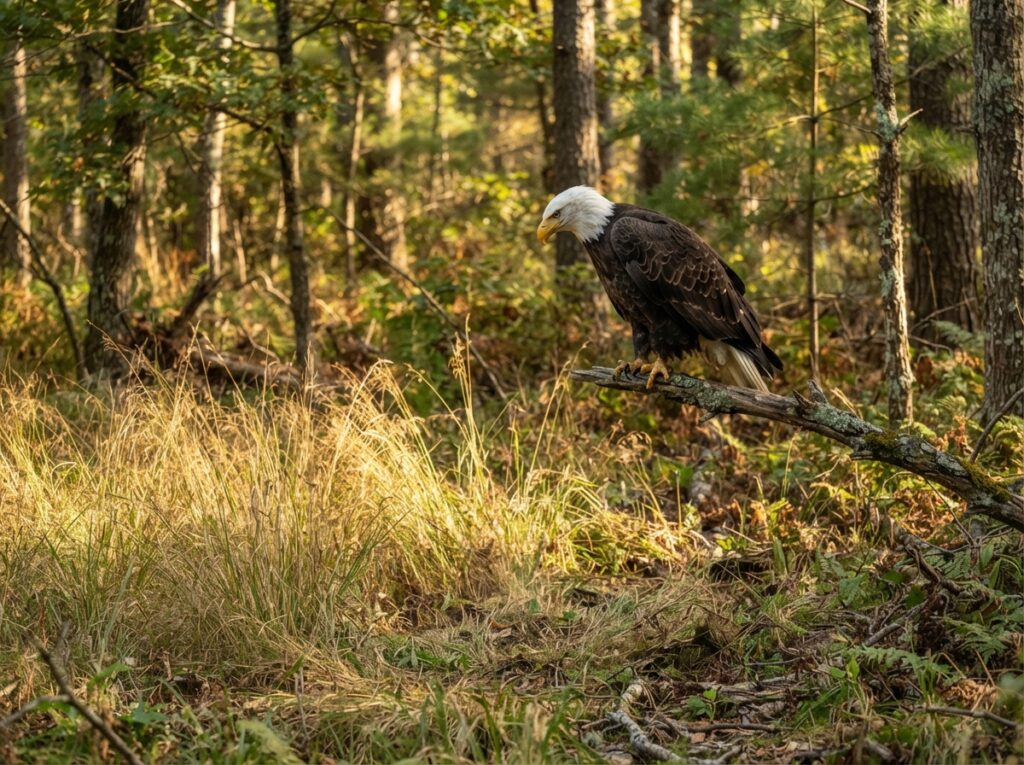
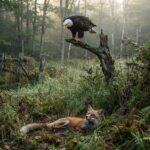
The camera showed it landing on the same low branch.
The exact branch.
The one overlooking the patch of grass where the fawn had been trapped.
The eagle stood there quietly.
It looked down.
Then it shifted its position and looked toward the woodland.
The fawn was gone.
For several minutes, the eagle remained in place.
Then it flew away.
The farmer watched the footage twice.
He couldn’t explain why the moment affected him so much.
The eagle had not carried the fawn away.
It had not attacked it.
It had not obviously rescued it.
A human had done that.
The wildlife rescuer had carefully lifted the branch, examined the young deer, and waited until it was strong enough to walk away.
But the eagle had been there before anyone knew the fawn was trapped.
And now it had returned after the fawn was gone.
That detail stayed in the farmer’s mind.
The next morning, he walked back to the clearing.
He did not go looking for the fawn.
He knew better than to disturb a young deer that might still be hiding nearby.
Instead, he stood at the edge of the trees and looked across the grass.
The place looked completely different in daylight.
The previous afternoon, he had seen a frightened animal lying almost invisible beneath the vegetation.
Now there was barely any evidence that anything had happened.
The grass had begun to spring back upright.
A few broken leaves marked the place where the branch had been lifted.
The woods had returned to their ordinary rhythm.
That was what surprised him most.
Nature had already moved on.
The wind moved through the branches.
Small birds jumped between the trees.
A squirrel ran along a fallen log.
Somewhere in the distance, a vehicle passed on the road.
And the place where a young deer had been trapped looked almost completely normal.
The farmer checked the trail camera again.
Nothing unusual appeared that morning.
Then, just after sunrise, a deer walked across the far edge of the clearing.
The farmer leaned closer to the screen.
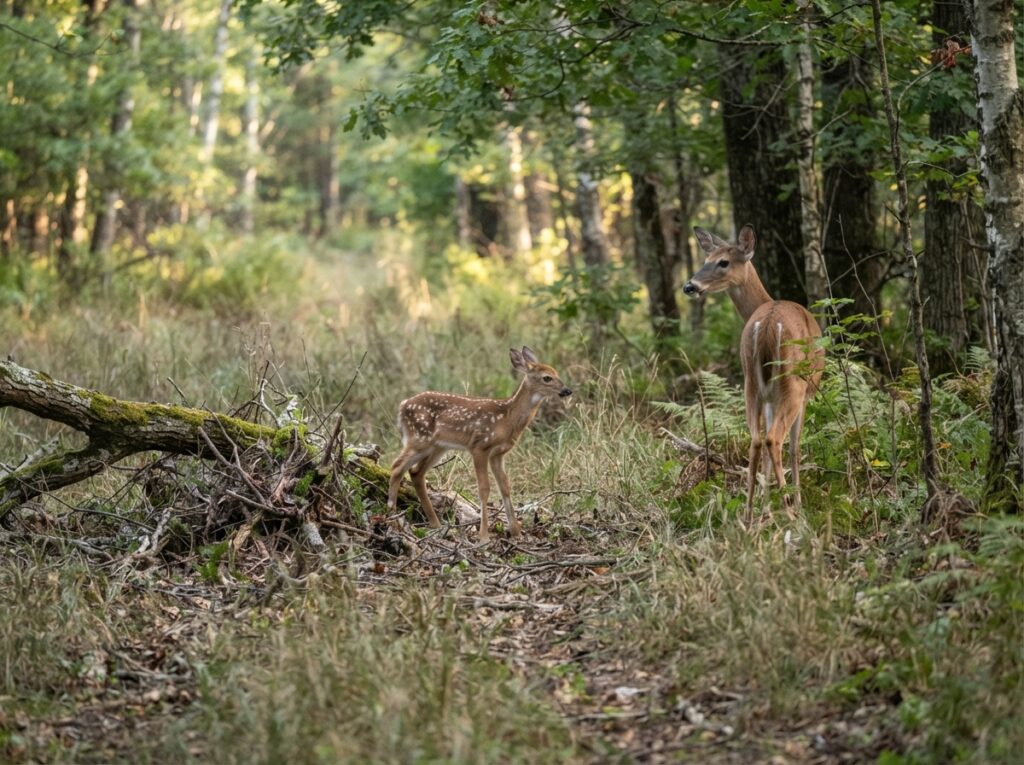
It was an adult doe.
She moved slowly through the trees, stopping occasionally to listen.
Then another shape appeared behind her.
A small fawn.
The farmer immediately recognized the movement.
The little deer followed its mother carefully.
It wasn’t limping.
It wasn’t dragging a leg.
It wasn’t struggling to stand.
It simply walked.
The farmer watched the recording several times.
There was no way to prove it was the same fawn.
The camera angle was too distant, and the markings were not clear enough to identify the animal with certainty.
But he hoped.
He hoped it was the same young deer.
Because after everything that had happened, seeing a healthy fawn following its mother was the kind of ending he wanted.
The farmer kept the footage.
He also kept the earlier recording.
The one showing the eagle.
When he placed the two clips beside each other, the contrast was striking.
In the first, the fawn was trapped.
In the second, it was walking behind its mother.
Between those two moments was a rescue that had only happened because someone had followed an unusual clue.
But there was still one part of the story that bothered him.
Why had the eagle kept returning?
The farmer knew enough about wildlife not to turn an unexplained behavior into a sentimental story.
The eagle was a predator.
A fawn was vulnerable.
There was an obvious possibility that the bird had simply noticed an easy potential meal.
Perhaps the eagle had been waiting.
Perhaps it had been watching for an opportunity.
Perhaps the repeated visits had nothing to do with helping the deer.
And yet, the behavior had not looked quite like a normal hunting attempt.
The eagle had spent long periods sitting on a branch.
It had moved between several trees.
It had looked toward the grass.
It had returned again and again.
There had been no dive.
No attack.
No attempt to approach the fawn directly.
But none of that proved intention.
The farmer understood that.
Still, there was something about those recordings that he couldn’t forget.
A few days after the rescue, he noticed another unusual sequence on the camera.
At 6:14 AM, the eagle appeared again.
It landed on the same low branch.
The branch overlooking the clearing.
It looked down.
Then it looked toward the trees.
A few seconds later, it turned its head toward the grass where the fawn had been trapped.
It remained there for almost ten minutes.
Then it flew away.
The farmer watched the footage silently.
The fawn was no longer there.
The place was empty.
Whatever had originally drawn the eagle to that patch of woodland was gone.
Yet the bird had returned anyway.
That was when the farmer began to wonder whether the eagle had been responding to more than movement.
Maybe it had noticed the fawn struggling.
Maybe it had been waiting for an opportunity.
Maybe it had been guarding a feeding territory.
Maybe it had simply been curious about something unusual below.
There were too many possibilities.
And the camera could not answer any of them.
The following week, the farmer contacted the wildlife rescuer who had helped free the fawn.
He showed her the recordings.
She watched the first sequence carefully.
Then the second.
Then the footage from after the rescue.
When it ended, she smiled.
“I can see why you’re curious.”
“Do you think it knew the fawn was trapped?”
She paused.
“It probably noticed something. Whether it understood what was happening is impossible to say.”
The farmer nodded.
That answer sounded familiar.
It was the same lesson he had already learned.
Wild animals can notice things we don’t.
But noticing something is not the same as understanding it the way a human would.
“Still,” he said, “if it hadn’t kept coming back, I might never have gone out there.”
The rescuer nodded.
“That’s the part that matters.”
Not whether the eagle was trying to help.
Not whether the eagle understood the danger.
The important thing was what happened because someone paid attention.
The farmer had seen something unusual.
Instead of ignoring it, he followed the clue.
And beneath a fallen branch, he found a young animal that needed help.
Weeks passed.
The fawn did not appear again on every recording.
Sometimes days went by without a single deer entering the clearing.
Then one morning, the camera captured the doe again.
This time, the fawn was larger.
It moved more confidently through the grass.
The little deer stopped beside its mother and began feeding.
The farmer smiled when he saw it.
He still couldn’t prove it was the same animal.
But he had started recognizing the pattern of its movement.
The careful steps.
The slight hesitation before entering open ground.
The way it stayed close to the doe.
He saved that footage too.
Then he noticed something else.
High above them, almost hidden against the pale morning sky, a bald eagle passed over the trees.
The camera caught only a few seconds of it.
The bird crossed the frame and disappeared.
The doe continued walking.
The fawn followed.
Nothing happened.
And perhaps that was exactly what the farmer wanted to see.
No emergency.
No injury.
No rescue.
Just a young deer living normally.
The eagle continued living its own life too.
It hunted.
It traveled.
It perched in the trees.
It came and went from the woodland.
The two animals were not friends.
There was no evidence of a special bond.
There was no way to know whether the eagle remembered the fawn.
And the farmer stopped trying to give the encounter an answer it could not provide.
Instead, he began thinking about the first moment differently.
At 6:14 that morning, he had seen an eagle land in the clearing.
At first, it was simply a bird.
Then it returned.
Again.
And again.
The repeated behavior created a question.
Why?
That question caused him to leave the farmhouse.
It caused him to walk into the woods.
It caused him to stop when he heard a faint sound.
And it caused him to look beneath the grass.
The answer was a frightened young deer.
Sometimes the most important part of a rescue happens before anyone realizes a rescue is needed.
It begins with noticing.
A strange sound.
An unusual movement.
An animal behaving differently.
A bird returning to the same place.
Something that does not quite fit the ordinary pattern.
The farmer thought about that often.
He had walked through those woods many times.
He knew the clearing.
He knew the trees.
He knew how easily a small animal could disappear beneath the grass.
But on that particular day, the eagle gave him a reason to look more carefully.
And looking carefully changed everything.
One evening, months later, he sat inside the farmhouse reviewing old trail-camera footage.
He stopped at the first recording.
6:14 AM.
The eagle landed.
He watched the bird look toward the grass.
Then he watched the next recording.
The eagle returned.
Then the next.
And the next.
Finally, he reached the footage showing the fawn walking away after the branch had been lifted.
The young deer stumbled once.
Then steadied itself.
A few seconds later, it disappeared into the trees.
The farmer watched until the screen was empty.
He realized that was the moment he wanted to remember.
Not because it proved the eagle had saved the fawn.
It didn’t.
Not because it proved the eagle understood the situation.
It didn’t.
And not because every strange wildlife behavior has a hidden meaning.
It doesn’t.
He wanted to remember it because an unexplained moment had made someone pay attention.
That was enough.
The eagle might have been hunting.
It might have been curious.
It might have noticed a struggling animal.
It might have been responding to something else entirely.
Nobody would ever know.
But the fawn was free.
And later, the camera showed it walking beside its mother.
Sometimes that is the only ending a rescue story needs.
Not a dramatic reunion.
Not a miracle.
Not an explanation.
Just life continuing.
The next spring, the farmer still kept the trail camera pointed toward the clearing.
The woodland changed with the seasons.
Snow disappeared.
The grass turned green.
Flowers appeared along the edge of the trees.
Young leaves filled the branches.
The same wildlife returned.
Deer.
Foxes.
Turkeys.
Raccoons.
And, occasionally, the bald eagle.
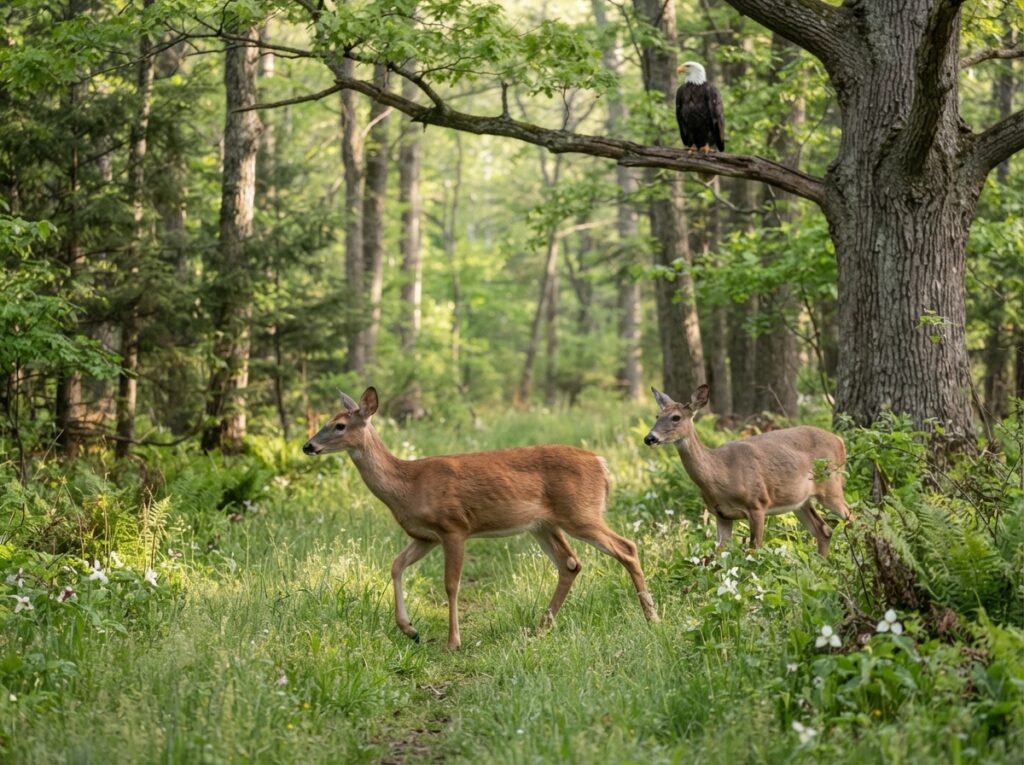
One morning, the camera caught it landing on the same low branch.
The eagle looked toward the clearing.
Below it, several deer moved through the grass.
One was a young deer, nearly grown.
The eagle watched for a moment.
Then it spread its wings and disappeared over the trees.
The deer continued feeding.
Nothing happened.
The farmer smiled when he saw the footage.
He didn’t need anything else.
He had learned not to force a meaning onto wildlife.
Sometimes animals do extraordinary things for reasons we understand.
Sometimes they do ordinary things that happen to lead to extraordinary consequences.
And sometimes, we simply don’t know.
But there is value in paying attention anyway.
Because somewhere beneath the leaves, behind the branches, or just beyond the path we normally take, something may be happening that we would never notice unless we stopped and looked.
That young fawn had been almost invisible.
The branch had hidden its body.
The grass had hidden its movement.
The woods had hidden its distress.
But the eagle’s repeated presence created a question.
And that question brought a person closer.
The farmer never called the eagle a rescuer.
He never claimed the bird had saved the deer.
He simply described what the camera showed.
An eagle returned repeatedly to one clearing.
A fawn was trapped there.
A human noticed.
The branch was lifted.
The fawn walked away.
Later, a healthy young deer appeared on the same camera.
And the eagle continued flying over the woodland.
Maybe there was a connection.
Maybe there wasn’t.
The truth was that the camera could record what happened.
It could not record what the eagle was thinking.
But perhaps that uncertainty was part of what made the story worth remembering.
Because not every act of kindness begins with certainty.
Sometimes it begins with a question.
Why is that bird here?
Why does it keep coming back?
Why does something feel different?
And sometimes, if we take the time to follow that question, we discover something that was waiting quietly to be noticed.
The farmer never forgot the little fawn beneath the fallen branch.
He never forgot how easily it could have been missed.
And whenever the eagle returned to the clearing, he still looked up.
Not because he expected another rescue.
But because he had learned something simple.
When nature gives you a reason to look closer, sometimes you should.
The eagle may never have known what happened beneath that branch.
The fawn may never have known how close it came to being overlooked.
But the farmer knew.
And for him, that was enough.
No Comments