

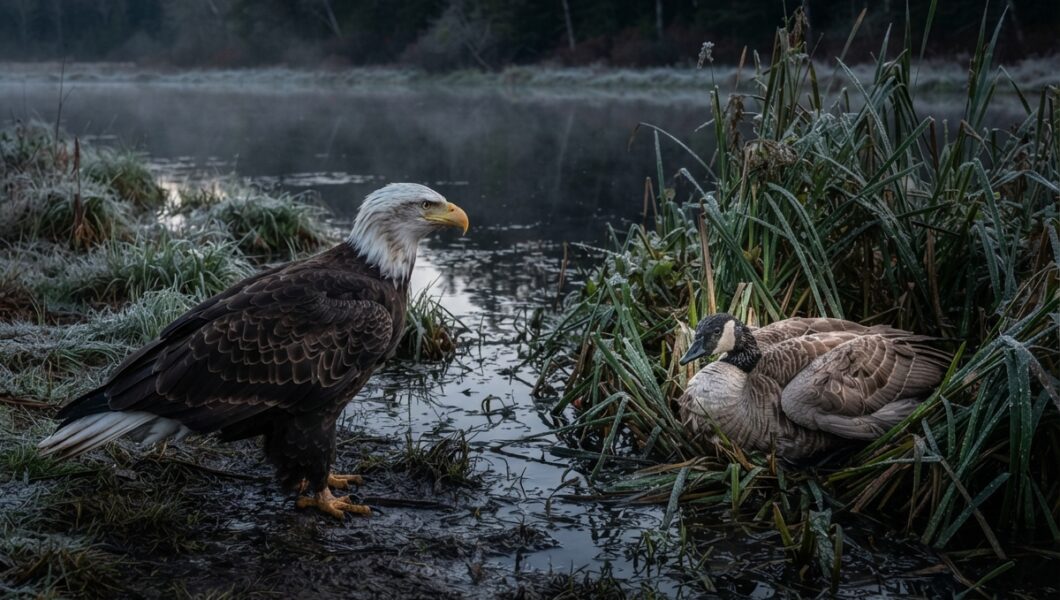
The homeowner thought he was watching an eagle looking for breakfast.
It was 5:42 in the morning, and the pond behind the house was still wrapped in the quiet of early dawn.
A thin layer of mist hovered above the water.
The trees along the far bank were dark silhouettes against the slowly brightening sky.
Then the bald eagle landed.
At first, there was nothing unusual about it.
Bald eagles occasionally visited the pond, especially during the colder months when the open water attracted fish and other wildlife.
But this eagle did something that caught the homeowner’s attention.
It didn’t dive.
It didn’t scan the water for fish.
It didn’t fly from tree to tree looking for prey.
Instead, it walked along the muddy shoreline.
Several steps.
Then it stopped.
It looked into the reeds.
The homeowner watched from the kitchen window, coffee still in his hand.
The eagle moved again.
Another few steps.
Then it stopped in almost exactly the same place.
Again, it looked toward the reeds.
Something had caught its attention.
The homeowner couldn’t see what.
From the kitchen window, the pond looked normal.
The reeds moved gently in the morning breeze.
The water was still.
Nothing appeared to be moving near the shoreline.
The eagle continued walking.
Then it turned around and came back.
That was when the homeowner became curious.
At 6:03, the eagle flew to a low branch overlooking the pond.
It settled there and looked directly toward the reeds.
The homeowner put down his coffee.
He watched for another minute.
Then he reached for his boots.
He wasn’t sure what he was looking for.
He simply wanted to see what had caught the bird’s attention.
Outside, the air was cold.
The homeowner walked slowly toward the pond.
The eagle immediately lifted from the branch and crossed the water.
It landed in a tree on the opposite side.
The homeowner stopped.
He didn’t want to disturb it.
Instead, he stood near the shoreline and looked into the reeds.
Nothing.
He took a few more steps.
Still nothing.
The eagle moved again.
This time, it landed farther down the bank.
The homeowner followed it with his eyes.
The bird turned its head toward the same section of reeds.
Again.
The homeowner frowned.
There had to be something there.
He walked closer.
The reeds were thick enough to hide a small animal.
He slowed down.
Then he heard it.
A faint rustling.
He stopped.
The reeds moved.
For a moment, he saw nothing.
Then something white appeared between the stems.
A feather.
He moved only a few inches closer.
And suddenly, the shape of a bird became visible.
A Canada goose.
It was lying low in the reeds.
Alive.
But clearly struggling.
One wing was held tightly against its body.
The goose tried to move when it noticed him.
It pushed against the muddy ground.
Its body shifted.
The injured wing dragged slightly.
Then it settled back down.
The homeowner froze.
He immediately understood why the eagle had been staring toward the reeds.
But he still didn’t know what the eagle had understood.
The goose was almost impossible to see from the house.
Even standing only a short distance away, the reeds had concealed most of its body.
If the eagle hadn’t kept returning to that exact section of shoreline, the homeowner might never have looked closely enough to find it.
He slowly backed away and called a local wildlife rescue organization.
While he waited, he watched from several yards away.
The eagle was still nearby.
It had returned to the pond and landed on a low branch across from the reeds.
The homeowner looked at the eagle.
Then at the goose.
For a moment, he wondered whether the bird had somehow been trying to draw his attention to the injured goose.
But he immediately pushed the thought away.
There was no way to know.
The eagle could have been watching because the goose was vulnerable.
It could have been curious.
It could have been considering the goose as potential prey.
Or it could have simply noticed something moving in the reeds.
Wild animals don’t explain themselves.
All the homeowner knew was that the eagle had made him look.
And now he knew there was an injured goose hidden below.
About twenty minutes later, the wildlife rescuer arrived.
She approached the pond carrying a towel and transport carrier.
When she saw the goose, she slowed immediately.
“Keep your distance,” she told the homeowner.
He stepped back.
The rescuer moved toward the reeds carefully.
The goose noticed her and tried to shift away.
She stopped.
“Easy.”
She waited.
The bird settled.
Then she gently moved the reeds aside.
The injury was clear.
The wing was swollen around the joint, and the goose was holding it tightly against its body.
There was no obvious open fracture.
That was encouraging.
The rescuer explained that the safest thing would be to cover the bird calmly before attempting to move it.
She placed the towel over the goose.
The bird struggled for a few seconds.
Then became still.
The rescuer carefully secured it and lifted it from the reeds.
The homeowner watched silently.
Only moments earlier, the goose had been almost completely hidden.
Now it was being carried toward the waiting vehicle.
The eagle suddenly lifted from its branch.
It circled once above the pond.
Then it disappeared beyond the trees.
The homeowner watched until it was gone.
He wondered if he would ever know why it had stayed.
The goose was transported to the rehabilitation center.
An examination revealed a significant soft-tissue injury to the wing.
Fortunately, there was no major fracture.
That was the news everyone had hoped for.
The goose was given supportive care and placed in a quiet enclosure where the rehabilitation team could monitor its condition.
The first few days were difficult.
It barely moved.
It stayed close to the side of the enclosure and kept its injured wing tucked against its body.
The rehabilitation staff monitored its eating and drinking.
They checked its weight.
They watched its breathing.
Most importantly, they watched the injured wing.
The homeowner received occasional updates.
Every time his phone rang, he hoped the news would be better.
Then, several days later, the update finally changed.
The goose was eating normally.
It had started moving around the enclosure.
Then came another improvement.
One morning, the goose slowly opened its injured wing.
Only a little.
But it opened.
The rehabilitation staff watched carefully.
Over the next several days, the movement improved.
The goose began stretching.
Then walking more.
Eventually, it was moved into a shallow recovery pool.
At first, it stayed close to the edge.
It moved slowly through the water.
Then it made a small circle.
The next day, it swam farther.
The day after that, farther still.
Weeks passed.
The goose grew stronger.
Its wing became more flexible.
Its swimming became almost completely normal.
The homeowner kept thinking about the pond.
He thought about the reeds.
He thought about the eagle.
He thought about how easily the goose could have remained hidden.
There had been no loud cry for help.
No obvious sign from the road.
No way for him to know that an injured bird was lying only a short distance from his house.
The eagle had simply behaved strangely.
And he had noticed.
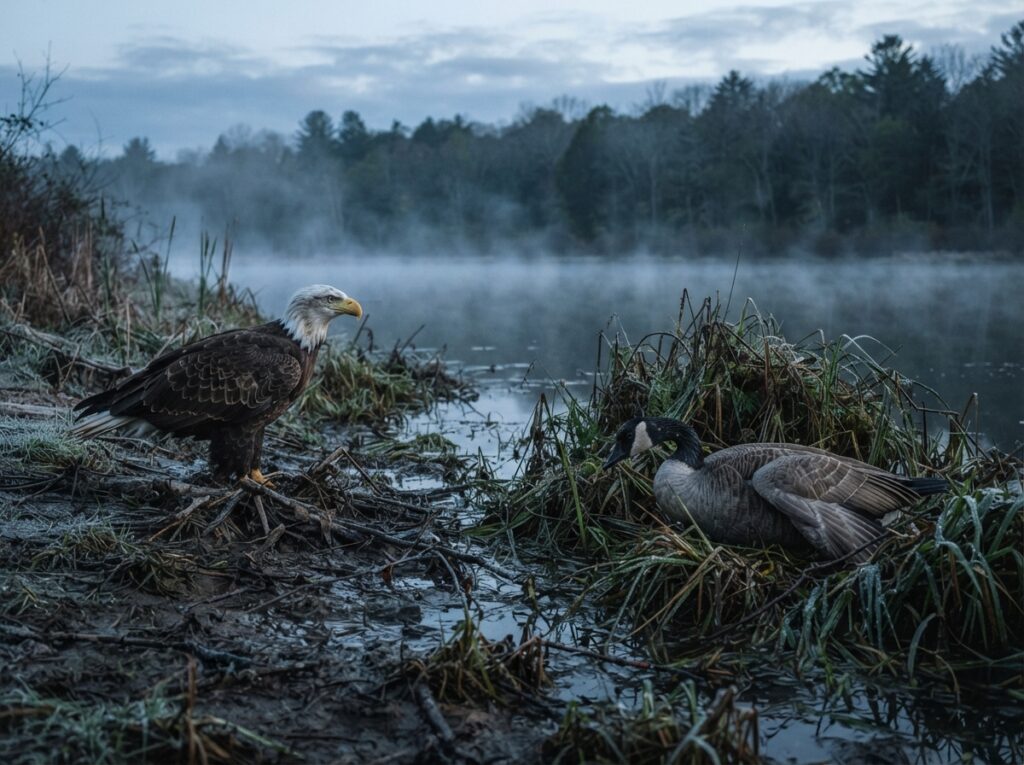
Several weeks after the rescue, the rehabilitation center called.
The goose was ready.
The homeowner returned to the pond.
He stood beside the same shoreline where he had first discovered the bird.
The reeds were still there.
The muddy bank was still there.
The trees were still there.
Everything looked almost exactly the same.
But he knew how different the place was now.
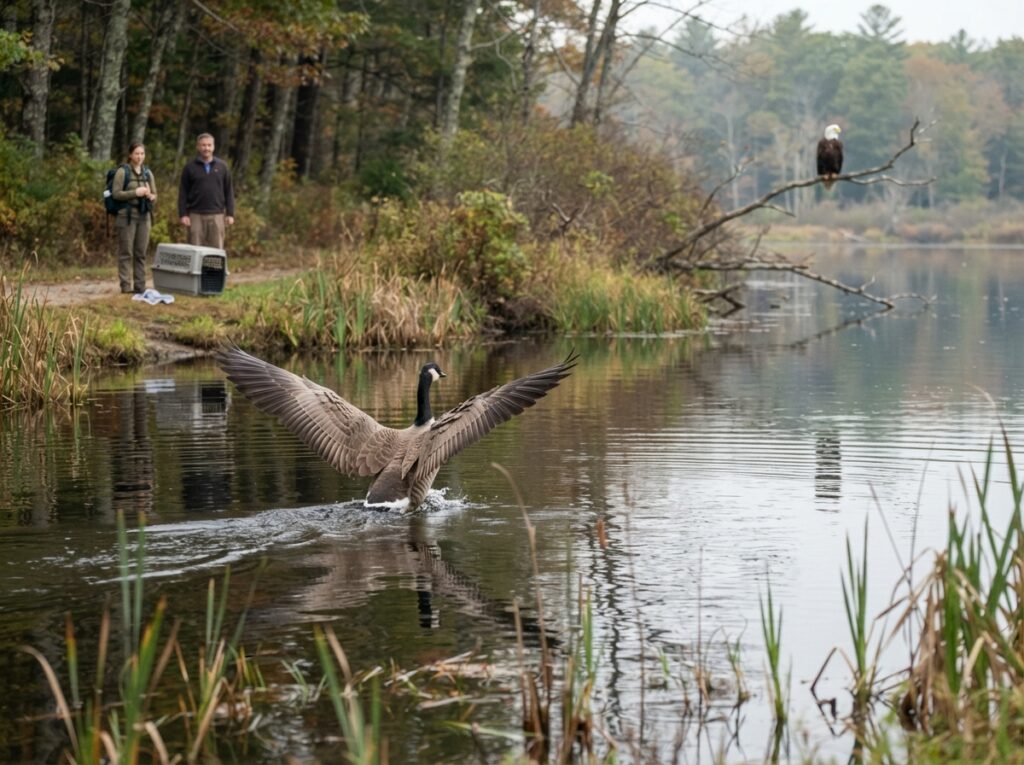
The carrier was placed near the water.
The door opened.
The goose remained inside.
For several seconds, it didn’t move.
Then it stepped forward.
One foot.
Then another.
It stopped at the edge of the pond.
The homeowner held his breath.
The goose entered the water.
At first, it moved slowly.
Then it began swimming.
One gentle stroke after another.
It moved farther from the shore.
The homeowner watched its body become more relaxed.
Then the goose stretched its neck.
It dipped its head into the water.
And finally, it opened both wings.
The injured wing moved with the other.
Fully.
The homeowner smiled.
“That’s a good sign.”
The goose continued swimming.
It no longer looked like the exhausted bird he had found hidden among the reeds.
It looked like a wild bird again.
A few minutes later, something appeared above the trees.
The homeowner looked up.
A bald eagle.
He recognized it immediately.
The eagle circled once over the pond.
Then it landed on a branch on the far side.
The homeowner looked back at the goose.
The goose continued swimming.
The eagle watched.
Neither animal approached the other.
There was no dramatic interaction.
No sudden movement.
No obvious sign of recognition.
The eagle simply remained there for several minutes.
Then it spread its wings and disappeared into the woodland.
The goose stayed on the pond.
The homeowner watched until it disappeared among the reeds.
For a moment, he wondered whether it had all somehow come full circle.
The same pond.
The same reeds.
The same kind of early morning light.
The same eagle.
But he knew better than to turn an uncertain wildlife encounter into something it couldn’t prove.
Maybe the eagle remembered the goose.
Maybe it didn’t.
Maybe it had never been concerned about the goose at all.
Maybe it had simply noticed movement.
There was no way to know.
But there was one thing the homeowner knew with certainty.
That first morning, the eagle had caused him to look closer.
And looking closer had changed everything.
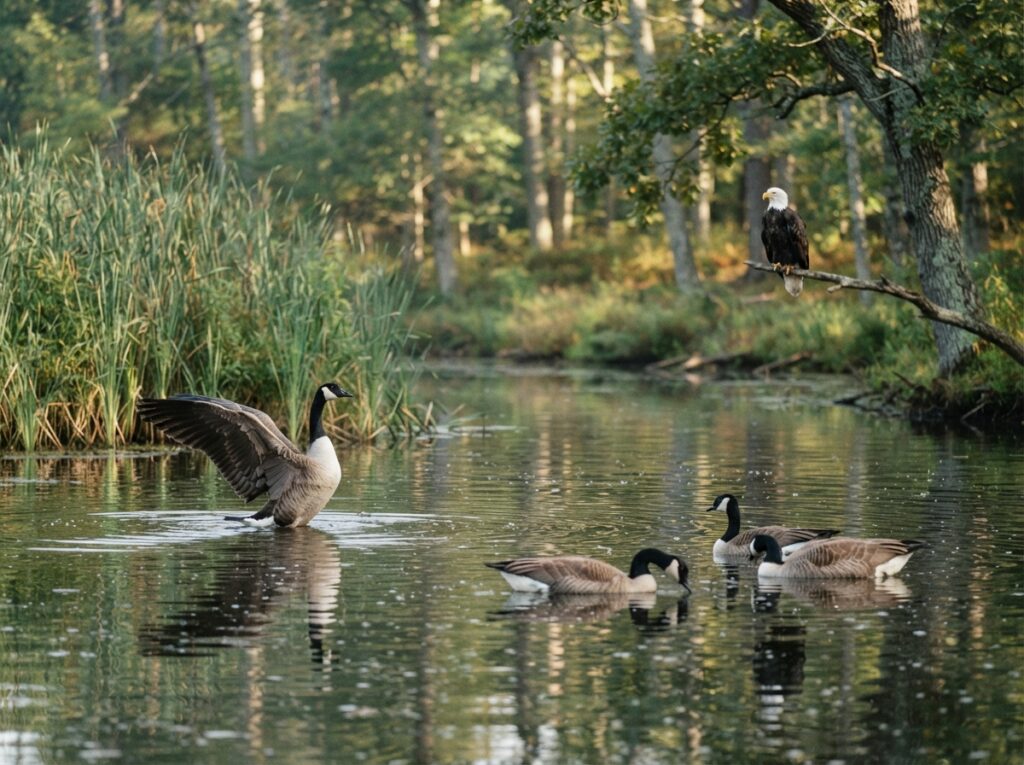
The goose eventually joined other geese farther down the water.
The pond became quiet again.
The eagle continued visiting occasionally.
Sometimes it landed in the trees.
Sometimes it disappeared for weeks.
The homeowner stopped trying to predict it.
Instead, whenever he saw the bird near the pond, he watched for a little longer.
Not because he expected another rescue.
Because he had learned that unusual behavior was sometimes worth noticing.
Months passed.
Then one morning, the homeowner checked the camera again.
The eagle appeared.
It landed on the same low branch.
The camera captured it looking toward the reeds.
The reeds moved in the wind.
Nothing else happened.
The eagle remained there for several minutes.
Then it flew away.
Later that day, a group of geese appeared on the pond.
The homeowner watched them swimming together.
One bird separated from the group and moved toward the reeds.
He looked closely.
It was impossible to know whether it was the same goose.
But the bird was healthy.
It swam strongly.
It stretched both wings.
Then it disappeared behind the vegetation.
The homeowner smiled.
The story had never really been about proving what the eagle intended.
It was about what happened when someone paid attention.
The eagle might have been hunting.
It might have been curious.
It might have noticed an injured animal.
It might have simply been responding to movement along the shoreline.
There was no reliable way to tell.
And perhaps that uncertainty was important.
Because the truth did not need to be more dramatic than it was.
An eagle landed beside a pond.
It repeatedly looked toward one section of reeds.
A homeowner became curious.
He walked closer.
He found an injured goose.
A rescuer arrived.
The goose received treatment.
It healed.
And eventually, it returned to the same water where it had once been too weak to move.
That was enough.
The homeowner sometimes wondered what would have happened if he had ignored the eagle.
Maybe he would have noticed the goose later.
Maybe someone else would have found it.
Maybe the goose would have survived on its own.
Or maybe it wouldn’t have.
He couldn’t know.
But that was exactly why the morning stayed with him.
There had been no certainty.
Only a strange behavior.
A bird walking back and forth along a shoreline.
Stopping.
Looking.
Returning.
Stopping again.
It was enough to create a question.
What is it looking at?
That question led him to the reeds.
And beneath those reeds was a bird that needed help.
The experience changed the way he looked at the pond.
Before that morning, wildlife was simply part of the scenery.
Eagles passed through.
Geese came and went.
Ducks moved along the water.
Occasionally, something rustled in the reeds.
He had seen it all before.
But after finding the injured goose, he realized how much could be happening just beyond the edge of what people notice.
An animal could be struggling only a few feet away.
A bird could be watching something hidden.
A small movement could mean almost nothing.
Or it could mean everything.
The lesson wasn’t that every eagle was trying to save another animal.
It wasn’t.
The lesson wasn’t that animals always understand when another animal is in trouble.
They don’t necessarily.
The lesson was simpler.
Pay attention.
When something looks unusual, take another look.
When an animal behaves differently, don’t automatically dismiss it.
Sometimes there is a perfectly ordinary explanation.
Sometimes there isn’t.
And occasionally, looking twice can make the difference between an animal remaining unseen and an animal receiving help.
The homeowner never called the eagle a hero.
He never claimed it had rescued the goose.
He knew he couldn’t prove that.
Instead, he kept the footage.
The early morning recording.
The eagle walking beside the water.
The eagle stopping near the reeds.
The eagle watching from the branch.
And the moment when the homeowner finally discovered the hidden goose.
He kept the later footage too.
The goose swimming again.
The wing opening fully.
The eagle appearing over the trees.
Two wild animals sharing the same pond without either one needing to do anything dramatic.
Years later, he would probably remember the same detail.
Not the rescue vehicle.
Not the rehabilitation center.
Not even the release.
He would remember the first sight of that white feather between the reeds.
Because before he saw the goose, there was only grass.
Then there was a feather.
Then two eyes.
And suddenly, what had looked like an ordinary morning became something he would never forget.
The eagle eventually flew away.
The goose eventually moved on.
The pond remained.
The reeds grew.
The seasons changed.
But every now and then, the homeowner would stand by the kitchen window with his coffee and look toward the water.
If an eagle appeared, he watched.
Not because he expected another hidden animal.
Not because he believed the bird was sending him a message.
Simply because he had learned that sometimes the smallest unusual detail deserves a second look.
The eagle may never have intended to lead him to the goose.
It may never have understood what was happening.
It may have been watching for reasons no human could know.
But its behavior became the beginning of a rescue.
And for the goose lying helpless in those reeds, that was enough.
Sometimes nature doesn’t give us explanations.
Sometimes it only gives us clues.
A bird that keeps returning.
A sudden movement in the grass.
A sound that doesn’t belong.
And if we are willing to stop for a moment and ask why, we may discover that something has been waiting quietly for someone to notice.
That morning, the homeowner looked twice.
And a goose got another chance to fly.
No Comments