

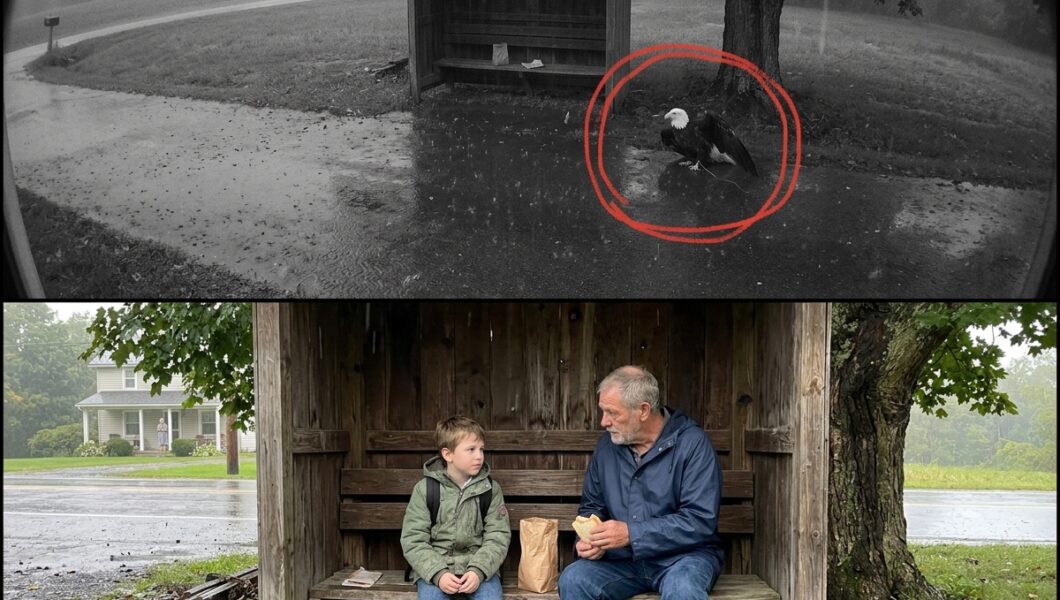
Eleanor Bennett stared through her kitchen window at the young woman standing beside the car.
She held a faded envelope against her chest.
Even from a distance, Eleanor recognized the handwriting on its front.
Walter’s handwriting.
Her husband had been gone for six years, yet the sight of those familiar letters made her heart ache as though she had lost him only yesterday.
Thomas Reed stood quietly beside the kitchen table.
“Her name is Rebecca Miller,” he said. “She’s Noah’s mother.”
Eleanor turned toward him.
“Why does she have a letter from my husband?”
Thomas shook his head.
“That’s something she needs to explain.”
Eleanor opened the front door.
Rebecca looked exhausted. She appeared to be in her early thirties, with dark hair pulled into a loose ponytail and tired eyes that suggested too many sleepless nights.
“Mrs. Bennett?”
Eleanor nodded.
“I’m Rebecca. Noah’s mother.”
She looked down at the envelope.
“I think my grandmother would have wanted you to have this.”
Eleanor stepped aside.
“Please come in.”
Rebecca entered the farmhouse slowly, glancing at the old family photographs along the hallway.
When she reached the kitchen, her eyes settled on Walter’s picture beside the window.
She stopped.
“That’s him.”
Eleanor felt her chest tighten.
“You knew my husband?”
Rebecca nodded.
“Not well. I was little when I met him. But my grandmother talked about him all the time.”
She placed the envelope on the table.
“She said he was one of the reasons our family had a home.”
Eleanor sat down.
Outside, rain began tapping against the windows again.
Rebecca carefully unfolded the letter.
It was dated twenty years earlier.
“Dear Margaret,
I hope the shelter gives the children somewhere dry to wait on rainy mornings. You were right that the old road needs a safer place for them.
I’m glad the school district and neighbors agreed to help.
Please don’t thank me for the lumber or the work. You and your daughter have already given this community more than you realize.
And if you ever need anything, you know where to find Eleanor and me.
Your friend,
Walter Bennett.”
Eleanor read the letter twice.
Then she looked up.
“Margaret?”
Rebecca nodded.
“My grandmother’s name was Margaret Miller.”
Eleanor felt the room grow strangely quiet.
Forty years earlier, a frightened young mother had knocked on her farmhouse door during a winter storm.
She had been carrying a newborn baby.
Eleanor and Walter had given her a warm room, clean blankets, and food.
Before leaving, Eleanor had pressed a small silver bracelet into her hand.
A bracelet with a tiny blue stone.
Margaret.
That had been her name.
Eleanor remembered it now.
“Oh, my goodness,” she whispered.
Rebecca’s eyes filled.
“That baby was my mother.”
For several seconds, Eleanor couldn’t speak.
The woman she had helped forty years earlier had raised a daughter.
That daughter had grown up and become Rebecca’s mother.
And Rebecca had become Noah’s mother.
Three generations.
All connected by three nights of kindness during a winter storm.
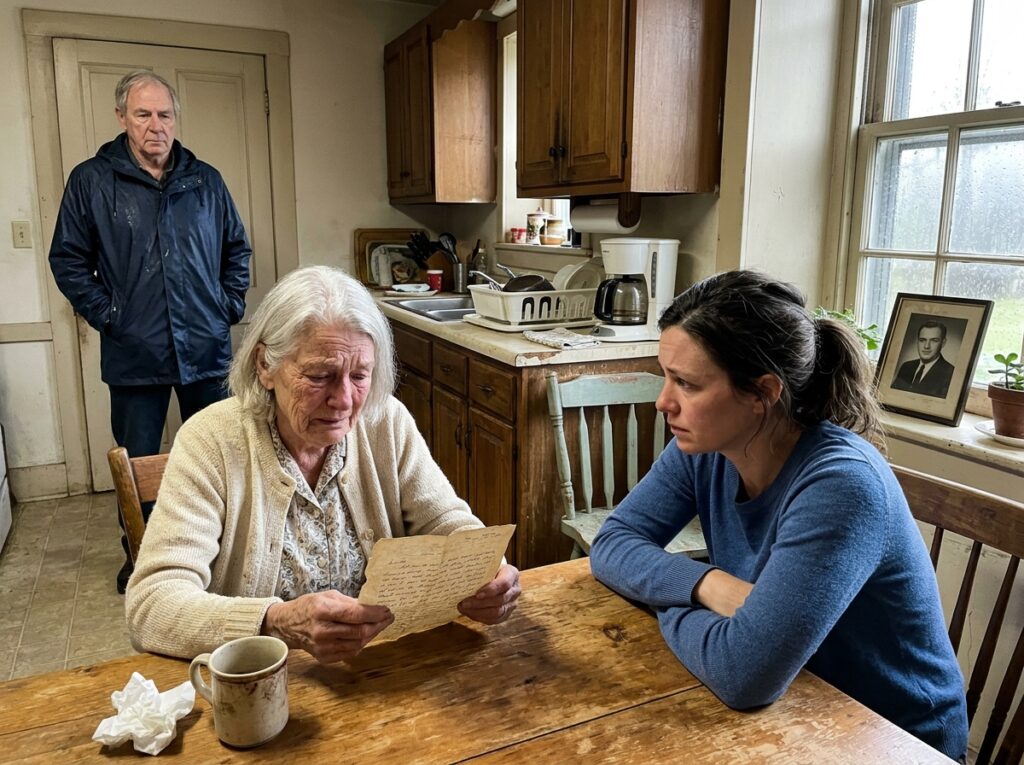
Rebecca explained that her grandmother had rarely spoken about the hardest years of her life.
But she always talked about the farmhouse on Willow Creek Road.
She remembered the smell of fresh bread.
The warmth of the spare bedroom.
And the elderly couple who never asked why she had nowhere else to go.
“She said you made her feel like she still mattered,” Rebecca whispered.
Eleanor wiped her cheeks.
“We only gave her somewhere to sleep.”
Rebecca shook her head.
“Grandma said you gave her enough hope to keep going.”
After leaving the farmhouse, Margaret eventually found work and settled in the county.
Years later, when she learned that children were waiting for the school bus beside the road without shelter, she began asking neighbors and the school district for help.
Walter offered to build the wooden structure once the necessary permission had been arranged.
Margaret helped paint it.
Thomas, who was still working as a firefighter then, assisted with the roof.
And for years, children waited beneath its narrow wooden roof during rain and snow.
“Grandma used to say that shelter was her way of passing on what you and Walter gave her,” Rebecca explained.
Eleanor looked toward the window.
Across the road, the little structure stood beneath the maple tree.
For years, she had considered it nothing more than an abandoned bus shelter.
Now she understood that it had been built from a promise.
A promise made by a woman who once arrived at her door with nowhere to go.
Rebecca reached into her handbag.
There was another photograph.
It showed Margaret standing beside Walter and Thomas on the day the shelter was completed.
Margaret was smiling.
And around her wrist was the same silver bracelet.
Eleanor touched the photograph gently.
“I thought I’d never see her again.”
Rebecca lowered her eyes.
“She wanted to visit you. She kept saying she would come when she had something good to tell you.”
“Why didn’t she?”
“She was afraid you’d forgotten her.”
Eleanor closed her eyes.
“I never forgot that night.”
Rebecca began crying.
“Grandma didn’t either.”
For a long time, the two women sat quietly together.
Then Eleanor asked about Noah.
“Does he know about all this?”
Rebecca nodded.
“Grandma told him the story before she died. She said that when somebody is hungry or lonely, you help if you can.”
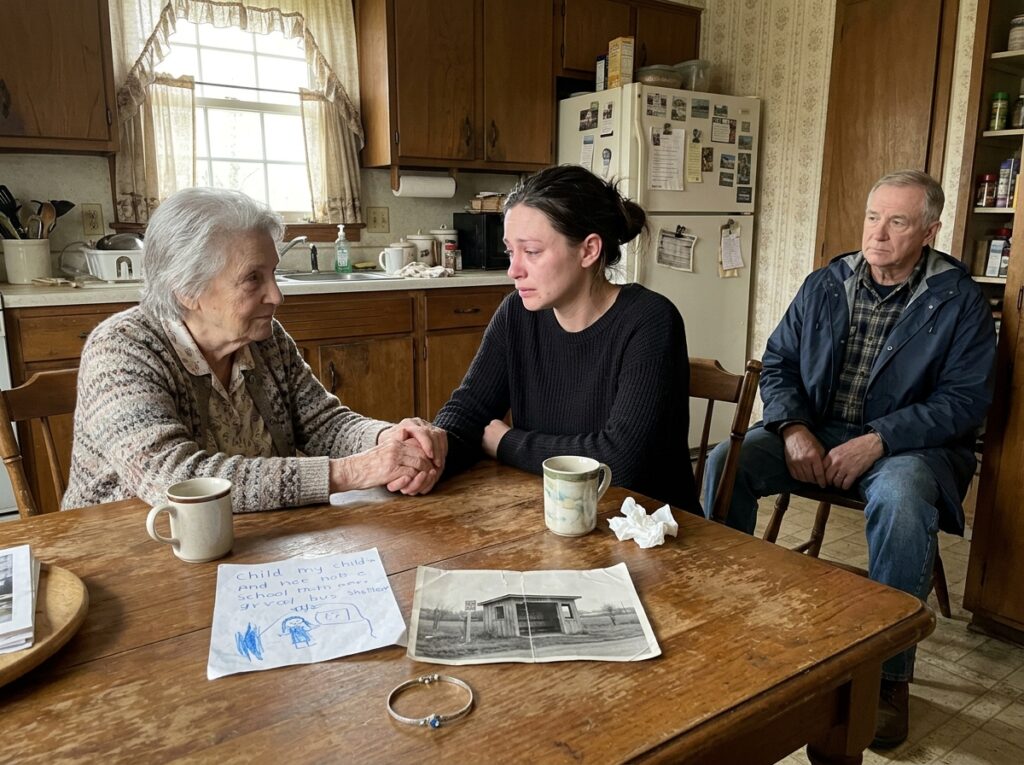
Eleanor looked down at the note written in blue crayon.
Dear whoever is hungry, I don’t have much, but you can have some of mine. My grandma says nobody should feel forgotten.
Now the words carried an entirely different meaning.
Noah had not simply been leaving food for strangers.
He had been trying to continue a kindness that began before he was born.
But Eleanor also remembered what the principal had told her.
Noah had been refusing school breakfast because he believed other children needed it more.
She looked at Rebecca carefully.
“Is your family getting enough to eat?”
Rebecca hesitated.
Then she shook her head.
“I’ve been trying.”
She explained that she worked evening shifts at a nursing home.
After her grandmother died, childcare arrangements became more difficult, and unexpected expenses had left the family struggling.
Some weeks were manageable.
Others were not.
“Noah knows things have been hard,” Rebecca whispered. “I try not to let him worry.”
Eleanor reached across the table.
“Children notice more than we think.”
Rebecca wiped her eyes.
“I know.”
Eleanor told her about the school’s family assistance program.
She explained that the principal had offered to connect them privately with groceries, meal support, and other resources.
Rebecca looked embarrassed.
“I don’t want people thinking I can’t take care of my son.”
Eleanor shook her head gently.
“Accepting help doesn’t mean you haven’t been taking care of him.”
Thomas spoke for the first time.
“Your grandmother accepted help once. Then she spent years helping other people.”
Rebecca looked at him.
Thomas smiled.
“That’s how a community is supposed to work.”
Rebecca began crying again.
This time, she accepted Eleanor’s offer to help arrange support through the school.
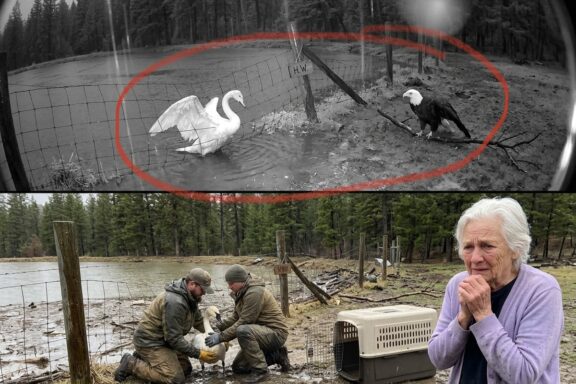
That evening, Eleanor received another update about the injured bald eagle.
The bird was stable.
The fishing line had been removed from its leg, and veterinarians were treating the resulting injury.
The wing also required careful assessment.
The rehabilitator explained that the eagle’s recovery would take time.
There was no guarantee it could return to the wild.
Eleanor thanked her.
Then she asked whether there was anything the community could do to prevent similar injuries.
The rehabilitator suggested properly disposing of fishing line and reporting hazardous litter near waterways.
Eleanor thought about the creek running behind the abandoned shelter.
She remembered Walter complaining about discarded fishing line tangled among the reeds.
The eagle’s injury might not have originated there.
But the danger was real.
The next morning, Eleanor called the school principal again.
She explained what she had learned about the shelter’s history.
She also asked whether the school would consider organizing a small kindness project in Margaret Miller’s memory.
The principal loved the idea.
But she suggested beginning with something simple.
A school food-sharing initiative coordinated through staff, so children could help families without giving away meals they needed themselves.
Eleanor agreed immediately.
She didn’t want Noah to feel that he had to go hungry to be kind.
She wanted him to understand that kindness could be shared safely, without anyone sacrificing their own well-being.
The school counselor spoke privately with Noah and Rebecca.
Noah learned that he could accept breakfast at school and still help others through the school’s supervised donation program.
He also learned why leaving food outdoors could attract wildlife toward the road.
He listened carefully.
Then he asked one question.
“Can I still go to Grandma’s bench?”
The counselor smiled.
“Of course. You can remember her there without leaving food behind.”
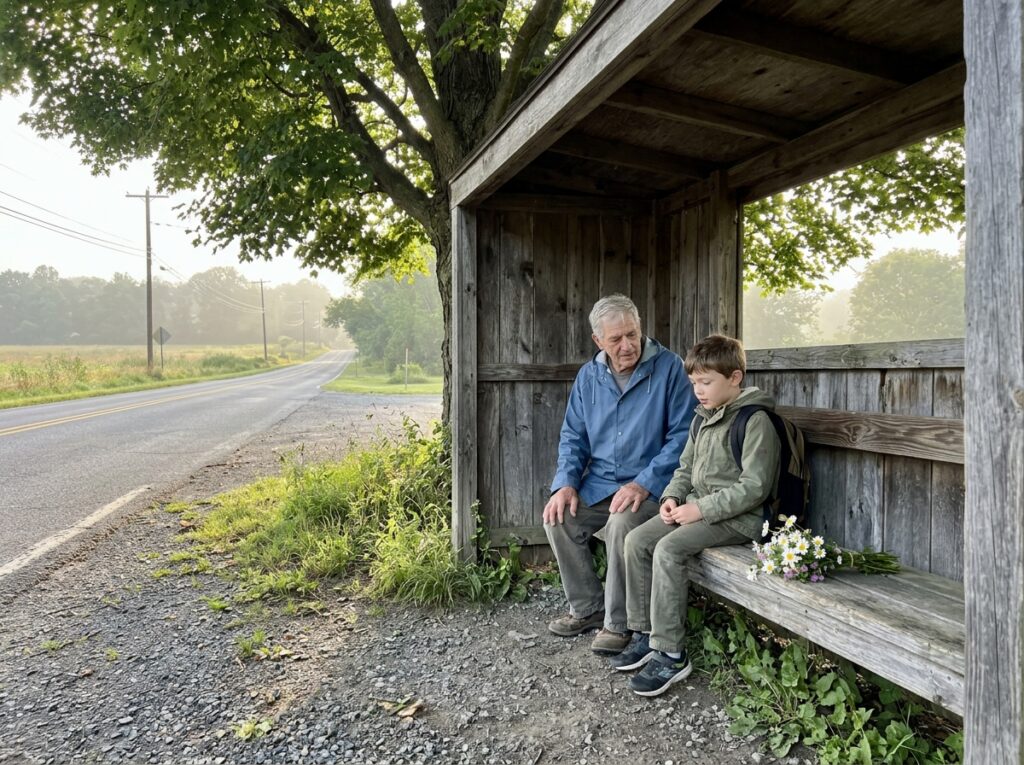
A week later, Eleanor saw Noah return to the old shelter.
This time, he carried no lunch bag.
Instead, he held a small bunch of wildflowers.
He placed them carefully on the bench.
Then he sat down.
Thomas arrived a few minutes later.
He sat beside the boy.
The two watched the morning sunlight spread across the road.
Eleanor observed from her kitchen window.
She couldn’t hear their conversation.
But she saw Noah smile.
And for the first time since his grandmother’s death, the little boy did not look quite so alone.
Several days later, the school announced a community project called Margaret’s Table.
Families could contribute unopened shelf-stable food through the school’s approved donation program.
Staff would distribute assistance discreetly to households that needed it.
No child would be expected to give away their own lunch.
No family would be singled out.
And the project would honor the woman who had once helped build the little shelter beneath the maple tree.
Eleanor donated the first box of groceries.
Thomas brought another.
Rebecca volunteered to help organize supplies when her work schedule allowed.
And Noah drew a picture of a table surrounded by smiling people.
At the bottom, he wrote:
“Nobody should feel forgotten.”
As the weeks passed, Eleanor continued receiving updates about the bald eagle.
The bird’s leg injury improved.
Its wing required longer rehabilitation.
The veterinary team monitored its strength, balance, and ability to fly.
Some days brought progress.
Others brought little change.
Eleanor tried not to hope too much.
But she remembered the terrible morning when the eagle collapsed beneath the shelter.
She remembered its wet feathers, its injured wing, and the fishing line wrapped around its leg.
She also remembered Noah’s small handwritten note.
Two vulnerable lives had appeared in the same place.
One needed professional wildlife care.
The other needed people who understood that a child should not have to carry the weight of the world.
Eleanor was grateful that both had received help.
One afternoon, Rebecca visited with Noah.
The little boy stood shyly beside his mother.
“Mrs. Bennett?”
Eleanor smiled.
“Hello, Noah.”
He held out a folded piece of paper.
“I made you something.”
Eleanor opened it.
Inside was a drawing of the old bus shelter.
A little boy sat on the bench beside his grandmother.
Above them, a bald eagle flew across the sky.
At the bottom, Noah had written:
“Thank you for helping everyone.”
Eleanor’s eyes filled with tears.
She knelt carefully so she could look him in the eye.
“Sweetheart, do you know something?”
Noah shook his head.
“Your grandma helped my husband build that shelter.”
His eyes widened.
“She did?”
Eleanor nodded.
“And long before that, your grandma came to our house when she needed help. We were lucky enough to be there for her.”
Noah looked toward his mother.
“Grandma never told me that part.”
Rebecca smiled.
“She told me.”
Eleanor touched the drawing gently.
“Your grandmother spent her whole life passing kindness along. And now you’re doing the same.”
Noah looked down.
“But I only had half a sandwich.”
Eleanor smiled through her tears.
“Sometimes the smallest things remind people that somebody cares.”
Then she added something she wanted him to remember.
“But you need to eat your lunch too. You deserve kindness just as much as anyone else.”
Noah nodded solemnly.
“I will.”
Eleanor hugged him.
For a moment, she imagined Margaret standing beside them, smiling with the silver bracelet on her wrist.
She wished she could tell her that the frightened young mother from forty years ago had built a beautiful life.
That her kindness had reached her great-grandson.
And that the little shelter Walter helped build had become a place where people remembered how much small acts could matter.
Winter approached.
The maple leaves turned red and gold.
The abandoned shelter stood quietly beside the road.
The school district inspected the structure and determined what repairs and permissions would be needed before it could serve any new community purpose.
Eleanor hoped it might someday become a small memorial to Margaret.
But even if it remained only an old wooden bench beneath a tree, its story would not be forgotten.
Then, one morning in early spring, the wildlife rehabilitation center called.
The eagle had made substantial progress.
After months of treatment and supervised flight conditioning, the bird had completed the assessments required for release.
Eleanor covered her mouth.
“Does that mean it’s going home?”
“Yes,” the rehabilitator replied. “It’s ready.”
Eleanor began crying.
The release took place several days later at a suitable location selected by wildlife professionals.
Eleanor attended with Thomas, Rebecca, and Noah.
They stood in a designated viewing area at a safe distance.
The morning was clear and cool.
When the rehabilitator opened the transport carrier, the eagle hesitated.
Then it stepped forward.
Its wings spread wide.
Noah gripped his mother’s hand.
With several powerful beats, the bird lifted into the air.
It climbed above the clearing, turned toward the distant trees, and continued flying until it disappeared beyond the ridge.
Eleanor began crying.
Thomas stood quietly beside her.
Rebecca wiped her eyes.
And Noah looked up at the sky.
“Do you think Grandma saw that?” he whispered.
Rebecca knelt beside him.
“I think she would have loved it.”
Noah smiled.
“She always said every kindness finds its way home.”
Eleanor looked toward the mountains.
Forty years earlier, she had opened her door to a frightened young mother.
She had given her three nights of shelter and a small silver bracelet.
She never expected anything in return.
Now that woman’s great-grandson stood beside her, watching a rescued eagle return to the sky.
Eleanor thought about Walter.
She thought about Margaret.
And she thought about the countless small acts of kindness that quietly connect one life to another.
That evening, she returned to her farmhouse and placed Noah’s drawing beside Walter’s photograph.
Outside, the old bus shelter stood beneath the maple tree.
The bench was empty.
But Eleanor no longer saw it as abandoned.
She saw Margaret sitting beside her grandson.
She saw Walter holding a hammer.
She saw Thomas sharing a sandwich with a lonely little boy.
And she saw a bald eagle spreading its wings above the Pennsylvania countryside.
Eleanor smiled through her tears.
“Well, Walter,” she whispered, “I think your little shelter did more good than either of us ever imagined.”
Then she turned off the kitchen light.
But she left the porch light burning.
Because forty years earlier, one frightened mother had found safety behind that door.
And Eleanor still believed that nobody should feel forgotten.
The End.
This is a fictional kindness and wildlife rescue story created for emotional storytelling.
No Comments