

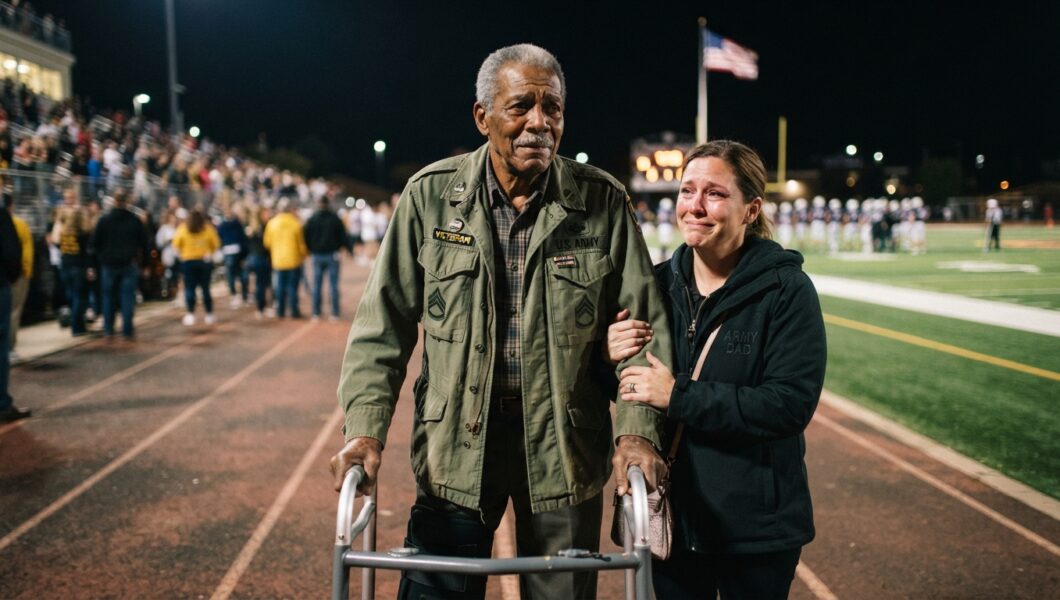
Two days after the football game, I found my dad sitting at the kitchen table with his walker beside him and his antibiotic cooler humming quietly on the floor.
He was reading the newspaper like nothing unusual had happened.
I stood in the doorway for a moment, watching him turn the pages with the same calm concentration he had always had. His left foot was still heavily bandaged. The PICC line ran from his arm to the medication he needed throughout the day. His movements were slower now, more careful.
But there was something different about him that morning.
Maybe it was because I couldn’t stop thinking about what I had seen at the stadium.
Maybe it was because, for the first time, I had truly understood that the man sitting at that kitchen table wasn’t indestructible.
For most of my life, I had treated my father like he was.
When I was little, Dad was the person who could fix anything. A broken bicycle. A leaking faucet. A door that wouldn’t close properly. He never seemed to hesitate. He’d grab his tools, kneel down and figure it out.
When I was scared, he made things feel manageable.
When I was sick, he stayed beside my bed.
When I was struggling with something at school, he’d tell me, “One problem at a time.”
I suppose part of me always believed he would be there forever.
Then cancer took one kidney.
Diabetes took eight toes.
Age took some of his strength.
And suddenly, the man who had once carried me on his shoulders needed someone to help him cross a parking lot.
That realization hurt more than I expected.
I walked over and poured him some coffee.
“You were really something Friday night,” I said.
He looked up from the newspaper.
“What did I do?”
“You know what you did.”
He smiled.
“Stood up.”
“Exactly.”
He shrugged.
“Didn’t seem like much.”
I sat across from him.
“To me, it was.”
He was quiet for a moment.
Then he folded the newspaper.
“You know, son, people make too much of things sometimes.”
“Maybe.”
He looked down at his hands.
“But I meant it.”
I knew exactly what he meant.
He wasn’t talking about politics.
He wasn’t trying to make a statement.
He wasn’t trying to impress anyone.
He simply believed that after everything he had experienced, standing during the anthem was one small thing his body could still give.
And perhaps that was why it affected me so deeply.
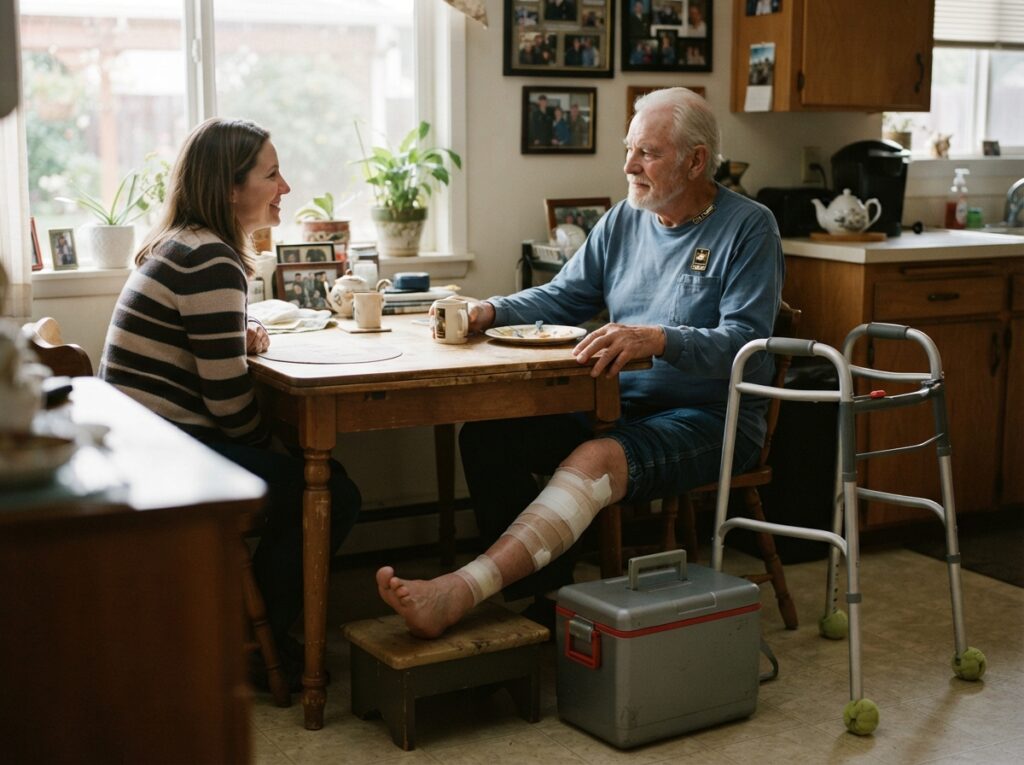
Later that afternoon, I asked him something I’d never asked before.
“Do you ever regret serving?”
He didn’t answer immediately.
He looked toward the window.
Outside, my nephew was shooting baskets in the driveway.
Finally Dad said, “No.”
“Not even after everything?”
He shook his head.
“I regret things that happened. I regret people we lost. I regret things I couldn’t change. But serving?”
He paused.
“No.”
Then he added something I hadn’t expected.
“I don’t think you have to believe everything your country does to love your country.”
I stayed quiet.
He continued.
“People confuse those things. They’re not the same.”
He told me that when he enlisted, he was young enough to think service would be simple.
He thought it meant wearing a uniform, following orders and doing his job.
He learned quickly that it meant much more.
It meant trusting people with your life.
It meant missing birthdays.
It meant hearing bad news far away from home.
It meant watching friends become family and sometimes watching those friends disappear.
“It wasn’t about being fearless,” he said.
“Then what was it about?”
“Doing what needed to be done even when you were afraid.”
I’d heard my father say versions of that my whole life.
But sitting there, looking at his bandaged foot, I realized he had never only been talking about the Army.
That was how he lived.
When cancer came, he did what needed to be done.
When diabetes took another toe, he adapted.
When walking became difficult, he learned to use a walker.
When my nephew had a football game, he went anyway.
He wasn’t fearless.
He was simply unwilling to let fear make every decision for him.
A week after the game, I drove him to his follow-up appointment.
Getting him into the car took longer than it used to.
He hated that.
“Don’t rush me,” he said when I instinctively reached for him.
“I’m not.”
“You are.”
“I’m just trying to help.”
“I know.”
He sighed.
“That’s the problem.”
I laughed.
He laughed too.
There were still pieces of the old Dad in there.
The stubbornness.
The jokes.
The refusal to admit when something hurt.
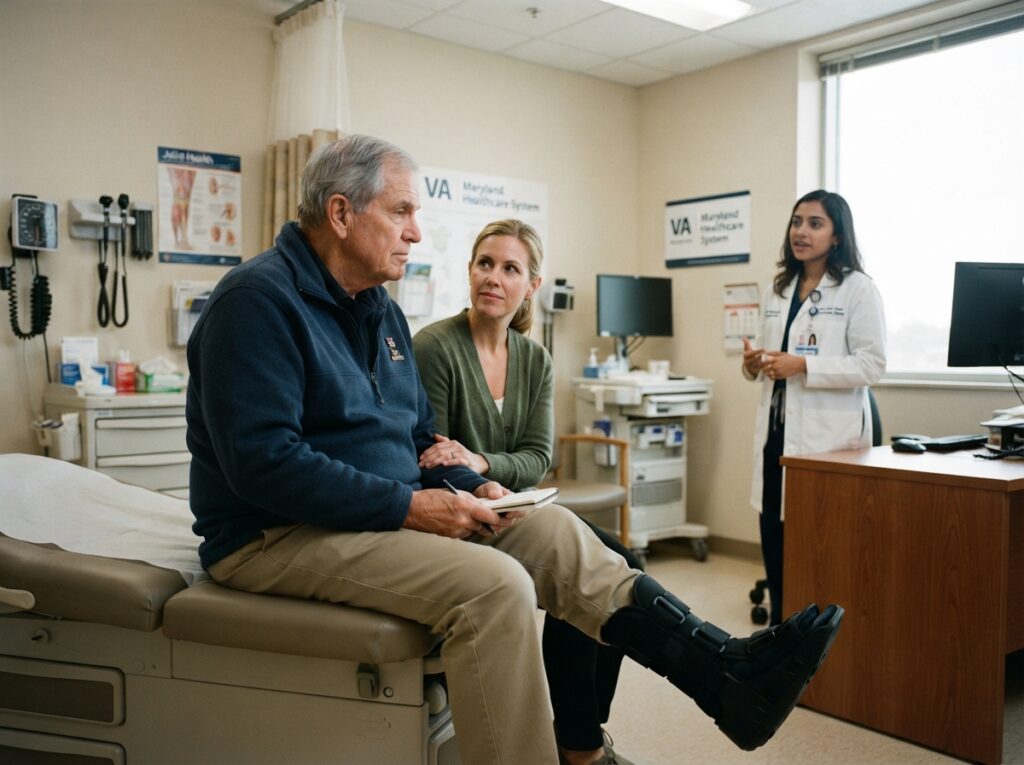
The doctor examined his foot and asked him several questions.
Dad answered honestly.
For once.
The doctor told him recovery was progressing, but he needed to remain patient.
Dad nodded.
“Patience isn’t my specialty.”
The doctor smiled.
“We’ve noticed.”
On the way home, Dad was unusually quiet.
Then he said, “I’m not afraid of losing another part of myself.”
I looked at him.
“What do you mean?”
“I’m afraid of becoming useless.”
That sentence hit me hard.
I pulled the car over.
“You’re not useless.”
“I know what you mean.”
“No, Dad. You don’t.”
He looked at me.
“You think because you can’t walk like you used to, or because you need help getting around, you’re somehow less important.”
He didn’t say anything.
“But you’re still the person who taught me how to change a tire. You’re still the person my nephew waits for after every game. You’re still the person Mom calls when the washing machine makes a strange noise.”
He smiled.
“Your mother shouldn’t call me about that anymore.”
“Why?”
“Because I have no idea how to fix that thing.”
We both laughed.
Then I said, “You don’t have to be useful to be loved.”
He looked out the window.
For a long time, he didn’t respond.
Then he quietly said, “Your grandmother used to tell me that.”
I had never heard that before.
He told me his mother had said the same thing when he returned from the Army.
He had struggled with the transition back to civilian life.
He had felt restless.
He didn’t know what he was supposed to do with himself.
She had told him, “Michael, you don’t have to earn your place at this table.”
He remembered those words nearly fifty years later.
That night, I told my mother what Dad had said.
She was quiet.
Then she smiled.
“That’s always been his biggest problem.”
“What?”
“He thinks he has to earn the right to be cared for.”
I looked toward the living room.
Dad was asleep in his chair.
His walker was leaning against the wall.
The television was playing quietly.
“He doesn’t,” I said.
“No,” Mom replied. “He doesn’t.”
Over the next several weeks, we started noticing small improvements.
Dad could stand a little longer.
He could move from the bedroom to the kitchen without stopping as often.
He still needed help, but he wasn’t completely dependent.
One morning, I found him in the garage.
“What are you doing?”
He was sitting on a stool with an old toolbox beside him.
“Looking for something.”
“What?”
“A screwdriver.”
“Why?”
He looked at me as if the answer were obvious.
“Your nephew’s bike is making a noise.”
I laughed.
“You’re supposed to be resting.”
“I am resting.”
“You’re fixing a bike.”
“That’s resting for me.”
I shook my head.
He eventually found the screwdriver.
He couldn’t do the repair himself, but he showed my nephew where to look.
My nephew listened carefully.
When they finished, the boy looked at him.
“Thanks, Grandpa.”
Dad smiled.
“Anytime.”
I stood there watching them.
It wasn’t the old Dad.
Not exactly.
But maybe that was the point.
He didn’t need to be the man who could march twenty miles or work twelve-hour shifts or carry heavy boxes without thinking twice.
He could be this version.
A slower version.
A more fragile version.
Still my father.
Still himself.
And maybe there was dignity in allowing someone to change without making them feel like they had disappeared.
A month after the football game, my nephew’s team made it to the championship.
Dad insisted on going.
This time, nobody argued.
We arrived early and found a place near the family section.
The weather was colder than the previous game.
Dad wrapped himself in his old Army jacket.
It was faded now.
The sleeves were worn.
But he still wore it with pride.
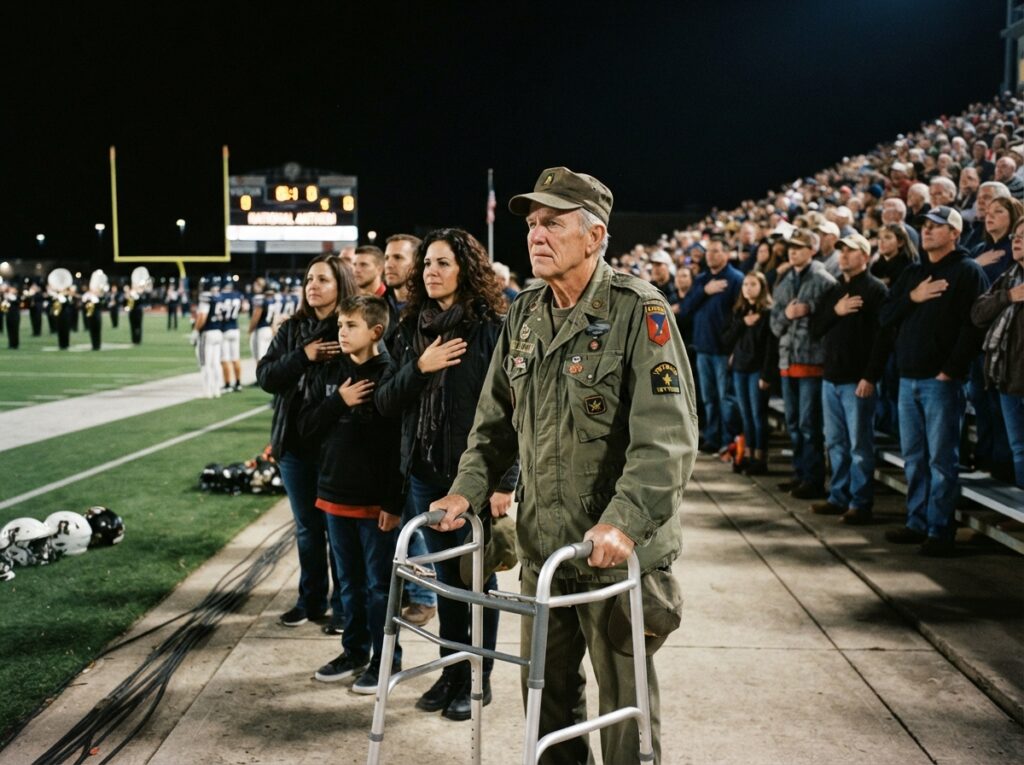
Before kickoff, the announcer asked everyone to stand for the national anthem.
Dad looked at me.
I thought he might stay seated.
His foot was still healing.
The stadium bleachers were uneven.
Standing had been painful the first time.
He put both hands on his walker.
Then he pushed himself upward.
I reached for him.
He nodded.
“Got me?”
“Always.”
He stood.
Not perfectly.
Not straight.
Not without pain.
But he stood.
I looked around the stadium.
There were hundreds of people standing.
Some young.
Some old.
Some wearing uniforms.
Some wearing work clothes.
Some holding children.
Everyone had their own reason for being there.
And suddenly I understood something.
The meaning of that moment wasn’t contained in the anthem itself.
It was in the people hearing it.
Everyone brought their own history.
Dad brought his.
His friends.
His sacrifices.
His twenty-one years of service.
His family.
His losses.
His scars.
His belief that even an imperfect country could still be worth serving.
My nephew’s team won that night.
Dad stayed until the end.
Getting back to the car took almost fifteen minutes.
He had to stop twice.
When we finally reached the passenger door, he looked exhausted.
But he was smiling.
“Good game,” he said.
“You mean good game?”
“Of course.”
“You nearly fell asleep during the second quarter.”
“I was resting my eyes.”
I laughed.
On the drive home, my nephew sat in the back seat.
After a few minutes, he said, “Grandpa?”
“Yeah?”
“Why did you stand?”
Dad looked out the window.
Then he turned around.
“Because I wanted to.”
My nephew thought about that.
“Did it hurt?”
“Yep.”
“Then why?”
Dad smiled.
“Because sometimes something can hurt and still be worth doing.”
My nephew nodded.
That was all.
But I could tell he would remember it.
So would I.
I used to think my father was teaching me about patriotism.
Maybe he was.
But now I think he was teaching me something bigger.
He was teaching me that respect can be personal without being political.
That sacrifice can be remembered without becoming an argument.
That people can disagree about what a country is doing while still caring deeply about the people who live in it.
And most importantly, he was teaching me that a person’s worth doesn’t disappear when their body changes.
Dad has lost a kidney.
He has lost eight toes.
He has lost some of the physical freedom he once took for granted.
But he has not lost himself.
He’s still the man who makes terrible jokes.
He’s still the grandfather who refuses to miss a football game.
He’s still the husband my mother has loved for decades.
He’s still the father who taught me that you don’t have to be perfect to do something meaningful.
And he’s still the soldier who believes that standing for something can matter, even when standing itself becomes difficult.
I don’t know how much time we have left with him.
That’s something I’ve finally stopped pretending I can control.
None of us knows.
So I’m trying to pay attention now.
When he tells an old story, I listen.
When he wants to sit outside, I sit with him.
When he needs help, I help without making him feel weak.
And when he insists on doing something himself, I let him try when it’s safe.
Because he’s still my dad.
Not the younger version.
Not the strongest version.
Not the man in the old photographs.
This version.
The one sitting in his chair with a walker nearby.
The one learning how to live differently.
The one still finding reasons to show up.
And maybe that’s what I hope people take from the story I shared.
You don’t have to agree with my father.
You don’t have to share his beliefs.
You don’t even have to understand why standing during an anthem means so much to him.
But I hope you can understand this:
There is a human being behind every opinion.
There is a lifetime behind every gesture.
And sometimes the person standing beside you has already sacrificed more than you’ll ever know.
That night at the stadium, I thought I was watching my father stand for a song.
Now I realize I was watching him stand for everything that song represented to him.
His friends.
His family.
His memories.
His promises.
His country.
And perhaps most of all, the younger man he used to be.
A skinny kid from a small town who enlisted before he really understood what he was signing up for.
A young soldier who believed service mattered.
A husband.
A father.
A grandfather.
A survivor.
A man whose body has given up pieces of itself year after year, but whose spirit still refuses to surrender.
And as long as my dad is still willing to stand, even if he needs a walker and someone beside him, I’ll be there to hold his arm.
Not because he can’t stand alone.
But because after all the years he’s spent helping me stand, it’s the least I can do.
No Comments