

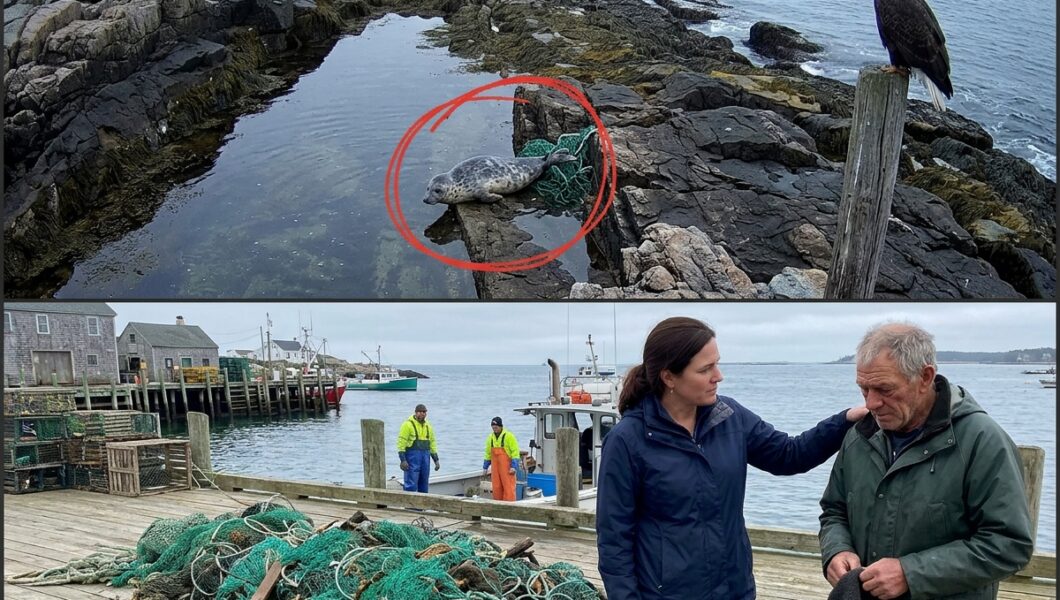
At 5:38 AM, forty-three-year-old lighthouse caretaker Rebecca Morgan stood alone inside the security room at Harbor Point Lighthouse, Maine.
Outside, the Atlantic Ocean was almost black.
Waves struck the granite peninsula with enough force to send white spray above the rocks.
Rebecca had barely slept.
All night, she had been thinking about the strange movement she discovered in yesterday’s security footage.
A small pale flipper.
A shadow beneath the water.
And a section of green fishing net that might still be tangled somewhere below the rocks.
The first seal pup had been rescued.
But there might be another animal trapped beneath the surface.
Rebecca checked the tide chart for the fourth time.
Low tide was approaching.
The marine mammal response team was expected shortly after sunrise.
Then her telephone rang.
It was Dr. Hannah Ellis.
“Rebecca, we’re about fifteen minutes away.”
Rebecca looked toward the south rocks.
“Can you see anything from the harbor?”
“Not yet. We’re bringing an underwater inspection camera and additional equipment. We need to find out exactly what’s down there before anyone approaches.”
Rebecca swallowed.
“Do you think it’s another seal?”
Hannah paused.
“I don’t know. And I don’t want to guess.”
Rebecca nodded.
She understood.
But somewhere beneath those dark waves, the answer was waiting.
And she couldn’t stop imagining another frightened animal struggling to breathe.
At 6:02 AM, sixty-eight-year-old fisherman Thomas Callahan arrived at the lighthouse.
He was carrying two thermoses of coffee.
Rebecca met him at the entrance.
“Tom, you didn’t have to come this early.”
He looked toward the ocean.
“Couldn’t sleep.”
His weathered face was tired.
For fifty-two years, Thomas had worked the waters around Harbor Point.
He knew the tides.
The currents.
The hidden ledges where lobster traps sometimes became tangled.
And the dangerous channels where storm waves could pull a person off their feet.
But yesterday, he had learned something about the ocean that he wished he’d understood years earlier.
A section of fishing gear lost during a September storm had trapped a young seal.
And now there might be more of that gear beneath the rocks.
Rebecca accepted the coffee.
“How are you holding up?”
Thomas looked down.
“Keep thinking about that little seal.”
Rebecca said nothing.
He continued.
“I’ve spent my whole life on the water. I always thought I was careful.”
“You reported the lost gear, Tom.”
“I know.”
He looked toward the dark shoreline.
“But reporting it didn’t make it disappear.”
Rebecca gently touched his arm.
“No. But what you do next matters.”
Thomas nodded.
Then whispered:
“That’s why I’m here.”
At 6:21 AM, Hannah Ellis and three trained responders arrived.
They brought protective equipment, a remote inspection camera, marine mammal transport supplies, and gear for documenting submerged debris.
A coastal safety officer joined them to assess the conditions.
The tide was low enough to expose part of the rocky shoreline.
But the submerged channel remained dangerous.
Hannah reviewed Rebecca’s recording.
The pale movement appeared beneath the green netting.
It lasted less than two seconds.
Then vanished.
Thomas leaned closer.
“That’s the north side of the tidal pool.”
Hannah nodded.
“Can you identify the current there?”
“Strong on the flood tide. Weaker around low water, but it can surge without warning.”
The safety officer studied the conditions.
“We’ll keep everyone on stable ground and use the remote camera first.”
Rebecca watched as the team prepared.
Nobody entered the water.
Nobody climbed into the narrow gap between the rocks.
Instead, the responders positioned the inspection equipment from a secure area above the tidal pool.
At 6:43 AM, the camera entered the water.
The monitor showed greenish-gray seawater.
Barnacles.
Dark granite.
Long strands of kelp moving with the current.
Then something appeared.
A thick bundle of green fishing net.
It was wrapped around a submerged rock and stretched toward a narrow crevice.
Hannah leaned closer.
“There’s much more of it than we recovered yesterday.”
Thomas stared at the screen.
He recognized the heavy braided line.
The mesh pattern.
And a small orange plastic marker still attached to one corner.
His face went pale.
“That’s mine.”
Rebecca turned toward him.
“Are you sure?”
Thomas nodded.
“I tied that marker on myself.”
For several seconds, nobody spoke.
Then the camera moved beneath the net.
And something pale appeared.
A curved shape.
Smooth.
Almost white.
Rebecca gripped the edge of the table.
“There!”
Hannah adjusted the camera.
The object moved with the water.
Then the image sharpened.
It wasn’t a flipper.
It was a torn piece of pale plastic attached to the net.
Rebecca exhaled.
“Oh, thank goodness.”
But Hannah didn’t relax.
“Keep looking.”
The camera moved farther into the crevice.
And at 6:51 AM, the team discovered something that changed the entire operation.
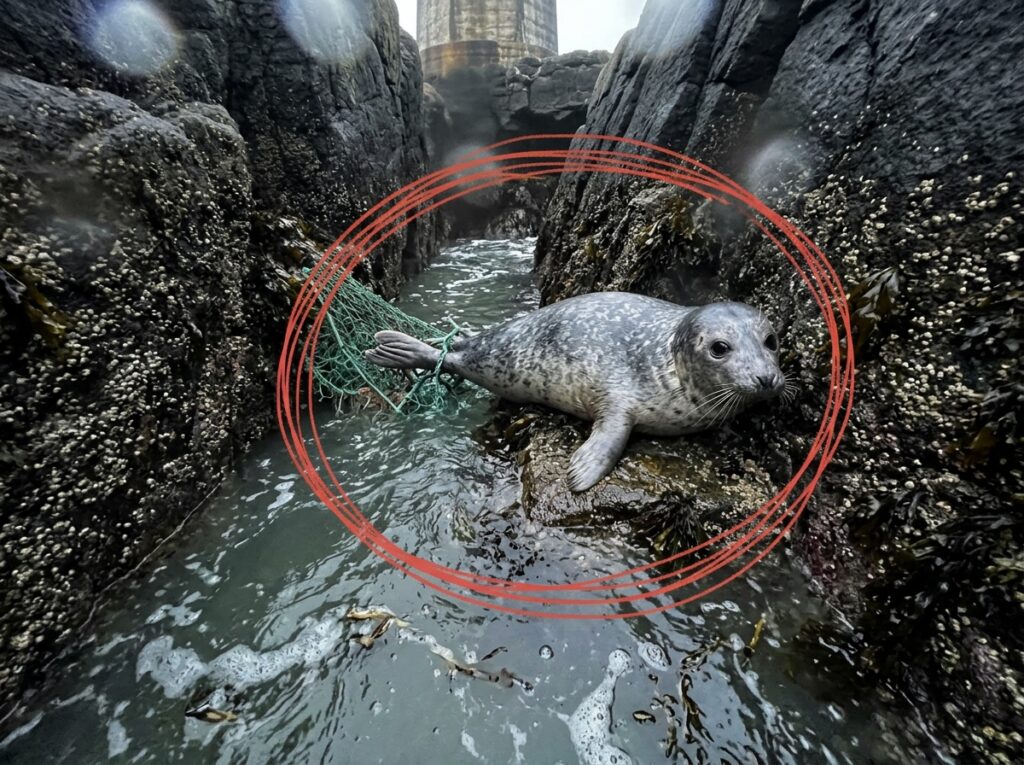
A small gray seal was resting on a narrow ledge beyond the net.
Its head was above the water.
But one of its hind flippers appeared tangled in a loose strand.
The animal lifted its head.
Then tried to move.
The line tightened.
Rebecca covered her mouth.
“Oh, no.”
Hannah immediately stopped the camera’s advance.
“We’ve got another live seal.”
Thomas stepped backward.
His hands began trembling.
“Another one?”
Hannah nodded.
“Yes.”
The seal was larger than the pup rescued the previous morning.
But it was still relatively young.
And unlike the first animal, it was trapped in a partially sheltered crevice that could become submerged as the tide rose.
The safety officer checked the water conditions.
They had a limited working window.
Hannah contacted the regional response coordinator and requested additional specialized assistance.
The team would not attempt a dangerous improvised extraction.
They needed a safe plan.
Rebecca looked toward the monitor.
The seal lifted its head again.
Its dark eyes reflected the inspection light.
Then it settled back against the rock.
Thomas whispered:
“Please don’t let that one die.”
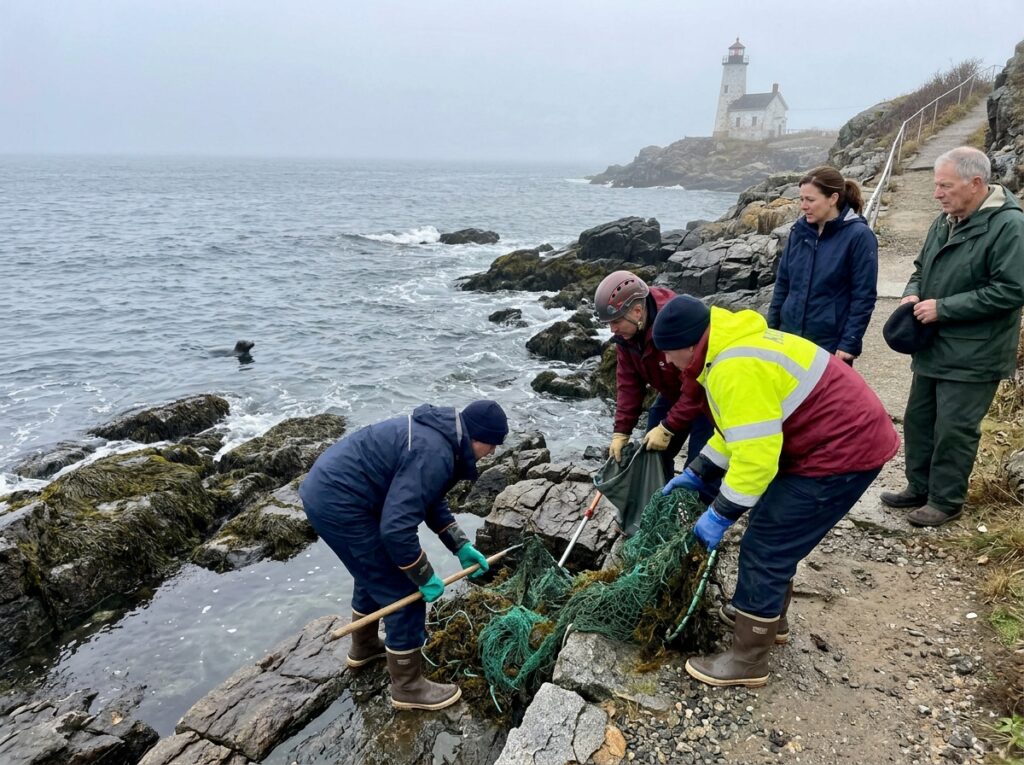
By 7:18 AM, additional trained personnel had arrived.
The responders reviewed the underwater footage and the predicted tide.
The seal was trapped in a position that could not be reached safely from the open shoreline.
A specialized marine rescue team assessed whether the net could be removed from above without placing anyone in the narrow crevice.
After securing their equipment and confirming a safe approach, the team used long-reach cutting tools to separate the accessible net from the surrounding rocks.
They worked slowly.
The seal reacted to the movement.
It lifted its head.
Twisted its body.
Then settled again.
Hannah watched the monitor.
“Don’t pull against the animal. We need to release the tension first.”
The responders adjusted their equipment.
One section of net came free.
Then another.
But the line around the hind flipper remained.
The team repositioned the inspection camera to see the attachment more clearly.
A thin green cord was looped around the flipper.
It was connected to a heavier bundle of netting wedged beneath a rock.
Hannah studied the image.
“If we cut the main section first, we may be able to free the animal without dragging the net across its body.”
The safety officer confirmed the working position remained secure.
The team proceeded carefully.
At 7:39 AM, the first heavy section separated.
The net loosened.
The seal shifted.
For a moment, Rebecca thought it might swim away.
But the cord around the flipper remained caught.
Hannah spoke into the radio.
“One more connection.”
The responder adjusted the cutting tool.
A few seconds passed.
Then the final strand separated.
The seal pulled its flipper free.
It remained on the ledge for several moments.
Then slid toward the water.
Rebecca leaned forward.
“Is it free?”
Hannah watched carefully.
The animal moved through the tidal pool.
Its hind flippers worked normally enough for it to swim away from the crevice.
It surfaced once near the outer rocks.
Then disappeared beneath the water.
The team continued observing from a distance.
No one attempted to chase or handle the seal.
Hannah explained that the animal would need to be reported and monitored if it showed signs of injury or abnormal behavior.
But the immediate entanglement was gone.
Rebecca began crying.
Thomas removed his cap.
He stared at the water.
Then whispered:
“Two of them.”
Hannah looked toward him.
“Two seals were caught in the same lost gear.”
Thomas nodded slowly.
His eyes filled.
“I never imagined.”
Rebecca stepped beside him.
He looked at the ocean.
“How many more animals could that net have hurt?”
Nobody answered.
Because nobody knew.
And that uncertainty was exactly why the remaining gear needed to be removed.
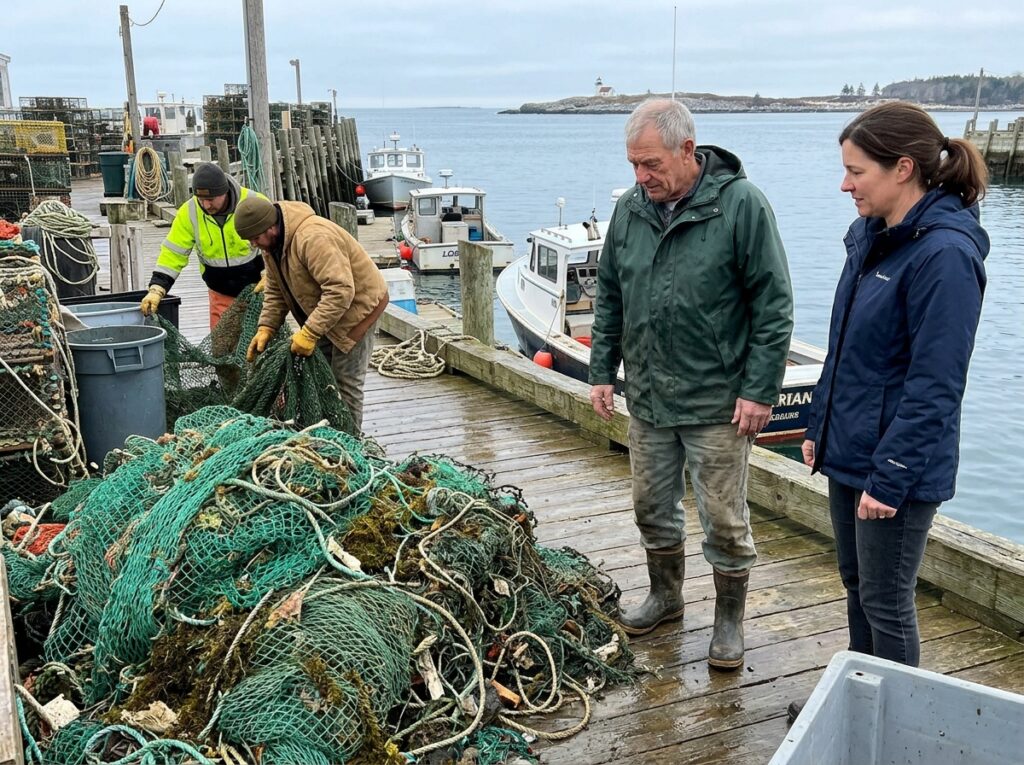
By 9:12 AM, the responders had removed several large sections of netting.
But the inspection camera revealed more material extending into deeper water.
The remaining gear was too heavy and too deeply lodged to remove safely during the wildlife rescue.
Hannah contacted the regional marine debris response coordinator.
A separate cleanup operation would be needed, with appropriate vessels, equipment, and permits.
Thomas volunteered immediately.
“I know these rocks better than almost anybody.”
Hannah nodded.
“Your knowledge could be valuable. But the work needs to be coordinated.”
Thomas agreed.
“I’ll do whatever they need.”
Rebecca looked toward the water.
The seal had disappeared.
The rocks were empty.
But the green net remained partly hidden beneath the surface.
And she knew the danger wasn’t over.
That afternoon, Hannah called Rebecca with news about the first seal pup.
The animal had arrived safely at an authorized rehabilitation facility.
Veterinary staff had examined the swelling around its front flipper.
The injury was painful, but there was no confirmed major fracture.
The pup was receiving supportive care and would be monitored for complications associated with entanglement.
Rebecca sat down.
“Is it eating?”
“Not yet consistently. But it’s alert, and the team is encouraged by its response to treatment.”
Rebecca smiled.
“That’s good.”
Hannah continued.
“We’re calling the pup Harbor for our records.”
Rebecca laughed softly.
“Harbor?”
“After the place where it was found.”
Rebecca looked toward the lighthouse window.
“That’s a good name.”
Then she asked:
“What about the second seal?”
Hannah answered carefully.
“We observed it swimming away, but we can’t guarantee its condition. We’ve documented the entanglement and will continue coordinating observations.”
Rebecca nodded.
She understood.
Not every wildlife rescue ended with an animal being carried into a warm room.
Sometimes, success meant removing the immediate danger and allowing a wild animal to return to the ocean.
And sometimes, there were no guarantees.
That evening, Thomas returned to his small house overlooking the harbor.
His wife, Margaret, was waiting in the kitchen.
They had been married for forty-six years.
She knew something was wrong the moment he entered.
“Tom?”
He placed his cap on the table.
Then sat down.
Margaret pulled out a chair.
“What happened?”
Thomas looked at his hands.
“Another seal was caught in my net.”
Margaret went quiet.
He continued.
“They freed it this morning.”
“Is it all right?”
“It swam away.”
Thomas swallowed.
“But there’s still more net down there.”
Margaret reached for his hand.
He looked toward the window.
“I’ve been fishing since I was sixteen.”
She nodded.
“I know.”
“I’ve always tried to do things right. I followed the rules. I reported lost gear. I repaired what I could.”
His voice broke.
“But I never really thought about what happened to the gear we couldn’t recover.”
Margaret listened.
Thomas wiped his eyes.
“I keep thinking about that little seal struggling in the rocks.”
She squeezed his hand.
“You didn’t leave the gear there on purpose.”
“I know.”
He looked down.
“But I want to do something about it.”
Margaret smiled gently.
“Then do something.”
Thomas looked at her.
She continued.
“You’ve spent your whole life teaching younger fishermen how to work safely.”
He nodded.
“Maybe it’s time to teach them something else.”
The next morning, Thomas called the Harbor Point Fishermen’s Association.
He asked for a meeting.
Not to complain.
Not to defend himself.
But to discuss lost fishing gear and how the community could help prevent future entanglements.
At first, some fishermen were uncomfortable.
They knew lost gear was a serious problem.
But storms could destroy equipment without warning.
And recovering gear from dangerous coastal waters was not simple.
Thomas understood their concerns.
He had experienced the same losses himself.
So he didn’t lecture them.
Instead, he showed the photographs.
The first seal pup trapped between rocks.
The second seal tangled in the underwater crevice.
And the heavy green net recovered by the response team.
The room became quiet.
Thomas looked around.
“I lost that gear in September.”
He paused.
“I reported it. I thought I’d done what I could.”
He held up the photograph of the trapped pup.
“But two animals nearly paid for it.”
A younger fisherman named Ben Carter raised his hand.
“What do you want us to do?”
Thomas answered:
“Help the people who know how to remove it safely. Report lost gear quickly. Keep better records of where it goes missing. And support efforts to get it out of the water.”
Ben nodded.
Then said:
“My father lost two traps near the south ledge last winter. I’ll bring the coordinates.”
Another fisherman spoke.
“I’ve got an old chart showing where nets snag after storms.”
A third offered to help transport authorized cleanup crews.
By the end of the meeting, twelve local fishermen had agreed to support a coordinated marine debris initiative.
Thomas sat quietly as everyone began discussing plans.
Margaret, who had come to help organize the meeting, stood beside him.
“Looks like you’ve started something.”
Thomas smiled faintly.
“I hope it helps.”
She touched his shoulder.
“It already has.”
Over the following weeks, Harbor Point began changing.
The local school invited marine wildlife educators to speak with students.
Harbor workers helped document reports of abandoned gear.
Fishermen shared information about dangerous snagging areas.
And the regional cleanup team scheduled an operation to remove the remaining net from beneath the lighthouse rocks when conditions were safe.
Rebecca continued checking the security cameras each morning.
She still watched seals resting on the offshore ledges.
She still saw bald eagles hunting along the coast.
And she still recorded the changing tides.
But now, whenever she saw a piece of floating rope or abandoned gear, she documented its location and reported it to the appropriate responders.
She had learned that noticing something was only the beginning.
What mattered was knowing how to respond safely.
On December 2, 2026, the authorized cleanup team returned to Harbor Point.
The weather was calm.
The sea was unusually gentle.
And the tide conditions were suitable for the planned operation.
Thomas joined the team as a local navigation adviser aboard a support vessel.
Rebecca watched from the lighthouse.
Specialists used appropriate lifting and cutting equipment to recover the remaining netting from the submerged rocks.
The work took several hours.
When the final section was brought aboard, Thomas stared at the pile.
It was larger than he expected.
Heavy green mesh.
Old rope.
Broken floats.
And fragments of other fishing gear tangled together.
He recognized pieces of his own equipment.
But some material clearly came from other sources.
The storm had gathered debris from several places and trapped it against the granite ledge.
Thomas looked toward the lighthouse.
For weeks, he had imagined the lost net lying somewhere offshore.
He had never pictured it becoming part of a larger underwater hazard.
The cleanup coordinator approached.
“We’ve recovered the accessible material from this site. We’ll document everything and assess whether any additional debris remains.”
Thomas nodded.
“Thank you.”
The coordinator smiled.
“Your local knowledge helped us plan the work.”
Thomas looked toward the rocks.
“Glad I could help.”
Then he said something quietly.
“I wish I’d understood sooner.”
The coordinator answered:
“What’s important is that people are acting on what they’ve learned.”
Three days later, Rebecca received a call from Hannah.
“Rebecca, I have some good news.”
Rebecca sat down.
“About Harbor?”
“Yes.”
The young seal had recovered from the immediate effects of the entanglement.
The swelling had decreased.
The animal was moving normally in the rehabilitation pool.
And it had begun feeding independently.
Rebecca smiled.
“That’s wonderful.”
Hannah continued.
“The veterinary team is evaluating when it will be ready for release.”
Rebecca looked toward the ocean.
“Do you think it’ll come back here?”
Hannah laughed softly.
“There’s no way to know. Seals can travel considerable distances.”
Rebecca nodded.
“I suppose that’s how it should be.”
“Exactly.”
Over the following weeks, Harbor continued improving.
The rehabilitation staff monitored its weight, swimming, feeding, and overall condition.
They wanted to be confident that the seal could survive independently before returning it to the wild.
Finally, in early January 2027, the veterinary team approved its release.
The location was selected by the authorized marine mammal rehabilitation team.
It offered suitable coastal habitat and safe conditions.
Rebecca and Thomas were informed afterward.
They did not crowd the release site.
They understood that Harbor was a wild animal.
Its return to the ocean was not a public performance.
It was the final step in a careful rehabilitation process.
On January 8, the team transported Harbor to the selected shoreline.
The morning was cold.
The sky was pale blue.
The Atlantic rolled gently against the rocks.
The transport crate was positioned on stable ground.
The team opened the door and stepped back.
For several seconds, the young seal remained inside.
Then its gray head appeared.
It looked toward the water.
Paused.
And slowly moved forward.
The seal crossed the wet sand.
Reached the edge of the surf.
And slipped into the ocean.
It surfaced once beyond the small waves.
Then disappeared.
The rehabilitation staff watched from a distance.
No one chased it.
No one tried to call it back.
The animal was free.
When Hannah telephoned Rebecca later that day, her voice was warm.
“Harbor went back to the ocean this morning.”
Rebecca closed her eyes.
For a moment, she couldn’t speak.
Then she whispered:
“Thank you.”
Hannah smiled.
“Everyone on the team is pleased.”
Rebecca looked toward the south rocks.
The place where the pup had once been trapped was now empty.
The green net was gone.
And somewhere along the Maine coast, a young seal had another chance at life.
Rebecca called Thomas.
He answered from his boat.
“Hello?”
“Tom, Harbor was released today.”
There was silence.
Then Thomas whispered:
“Really?”
“Yes.”
He looked toward the open water.
For several seconds, he said nothing.
Then Rebecca heard him crying.
“Tom?”
He cleared his throat.
“I’m here.”
Rebecca smiled through her own tears.
“Good news, isn’t it?”
Thomas laughed softly.
“Best news I’ve heard in a long time.”
That evening, Thomas returned home earlier than usual.
Margaret was preparing dinner.
He walked into the kitchen.
She looked up.
“Everything all right?”
Thomas nodded.
“The little seal went home.”
Margaret smiled.
“Oh, Tom.”
He sat down.
Then looked toward the window.
“I keep thinking about that morning.”
She joined him at the table.
“The lighthouse?”
He nodded.
“The eagle. Rebecca calling on the radio. That little animal caught in my net.”
He paused.
“I thought I’d spend the rest of my life remembering how I nearly hurt something.”
Margaret reached for his hand.
Thomas continued.
“But now I think I’ll remember what happened afterward too.”
She smiled.
“The people who helped?”
“All of them.”
He looked down.
“Rebecca. Hannah. The rescue team. The fishermen who came together. The people who pulled that net out of the water.”
Margaret squeezed his hand.
Thomas smiled sadly.
“I can’t change what happened in September.”
“No.”
“But I can make sure I don’t ignore what it taught me.”
Margaret nodded.
“That’s enough to start with.”
One year later, on November 7, 2027, Rebecca Morgan stood inside the lighthouse security room.
The morning was cold and clear.
The Atlantic stretched toward the horizon beneath a pale blue sky.
She checked the weather instruments.
Reviewed the overnight security footage.
And glanced toward the south rocks.
The tidal pool was visible at low water.
There was no green netting.
No tangled rope.
No trapped animal.
Just granite.
Seaweed.
And waves moving gently through the channel.
Rebecca smiled.
The cleanup program had continued throughout the year.
Fishermen reported lost gear more consistently.
Local volunteers helped document shoreline debris.
And trained teams had removed additional hazardous material from several coastal locations.
The community had not eliminated every danger.
Storms still damaged equipment.
Gear could still be lost.
And marine wildlife continued to face threats from human activity.
But Harbor Point had become more attentive.
More organized.
And more willing to work together.
At 6:11 AM, Rebecca noticed movement on the security monitor.
A bald eagle descended toward the shoreline.
Its enormous wings spread above the rocks.
Then it landed on the same weathered wooden post where Rebecca had first noticed it a year earlier.
She leaned closer.
The bird scanned the water.
Its white head turned toward the tidal pool.
Rebecca smiled.
“Well, hello again.”
She couldn’t know whether it was the same eagle.
And she knew the bird hadn’t deliberately alerted her to the trapped seal the previous year.
It had simply been hunting along the shoreline.
But its movement had drawn her attention toward something she might otherwise have missed.
That ordinary moment had started a chain of events.
A phone call.
A rescue.
A second discovery beneath the rocks.
A community meeting.
And a coordinated effort to remove dangerous fishing gear.
Rebecca watched the eagle for another minute.
Then the bird lifted from the post.
Its wings spread wide.
And it disappeared toward the open ocean.
A few minutes later, Thomas called on the marine radio.
“Morning, Rebecca.”
She smiled.
“Morning, Tom.”
“Beautiful day out here.”
“It certainly is.”
He paused.
“Any wildlife on the cameras?”
Rebecca looked toward the empty post.
“Just an eagle.”
Thomas laughed.
“Another one?”
“Maybe the same one.”
He chuckled.
“Guess we’ll never know.”
Rebecca smiled.
Then she asked:
“How’s the fishing?”
“Good. And I’ve got something else to tell you.”
“Oh?”
“The harbor association approved another gear-recovery workshop next month. We’re bringing in some younger crews.”
Rebecca smiled.
“That’s wonderful.”
Thomas continued.
“And Ben Carter’s helping organize it.”
“Good for him.”
Thomas looked toward the sea.
“Funny how one morning can change the way you look at things.”
Rebecca nodded.
“It really is.”
For a moment, neither spoke.
Then Thomas said quietly:
“You know, Rebecca, I never properly thanked you.”
She frowned.
“For what?”
“For calling me that morning.”
Rebecca smiled.
“Tom, I just wanted to know if you could see the rocks.”
“I know.”
He paused.
“But if you hadn’t called, I might never have realized where that net ended up.”
Rebecca looked toward the shoreline.
“You came back and helped.”
Thomas nodded.
“Still am.”
She smiled.
“Then that’s what matters.”
After the radio call ended, Rebecca stepped outside.
The wind smelled of salt.
Gulls circled above the harbor.
And waves moved steadily against the granite peninsula.
She stood beside the lighthouse railing and looked down at the tidal pool.
One year earlier, a young seal had been trapped there.
Its neck and flipper caught in discarded fishing gear.
Another seal had been hidden beneath the rocks.
And an old fisherman had stood beside her, heartbroken to discover what his lost equipment had done.
Now the rocks were clear.
Harbor had returned to the ocean.
And the fishing community had made a commitment to help prevent similar rescues from becoming necessary.
Rebecca thought about the first morning.
The eagle dropping toward the rocks.
The tiny gray head appearing between two stones.
The green rope tightening around the seal’s neck.
And the moment she realized the animal wasn’t swimming.
It was trapped.
She remembered how frightened she had been.
How helpless she felt watching from above.
And how relieved she was when the trained responders arrived.
But most of all, she remembered what happened after the rescue.
People who had never worked together before began sharing information.
Fishermen offered their boats.
Harbor workers helped locate debris.
Children learned about marine wildlife.
And an entire village began paying closer attention to what was happening along its shoreline.
Rebecca smiled.
Because the story had never really been about an eagle performing a miracle.
It was about an ordinary bird whose movement made someone look in the right direction.
And about what people chose to do after they noticed something was wrong.
One young seal was rescued from the rocks. Another was freed from a hidden underwater net. But the greatest change happened when an entire community decided that protecting the ocean was everyone’s responsibility.
Rebecca looked toward the horizon.
Somewhere beyond the waves, Harbor might still be swimming along the Maine coast.
There was no way to know.
The seal would never understand how many people had worked to save it.
And it would never know the name of the old fisherman who helped remove the net.
But that was all right.
Wild animals didn’t need to understand human kindness.
They needed clean water.
Safe habitat.
And the freedom to live without becoming trapped in what people left behind.
Rebecca took one last look at the empty tidal pool.
Then returned to the lighthouse.
There were weather readings to record.
Equipment to inspect.
And another ordinary day to begin.
But before closing the security room door, she glanced at the monitor once more.
The weathered wooden post stood empty above the rocks.
The eagle was gone.
And the ocean kept moving.
Rebecca smiled softly.
Then whispered:
“Stay safe out there, little Harbor.”
THE END
No Comments