

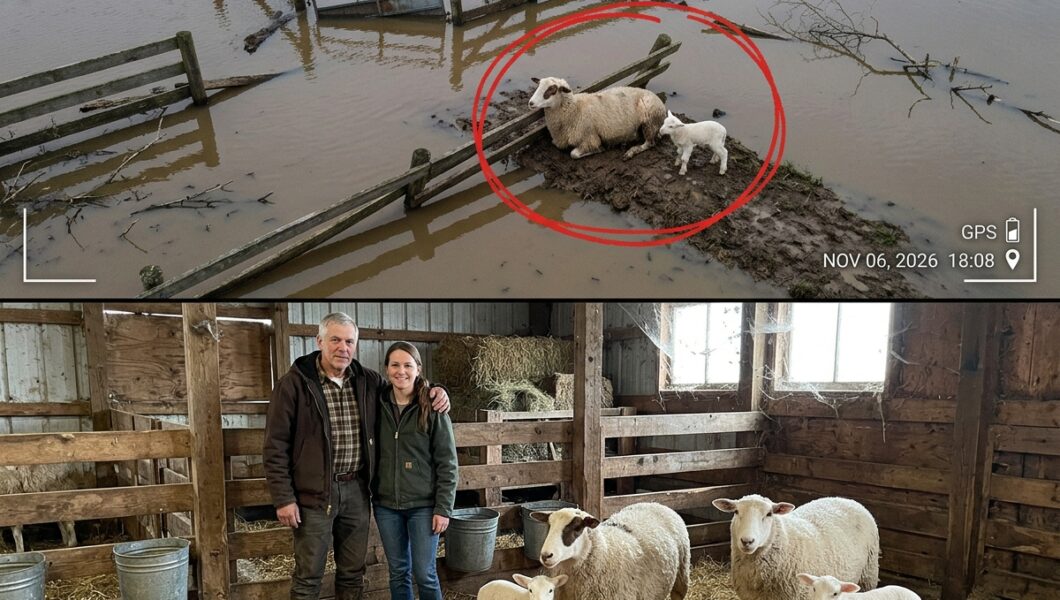
At 5:47 PM, sixty-four-year-old Iowa farmer Robert Miller stood beside his daughter, staring at a drone monitor that had suddenly gone black.
The last image remained burned into his memory.
A newborn lamb.
An adult sheep lying beneath a tangle of broken branches.
And muddy floodwater rising around them.
The adult sheep was Molly, Daisy’s older sister, who had been missing since the previous night’s storm.
Robert had spent forty-one years raising sheep, but he had never felt so helpless standing on his own land.
“Hannah, can you get the drone back?”
His thirty-two-year-old daughter was already working the controls.
“It’s returning automatically, Dad. The battery’s almost gone.”
“Can you still see them?”
“No.”
Robert looked toward the flooded pasture.
The sun was disappearing behind a thick wall of gray clouds.
The drainage gate had been damaged during the storm, and water was still moving through the lowest part of the field.
Somewhere beyond the broken fence, Molly and a tiny lamb were trapped.
And they had no idea how much longer the animals could survive.
Robert grabbed his phone and called the county rescue coordinator again.
“This is Robert Miller at Willow Creek Farm. We have two more animals stranded near the eastern drainage channel.”
The coordinator, Captain James Walker, had helped organize the first rescue that morning.
“Robert, are you and Hannah somewhere safe?”
“Yes, sir.”
“Stay there. Tell me exactly what you saw.”
Robert described the drone footage.
A small white lamb standing on a narrow patch of muddy ground.
An adult ewe lying beside it.
Branches piled against the damaged drainage gate.
And water moving around both animals.
James was quiet for a moment.
“Is the adult sheep moving?”
“She lifted her head.”
“All right. We’re coming back. Nobody goes into that water until we’ve assessed it.”
Robert ended the call.
Then he looked at Hannah.
She was staring toward the barn.
Inside, Daisy stood beside the lamb they had rescued earlier that morning.
The little animal was warm now.
Its legs were steadier.
And it had finally begun nursing.
Hannah had spent the afternoon believing the worst was over.
Now she was facing the possibility that another newborn had been left behind.
“Dad,” she whispered, “what if we’ve been wrong about everything?”
Robert frowned.
“What do you mean?”
She looked toward the barn.
“We assumed the first lamb belonged to Daisy because of the yellow tag.”
Robert nodded.
“Twenty-seven.”
“But that tag identifies Daisy’s lambing group. It doesn’t prove which newborn is hers if the records were mixed up.”
Robert thought about the chaos of the previous night.
The power outage.
The flooded barn entrance.
The sheep moving between pens when a gate failed.
He remembered that Molly had also been heavily pregnant.
Then his expression changed.
“Hannah…”
She looked at him.
“What?”
“Molly was due this week too.”
Hannah stared at her father.
For several seconds, neither spoke.
Then she whispered:
“What if Daisy didn’t have twins?”
Robert looked toward the darkening pasture.
“What if that second baby belongs to Molly?”
The possibility made the situation even more urgent.
Because if Molly was the lamb’s mother, the newborn had spent nearly an entire day beside an injured ewe, surrounded by cold floodwater.
And the little animal might never have nursed properly.
At 6:04 PM, the drone returned to its landing pad.
Hannah removed the battery and inserted a fully charged replacement.
She checked the weather.
Wind gusts were increasing.
Rain was beginning again.
She couldn’t safely fly into the approaching darkness for long.
But she needed one more look.
“Just one short flight,” she told her father.
Robert nodded.
“Stay over our property. Don’t push it.”
The drone rose above the barn.
Its camera passed over the damaged fence, the flooded feeding trough, and the small grassy mound where the first lamb had been found.
Then Hannah turned toward the eastern drainage channel.
The image sharpened.
There they were.
Molly was lying on her side beside a fallen section of fence.
Her dark eye marking was unmistakable.
The newborn lamb stood near her shoulder.
Its legs were trembling.
Every few seconds, it lowered its head toward Molly’s neck.
Then lifted it again.
Hannah zoomed closer.
“Dad, Molly’s trying to stand.”
The ewe pushed against the muddy ground.
Her front legs straightened.
But her hindquarters remained trapped beneath a fallen wooden rail.
She struggled briefly.
Then collapsed back onto her side.
Robert covered his mouth.
“She’s pinned.”
Hannah looked at the lamb.
The tiny animal pressed against Molly’s shoulder.
Then bleated.
Molly lifted her head.
And answered.
Robert’s eyes filled.
“She’s been trying to get up for her baby.”
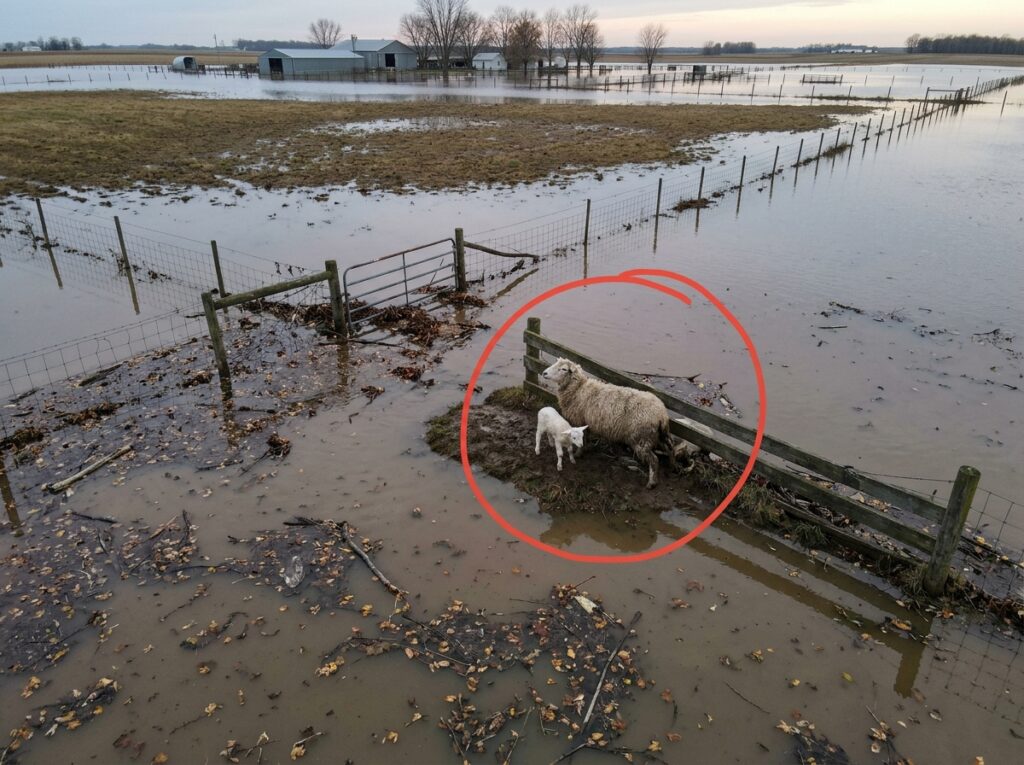
At 6:19 PM, the rescue vehicles arrived.
Captain James Walker stepped out with two trained water rescue personnel and a county livestock veterinarian, Dr. Emily Foster.
A neighboring farmer, Thomas Bennett, arrived with a livestock trailer and portable pen panels.
Robert met them near the raised access lane.
“She’s pinned beneath a fence rail,” he explained.
James studied the drone footage.
“How deep is the water?”
“About three feet near the drainage channel. Shallower on the west side, but there are hidden ditches.”
James nodded.
“Then nobody walks into it.”
The rescue team examined the safest possible approach.
The raised farm lane reached within several yards of the trapped animals, but the final stretch crossed unstable, flooded ground.
They prepared a secured inflatable rescue craft suitable for the conditions.
The responders wore appropriate protective equipment and maintained a safety line from the stable access lane.
Hannah stayed beside the veterinarian.
She wanted desperately to help.
But she understood that entering the floodwater herself could turn one emergency into two.
At 6:34 PM, the rescue team began moving toward Molly.
Robert stood beside Hannah, watching every movement.
The newborn lamb was still standing.
Molly had stopped struggling.
Her head rested against the muddy ground.
“Dad,” Hannah whispered, “she’s getting weaker.”
Robert placed a hand on her shoulder.
“I know.”
The rescuers approached slowly.
Molly raised her head when she heard them.
The lamb moved closer to her.
One responder carefully secured the newborn first, using a dry towel to support its small body before placing it into a ventilated livestock carrier.
The lamb bleated.
Molly immediately lifted her head.
Hannah could hear the faint call across the water.
“Oh, sweetheart.”
The rescuer secured the carrier in the craft.
Then the team turned toward Molly.
The fallen fence rail was heavier than it had appeared on the drone footage.
It had become wedged beneath a tangle of branches.
Molly’s hind leg was trapped beneath one end.
The responders stabilized the rail before carefully lifting it with appropriate equipment.
The ewe tried to move.
But she was exhausted.
Dr. Foster guided the team by radio as they assessed the animal’s position.
They avoided pulling her by the limbs.
Instead, they used a broad animal rescue sling to support her body.
At 6:51 PM, the rail was finally lifted clear.
Molly’s trapped leg was free.
But she couldn’t stand.
Robert’s heart sank.
“Why isn’t she getting up?”
Dr. Foster answered calmly.
“She’s cold, exhausted, and may have an injury. We need to examine her properly.”
The team carefully moved Molly onto the secured rescue platform.
For several seconds, the ewe remained still.
Then her head lifted.
And she bleated.
From the carrier, the newborn answered.
Hannah began crying.
“She heard her baby.”
Robert pulled his daughter close.
“Yes, she did.”
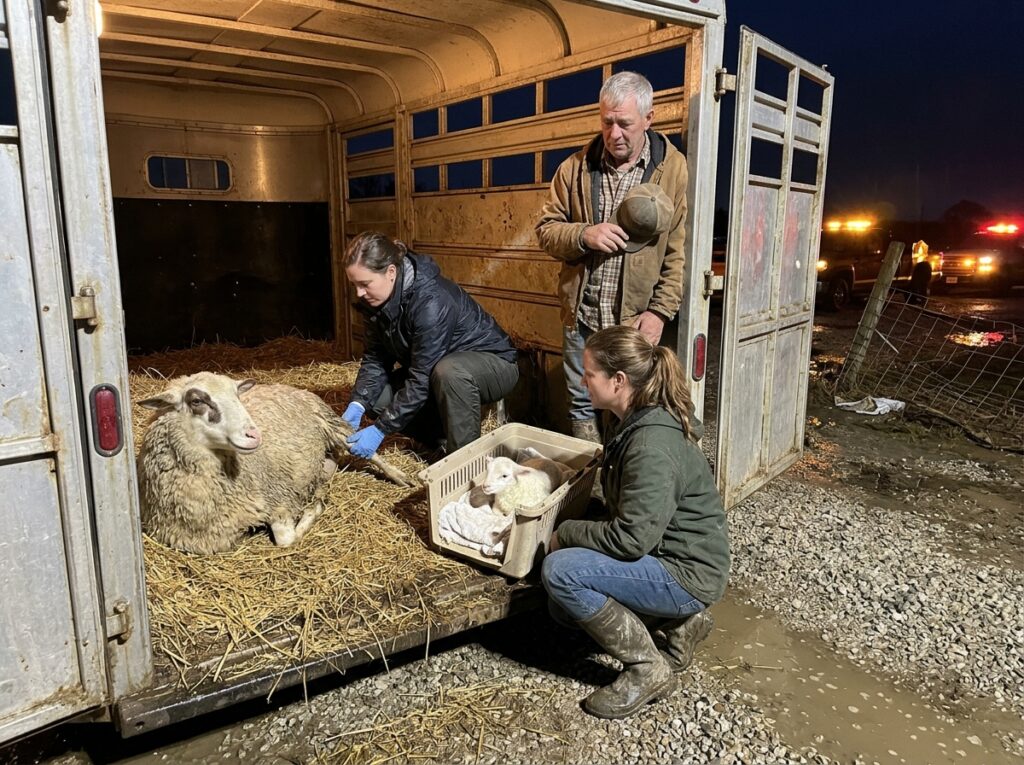
At 7:03 PM, the rescuers reached the stable access lane.
The newborn lamb was carried into the warm livestock trailer.
Molly was transferred onto dry bedding, where Dr. Foster immediately began examining her.
Robert stood nearby, holding his cap against his chest.
“Please tell me she’s going to make it.”
The veterinarian listened to Molly’s breathing and checked her circulation.
“She’s alive and responsive. That’s encouraging. But she’s been cold and trapped for hours.”
Hannah knelt beside the lamb’s carrier.
The little animal was shivering.
Its tiny mouth opened.
A faint bleat escaped.
Dr. Foster checked the lamb’s temperature and directed gradual warming.
The newborn was weak, but breathing normally.
Molly had swelling around her hind leg and several superficial abrasions.
There were no obvious open fractures, but further examination would be needed.
The veterinarian arranged continued care in a dry, sheltered barn.
And she made one thing clear.
Neither animal was out of danger yet.
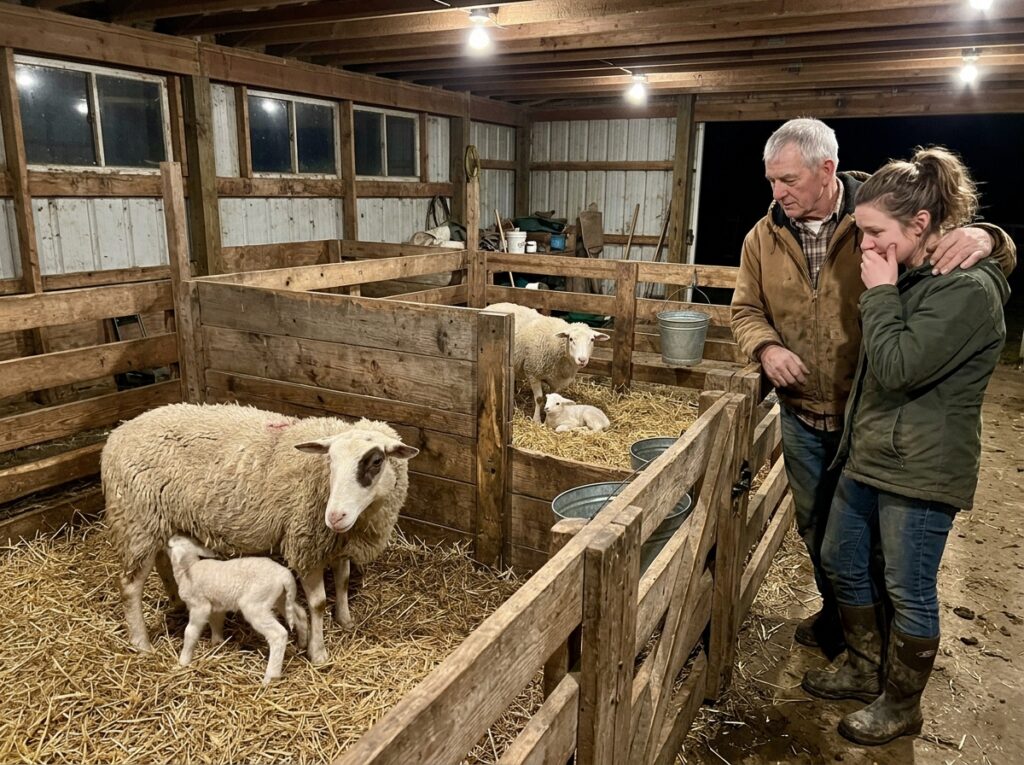
At 8:26 PM, the animals were safely inside the barn.
The rain had begun falling heavily again.
Robert closed the large sliding doors while Hannah helped prepare a quiet recovery area.
Daisy stood in the neighboring pen with the lamb rescued that morning.
The little animal had become noticeably stronger.
It was nursing regularly.
And Daisy remained attentive whenever it moved away from her.
Across the barn, Molly lay on deep straw bedding.
Her newborn rested in a separate warm space nearby while Dr. Foster continued treatment.
Hannah checked the farm records again.
Daisy had been recorded as a possible twin pregnancy.
Molly had been listed as expecting a single lamb.
But the storm had disrupted the usual lambing observations, and neither birth had been witnessed.
The veterinarian examined both ewes and reviewed their condition.
She explained that the available evidence supported the likelihood that the rescued lamb from the morning belonged to Daisy, while the second newborn belonged to Molly.
But she wanted the team to confirm that each ewe was accepting and feeding the appropriate lamb.
Hannah nodded.
“We’ll monitor them carefully.”
Dr. Foster smiled.
“That’s exactly what we need.”
By 10:15 PM, Molly’s temperature was improving.
She had received veterinary treatment and supportive care.
Her injured leg was swollen, but she could move it.
The newborn lamb had warmed sufficiently to begin attempting to stand.
Hannah sat on a small wooden stool beside the pen.
Her father brought her a cup of tea.
“You should get some sleep.”
She shook her head.
“Not yet.”
Robert sat beside her.
For a while, they listened to the rain on the barn roof.
Then Hannah looked toward Molly.
“Mom would’ve stayed up all night.”
Robert smiled faintly.
“Your mother stayed up for plenty of lambs.”
Hannah laughed softly.
“Remember the one she brought into the kitchen?”
Robert shook his head.
“That little troublemaker slept beside the stove for three nights.”
“And chewed the corner of the rug.”
Robert smiled.
“Your mother said it gave the rug character.”
Hannah began laughing.
Then, without warning, she started crying.
Robert turned toward her.
“Hannah?”
She wiped her eyes.
“I’m sorry.”
“For what?”
She looked down at her hands.
“I keep thinking about her.”
Robert’s expression softened.
Hannah had returned to the farm six months earlier after her mother’s death.
She had told everyone she was only staying temporarily.
She planned to return to Des Moines.
Find another veterinary technician position.
And continue the life she had built away from home.
But each morning, she found herself walking through the barn where her mother used to work.
She remembered the sound of her mother’s boots on the concrete floor.
The way she hummed while preparing feed.
And how she always checked the youngest animals before going to bed.
“I thought coming home would make it easier,” Hannah whispered.
Robert listened.
“But everywhere I look, I see something that reminds me she’s gone.”
Robert lowered his head.
“I know.”
Hannah looked toward Daisy.
“She loved those sheep.”
Robert smiled sadly.
“She loved all of them.”
Hannah wiped her cheeks.
“I don’t know how you manage being here alone.”
Robert was quiet for a long time.
Then he answered.
“Some days, I don’t manage very well.”
Hannah looked at him.
He continued.
“I get up because the animals need feeding. I fix fences because they need fixing. I keep busy because if I stop too long, the house feels empty.”
His voice trembled.
“But when you came home, it didn’t feel quite so empty anymore.”
Hannah reached for his hand.
Robert smiled.
“You don’t have to stay here because you think I need you.”
She shook her head.
“Dad…”
“I mean it. Your mother and I always wanted you to have your own life.”
Hannah looked toward the animals.
Then whispered:
“What if this is the life I want?”
Robert stared at her.
She smiled through her tears.
“I’ve spent six months telling myself I’m only visiting.”
She looked around the barn.
“But today, when I saw that little lamb stranded in the water, all I could think was that I couldn’t leave.”
Robert’s eyes filled.
“Hannah…”
She squeezed his hand.
“I think I want to stay.”
For several seconds, Robert couldn’t speak.
Then he pulled his daughter into his arms.
And cried.
Not because the day had been easy.
Not because the farm was safe.
But because, for the first time since losing his wife, he could imagine a future that didn’t feel quite so lonely.
At 11:07 PM, a soft bleat interrupted them.
Hannah lifted her head.
Molly was trying to stand.
Dr. Foster had advised them to monitor the ewe closely and avoid forcing movement.
Now Molly carefully shifted her weight.
Her front legs straightened.
Then, with a slow effort, she rose onto all four feet.
She stood unsteadily.
But she stood.
Hannah covered her mouth.
“Dad…”
Robert turned.
Molly took one cautious step.
Then another.
The newborn lamb lifted its head.
It bleated.
Molly answered.
Hannah hurried to call Dr. Foster, who was resting in a nearby room while continuing to supervise the overnight care.
After examining Molly again, the veterinarian allowed a carefully monitored reunion.
The lamb was brought close to the ewe.
Molly lowered her head.
She sniffed the newborn.
Then began licking its fleece.
The lamb moved toward her.
It wobbled on its tiny legs.
For a moment, it lost its balance.
Hannah instinctively leaned forward.
But the little animal regained its footing.
It moved closer to Molly.
Then began searching for milk.
Dr. Foster watched carefully.
After several attempts, the newborn successfully nursed.
Hannah started crying again.
Robert laughed through his tears.
“Well, look at that.”
Molly stood quietly while her lamb fed.
And across the barn, Daisy rested beside her own baby.
Two mothers.
Two newborns.
All four alive.
By the following morning, the storm had finally passed.
The sky above Willow Creek was pale blue.
Water still covered parts of the lower pasture, but the current had slowed.
Robert walked outside shortly after sunrise.
He stood beside the fence and looked across the damage.
Several posts were missing.
The feeding trough had been pushed against a tree.
A section of the drainage gate would need replacing.
And nearly twenty acres of pasture remained too wet for livestock.
It would take weeks to repair everything.
Robert knew that.
But for the first time in twenty-four hours, he wasn’t thinking about what the flood had taken.
He was thinking about what had survived.
Inside the barn, Hannah was checking Molly’s temperature.
The ewe was standing more comfortably.
Her lamb had nursed several times overnight.
Daisy and her own newborn were also doing well.
Dr. Foster returned later that morning and confirmed that all four animals were improving.
Molly would need rest, follow-up examinations, and continued monitoring of her injured leg.
The newborns would need careful observation to ensure they were feeding and gaining strength.
But the immediate danger had passed.
Robert shook the veterinarian’s hand.
“Thank you for coming back last night.”
She smiled.
“I’m glad you called when you did.”
Hannah looked toward Molly.
“If we’d waited until morning…”
Dr. Foster answered gently.
“It’s difficult to know exactly what would have happened. But getting them out of the cold water was important.”
Robert nodded.
Then he looked toward his daughter.
“And using the drone meant nobody had to go looking through that water.”
Hannah smiled.
“Mom always said the best farm tool was the one that kept you from doing something foolish.”
Robert laughed.
“She certainly did.”
That afternoon, neighbors began arriving.
Thomas Bennett brought hay.
A family from the next farm delivered clean bedding.
Two brothers from the volunteer fire department helped Robert assess the damaged fence line.
Others offered temporary pasture space for sheep that couldn’t return to the flooded fields.
The community had seen Hannah’s short drone video of the first rescue.
Now they learned about the second lamb and Molly.
And the story spread.
Not because a bald eagle had performed some extraordinary act of kindness.
The bird had simply been hunting near the flooded pasture that morning.
Its movement had drawn Robert’s camera toward the stranded lamb.
The rest had happened because people noticed, made calls, shared equipment, and worked together.
By the end of the weekend, volunteers had helped clear debris from the safer parts of the property.
A neighboring farmer offered to lend Robert portable fencing.
And several families had brought enough hay to keep the sheep fed while the lower pasture recovered.
Robert stood beside the barn, watching a group of neighbors unload supplies.
Hannah approached carrying two cups of coffee.
“Looks like we’re going to have a busy week.”
Robert smiled.
“Looks like it.”
She handed him a cup.
Then said something that surprised him.
“I called my old supervisor in Des Moines.”
Robert looked at her.
“Oh?”
“I told her I won’t be returning.”
He lowered his coffee.
“Hannah, are you sure?”
She nodded.
“I’ve been thinking about it for months.”
Robert looked toward the barn.
“You don’t have to make a decision because of one bad storm.”
“I know.”
She smiled.
“But the storm helped me understand something.”
Robert waited.
Hannah continued.
“I loved my work in Des Moines. I learned a lot. But every time I came home, I felt like I was leaving something unfinished when I went back.”
She looked across the fields.
“This farm is part of me.”
Robert’s eyes filled.
Hannah laughed softly.
“And somebody has to stop you from trying to fix fences by yourself.”
Robert chuckled.
“I’ve been fixing fences since before you were born.”
“Exactly. It’s time you had help.”
They stood together in the cool November sunlight.
Then Robert reached into his jacket pocket.
He pulled out a small brass key.
Hannah frowned.
“What’s that?”
Robert held it out.
“The old office.”
She stared at him.
The farm office had been her mother’s favorite room.
It contained lambing records, veterinary supplies, old photographs, and a wooden desk beside the window.
Since her mother’s death, Robert had kept the door closed.
Hannah hadn’t entered it in months.
“Dad…”
Robert smiled.
“Your mother always said that someday you’d be running this place better than either of us.”
Hannah’s eyes filled.
He placed the key in her hand.
“I think it’s time.”
Hannah stared at the little brass key.
Then hugged him.
For a long time, neither spoke.
That evening, they opened the office together.
The room smelled faintly of old paper and cedarwood.
Her mother’s reading glasses still rested beside the desk.
A faded calendar hung on the wall.
And above the filing cabinet was a photograph taken nearly twenty years earlier.
A much younger Hannah stood in the pasture holding a tiny white lamb.
Beside her stood her mother.
Smiling.
Laughing.
Her arm wrapped around Hannah’s shoulders.
Robert looked at the photograph.
“That was Daisy.”
Hannah smiled.
“The day we brought her home.”
Robert nodded.
“She was so small your mother thought she might not survive.”
Hannah remembered.
Daisy had been rejected by her own mother.
Hannah was twelve years old when they brought the orphaned lamb into the barn.
She fed Daisy from a bottle.
Helped keep her warm.
And slept on a cot beside the pen for two nights because she was afraid the lamb would become lonely.
Her mother had sat beside her.
Reading stories.
Making hot chocolate.
And reminding her that caring for an animal meant being patient even when things were difficult.
Hannah looked toward the photograph.
“Mom would be proud of Daisy.”
Robert smiled.
“She’d be proud of you too.”
Hannah wiped her eyes.
Then she noticed something written on the back of the photograph.
She carefully lifted it from the frame.
In her mother’s familiar handwriting were the words:
“Some of the smallest lives teach us the biggest lessons about love.”
Hannah read the sentence twice.
Then pressed the photograph against her chest.
Robert looked away, blinking back tears.
Outside, the sheep were settling into their pens.
The barn was warm.
The rain had stopped.
And for the first time since her mother’s death, Hannah felt that coming home didn’t mean living in the past.
It meant carrying forward something worth protecting.
Over the following weeks, Molly recovered steadily.
Her leg swelling decreased.
She began walking normally.
And her newborn grew stronger.
Daisy remained attentive to her own lamb, who soon became energetic enough to bounce around the pen whenever Hannah arrived with fresh bedding.
The family named Daisy’s lamb Hope.
Molly’s lamb became Willow.
Hannah chose the names.
Robert pretended to complain.
“We’re running a sheep farm, not a nursery.”
But every morning, he greeted the two lambs by name.
And Hannah caught him doing it.
One afternoon, she found him standing beside Molly’s pen.
“Morning, Willow,” he said softly.
The little lamb lifted its head.
Robert smiled.
“You’re getting big.”
Hannah leaned against the doorway.
“Thought we weren’t running a nursery.”
Robert turned.
His face reddened.
“Just checking the livestock.”
Hannah laughed so hard she had to hold the doorframe.
Robert shook his head.
“Don’t tell anybody.”
But she did.
And for the first time in months, the farmhouse was filled with laughter again.
On November 6, 2027, exactly one year after the flood, Robert and Hannah stood beside the same pasture.
The damaged fence had been replaced.
The drainage gate had been rebuilt.
And the low ground had been restored with improved flood management measures.
Daisy and Molly grazed nearby.
Hope and Willow were no longer tiny lambs.
They had grown into healthy young sheep.
Robert launched his drone for a routine inspection.
Hannah stood beside him holding two cups of coffee.
“Remember last year?” she asked.
Robert smiled.
“How could I forget?”
The drone rose above the pasture.
Its camera swept across the green fields.
The repaired fence.
The creek.
And the small grassy mound where Hope had once stood surrounded by water.
Robert paused the camera.
For a moment, he remembered the tiny white shape he had almost mistaken for a feed sack.
He remembered the bald eagle flying across the screen.
The mother sheep calling from the opposite side of the pasture.
And the way Hannah had whispered:
“Dad, it’s getting tired.”
Then he remembered the second drone flight.
The falling darkness.
Molly pinned beneath the broken fence.
And Willow standing beside her.
Robert lowered the controller slightly.
“That was a long day.”
Hannah smiled.
“The longest.”
He looked toward the barn.
“Your mother would’ve been proud of how you handled it.”
Hannah’s eyes softened.
“I hope so.”
Robert nodded.
“I know so.”
Then Hannah pointed toward the screen.
“Dad, look.”
A bald eagle was gliding above the creek.
Its white head was unmistakable against the dark trees.
Robert adjusted the camera slightly, keeping a safe distance from the bird.
The eagle circled once.
Then continued downstream.
Hannah smiled.
“Another eagle.”
Robert chuckled.
“Or maybe the same one.”
She laughed.
“We’ll never know.”
Robert looked toward the pasture.
He knew the eagle hadn’t deliberately led him to the stranded lamb.
It had been searching for food, doing what wild eagles do.
But following its flight had changed where his camera was pointing.
And that small decision had helped him notice something he might otherwise have missed.
Hannah rested a hand on his shoulder.
“Funny how things happen.”
Robert nodded.
“Sure is.”
They watched the drone feed for another minute.
Then Robert brought it home.
As the aircraft descended toward the landing pad, Hannah looked across the fields.
Daisy was grazing near the fence.
Molly stood a short distance away.
Hope and Willow were moving together through the grass.
All four were healthy.
All four were safe.
And the farm that had nearly been overwhelmed by floodwater was thriving again.
Hannah smiled.
“Come on, Dad. We’ve got work to do.”
Robert laughed.
“Always.”
They walked toward the barn together.
Father and daughter.
Two people who had lost someone they loved.
Two people who had nearly lost the animals their family had raised for generations.
And two people who had discovered that sometimes the best way to honor the past was to build something meaningful for the future.
Robert stopped beside the barn door.
He looked toward the sky one last time.
The eagle was gone.
The clouds were drifting slowly over Willow Creek.
And the fields were peaceful.
He thought about the tiny lamb standing alone on a mound of grass.
The mother sheep calling across the water.
The neighbors who had arrived with equipment and supplies.
And his daughter, who had decided to stay.
Then he smiled.
Because that terrible November morning had taught him something he would never forget.
Sometimes, saving one small life doesn’t just change the future of that animal. It changes the people who come together to save it.
The eagle hadn’t known what it would set in motion.
Hope and Willow would never understand how close they had come to being lost.
And Daisy and Molly would simply continue doing what mother sheep do, caring for their young.
But Robert and Hannah would remember.
They would remember the fear.
The rain.
The muddy water.
The sound of newborn lambs calling for their mothers.
And the moment the barn finally became quiet because every animal was safe.
That night, Hannah placed the old photograph of herself and her mother on the office desk.
Beside it, she set a new picture.
Robert standing in the barn.
Daisy and Molly behind him.
And Hope and Willow resting on clean straw.
She looked at both photographs.
Then whispered:
“We’re taking good care of them, Mom.”
Outside, the evening wind moved gently through the trees.
And from the barn came the soft, familiar sounds of sheep settling down for the night.
Four sheep had survived the flood. But for Robert and Hannah, the greatest thing rescued that day was the feeling that their family still had a future together. ❤️🐑🦅
THE END
This is a fictional emotional farm animal rescue story. The characters, events, and locations are invented for storytelling.
No Comments