

The last time I saw Harold, he was sitting in the same corner of the senior center where I had first met him.
It had been almost two years since our first conversation, but I could still remember exactly where he had been sitting that afternoon, slowly stirring his soup and telling me something I was too young to fully understand.
“I’ve never really felt old,” he had said.
At the time, I thought it was an interesting observation.
Now I realize it was one of the most important things anyone had ever told me.
After that first meeting, I started volunteering at the senior center more often. At first, I told myself it was because they needed extra help serving meals. The truth was that I had become curious about the people sitting at those tables. I wanted to hear their stories.
Harold became one of the people I looked forward to seeing.
He always arrived early.
He always wore a clean sweater, even when everyone else showed up in whatever clothes they had grabbed that morning. He liked his coffee with one spoonful of sugar and complained that the center’s radio was never loud enough.
He also had a habit of making jokes at exactly the wrong moment.
Once, a staff member was giving everyone instructions about an upcoming fire drill. Harold raised his hand and asked, completely seriously, “Do we get to choose which direction we run?”
The entire room laughed.
He looked at me and whispered, “You have to keep people laughing. Otherwise they start thinking too much.”
That was Harold.
He could turn an ordinary Tuesday into something memorable without even trying.
Over the months, I learned pieces of his life.
He had been married for more than sixty years. His wife, Margaret, had passed away several years earlier. They had three children, seven grandchildren and, according to Harold, “more opinions in the family than there are people.”
He had worked most of his life repairing appliances.
He loved old music.
He hated being told to slow down.
And he still had a stubborn belief that he could fix almost anything with enough patience and the right screwdriver.
One afternoon, I found him sitting alone.
I asked whether everything was okay.
He nodded.
“Just thinking.”
“About what?”
He looked toward the window.
“How quickly everything changes.”
I sat down beside him.
He pointed toward a group of younger volunteers across the room.
“When I was their age, I thought people my age knew everything.”
He laughed.
“Now I know we don’t.”
I asked him whether getting older had turned out differently from what he expected.
“Completely.”
“How?”
He thought for a moment.
“I expected to become somebody else.”
That answer caught me off guard.
“Somebody else?”
“Yes. When you’re twenty, you think sixty will feel like being sixty. You imagine you’ll wake up one morning and suddenly understand you’re an old person.”
He shook his head.
“But you wake up and you’re still you.”
That simple sentence stayed with me.
A few weeks later, Harold asked me to help him with something.
He wanted to organize a small birthday party.
I assumed it was for one of his grandchildren.
It wasn’t.
“It is for me,” he said.
I laughed.
“I know it’s for you. I mean, who are you inviting?”
“Everyone.”
“Everyone?”
“Everyone who wants cake.”
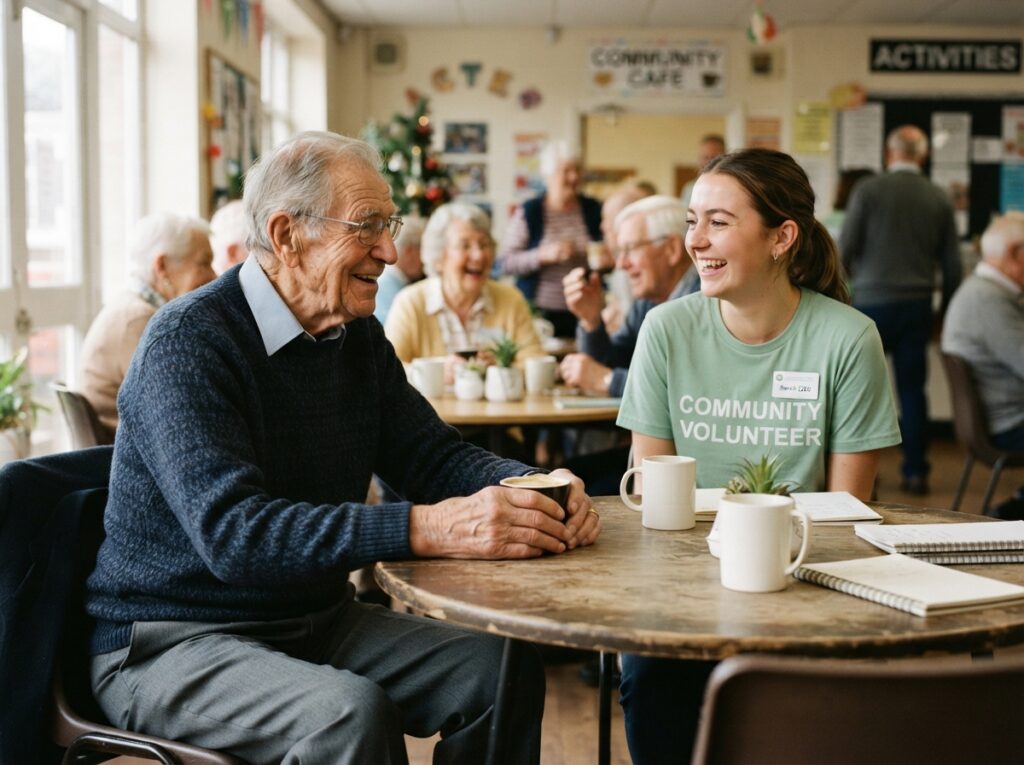
He had just turned ninety.
He didn’t want a fancy celebration.
He wanted cake, coffee and music.
So we decorated one of the common rooms with balloons and photographs from different periods of his life.
There was a picture of Harold as a little boy standing beside his mother.
Another showed him in his twenties wearing a suit that looked far too large for him.
There were photographs of him and Margaret on their wedding day, holding their first baby, standing beside a car during a family vacation and sitting around a Christmas tree surrounded by grandchildren.
Harold walked slowly from picture to picture.
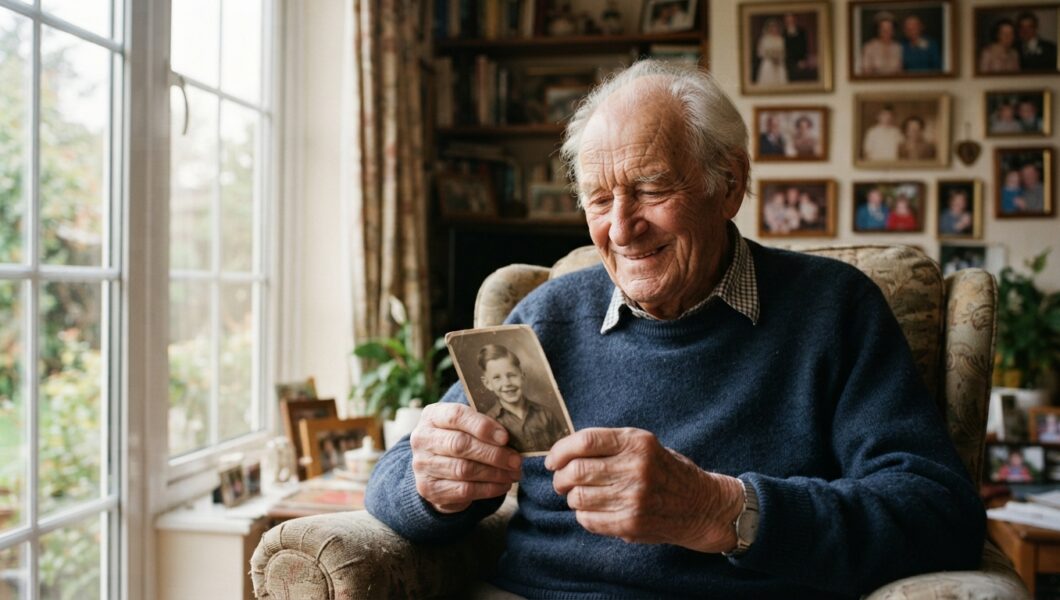
When he reached the photograph of himself as a boy, he stopped.
“That’s me,” he said.
“I know.”
He smiled.
“Look at that troublemaker.”
“You were trouble?”
“Absolutely.”
He pointed at the photograph.
“I climbed everything. Trees, roofs, fences. My mother was convinced I’d eventually kill myself.”
He laughed.
Then he became quiet.
“I wish I could tell that little boy something.”
“What?”
“That everything is going to go faster than he thinks.”
He looked at the photograph for another moment.
“Tell him to pay attention.”
That was the closest I ever heard Harold come to regret.
Not regret over mistakes.
Regret over how quickly ordinary moments disappear.
He told me he wished he had appreciated more of the boring days.
“The birthdays are easy to remember,” he said. “The vacations too. But you know what I miss?”
“What?”
“Tuesday mornings.”
I smiled.
“What happened on Tuesday mornings?”
“Nothing.”
He laughed.
“That’s why I miss them.”
He remembered Margaret making coffee while he read the newspaper. He remembered their children arguing over the bathroom. He remembered the sound of the washing machine. He remembered rushing to work and complaining about traffic.
“Back then, I thought those were just regular days,” he said. “Now I’d give almost anything to have one of them back.”
I understood then that aging wasn’t only about losing physical ability.
It was also about accumulating memories until ordinary moments became precious.
Harold’s birthday party was full of laughter.
His grandchildren surprised him by showing up.
One brought an old record player.
Another brought a photograph of Harold dancing with Margaret.
Someone put on music from the 1950s.
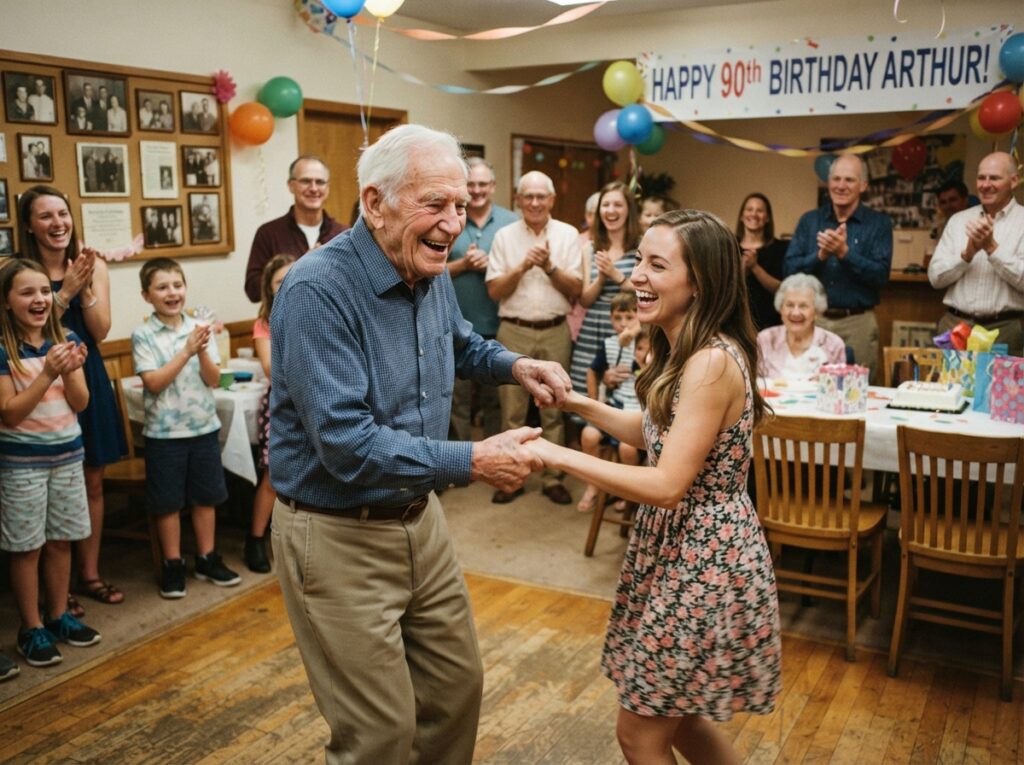
And for a few minutes, Harold forgot that his knees hurt.
He stood up.
“Come on,” he said to one of his granddaughters.
“Grandpa, you shouldn’t.”
“Who said?”
“You just told me your knees hurt.”
“They hurt when I’m sitting too.”
She laughed and took his hand.
He started dancing.
It wasn’t graceful.
It wasn’t fast.
But he was smiling like a teenager.
I stood across the room watching him, and I suddenly understood exactly what he had meant.
His body was ninety.
But the man dancing in that room didn’t feel ninety.
He was still the young man who had danced with Margaret.
Still the boy who climbed trees.
Still the father who had held his first child.
Still the person who had spent decades believing there would always be another ordinary Tuesday morning.
After the party, Harold sat down beside me.
He was breathing heavily.
“That was a mistake,” he said.
I laughed.
“Your knees?”
“My knees are filing a formal complaint.”
We both laughed.
Then he looked at me seriously.
“Promise me something.”
“What?”
“Don’t wait until you’re old to start living.”
I didn’t know what to say.
He continued.
“People think they have plenty of time. That’s the biggest lie we tell ourselves.”
He pointed toward the photographs.
“Look at all that.”
I looked.
“That’s ninety years.”
He shook his head.
“It feels like yesterday.”
I thought about my own life.
The things I had postponed.
The phone calls I kept meaning to make.
The family dinners I had skipped because I was busy.
The places I wanted to visit someday.
The people I loved but assumed I would have plenty of time to see again.
Harold had made me realize that someday is not a promise.
It is only a word.
A few months later, Harold stopped coming to the senior center.
I noticed immediately.
I asked one of the staff members about him.
“He hasn’t been feeling well.”
I called him that evening.
He answered on the fourth ring.
“Who’s this?”
“It’s me.”
“Oh.”
His voice became brighter.
“The young troublemaker.”
I smiled.
“You mean the volunteer who brings you coffee?”
“Same person.”
We talked for nearly half an hour.
His voice was weaker than before, but his sense of humor was still there.
Before we hung up, I asked if I could visit.
“Of course.”
So I did.
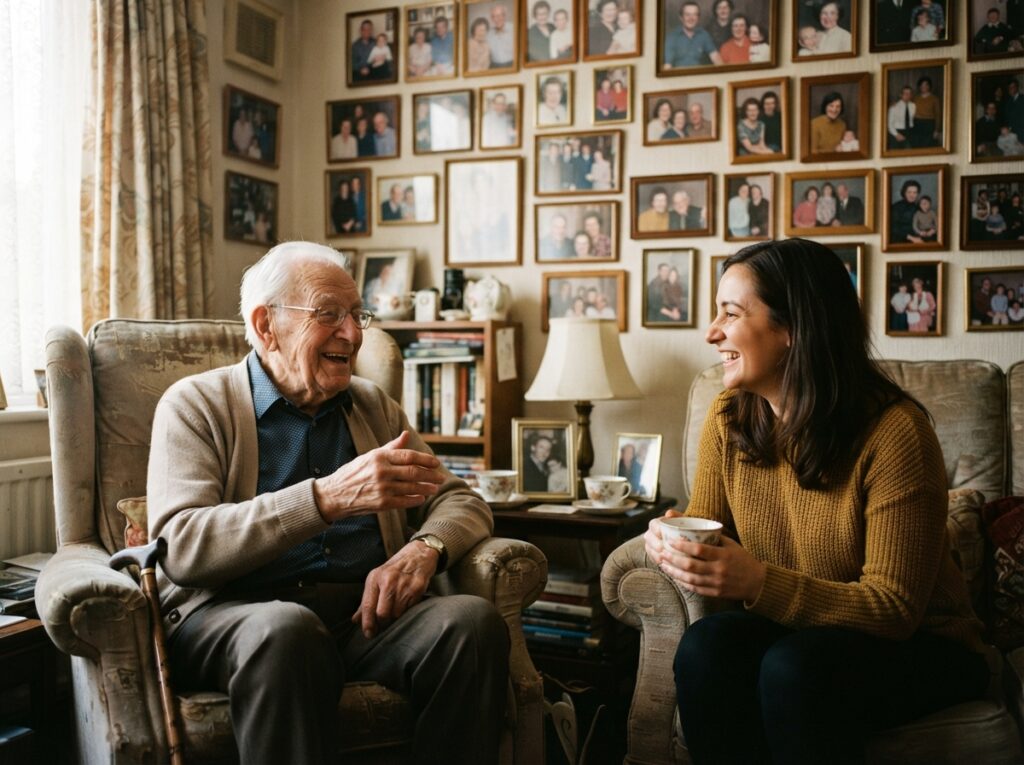
He lived in a small house filled with photographs.
Photographs of Margaret.
Photographs of his children.
Photographs of grandchildren.
Photographs of people I didn’t recognize but who clearly mattered.
He showed me a framed picture of himself and Margaret from their first anniversary.
“We thought we were old then,” he said.
I laughed.
“You were young.”
“Didn’t feel young.”
He looked at the photograph.
“Funny how that works.”
We sat together for a while.
Then Harold said something I’ll never forget.
“I used to think getting old meant losing your youth.”
He looked at his hands.
“Now I think getting old means carrying your youth with you.”
I nodded.
“The little boy doesn’t disappear,” he continued. “He just gets buried under responsibilities. Bills. Jobs. Children. Worries. Then one day you have more time to remember him.”
He smiled.
“And sometimes he comes back.”
That evening, before I left, Harold asked me to do something.
“Next time you see an old person sitting alone, sit down.”
I promised.
“Even if they’re grumpy.”
“Especially if they’re grumpy.”
He laughed.
“People need to know they’re still here.”
I never forgot that.
Harold passed away several weeks later.
I received the news on a rainy morning.
For a while, I just sat there.
I thought about his laugh.
His terrible jokes.
His stubbornness.
His stories about Margaret.
His complaints about the radio.
His birthday dance.
And most of all, I thought about the boy inside the ninety-year-old man.
At his memorial service, one of his granddaughters spoke.
She said Harold had taught her that age was not a personality.
That sentence made me smile.
Because it was exactly what he had been trying to teach me all along.
When I left the service, I walked past a group of older people standing together outside.
For the first time, I didn’t see their gray hair first.
I saw the lives behind it.
I saw people who had once been children.
People who had fallen in love.
People who had made mistakes.
People who had raised families.
People who had lost friends and spouses.
People who had started over.
People who still had favorite songs.
Favorite foods.
Inside jokes.
Plans.
Fears.
Dreams.
And a sense of humor that probably hadn’t changed much since they were young.
Harold was right.
The body listens to the calendar.
The spirit doesn’t always follow.
That doesn’t mean aging is easy. It isn’t. Bodies change. People we love disappear. Independence can become harder. Some days become lonely.
But none of those things make an older person less human.
The person inside is still there.
So now, when I see an elderly man struggling to carry groceries, I don’t simply see someone who needs help.
I see someone who may have carried much heavier things for most of his life.
When I see an older woman sitting alone, I don’t assume she has nothing to say.
I wonder what stories she has been carrying for decades.
When an elderly person repeats a story, I try to listen anyway.
Because maybe it isn’t about the story.
Maybe it’s about wanting someone to remember it with them.
And when I visit my own parents now, I try to put my phone away.
I sit longer.
I ask questions.
I listen to stories I’ve heard before.
Because Harold taught me that the ordinary moments are the ones we eventually miss the most.
I don’t know how old I’ll feel when I reach ninety.
Maybe my knees will complain.
Maybe my hair will turn gray.
Maybe I’ll look in the mirror and wonder when the years happened.
But I hope that somewhere inside me, the younger version of myself will still be there.
I hope I’ll still laugh at stupid jokes.
I hope I’ll still get excited about a beautiful morning.
I hope I’ll still want to learn something new.
I hope I’ll still dance, even if someone tells me my knees shouldn’t.
And more than anything, I hope the people around me remember that growing older doesn’t mean becoming invisible.
Harold’s life taught me that every older person is carrying a younger self inside them.
The child who once ran barefoot.
The teenager who dreamed about the future.
The young adult who fell in love.
The parent who worried about their children.
The person who once believed they had endless time.
That person never completely disappears.
So the next time you see an older person moving slowly through a grocery store, sitting alone at a restaurant, waiting at a bus stop, or quietly watching the world go by, remember Harold.
Don’t just see the wrinkles.
See the person.
Say hello.
Ask how their day is going.
Listen to the answer.
Because one day, if we’re fortunate enough to live long enough, we’ll be the ones sitting there.
And underneath the gray hair, the slower steps and the tired hands, we’ll still be ourselves.
Still hoping.
Still remembering.
Still laughing.
Still wanting to matter.
Still carrying the child we once were.
And maybe that’s the real secret of growing old.
You don’t become someone else.
You simply spend more years becoming fully aware of the person you’ve been all along.


No Comments