

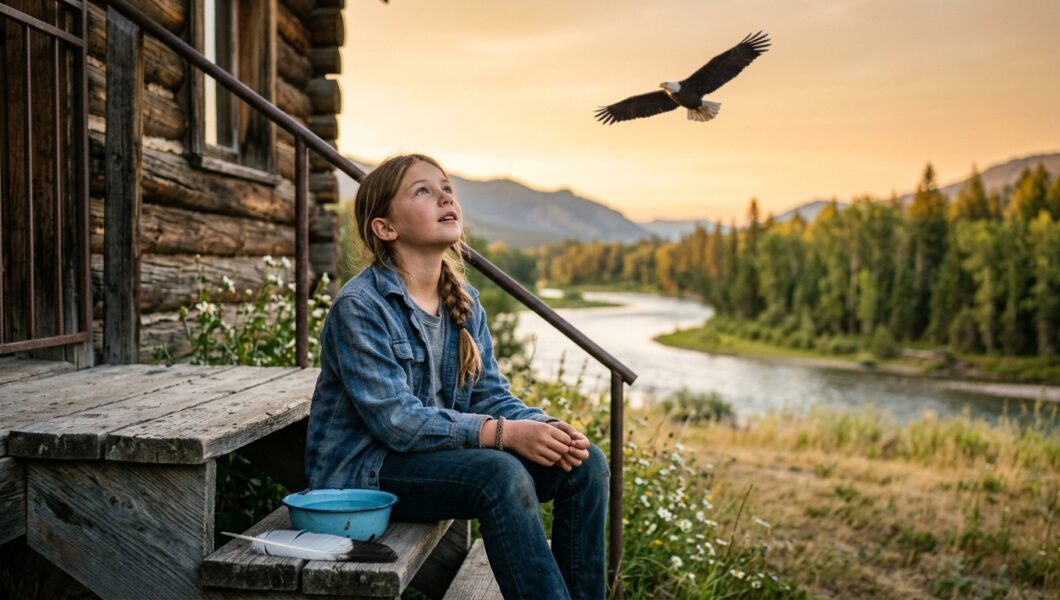
The following summer, Lily Morgan came back to Montana expecting to see the eagle.
She was ten years old now, and after everything that had happened the previous summer, she had spent most of the year thinking about the bald eagle she had named Sky. She had watched the bird drink from the little blue bowl behind her grandmother’s house. She had watched two eaglets grow up in the cottonwood tree near the river. She had even seen them make their first flights.
Now she wanted to know if they would come back.
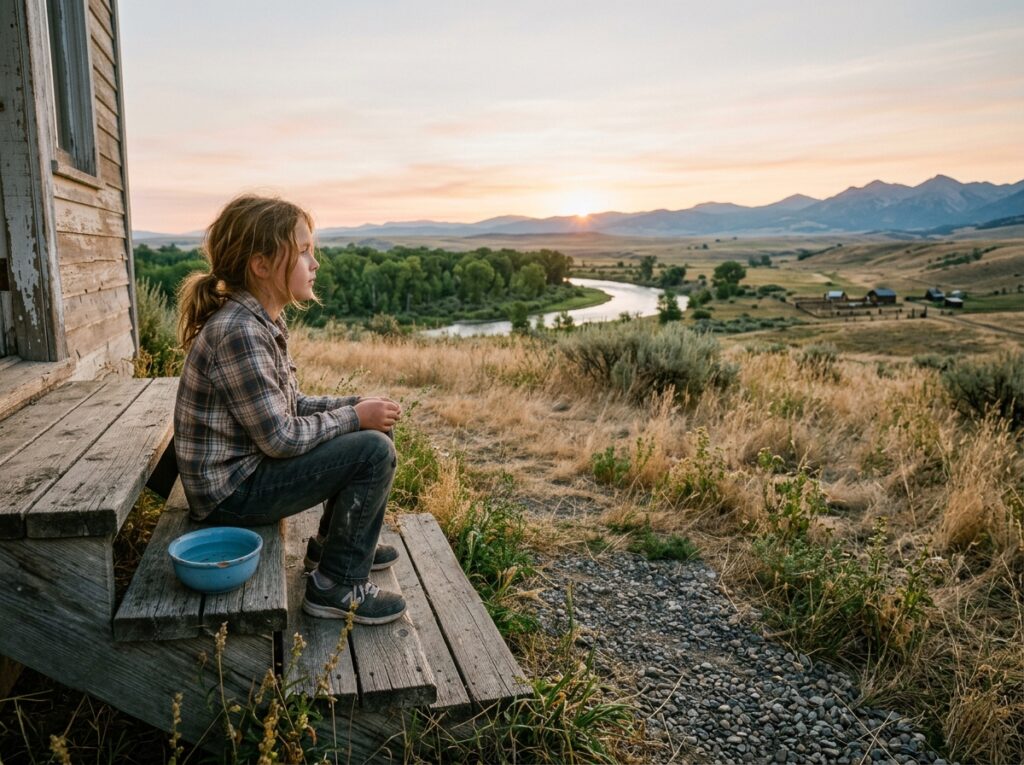
On her first morning, Lily woke before breakfast and carried the blue bowl outside. The paint was already beginning to fade, but she filled it with fresh water and placed it carefully on the wooden steps.
Then she waited.
Nothing happened.
She sat on the porch for nearly an hour, watching the cottonwood trees and the river beyond them. Every time she heard wings, she looked up.
No eagle.
The next morning was the same.
And the morning after that.
By the fourth morning, Lily was beginning to wonder if she had imagined how special the previous summer had been.
Her grandmother, Evelyn, noticed the disappointment on her face.
“You’re worried,” she said.
“I thought she’d come back.”
“Maybe she will.”
“What if she doesn’t?”
Evelyn smiled gently.
“Wild animals don’t make promises.”
Lily nodded because she knew her grandmother was right. Sky wasn’t a pet. She didn’t belong to Lily. She had a life somewhere beyond the house, the porch, and the little blue bowl.
Still, Lily hoped.
Then, on the fourth morning, Lily heard the sound she had been waiting for.
Wings.
She looked up.
An eagle was flying toward the house.
Her heart immediately started racing.
The bird landed on the fence and remained there for several seconds. Lily didn’t move. She stared at the white head, the dark feathers, and the familiar shape of the bird’s wings.
Then she noticed a small marking near the wing.
“Sky?” she whispered.
The eagle flew down to the ground.
It walked toward the blue bowl.
Lily held her breath as the bird lowered its head and began drinking.
Her grandmother stepped quietly onto the porch.
Neither of them spoke.
When the eagle finished, it lifted its head and looked directly toward Lily.
For a moment, everything seemed completely still.
Then the eagle flew toward the woods.
Lily watched until it disappeared.
“She came back,” Lily said.
Evelyn smiled.
“I told you she might.”
Lily filled the bowl again the next morning.
The eagle didn’t return.
And strangely, Lily wasn’t disappointed this time.
She had learned something during the year.
Sky didn’t have to come every day for the visit to matter.
The eagle had her own life. She had to find food, avoid danger, protect her territory, and survive without depending on people. Lily understood that the best thing she could do was leave the water in a safe place and give the bird the freedom to decide whether to use it.
A few days later, Lily walked outside and stopped beside the bowl.
Something was lying on the wooden step.
At first, she thought it was a piece of dried grass.
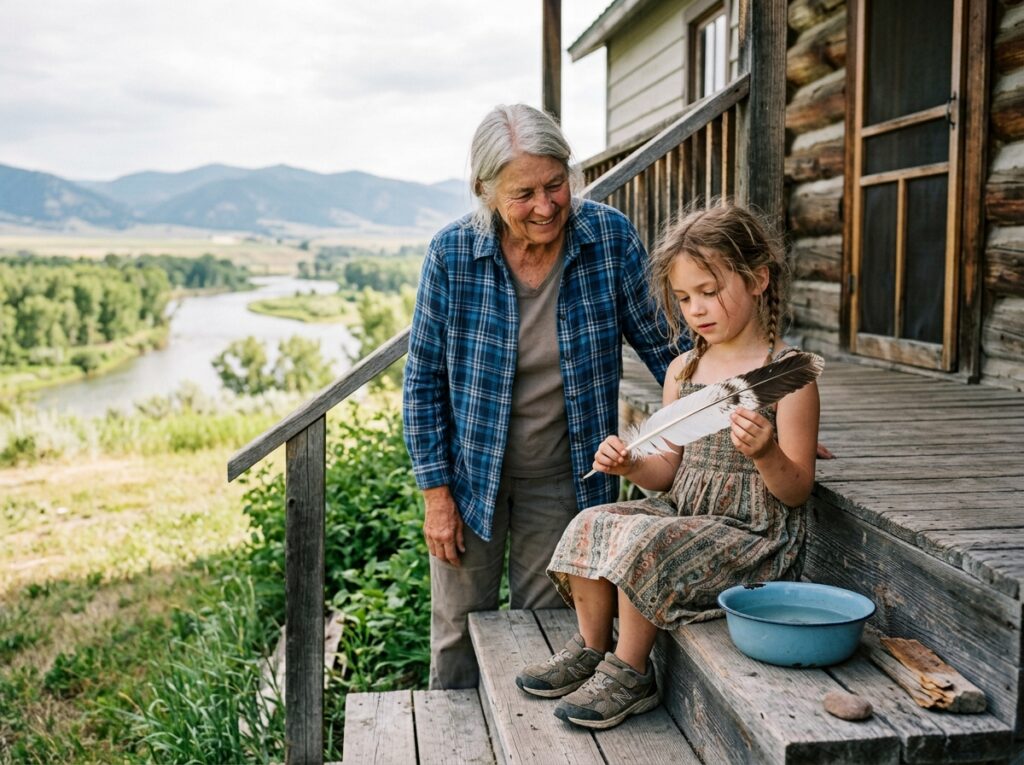
Then she realized it was a large white feather.
“Grandma!”
Evelyn came outside.
Lily held the feather carefully in both hands.
“Look.”
Evelyn smiled.
“That’s beautiful.”
“Sky left it.”
Evelyn raised an eyebrow.
“You think so?”
Lily nodded.
“She brought it.”
“Maybe she did.”
Lily carefully placed the feather inside her notebook.
She wrote the date beside it.
Then she added one sentence.
Sky came back.
The next morning, another feather appeared.
This one was smaller.
Lily picked it up and ran inside to show her grandmother.
Evelyn laughed.
“You’re going to have a whole collection.”
Lily smiled.
But then something happened that made the little tradition even more interesting.
The following morning, Lily found a small piece of dried grass beside the bowl.
She looked toward the cottonwood.
The eagle was sitting high on a branch.
Lily watched it through her binoculars.
After several seconds, the eagle flew away.
Lily turned to her grandmother.
“She left that.”
Evelyn smiled.
“Birds drop things.”
“I know.”
“But you still think it’s special.”
“Yes.”
Evelyn nodded.
“So do I.”
The visits continued, but never on a schedule Lily could predict.
Sometimes the eagle came in the morning.
Sometimes in the afternoon.
Sometimes it didn’t come at all.
Lily stopped expecting it to behave according to her routine.
Instead, she began paying attention to the world around it.
She noticed other birds using the water.
She watched smaller animals passing through the yard.
She learned how weather affected wildlife.
She began asking questions about the river, the cottonwoods, and the nesting areas.
Her little notebook slowly changed too.
At first, it had been a record of when Sky visited.
Now it became a record of everything Lily was learning.
She wrote down the dates.
She recorded the weather.
She drew pictures of eagles.
She noted where she had seen them flying.
She kept the feathers in small envelopes and wrote the dates on each one.
Her grandmother repeatedly reminded her of the same rules.
Never approach the eagles.
Never go near the nest.
Never try to touch them.
Never leave food.
Lily followed every rule.
As she grew older, she began to understand why those rules mattered.
Helping wildlife didn’t mean making wild animals comfortable around people.
It didn’t mean trying to make them dependent on humans.
Sometimes helping meant protecting their habitat and giving them enough space to remain wild.
That lesson stayed with her.
Over the next several years, Lily returned to Montana every summer.
The blue bowl always came out.
Sometimes Sky appeared.
Sometimes another adult eagle appeared.
Sometimes there were younger birds flying nearby.
Lily could never be completely certain that every eagle she saw was the same bird.
Her grandmother reminded her of that whenever Lily asked.
“Do you think it’s Sky?”
“Maybe.”
“You always say maybe.”
“Because maybe is honest.”
Lily laughed.
But secretly, she liked believing it was Sky.
The notebook grew thicker.
So did Lily’s understanding of the natural world.
She began volunteering at a local nature center when she was old enough. She learned about birds, habitats, conservation and wildlife rehabilitation.
The little girl who had once asked whether an eagle might be thirsty was becoming a young woman who understood that wild animals needed something much bigger than a bowl of water.
They needed safe rivers.
Healthy forests.
Protected nesting areas.
Clean habitats.
And people who understood when to step back.
One summer, when Lily was sixteen, she returned to her grandmother’s house.
The blue bowl was still sitting on the steps.
Lily laughed when she saw it.
“You kept it.”
Evelyn smiled.
“Of course.”
Lily filled it with water.
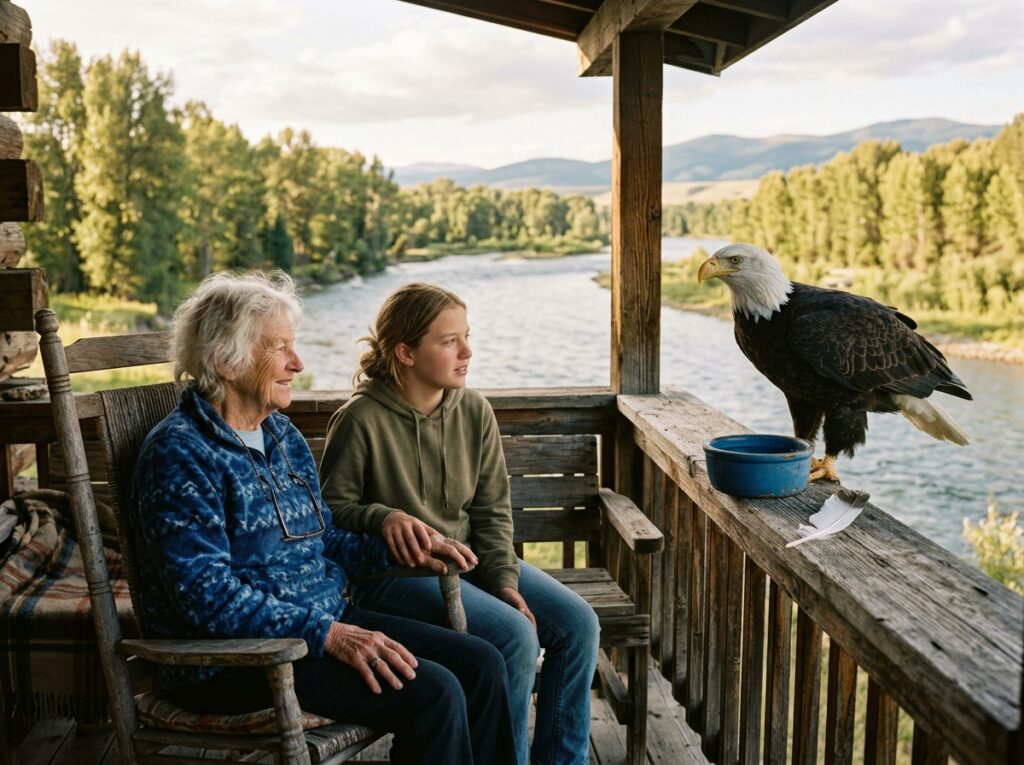
Then the two of them sat together on the porch.
For a while, they simply watched the river.
Then Lily saw an eagle circling above the cottonwoods.
“Look.”
Evelyn followed her gaze.
“I see her.”
The eagle made one wide circle before landing on the fence.
Lily picked up the binoculars.
“Do you think it’s Sky?”
Evelyn smiled.
“Maybe.”
Lily laughed.
“You always say that.”
“Because it’s true.”
The eagle remained on the fence for a few moments.
Then it flew down.
It walked toward the blue bowl.
Lily didn’t move.
Neither did Evelyn.
The eagle drank for several seconds before lifting its head.
Then it looked toward the two women sitting on the porch.
For one brief moment, Lily felt like she was looking at the same bird she had watched as a little girl.
Then the eagle spread its wings and disappeared toward the river.
Lily watched it go.
A few minutes later, she noticed something beside the bowl.
A white feather.
She picked it up.
Then she looked at her grandmother.
Neither of them said anything.
They didn’t need to.
Years later, Lily would become a wildlife rehabilitation specialist.
Whenever people asked why she chose that career, she often told them about the blue bowl.
She explained that she had once been a nine-year-old girl who saw a bald eagle on a hot summer day and wondered whether it might be thirsty.
She had thought she was helping one bird.
Instead, the experience changed the direction of her entire life.
But Lily never told people that the eagle definitely remembered her.
She never claimed that Sky intentionally brought her feathers.
She never pretended to understand things that couldn’t be proven.
In fact, as she became more knowledgeable about wildlife, she became even more careful about the story.
Birds lose feathers.
Birds carry nesting material.
Things fall from trees.
A feather beside a water bowl doesn’t necessarily mean an eagle left it as a gift.
Lily knew all of that.
She still kept every feather.
She still kept the notebooks.
And she still had the old blue bowl.
By then, the bowl was scratched and faded. The paint had worn away in several places. It was no longer the bright blue bowl Lily remembered from childhood.
But she couldn’t throw it away.
It represented the beginning of something.
Inside a box beside it were her old notebooks.
The pages were filled with drawings, dates, weather observations and memories.
Each feather was stored in an envelope.
Some were large.
Some were small.
Some had faded with time.
Lily never sold them.
She never turned them into decorations.
They were simply pieces of a childhood she didn’t want to forget.
Years after her grandmother’s house was sold, Lily returned to the area near the river.
The house belonged to another family now.
The porch had been rebuilt.
The garden had changed.
But the cottonwoods were still there.
So was the river.
Lily walked along the bank as the evening light began to fade.
She stopped beneath the trees and looked toward the valley.
Then she heard an eagle calling overhead.
She looked up.
One bald eagle circled above the river.
Then another appeared.
A smaller eagle followed behind them.
Lily smiled.
She couldn’t know whether the original eagle was still alive.
She couldn’t know whether the birds overhead were descendants of the eaglets she had watched as a child.
She couldn’t even know whether the first eagle she called Sky had ever thought about her at all.
And somehow, she was completely comfortable with that.
Because the most important part of the story had never been whether the eagle remembered Lily.
It was that Lily remembered what the eagle taught her.
Love doesn’t always mean holding something close.
Sometimes it means giving it space.
Sometimes kindness means offering help without expecting anything in return.
Sometimes caring for wildlife means leaving it alone.
And sometimes one small moment can open a door to an entirely different life.
Lily thought about that first summer.
She had been nine years old.
She had seen an eagle struggling in the heat.
She had asked her grandmother whether the bird might be thirsty.
Her grandmother had taught her to be careful.
Lily had listened.
She didn’t chase the eagle.
She didn’t try to touch it.
She didn’t attempt to make it dependent on her.
She simply placed a bowl of clean water somewhere safe.
Then she waited.
The eagle remained wild.
It came when it wanted.
It left when it wanted.
It raised young.
It flew across the valley.
It survived without Lily.
And that was exactly how it should have been.
The blue bowl had never been about owning the eagle.
It had been about noticing.
Lily had noticed a living creature.
She had cared.
And that small act of compassion had eventually led her toward a career spent protecting animals and the places they depended on.
As the eagle disappeared beyond the mountains, Lily stood beside the river for a few more minutes.
She thought about her grandmother.
She thought about Sky.
She thought about the little girl who used to sit on the porch with binoculars that were almost too large for her face.
Then she smiled.
Maybe the eagle had remembered her.
Maybe it hadn’t.
Maybe the feathers had been gifts.
Maybe they had simply fallen there.
Lily no longer needed to know.
The mystery was part of what made the memory special.
She had once believed that kindness always needed an answer.
Now she understood that it doesn’t.
You can do something good without knowing what will happen next.
You can protect something without expecting gratitude.
You can care for a creature without ever being able to hold it.
And sometimes, the thing you think you’re helping for one small moment ends up shaping the person you become.
The old blue bowl eventually found its place on a shelf in Lily’s home.
It was no longer used for water.
It didn’t need to be.
Every time she looked at it, she remembered the Montana summers, the cottonwoods, the river and the eagle that came and went on its own terms.
Most of all, she remembered what she had learned.
The world doesn’t always give us clear answers.
Sometimes it gives us a moment.
A bird landing on a fence.
A drink of water.
A feather on a wooden step.
A grandmother saying, “Maybe.”
And sometimes that is enough.
Because Lily never truly needed to know whether Sky remembered the little girl who left a blue bowl behind her grandmother’s house.
She only needed to remember that one summer morning, an eagle came down from the sky, drank from the water, and then flew freely back into the world.
That was the lesson Lily carried with her.
Kindness isn’t about making something stay.
It is about giving what you can, respecting what you cannot control, and allowing life to continue on its own path.
And somewhere above the Montana river, long after Lily had grown up, the eagles were still flying.
The cottonwoods were still standing.
The water was still moving.
And every summer, when the morning sun touched the trees, Lily could still picture that little blue bowl sitting on the wooden steps.
She had placed it there because she thought an eagle might be thirsty.
She never expected it to change her life.
But sometimes the smallest acts of kindness lead us somewhere we never imagined.
And sometimes, if we’re lucky, they give us a memory we can carry for the rest of our lives.


No Comments