
The question came on an ordinary Saturday afternoon, which somehow made it harder to prepare for.
Daniel was fifteen by then, old enough to have opinions about almost everything and young enough to still leave cereal bowls in his room. He had just come home from football practice, dropped his backpack by the stairs, and wandered into the kitchen looking for something to eat.
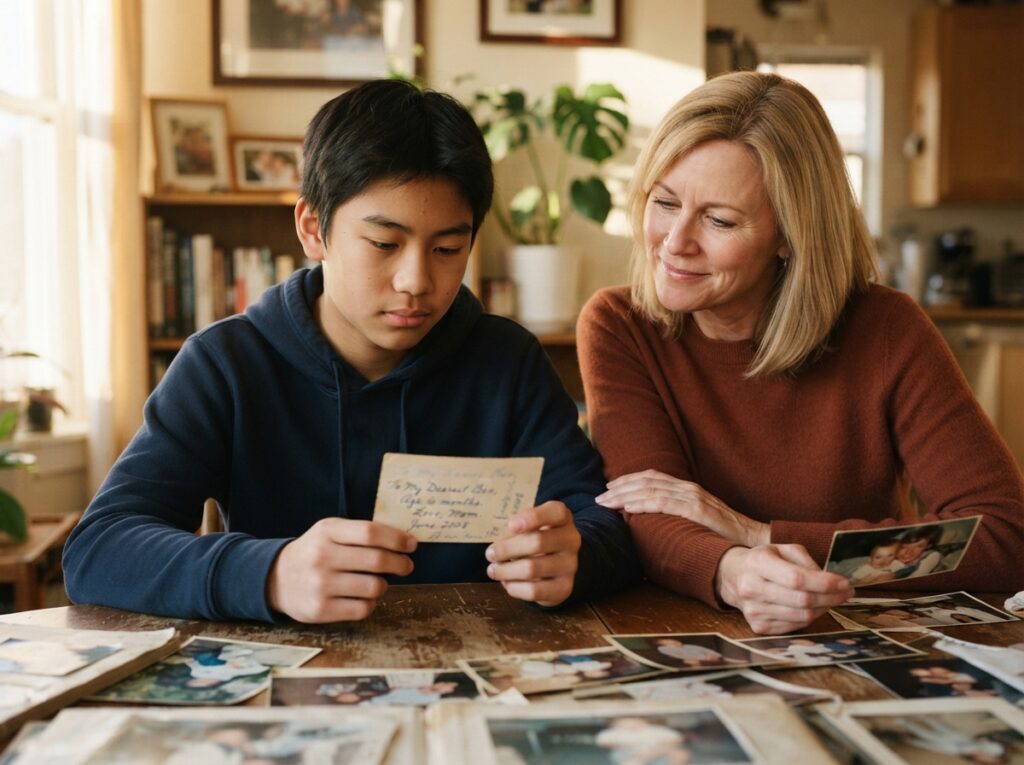
I was sorting through a box of old photographs at the dining table when he stopped beside me.
“What are you looking at?”
“Old pictures.”
He leaned over my shoulder, barely interested at first. Then I pulled out the photograph I had shown him years earlier—the one of him as a baby in those little blue overalls.
He smiled.
“I was tiny.”
“You were.”
He picked up the picture and turned it over.
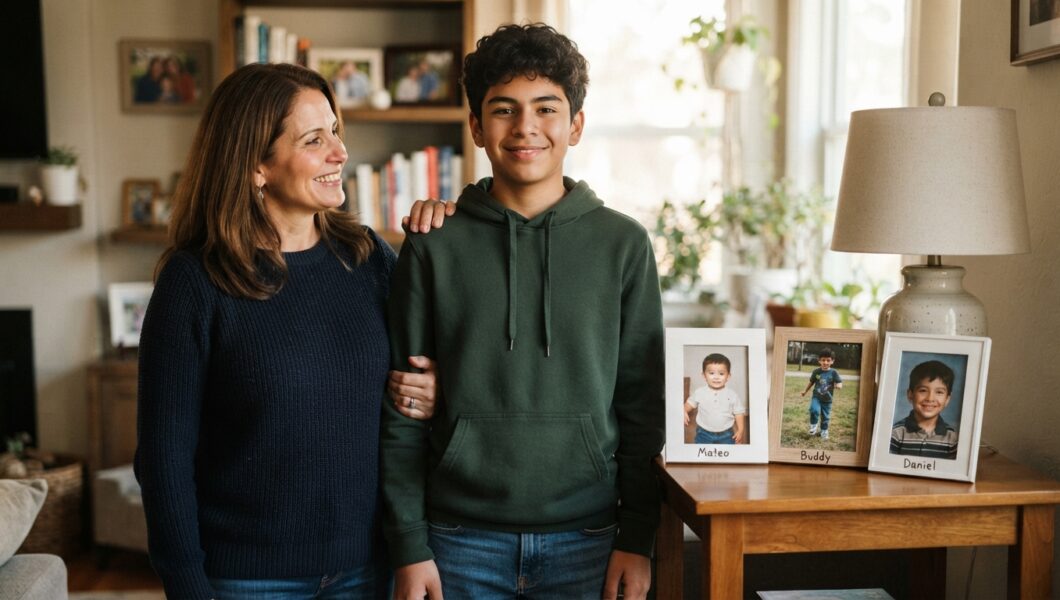
On the back, in faded handwriting, was the name Mateo.
He stared at it for several seconds.
Then he said, “Mom, can I ask you something?”
I knew immediately that this wasn’t going to be one of his usual questions.
“Of course.”
“Do you ever wish you had kept my first name?”
I put the photographs down.
For years, I had wondered whether this question would come someday. We had always tried to be honest with Daniel about his story. We never wanted his adoption to be something whispered about behind closed doors. We wanted him to know that being adopted wasn’t something he needed to hide or feel ashamed of.
But knowing how to tell a child the truth and knowing how that child will feel about it are two very different things.
I looked at him.
“I don’t wish we had done anything differently,” I said carefully. “But I sometimes wonder what your life would have looked like if you’d grown up as Mateo.”
He nodded.
“So do I.”
That was the first time he had said it so plainly.
He sat down across from me.
“I don’t hate Daniel,” he said. “I like Daniel.”
“I know.”
“And I don’t hate Buddy either.”
I smiled.
“You definitely don’t hate Buddy.”
He laughed.
Then his expression became serious again.
“But sometimes I feel like Mateo is the part of me nobody really knows.”
That sentence stayed with me.
I reached across the table and took his hand.
“I know we can’t give you back those first nine months,” I said. “And we can’t tell you everything about them because we weren’t there. But that doesn’t mean that part of your story doesn’t matter.”
Daniel looked down at the photograph.
“Do you think my birth parents called me Mateo every day?”
“I think they probably did.”
“Do you think my dad picked it?”
“I don’t know.”
“I wish I knew.”
“So do I.”
He was quiet.
For the first time, I realized that the name Mateo wasn’t simply an old name to him. It was a doorway.
Behind it were people he couldn’t remember, places he had never seen, and a beginning he could only imagine.
I had spent years thinking of his three names as three chapters of one beautiful story.
Now I understood that sometimes a person wants to go back and read the first chapter, even if they already love the rest of the book.
A few months later, Daniel asked whether we could look for more information about his birth family.
We had always known that the day might come.
Adoption records can hold answers, but they can also hold painful gaps. There were things we could discover and things we might never know.
Still, I told him I would help.
We began with what we had.
His birth name.
His birth date.
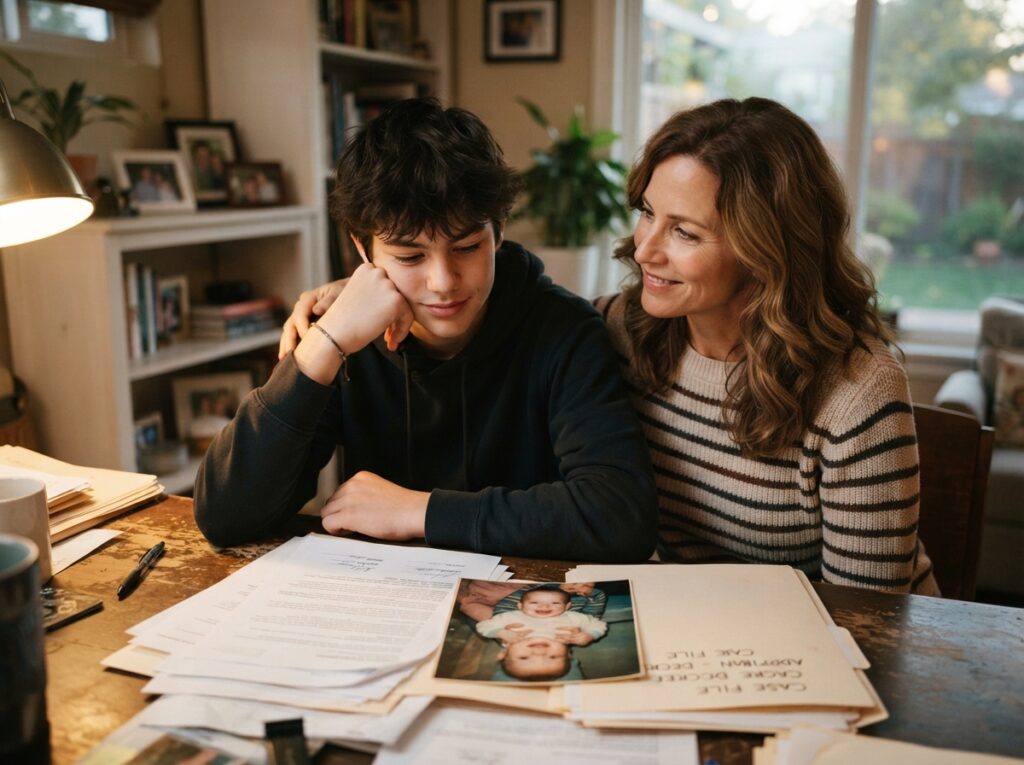
The information included in his adoption records.
The names we were legally permitted to know.
Daniel became fascinated by every small detail.
He wanted to know what city he had been born in. He wanted to know what his birth mother had been like. He wanted to know whether his birth father had dark hair. He wanted to know whether anyone had ever held him before he entered foster care.
I answered what I could.
When I didn’t know, I told him.
That became one of the most important promises between us.
I would never fill the empty spaces with stories just because the truth was uncomfortable.
If we didn’t know, we would say we didn’t know.
One evening, while we were looking through the documents, Daniel pointed to his original name.
“Mateo.”
Then he pointed to his legal name.
“Daniel.”
Then he grinned.
“And Buddy.”
I laughed.
“Don’t forget Buddy.”
“I couldn’t if I tried.”
He leaned back in his chair.
“You know what’s weird?”
“What?”
“All three names sound like different people.”
“Do they?”
“Kind of.”
I waited.
“But they’re all me.”
There it was.
The thing I had hoped he would understand someday, but had never wanted to force him to believe.
His names didn’t have to compete.
They could coexist.
Daniel didn’t need to choose which version of himself was real.
The following summer, something happened that none of us expected.
We received a letter.
It was addressed to Daniel.
The return address was unfamiliar.
Daniel stood in the kitchen holding it.
“Mom?”
My stomach tightened.
“What is it?”
“I don’t know.”
We opened it together.
It was from someone connected to his birth family.
There wasn’t a dramatic confession or some impossible secret hidden inside. It was simply a letter from a relative who had learned that Daniel was old enough to receive contact and wanted him to know that he had not been forgotten.
There were a few photographs.
One showed a younger version of his birth mother.
Another showed a family gathering.
And one was a photograph of a little boy.
Daniel stared at it.
“Is that me?”
“Yes.”
He turned the photograph over.
On the back was a date and one word.
Mateo.
He didn’t cry.
He didn’t smile.
He simply held the picture carefully in both hands.
After several minutes, he said, “I want to keep this.”
“Of course.”
He put it in his room.
Over the next few months, Daniel learned more about where he came from.
Not everything.
Some questions remained unanswered.
But enough to give shape to a beginning that had always felt blurry.
He discovered that his Mexican heritage wasn’t simply a sentence in his adoption paperwork. It was food, music, family traditions, language and people who had known the name Mateo before anyone ever called him Buddy or Daniel.
He began learning more Spanish.
He started asking his grandmother questions about Mexican traditions.
Sometimes he’d come into the kitchen and say a Spanish phrase he’d learned, then laugh when I struggled to pronounce it.
He was becoming more comfortable with all the pieces of himself.
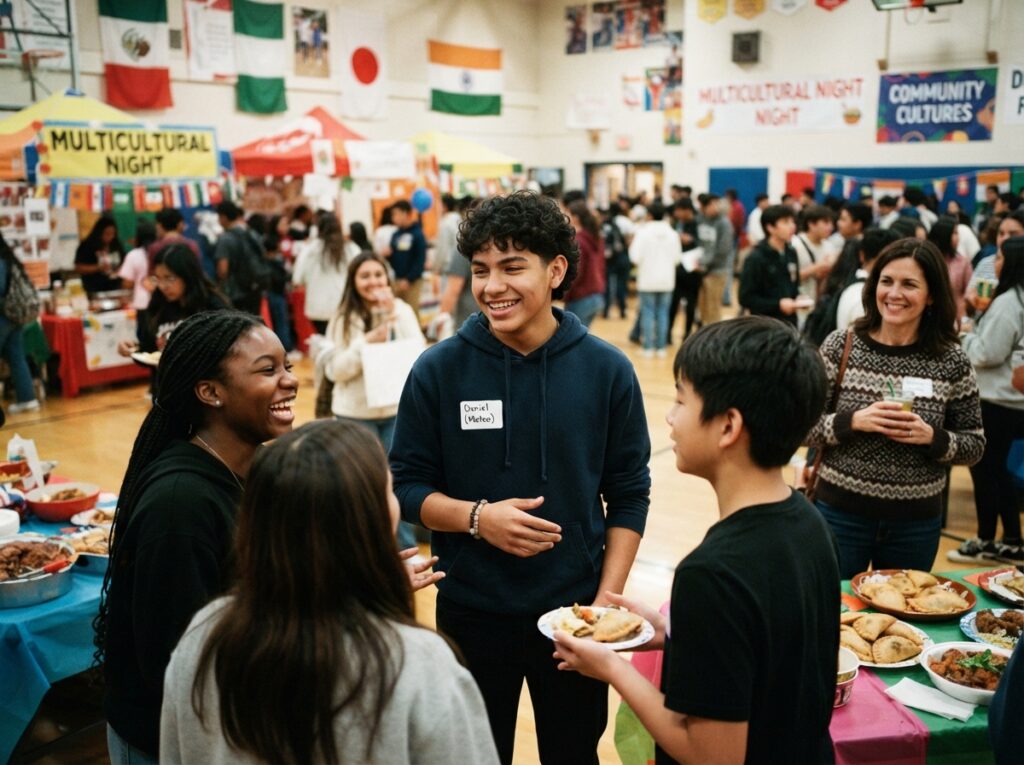
Then came the multicultural night at his school.
I almost didn’t recognize him when I saw him across the gym.
Not because he looked different.
Because he looked completely comfortable.
He was standing with a group of friends near a table covered with food, laughing about something one of them had said.
Around the room were students celebrating their different backgrounds.
Daniel had written his name on his badge himself.
Daniel (Mateo).
I stood there watching him for a while.
Eventually he noticed me.
“Mom!”
He waved.
I walked over.
“Nice name tag.”
He smiled.
“I figured I’d give everybody the full version.”
I looked at him.
“Does it feel strange?”
“No.”
He paused.
“It feels right.”
That answer meant more to me than he probably realized.
Because when we changed his name years earlier, we had hoped Daniel would feel like home.
But now I understood that home didn’t have to be a single name.
Home could be all three.
On the drive home that night, Daniel sat quietly in the passenger seat.
Then he said, “Mom?”
“Yeah?”
“Thanks.”
“For what?”
“For letting me decide who I am.”
I looked at him.
“I didn’t give you permission to be yourself,” I said. “You never needed permission.”
He smiled.
“Still. Thanks.”
We drove the rest of the way in comfortable silence.
I thought about that little baby who had arrived at our home years earlier answering to Buddy.
I thought about the name Mateo written on the back of an old photograph.
And I thought about the fifteen-year-old sitting beside me now, carrying all three names without being ashamed of any of them.
I used to believe that giving him a new name was the way we could help him build a future.
Now I know that the better gift was giving him the freedom to understand his past.
We didn’t erase Mateo.
We didn’t erase Buddy.
We simply became another part of his story.
Daniel still introduces himself as Daniel most of the time. His teachers know him that way. His friends call him Daniel. His football jersey says Daniel. When someone asks his name, he doesn’t hesitate.
But every once in a while, when we’re home and he’s joking around, he’ll sign something “Buddy.”
And Mateo is still there too.
It’s in the family history he is beginning to explore. It’s in the photographs. It’s in the Spanish words he is learning. It’s in the questions he continues to ask.
Most importantly, it’s in the way he now talks about himself.
Not as someone who lost one identity and received another.
But as someone who has always carried more than one piece of his story.
That is what I hope every adopted child gets to understand someday: your beginning doesn’t disappear just because your life changes direction.
The people who loved you before may belong to a chapter you don’t remember.
The people who raised you may belong to the chapter you know best.
And the person you become will write the chapters that come next.
We can’t control every part of a child’s story.
We can’t protect them from every question.
We can’t give them back the time they lost or answer every mystery waiting in their past.
But we can give them something else.
The certainty that they never have to choose between being loved and being curious about where they came from.
That they can ask difficult questions without hurting us.
That remembering doesn’t mean rejecting.
That loving one family doesn’t require pretending another never existed.
Daniel once asked me whether he could become Mateo again.
Today, I realize he never had to become Mateo again.
He never stopped being him.
He was Mateo when his story began.
He was Buddy when someone cared for him during a difficult first chapter.
He became Daniel when he came home to us.
And now, at fifteen, he has learned that he doesn’t have to leave any of those names behind.
He can carry them all.
And when I look at my son today, I don’t see three names.
I see one boy who was loved, found, welcomed, remembered and given the freedom to decide who he wants to be.
That has always been the most important part of his story.
Not what we called him.
But that we never stopped loving him.


No Comments