

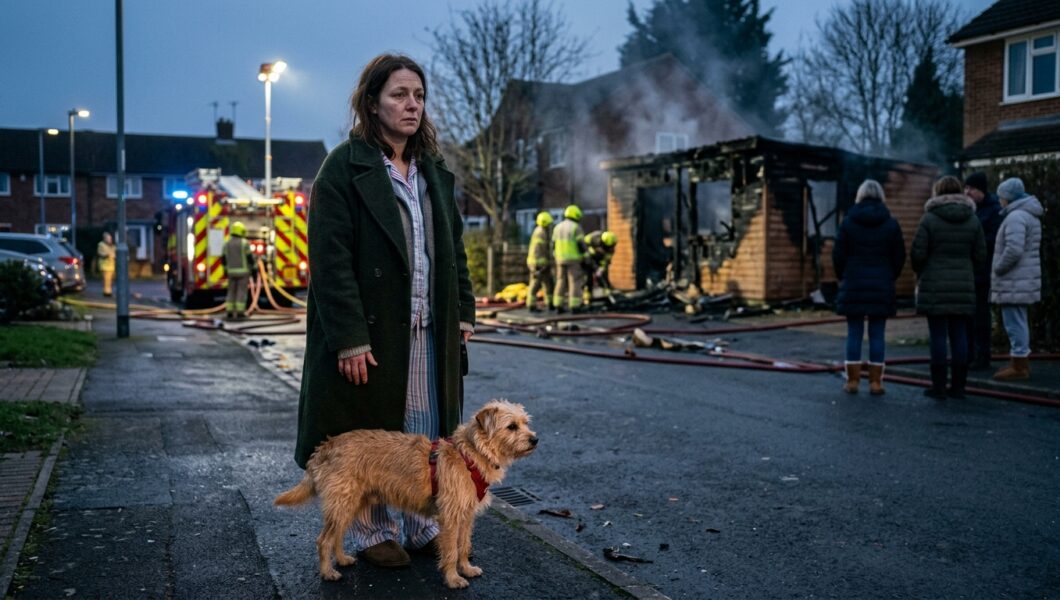
Three days after the fire, someone knocked on our front door at 7:12 in the evening.
Lucy got there before I did.
Of course she did.
She barked twice, then stood with her nose pressed against the glass.
“Easy,” I told her.
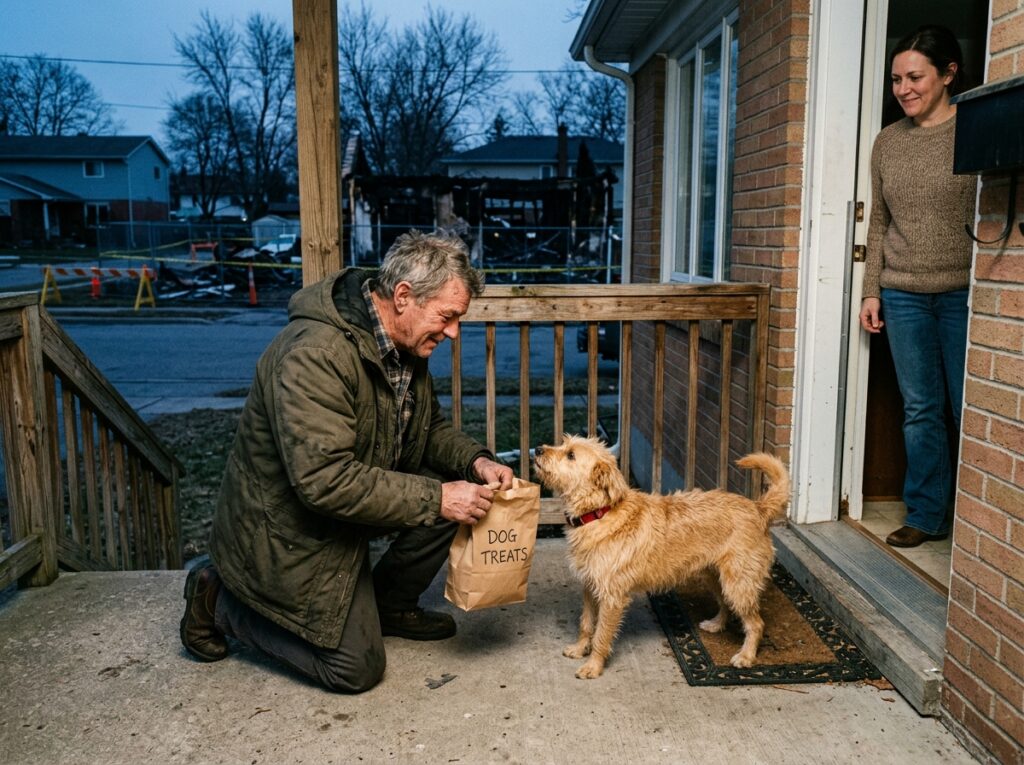
When I opened the door, a man was standing on the porch holding a brown paper bag.
I recognized him immediately.
His name was Frank Miller.
He owned the workshop across the street.
Frank was sixty-two, quiet, and the kind of neighbor you could live across from for ten years without knowing much beyond the fact that he drove an old Ford and waved every morning.
His workshop had been there longer than we had.
I’d always assumed it was mostly storage.
I was wrong.
Frank looked exhausted.
“Sorry to bother you.”
“You’re not bothering us.”
He looked past me.
“Is that her?”
Lucy immediately pushed her nose around my leg.
Frank crouched.
For several seconds, he just looked at her.
Then he whispered:
“So you’re the troublemaker.”
Lucy’s tail started going.
Frank laughed.
Then, unexpectedly, his face crumpled.
He put one hand over his eyes.
“Sorry.”
I didn’t know what to say.
My husband came into the hallway.
Frank stood again and handed us the paper bag.
Inside were dog treats.
A ridiculous number of dog treats.
“I didn’t know what kind she likes.”
“All of them,” my husband said.
That got a small laugh.
Then Frank looked across the street.
The workshop was still a blackened shell.
Yellow tape surrounded parts of the property.
During daylight, the damage somehow looked worse.
At night, flames had hidden the details.
Now we could see the warped metal roof.
Burned framing.
Broken windows.
Everything inside covered in soot or gone completely.
Frank stared at it.
“I was at my daughter’s.”
“You weren’t home?”
He shook his head.
“She lives about forty minutes away. Grandson had a school thing.”
He had stayed overnight because the roads were icy.
At 2:47 that morning, his phone had started ringing.
Neighbor.
Fire department.
Another neighbor.
Then his daughter drove him home.
“When we turned onto this street, I thought my house was gone too.”
It wasn’t.
Neither were ours.
Neither was the elderly couple’s house beside the workshop.
The firefighters had contained the fire before it reached them.
Frank looked down at Lucy.
“I heard she woke everybody.”
I corrected him.
“She woke us. Other people saw it too and called.”
Frank nodded.
“That’s what the chief said.”
Then he added:
“But somebody had to be first.”
We invited Frank inside.
Lucy followed him to the kitchen as if she’d personally scheduled the meeting.
He sat at our table.
For a while, we talked about practical things.
Insurance.
Cleanup.
Fire investigators.
The smell of smoke.
Frank said the preliminary investigation suggested the fire may have started around an electrical area in the workshop, but he was waiting for the official conclusion.
Then he became quiet.
“There was something in there I can’t replace.”
I assumed photographs.
Maybe tools inherited from his father.
Instead, Frank said:
“Bicycles.”
I must have looked confused.
He explained.
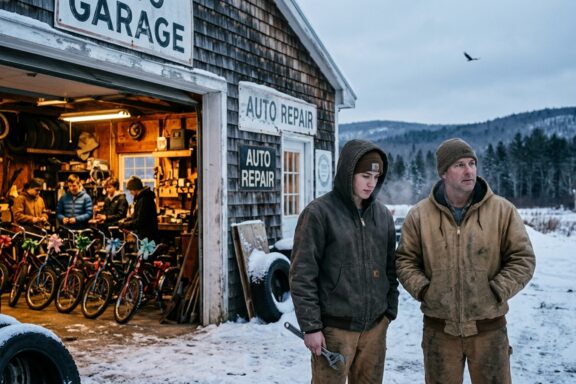
For nearly twelve years, Frank had been quietly repairing old bicycles.
Not as a business.
For kids.
He collected bikes people didn’t want anymore.
Rusty ones.
Bikes children had outgrown.
Ones with flat tires or broken chains.
He repaired what could safely be repaired.
Then a local community organization helped get them to families who couldn’t easily afford one.
“Why didn’t we know about this?”
Frank shrugged.
“Why would you?”
There had been twenty-three bicycles inside the workshop the night it burned.
Some were finished.
Some still needed work.
Most were destroyed.
I felt sick.
Frank saw my face.
“It’s stuff.”
“But you spent all that time—”
“Still stuff.”
Then he pointed toward the houses outside.
“That’s not.”
He meant people.
Homes.
The neighbors who had been sleeping only yards from the fire.
Frank looked at Lucy.
“If losing some bikes is the bill for everybody being okay, I’ll pay it.”
That was Frank.
I learned that later.
He had a way of making generosity sound like basic arithmetic.
But the bicycle story didn’t stay private very long.
Not because Frank told people.
Because my husband did.
The next morning, he mentioned it to one of the neighbors.
That neighbor told someone at work.
Someone knew somebody from a cycling club.
By Saturday, three bicycles were leaning against Frank’s garage.
He called me.
“Do you know anything about this?”
“No.”
That was technically true.
By Sunday there were seven.
Then eleven.
Someone left a note:
Heard what happened. This one belonged to our daughter. Hope another kid can ride it.
Another bike appeared with new tires tied to the handlebars.
A local repair shop offered parts.
Someone donated helmets through the community organization.
Frank was horrified.
“Where am I supposed to put all these?”
My husband pointed at our garage.
Frank looked at him.
“No.”
“Half of it is junk.”
“It’s your junk.”
“Exactly. It won’t mind.”
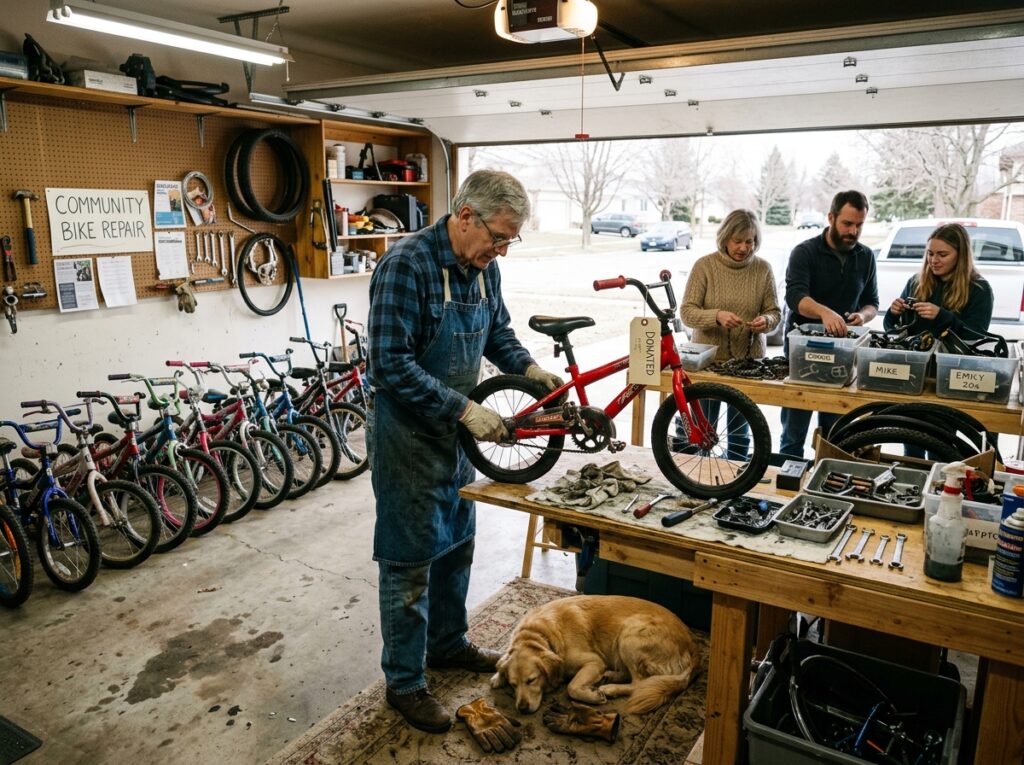
That was how our garage became the temporary bicycle workshop.
Lucy supervised.
Poorly.
Her primary contribution was stealing one work glove and sleeping underneath the bench.
Then the story reached the fire department.
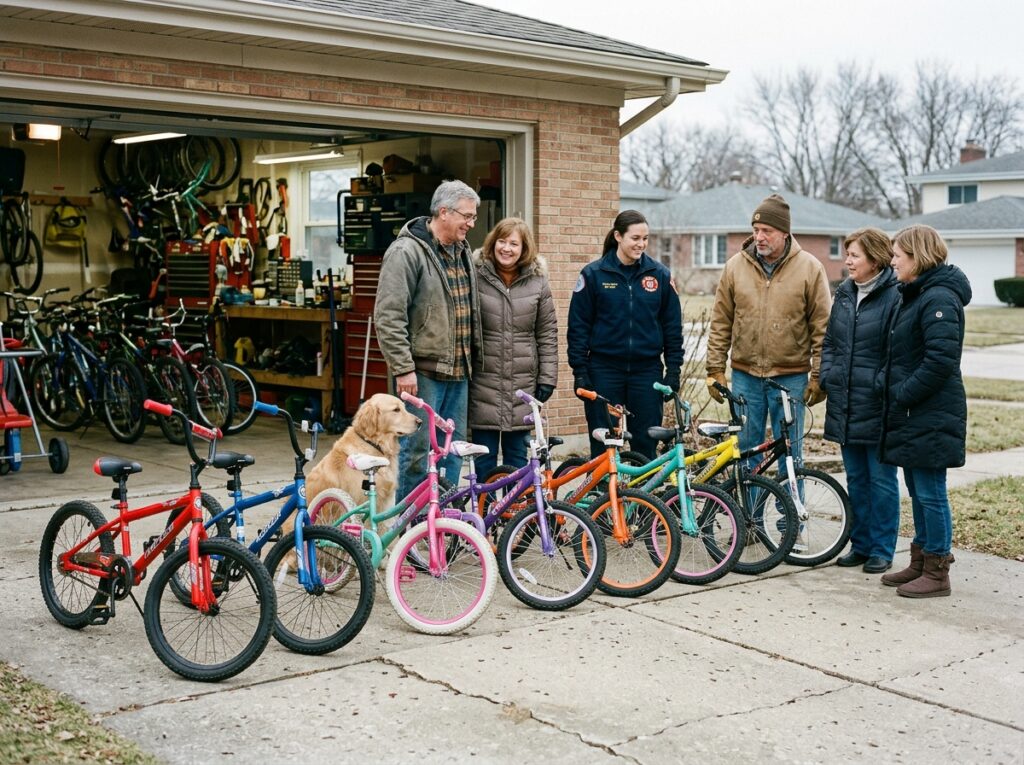
The young firefighter who had crouched beside Lucy that night stopped by.
Her name was Rachel.
Lucy remembered her—or at least behaved as if she did.
Rachel brought a tennis ball.
Frank brought coffee.
We stood in the driveway looking at the collection of bikes.
Rachel asked Frank:
“How many do you think you lost?”
“Twenty-three.”
“How many do you have now?”
My husband counted.
“Thirty-one.”
Frank groaned.
“This is getting out of control.”
Rachel smiled.
“Seems like a recurring problem around here.”
Frank pointed at Lucy.
“Her fault.”
The dog wagged.
Over the next few weeks, the neighborhood became oddly busy.
People who had lived three houses apart for years and barely exchanged more than a wave were suddenly standing around our garage.
Tom from the corner turned out to know bicycle gears.
A college student down the street could replace cables.
Mrs. Henderson, who was seventy-eight and had absolutely no interest in bicycles, brought sandwiches.
Children pumped tires.
Parents cleaned frames.
Frank inspected everything before it could be distributed.
He was particular about that.
Kind intentions did not make unsafe equipment safe.
If a frame was compromised, it didn’t go.
If brakes weren’t right, it didn’t go.
If a helmet wasn’t appropriate for reuse, the community organization sourced a suitable one.
Nobody wanted generosity to outrun common sense.
And Lucy?
Lucy became famous.
At least locally.
People brought treats.
Too many treats.
I had to put a sign on the garage:
PLEASE ASK BEFORE FEEDING THE FIRE ALARM.
Someone crossed out FIRE ALARM and wrote:
FIRE BARK.
Frank thought that was hilarious.
The first Saturday we finished ten bicycles, he stood looking at them in the driveway.
Red.
Blue.
Purple.
One bright yellow.
None matched.
Some had scratches.
All were safe.
Ready.
Frank put his hands in his coat pockets.
“I think we’re done.”
My husband laughed.
“With ten?”
“Ten is plenty.”
Then a pickup arrived carrying four more.
Frank closed his eyes.
I had not laughed that hard in weeks.
The bikes went through the same community partner Frank had already worked with.
No photographs of recipients unless families wanted them.
No children lined up for a social media post.
Frank insisted on that.
“They’re getting bicycles,” he said. “They’re not getting recruited into our publicity department.”
Nobody argued.
A week later, the organization sent Frank a drawing from one of the children.
It showed a red bicycle.
A huge sun.
A stick figure with extremely long arms.
And what I think was supposed to be Lucy.
The dog had six legs.
Underneath, the child had written:
THANK YOU FOR MY BIKE. I AM FAST.
Frank taped it above the workbench.
He pretended it was because the drawing was funny.
It wasn’t.
I caught him staring at it more than once.
Spring arrived.
The burned workshop came down.
For a while there was just an empty concrete slab across the street.
It looked strange.
Like a missing tooth.
Frank’s insurance situation took time.
There were forms.
Inspections.
Contractors.
Delays.
The things that happen after emergencies when the sirens are gone and life becomes paperwork.
That’s another thing I learned.
A disaster can last much longer than the dramatic part.
The fire took hours.
The recovery took months.
Frank had bad days.
Once I found him sitting on the edge of the concrete slab staring at nothing.
Lucy and I were walking.
She pulled toward him.
“Leave him alone,” I whispered.
Lucy ignored me.
She walked over and sat beside Frank.
Didn’t jump.
Didn’t lick him.
Didn’t perform any miracle.
She just sat.
Frank rested one hand on her back.
After a while, I walked over too.
“I keep remembering things,” he said.
“What things?”
“Stupid things.”
An old radio.
A coffee mug.
A metal sign his brother had given him.
The marks on the wall where he’d measured his grandson.
Things insurance couldn’t replace because their value wasn’t financial.
“I know I should be grateful.”
“You can be grateful and still hate what happened.”
Frank looked at me.
That seemed to help.
We sat there.
Lucy between us.
No speeches.
Eventually Frank stood.
“Coffee?”
“Sure.”
That became our routine for a while.
The fire had introduced us even though we’d lived across from one another for years.
I began wondering how many people I technically knew without knowing anything about them.
Then, one evening in May, Frank knocked on our door again.
This time he wasn’t carrying dog treats.
He had an envelope.
“What’s this?”
“Open it.”
Inside was a certificate from the local community organization.
The bicycle project had delivered fifty-two refurbished bicycles since the fire.
Fifty-two.
Frank had lost twenty-three.
Somehow the fire had resulted in more bikes being repaired than he’d normally manage in a year.
I looked at him.
“You did this.”
“No.”
He pointed toward our garage.
“We did this.”
Then he looked down at Lucy.
“She started it.”
I smiled.
“She barked at a fire.”
“Exactly. Management.”
By summer, Frank’s new workshop was finished.
Smaller than the old one.
Better wiring.
Better storage.
Smoke and heat alarms installed appropriately.
A fire extinguisher where it should be.
Rachel stopped by and made him promise not to turn the place into an obstacle course.
The first thing Frank hung on the wall wasn’t a tool.
It was the six-legged Lucy drawing.
Under it, he placed a small photograph someone had taken of the neighborhood bicycle crew.
Lucy was in front.
Of course.
The second thing he hung was a smoke alarm.
Rachel approved of that more.
Life became ordinary again.
Which was exactly what we’d wanted.
Then, almost one year after the fire, I woke at 2:41 in the morning.
Lucy was barking.
I sat upright so fast I nearly fell out of bed.
My heart exploded into that same terrified rhythm.
“Lucy?”
Another bark.
My husband woke.
“What is it?”
I smelled the air.
Nothing.
No smoke.
Lucy raced down the hallway.
We followed.
She stood at the back door.
Bark.
Bark.
Bark.
My husband looked outside.
Then he started laughing.
A raccoon was sitting on the trash can.
I leaned against the wall.
“You have got to be kidding me.”
Lucy looked very proud.
The raccoon looked offended.
My husband opened the door just enough to make noise, and the raccoon disappeared.
Lucy strutted back toward the bedroom.
“Hero,” I muttered.
She wagged her tail.
That moment mattered more than I expected.
For almost a year, every unusual nighttime sound had taken me back to orange flames.
I’d checked windows.
Smelled outlets.
Rechecked alarms.
Watched Frank’s property.
That night, Lucy barked.
And it was only a raccoon.
Nothing burned.
Nobody called 911.
Nobody needed saving.
I laughed.
Maybe ordinary annoyance was another kind of recovery.
A few weeks later, the anniversary arrived.
I hadn’t planned anything.
Neither had Frank.
Rachel was working.
The neighbors were busy.
There was no ceremony.
At around 7:00 that evening, I walked Lucy.
When we passed Frank’s new workshop, the door was open.
He was inside adjusting the brakes on a small blue bicycle.
“Another one?” I asked.
He nodded.
“Kid outgrew it. Brother doesn’t want it.”
“How many now?”
“No idea.”
“You absolutely know.”
He sighed.
“Eighty-six since the fire.”
I stared at him.
“Eighty-six?”
“Don’t make it weird.”
Lucy wandered into the workshop and lay beneath the bench.
Same spot she used in our garage.
Frank looked down at her.
Then at me.
“You know what I think about sometimes?”
“What?”
“The chief said a few more minutes could’ve changed everything.”
I nodded.
Frank tightened something on the bike.
“I used to think about those minutes.”
He paused.
“Now I think about everything that happened after.”
The bikes.
The neighbors.
Rachel.
The child with the six-legged dog drawing.
Our friendship.
People who learned each other’s names because they happened to stand outside together at three in the morning watching a building burn.
Fire destroys.
Nothing about that night changed that fact.
We didn’t need to pretend losing Frank’s workshop was somehow good.
It wasn’t.
But destruction wasn’t the only thing that followed.
People followed too.
They carried bikes.
Tools.
Sandwiches.
Coffee.
They offered garages.
They showed up.
And somewhere along the way, the story stopped being only about what the fire took.
That winter, Frank repaired bicycle number one hundred.
He tried to keep it quiet.
Rachel found out.
So did my husband.
We did not throw him a party.
He would’ve hated that.
Instead, we put a small paper sign above the workbench:
100
Frank took it down.
Someone put it back.
He took it down again.
This continued for three days.
Then a child sent another drawing.
This time Lucy had four legs.
Progress.
Frank taped that one beside the first.
The following Christmas, the neighborhood held a small collection for bicycle parts.
No big campaign.
People brought tubes.
Lights.
Locks.
Gift cards for parts that needed to be purchased new.
A retired teacher donated three children’s bikes.
Someone brought a nearly new adult bicycle and said:
“Maybe a parent needs one too.”
Frank looked at me.
“This is how things get out of hand.”
“You’ve repaired more than a hundred bicycles.”
“Exactly.”
Then he smiled.
The fire is several years behind us now.
Lucy has gray around her muzzle.
She sleeps more.
She still believes every delivery driver is a threat to national security.
And yes, she still barks at raccoons.
Frank’s workshop is still across the street.
Some evenings, I can see him through the open door.
Bent over another bicycle.
Radio playing.
Lucy occasionally asleep near his feet.
Our street looks ordinary.
That’s the part photographs never capture.
After the emergency vehicles leave, after the smoke clears, after everyone stops saying how lucky you were, eventually ordinary life comes back.
And ordinary life is precious.
A porch light.
A neighbor waving.
A dog asleep on the rug.
A man repairing a bicycle across the street.
Sometimes I think about the way I described Lucy after the fire.
Guardian angel.
Hero.
Lifesaver.
I understand why I said it.
I was terrified and grateful.
But Lucy doesn’t know those words.
She doesn’t need them.
She’s a dog.
She smelled or heard something that alarmed her.
She barked.
We listened.
Neighbors called.
Trained firefighters did the dangerous work of controlling the fire.
Everybody played a part.
I actually love the story more when I think about it that way.
Because communities aren’t usually saved by one dramatic hero.
They’re protected by layers of ordinary attention.
A dog that won’t stop barking.
A person who gets out of bed.
A neighbor who calls emergency services.
A dispatcher who answers.
Firefighters who arrive.
Someone who checks on the elderly couple next door.
Someone who opens a garage for donated bicycles afterward.
Someone who brings sandwiches.
Someone who stays after the exciting part is over.
That’s what happened on our street.
Lucy sounded the first alarm.
But then everybody else answered it.
Last week, I was sitting on the porch when Frank walked across the street.
Lucy slowly stood to greet him.
He scratched behind her ears.
“You getting old, troublemaker?”
Her tail thumped against the porch boards.
Frank handed her one treat.
Then another.
I said, “That’s enough.”
He ignored me.
“She earned compound interest.”
“For barking several years ago?”
“Correct.”
Lucy agreed with his accounting.
Before Frank left, he looked down at her.
“Good girl.”
Two words.
Nothing dramatic.
Lucy licked his hand.
Then she went back to her bed.
Frank crossed the street.
A few minutes later, I heard the soft clicking of a bicycle wheel spinning inside his workshop.
And I thought about how strange it is that one frightened dog’s bark at 2:30 in the morning could become connected to so many things.
A saved row of houses.
Neighbors becoming friends.
Fifty-two bicycles.
Then eighty-six.
Then a hundred.
Children we will probably never meet riding down streets we will never see.
Not because the fire was meant to happen.
Not because everything happens for a reason.
Sometimes terrible things simply happen.
What matters is what people decide to do afterward.
Listen when something is wrong.
Call for help.
Let professionals do the dangerous work.
Check on the person next door.
And when morning comes, look around at what’s left.
There may be something worth rebuilding.
Maybe even something worth making bigger than it was before.
Lucy is asleep beside me as I write this.
Her paws twitch occasionally.
Probably chasing that raccoon.
Our smoke alarms are working.
Frank’s workshop light is on across the street.
And tonight, if Lucy starts barking at 2:30 in the morning, I’ll still get up.
I may complain.
I may stumble into a wall.
I may discover absolutely nothing more dangerous than a trash-can bandit.
But I’ll listen.
Because once in a while, the smallest member of the family notices something first.
And sometimes the most important thing the rest of us can do is pay attention.
No Comments