

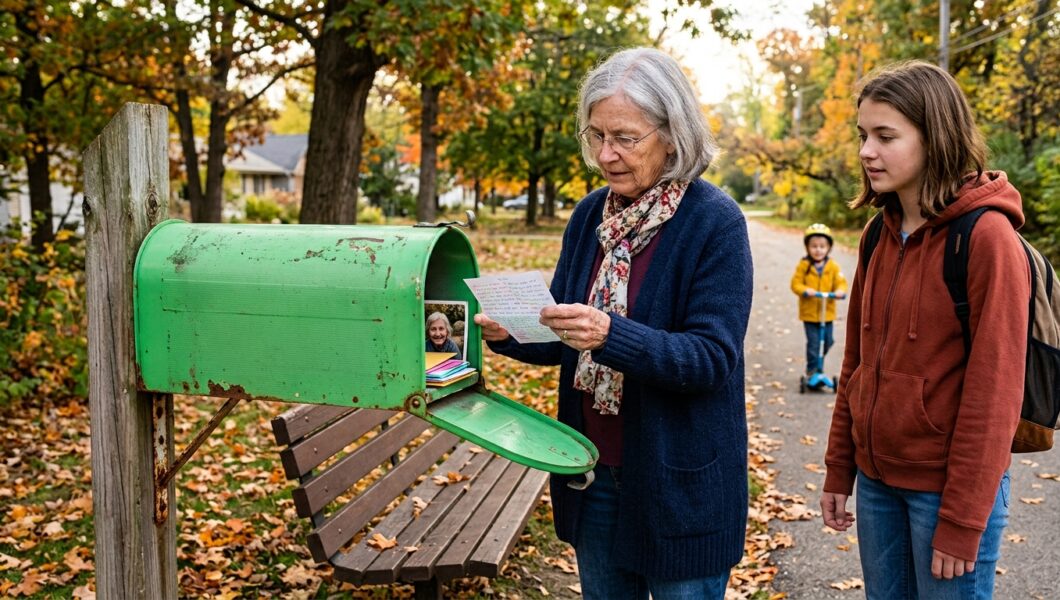
The first note that scared us appeared on a Tuesday morning in February.
By then, the little green mailbox had been beside our Wisconsin walking path for years.
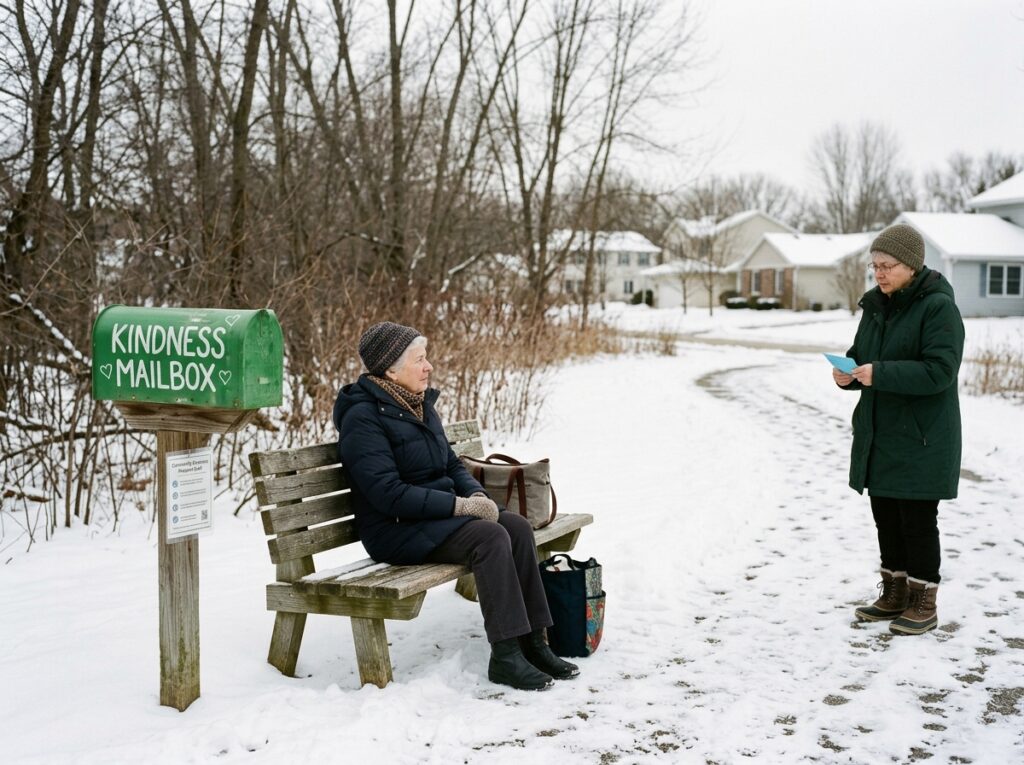
Snow was piled along the edges of the trail.
The temperature had dropped into the teens overnight.
I wasn’t even supposed to be walking that morning.
I’d gone out because I’d spent too much time inside and needed fresh air.
When I reached the mailbox, Louise was already there.
She was holding a piece of blue notebook paper.
She wasn’t smiling.
That was unusual.
“Everything okay?”
She handed me the note.
There were only seven words.
I don’t think anybody would miss me.
I read it twice.
Then looked at Louise.
There was no name.
No phone number.
Nothing identifying the writer.
For years, we’d celebrated the anonymity of that mailbox.
People could admit they were lonely.
Grateful.
Scared.
Hopeful.
Nobody had to explain themselves.
But suddenly anonymity felt different.
Somebody had left words that could mean they were in serious distress, and we had no idea who.
Louise sat on the bench.
“I don’t know what to do with this.”
Neither did I.
But we knew what not to do.
We weren’t going to turn the mailbox into amateur counseling.
We weren’t going to photograph the note and post it online asking people to identify the handwriting.
We weren’t going to start guessing which neighbor looked sad.
And we certainly weren’t going to treat seven frightening words as material for neighborhood gossip.
We contacted people who actually knew how to handle situations like that.
By that afternoon, after getting guidance, Louise added something beside the mailbox.
Not a response to one anonymous person.
Resources for everybody.
Local and national crisis-support information.
Directions for getting immediate emergency help.
Contact information for community mental-health services.
And one simple handwritten sentence:
If a note feels too heavy to carry alone, please tell someone who can help you carry it.
The little green mailbox could offer kindness.
It could not replace real support.
That distinction mattered.
For several days, I thought about that anonymous writer.
Every person I passed on the trail became a possibility.
The teenager with headphones.
The elderly man walking his terrier.
The mother pushing a stroller.
The young guy who ran every morning regardless of weather.
Then I realized I was doing exactly what we’d promised ourselves we wouldn’t do.
Guessing.
So I stopped.
Instead, I wrote a note.
You don’t have to prove you’re struggling enough before asking someone to stay with you.
I left it in the mailbox.
Louise wrote:
Your absence would leave a space, even if you can’t see its shape right now.
Someone else wrote:
Please stay long enough to let today change.
But people also continued leaving ordinary notes.
That was important.
We didn’t want the mailbox to become a place that felt frightening.
One child contributed:
BANANAS ARE WEIRD BUT GOOD.
Another:
I SAW A DOG WITH A SWEATER.
And another:
MY DAD BURNT PANCAKES BUT I ATE THEM.
Louise laughed when she read that one.
“Now this is the level of emotional support I’m qualified to provide.”
Weeks passed.
We never learned who wrote the original note.
Maybe they found help.
Maybe the note wasn’t intended the way we feared.
We couldn’t know.
What we could do was make sure anyone stopping there saw both kindness and a path toward real help if they needed more than a folded sentence.
Then spring came.
Snow melted.
Robins returned.
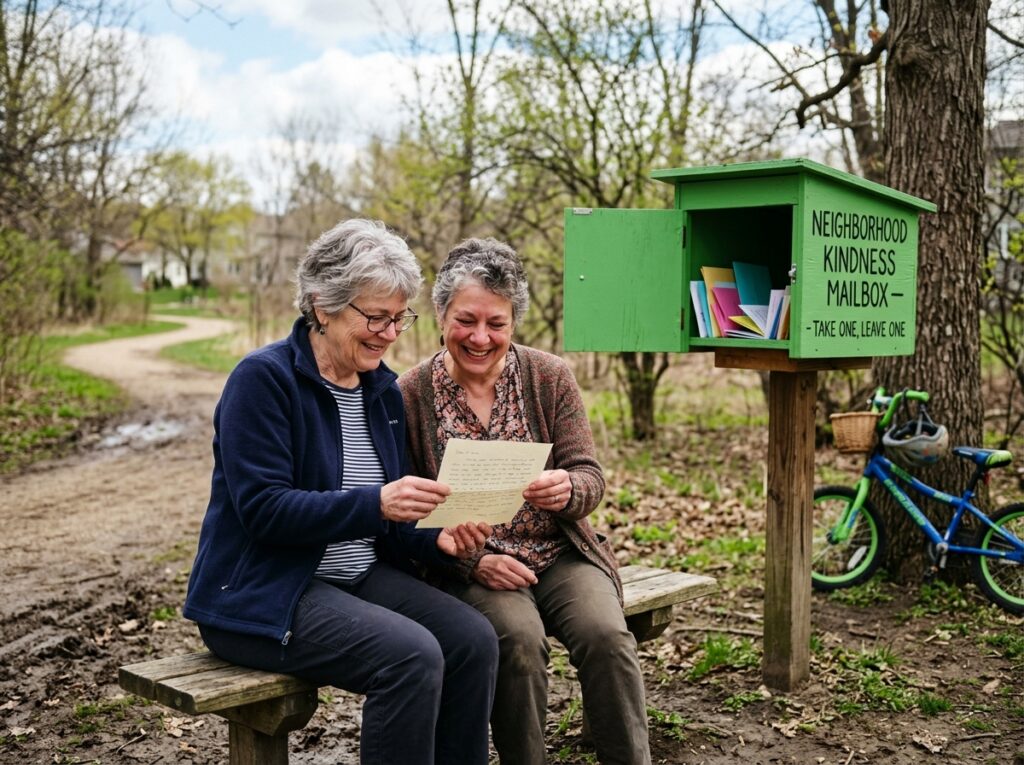
The trail became muddy.
Children started riding bicycles again.
And one Saturday morning, I found a white envelope inside the mailbox.
Unlike the usual folded scraps, this one had writing across the front.
FOR EVERYONE WHO USES THIS MAILBOX
I sat on the bench before opening it.
Inside was a full page.
The handwriting was neat.
No signature.
It began:
I don’t know who started this, but thank you.
The writer explained that they’d been stopping at the mailbox for months.
They had recently gone through what they described only as “a very dark season.”
They didn’t say what had happened.
They didn’t need to.
One morning, they had found the new resource information beside the mailbox.
That had mattered.
But so had something smaller.
A child’s note inside.
It said:
Tomorrow might have pancakes.
I laughed and cried at the same time.
Apparently the writer had too.
The letter continued.
They had gone home.
Called someone they trusted.
Eventually reached out for professional help.
They were doing better.
Not magically fixed.
Not transformed by a mailbox.
They were very clear about that.
The mailbox hadn’t saved them.
People had.
Support had.
Treatment had.
But the little green box had interrupted one lonely walk long enough to remind them that reaching out was still possible.
At the bottom, the writer added:
Please keep the silly notes too. Sometimes you don’t need wisdom. Sometimes you need to remember there might still be pancakes.
Louise framed a copy.
The original stayed private.
The pancake note became neighborhood legend.
That summer, something else changed.
Louise got sick.
She was seventy-four then.
She had always seemed permanently attached to the walking trail.
Raincoat in spring.
Sunhat in July.
Red scarf in winter.
Then suddenly I went two Saturdays without seeing her.
I called.
“Where have you been?”
“Busy.”
That was a lie.
I could hear it.
Eventually she admitted she’d been having heart problems.
Tests.
Appointments.
Medication changes.
Her doctor wanted her taking things easier for a while.
“I hate taking things easier.”
“I know.”
“And don’t you dare make a fuss.”
I should’ve known better than to tell our neighborhood that.
People did not make a fuss.
Technically.
They did something worse.
They organized.
Quietly.
One neighbor began checking the mailbox after heavy rain.
Another repainted the post where the wood had started peeling.
A teenager cleared weeds.
Two children made sure it stayed stocked with colored pencils and blank paper.
Someone repaired the little door when the hinge loosened.
Louise found out.
She called me.
“You people are interfering with my property.”
“It’s beside a public trail.”
“Emotionally, it’s my property.”
“Then emotionally, your property has volunteers.”
She hung up on me.
The next week, I found her sitting beside the mailbox.
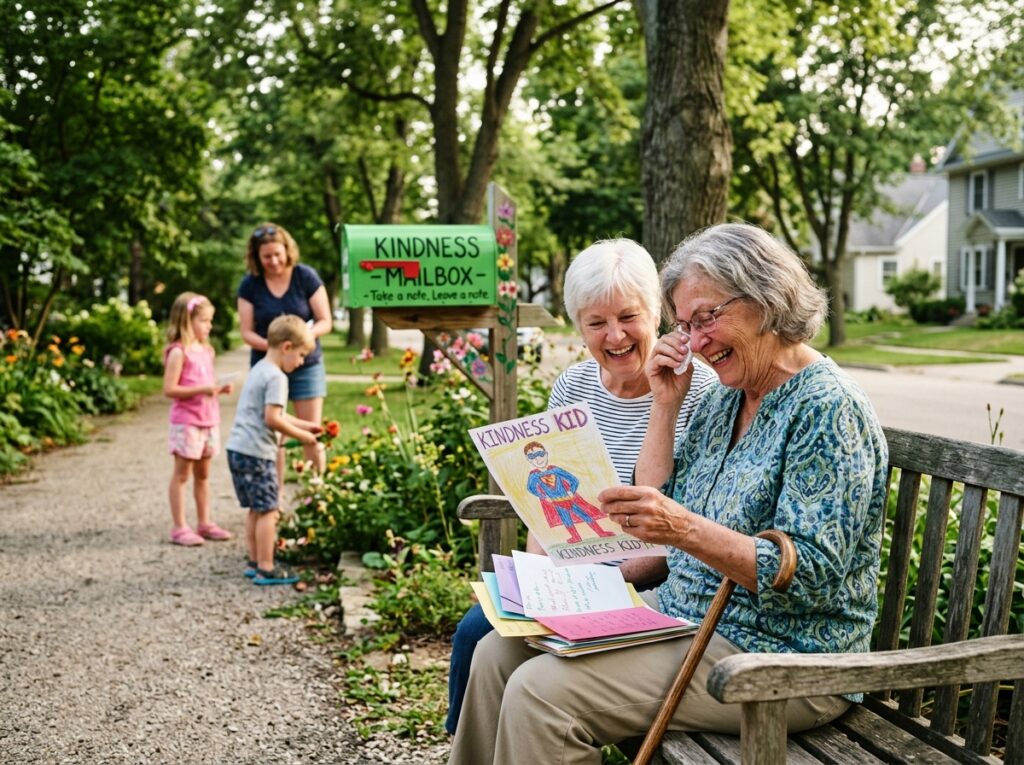
She’d walked there slowly with a cane.
Inside was a pile of notes addressed to her.
Not because we’d asked people to write them.
Someone had simply started.
GET WELL, GREEN MAILBOX LADY.
THANK YOU FOR MAKING MY WALKS BETTER.
YOU LEFT KINDNESS HERE. WE CAN WATCH IT FOR A WHILE.
One child had drawn Louise as a superhero.
The resemblance was unfortunate.
She had enormous muscles and appeared to be flying while carrying the green mailbox over her head.
Louise stared at it.
“I look ridiculous.”
“You look powerful.”
“I look constipated.”
I laughed so hard I had to sit down.
Then Louise cried.
That was the first time I’d ever seen her really cry.
She touched the stack of notes.
“I put that stupid box here because I was lonely.”
I turned toward her.
She had never told me that.
Years earlier, shortly before she painted the mailbox, her husband, Robert, had died.
They’d been married forty-six years.
He was the person she walked with.
Every evening after dinner.
Same path.
Same loop.
After he died, Louise stopped walking for months.
“When I started again, everybody seemed to have somebody.”
Couples.
Parents with children.
Friends.
Dog walkers who somehow knew every other dog walker.
Louise felt invisible.
At the yard sale, she’d seen the old mailbox.
Robert had always joked about how much he hated bills.
So she bought it for three dollars.
Painted it green.
And wrote the first five notes herself.
I stared at her.
“You never told me that.”
“You never asked.”
Fair.
“What did the first one say?”
She smiled.
“I don’t remember.”
I didn’t believe her.
Finally she admitted:
If you’re lonely too, I hope something good finds you today.
That was the beginning.
Not a community project.
Not an experiment.
One grieving woman leaving herself the kind of words she wished somebody else would say.
Louise recovered enough to resume her walks.
Shorter ones.
Slower ones.
She hated both descriptions.
But she returned.
And something about knowing why she’d created the mailbox changed how I saw it.
I had assumed generous people started kindness projects because they had an abundance of kindness to distribute.
Sometimes they start them because they’re missing something too.
Louise hadn’t stood outside her loneliness handing hope to everybody beneath her.
She’d been inside it.
The mailbox was a door.
People walked through from both directions.
That autumn, my granddaughter visited again.
She remembered the butterflies.
And the reply.
WE DID.
She was older now and considered herself much more sophisticated.
She spent several minutes pretending she wasn’t excited about checking the mailbox.
Then she found a note.
I have a job interview today. Please think good thoughts.
She immediately grabbed a blank piece of paper.
WHOEVER HAS THE INTERVIEW: YOU GOT THIS.
I said, “Technically we don’t know if they got it.”
She rolled her eyes.
“That’s not what it means.”
Apparently I needed to improve my modern encouragement vocabulary.
The next morning there was a reply.
I GOT THE JOB.
My granddaughter screamed.
Louise heard her from halfway down the trail.
Another tradition started.
Not conversations exactly.
More like echoes.
FIRST DAY AT A NEW SCHOOL TOMORROW.
A few days later:
NEW SCHOOL PERSON — HOPE IT WENT OKAY.
Then:
IT DID. I ATE LUNCH WITH SOMEONE.
Another:
MY DOG IS HAVING SURGERY TODAY.
Later:
DOG SURGERY PERSON — HOW’S THE PUP?
Then:
HOME. SLEEPY. STOLE MY PILLOW.
Nobody knew anyone’s name.
That somehow made it sweeter.
People were remembering strangers.
Eventually, Louise added another little sign.
IF YOU TAKE A NOTE, YOU MAY KEEP IT.
IF YOU LEAVE A NOTE, DON’T EXPECT AN ANSWER.
BUT SOMETIMES THE WORLD ANSWERS ANYWAY.
That felt exactly right.
Years passed.
The green paint faded.
We repainted it.
The first post rotted.
We replaced it.
The original mailbox door eventually rusted through.
A local metalworker repaired it instead of replacing the whole thing.
“Too much history,” he said.
Children who had once left crayon drawings became teenagers.
Teenagers became college students.
Some came home and still checked the mailbox.
One young woman told Louise she’d taken a note from it the morning she left for college.
It said:
Being scared doesn’t mean you’re making the wrong choice.
She kept it in her wallet for four years.
Another man admitted he had stopped there every morning during his wife’s chemotherapy.
He never left notes.
Only took them.
“I always felt guilty about that,” he told Louise.
She looked horrified.
“That’s what they’re for.”
“I know, but—”
“No.”
She pointed at the sign.
“Take one if you need a smile. It doesn’t say take one after submitting proof that you’ve donated twelve.”
He laughed.
Then cried.
Louise hugged him.
The older she got, the less patience she had for people apologizing for needing things.
I loved that about her.
Then came a winter when Louise could no longer walk to the mailbox.
She was eighty-one.
Her heart wasn’t cooperating.
Neither were her knees.
I started bringing the mailbox to her.
Not literally.
Though she suggested it once.
Every Saturday, I’d collect a handful of notes.
Nothing private or alarming.
Just the ordinary ones.
I’d take them to her apartment.
She’d sit in her recliner with a cup of tea and read them.
SAW MY FIRST CARDINAL TODAY.
MY GRANDSON CALLED ME FOR NO REASON. BEST DAY.
I PASSED ALGEBRA!!!
I BURNT THE COOKIES BUT MY KIDS ATE THEM ANYWAY.
Louise loved that one.
“Pancake family descendants.”
Probably not.
But we decided it was.
One afternoon, she handed me a stack of notes she’d written herself.
Her hands shook more now.
The handwriting wandered uphill.
“What are these?”
“Inventory.”
“For what?”
“The mailbox.”
I looked at the first.
If today is difficult, you don’t have to make tomorrow difficult in advance.
The next:
Someone remembers something kind you did, even if you’ve forgotten it.
Then:
Drink some water. You people are terrible at that.
I laughed.
“Louise.”
“Practical kindness.”
There were fifty-three notes.
I counted.
“You’ve been busy.”
She shrugged.
“I have a lot of sitting time.”
For the next year, I slipped one of Louise’s notes into the mailbox every Saturday.
I never labeled them.
Nobody knew.
Then Louise died in early October.
Quietly.
Her niece called me.
I sat at my kitchen table holding the phone long after the conversation ended.
The next morning, I walked to the mailbox.
For the first time in years, I didn’t open it.
I just sat on the bench.
The green paint looked brighter than it should have against the brown leaves.
A woman approached.
She opened the mailbox.
Took a note.
Read it.
Smiled.
Then continued walking.
She had no idea.
That helped.
The mailbox did not know Louise was gone.
The trail didn’t know.
The folded notes kept moving.
Two days later, someone learned about her death.
Then everybody did.
Flowers appeared.
Too many.
Cards.
Photographs.
Children’s drawings.
For a week, the mailbox almost disappeared beneath them.
Louise would’ve hated it.
So after talking with her niece, we cleared most of it away.
We kept one photograph.
Louise sitting on the bench beside the freshly painted mailbox years earlier.
No plaque.
No giant memorial.
Just a tiny line inside the mailbox door:
LOUISE STARTED THIS WITH FIVE NOTES.
YOU’RE WRITING THE REST.
That was enough.
A month after she died, I reached the final note from the stack she’d given me.
I didn’t know it was the final one until I opened it.
Her handwriting was especially shaky.
It said:
If something kind outlives you, let it.
I sat on the bench and cried.
Then I laughed.
Because underneath she’d added:
And please repaint this thing before it gets ugly.
That was Louise.
Even her last message came with maintenance instructions.
I placed the note inside.
For several minutes, I considered taking it back.
Keeping it.
Framing it.
Putting it beside her photograph.
Instead, I closed the little green door.
Someone else found it.
I don’t know who.
By the following Saturday, it was gone.
Good.
That’s how the mailbox works.
Nothing really belongs to one person.
Not even Louise’s last note.
Last spring, my granddaughter visited again.
She’s a teenager now.
She walked ahead of me toward the mailbox.
Opened it.
Read several notes.
Then sat on the same bench where Louise once told me she’d been lonely.
My granddaughter wrote something.
Folded it.
Slipped it inside.
“What did you write?”
She smiled.
“None of your business.”
Fair enough.
As we walked away, a little boy on a scooter stopped at the mailbox.
He opened the door.
Reached inside.
I don’t know whether he chose my granddaughter’s note.
I hope I never know.
Because the mystery is part of the gift.
Someone writes.
Someone receives.
Sometimes the two people never meet.
Sometimes that’s exactly what makes it work.
The little green mailbox has never received a bill.
Never received a package.
Never received anything requiring a stamp.
But over the years, it has carried loneliness.
Jokes.
Fear.
Job interviews.
Sick dogs.
Burnt pancakes.
Grief.
Hope.
And thousands of tiny reminders that strangers can care about one another without needing to know each other’s names.
Louise once told me she wanted people to leave encouragement instead of bills.
She succeeded.
But I think she built something bigger without realizing it.
She created a place where needing kindness didn’t put you in debt.
Take one.
Leave one.
Or don’t.
Nobody keeps score.
That’s why it lasted.
And every Saturday, I still stop.
I read one.
Sometimes I leave two.
Before I walk away, I always check the paint.
Louise would expect that.


No Comments