

Two years after Henry donated Ruth’s wheelchair, I saw it again.
At least, I thought I did.
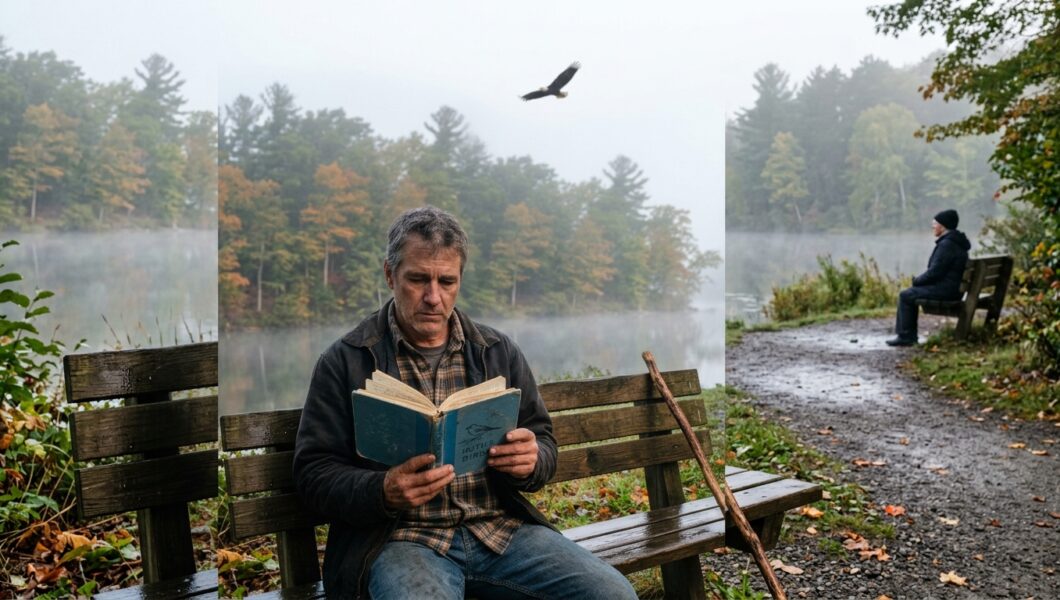
It was 8:06 on a Saturday morning in October.
Henry and I had just finished our usual loop around the lake and were sitting on Ruth’s bench arguing about whether the Packers had any business making us this miserable.
Henry was eighty-two by then.
He walked with a cane now.
He hated the cane.
Called it “the stick of surrender.”
His daughters called it “the reason you haven’t fallen on your face lately.”
I stayed out of that argument.
A woman was coming slowly down the trail pushing an elderly lady in a wheelchair.
Nothing unusual about that.
Then I saw the blanket.
Red.
Faded.
Folded across the woman’s knees.
I stopped listening to Henry.
“What?”
I pointed.
He followed my eyes.
The joking disappeared from his face.
“No.”
The chair came closer.
Same dark frame.
Same slightly scratched right wheel.
Same worn handle where Henry’s hand had rested during thousands of walks with Ruth.
He stood.
The younger woman noticed us staring.
“Sorry,” she said. “Are we in your way?”
Henry didn’t answer.
He was looking at the blanket.
Finally he asked:
“Where did you get that chair?”
The woman immediately looked concerned.
“Mobility lending program.”
Henry swallowed.
“Here in town?”
“Yes.”
She looked at him more carefully.
“Why?”
Henry stepped closer.
He touched the handle.
His fingers stayed there.
“My wife used to own it.”
The elderly woman in the chair looked up at him.
“Oh.”
That one word carried more tenderness than I expected.
Her name was Evelyn.
She was seventy-six and recovering from a complicated hip surgery.
Her daughter, Rachel, had borrowed the wheelchair because Evelyn wasn’t strong enough to walk far but was becoming miserable inside her apartment.
“I was driving my daughter crazy,” Evelyn said.
Rachel corrected her.
“You were driving everyone crazy.”
“That’s what daughters are for.”
Henry laughed.
Ruth would’ve liked her immediately.
Rachel told us they’d already taken the chair to a botanical garden.
A farmers market.
Her granddaughter’s soccer game.
And now the lake.
Henry looked at the red blanket.
Rachel noticed.
“This came with it.”
“I know.”
He touched the corner.
“My wife picked that out.”
Evelyn looked down.
“Do you want it back?”
Henry answered immediately.
“No.”
Then more softly:
“No. That’s exactly where it’s supposed to be.”
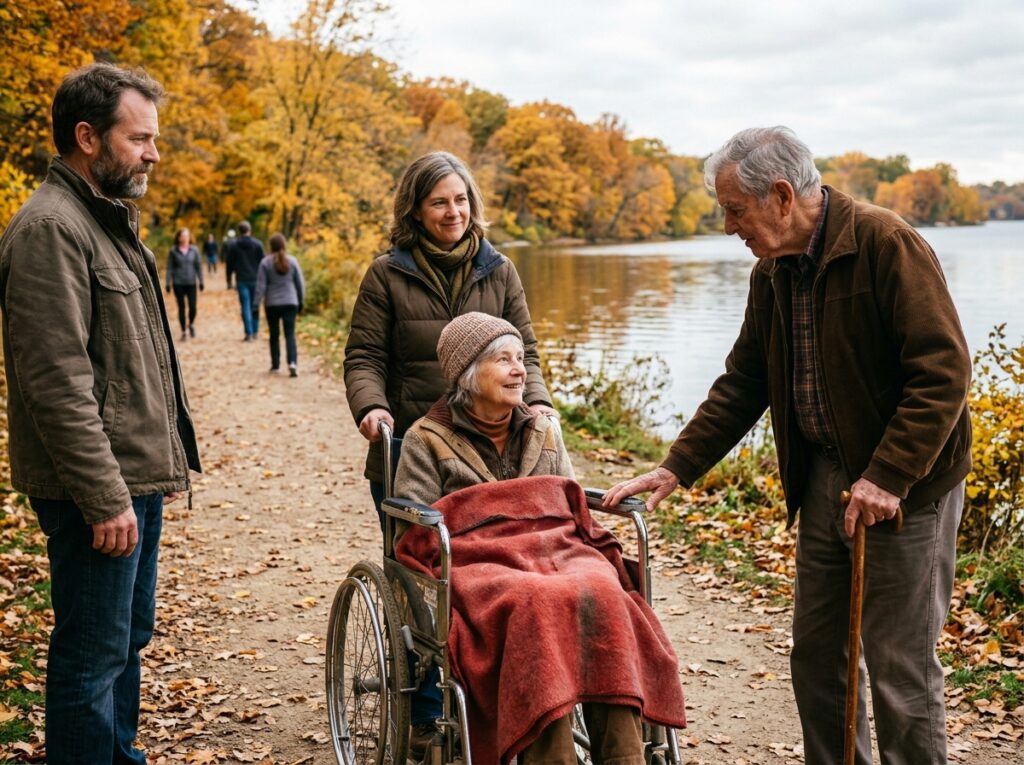
We walked together.
Slowly.
Very slowly.
Henry had finally found somebody whose pace made his look athletic.
He was delighted.
“Want me to slow down?”
Evelyn pointed at his cane.
“Don’t get arrogant.”
That started it.
For the next half mile, those two insulted each other like they’d been friends for thirty years.
At Ruth’s favorite maple tree, Henry stopped.
He told Evelyn about her.
Not everything.
Just enough.
Fifty-four years.
School librarian.
Terrible opinion of raisins.
Bossy wheelchair passenger.
Bird watcher.
Rachel listened quietly.
Then Henry told them about the final walk.
The empty chair.
The coffee.
The eagle.
The notebook.
Evelyn reached beneath the red blanket and rubbed the fabric between her fingers.
“This was hers?”
“Yep.”
“Was she nice?”
Henry considered the question far too seriously.
“Sometimes.”
I laughed.
He smiled.
“She was wonderful.”
Evelyn nodded.
“I’ll take care of her blanket.”
Henry’s face changed.
For a moment, I thought he might cry.
Instead he said:
“Use it.”
Evelyn looked confused.
“Don’t take care of it too much.”
He pointed toward the lake.
“Spill coffee on it. Get crumbs on it. Take it places.”
Then he smiled.
“Ruth didn’t save things for good.”
That sentence stayed with me.
So much of grief is the instinct to preserve.
Don’t move the shoes.
Don’t wash the sweater.
Don’t delete the voicemail.
Don’t use the good dishes.
Don’t disturb anything because the person who touched it last isn’t coming back to touch it again.
Henry had done some of that.
Ruth’s coat stayed on the hook for almost a year.
Her library card remained in his wallet.
For months, he couldn’t throw away a grocery list she’d written.
Milk.
Bananas.
Oatmeal.
Toothpaste.
How do you throw away someone’s handwriting when you know there will never be new handwriting?
But the wheelchair had taught him something.
Objects could hold memory without being frozen inside it.
Ruth had used that chair to get outside.
Now Evelyn was using it for the same reason.
That wasn’t losing Ruth.
It was letting something useful continue being useful.
Three weeks later, Rachel sent Henry a photograph.
Evelyn was sitting at her granddaughter’s soccer game.
Red blanket.
Paper coffee cup.
Huge smile.
Mud on one wheel.
Henry showed me.
“Look at that.”
“You told her to use it.”
“I didn’t tell her to drive through a swamp.”
“You sound like Ruth.”
He stared at me.
Then started laughing.
That winter, Henry’s own walking became harder.
Nothing dramatic happened.
Age simply continued negotiating.
His right knee got worse.
The cane became permanent.
Our mile became three-quarters.
Then half.
At first, he apologized.
That bothered me.
“Why are you apologizing?”
“You used to walk faster.”
“I still can.”
“Exactly.”
“Henry, I didn’t start walking with you for cardio.”
He looked offended.
“Then you’ve wasted several years.”
The truth was, somewhere along the way, our walks had stopped being something I did for Henry.
I needed them too.
My job had changed.
My mother had been having health problems.
My oldest son had moved away.
Life had become that strange middle-aged combination of worrying about parents while learning to let children go.
Henry listened.
Not always helpfully.
When I complained that my son wasn’t calling enough, Henry said:
“You raised him to have a life.”
“I know.”
“Then quit being surprised he has one.”
Annoying.
Accurate.
Very Henry.
One morning I told him I was worried about my mother.
He didn’t offer advice.
He just said:
“Tell me about her.”
So I did.
That was something I’d learned from him.
Sometimes when people are frightened of losing someone, they don’t need you to explain grief.
They need permission to talk about the person while they’re still here.
By spring, Henry had started using the trail benches more.
We developed a system.
Walk.
Bench.
Complain.
Walk.
Coffee.
More complaining.
He kept Ruth’s notebook in his jacket.
The entries had become less about birds.
Daniel’s mother doing better.
Melissa brought soup. Too much.
Karen says cane stays. Dictator.
First warm morning.
Forgot coffee. Ruth would’ve filed complaint.
Then one April morning:
Walked only 1/4 mile. Still counts.
I loved that one.
Then in June, Henry didn’t show up.
I waited fifteen minutes.
Called him.
No answer.
Called again.
Nothing.
My stomach tightened.
I drove to his house.
His daughter Karen’s car was in the driveway.
She opened the door before I reached it.
“It’s okay.”
Those are terrible first words.
“What’s okay?”
“He fell.”
Henry had gotten dizzy getting out of bed.
Nothing broken.
But the doctors wanted him observed overnight.
I went to the hospital.
He looked furious.
Hospital gown.
Blanket.
Heart monitor.
His blue baseball cap sitting on the table beside him like the only remaining piece of dignity he controlled.
“Don’t say it.”
“I haven’t said anything.”
“You’re thinking it.”
“What am I thinking?”
“That I’m old.”
“You’ve been old since I met you.”
“Good.”
He relaxed.
Then he looked toward the hospital window.
“Terrible view.”
It overlooked a parking structure.
No lake.
No trail.
No birds.
Just concrete.
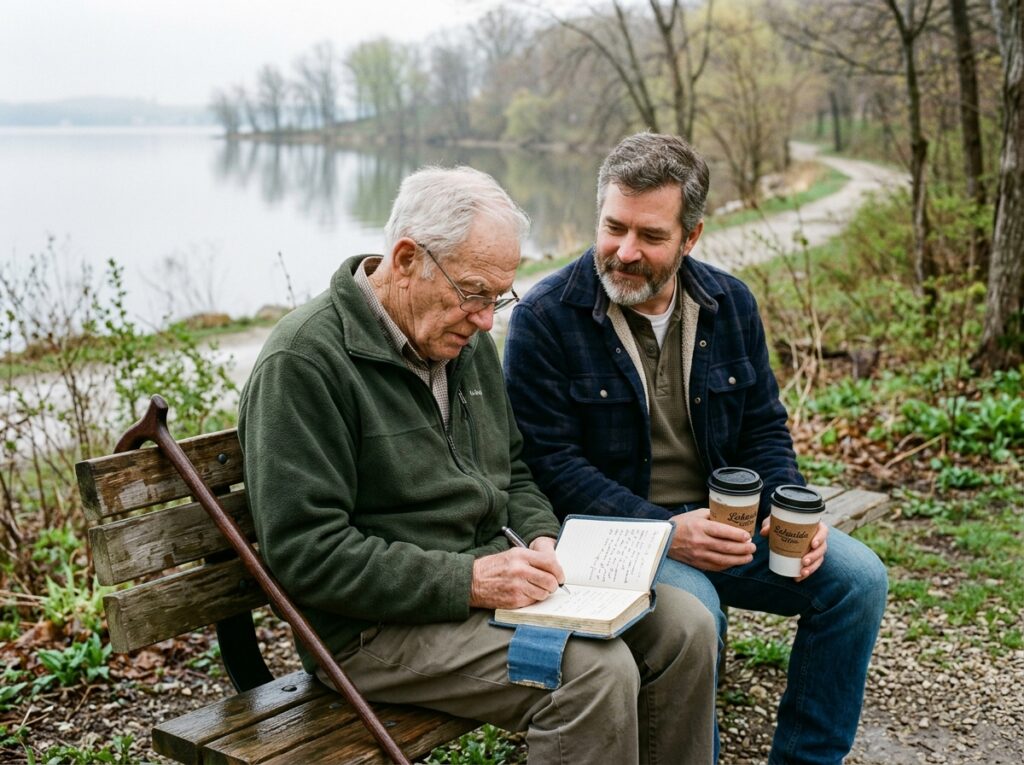
I pulled Ruth’s notebook from the bag Karen had brought.
“Want it?”
He shook his head.
“Nothing to report.”
I looked outside.
“Silver Honda.”
“Don’t.”
“Woman carrying enormous purse.”
“Daniel.”
“Man parked badly.”
He turned toward the window.
“Where?”
I pointed.
“That is terrible parking.”
“Historical record?”
Henry sighed.
“Give me the notebook.”
He wrote:
June 11. Hospital. Idiot parked across two spaces.
Then underneath:
Still here.
That one made me look away.
Henry saw.
“Don’t get emotional.”
“I’m not.”
“You are.”
“Your parking commentary moved me.”
He smiled.
The next morning, Karen brought coffee.
Melissa brought oatmeal cookies.
Beth called.
I came after work.
Henry complained that everyone was overreacting.
Then a nurse asked him a simple question.
“Who helps you at home?”
Henry started answering automatically.
“My daughters, but I don’t—”
He stopped.
Years earlier, he probably would’ve finished:
I don’t need help.
This time he said:
“My daughters.”
Then he looked at me.
“And him, apparently.”
I nodded.
“Unfortunately.”
It was a tiny moment.
But I noticed.
Henry had spent most of his life being the person behind the wheelchair.
The husband pushing.
The mechanic fixing.
The father helping.
The man carrying coffee.
Needing somebody else was harder for him.
Maybe because needing help made Ruth’s absence louder.
She should have been the person beside him.
She wasn’t.
No kindness could change that.
But that didn’t mean the space around Henry had to remain empty too.
His daughters organized medication.
A neighbor started taking his garbage bins out.
I drove him to appointments occasionally.
He hated all of this less than expected.
One afternoon, he admitted why.
“Ruth would yell at me.”
“For accepting help?”
“For not accepting it.”
That sounded right.
Late that summer, the mobility program called Henry.
They didn’t normally contact previous donors about where equipment went.
But Rachel had asked permission to pass along a message.
Evelyn no longer needed the wheelchair.
She was walking with a cane.
The chair had been returned.
Henry smiled when I told him.
“Good.”
Then the program coordinator asked him something.
The red blanket had become worn.
One corner was fraying.
Would he mind if they replaced it?
Henry became quiet.
I knew that blanket.
I knew what it represented.
I expected him to ask for it back.
Instead he said:
“Can you repair it?”
They could.
“Then repair it.”
He paused.
“And keep it with the chair.”
A month later, the wheelchair went to someone else.
Then someone else.
We stopped keeping track.
That was better.
It wasn’t Ruth’s wheelchair anymore.
It was simply a wheelchair that had once been hers.
There’s a difference.
Three years after I first found Henry standing beside that empty chair, we met at the lake on September 24.
He was eighty-three.
I brought the coffee.
One cream.
No sugar for him.
I remembered now.
“Look at you,” he said.
“Trainable.”
Fog covered the lake.
We made it to the bench.
Slowly.
Henry sat.
He was breathing harder than he used to.
I didn’t mention it.
He knew.
He opened Ruth’s notebook.
We waited.
No eagle.
A gull crossed.
Then geese.
A small brown bird landed near the path.
“Sparrow,” Henry said.
“You sure?”
“No.”
“Ruth would’ve called it one.”
“Exactly.”
At 8:02, he wrote:
Probably sparrow. Ruth rules apply.
Then he closed the notebook.
“Daniel?”
“Yeah?”
“I want you to have this eventually.”
He held it toward me.
I didn’t take it.
“No.”
“I’m not giving it to you today.”
“Still no.”
“You’re very difficult.”
“You taught me.”
He put the notebook back into his jacket.
“I don’t want the girls arguing over it.”
“They wouldn’t.”
“They’re my children. Of course they would.”
“What do you want me to do with it?”
He looked across the water.
“Keep walking.”
I laughed.
“That’s extremely vague.”
“Good instructions usually are.”
Then he said:
“And if you meet somebody sitting alone, don’t assume they want company.”
I nodded.
“Okay.”
“But maybe give them the chance.”
That sounded more like Henry.
A few months later, Ruth’s old wheelchair returned to the trail again.
This time neither Henry nor I knew the person using it.
A middle-aged man pushed an older gentleman past us.
Red blanket.
Same chair.
Henry noticed.
He smiled.
He didn’t stop them.
Didn’t tell them its history.
Didn’t explain Ruth.
Didn’t claim it.
He simply watched them go.
I asked:
“You’re not going to say anything?”
“Nope.”
“Why?”
Henry looked at me like the answer should’ve been obvious.
“They’re busy living.”
That may be my favorite thing he ever said.
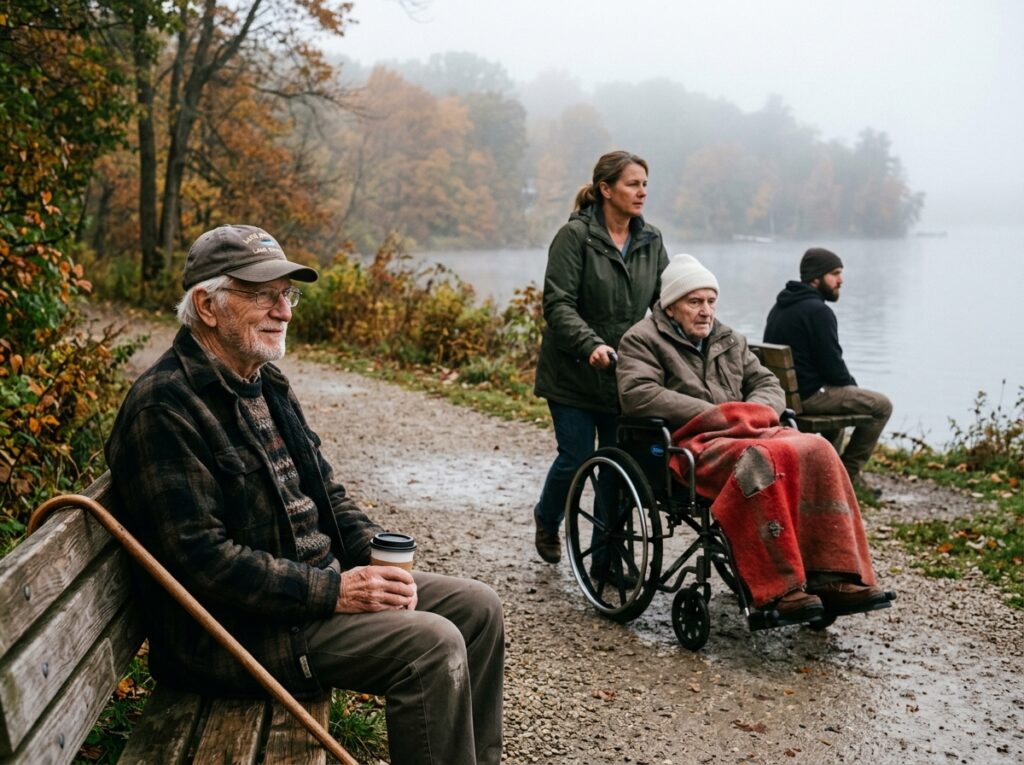
Henry died the following February.
His daughter Melissa called me.
It was early.
I knew before she said it.
He’d been home.
His daughters had been taking turns staying with him after another illness.
He died during the night.
Quietly.
His blue baseball cap was on the bedside table.
Ruth’s notebook was beside it.
Melissa said:
“There’s something in here for you.”
I drove over that afternoon.
The house felt wrong without Henry.
His coffee mug was in the sink.
Cane beside the chair.
Coat hanging by the door.
Ordinary evidence of a person who had expected another day.
Melissa handed me the notebook.
There was a folded piece of paper inside the back cover.
My name was written on it.
Daniel.
I opened it.
Henry had written:
Don’t turn this into some big lesson.
I laughed while crying.
Of course.
Underneath:
Ruth liked being alive. So did I. That’s enough.
Then:
Keep walking.
That was it.
No final wisdom.
No instructions about the eagle.
No request to scatter anything.
No speech about destiny.
Just Henry.
His funeral was full.
Three daughters.
Grandchildren.
Former coworkers.
Neighbors.
People from Ruth’s library.
A few people from the mobility lending program.
Evelyn and Rachel came.
Evelyn walked in with a cane.
When she saw me, she hugged me.
“Where’s the blanket?”
I laughed.
“Still working.”
“Good.”
After the funeral, Henry’s daughters asked if I wanted to keep the notebook.
I did.
But I made copies for them first.
The original lives in my desk now.
I don’t carry it every day.
That would feel wrong.
It was Ruth’s.
Then Henry’s.
I am only keeping it safe.
But every September 24, I take it to the lake.
The first year without Henry, I almost didn’t go.
I told myself it would feel performative.
Too sentimental.
Maybe even silly.
Then I heard his voice in my head.
Not some spiritual message.
Just memory.
Keep walking.
So I went.
7:34.
Same trail.
Same lake.
Different coffee.
Henry would’ve complained about the coffee.
Fog hung low.
I reached the bench.
For the first time since I’d known him, nobody was waiting.
That hurt more than I expected.
I sat.
Opened the notebook.
Read Ruth’s last entry.
No eagle. Try tomorrow.
Then Henry’s.
Still walking.
I stared at the blank page after it.
For a long time, I couldn’t write anything.
Eventually I did.
September 24. Fog early.
I stopped.
A shadow crossed the water.
My heart reacted before my brain did.
I looked up.
A bald eagle was moving high above the lake toward the wooded shoreline.
I laughed.
Actually laughed.
Not because I thought Ruth sent it.
Not because I thought Henry sent it.
They didn’t need to.
It was a bald eagle flying over a lake where bald eagles sometimes fly.
That was enough.
I watched until it disappeared.
Then I wrote:
One eagle.
I thought about adding something meaningful.
Instead I added:
Coffee terrible. Henry would’ve complained.
Much better.
I closed the notebook.
On my walk back, I passed a woman sitting alone on another bench.
Maybe sixty.
She was staring across the water.
I almost kept walking.
Then I remembered Henry’s instructions.
Don’t assume they want company.
Give them the chance.
“Beautiful morning,” I said.
She looked up.
For a second, I thought she might simply nod.
Instead she said:
“It is.”
I stopped.
Not too close.
“You walk here often?”
“First time since my husband died.”
There it was.
A whole life hidden behind one ordinary sentence.
I didn’t tell her about Henry.
Not yet.
I didn’t tell her grief gets easier.
I didn’t tell her everything happens for a reason.
I didn’t tell her to move on.
I simply asked:
“What was his name?”
Her face changed.
“Michael.”
So I sat down.
And she told me about Michael.
That’s how these things continue.
Not because empty chairs get filled.
They don’t.
Not because another person replaces the one who is gone.
They can’t.
Kindness is smaller than that.
And more respectful.
It notices the empty chair.
It learns the name of the person who should have been sitting there.
Then it sits nearby.
For a minute.
For a mile.
For however long somebody needs.
Henry once pushed an empty wheelchair down a Wisconsin trail because Ruth asked him for one final walk.
Years later, that chair carried strangers through gardens, soccer games and mornings by the lake.
The red blanket kept warming knees that weren’t Ruth’s.
Henry kept walking after he thought the walks were over.
And eventually, so did I.
Maybe that’s what grief asks of us.
Not to leave people behind.
Not to pretend the empty places disappear.
Just to keep making room for life beside them.
One morning.
One conversation.
One terrible cup of coffee.
One more walk.


No Comments