

Nine days after I finally shared the story of that flight, a message appeared in my inbox at 11:47 at night.
By then, thousands of people had read the post.
That wasn’t what I’d expected.
Honestly, I almost hadn’t posted it at all.
I had written it three times.
Deleted it twice.
The third version sat in my drafts for four days because every time I reached the part about the napkin, I stopped.
Grief does strange things to ordinary objects.
A shirt becomes impossible to donate.
A voicemail becomes priceless.
A coffee mug becomes something nobody else is allowed to use.
And somehow, a thin airline napkin with a few handwritten sentences had become one of those objects for me.
I kept it inside a small clear sleeve in my nightstand.
Every few days, I’d take it out.
Not because the words changed.
Because I did.
Some days:
I hope you find peace.
made me angry.
Peace?
How?
My son was gone.
Other days:
You’re stronger than you know.
felt impossible.
I wasn’t strong.
I was getting out of bed because eventually your body gets out of bed whether your heart agrees or not.
But the last line always stopped me.
From someone who cares.
A stranger.
Someone who owed me nothing.
That was why I finally shared it.
Not to find him.
At least that’s what I told myself.
I wanted people to know that small kindness counts.
Then the messages started.
Hundreds of them.
Parents who had buried children.
People who had flown home after terrible phone calls.
Nurses.
Teachers.
Widows.
Flight attendants.
People who remembered strangers sitting beside them during the worst hour of their lives.
One woman wrote:
A stranger held my hand in an emergency room twenty-three years ago. I don’t remember her face anymore. I remember her hand.
Another said:
A cashier closed her register and walked me to my car after I started crying while buying flowers for my husband’s funeral.
I read too many of them.
Then I stopped reading for a while.
Grief recognizes grief too easily.
Some nights it felt like opening a door into a room filled with everybody else’s pain when I was barely standing inside my own.
My daughter helped me filter the messages.
Then, nine days after the post, she called from the kitchen.
“Mom?”
Something in her voice made me look up.
“What?”
“I think you need to read this one.”
She handed me the phone.
The message began:
I don’t know if I’m the person you’re looking for.
My hands started shaking.
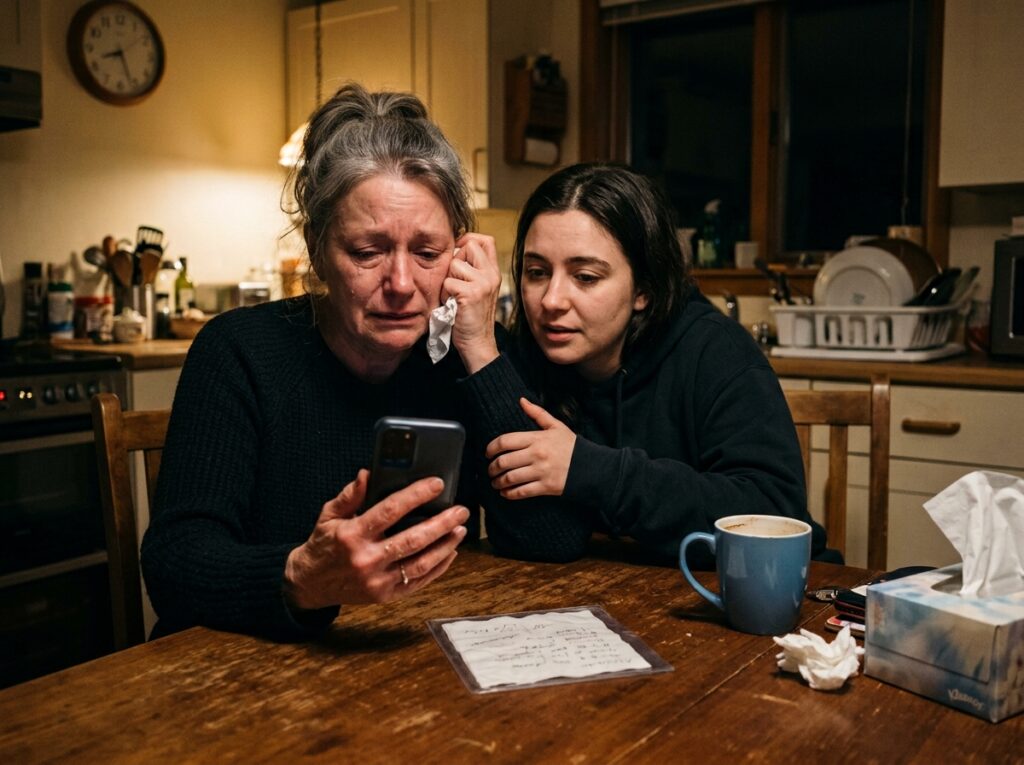
The message was from a young man.
He said he’d worked the flight on August 18.
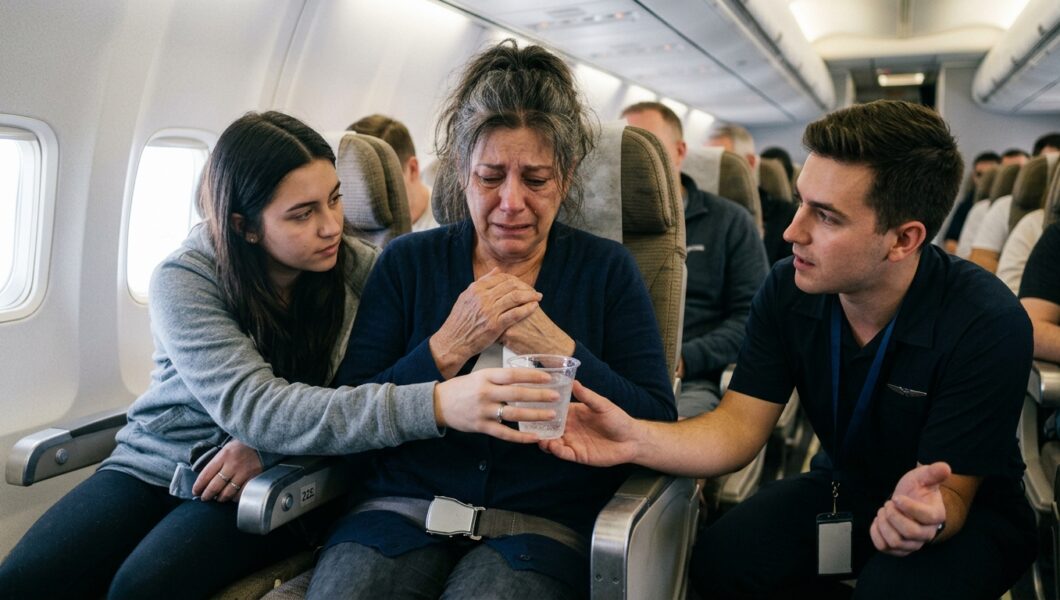
He remembered a woman in a middle seat.
He remembered bringing water and a diet soda.
He remembered her shaking.
And he remembered writing something after landing because he’d spent the last part of the flight wondering whether he should say more.
My daughter sat beside me.
“Mom?”
I couldn’t answer.
I kept reading.
He said he had seen my post because another crew member sent it to him.
At first, he wasn’t sure he should contact me.
He worried that doing so might make a private act about him.
That sentence made me believe him more than anything else.
Then he wrote:
I think I wrote that you were stronger than you knew. If the napkin says that, then yes, I was the one who wrote it.
I got up.
Walked to the bedroom.
Opened the nightstand.
Brought back the sleeve.
There it was.
You’re stronger than you know.
I cried before I reached the end of his message.
His name was Aaron.
He was twenty-six.
He’d been working as a flight attendant for less than two years.
And there was something he wanted me to know.
He almost hadn’t written the napkin.
During the flight, he had gone to the back and told another crew member about me.
Not my story in detail.
Just that a passenger was grieving and he didn’t know what to say.
The other crew member told him:
“Don’t try to fix it.”
Aaron said that sentence stayed with him.
Don’t fix it.
Because there was nothing to fix.
He couldn’t make my son alive again.
Couldn’t make the funeral disappear.
Couldn’t make the plane turn around and return me to the version of my life before that phone call.
So he took a napkin.
He wrote three sentences.
Then he almost threw it away.
He worried they sounded stupid.
Generic.
Too small.
Finally, he folded it and waited near the door.
He wrote:
I had no idea whether giving it to you was the right thing. I just didn’t want you to leave that airplane thinking nobody had noticed how hard you were trying to hold yourself together.
I put the phone down.
That was the sentence that broke me.
Not the napkin.
That.
Because he’d understood something I hadn’t been able to explain.
I wasn’t trying to be strong on that airplane.
I was trying not to collapse.
There is a difference.
And somebody noticed.
I wrote Aaron back.
It took me almost an hour to compose six sentences.
I thanked him.
Told him the napkin had been blessed.
Told him I still had it.
Told him his kindness mattered.
Then I wrote:
You said you didn’t want me to think nobody noticed. I need you to know that I noticed you too.
I hit send.
Then I cried again.
Aaron replied the next morning.
He told me he cried too.
That should have been the end.
It would have been enough.
But grief rarely follows the endings we plan.
Neither does kindness.
A few weeks later, Aaron asked if he could mail me something.
I hesitated.
Then agreed to receive a card through an arrangement that protected our personal information.
When it arrived, there was no grand gift inside.
Just another handwritten note.
This one was on actual stationery.
He joked that he’d upgraded from napkins.
Then he explained why my story had affected him so deeply.
Aaron had lost his older brother when he was nineteen.
Suddenly.
He didn’t give me details.
I didn’t ask.
He said that after his brother died, people often became uncomfortable around his grief.
Some avoided mentioning his brother.
Some tried to explain the loss.
Some offered sentences that were probably meant kindly but felt like instructions for how quickly he should recover.
But one of his college professors had done something different.
She found him sitting alone after class.
She sat beside him.
She said:
You don’t have to be okay in front of me.
Then she stayed.
Aaron never forgot it.
He wrote:
I think that’s why I noticed you. I knew what trying not to fall apart in public looked like.
I sat with that sentence for a long time.
The kindness on flight 2210 hadn’t started on flight 2210.
It had started years earlier.
Maybe even earlier than Aaron knew.
Someone had once sat beside a grieving nineteen-year-old.
Years later, that grieving young man became a flight attendant.
Then one August afternoon, he saw a mother trembling in row 14.
He recognized something.
He stopped.
He brought water.
He wrote on a napkin.
Kindness had traveled.
Quietly.
Without anybody organizing it.
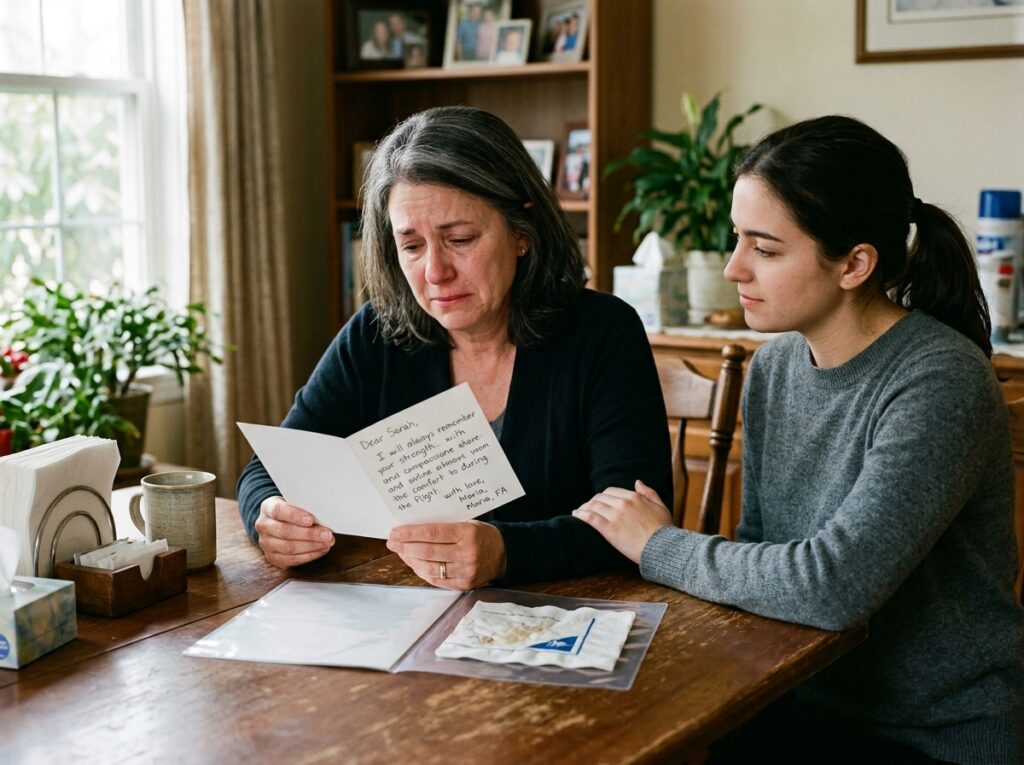
Around that time, I finally learned the name of the young woman who had sat beside me on the airplane too.
Not because I tracked her down.
She found the post.
Her name was Natalie.
She was twenty-three.
She’d been flying home after visiting her sister.
Her message was much shorter than Aaron’s.
I think I was sitting next to you. I poured your water because your hands were shaking. I hope it’s okay that I’m reaching out.
I stared at those words.
Then I remembered her hand on my back in the jet bridge.
I hope you’re surrounded by love when you get there.
I had been.
Not in the way I wanted.
I wanted my son.
Nothing could substitute for him.
But family had been waiting.
Friends brought food.
Someone mowed the lawn.
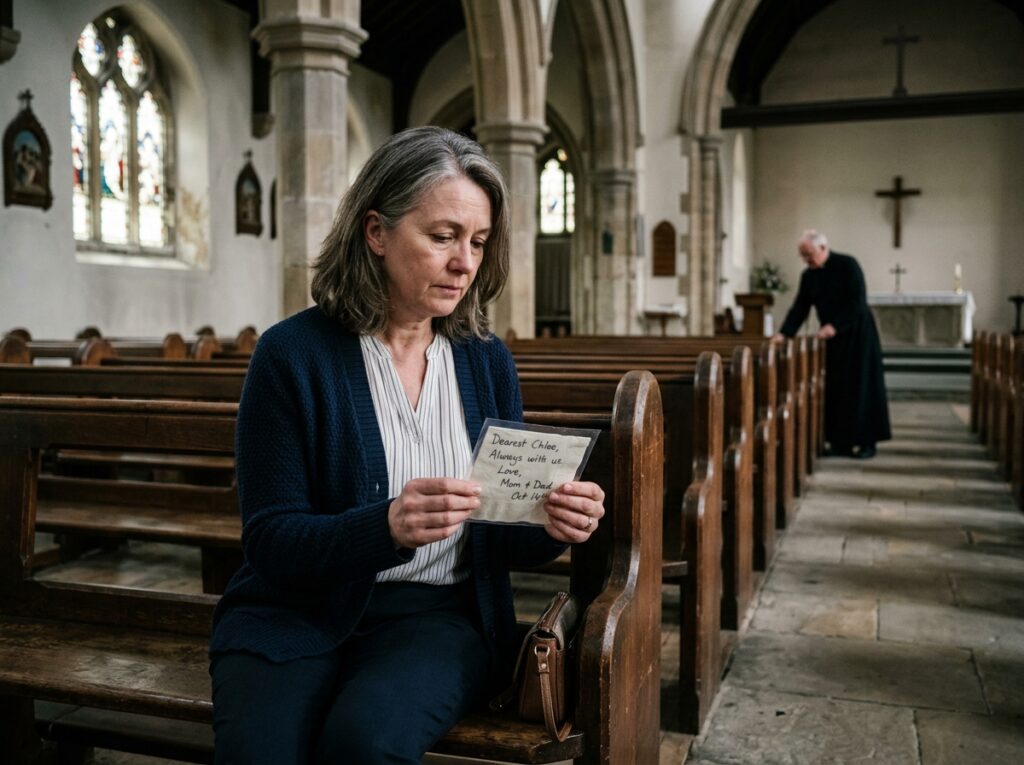
My priest came.
People sat in my living room when I had nothing to say.
A neighbor took out our garbage because nobody remembered collection day.
Those things sound tiny until your life falls apart.
Then tiny things become infrastructure.
I wrote Natalie back.
She told me something that made me laugh.
She had been terrified she’d offended me by pouring the water.
“Why?”
She said she worried I’d think she was treating me like a child.
I told her:
I couldn’t make my hands work. You made them unnecessary for thirty seconds.
She replied with a heart.
That was enough.
Months passed.
The attention around the original post faded.
I’m grateful for that.
My son’s death was never supposed to become content.
He was a person.
A whole person.
Funny.
Complicated.
Stubborn.
Loved.
The story wasn’t really about the internet finding Aaron.
It was about what happened in a small airplane seat when three strangers briefly stopped behaving like strangers.
I stayed in occasional contact with him.
Nothing excessive.
A message around Christmas.
A birthday.
Once, he sent a picture of an airport sunrise.
I sent him one of my garden.
Natalie and I exchanged a few messages too.
Then life carried us in separate directions.
Exactly as it should.
The first anniversary of my son’s death was harder than I expected.
People warn you about birthdays.
Holidays.
The date itself.
Nobody warned me about August.
The light looked wrong.
The weather felt familiar.
A commercial on television reminded me of something completely unrelated and suddenly I couldn’t breathe.
Grief is rude that way.
It doesn’t wait for meaningful triggers.
One morning, I took out the napkin.
The ink had faded slightly.
I read:
I hope you find peace.
For the first time, I didn’t get angry at that sentence.
I understood peace differently now.
Peace wasn’t being okay with my son dying.
I will never be okay with that.
Peace was being able to say his name and sometimes smile before crying.
Peace was remembering something funny without immediately feeling guilty.
Peace was surviving an ordinary Tuesday and realizing I’d gone three hours without thinking about the funeral.
Peace was not the absence of grief.
It was a little room inside it where I could breathe.
I wrote Aaron.
I think I finally understand what you meant by peace.
He replied:
I wasn’t sure what I meant either.
That made me laugh harder than it should have.
Maybe that’s another reason his words mattered.
He hadn’t delivered wisdom.
He was twenty-six years old standing in a jet bridge trying to help a stranger.
He didn’t know what to say.
He said something anyway.
Imperfect kindness still counts.
Especially when it doesn’t pretend to have answers.
The following August 18, I flew again.
I almost changed the date.
That sounds ridiculous.
Thousands of airplanes fly every August 18.
But grief creates strange rules.
Part of me believed stepping onto another plane that day would somehow recreate the worst journey of my life.
I nearly booked the 19th.
Then I thought about my son.
He would’ve made fun of me.
So I booked the 18th.
Different route.
Different flight.
Different airline crew.
I chose an aisle seat.
I wasn’t ready for the middle.
Progress doesn’t have to be dramatic.
Across from me sat an older man.
Maybe seventy.
About halfway through the flight, he received a message before we lost service.
His face changed.
He stared at his phone.
Then lowered his head.
I recognized it.
That look.
The one Aaron had recognized in me.
I didn’t ask what happened.
I didn’t touch him.
I didn’t tell him everything would be okay.
When the drink cart came, he asked for water.
His hands were shaking.
The flight attendant set down a cup.
A little water spilled.
I reached into my bag.
Pulled out a napkin.
And handed it across the aisle.
“Here.”
The man looked at me.
“Thank you.”
That was all.
I didn’t write anything on it.
I didn’t need to.
Twenty minutes later, he asked if I had a pen.
I gave him one.
He wrote something on the napkin.
Folded it.
Put it into his pocket.
I have no idea what he wrote.
Maybe a phone number.
Maybe a reminder.
Maybe nothing important.
It doesn’t matter.
I sat back.
Closed my eyes.
And thought about Aaron.
About Natalie.
About the professor who once sat beside a nineteen-year-old grieving his brother.
About Father Michael.
About everybody who brought food after my son died.
About the neighbor who remembered garbage day when I couldn’t remember what day it was.
None of us removed anybody’s grief.
That’s not what kindness does.
Kindness does not erase the terrible thing.
It doesn’t make death fair.
It doesn’t answer why.
It doesn’t replace the person missing from the room.
It simply makes sure pain isn’t the only thing present.
That’s what Aaron gave me on flight 2210.
Not strength.
Not closure.
Not an answer.
Company.
For a few minutes in row 14, my grief was visible to someone else.
And instead of turning away because it was uncomfortable, he moved closer.
So did Natalie.
That’s why I kept the napkin.
Not because I believe paper has power.
Because it reminds me what people can do.
We can notice.
We can bring water.
We can steady a cup.
We can lift somebody’s bag.
We can sit without fixing.
We can write three imperfect sentences.
We can say:
I see you.
I’m sorry.
I care.
Years have passed now.
The napkin is still in its clear sleeve.
The blessing Father Michael gave it mattered to me, and so did the faith I carried through those months. But I’ve also come to understand something broader.
Kindness doesn’t require two people to understand a moment in exactly the same way.
You can call it grace.
Someone else can call it compassion.
Someone else might simply call it a decent human being noticing another human being in pain.
Whatever words we use, the act still matters.
I still miss my son.
That sentence will never become past tense.
I miss him when something good happens and he’s not the first person I can tell.
I miss him when his birthday arrives.
I miss him when someone says something he would’ve found funny.
I miss the version of myself that existed when all my children were alive.
There is no ending where I stop missing him.
But there is life beside the missing.
I didn’t know that when I boarded that airplane.
Aaron probably didn’t know it either.
He simply saw a woman struggling to hold a cup of water.
So he helped.
Natalie saw shaking hands.
So she poured.
A professor once saw a grieving student.
So she sat down.
Years later, I saw an older man across an airplane aisle whose hands were shaking.
So I handed him a napkin.
Maybe that’s how kindness travels.
Not as one giant act.
As recognition.
One hurting person remembers what it felt like when somebody noticed.
Then, someday, they notice someone else.
The last time Aaron and I exchanged messages, I told him that.
He responded with one sentence:
Then I guess you don’t have to keep the napkin forever.
I stared at it.
He was right.
I still have it.
I’m not that evolved.
Maybe someday I’ll let it go.
Maybe I won’t.
Some objects earn their place.
But the point was never to preserve the napkin.
The point was to become the kind of person who no longer needed a piece of paper to remember what it taught me.
When someone’s hands are shaking, steady the cup.
When someone is crying, don’t rush to explain their pain.
When grief enters the room, don’t be afraid of it.
You don’t need perfect words.
Sometimes there aren’t any.
Stay.
Listen.
Notice.
And if all you have is a napkin and a pen, that may be enough to remind someone that, for this one impossible moment, they are not completely alone.


No Comments