

Robert Hayes stood in his kitchen with the sheriff’s voice still echoing in his ears.
“Please don’t go back there alone.”
He looked at the photograph on his computer screen. Daniel Foster stood beside a younger black Labrador in front of a forest ranger station. The dog’s white patch beneath its chin looked almost identical to Duke’s.
On the back of the photograph were three words.
Robert, he remembers.
Robert lowered himself into a chair.
Daniel Foster had disappeared nearly a decade earlier during a stormy search operation in the Montana wilderness. He had been a young volunteer with a reputation for being patient, determined, and unusually good with working dogs. Robert had trained alongside him during several search-and-rescue exercises before Daniel joined a larger volunteer team.
The night Daniel vanished, Robert had been one of the last rangers to speak with him.
He remembered the radio call. He remembered the rain growing heavier and the visibility deteriorating along the forest road. He remembered the search teams returning one by one, exhausted and soaked, until the operation was suspended because conditions had become too dangerous.
But most of all, he remembered the final message Daniel had sent over the radio.
“I’m checking the old cabin. I’ll report back in ten minutes.”
Daniel never reported back.
The search continued for days. Crews followed tracks, checked drainage channels, and searched the steep ground beyond the cabin. They found pieces of equipment, but no reliable sign of Daniel’s location.
Eventually, the operation ended without an answer.
Robert had carried the memory into retirement, sometimes wondering whether a different decision might have changed the outcome. He had never told anyone how often he replayed that final radio message in his mind.
Now, after all those years, a stranger had returned to the same cabin with a photograph and a message about Duke.
Robert called the sheriff back.
“What did you find inside?”
“We’ve located an old storage compartment beneath a section of the cabin floor,” Deputy Collins replied. “It appears to have been disturbed recently. We haven’t finished documenting what’s inside.”
“Does it have anything to do with Daniel?”
“We found an item bearing his name. That’s all I can confirm right now.”
Robert closed his eyes.
“Is there any sign that someone has been staying there?”
“There are recent footprints and evidence of recent access. We don’t yet know who has been using the cabin or why.”
The deputy repeated that Robert should remain away from the site until investigators had completed their work.
Robert promised he would.
Then he called the veterinary clinic.
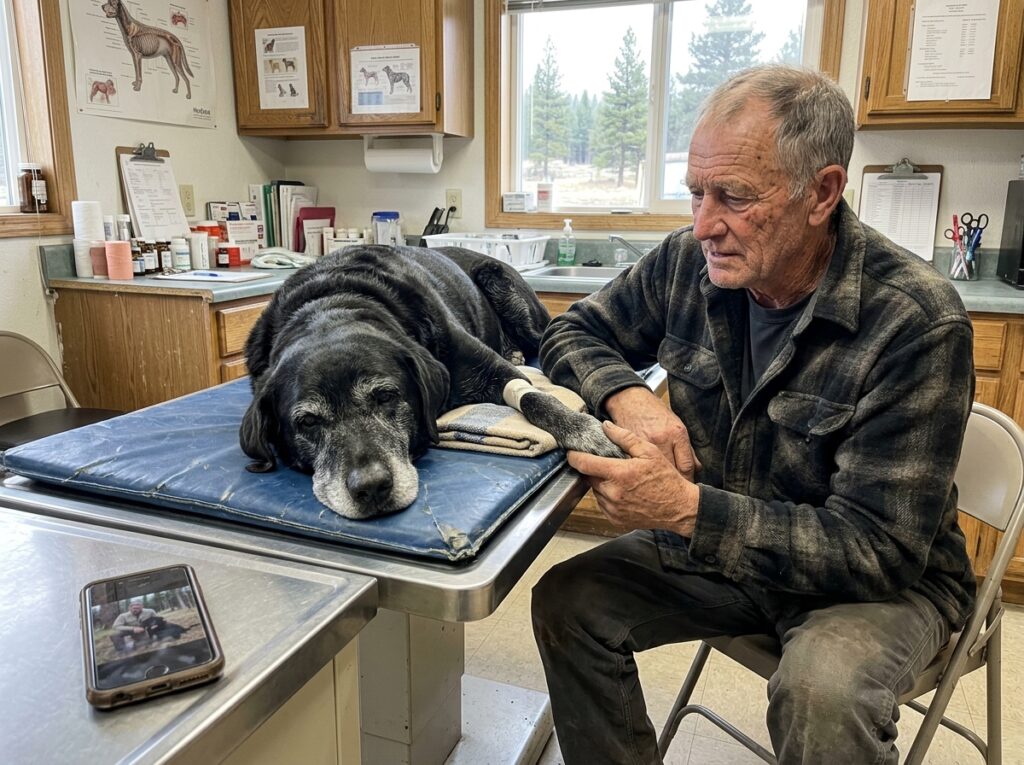
Duke was stable. His dehydration had improved, and the veterinarian was assessing the injury to his front leg. The dog would need rest and follow-up care, but he was responsive and had begun eating small amounts of food.
Robert felt a wave of relief.
“Can I see him?”
“You can visit this afternoon,” the veterinarian said. “We’ll make sure he stays comfortable.”
After the call, Robert returned to the old photograph.
He remembered the younger dog beside Daniel. It had been called Ranger, a black Labrador trained to help locate people in difficult terrain. Robert had worked with the pair during a few exercises, although he had never been their primary handler.
Ranger had a distinctive white patch beneath his chin.
The resemblance to Duke was striking.
But a similar marking did not prove that the dogs were related, and the photograph could not establish what had happened during the missing volunteer’s final hours.
Robert opened a drawer containing old ranger documents. He found notebooks from his final years on the job, a few maps, and a folder of photographs from past search operations.
One picture showed Daniel standing beside Ranger outside the ranger station. Another showed the volunteer team gathered near a trailhead.
Robert studied the faces.
He wondered whether the person in the recent cabin footage was Daniel himself, someone who had known him, or a person carrying a photograph left behind years earlier.
The camera had not captured a clear face.
He had to accept that he did not yet know.
At 2:40 p.m., Robert drove to the veterinary clinic.
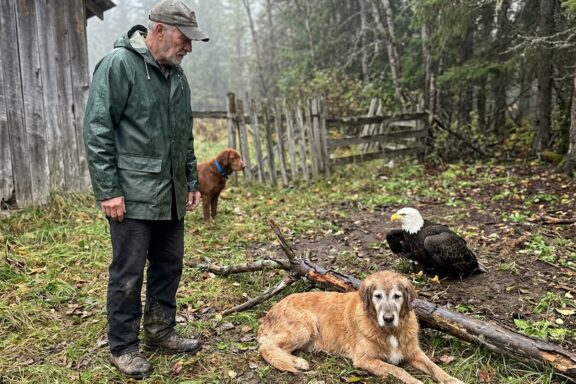
Duke was resting on a padded bed, his graying muzzle turned toward the door. When Robert entered, the old Labrador lifted his head and wagged his tail.
“There you are,” Robert whispered.
He sat beside the bed and gently stroked Duke’s head.
“I thought I’d lost you, old boy.”
Duke pushed his nose into Robert’s palm.
For a few minutes, Robert let himself forget the cabin, the photograph, and the unanswered questions. His companion was alive, and the dog was receiving the care he needed.
Then the veterinarian approached with an update.
“We’re still checking the leg injury,” she explained. “He has several superficial scratches, and he’s tired, but there are encouraging signs. We can’t tell exactly where he spent the last three days.”
Robert nodded.
“Could he have followed someone to the cabin?”
“It’s possible, but we can’t determine that from his condition alone. Dogs can travel a surprising distance, especially when frightened or disoriented. The camera footage may help establish the timeline.”
Robert thanked her.
Before leaving, he showed the veterinarian a picture of Duke and the younger black Labrador beside Daniel.
She examined it carefully.
“They look similar,” she said. “But we’d need more evidence to establish any relationship. Their markings alone aren’t enough.”
Robert tucked his phone away.
He had spent years in the forest learning that a good search depended on separating what people hoped was true from what the evidence actually showed.
He needed to remember that lesson now.
That evening, Deputy Collins called again.
“The item we found beneath the cabin floor appears to be a weatherproof field notebook,” he said. “It contains several dates, location references, and notes from the old search operation.”
Robert gripped the phone.
“Daniel’s notebook?”
“We can’t confirm who wrote every entry yet. Some pages appear to be from the period when he disappeared. The investigators are documenting the handwriting and comparing it with available records.”
“Did you find anything that explains why he went back to the cabin?”
“Not yet. There’s a map marking the creek crossing and an old service trail. We’re checking whether those locations match the original search records.”
Robert knew both places.
The creek crossing was narrow, with slippery rocks and a steep bank. The service trail led through dense pine trees toward an area where rainwater often collected in deep channels. During storms, the route could become difficult to navigate.
It was a dangerous place to be after dark.
“Was there a message in the notebook?” Robert asked.
“There is a short note on one page, but we haven’t established who wrote it or when. I don’t want to read too much into it before the examination is complete.”
Robert appreciated the caution, even though every minute without answers felt longer than the last.
After the call, he reopened the trail-camera footage.
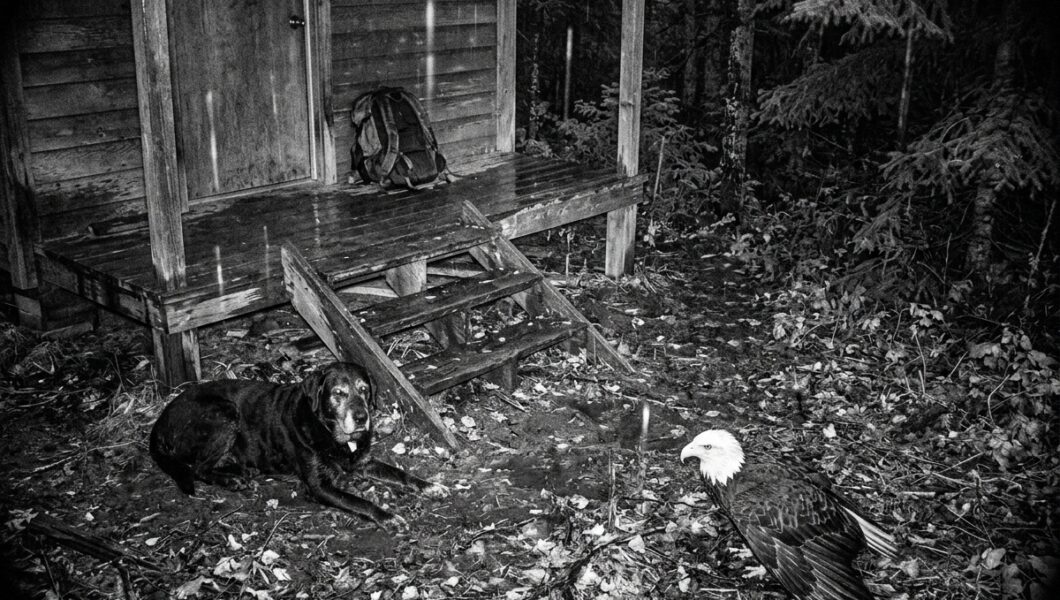
He watched Duke approaching the cabin. He watched the dog lower himself onto the wet ground. He watched the injured eagle resting several feet away.
Then he reviewed the recording of the person leaving the red backpack.
The figure had placed the bag carefully beside the steps, turned toward the forest, and walked away. There was no obvious struggle, and the camera did not show anyone forcing Duke to follow.
Could the person have been trying to help the dog?
Had Duke followed someone he recognized?
Or had the backpack simply been left at the cabin for a different reason?
Robert could not answer those questions.
He sent the original recordings to the sheriff and preserved copies without editing them.
The next morning, a wildlife rehabilitator contacted him with an update about the bald eagle. The bird was receiving treatment, and its wing injury was being assessed. It was too early to determine whether it would recover sufficiently to fly again.
Robert thanked the rehabilitator.
He hoped the eagle would survive, but he understood that its recovery would depend on the nature of the injury and how it responded to treatment.
The bird had been part of the same frightening scene as Duke, yet there was no evidence that the two animals had a special connection. They might have reached the cabin independently, both seeking shelter or simply moving through the same stretch of woodland.
Robert made a note of the update and returned to his own investigation.
At 10:15 a.m., Deputy Collins asked him to come to the sheriff’s office.
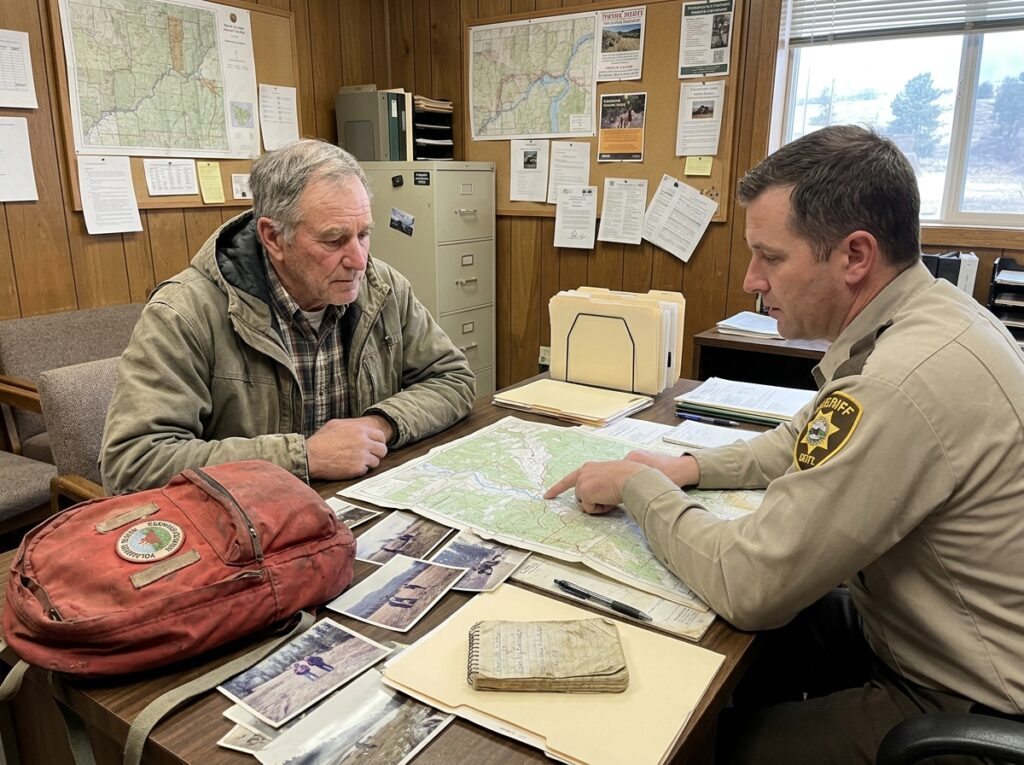
Robert brought the photographs and his old ranger notebook. He did not visit the cabin.
Inside the office, the deputy showed him a photograph of the storage compartment beneath the cabin floor. Several objects had been recovered, including the field notebook, a damaged compass, and a small waterproof pouch.
The pouch contained a folded sheet of paper.
The writing was faint, but one line could be read:
If anyone finds this, check the east side of the creek crossing.
Robert felt his stomach tighten.
“That was where we searched,” he said. “We checked that crossing more than once.”
“According to the original records, teams searched the accessible banks,” Deputy Collins replied. “But the area beyond the crossing was difficult to reach during the storm. We’re comparing the map with the notes to determine whether any locations were missed.”
Robert leaned closer to the photograph.
“Why would someone leave this hidden under the floor?”
“We don’t know. It may have been placed there during the original operation, or it may have been moved more recently. The condition of the materials and the records may help establish a timeline.”
The deputy showed him another image.
It was a close-up of the red backpack.
A faded patch on its side carried the emblem of the search-and-rescue volunteer group Daniel had joined. The bag appeared old, but its straps and stitching were in better condition than Robert expected after years in the weather.
“Could it have been stored somewhere else?” Robert asked.
“That’s one possibility. We haven’t established where it was kept before it appeared at the cabin.”
Robert studied the photograph.
He remembered seeing similar bags during the original search. Volunteers had carried maps, medical supplies, food, and emergency equipment in them. But he could not say whether this particular backpack had belonged to Daniel.
The deputy placed the image on the desk.
“We’re trying to identify the person in the camera footage. We have not confirmed that the person is Daniel, and we don’t want to give you false hope.”
Robert looked down.
“I understand.”
But he could not stop thinking about the message.
Robert, he remembers.
Whoever had written it knew his name. They knew about Duke. They also knew enough about the old search to return to the cabin and leave a photograph.
That suggested a connection, but it did not reveal what the connection was.
Before Robert left, the deputy told him that investigators planned to examine the east side of the creek crossing when conditions were safe. They would also contact people who had participated in the original search.
Robert offered to provide his notes and answer questions about the terrain.
Then he returned home.
For the next two days, Robert focused on Duke’s recovery.
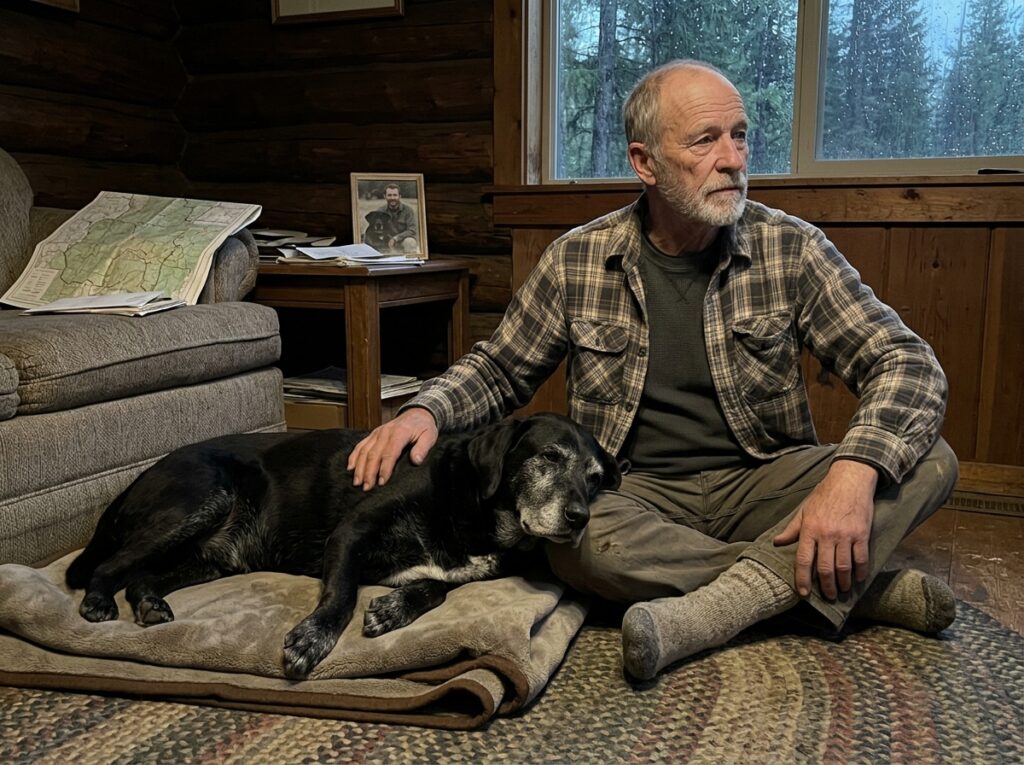
The dog returned home under veterinary instructions and spent most of his time resting on a thick blanket beside the living-room window. Robert helped him outside for short, careful walks and kept him away from the woods.
Duke was still weak, but his appetite gradually improved.
Every evening, Robert sat beside him and spoke softly, as he had done for years.
“You don’t have to tell me where you’ve been,” he said one night. “Just get better.”
Duke lifted his head and gave a slow wag of his tail.
Robert smiled.
Then, on the third afternoon, Deputy Collins called with an update.
The team had inspected the east side of the creek crossing. They had found old boot impressions, but the recent rain made it difficult to determine their age. They had also discovered a weathered piece of equipment partially buried beneath leaves.
The object was being documented, and investigators were checking whether it matched anything recorded in the original search inventory.
“Could it belong to Daniel?” Robert asked.
“Possibly. We haven’t confirmed that yet.”
Robert looked toward the window.
The forest was quiet. Sunlight fell across the pasture, and the wet branches shone where the clouds had begun to lift.
“Is there any evidence he survived that night?” he asked.
The deputy paused before answering.
“We have not found enough to establish what happened to him. The new evidence gives us places to investigate, but we need to be careful about what we conclude.”
Robert thanked him.
He had hoped for a different answer, but he understood why the deputy could not offer one.
That evening, he took out the photograph of Daniel and Ranger. He placed it beside a picture of Duke as a young dog, both images showing black Labradors with white markings beneath their chins.
He wondered whether the resemblance had drawn his attention because he wanted the two stories to be connected.
Perhaps it was only a coincidence.
Perhaps the person at the cabin had known Daniel. Perhaps the backpack had been recovered from an old storage place. Perhaps the note had been written by someone who believed a detail from the original search had been overlooked.
There were too many possibilities.
Robert folded his old ranger notebook closed.
He had spent much of his career helping people search for answers in difficult terrain. He knew that patience mattered, and that a search could be led astray when a team treated assumptions as facts.
This time, the hardest part was waiting.
At 9:06 p.m., his phone vibrated.
Another motion alert had appeared from the cabin camera.
Robert opened the footage.
Rain had returned, falling in thin silver lines through the infrared image. The cabin stood empty, and the red backpack was no longer beside the steps. Investigators had already removed it.
Then a figure appeared at the edge of the frame.
The person stopped beside the cabin wall and looked toward the trail. Their face remained hidden beneath a hood.
For several seconds, the figure stood motionless.
Then they placed a hand against the wooden wall, right where the earlier photograph had been held.
The camera captured a small movement.
The person left something behind.
Robert enlarged the image.
It looked like a folded piece of paper.
He immediately contacted Deputy Collins and sent the recording. He did not approach the cabin or try to retrieve the object himself.
The deputy thanked him and said a team would inspect the site.
Robert sat quietly after the call.
He thought of Duke resting safely at home, the eagle recovering at the wildlife facility, and the search team preparing to return to a place that had haunted him for years.
He did not know who had visited the cabin. He did not know what the new note contained. And he did not know whether Daniel Foster was alive.
But he now understood that the old search might not have been the end of the story.
Someone had returned to the cabin, and that person wanted Robert to look again.
The next morning, the sheriff’s office would examine the new evidence and compare it with the original records.
Until then, Robert would wait.
He sat beside Duke and rested a hand on the old Labrador’s back.
“Whatever happened out there,” he whispered, “we’ll face it one step at a time.”
Duke breathed slowly, his head resting on the blanket.
Outside, the forest stood beneath the clearing sky. The abandoned cabin remained hidden among the pines, holding questions that had waited for years.
Robert had once believed that the search for Daniel Foster ended when the last volunteer returned home.
Now, with Duke safe beside him and a new clue waiting at the cabin, he was willing to look again.
Not because he was certain of what he would find.
Because someone, somewhere, might still be waiting to be found.
No Comments