

For a while, I thought things had finally settled down.
Miguel was doing okay.
My daughter and granddaughter were coming over every Sunday again.
I had even started talking to my neighbor, something I hadn’t done in months.
Life felt quieter.
Better.
But then, one Saturday morning, someone knocked on my front door.
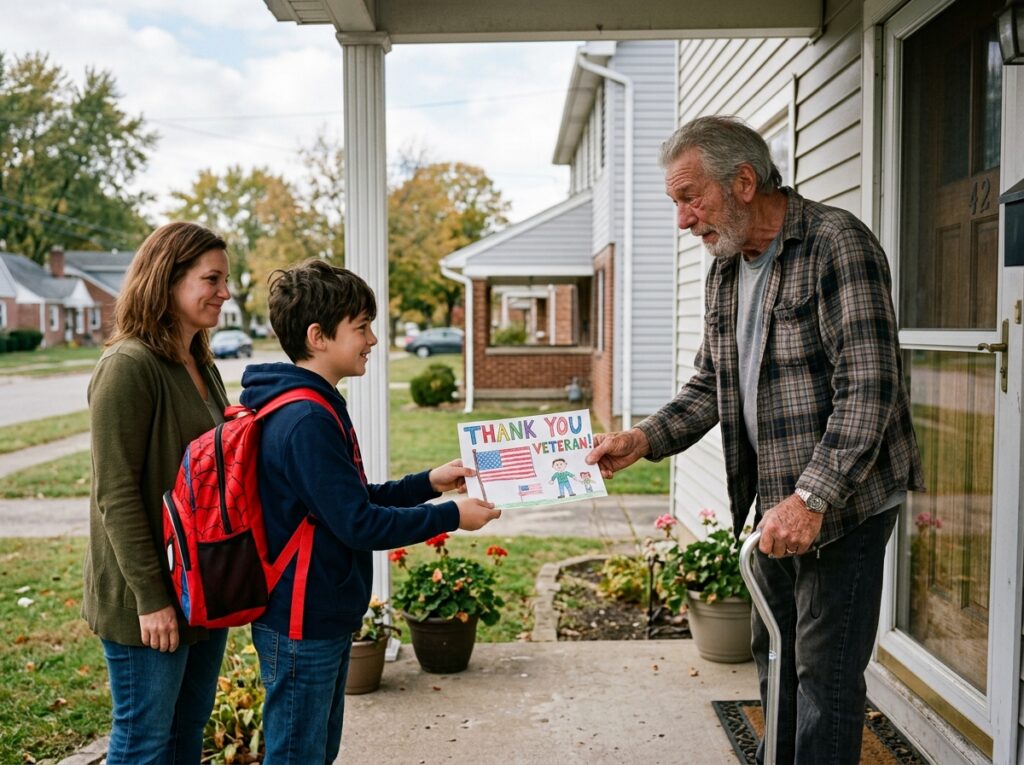
I opened it and saw Miguel standing there.
He was wearing the same red Spider-Man backpack I’d seen him carrying at Kroger.
But this time, he wasn’t crying.
He was smiling.
Standing beside him was his mother.
She looked nervous at first, but when she saw me, she smiled.
“Mr. Hank,” Miguel said.
“Hey, buddy.”
He looked down at something he was holding.
Then he handed it to me.
It was a folded piece of paper.
I opened it.
There was a drawing.
It showed an American flag, a grocery store, a little boy, and an old man with a cane.
Above them, in crooked blue letters, Miguel had written:
“People Are Supposed To Help People.”
I stared at it longer than I probably should have.
“Did you draw this?”
He nodded.
“I wanted you to have it.”
I swallowed hard.
“Thank you, son.”
His mother stepped forward.
“He talks about you all the time.”
I looked at Miguel.
“He does?”
She smiled.
“He says you’re the first person here who made him feel like he belonged.”
Those words hit me harder than I expected.
Because I knew exactly what that feeling was.
Not belonging.
I’d carried it for fifty years.
After Vietnam, I had come home expecting relief.
Instead, I found anger.
I didn’t know where to put it.
So I put it everywhere.
Into politics.
Into arguments.
Into strangers online.
Into anyone who seemed different from me.
I thought I was fighting for my country.
Maybe I was just trying to convince myself that I still had a place in it.
Miguel had somehow shown me something I’d forgotten.
Belonging isn’t something someone gives you because you earned it.
Sometimes it’s something another person reminds you that you already have.
I invited them inside.
His mother looked around the living room.
There were photographs everywhere.
Mary on our wedding day.
Lisa as a little girl.
Emma sitting on my lap when she was three.
And a photograph of me in uniform.
Miguel stopped in front of that one.
“That’s you?”
“Yeah.”
“You were young.”
I laughed.
“Very young.”
He studied the photograph.
“Did you like being a soldier?”
I didn’t answer immediately.
That’s a complicated question.
“I liked the people I served with,” I finally said.
He nodded.
“Did you miss them?”
“Every day.”
His mother sat quietly on the couch.
Miguel looked at the photograph again.
“Do you think America is a good country?”
I almost smiled.
What a question for a twelve-year-old.
“I think America is a country full of people,” I said.
He waited.
“Some are good. Some aren’t. Most are just trying to figure things out.”
He thought about that.
“Then why do people fight so much?”
I looked at him.
“Because sometimes people forget they’re talking to people.”
He nodded slowly.
That sentence felt strangely important.
After they left, I put Miguel’s drawing on the refrigerator.
Right beside his first note.
“I am not invisible.”
Two pieces of paper from a twelve-year-old boy.
Two sentences that had changed me more than thousands of hours of television ever had.
The following Monday, I went down to the VFW.
The same guys were sitting around the bar.
One of them looked at me.
“How’s your new friend?”
I smiled.
“He’s doing good.”
Another guy laughed.
“You really have gone soft.”
I pulled up a chair.
“Maybe.”
Then I told them about the drawing.
Nobody laughed this time.
The bartender looked down at his coffee.
“My grandson gets picked on at school,” he said quietly.
The room went still.
Another man said his granddaughter had been afraid to speak up because she didn’t want to get called names.
Then someone else talked about his neighbor.
Then another person.
For the first time in years, we weren’t talking about politics.
We were talking about people.
Real people.
Our families.
Our neighbors.
Our fears.
Our mistakes.
It was strange.
We had spent years arguing about what was wrong with America.
But that night, sitting around an old wooden table, we started talking about what was happening to us.
And maybe that was the beginning of something.
A few weeks later, I suggested we do something.
Nothing political.
No speeches.
No signs.
No arguments.
Just dinner.
We called it “Neighbor Night.”
The idea was simple.
Everyone was invited.
You didn’t have to agree with anyone.
You didn’t have to belong to a certain church or political party.
You didn’t have to explain yourself.
You just had to show up.
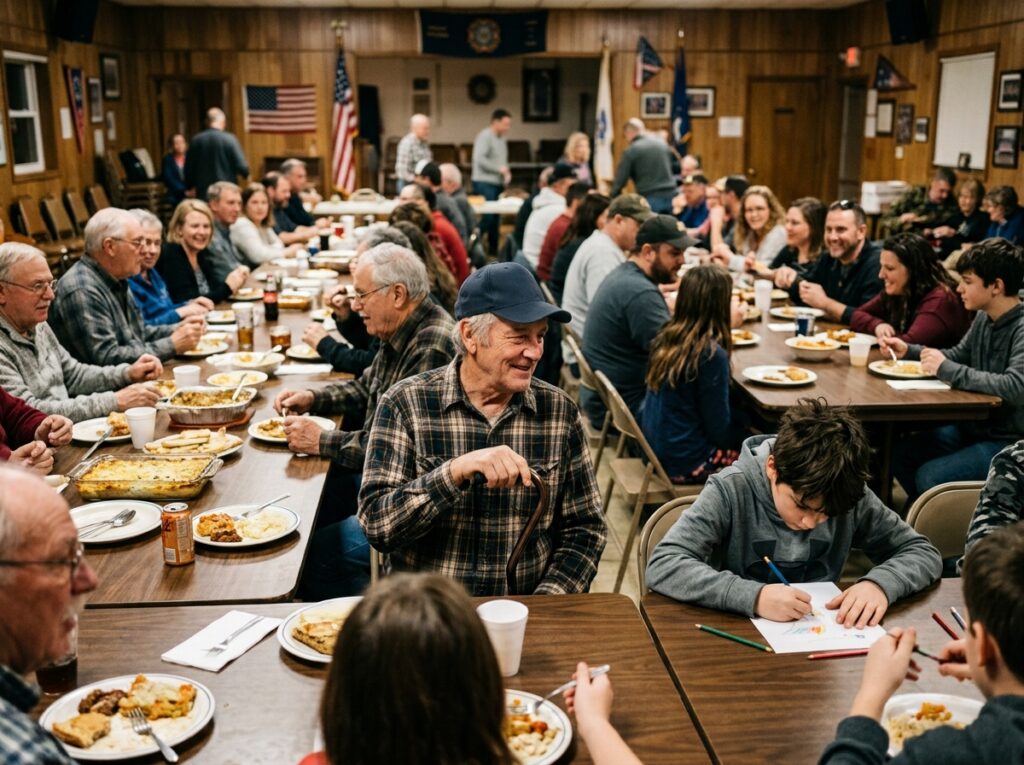
The first one was held in the basement of the VFW.
I expected maybe twenty people.
More than seventy showed up.
Families brought food.
Kids ran around.
Older folks sat at tables.
People who hadn’t spoken in years ended up sitting beside each other.
Miguel came with his mother.
My daughter brought Emma.
Emma was nervous at first.
She had heard me talk about Miguel so much that she felt like she already knew him.
Within ten minutes, the two of them were sitting on the floor drawing pictures together.
I watched them from across the room.
Then I noticed something.
Miguel had drawn the same little American flag from his picture.
But this time, there were dozens of people standing beneath it.
Different ages.
Different faces.
Different backgrounds.
All together.
He brought the picture over.
“What do you think?”
I smiled.
“I think you got it right.”
Neighbor Night became monthly.
Then twice a month.
People started bringing friends.
A teacher came one evening and asked if she could bring some of her students.
A firefighter showed up with his wife.
The owner of a small hardware store brought coffee.
A retired nurse brought homemade bread.
Nobody was trying to fix the country.
We were just learning each other’s names.
And somehow, that seemed to matter.
I started noticing things I’d ignored before.
The man across the street who always sat alone.
The woman at the grocery store who seemed to be struggling with her bags.
The teenager who ate lunch alone at the diner.
The older couple who rarely left their house.
I began saying hello.
Sometimes I stopped.
Sometimes I asked a question.
Sometimes all I did was smile.
And I discovered something.
People usually don’t need much to feel seen.
Sometimes they just need someone to notice they’re there.
One afternoon, I went to Kroger.
I walked past the canned vegetables.
The same aisle.
The same shelves.
The same fluorescent lights.
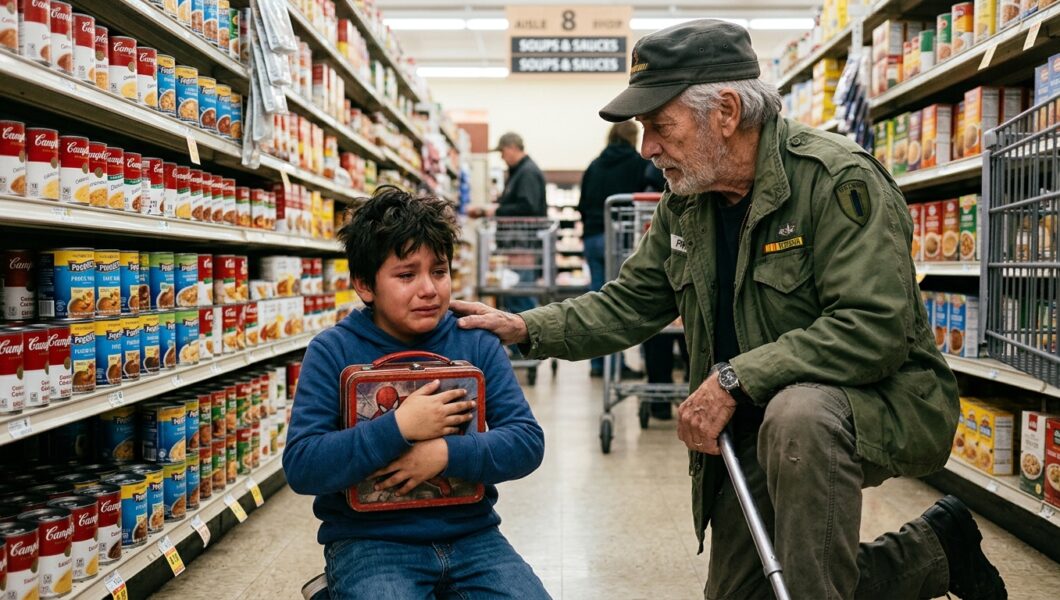
For a second, I remembered Miguel sitting on the floor with his lunchbox pressed against his chest.
Then I heard a voice.
“Mr. Hank!”
I turned.
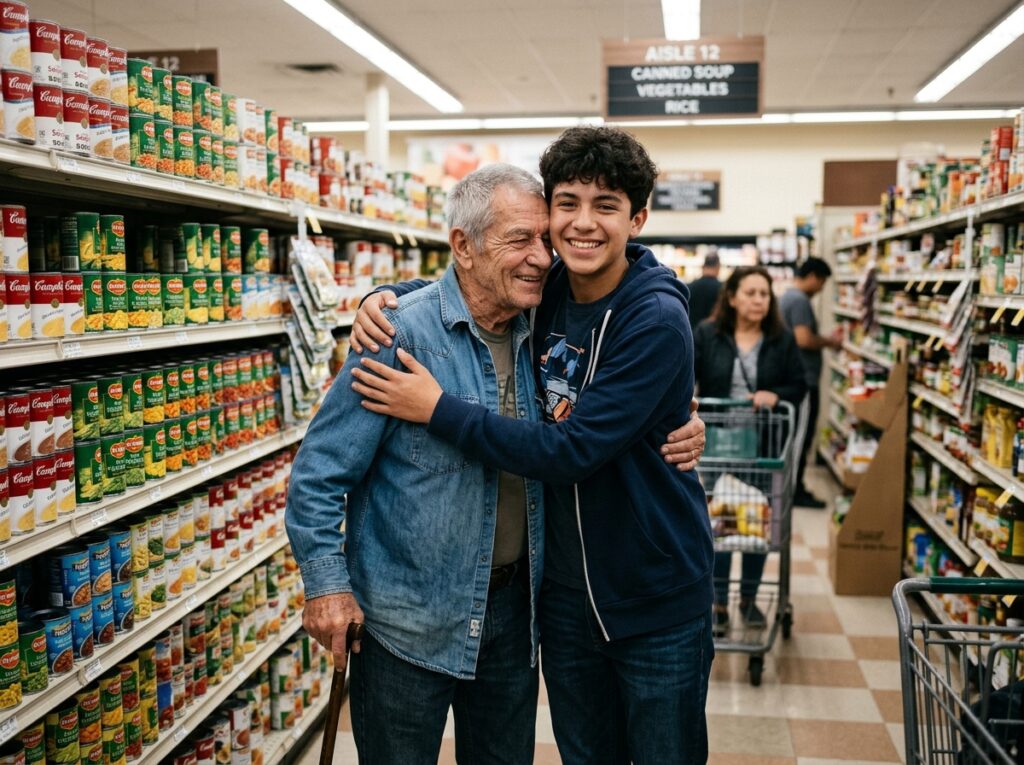
Miguel was standing at the end of the aisle.
He was taller now.
Not much.
But enough that I noticed.
He ran toward me.
“Hey, buddy.”
He smiled.
“I got an A on my history test.”
“That’s my man.”
He laughed.
Then he pointed toward the shelves.
“This is where we met.”
“Yeah.”
He looked around.
“I was scared.”
“I know.”
“You weren’t scared.”
I laughed.
“Oh, I was.”
He looked surprised.
“Really?”
“Absolutely.”
“Of those boys?”
I shook my head.
“No.”
“Then what?”
I thought about it.
“I was scared I’d walk away and pretend I hadn’t seen you.”
Miguel became quiet.
Then he hugged me.
Right there in the grocery store.
People walked past.
Nobody cared.
For a few seconds, I closed my eyes.
And I thought about the young soldier who had once been spat on for wearing a uniform.
I thought about the angry old man I’d become.
I thought about my wife.
My daughter.
My granddaughter.
And this kid.
This one scared little boy who had somehow reminded me that being strong wasn’t about having the loudest voice.
It was about refusing to walk away.
That evening, I went home and opened the drawer beside my chair.
Inside were Miguel’s notes.
His drawing.
The old photograph of Mary.
And a small folded piece of paper I had written myself.
It said:
“Remember their names.”
I had written it after that first meeting.
I don’t even remember doing it.
But I knew why.
Because I’d spent years reducing people to labels.
Republican.
Democrat.
Immigrant.
Veteran.
Rich.
Poor.
Neighbor.
Stranger.
I had forgotten that every label belonged to someone with a name.
Someone with a mother.
Someone with a father.
Someone who had been a child once.
Someone who was carrying something I couldn’t see.
Miguel taught me that.
A twelve-year-old kid with a Spider-Man lunchbox taught a seventy-two-year-old Vietnam veteran something he should have understood a long time ago.
You don’t heal a divided community by winning every argument.
You heal it by seeing people.
By remembering names.
By asking questions.
By sitting at the same table.
By helping someone carry groceries.
By knocking on a neighbor’s door with a bowl of soup.
By choosing curiosity when anger would be easier.
By refusing to let loneliness turn into hatred.
I still have opinions.
Plenty of them.
I still get frustrated.
Sometimes I still turn on the radio and catch myself getting worked up.
But now I turn it off.
Then I call my neighbor.
Sometimes we disagree.
That’s okay.
We’re still neighbors.
And every Sunday, my daughter and Emma come over for dinner.
Sometimes Miguel and his mother join us.
Emma and Miguel are older now.
They tease me about how serious I used to be.
I tell them I wasn’t serious.
I was just stubborn.
They laugh.
Maybe they’re right.
Last Thanksgiving, we were sitting around the table when Miguel stood up.
He had something in his hand.
It was that original drawing.
The one he gave me years earlier.
He had kept a copy.
He unfolded it carefully.
The paper was worn.
The colors had faded.
But I could still see the little flag.
The grocery store.
The boy.
The old man.
And those words.
“People are supposed to help people.”
Miguel looked around the table.
“I’m glad I met Mr. Hank.”
I couldn’t speak.
My daughter reached across the table and squeezed my hand.
Miguel continued.
“When I was little, I thought America was a place where everyone was supposed to be the same.”
He looked at me.
“Now I think it’s a place where people are supposed to take care of each other even when they’re different.”
Nobody said anything for a moment.
Then my granddaughter started clapping.
Everyone laughed.
I looked around that table.
Different generations.
Different backgrounds.
Different opinions.
One family, in a way none of us had planned.
And I thought about the country I used to believe I understood.
I don’t think I understand it anymore.
Maybe that’s a good thing.
Because now I know enough to realize how little I knew.
I used to think America was a collection of arguments.
Now I think it’s a collection of people.
People who are lonely.
People who are scared.
People who are struggling.
People who are trying.
People who make mistakes.
People who need someone to remind them that they belong.
And maybe the greatest patriotic thing we can do isn’t shouting about how much we love our country.
Maybe it’s loving the people who live in it.
The neighbor who votes differently.
The kid whose family came from somewhere else.
The veteran carrying memories he doesn’t talk about.
The widow eating dinner alone.
The teenager who thinks nobody notices him.
The cashier who has been standing on her feet for eight hours.
The stranger sitting quietly at the bus stop.
We don’t have to agree with everyone.
We don’t even have to like everyone.
But we can see them.
We can remember their names.
We can choose not to walk away.
I still have that little note Miguel gave me.
“I am not invisible.”
I keep it beside Mary’s photograph.
Whenever I start getting angry at the world, I look at those words.
Then I remember a little boy sitting on a grocery store floor, clutching a Spider-Man lunchbox.
And I remember what he taught me.
Nobody wants to be invisible.
Not really.
Most of us just want to know that somebody sees us.
Somebody hears us.
Somebody remembers our name.
And sometimes, that’s where healing begins.
Not in Washington.
Not on television.
Not in an argument online.
It begins in a grocery store aisle.
At a neighbor’s front door.
At a dinner table.
With a simple question.
“What’s your name?”
Then, if you’re lucky enough to hear it, remember it.
Because I spent seventy-two years thinking strength meant standing my ground.
Now I know better.
Sometimes strength is taking one step toward someone else.
Sometimes it’s putting down the phone.
Sometimes it’s turning off the radio.
Sometimes it’s kneeling beside a scared twelve-year-old and telling him he belongs.
And sometimes, the person you think you’re helping turns around and saves something inside you that you didn’t even realize was broken.
That’s what Miguel did for me.
I thought I was the one who rescued a kid that day.
Turns out, he rescued me.


No Comments