

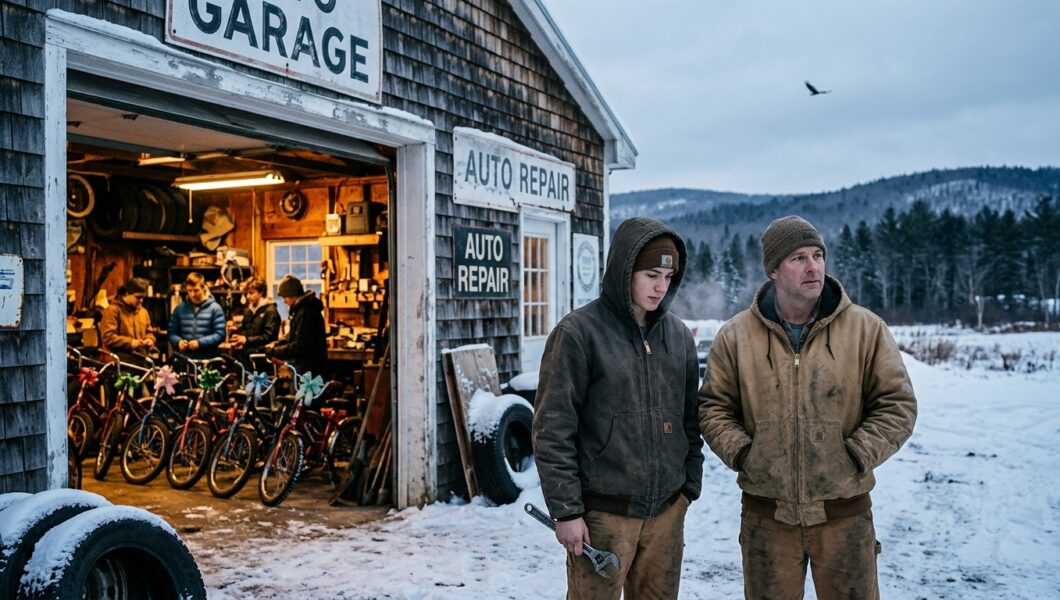
Three Christmases after Caleb started helping Frank restore bicycles, a stranger walked into Miller’s Auto Repair carrying an old red bicycle pedal.
It was October.
Saturday morning.
Cold enough that Frank had already started the wood stove.
By then, Frank was eighty-two.
Caleb was fourteen.
And what had once been one old mechanic quietly fixing one bicycle every Christmas had become something Frank claimed he had completely lost control of.
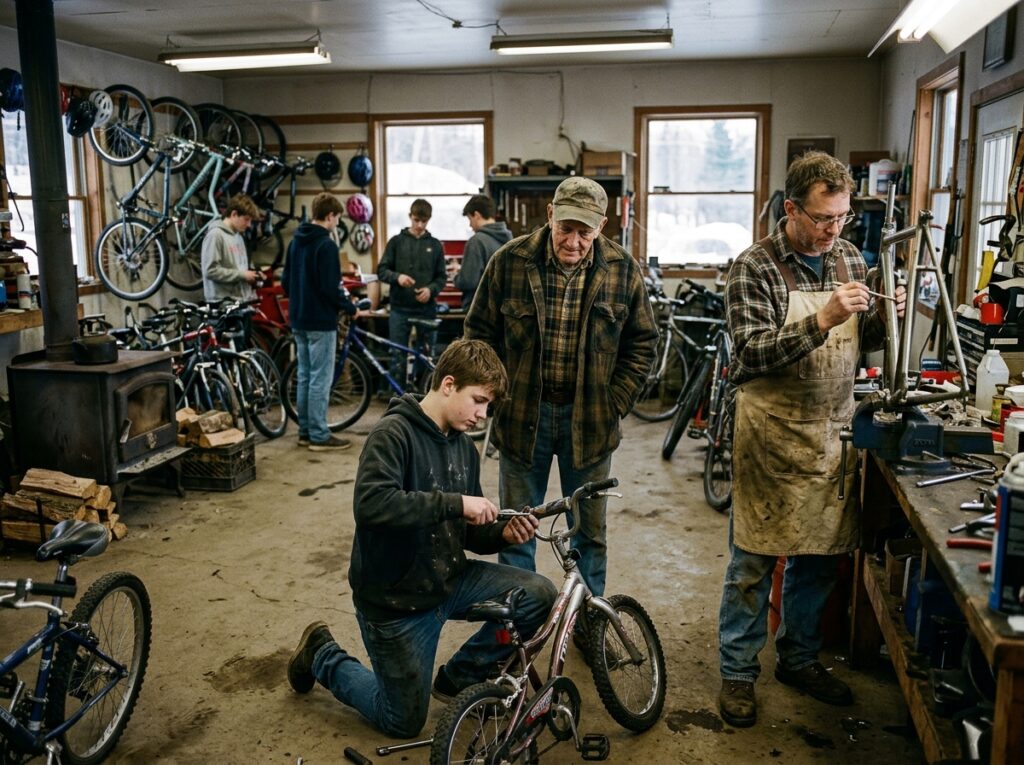
There were seventeen bicycles in the garage.
Seventeen.
Frames hanging from hooks.
Wheels leaning against walls.
Boxes of donated parts.
Helmets stacked beside the office.
Four high school students were working at benches.
Caleb was trying to remove a rusted crank from a girl’s bicycle.
Frank stood behind him.
“Wrong wrench.”
“It fits.”
“So does a butter knife. Doesn’t mean you rebuild an engine with it.”
Caleb sighed.
Then the side door opened.
A man stepped inside.
Maybe fifty.
Work boots.
Dark canvas jacket.
Gray beginning at his temples.
He stood near the doorway like he wasn’t sure he belonged there.
Frank looked up.
“Help you?”
The man held out his hand.
On his palm was an old bicycle pedal.
Red.
Paint chipped.
Rubber worn almost smooth.
“I think this belonged to you.”
Frank stared at it.
Then sat down.
I happened to be there.
I’d stopped by with coffee and, according to Frank, had immediately become free labor.
I watched his face change.
He took the pedal.
Turned it over.
On the metal shaft were two tiny scratches.
An X.
Then another X.
Frank whispered:
“No.”
The stranger smiled.
“You recognize it?”
Frank looked toward the photograph hanging on the office wall.
Danny.
Nine years old.
Striped sweater.
Huge smile.
Red bicycle.
Christmas morning, 1978.
Frank looked back at the pedal.
“Where did you get this?”
The man’s name was Michael Harris.
His grandfather had been George Harris.
The retired mill worker.
Green work jacket.
Gray hair.
Heavy boots.
The man who had shown up on Christmas Eve in 1978 with a replacement wheel for Danny’s unfinished bicycle.
The man whose first name Frank hadn’t been able to remember.
George.
His name had been George.
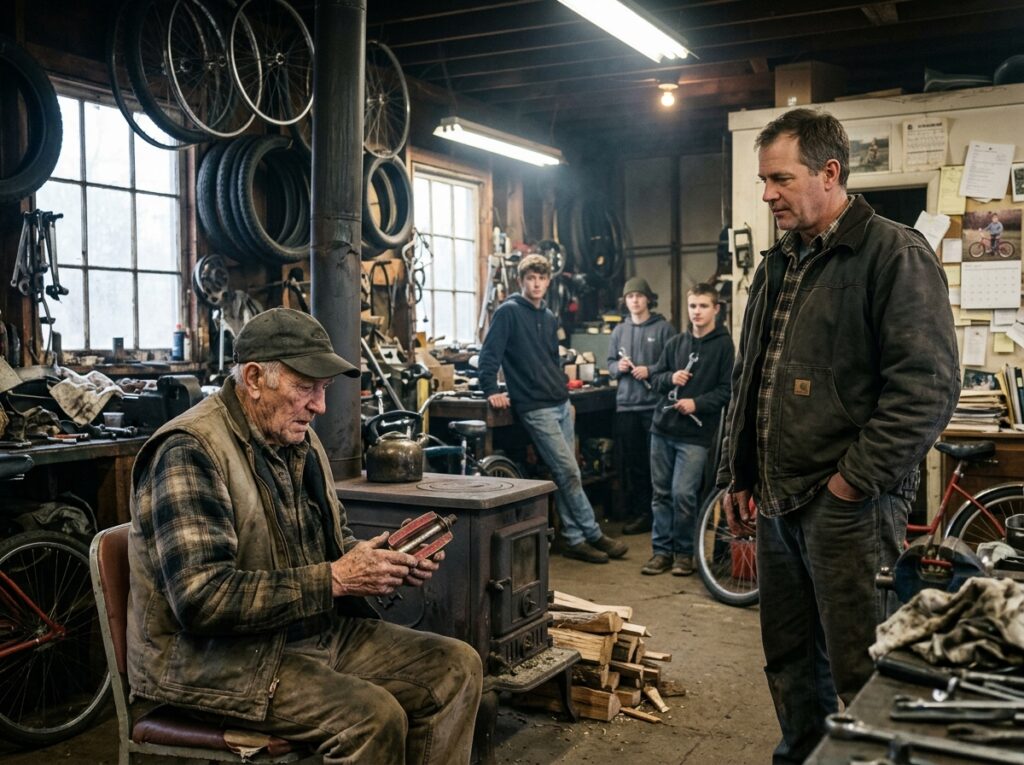
Michael explained.
George Harris had died in 1991.
Frank knew that much.
What he didn’t know was that George had kept things.
Receipts.
Tools.
Old photographs.
Bits of hardware that any reasonable person would’ve thrown away.
After Michael’s mother died, he started cleaning out the family house.
In a metal coffee can on a basement shelf, he found bicycle parts.
A reflector.
Two bolts.
The red pedal.
And an envelope.
Written on the front:
MILLER BIKE — CHRISTMAS ’78
Inside was a receipt from a hardware store.
December 24, 1978.
One bicycle wheel.
Black vinyl.
Steel wool.
Red paint.
Frank stared at the receipt.
“You said he had the wheel.”
Michael laughed.
“Apparently he bought it.”
Frank closed his eyes.
He’d known.
Of course he’d known.
George had disappeared for forty minutes and returned with a nearly new wheel.
Frank just hadn’t wanted to challenge the lie.
There was something else in the envelope.
A piece of paper.
George’s handwriting.
Michael read it aloud.
Frank Miller’s boy needed a bike. Frank couldn’t finish it. Helped him. Wouldn’t take money. Hope he does the same someday.
That was it.
No profound journal entry.
No prediction.
No mention of changing lives.
George had recorded it with the same emotional intensity as somebody writing down a furnace repair.
Frank laughed.
“He made it sound like we changed a tire.”
Michael nodded.
“My grandfather wasn’t exactly poetic.”
Then Michael asked:
“Did you?”
“Did I what?”
“Do the same someday?”
Everybody in the garage went quiet.
Frank looked around.
Seventeen bicycles.
Teenagers with grease on their hands.
Caleb holding the wrong wrench.
Boxes of donated helmets.
Then he looked back at Michael.
“Couple times.”
Michael didn’t understand.
Caleb did.
He started laughing.
“Couple?”
Frank glared.
“Work.”
Michael eventually heard the whole story.
The first bicycle Frank left for a child in 1986.
Then another.
Thirty-nine.
Danny helping.
Danny dying.
The purple bicycle Frank nearly didn’t restore.
Caleb.
The shop class.
Eleven bicycles the previous Christmas.
Michael sat on an overturned bucket and listened.
When Frank finished, Michael rubbed both hands across his face.
“My grandfather never knew?”
“No.”
“He never knew you kept doing it?”
“I don’t think so.”
Michael looked genuinely upset.
Frank noticed.
“Hey.”
Michael looked up.
“He didn’t need to.”
“But wouldn’t you have wanted to tell him?”
“Sure.”
Frank shrugged.
“Didn’t get the chance.”
Then he held up the red pedal.
“But that’s not why he helped me.”
That sentence changed the room.
George hadn’t fixed Danny’s bicycle as an investment.
He wasn’t buying future generosity.
He didn’t know there would be another bicycle.
He helped because on December 24, 1978, one father was sitting on a garage floor beside a bent wheel.
That need had been enough.
Frank handed the pedal back.
Michael shook his head.
“It’s yours.”
“No.”
“It came off Danny’s bike.”
“Maybe.”
Frank closed Michael’s fingers around it.
“But your grandfather kept it.”
Neither man argued after that.
Sometimes you can tell when an object has already decided where it belongs.
Michael put it carefully in his jacket pocket.
Then Frank said:
“You know anything about bicycles?”
Michael smiled.
“No.”
Frank pointed at Caleb.
“Neither did he.”
“Hey.”
“Grab a broom.”
And just like that, George Harris’s grandson joined the garage.
He came back the following Saturday.
Then the next.
He was terrible at bicycle repair.
Frank told him frequently.
But Michael could paint.
Really paint.
He worked for a company that refinished kitchen cabinets.
The first frame he restored was dark green.
Smooth.
Clean.
Beautiful.
Frank ran one finger across it.
“Too nice.”
Michael stared.
“That’s a complaint?”
“Kid’s going to be afraid to scratch it.”
Caleb shook his head.
“You complain professionally.”
“Fifty years of practice.”
By December, they had twenty-two bicycles ready.
That created a new problem.
Finding twenty-two children without turning the process into some humiliating competition over who was needy enough.
Frank refused applications that asked families to describe their hardship.
“No.”
The school counselor tried to explain.
“We need some way to know—”
“Then ask what size bike they need.”
“Frank.”
“Don’t ask parents to write an essay about the worst year of their life for a bicycle.”
He had a point.
They worked with school staff and local family organizations who already knew families and could privately offer bicycles.
No public nominations.
No photographs of recipients.
No requirement to explain.
Just:
Would a bicycle help your child this Christmas?
Yes?
What size?
Done.
Christmas Eve arrived with heavy snow.
Of course it did.
By 5:30 that morning, I was at the garage.
Caleb was there.
Michael.
Four students.
Frank.
Coffee everywhere.
Twenty-two bicycles lined the wall.
Each had a helmet.
Each had a bow.
Frank hated the bows.
“They’re bicycles, not puppies.”
Nobody listened.
Deliveries started at six.
Families who had agreed to receive bikes had been told only that something would arrive.
Most bicycles were left quietly on porches or with designated adults.
No one waited to watch children open doors.
That part had changed.
Caleb had grown older.
He understood Frank better now.
The point wasn’t to witness the reaction.
The point was that there would be a bicycle when the child woke up.
At 8:40, only one bicycle remained.
Small.
Red.
Michael had painted it.
Frank had chosen the color.
Nobody commented on that.
The bike was for a seven-year-old girl named Emma.
Her father worked nights at a paper mill.
Her mother had been dealing with serious car repairs and reduced work hours.
They didn’t need their hardship turned into a Christmas story.
They just needed a bike.
We drove out.
Michael carried it to the porch.
Frank stayed in the truck.
Caleb tied the bow tighter.
They left it.
Knocked.
Walked away.
No waiting.
No looking through windows.
Frank insisted.
On the drive back, Michael asked:
“Does it ever feel strange not seeing them get it?”
Caleb answered before Frank could.
“Knowing isn’t part of the gift.”
Frank turned toward him.
“That mine?”
“You said it.”
“Good line.”
“You don’t remember?”
“I’ve said lots of smart things.”
We laughed.
Then Michael became quiet.
“My grandfather would’ve liked this.”
Frank looked through the windshield.
“Probably would’ve complained about the bows.”
Michael smiled.
“Definitely.”
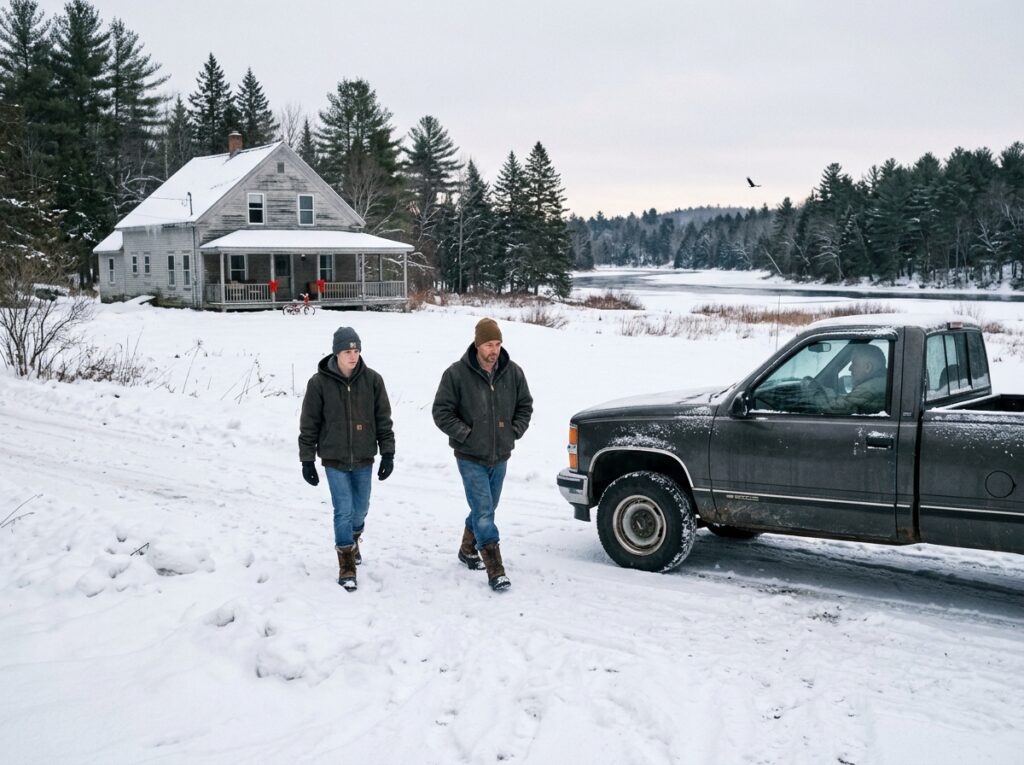
At the river, Caleb pointed.
Bald eagle.
High above the water.
It crossed toward the pines.
Frank watched.
So did Michael.
Nobody assigned it a dead relative.
Nobody needed to.
It was simply something beautiful happening while we happened to be paying attention.
That spring, Frank had a heart attack.
Not the dramatic kind.
He was at the garage.
Complained about indigestion.
Caleb noticed he looked gray.
Frank told him:
“I’m eighty-three. Gray’s the theme.”
Caleb called 911 anyway.
Good thing.
Frank spent five days in the hospital.
When he came home, the doctor told him he needed to slow down.
Frank interpreted that as a personal insult.
But he did.
A little.
No more lifting engines.
No crawling under cars.
Fewer hours.
The auto repair side of Miller’s Garage gradually closed.
The bicycle side didn’t.
That’s when Frank faced something he hadn’t expected.
If he couldn’t do the work himself, did the tradition still belong to him?
At first, he hovered.
Caleb tightened a brake cable.
Frank retightened it.
Michael painted a frame.
Frank inspected it under three different lights.
Students swept.
Frank swept after them.
Finally Caleb snapped.
“You know we’re not going to learn if you keep redoing everything.”
Frank stared at him.
“I’m supervising.”
“You’re being annoying.”
I prepared for death.
Frank looked at Caleb for a long time.
Then:
“Both can be true.”
He sat down.
That was harder for him than fixing bicycles.
Receiving help had never come naturally.
Neither had letting younger hands take over.
But gradually, he did.
Caleb became good.
Really good.
By sixteen, he could rebuild most ordinary bicycles without Frank standing over him.
Michael coordinated donations.
The shop teacher supervised students.
Frank sat near the wood stove.
Drank coffee.
Insulted everyone’s technique.
It worked.
Then one October morning, a truck arrived.
Inside were fourteen donated bicycles.
The driver was Tyler.
I recognized the name before I recognized the man.
The ten-year-old boy who had received Frank’s blue bicycle years earlier.
Except Tyler was nineteen now.
Tall.
Community college student.
Working part-time at the same nursing home where his mother had worked.
He walked into the garage.
Frank squinted.
“Help you?”
Tyler smiled.
“You already did.”
Frank didn’t recognize him.
That pleased Tyler.
He told the story.
Blue bicycle.
Rented farmhouse.
Christmas Eve.
Red bow.
His mother trying to stop him from running into the snow in socks.
Frank’s face changed.
“You knew?”
“My mom figured it out.”
“How?”
“You fixed her car a month before.”
Frank muttered:
“I was bad at anonymous.”
Tyler laughed.
He’d ridden the blue bicycle for five years.
Then given it to a cousin.
He didn’t know where it was now.
But he remembered something more important.
For years, he’d assumed his mother had somehow bought it.
When he was fifteen, she told him the truth.
“She said that Christmas was the first time she understood people could help you without wanting something from you.”
Frank looked down.
Tyler continued.
“I remembered that.”
He’d organized a used-bike collection at his community college.
Fourteen bicycles.
Some terrible.
Some decent.
All repairable.
Frank looked at them.
Then at Caleb.
Then Michael.
Then Tyler.
“I’m going to need a bigger garage.”
Caleb grinned.
“You’re retired.”
“Apparently nobody respects that.”
The next Christmas they restored thirty-one bicycles.
Frank touched maybe six.
He complained about all thirty-one.
That Christmas morning, I picked him up at 5:45.
He’d turned eighty-four.
Walked slowly.
Cane now.
No argument.
Progress.
We drove to the garage.
Lights were already on.
Caleb.
Michael.
Tyler.
Students.
Parents.
Bicycles lined in two rows.
Frank stopped in the doorway.
Nobody said anything.
He looked around.
Then:
“Who put that bow on crooked?”
Everybody laughed.
He sat beside the wood stove.
For the first time in forty years, Frank didn’t deliver a bicycle.
Others did.
I wondered whether that hurt.
Later I asked.
He thought about it.
“Little bit.”
Then he smiled.
“But that’s how you know you did it right.”
“What?”
“They don’t need you anymore.”
That may have been the hardest truth of all.
We often imagine legacy means people continuing to talk about us.
Maybe not.
Maybe legacy is building something capable of continuing without us.
Mr. Harris didn’t need to be remembered for Frank to fix the next car.
Frank didn’t need to deliver every bicycle for Caleb to keep repairing them.
Danny didn’t need to be standing at the workbench for what he taught his father to remain there.
The person can leave.
The good can stay.
Frank died the following August.
Eighty-four.
At home.
Louise’s photograph beside his bed.
Danny’s photograph on the dresser.
His daughters were there.
Caleb visited the night before.
They talked mostly about bicycles.
Frank gave him one thing.
A wrench.
Old.
Scratched.
Nothing special.
Caleb looked at it.
“What’s this?”
“Wrong wrench.”
Caleb started laughing.
Then crying.
Frank smiled.
“You finally learned.”
At the funeral, nobody brought bicycles into the church.
Frank would’ve hated that.
But outside, after the service, twenty-three teenagers stood near the parking lot.
Many had learned in his garage.
Some had received bicycles when they were children.
Others simply wanted to help.
Michael Harris stood with them.
So did Tyler.
Caleb held the wrench in his pocket.
That October, they opened the garage again.
Not for cars.
For bicycles.
The sign still said:
MILLER’S AUTO REPAIR
Nobody wanted to change it.
Caleb was seventeen.
He unlocked the door.
Turned on the lights.
Started the wood stove exactly the way Frank had taught him.
Then he saw something leaning against the wall.
A bicycle.
Old.
Purple.
Broken rear tire.
Rusty chain.
No note.
Somebody had left it overnight.
Caleb stood looking at it.
Michael asked:
“What do you think?”
Caleb smiled.
“Bring it inside.”
Christmas Eve came.
Thirty-six bicycles that year.
At 6:19 in the morning, I stood outside the garage with Caleb.
Snow had fallen overnight.
Three inches.
Almost exactly like the morning we’d first stopped there.
Caleb was seventeen now.
Nearly my height.
No hot chocolate.
Coffee.
I didn’t approve.
He ignored me.
Behind us, the garage was alive.
Tools.
Voices.
Teenagers.
Adults.
Bicycles.
Ahead of us, the river moved dark between snowy banks.
Then Caleb looked up.
An eagle crossed above the distant water.
High.
Slow.
Wild.
We watched.
After it disappeared, Caleb said:
“Think Frank would’ve complained about something today?”
“Yes.”
“What?”
“Everything.”
Caleb laughed.
Then the garage door opened behind us.
“Caleb!”
Someone yelled.
“We need you.”
He turned.
For a second, I saw the eleven-year-old boy who had once opened my truck door without permission because he wanted to ask an elderly mechanic about a blue bicycle.
Then he walked back inside.
And I understood something Frank had tried to tell me.
We spend a lot of time worrying about whether people will remember us.
Our names.
Our work.
Our stories.
But George Harris’s name was almost forgotten.
His kindness wasn’t.
Danny was gone.
What he’d helped build wasn’t.
Frank was gone.
The garage lights were still coming on.
Maybe that’s enough.
Maybe the goal isn’t to be remembered.
Maybe it’s to teach somebody how to repair what they can.
Then hand them the wrench.
Step aside.
And trust that when something broken appears outside their door someday, they’ll know what to do.
Bring it inside.
See what can be saved.
Fix what you can.
And when it’s ready—
keep it moving.
No Comments