

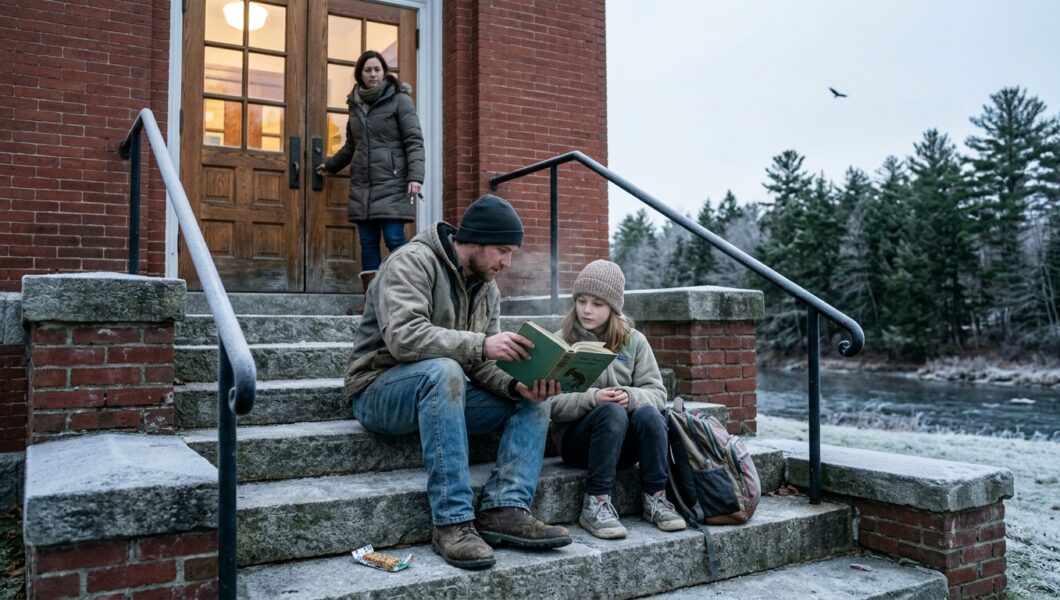
For almost two years after Arthur died, the boy near the radiator came to the library every weekday.
Then one Monday in February, he didn’t.
Tuesday either.
By Friday, Susan noticed.
So did I.
I still walked Murphy past the library most mornings.
Murphy was older by then.
Gray around the muzzle.
Moving slower.
But still convinced every tree in town required daily inspection.
I’d gotten to know Susan well enough that sometimes we’d stop inside.
Especially when it was cold.
The boy was usually there.
Backpack on the floor.
Coat unzipped.
Book open.
Granola-bar wrapper nearby.
I’d watched him change.
At first, he’d pretended to read.
Exactly like Arthur had nearly seventy years earlier.
Then he started reading for real.
Adventure books first.
Survival stories.
Anything involving forests.
Then birds.
That part made Susan smile.
Eventually he found Arthur’s old green copy of Birds of the Eastern Woodlands.
The one Margaret Collins had given Arthur before he left for college.
The cover was faded.
Binding repaired twice.
Pencil star beside the bald eagle illustration.
Arthur’s instructions remained tucked inside:
Please don’t put this behind glass.
Books are supposed to be touched.
Give it to a kid who needs somewhere to go.
The boy checked it out repeatedly.
Then suddenly he was gone.
Susan couldn’t tell me much.
Privacy.
She only said:
“Family situation changed.”
I asked whether he was safe.
“As far as I know.”
That had to be enough.
Weeks passed.
His chair near the radiator stayed empty.
Then another child started sitting there.
A girl this time.
Maybe nine.
Purple coat.
She liked graphic novels.
The cupboard continued emptying.
And filling.
Children came.
Children left.
That was the nature of the place.
Arthur’s story had taught me something I’d apparently still been forgetting.
Safe places aren’t valuable because everyone stays.
They’re valuable because they’re there when someone needs them.
Still, Susan worried about the boy.
One afternoon, she checked the computer.
The green bird book had never been returned.
Three months overdue.
Then six.
“Arthur would’ve liked that,” I said.
Susan looked at me.
“He specifically said books are supposed to be touched.”
“He did not say stolen.”
“Maybe it’s migrating.”
She rolled her eyes.
But she didn’t send a bill.
She marked it lost.
And life moved on.
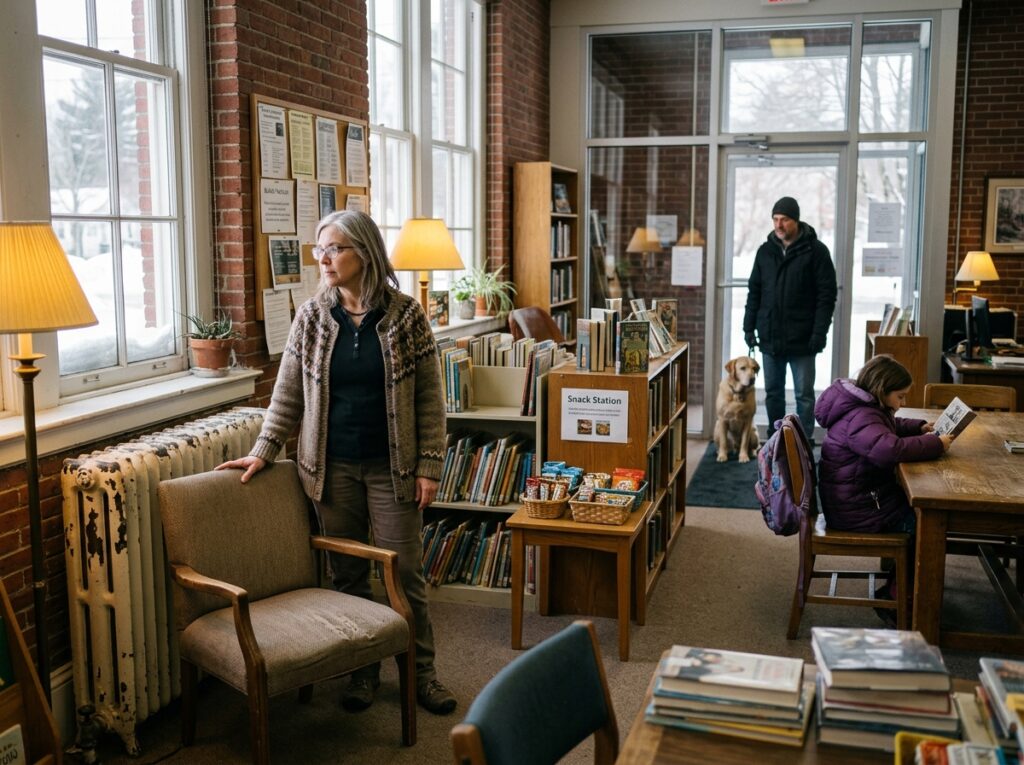
Seven years passed.
Murphy died.
That part has nothing to do with the library.
But it feels wrong not to mention him.
He was thirteen.
Good dog.
Mostly.
I still walked in the mornings after that.
Turns out the dog had been only part of the reason.
The river was still there.
The library.
The frost.
Occasionally an eagle.
I just walked slower.
Susan retired.
The new librarian was named Maya Patel.
Thirty-four.
Energetic.
Had approximately nine hundred ideas.
Susan distrusted this initially.
Then Maya convinced the town to expand Saturday hours without removing the old reading chairs.
Susan approved.
The snack cupboard remained.
So did the Margaret and Helen Fund.
Arthur’s daughter quietly added money every year.
Other people began contributing too.
Nobody renamed anything.
Nobody put Arthur’s portrait on the wall.
That would’ve violated the spirit of the whole thing.
Then, one November morning, Maya called me.
“Daniel?”
“Yeah?”
“Do you know anything about an old green bird book?”
I stopped.
“What happened?”
“Somebody brought it back.”
I was at the library ten minutes later.
The book sat on the front desk.
Same faded cloth cover.
More tape.
More scratches.
One corner looked like it had been chewed.
Maya pointed.
“Mouse?”
“Child?”
“Either possible.”
Inside the cover was Margaret’s inscription to Arthur.
Still readable.
But something new had been added.
A folded envelope.
On the front:
FOR THE LIBRARY
Inside was a letter.
The boy had a name.
Ethan Cole.
He was eighteen now.
He’d finally decided we could know it.
He wrote:
I’m sorry I kept the book.
Then:
I didn’t steal it on purpose.
His family had been evicted.
Everything happened quickly.
His mother picked him up from school.
They went directly to a motel.
Then stayed with relatives outside Bangor.
Then another apartment.
Then another.
The library book remained in his backpack through all of it.
He’d intended to return it.
But months passed.
Then embarrassment took over.
The longer he kept it, the harder returning felt.
So he carried it.
Motel.
Cousin’s house.
Apartment.
Another school.
Another town.
He wrote:
It was stupid, but it felt like having one thing from a place where nobody was angry.
I read that sentence twice.
Maya did too.
Ethan wrote that sometimes, when his mother worked evenings, he’d read the bird book.
He learned species.
Habitats.
Migration routes.
Then started watching birds.
At fifteen, a science teacher noticed.
She helped him apply for a summer youth program at a wildlife refuge.
That led to another summer.
Then college applications.
Ethan had been accepted to the University of Maine.
Environmental science.
First person in his immediate family planning to attend college.
Sound familiar?
It did to me.
Painfully.
The letter continued:
I found out about Mr. Arthur after I left. Mrs. Collins gave him this book when he was a kid. I think I was supposed to return it years ago. I hope he wouldn’t be mad.
I laughed.
Maya asked why.
“Arthur would’ve been furious if you hadn’t read it.”
There was something else inside the envelope.
A check.
Two hundred dollars.
Ethan had saved it from his summer job.
Written in the memo line:
SNACK CUPBOARD.
Maya shook her head.
“He’s eighteen.”
“I know.”
“He needs this money.”
“Probably.”
“We can’t take it.”
I remembered Arthur.
Then Harold.
Then Eleanor.
Then every stubborn person I’d met who thought receiving and giving were somehow opposites.
“Maybe taking it matters.”
Maya looked at me.
“Why?”
“Because he gets to decide he’s somebody who can give now.”
She thought about that.
The library deposited the check.
Every dollar went into the cupboard.
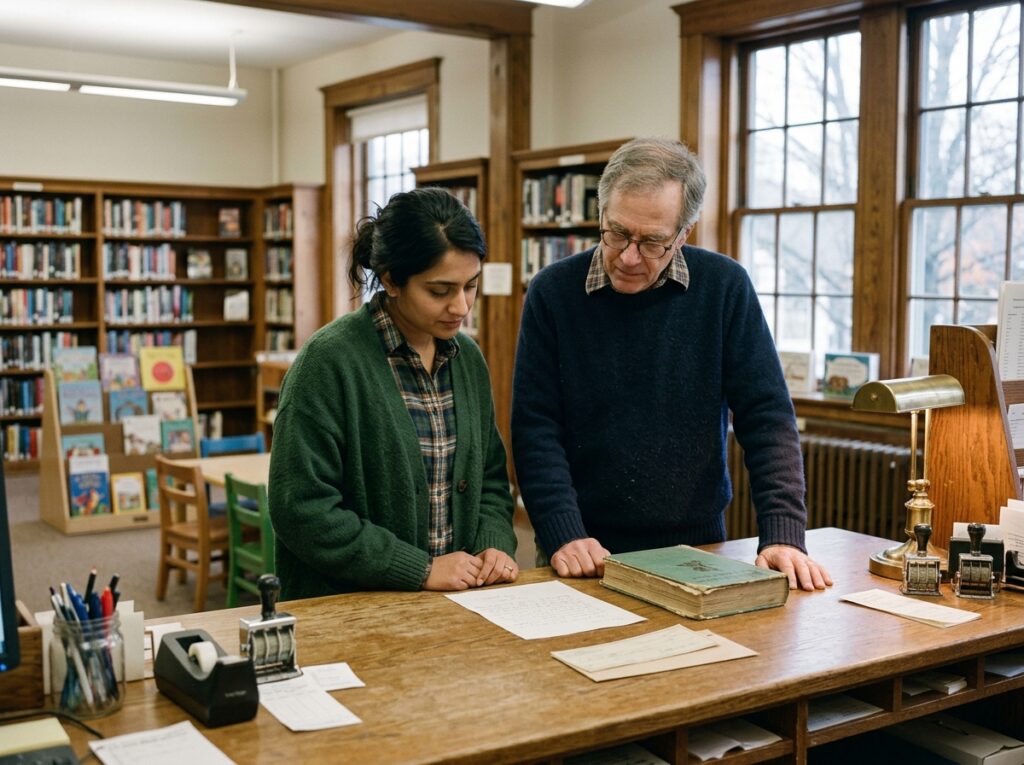
Ethan came back at Thanksgiving.
He didn’t announce himself.
I happened to be there because Maya had convinced me to help assemble a shelf.
This was a mistake.
I am not good at assembling shelves.
Arthur had been an engineer.
I am apparently a man capable of installing one bracket upside down three separate times.
A young man walked through the door.
Tall.
Thin.
Dark winter coat.
Backpack.
He stopped just inside.
Maya looked up.
Something in her face told me immediately.
“Ethan?”
He nodded.
Then he looked toward the radiator.
The chair was occupied.
A little boy sat there reading.
Ethan smiled.
“Good.”
That was his first word.
Good.
Maya hugged him.
I didn’t.
We hadn’t met.
I introduced myself.
He recognized my name from Arthur’s story.
“You were there that morning?”
“With my dog.”
“Murphy.”
That surprised me.
“You remember him?”
“He used to sit on my shoes.”
Accurate.
Ethan walked through the children’s section slowly.
Snack cupboard.
Radiator.
Margaret Collins Reading Corner.
Then he saw the bird book.
Back on the shelf.
“You put it back?”
“Where else?”
“I thought maybe it belonged in some archive.”
I nearly laughed.
“You never met Arthur.”
“What?”
“He specifically threatened us from beyond the grave about display cases.”
Ethan smiled.
Then he opened the book.
He found the bald eagle page.
Beside the original tiny pencil star was another mark.
A child’s handwriting:
SAW ONE 1/8
Maya looked horrified.
“Somebody wrote in the book.”
Ethan touched the note.
“Don’t erase it.”
She didn’t.
We sat near the radiator.
Ethan told us more.
His mother was doing better.
Not perfect.
Better.
Stable apartment.
Steady work.
He was living on campus.
Financial aid covered most of school.
He worked part-time.
He still watched birds.
Then he said something that bothered him.
“I’ve been telling people the library saved me.”
Maya asked:
“Why does that bother you?”
“Because it sounds fake.”
He looked around.
“A building doesn’t save somebody.”
I remembered Arthur saying Charlie—or rather in another story, another helper—hadn’t changed a life, only made space to survive.
Maybe people who receive kindness understand nuance better than people telling stories about it.
Ethan continued.
“The library didn’t fix my family.”
“No,” Maya said.
“It didn’t stop us getting evicted.”
“No.”
“It didn’t make my mom’s life easier.”
“No.”
“But…”
He looked toward the radiator.
“When everything was loud, this place was quiet.”
That was it.
Not rescue.
Refuge.
There’s a difference.
The library hadn’t pulled Ethan out of poverty.
It had given him somewhere warm to sit.
Food without interrogation.
Books without conditions.
Adults who noticed without demanding explanations.
And sometimes, that is enough to change what a child believes is possible.
Ethan began volunteering during college breaks.
Not constantly.
Maya wouldn’t let him turn gratitude into an obligation.
“You don’t owe us labor because you ate granola bars here.”
He laughed.
So he came when he wanted.
He helped children with reading.
Mostly science books.
Birds, obviously.
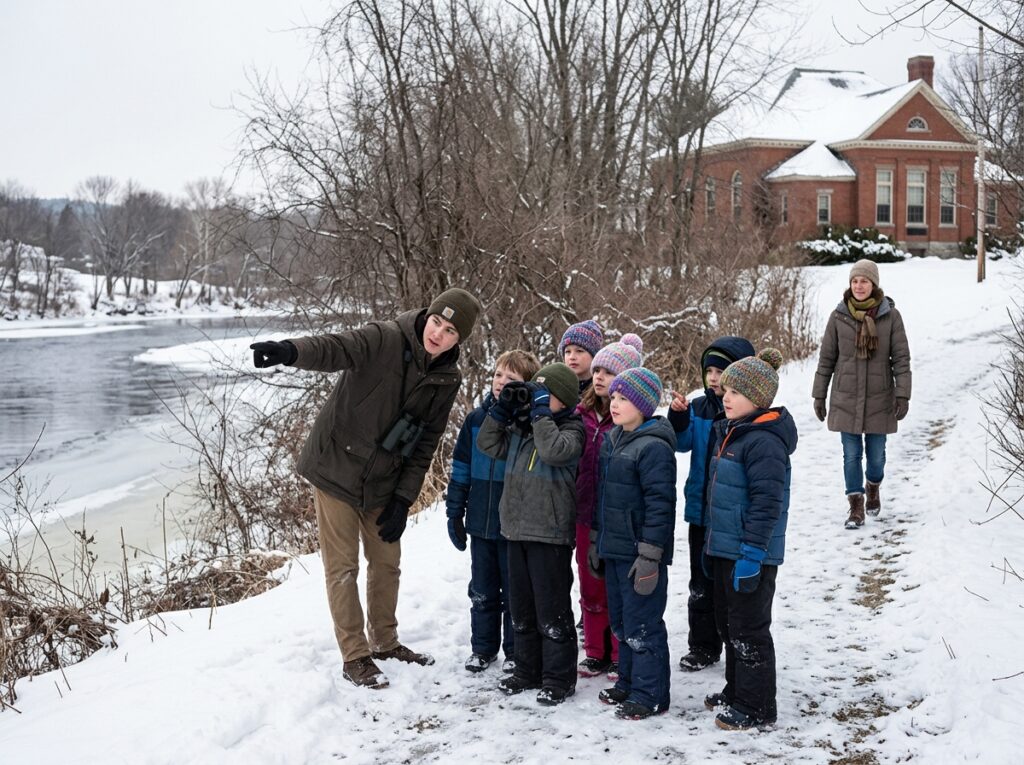
The first winter, he led a small bird walk along the river.
Eight children signed up.
Twelve came.
They saw chickadees.
Crows.
A red-tailed hawk.
No eagle.
One child complained.
Ethan said:
“Birds don’t read schedules.”
Arthur would’ve approved.
Four years later, Ethan graduated.
Environmental science.
Arthur’s daughter attended.
She’d never met him.
Afterward, she gave him something.
Arthur’s old binoculars.
He refused.
Of course.
Apparently generosity creates stubborn people.
She said:
“My father wanted things used.”
Ethan looked at them.
Old.
Scratched.
One eyepiece repaired with black tape.
He accepted.
Then she told him something none of us knew.
Arthur had written about the boy near the radiator.
Not by name.
He hadn’t known it.
But in the last notebook he kept, he’d written:
Boy at library today. Pretending to read. Took two granola bars. Hope nobody asks him why.
A few weeks later:
Boy reading now. Really reading. Bird book. Margaret would’ve noticed him.
And finally:
Maybe that’s all any of us are doing. Noticing the next one.
Ethan cried when he heard that.
So did Arthur’s daughter.
I behaved with enormous dignity by staring at a nearby tree for several minutes.
Ethan eventually took a job with a conservation organization in Maine.
Not because Arthur had been an engineer.
Not because Margaret had loved birds.
Not because anybody planned this tidy little circle.
Life isn’t that organized.
He simply liked the work.
But he stayed connected to the library.
Every November, a box arrives.
Children’s nature books.
Bird guides.
Outdoor activity books.
No donor name.
Maya knows.
She doesn’t argue anymore.
The snack cupboard grew too.
A local grocery store contributes.
People donate gloves in winter.
Hygiene supplies.
School supplies.
But Maya protects the original idea fiercely.
No sign that says:
FOR CHILDREN IN NEED.
The cupboard simply says:
HELP YOURSELF.
That’s all.
A child doesn’t have to identify as hungry.
They don’t need permission.
They don’t need to explain why they’re taking two.
One afternoon, I asked Maya whether kids ever take too much.
“Probably.”
“Does that bother you?”
“No.”
“Why?”
She shrugged.
“If a kid thinks they need six granola bars badly enough to put them in a backpack, I’m not interested in conducting an investigation.”
Margaret would’ve liked her.
Susan does.
She visits every Thursday and complains about whatever Maya has rearranged.
Some traditions are stronger than death.
Others are stronger than retirement.
Last November, I met Ethan at the library.
He was twenty-seven.
Married.
No children yet.
He had driven down because Maya asked him to speak to a group of middle-school students about local birds.
At 7:17 the next morning, we walked toward the river.
Same time I’d first found Arthur.
Frost covered the grass.
The library was still closed.
Ethan carried Arthur’s binoculars.
I asked:
“Do you remember sitting here?”
“Every day.”
“Did you know people noticed?”
He thought.
“Some.”
“Did that bother you?”
“Depends how they noticed.”
I asked what he meant.
He stopped walking.
“When you’re a kid who’s struggling, adults look at you in different ways.”
He adjusted the binocular strap.
“Some look at you like a problem.”
We kept walking.
“Some look at you like a sad story.”
Then:
“Margaret never met me. Arthur barely did. Susan knew more than she ever said.”
He looked back toward the library.
“They built a place where somebody could notice you without making you explain yourself.”
That’s the sentence I’ve carried.
Notice without demanding explanation.
There’s a kind of dignity in that.
At 7:24, Ethan stopped.
“Wait.”
He raised the binoculars.
Across the river, high in a bare pine, sat a bald eagle.
Far away.
Exactly where a wild eagle should be.
He handed me the binoculars.
I looked.
White head.
Dark body.
Morning light catching the edge of one wing.
“Arthur?” I joked.
Ethan laughed.
“He’d probably haunt you for saying that.”
We watched.
Eventually the eagle lifted from the branch.
Crossed the river.
Disappeared behind the trees.
Ethan lowered the binoculars.
“Still looking up.”
I smiled.
“Trying.”
When we returned, someone was sitting on the library steps.
A girl.
Maybe twelve.
Backpack.
Thin sweatshirt under a jacket that wasn’t warm enough.
The doors wouldn’t open for another hour.
Ethan noticed her immediately.
Of course he did.
“You waiting for the library?”
She nodded.
“Opens at ten.”
“I know.”
It was 8:51.
Cold enough that her breath hung in front of her.
Ethan looked at me.
Then at the building.
Maya wasn’t there yet.
He didn’t ask the girl why she was early.
Didn’t ask about home.
Didn’t ask whether she had breakfast.
He simply sat on the step a few feet away.
Then reached into his backpack.
Granola bar.
He held it out.
“Bought two by mistake.”
The girl looked at him.
I almost laughed.
Seventy years.
And apparently adults were still terrible liars.
She took it.
“Thanks.”
Ethan nodded.
Then pulled out the green bird book.
He’d checked it out the night before.
“Want to see something?”
He opened to the eagle page.
The pencil star was still there.
So was:
SAW ONE 1/8
Another child had added:
ME TOO 2/14
Ethan pointed toward the river.
“Sometimes they’re out there.”
The girl looked.
“Where?”
“Have to pay attention.”
For the next forty minutes, they sat on those steps.
Mostly quiet.
At ten, Maya arrived.
She looked at the girl.
Then Ethan.
Then the granola wrapper.
She understood.
She unlocked the door early.
The girl went inside.
No questions.
That’s when it hit me.
Margaret had been dead almost forty years.
Arthur was gone.
Helen was gone.
Susan had retired.
The boy near the radiator had grown into a man.
The old green book was barely holding together.
Yet somehow the same thing was still happening.
A cold child.
A warm building.
Food offered as though it were nothing.
A book.
An adult who noticed.
No interrogation.
No debt.
No demand that the child become extraordinary to justify the kindness.
Maybe that’s what Arthur meant.
Being noticed.
Not rescued.
Not selected.
Not turned into someone’s inspiring story.
Just noticed.
We tend to think legacy means leaving something with our name attached.
A building.
A scholarship.
A plaque.
Arthur refused all of that.
Margaret probably would’ve too.
And yet there they were.
On the library steps.
In Ethan’s backpack.
In the cupboard.
In the decision to unlock the door early.
Their names weren’t what survived best.
Their habits did.
Keep the room warm.
Keep food where a child can reach it.
Keep books available.
Don’t ask somebody to explain their pain before offering comfort.
And when you notice a kid lingering because somewhere else feels harder than here—
make room.
That’s all Margaret did in 1955.
She let a twelve-year-old boy stand on newspaper until his wet boots stopped dripping.
She gave him half a sandwich.
She opened a book.
She stayed until closing.
Arthur carried that kindness for nearly seventy years.
Ethan carried the book for seven.
And that November morning, another child walked through the same door.
I don’t know where her story goes.
That’s not mine to know.
Maybe she’ll remember the library forever.
Maybe she won’t.
Maybe the granola bar was just breakfast.
Maybe the bird book will mean nothing.
Kindness doesn’t need a guaranteed return to be worthwhile.
Sometimes you simply keep the light on because someone is outside.
And sometimes, if you’re lucky, years later you get to stand across the street and watch somebody who once needed that light hold the door open for the next person.
No Comments