

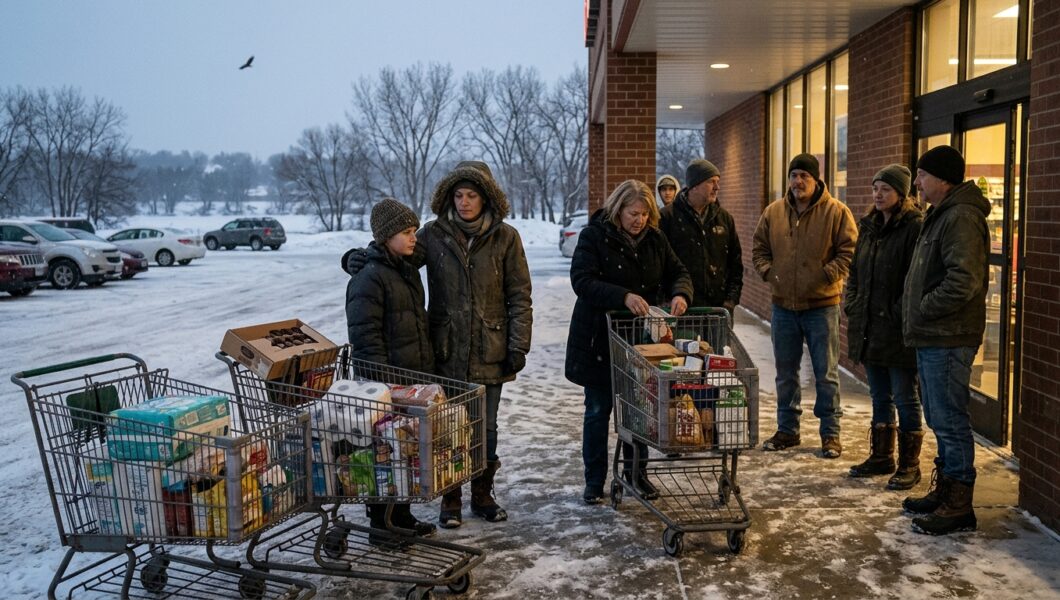
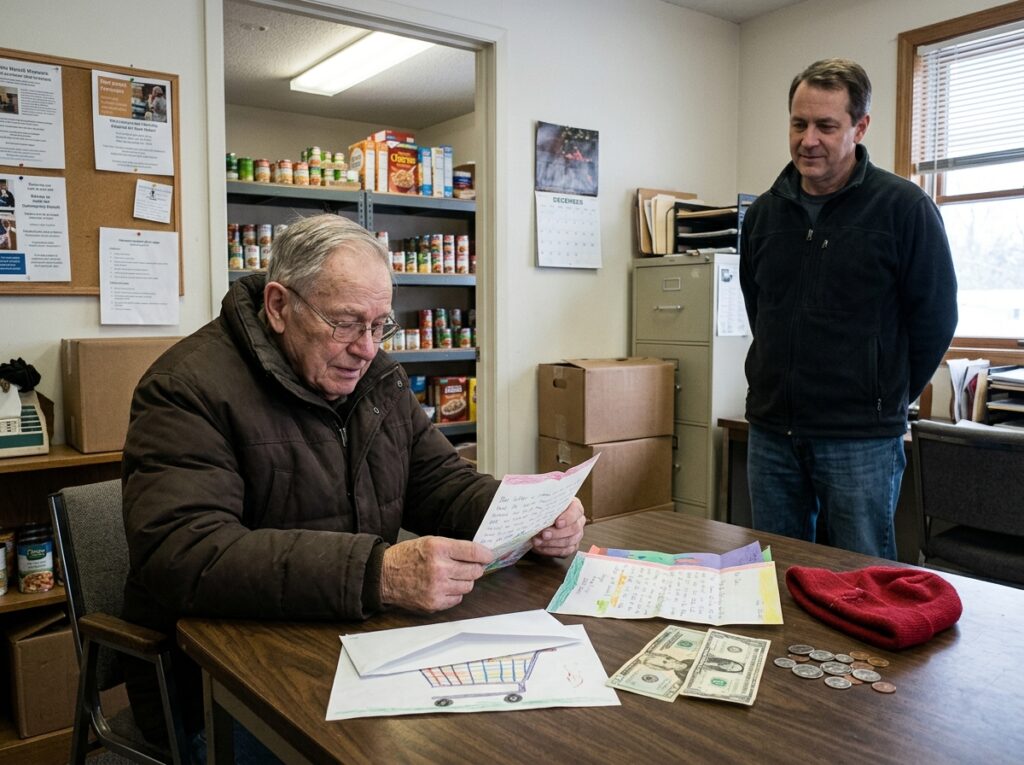
Three days after someone anonymously left $41.82 at the food shelf, another envelope arrived.
This one had Harold Peterson’s name on it.
No return address.
No stamp.
Someone had pushed it through the food shelf’s mail slot overnight.
The volunteer called me first.
By then, Harold was eighty-two.
His hearing wasn’t great.
His knees were worse.
And according to his daughter Rebecca, he had recently developed the dangerous belief that owning a cane and actually using a cane were two unrelated concepts.
I drove him over.
He complained the entire way.
“I can drive.”
“Rebecca took your keys.”
“She stole my keys.”
“She temporarily relocated them.”
“That’s stealing with extra words.”
When we arrived, the volunteer handed him the envelope.
Harold opened it.
Inside was a folded sheet of lined paper.
He read the first sentence.
Then stopped.
“What?”
He didn’t answer.
He read it again.
His hands started trembling.
Finally, he passed the letter to me.
It began:
Mr. Peterson,
My mother was the woman you helped at checkout lane four.
I looked at Harold.
The woman from the previous Christmas.
Work uniform.
Two children.
Removing chicken.
Cereal.
Diapers.
The little girl who had asked whether Harold was Santa.
Her name, we learned, was Natalie.
The letter was from her oldest daughter.
Sophie.
She was eight now.
Obviously, an eight-year-old hadn’t written the whole letter alone.
At the bottom, Natalie explained that Sophie had dictated most of it while she helped with spelling.
But the words were hers.
My mom said we have enough groceries this Christmas.
She said last year somebody helped us when we didn’t.
I remembered you said when we could buy groceries without counting we should help somebody else.
Then:
I saved $11.82 from my birthday and my mom put in $30.
That makes $41.82.
Harold sat down.
Nobody spoke.
Then he laughed once.
Softly.
“That’s where it came from.”
The anonymous envelope.
Not from some mysterious person connected to the food shelf decades earlier.
Not from Carol.
Not from the stranger in the green jacket.
From an eight-year-old girl who had watched her mother cry beside a grocery register the previous Christmas.
Harold read the letter again.
At the bottom, Sophie had drawn a grocery cart.
It had four wheels of completely different sizes.
Inside she’d drawn what appeared to be bread, milk, apples and an enormous chocolate bar.
Rebecca would’ve approved.
I thought Harold would be happy.
He was.
But something else bothered him.
“She shouldn’t have used her birthday money.”
I laughed.
“You’ve spent fifty years telling people to keep it moving.”
“She’s eight.”
“So?”
“She should buy something stupid.”
“What did you buy when you were eight?”
“Probably something stupid.”
“Exactly.”
He folded the letter carefully.
Then:
“I want to give it back.”
“No.”
“Why?”
“Because then you’re telling her gift doesn’t count.”
That stopped him.
For someone who had spent decades teaching people how to receive without shame, Harold still occasionally struggled when receiving something himself.
Especially from a child.
We compromised.
The $41.82 stayed.
Harold bought Sophie something with his own money.
Not a present exactly.
A purple piggy bank.
Rebecca picked it.
On the bottom, Harold wrote:
KEEP SOME. GIVE SOME. ENJOY SOME.
Natalie called after it arrived.
“You didn’t have to do that.”
Harold said:
“I know.”
Apparently that sentence had become contagious.
We learned more about Natalie.
She was thirty-two.
Single mother.
Two children.
Sophie, eight.
Eli, five.
She worked in the laundry department of a nursing home.
The previous year had been brutal.
Her hours had been cut.
Her car needed repairs.
Then Eli had gotten sick.
Nothing catastrophic.
Just enough missed work and extra expenses to push a tight budget over the edge.
By December, she was doing exactly what Carol had done fifty years earlier.
Calculating groceries.
But that next year was different.
Natalie had moved into a slightly cheaper apartment.
Her work hours stabilized.
She picked up occasional weekend shifts.
There still wasn’t much extra.
But there was enough that groceries stopped being terrifying.
Not easy.
Just possible.
One night Sophie asked:
“Are we rich now?”
Natalie laughed.
“No.”
“Then why aren’t you putting food back?”
Kids notice.
Natalie explained that they were doing better.
Sophie thought about it.
Then reminded her about Harold.
That’s how $41.82 ended up in the food shelf’s mail slot.
Harold invited them to breakfast.
Natalie almost said no.
She worried he was going to thank Sophie publicly.
Or make a big deal out of it.
He promised he wouldn’t.
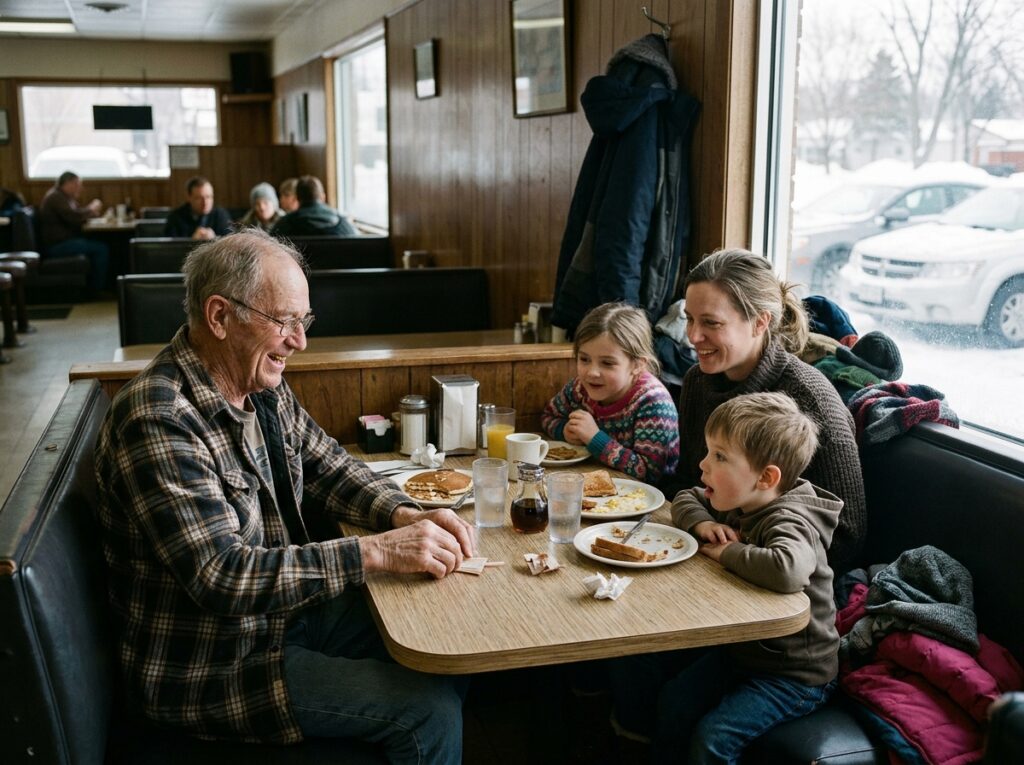
Breakfast lasted two hours.
Sophie ordered pancakes.
Eli spilled orange juice.
Harold taught them how to make straw wrappers stick to the ceiling.
Natalie objected.
Harold claimed it was educational.
At one point Sophie asked:
“Who gave you the first forty-one dollars?”
Harold explained.
A stranger.
Green jacket.
Gray hair.
Heavy boots.
No name.
Sophie frowned.
“So you never found him?”
“No.”
“That’s sad.”
Harold shook his head.
“No.”
“Why?”
“Because I found what he wanted me to do.”
She thought about that.
That’s a difficult concept even for adults.
We spend so much time trying to trace kindness backward.
Who started it?
Who deserves credit?
Who should be thanked?
Sometimes the better question is where it goes next.
That December, Sophie joined the extra cart.
This created problems.
She had opinions.
Strong ones.
Harold picked up canned green beans.
Sophie removed them.
“People don’t like those.”
“People eat vegetables.”
“Not those vegetables.”
“Put them back.”
She replaced them with macaroni and cheese.
Then came chocolate.
Rebecca arrived fifteen minutes later.
She and Sophie became immediate allies.
Harold realized he had lost control of his own tradition.
“Two generations of nonsense.”
Rebecca pointed at him.
“Essentials.”
Sophie nodded seriously.
“Essential.”
Chocolate went into the cart.
The extra cart had changed over the years.
Harold noticed that.
In 1976, the stranger had bought what Carol couldn’t afford.
Food.
By the 1990s, Carol added toiletries.
Their children added diapers.
Grandchildren added pet food because families shouldn’t have to choose between feeding themselves and feeding an animal they loved.
Now Sophie added children’s snacks.
“Kids need good stuff too.”
She was right.
Need isn’t only survival.
Dignity sometimes looks like a cookie in a lunchbox.
That’s something Harold hadn’t understood when he was young.
Poverty reduces life to necessities.
Rent.
Heat.
Food.
Gas.
But people still have birthdays.
Children still want treats.
Parents still want to make Christmas feel like Christmas.
A box of cookies doesn’t fix financial hardship.
It may still matter.
The cart was nearly full when Sophie suddenly stopped.
A woman two aisles away was looking at prices.
Not dramatically.
Just carefully.
She picked up a jar of pasta sauce.
Checked the price.
Returned it.
Picked up another.
Checked.
Sophie whispered:
“Is she counting?”
Harold looked.
“Maybe.”
“Should we help?”
Harold shook his head.
“Don’t assume.”
That was another lesson.
Not everybody comparing prices needs rescuing.
Not everybody with worn clothes is poor.
Not everybody struggling wants a stranger intervening.
Kindness without respect can become intrusion.
So they kept shopping.
At checkout, however, the same woman ended up ahead of them.
Her card declined.
She tried again.
Declined.
She apologized.
Started removing items.
Harold looked at Sophie.
Sophie looked at Natalie.
Natalie quietly asked the woman:
“Would you be comfortable if we covered the rest?”
Not:
We’ll pay.
Not:
You need help.
Would you be comfortable?
The woman hesitated.
Then nodded.
“Thank you.”
That was it.
No speech.
Sophie watched.
Outside, she asked Harold:
“Why didn’t you say the counting thing?”
“What counting thing?”
“What you told Mom.”
Harold smiled.
“Because she didn’t ask.”
That might be one of the most important things he ever taught her.
Not every act of kindness needs your wisdom attached.
Sometimes pay.
Smile.
Leave.
Let the person keep their privacy.
That winter passed.
Then another.
Harold slowed down.
At eighty-three, he finally stopped pushing the extra cart himself.
He walked beside it.
At eighty-four, he used one of the store’s mobility scooters.
He hated it.
Sophie loved it.
“Can I drive?”
“No.”
“Why?”
“Because I’d like to survive Christmas.”
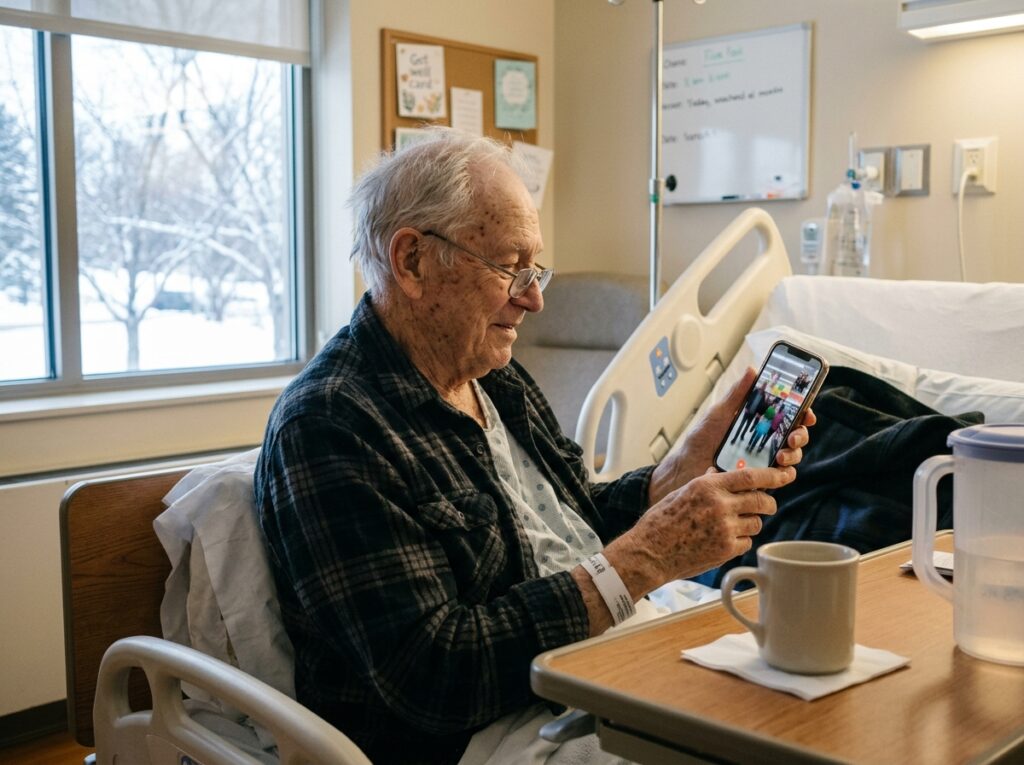
At eighty-five, Harold missed December 21 for the first time in more than fifty years.
Pneumonia.
Hospital.
Nothing immediately life-threatening.
But enough to keep him in bed.
He was furious.
I visited him that morning.
He looked at the clock.
7:09.
“Doors are opening.”
“You need to rest.”
“People still need groceries while I’m resting.”
I pointed toward the window.
“Harold.”
“What?”
“You trained an army.”
That was true.
At the grocery store were Amy.
Jason.
Rebecca.
Grandchildren.
Natalie.
Sophie.
Eli.
My daughter.
Me, eventually.
And several people from the food shelf.
Harold wasn’t needed.
That bothered him.
Then, slowly, I saw something else appear on his face.
Relief.
Maybe even pride.
“Rebecca remembered the chocolate?”
“She bought enough to medically concern me.”
“Good.”
We video-called him from the parking lot.
He complained about our cart arrangement.
Said we’d bought the wrong coffee.
Accused Jason of choosing terrible potatoes.
Then Sophie appeared on screen.
She was eleven now.
“Mr. Peterson?”
“Yeah?”
“We’ve got it.”
Three words.
We’ve got it.
Harold went quiet.
“Okay.”
Then:
“Don’t buy canned green beans.”
Sophie grinned.
“I know.”
Harold recovered.
But something changed after that Christmas.
He stopped thinking of the extra cart as his and Carol’s.
That was hard.
Traditions can become possessions without us realizing it.
We say:
My thing.
Our thing.
The way we’ve always done it.
Then eventually the healthiest thing we can do is let someone else carry it differently.
The following December, Harold came to the store.
But he didn’t make the list.
Sophie did.
Harold objected to approximately forty percent of it.
Nobody cared.
At checkout, he stood near the window.
Outside, the river was frozen.
At 7:31, Rebecca pointed.
A bald eagle crossed above the cottonwoods.
Harold took off his red cap.
Same as the morning I first met him.
He watched.
“Morning, Carol.”
Sophie stood beside him.
She knew the story now.
All of it.
She didn’t say the eagle was Carol.
Didn’t need to.
She simply slipped her hand into Harold’s.
They watched the bird disappear.
Harold died the following September.
Eighty-six.
His children were with him.
The last few months had been difficult.
His heart was failing.
He knew.
He’d made peace with most of it.
Except leaving Rebecca in charge of his garage.
“She throws things away.”
Rebecca promised she would throw away everything that looked dangerous.
Harold called this “an attack on history.”
After he died, the family found something in his desk.
An envelope.
On the front:
EXTRA CART
Inside was $41.82.
And a note.
Don’t make this bigger than it is.
Buy groceries.
Pay attention.
Don’t embarrass anybody.
Put chocolate in the cart so Rebecca will stop complaining.
Then:
Keep it moving.
No funeral instruction about the eagle.
No request for a plaque.
No foundation bearing his name.
No demand that the tradition continue forever.
Just groceries.
At his funeral, Sophie put something beside his photograph.
The purple piggy bank.
She was twelve.
On the bottom, Harold’s faded handwriting remained:
KEEP SOME. GIVE SOME. ENJOY SOME.
She didn’t leave it there.
She took it home.
That would’ve pleased him.
The next December 21, I wasn’t sure whether anyone would go to the store.
Harold was gone.
Carol had been gone years.
Traditions sometimes end.
That’s okay too.
Then at 6:58 that morning, my phone buzzed.
A message from Sophie.
You’re late.
I laughed.
When I arrived, there were four carts waiting outside.
Rebecca.
Natalie.
Sophie.
My daughter.
Others arrived behind them.
Nobody had organized it formally.
No matching shirts.
No charity logo.
No photographer.
Just people.
At 7:09, the doors opened.
Sophie pushed the first cart.
We bought food.
Some went to the food shelf.
Some went to a family whose heating bill had swallowed most of their grocery money.
One grocery-store gift card was quietly given to a woman caring for her husband after surgery.
No recipient photographs.
No forced stories.
No gratitude required.
Before we left, Sophie bought one final thing.
A box of chocolate.
“Essential?”
I asked.
She rolled her eyes.
“Obviously.”
Outside, snow had started falling.
We loaded the vehicles.
Then Rebecca looked toward the river.
An eagle sat high in a bare cottonwood.
Nobody had noticed it arrive.
We stood there for maybe thirty seconds.
Then it lifted.
Crossed above the frozen river.
And disappeared.
Sophie looked at me.
“Are you going to say it’s Harold?”
“No.”
“Good.”
She smiled.
“He’d hate that.”
Probably.
Harold understood something by the end that I think takes many of us a lifetime to learn.
Kindness isn’t supposed to make us indispensable.
If the good thing collapses the moment we’re gone, maybe we held it too tightly.
The stranger in the green jacket didn’t stay in Carol’s life.
He disappeared.
Carol eventually died.
Harold carried the extra cart.
Then Harold died.
Other hands reached for it.
That’s the point.
You don’t have to live long enough to see where every kindness goes.
You don’t have to know whether the person you helped paid it forward.
They don’t owe you that ending.
Give because the need is in front of you.
Then release the story.
Maybe it stops there.
Maybe it travels fifty years.
Maybe an eight-year-old girl saves $11.82 from her birthday because she remembers what it felt like when her mother didn’t have enough.
You may never know.
That’s okay.
This December, Sophie will be thirteen.
She already has a list.
Apparently canned green beans remain banned.
Chocolate remains mandatory.
And somewhere in Minnesota, someone will stand at a grocery register watching numbers rise.
Maybe they’ll have enough.
Maybe they won’t.
If they don’t, I hope somebody nearby is paying attention.
Not so they can become the hero of somebody else’s worst afternoon.
Just so they can quietly put the milk back.
Or the chicken.
Or the diapers.
And if the person asks:
“How can I pay you back?”
Maybe the answer is still the same one a nameless man gave Carol Peterson half a century ago.
Don’t.
Get steady first.
Live your life.
Take care of your family.
And someday, if you find yourself standing in a grocery store with enough money to stop counting every dollar, look around.
Someone else may still be counting.
That’s when you’ll know what to do.
Forty-one dollars and eighty-two cents started it.
But money was never really what kept it moving.
People did.

No Comments