

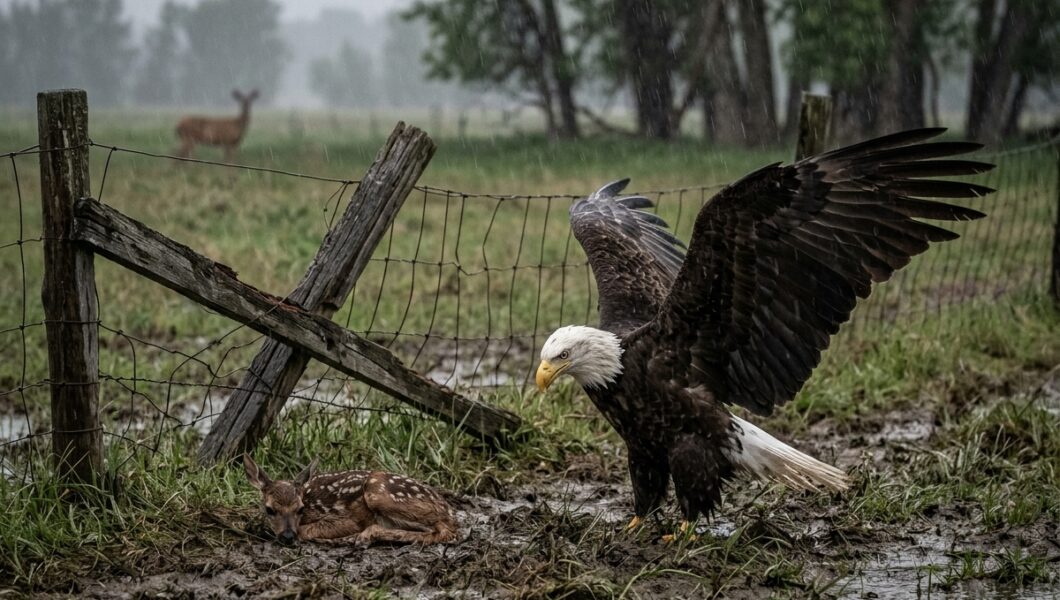
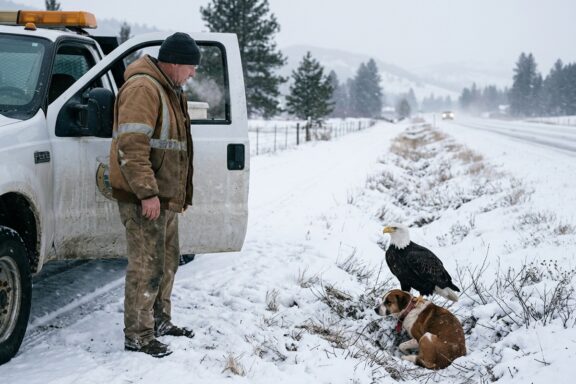
The rain had not stopped when Daniel Brooks opened the security camera feed again. The rescue truck carrying the injured fawn had already disappeared down the muddy ranch road, leaving deep tire tracks behind it. The adult bald eagle remained on the fence rail, its dark feathers slick with rain, while the doe stood at the far edge of the pasture, watching the place where her young one had been trapped. Daniel had spent nearly thirty years on that Montana property, and he knew enough about wildlife to understand that what he was seeing might have a simple explanation. Still, something about the doe’s behavior made him keep watching. She did not approach the fence immediately. She stood beneath the cottonwoods, lifted her head toward the pasture, and then took several slow steps forward. The eagle turned slightly in her direction. For a few seconds, neither animal moved. Then the doe lowered her head toward the muddy ground where the fawn had been lying.
Daniel leaned closer to the monitor. He could see the broken fence post, the twisted wire the rescuers had cut, and the flattened grass left behind by the stretcher. The doe moved around the area cautiously, stopping every few feet as if she were checking the ground. Daniel knew that deer could be difficult to observe during bad weather. They often sheltered near trees, and a frightened doe might keep her distance from a place where people had gathered. He could not know what she was thinking, but he wondered whether she had been searching for the fawn since the storm began. He picked up his phone and called Sarah, the wildlife responder who had arranged the rescue. He explained what the camera was showing and asked whether the team had any information about the fawn’s condition. Sarah told him that the animal was being transported for veterinary assessment. They had freed its leg, but the swelling and difficulty standing meant that its recovery could not yet be predicted. Daniel thanked her and returned to the monitor.
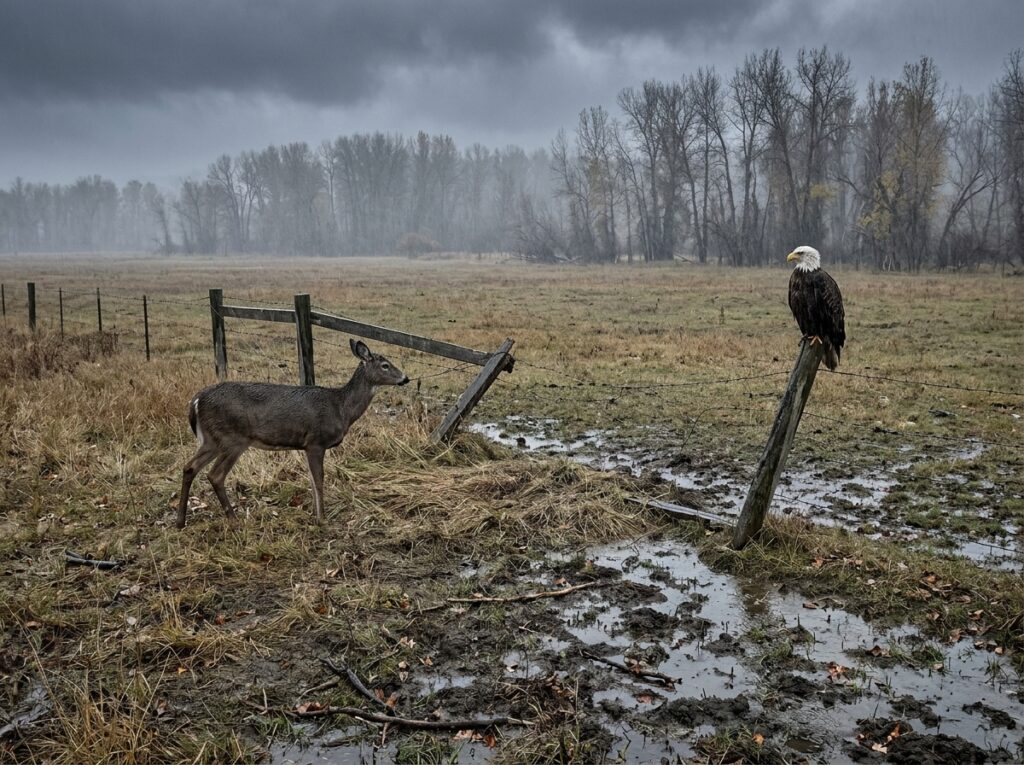
The doe remained near the fence for several minutes. Then she lifted her head and looked toward the farmhouse. Daniel stepped away from the monitor and walked to the kitchen window, hoping he might see the animals directly. The pasture was partly hidden by the rain, but he could make out the eagle on the fence and the doe near the cottonwoods. He put on his rain jacket again and stepped onto the porch. He did not approach the animals. He had already called the professionals, and he understood that his presence might make the deer retreat farther into the trees. Instead, he stood beneath the porch roof and watched from a distance. The doe moved slowly along the fence line, pausing whenever the eagle shifted its position. Eventually, the eagle opened its wings and flew to a nearby cottonwood. The doe watched it leave, then continued toward the far end of the pasture. Daniel followed her progress with his eyes until the trees obscured her.
For the next hour, he checked the camera every few minutes. The eagle returned to the pasture twice, landing first on the fence and later on a low branch. The doe appeared once more near the tree line, but she did not come back to the muddy patch. Daniel began to wonder whether the animals had simply been using the same stretch of land for different reasons. The eagle might have been hunting, resting, or responding to movement in the grass. The doe might have been searching the area where she had last seen her fawn. There was no reliable way to establish a connection between them from the footage alone. Daniel knew that stories about wildlife could become exaggerated when people tried to explain every unusual encounter as an act of protection or friendship. He did not want to turn uncertainty into a claim he could not support. What he knew was enough: the fawn had been trapped, the eagle had remained nearby, and the doe had appeared after the rescue team removed the wire.
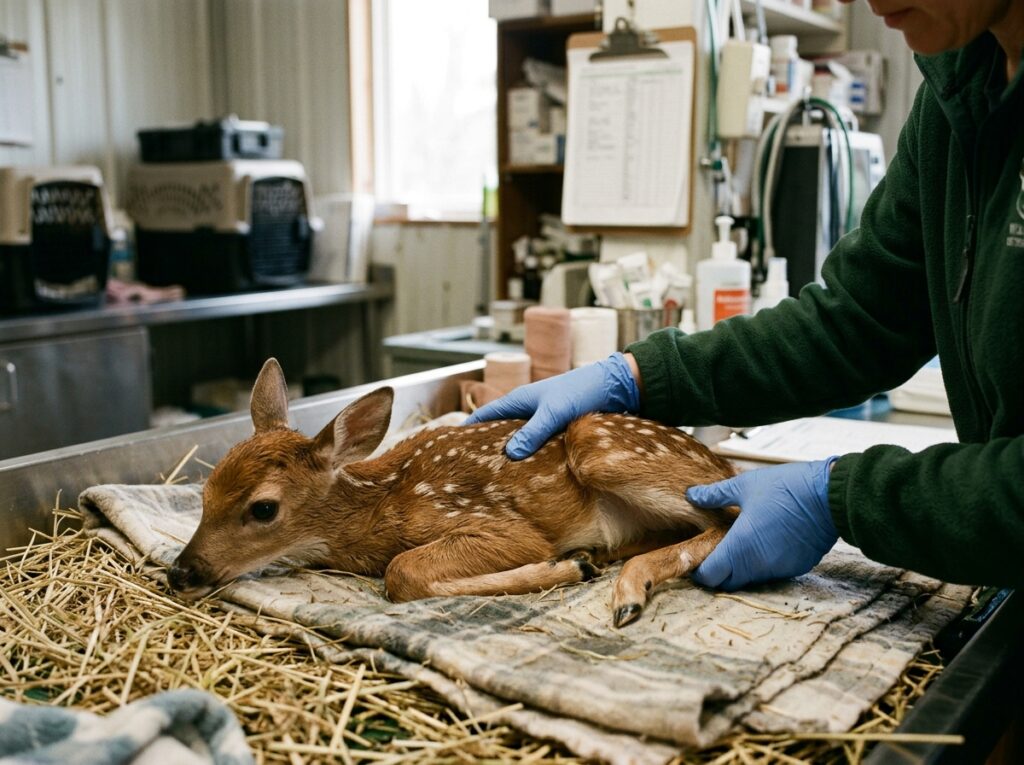
Late that afternoon, Sarah called with the first veterinary update. The fawn had received an examination, and the team was assessing the damage to its rear leg. It was weak from the ordeal and needed continued care, but it had survived the journey. Daniel listened carefully, asking whether there was anything he could do. Sarah explained that the wildlife facility would keep him informed as the examination progressed. The fawn needed rest, treatment, and time before anyone could determine whether it could return to the wild. Daniel thanked her and sat quietly at the kitchen table after the call ended. Outside, the rain continued to fall, although the wind had begun to ease. He thought about the doe standing in the trees, the eagle on the fence, and the tiny fawn being cared for somewhere beyond his property. He hoped the young deer would recover, but he knew hope was not the same as certainty.
The following morning brought a break in the weather. Daniel walked to the pasture after breakfast and inspected the damaged fence. He replaced the broken post, gathered the loose wire, and checked the surrounding ground for other hazards. He found several deep hoof marks in the mud near the cottonwoods and a few patches of flattened grass, but nothing that could tell him exactly how the fawn had become trapped. While he worked, he kept glancing toward the trees. The eagle did not appear, and the doe remained out of sight. He finished repairing the fence and returned to the house. There was work to do, as always, but the previous day’s encounter had stayed with him.
Over the next several days, Sarah provided occasional updates. The fawn was receiving care while the team evaluated its leg and monitored its progress. Daniel learned that wildlife rehabilitation could take time and that even a young animal that appeared alert might need careful observation before being considered ready for release. He resisted the temptation to ask for a quick answer. He knew that the people caring for the fawn had to make decisions based on its condition, not on what he hoped would happen. In the meantime, he continued checking the ranch cameras. Most of the footage showed ordinary activity: deer moving through the grass, birds crossing the pasture, and rainwater draining away from the fence. The eagle appeared on occasion, but never again in quite the same place as that first morning.
One evening, Daniel received a call from Sarah. The fawn had made progress, although the team still needed to decide when it would be appropriate to return it to the wild. She explained that they were looking for stable movement and a good overall condition before considering release. Daniel asked whether the doe had been seen near the pasture again. Sarah reminded him that they could not be certain the doe in the camera footage was the fawn’s mother. It was a reasonable possibility, but the images did not establish that relationship. Daniel appreciated her honesty. He had wondered the same thing, and he would have liked a definite answer, but the animals did not owe him one.
That night, he watched the footage one final time before going to bed. He saw the adult eagle standing on the fence, the doe emerging from the cottonwoods, and the muddy patch where the fawn had struggled. The scene looked ordinary in one sense. It was a ranch pasture during a storm, with wild animals moving through their environment. Yet it had caused Daniel to stop, call for help, and pay closer attention to the lives unfolding around him. He thought about how easily he could have missed the fawn if he had looked at the camera only briefly. He thought about the damaged wire that had turned a familiar fence into a hazard. Most of all, he thought about how much remained unknown, even after the rescue.
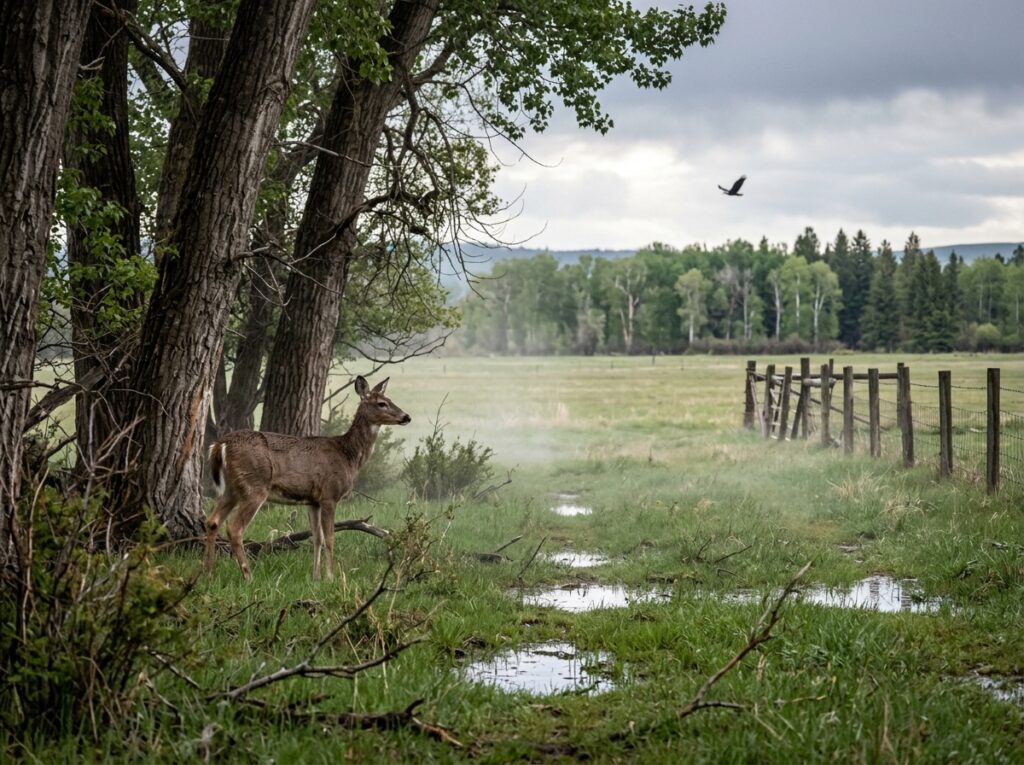
Several days later, Sarah called again. The fawn’s condition had improved enough for the team to begin discussing the next stage of its care. She did not promise a release date, but she said the staff were encouraged by its progress. Daniel thanked her and went outside to check the pasture. The ground had begun to dry, and the muddy tracks were fading. The repaired fence stood firm. He walked toward the cottonwoods and paused near the place where the fawn had been found. He could still picture the tiny deer lying in the rain, unable to free its leg. He could still see the eagle standing nearby, its wings partly spread against the weather. But the pasture was empty now, and the quiet felt different.
Daniel never learned exactly why the eagle had remained near the fawn. He never learned whether the doe in the footage was its mother or another deer moving through the property. He could not know what the animals understood about one another, and he did not pretend otherwise. What he did know was that the camera had shown him something worth investigating. That was enough to bring trained responders to the ranch and give the fawn a chance to recover. Sometimes a meaningful event does not come with a complete explanation. Sometimes the best thing a person can do is pay attention, ask for help, and allow the people with the right knowledge to do their work.
The rain eventually stopped. The pasture returned to its usual rhythm, and Daniel went back to his daily routine. Yet whenever he checked the security cameras, he looked a little more carefully at the edges of the field and the places where the grass grew high. He knew that wild animals crossed his land for reasons he would never fully understand. He also knew that a broken fence, a storm, or a few minutes of bad luck could leave an animal in danger without making any obvious sound. He could not prevent every accident, but he could repair hazards, keep an eye on the land, and respond when something seemed wrong.
Perhaps the most important part of the story was not whether the eagle had been protecting the fawn. Perhaps it was not even the doe’s appearance in the footage. It was the moment Daniel noticed that something was not right and chose to look closer. The fawn received professional care because he did not dismiss what he saw. The wildlife responders had a chance to help because someone made the call. And an ordinary rainy morning became a reminder that paying attention can matter, even when we cannot explain everything we witness.
Daniel still thinks about that morning at 6:42. The rain on the camera lens. The eagle standing in the pasture. The small fawn lying beside the broken fence. The doe appearing between the cottonwood trees after the rescue truck had left. He does not claim the animals were communicating or that he knows what the eagle intended. He simply remembers what happened and what it prompted him to do.
Sometimes kindness begins with a question we cannot answer. Why is that animal still there? Why does something look different today? Is there a reason to stop and check? We may never discover the full story, but we can still take the next responsible step. We can keep a safe distance, contact trained wildlife professionals, and give a vulnerable creature the opportunity to receive help.
That rainy Thursday, Daniel could not change the weather, explain the eagle’s behavior, or know what the doe was thinking. He could only make the call and wait while the rescuers worked. But that was enough to begin a rescue.
And sometimes, when a life is caught in the wrong place at the wrong time, beginning is what matters most.
No Comments