

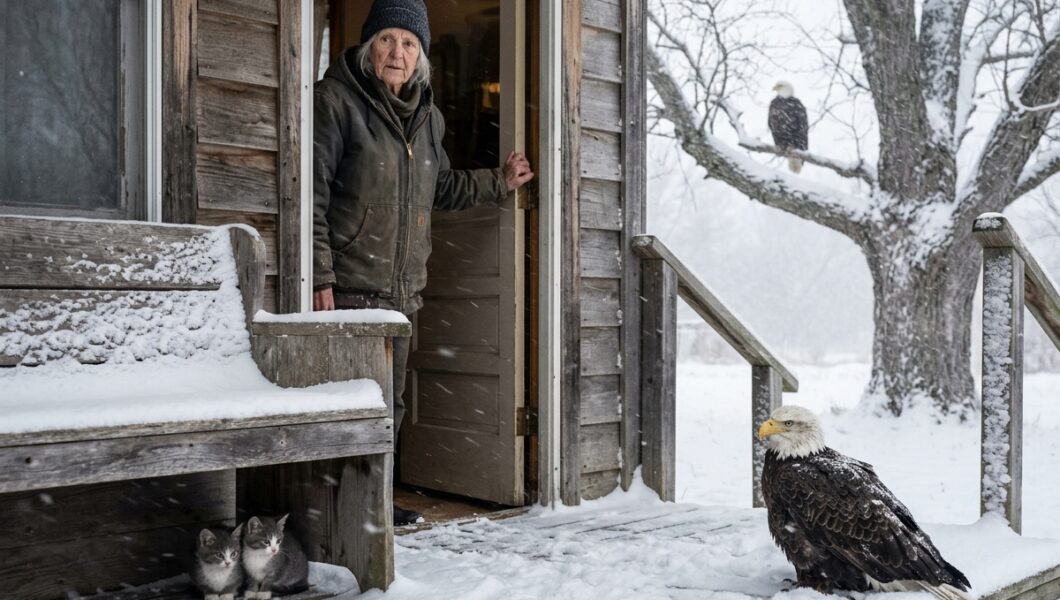
Margaret Wilson had lived through eleven Montana winters without her husband, Robert, but the blizzard that morning made the farmhouse feel lonelier than ever.
She stood behind the front window, watching the wildlife rescue truck disappear into the curtain of falling snow. Somewhere inside that vehicle, the injured bald eagle was being taken toward medical care. Margaret hoped the bird would survive, but her attention kept returning to the old wooden storage bench beside the porch.
Something was moving beneath it.
She could hear the faint sound again, a tiny, uneven cry that seemed almost swallowed by the wind.
Margaret remembered the tracks she had noticed earlier. They were much smaller than the eagle’s footprints, and they led toward the dark gap beneath the boards. Whatever had made them had apparently found shelter there before dawn.
She wanted to investigate, but the rescuer’s warning remained clear in her mind. Wild animals could be frightened and unpredictable, especially when injured or trapped.
So she stayed inside and called the wildlife center.
The responder listened carefully as Margaret described the sound. He asked her not to reach beneath the bench or attempt to pull anything out. If an animal was trapped, moving the boards without knowing what was underneath could make the situation worse.
He explained that the rescue team would try to return as soon as road conditions allowed. In the meantime, Margaret was asked to keep her distance and watch from a safe place.
She agreed, although waiting was difficult.
For several minutes, nothing happened. Snow drifted against the steps, and the old maple trees bent under the wind. Then the sound came again.
This time, Margaret heard two distinct cries.
She moved closer to the window.
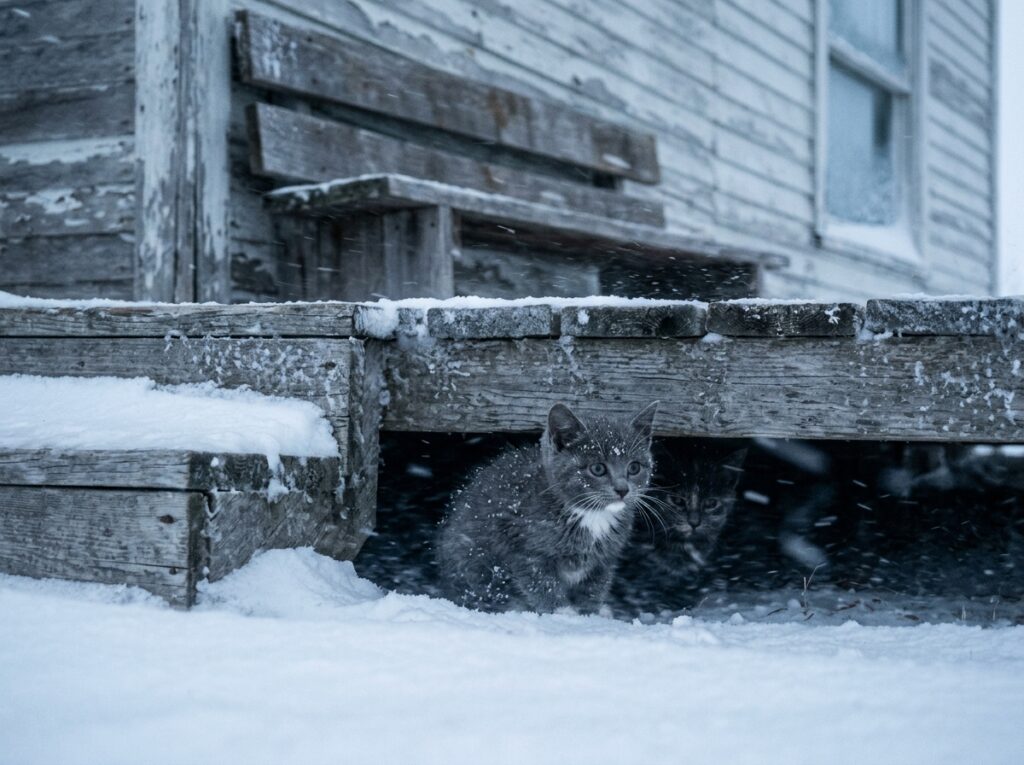
A small shape appeared in the narrow opening beneath the bench. It was difficult to see through the blowing snow, but she caught a glimpse of pale fur and two frightened eyes.
It was a young domestic kitten.
Its coat was mostly gray, with a white patch beneath its chin. Snow clung to its whiskers, and its little body trembled as it tried to move farther into the shelter. One front paw appeared to be held awkwardly off the ground, although Margaret could not tell whether it was injured or simply cold.
Behind it, another tiny shape shifted in the darkness.
There were two kittens.
Margaret pressed a hand against the window.
She had no idea where they had come from. She lived well away from the nearest village, and the closest occupied farmhouse was more than a mile down the road. She had not seen a cat around her property in months.
Yet here were two little animals huddled beneath her porch during a dangerous winter storm.
Margaret’s first instinct was to open the door and bring them inside.
She could place them in a basket, wrap them in a towel, and set them beside the kitchen stove. It was what she would have done for almost any small animal in distress.
But Robert’s old advice returned to her.
Being kind didn’t mean rushing in.
Margaret took a breath and reminded herself that she did not know whether the kittens were injured, whether their mother was nearby, or whether moving them might put them at greater risk. She had already called the people trained to handle these situations. The best thing she could do was follow their guidance.
She called the center again and explained what she had seen.
The responder told her the kittens could be suffering from exposure, especially if they had spent hours in the freezing weather. He also explained that a qualified responder should assess them as soon as possible. Margaret was advised to keep pets and other disturbances away from the porch and avoid blocking the opening beneath the bench.
Then he asked her a question.
“Have you seen any other animals around the house this morning?”
Margaret immediately thought of the second bald eagle.
She described the bird perched in the old maple tree at 6:43, facing the farmhouse while snow collected along its back. She also explained that the injured eagle had seemed to look toward the storage bench before the rescue team arrived.
The responder listened but did not jump to conclusions. He reminded Margaret that the timing alone could not establish any connection between the eagles and the kittens. The birds might have been in the area for entirely different reasons.
Margaret understood. She could not know what had brought any of the animals to her property.
Still, the morning had become something she would never forget.
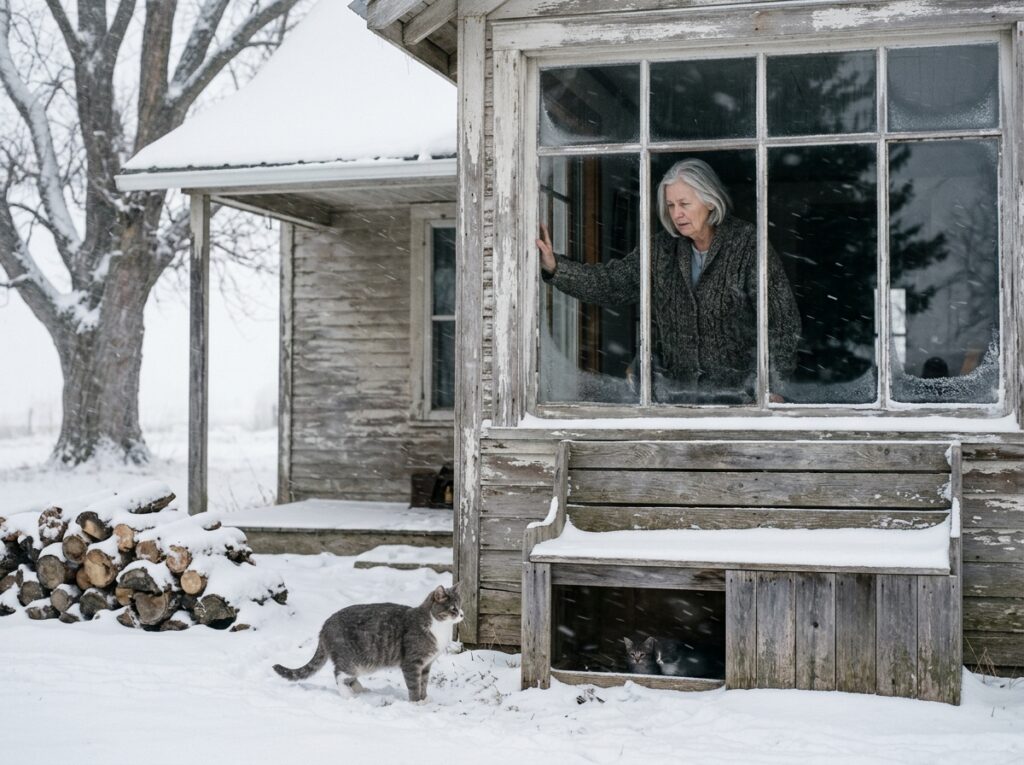
At 7:38, the wind briefly eased. Margaret looked outside and noticed movement near the woodpile beside the house.
A small animal stepped out from behind the stacked logs.
It was an adult gray cat.
The cat was thin, with damp fur and a white patch on its chest. It paused at the edge of the porch, looking toward the storage bench. Then it took several cautious steps forward before stopping again.
Margaret watched without opening the door.
The cat did not approach the window or make any obvious attempt to enter the house. It simply remained near the woodpile, partly sheltered from the wind.
Could it be the kittens’ mother?
It was possible, but Margaret had no way to be certain. The cat might have been their mother, another adult from the same litter’s surroundings, or an unrelated stray that had found shelter near the farmhouse.
Whatever the connection, the sight changed the way Margaret understood the tracks.
The kittens might not have been abandoned at all. They might have been sheltering close to an adult cat that was also struggling to survive the storm.
Margaret called the wildlife center again and described the new arrival. The responder told her not to try to catch the adult cat. Instead, she should remain indoors and let the trained team assess the situation when they arrived.
For the next twenty minutes, Margaret watched from her window.
The adult cat moved behind the woodpile and disappeared from view. One kitten poked its head out from beneath the bench, then retreated into the darkness. The other remained hidden.
Outside, the blizzard continued to cover the porch with fresh snow.
Margaret found herself thinking about all the animals that might be struggling beyond the windows of her farmhouse. The deer in the woods. The foxes along the creek. The birds that searched the frozen fields for food. Most winters, she had observed them from a distance and gone about her day.
Now, three different kinds of animals had appeared around her home within a single morning, and two tiny kittens were huddled in a space barely large enough to shelter them.
She could not rescue every animal in the world.
But she could make sure these two were not overlooked.
At 8:06, headlights appeared again at the end of the driveway.
This time, the vehicle was a smaller animal rescue truck. The driver had managed to reach Margaret’s property after taking a slower route around a section of road covered by drifting snow.
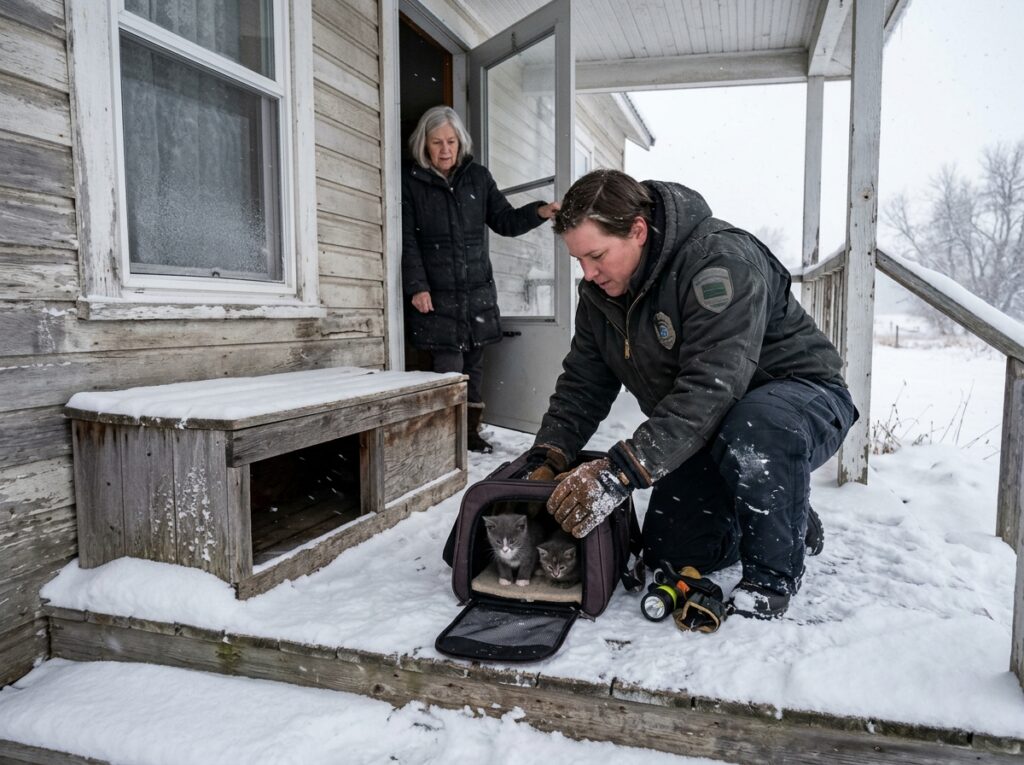
A trained responder stepped out carrying a secure animal carrier, thick gloves, a flashlight, and a small equipment bag. Margaret met the responder at the doorway but stayed back as instructed.
She pointed toward the storage bench and explained everything she had observed, including the two kittens, the adult cat near the woodpile, and the tracks disappearing beneath the porch.
The responder approached carefully and inspected the area without immediately reaching into the gap.
After a short assessment, the responder found a safe way to look beneath the bench. The two kittens were huddled close together in the sheltered space. Both were alive, but they were cold and frightened. The gray kitten with the white chin patch kept its front paw tucked beneath its body.
The responder gently secured the kittens and transferred them into a warm, protected carrier. Once they were out of the wind, their small bodies began to relax, although they still needed a proper examination.
The responder then checked the area around the woodpile and porch for signs of the adult cat. The cat was no longer visible.
Margaret asked whether the kittens would be all right.
The responder explained that it was too early to promise anything. The kittens needed to be warmed gradually and examined for injuries, dehydration, and other complications caused by exposure. Their condition would become clearer after a veterinary assessment.
Margaret nodded. It was not the certainty she had hoped for, but it was an honest answer.
Before leaving, the responder asked whether Margaret would be willing to contact the center if the adult cat returned. The team wanted to determine whether the cat might be connected to the kittens and whether it needed help as well.
Margaret agreed immediately.
Then she remembered the eagle.
She asked whether the wildlife center had learned anything about the injured bird.
The responder explained that the eagle had been taken for further assessment. Its wing injury required examination, and no one could yet say how serious the damage was or how long recovery might take. The second eagle had not been captured, and there was no confirmed evidence that it was the injured bird’s mate or had any connection to the situation beneath the porch.
Margaret appreciated the explanation.
She had seen something extraordinary that morning, but she did not need to invent answers for the parts she could not understand.
What mattered was that the injured eagle had received professional attention, and the two kittens had finally been brought out of the freezing space beneath the bench.
After the rescue truck departed, Margaret returned to the kitchen.
The house was warm, but she could still feel the cold morning in her bones. She put the kettle on and sat at the small table where she and Robert had shared breakfast for decades.
For eleven years, she had become accustomed to the silence. She had learned to repair small things around the farmhouse, manage the long winters, and find comfort in familiar routines. She still spoke to Robert sometimes, especially when something reminded her of him.
That morning, his words had followed her from the front door to the window and back again.
Being kind doesn’t mean rushing in.
Margaret had once thought of those words as a simple lesson about animals. Now she understood that they were about patience, too. She had wanted to act immediately, but the safest help came from knowing her limits, calling the right people, and allowing them to do their work.
At around nine o’clock, she looked out toward the old maple tree.
The second bald eagle was gone.
Fresh snow covered the branch where it had perched earlier. The storm had softened the tracks across the yard until they were almost impossible to distinguish from the surrounding snow.
Margaret never learned exactly why the injured eagle had ended up on her porch. She never discovered whether the second eagle was its mate, a relative, or simply another bird seeking shelter from the weather. And she could not know for certain how the kittens had arrived beneath the storage bench or whether the adult cat near the woodpile was their mother.
But she did learn what happened next.
Later that day, the rescue center contacted her with an update. The kittens had been assessed and were receiving the care they needed. The gray kitten’s paw required further examination, and the team would continue monitoring both animals as they warmed and recovered.
The center also explained that the eagle was under veterinary care. Its long-term outlook remained uncertain, but it had survived the journey through the storm and was being treated by people experienced with injured birds of prey.
Margaret listened to every word.
She did not ask whether the animals’ arrival had been a sign or whether the eagle had somehow led her to the kittens. There was no way to establish that. She was simply grateful that she had noticed the tracks, heard the faint cries, and made another call before turning away from the window.
In the days that followed, she kept an eye on the porch and woodpile from inside the house. She reported any new sightings to the rescue center and followed their advice about leaving the animals undisturbed.
The adult gray cat appeared once more near the edge of the property, but it disappeared before the team could safely assess it. The search for it continued, with the hope that it could eventually be identified and helped if necessary.
Margaret never claimed to know the full story of that stormy morning.
What she knew was enough.
An injured bald eagle had been found on her porch. Another eagle had appeared in the maple tree. Two tiny kittens had survived the cold beneath a wooden bench. And an adult cat had moved through the snow near the same spot.
Perhaps these events were connected in ways she would never discover. Perhaps they were separate lives briefly crossing paths during a harsh Montana winter.
Either way, each animal deserved care.
On the next clear morning, Margaret stood at the kitchen window with a cup of coffee and watched the sunlight touch the snow-covered fields. The farmhouse was quiet again, but it no longer felt quite as empty.
She thought of Robert and the advice he had left behind. Then she looked toward the porch, where the old storage bench sat beneath a fresh layer of snow.
Sometimes kindness began with an open hand.
Sometimes it began with a phone call.
And sometimes, Margaret realized, it began with the decision to stop, look more closely, and recognize that even the smallest cry for help deserved to be heard.
She could not control the storm or explain why those animals had come to her property. But she could choose what to do when she found them.
That morning, she had chosen not to look away.
And because she did, several frightened animals had a chance to receive the help they needed.
Sometimes the most extraordinary rescue begins with something so small that almost anyone else might miss it.
No Comments