

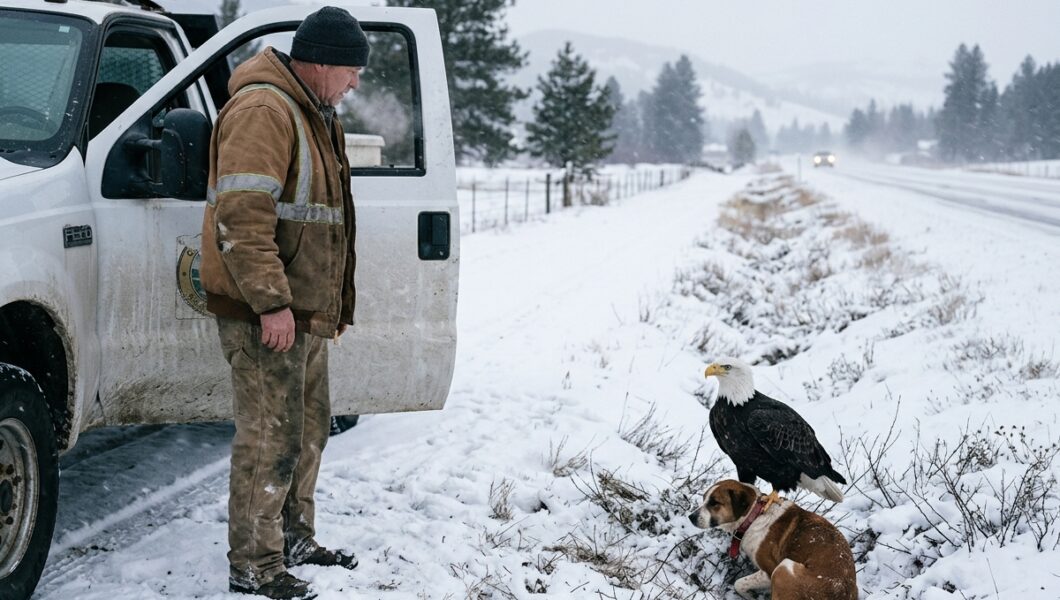
Some mornings change your life without warning. For Daniel Mercer, it began with a security camera, a freezing Montana highway, and two injured animals that everyone else seemed to pass without noticing. What happened next brought a missing dog home, gave an injured bald eagle another chance, and helped a grieving father find his way back to the daughter he thought he had lost.
Daniel thought the hardest part of that winter morning was over when the rescue vehicle disappeared down the highway. He had returned to his ordinary routine, finished his work, and gone home to the same quiet house where Rebecca had been missing from his life for two long years. But something had changed. For the first time in months, he had a reason to check his phone, someone to ask questions, and a story he wanted to tell. He could not have known that the injured dog and the wounded eagle would lead him toward a part of his own life he had almost stopped trying to repair.
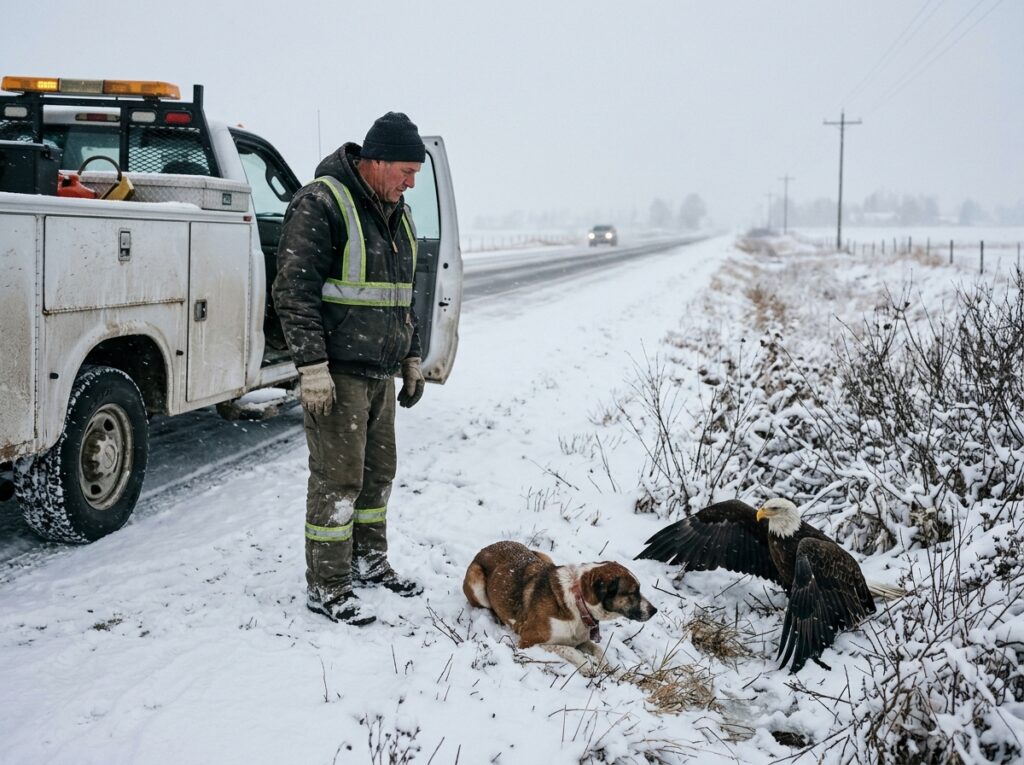
The first person to call Daniel after his Facebook post began spreading through the community was Sarah Collins, the wildlife rehabilitator who had helped rescue the animals. She had updates about both of them, but she also had questions. The dog’s microchip information had not led directly to its owner, and the eagle’s condition remained serious enough that nobody could promise a full recovery. Daniel listened carefully as she explained what the veterinary team and wildlife specialists were doing. He wanted both animals to survive, but he knew wanting something and making it happen were two very different things.
When Karen Miller finally identified the dog as Rusty, Daniel felt a kind of relief he had not expected. Karen had been searching since the storm on Tuesday night. Rusty was not simply a pet that had wandered away. He had been her late husband’s companion, a presence that had helped her endure the emptiness left behind after his death. When she learned that Rusty was alive, she cried before Daniel had even finished explaining where he had been found. Daniel recognized the sound of someone who had spent too long preparing for bad news and suddenly had a reason to hope again.
He went with Karen to the veterinary clinic that afternoon. He told himself he wanted to see how Rusty was doing, but he also understood that Karen should not have to face that moment alone. When the veterinarian brought her into the treatment room, Rusty was resting on a padded blanket, his injured hind leg stabilized and an intravenous line in his front leg. His condition was still serious, but he was responding to care.
Karen knelt beside him and whispered his name. Rusty’s ears moved, and he lifted his nose toward her hand. That small movement was enough to break her composure. She pressed her forehead against his fur and cried, while Daniel quietly turned toward the wall to give her a moment of privacy.
When Karen explained that Rusty had slept beside her husband during his illness, Daniel understood why finding him mattered so much. She had not merely been searching for a missing dog. She had been trying to hold on to a connection with someone she loved. Daniel knew what that kind of loss could do to a home. Since Rebecca died, he had spent too many evenings sitting in his recliner with the television on, allowing noise to fill the rooms where conversation used to be.
He did not offer Karen a speech about grief. He simply stayed.
Over the next two weeks, Rusty remained under veterinary care. His recovery was slow, and Karen visited every day. Daniel stopped by twice. On his second visit, he brought a small bag of groceries after learning that Karen had been spending so much time at the clinic that she had barely been eating.
She laughed when she saw the bag.
“You don’t even know me,” she told him.
Daniel shrugged. “I know you’ve got a dog who’s waiting for you.”
It was a simple answer, but it made her smile. In a season when both of them had experienced more loss than they knew how to explain, neither needed a grand gesture. They needed small reminders that someone else was paying attention.
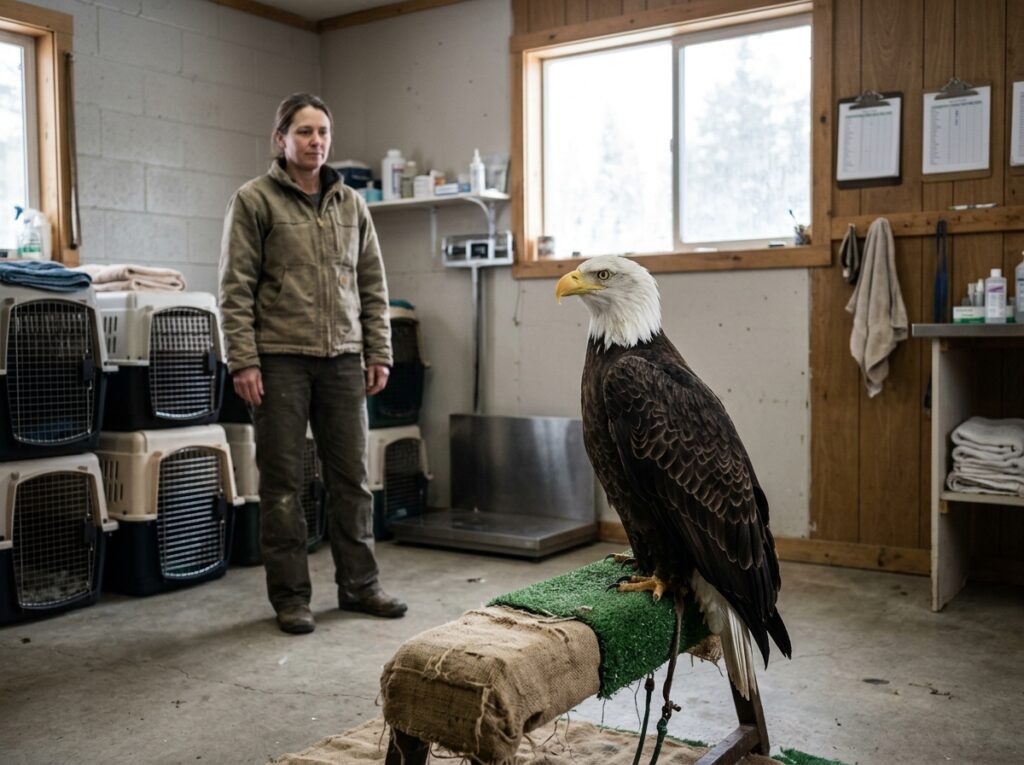
Meanwhile, the bald eagle was beginning its own difficult recovery. The wildlife rehabilitation team had identified it as an adult bald eagle with a significant injury to its left wing. It was receiving specialized care, and its future remained uncertain. Sarah sent Daniel occasional updates and photographs from the facility. One showed the eagle standing upright on a padded perch, its white head turned toward the camera. Another showed it eating while a rehabilitator watched from a safe distance.
Daniel printed the first photograph and placed it on his refrigerator. It was the first new picture he had displayed since Rebecca died.
He could not explain exactly why he did that. Perhaps it was because the bird reminded him of the morning he had chosen to stop instead of driving past. Perhaps it was because the photograph gave him something hopeful to look at when he walked into his kitchen. Whatever the reason, the eagle had become part of his everyday life, even though he had never touched it and might never see it again.
When Sarah invited Daniel to a community open house at the rehabilitation center, he nearly declined. He had become uncomfortable around groups of people. Conversations often felt like work, and he was tired of answering questions about how he was managing since Rebecca’s death. But Sarah mentioned that Karen and Rusty would be there, and he eventually agreed to go.
The center was a modest facility surrounded by pine trees. Families and children gathered in designated areas while staff members explained how injured wildlife was treated and why animals like bald eagles required specialized care. Daniel spotted Karen near a folding table. Rusty stood beside her in a harness, moving carefully on his recovering leg.
When the dog saw Daniel, his tail began wagging.
“Look at him!” Karen called. “He’s getting stronger every day.”
Daniel knelt and offered his hand. Rusty sniffed it, then leaned against his leg. Daniel smiled and scratched the dog gently behind the ears. For a few moments, he forgot about the cold morning, the injured wing, and the uncertainty that had followed the rescue. He was simply happy to see the dog standing again.
Sarah approached with another update about the eagle. Its recovery was progressing, but the team still needed to determine whether it would regain enough strength and flight ability to survive in the wild.
“We’re taking it one day at a time,” she said.
Daniel nodded. “That’s all you can do.”
Then Sarah asked him a question he had not expected.
“How are you doing, Daniel?”
He gave the answer he had given countless times before.
“I’m fine.”
But Sarah did not immediately move on. She waited, leaving him room to say something else if he wanted to.
Daniel looked around. Families were talking. Children were laughing. Volunteers were carrying supplies. Karen was showing someone a photograph of Rusty before his injury. For the first time in a long while, Daniel felt as though he was standing in the middle of life rather than watching it pass from the edges.
“Honestly?” he said. “I’m not sure.”
He told Sarah about Rebecca. He told her about the quiet house, the friends he had stopped calling, and the argument with Emily that had left both father and daughter waiting for the other to make the first move. He had convinced himself that he was giving Emily space. Somewhere along the way, that silence had become a habit, and the habit had started to feel permanent.
“She probably thinks I don’t want her around,” he admitted.
Sarah listened before asking a simple question.
“Do you want her around?”
Daniel looked at her.
“Of course I do.”
“Then maybe she needs to hear that.”
He stared at the floor. He had spent months trying to work out how to repair the relationship, as if there were a perfect set of words that could erase everything that had happened. Sarah reminded him that he did not have to fix everything in one day. He only had to start somewhere.
That evening, Daniel sat at his kitchen table with his phone in his hand. He opened Emily’s contact, typed a message, and deleted it. He tried again, then erased that one too. Finally, he stopped trying to make the words perfect and wrote what he actually felt.
He told Emily that he missed her and her family. He admitted that he had been waiting for her to call because he did not know what to say, and that he had made things harder by staying quiet. Then he asked whether she would come over for dinner the following Sunday.
He read the message twice and pressed send.
For several minutes, nothing happened. Daniel made coffee he did not really want and stood by the kitchen window. When his phone finally vibrated, he picked it up immediately.
Emily had replied.
“Dad, I’ve been waiting for you to ask.”
Daniel sat down and read the sentence again. Then he began to cry. One message could not erase months of hurt, and it did not suddenly make every difficult conversation easy. But it opened a door he had assumed was closed.
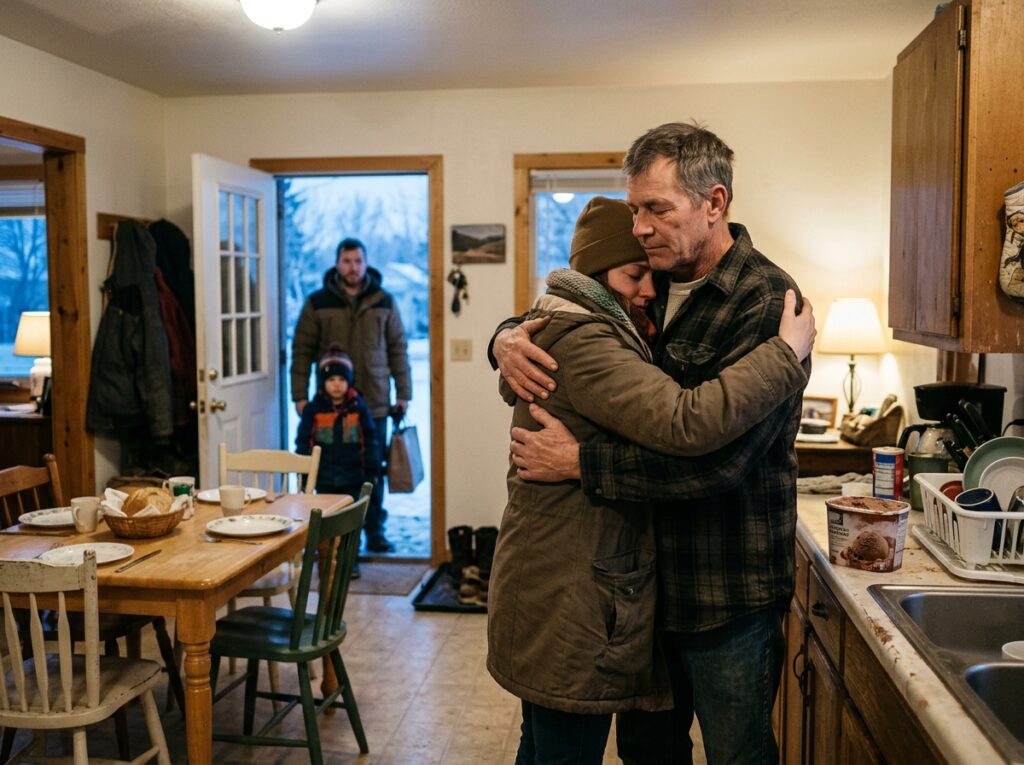
The following Sunday, Emily arrived with her husband and six-year-old son. Daniel had cooked too much food, cleaned the house twice, and bought the chocolate ice cream his grandson liked. When the doorbell rang, he stood still for a second before opening it.
“Hi, Dad,” Emily said.
He pulled her into a hug.
“I’m sorry,” he whispered.
She held him tightly.
“Me too.”
They talked for hours. Some conversations were easy, while others brought up feelings they still needed to work through. Nobody pretended that everything had been fixed. But when the evening ended, Emily promised to bring her son back the following weekend.
Daniel watched their car disappear down the road. The house became quiet again, but it no longer felt empty.
A month later, Sarah called with news about the eagle. Its rehabilitation had progressed enough for the team to begin evaluating whether it could return to the wild. The final decision would depend on its strength, flight ability, and overall condition. Daniel asked whether he could attend the release if the bird recovered sufficiently. Sarah said she would let him know.
In the meantime, Rusty continued to improve. Karen sent photographs of him walking around her property and sleeping beside the fireplace. One picture showed him resting his head on Daniel’s old work jacket, which Karen had washed and returned after the rescue. Daniel kept the jacket. It was not valuable, but it reminded him of the morning he had stopped beside the road and found two injured animals who needed help.
Months later, Sarah contacted him again. The eagle had recovered enough to be considered for release. Its examinations and flight assessments indicated that it could fly strongly and maneuver well enough to survive in the wild.
Daniel joined Sarah and a small group of wildlife professionals at the designated release site. The morning was bright, and the grass moved gently in the breeze. Nobody knew whether the eagle would return to that particular stretch of Montana highway. Nobody could promise what it would do next.
Sarah opened the transport carrier and stepped back.
For a moment, the eagle remained still.
Then it stepped forward, spread its wings, and lifted into the air. It rose above the grass, crossed the edge of the trees, and disappeared into the morning sky.
Daniel watched until he could no longer see it.
He thought about the security footage, the passing cars, the dog in the snow, and the eagle standing nearby. He would never know exactly why the bird had remained beside Rusty. He did not need to invent a dramatic explanation to make the moment meaningful.
What mattered was what happened after someone noticed.
Rusty had been reunited with Karen. The eagle had received specialized care and another chance to live in the wild. The community had supported the people caring for both animals. And Daniel, who had spent two years shutting himself away after losing Rebecca, had begun finding his way back to his daughter.
As they walked toward the parking area, Sarah asked whether he regretted stopping that morning.
Daniel smiled.
“Not for a second.”
He looked toward the open sky.
“I used to think helping someone meant you had to know what to do,” he said. “Now I think sometimes it just means you can’t keep driving.”
He returned home that day to a life that was not suddenly perfect, but was different in ways that mattered. He still missed Rebecca. He still had difficult feelings to work through with Emily. And he still had evenings when the house felt too quiet. But he was no longer waiting for someone else to make every first move.
He had learned that small actions could create openings where none seemed to exist. A phone call could begin repairing a relationship. A bag of groceries could remind a grieving person that she did not have to manage everything alone. A decision to stop beside a snowy road could change the lives of two animals and, unexpectedly, the life of the person who stopped.
Sometimes we imagine kindness requires money, special knowledge, or the ability to solve another person’s problems. Daniel had none of those things when he first saw the eagle and Rusty. He had a truck, a warm jacket, a phone, and the willingness to pay attention. He knew when to keep his distance and call professionals who could help.
He could not heal the eagle’s wing himself. He could not repair Rusty’s leg. He could not undo Karen’s loss or erase the distance between himself and Emily with a single conversation. But he could take the next small step.
And then another.
If you ever encounter an animal in danger, keep yourself safe and contact trained wildlife professionals or a veterinarian as appropriate. You do not need to handle an injured wild animal to make a difference. Sometimes helping means getting the right person there and giving them room to do their work.
The same principle applies in quieter moments of everyday life. A person who seems distant may be carrying a burden you cannot see. A family member may be waiting for a message that neither side knows how to begin. Someone who appears to be managing just fine may simply have become practiced at saying they are okay.
We cannot know every story around us. But we can choose not to ignore the moments when something asks for our attention.
Daniel stopped on a freezing Montana road. Two animals received another chance, a grieving woman found her dog, and a father took the first step toward reconnecting with his daughter. None of those outcomes was guaranteed when he parked his truck behind the guardrail. He only knew that he could not leave them there.
And sometimes, that is where kindness begins.
You do not have to save the whole world. Sometimes you just have to stop for one life, offer the help you can, and allow that small act to begin something bigger.
No Comments