

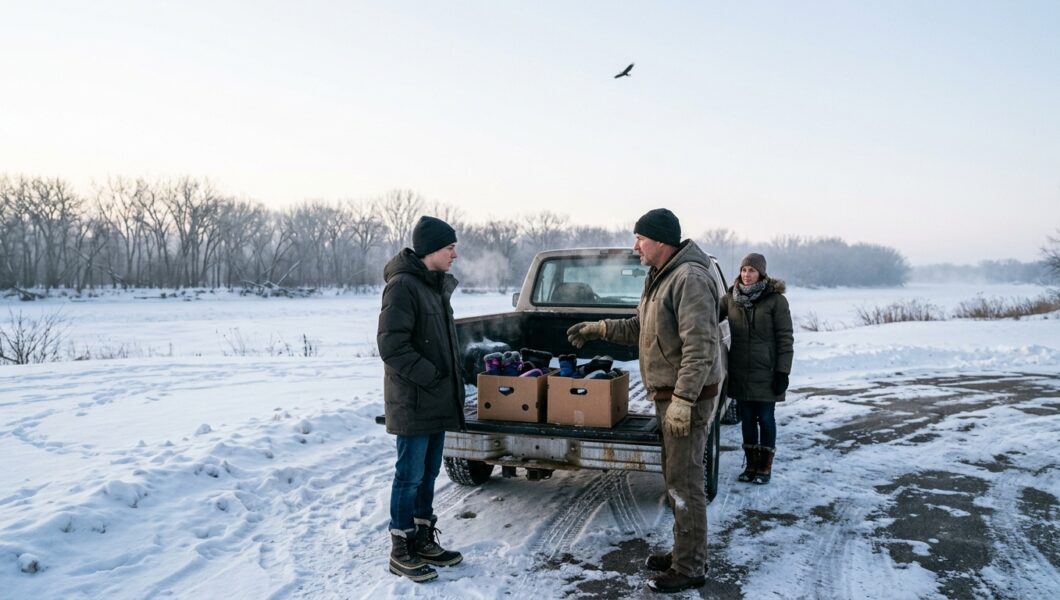
Two winters after Tommy Miller returned to Minnesota with twenty-four pairs of boots, an eleven-year-old boy stood outside the winter closet and refused to take a coat.
His name was Mason.
Fifth grade.
Skinny kid.
Dark hair that always needed cutting.
Quiet unless you asked him about hockey, in which case you had apparently made a serious commitment to the next forty minutes of your life.
I met him because Walt called me.
By then, Walt was eighty-three.
He no longer drove at night.
His knees had become unreliable.
He’d finally started using a cane, although he referred to it as:
“This stupid stick.”
But he still visited the elementary school.
Especially during winter.
One Tuesday afternoon, I drove him over.
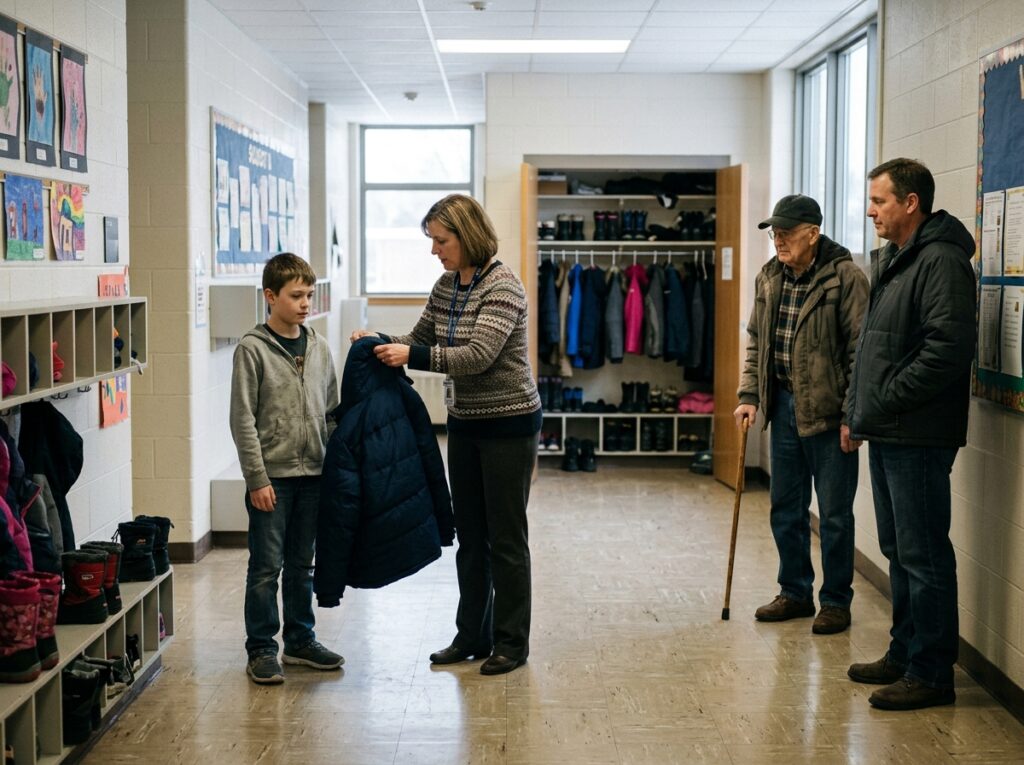
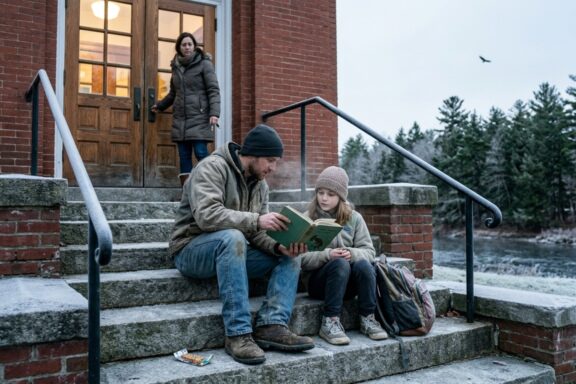
We were halfway through the entrance when we heard voices near the winter closet.
The school counselor was standing with Mason.
She held a navy winter coat.
Mason had his arms crossed.
“No.”
“Mason, it’s fifteen degrees outside.”
“I have a coat.”
He was wearing a sweatshirt.
A thin gray one.
The counselor remained calm.
“You had one yesterday.”
“It’s at home.”
“Okay. Take this one today.”
“No.”
“Why?”
The boy stared at the floor.
“Because it’s for poor kids.”
Walt stopped walking.
I felt him become completely still beside me.
The counselor answered carefully.
“It’s for any student who needs a coat.”
“I don’t need one.”
“Mason—”
“I’m not poor.”
He walked away.
The counselor didn’t chase him.
Walt watched until the boy disappeared around the corner.
Then he said:
“There’s the problem.”
“What?”
“We’ve got plenty of coats.”
He tapped his cane against the floor.
“But the kid thinks taking one means something about him.”
I looked toward the closet.
Above the door was still the photograph of Tommy’s old red boots.
TAKE WHAT YOU NEED. KEEP IT MOVING.
Apparently, that wasn’t enough.
In the truck afterward, Walt barely spoke.
That usually meant something was happening in his head.
Finally:
“I did the same thing to Tommy.”
“What?”
“Made him feel like he was receiving charity.”
“You bought him boots.”
“Exactly.”
“He needed them.”
“That’s not the point.”
Walt looked out the window.
“When you’re eight, needing something everybody else has can feel like the whole world is looking at you.”
He remembered Tommy refusing those red boots.
My mom can’t pay.
Then:
Then I can’t.
Walt had always told that part of the story as evidence of Tommy’s pride.
Now he saw something else.
Maybe Tommy had been protecting his family.
If he accepted the boots, perhaps it felt like admitting his mother hadn’t provided them.
Children can carry loyalty in strange ways.
Walt called Tommy that night.
Tommy was fifty now.
Still a social worker in Michigan.
Walt told him about Mason.
Tommy listened.
Then said:
“Don’t give him a coat.”
Walt frowned.
“He needs a coat.”
“I know.”
“Then what are you talking about?”
“Give him a job.”
That confused me when Walt repeated it.
It made perfect sense to him.
The next week, Walt returned to school.
He found Mason during lunch.
“Need help.”
Mason stared at him.
“With what?”
Walt pointed toward the winter closet.
“Disaster in there.”
It wasn’t.
The closet was extremely organized.
The school counselor had labeled everything.
Walt messed it up before Mason arrived.
I witnessed this crime.
He took gloves from one bin and dumped them into another.
Mixed several boot sizes.
Put scarves with hats.
“You’re making it worse.”
“That’s how problems work.”
Then Mason appeared.
Walt handed him a clipboard.
“We need somebody who understands numbers.”
Mason looked suspicious.
“Why me?”
“Principal says you’re good at math.”
He was.
Walt asked him to help count boots by size.
Then gloves.
Then coats.
Mason spent forty-five minutes reorganizing the closet Walt had deliberately sabotaged.
At the end, Walt said:
“Now I’ve got another problem.”
Mason sighed like a union employee being asked to work overtime.
“What?”
Walt held up the navy coat.
“This one’s taking up space.”
Mason looked at it.
“You should keep it.”
“Why?”
“Because we need room.”
Mason hesitated.
Then:
“I’d have to bring it back.”
“If you outgrow it.”
“What if something happens to it?”
“Then something happens to it.”
Mason rubbed the sleeve.
“This isn’t charity?”
Walt shook his head.
“It’s inventory management.”
That was absolutely a lie.
But apparently Walt’s lying skills had improved since 1994.
Mason took the coat.
The next morning, he wore it to school.
Nothing was said.
That was important.
Nobody congratulated him.
Nobody thanked him for “accepting help.”
Nobody took a photograph.
He just wore a coat.
Like every other kid.
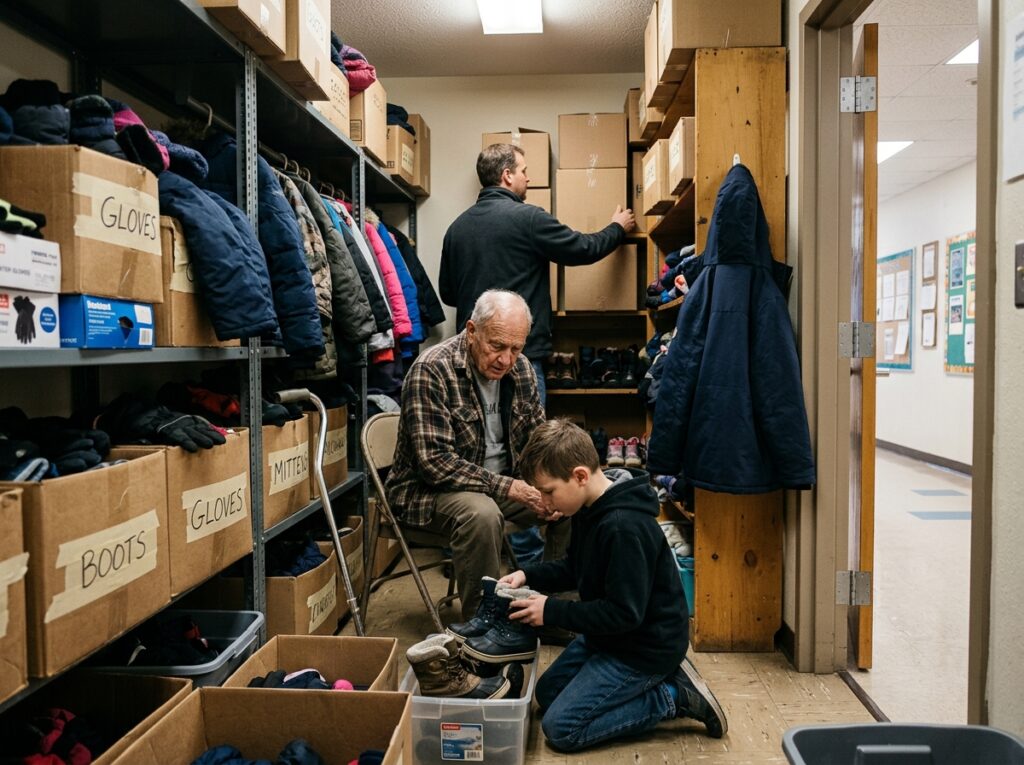
Mason kept helping.
Every Tuesday.
At first because Walt asked.
Then because he wanted to.
He became obsessive about organization.
Boot sizes in order.
Gloves paired.
Coats separated by size.
Anything damaged went into a repair bin.
One afternoon, he found a boot with a broken lace.
“Can’t give this away.”
“Why?”
“Because it looks bad.”
“Still warm.”
Mason shook his head.
“If you’re giving somebody something, it shouldn’t look like trash.”
Walt stared at him.
Then looked at me.
Kid had a point.
After that, the closet added a rule.
Everything offered had to be something you’d be comfortable giving to your own child.
No garbage disguised as generosity.
No stained shirts.
No boots with holes.
No broken zippers unless they were repaired first.
Mason became quality control.
Terrifying quality control.
He rejected a pair of gloves I donated.
“What’s wrong with those?”
“One has a hole.”
“Tiny hole.”
“Still a hole.”
“I’m getting bullied by a fifth-grader.”
“You should buy better gloves.”
Walt nearly fell over laughing.
By February, something else had changed.
Students started contributing.
Not just parents.
A fourth-grader brought boots she’d outgrown.
Another child brought two coats.
A boy walked into the office carrying gloves and said:
“These are too small. Somebody can have them.”
Nobody called it charity.
The language changed.
Keep it moving.
That was all.
Mason understood that better than anyone.
Then one morning, he didn’t come to school.
Then another.
Then another.
On the fourth day, Walt asked the counselor.
She couldn’t tell him much.
Family privacy.
But she said:
“They’re going through something.”
Walt nodded.
Didn’t push.
A week later, Mason returned.
Same coat.
Different face.
Quiet.
He went directly to the closet after school.
Walt was there.
Mason started pairing gloves without speaking.
After ten minutes he said:
“We moved.”
Walt waited.
“Mom couldn’t pay rent.”
Still Walt said nothing.
“We’re staying with my aunt.”
Mason’s hands kept moving.
“There are six people there already.”
Walt finally said:
“That sounds crowded.”
Mason nodded.
Then:
“Are we homeless?”
I was standing across the room.
That question has stayed with me.
Walt didn’t rush to answer something he didn’t fully understand.
He said:
“I don’t know what word your family is using.”
Mason looked at him.
“But I know where you sleep doesn’t decide what kind of kid you are.”
Mason stared down at the gloves.
Then he whispered:
“I knew the coat was for poor kids.”
There it was.
All along.
He had known his family was struggling.
He had been terrified other people would know too.
Walt leaned back.
“When I was your age, I wore my brother’s pants.”
Mason looked up.
“What?”
“Terrible things. Too short.”
“You were poor?”
“Some years.”
Walt shrugged.
“Some years we were okay.”
He pointed at the shelves.
“Life moves.”
Then Mason asked:
“Did people know?”
“Probably.”
“Were you embarrassed?”
“Yes.”
That answer mattered.
Walt didn’t give him a speech about how he shouldn’t feel ashamed.
Feelings don’t disappear because an adult says they’re unnecessary.
He simply told the truth.
“Yes.”
Then:
“But I wish somebody had told me sooner that needing help and being helpless aren’t the same thing.”
Mason started crying.
Quietly.
Walt didn’t hug him.
Didn’t move closer.
He just sat there.
After a minute, Mason wiped his face with his sleeve.
Walt handed him tissues.
“Use those. You’re disgusting.”
Mason laughed.
There it was.
A little oxygen.
Mason’s family eventually found another apartment.
His mother got steadier work.
Not a miracle.
Not instant.
It took months.
There were forms.
Waiting lists.
Help from relatives.
Community services.
A lot of adults doing unglamorous work.
The coat didn’t fix their life.
That’s important.
Kindness doesn’t become more meaningful by pretending it solved something it couldn’t solve.
The coat did one thing.
It kept an eleven-year-old warm.
Sometimes that’s enough reason to give one.
That spring, Mason returned it.
Walt was sitting beside the closet.
Mason handed him the navy coat.
“Too small.”
“Already?”
“I grew.”
“Show-off.”
Mason placed it on the rack.
Then stopped.
“Wait.”
He took a piece of paper from his backpack.
On it he’d written:
I USED THIS WHEN I NEEDED IT. NOW YOU CAN.
“Can we put this in the pocket?”
Walt read it.
Then nodded.
The counselor suggested making copies.
Mason said no.
“This one’s for this coat.”
So they left it.
The following winter, the navy coat disappeared from the rack.
Nobody knew who took it.
Perfect.
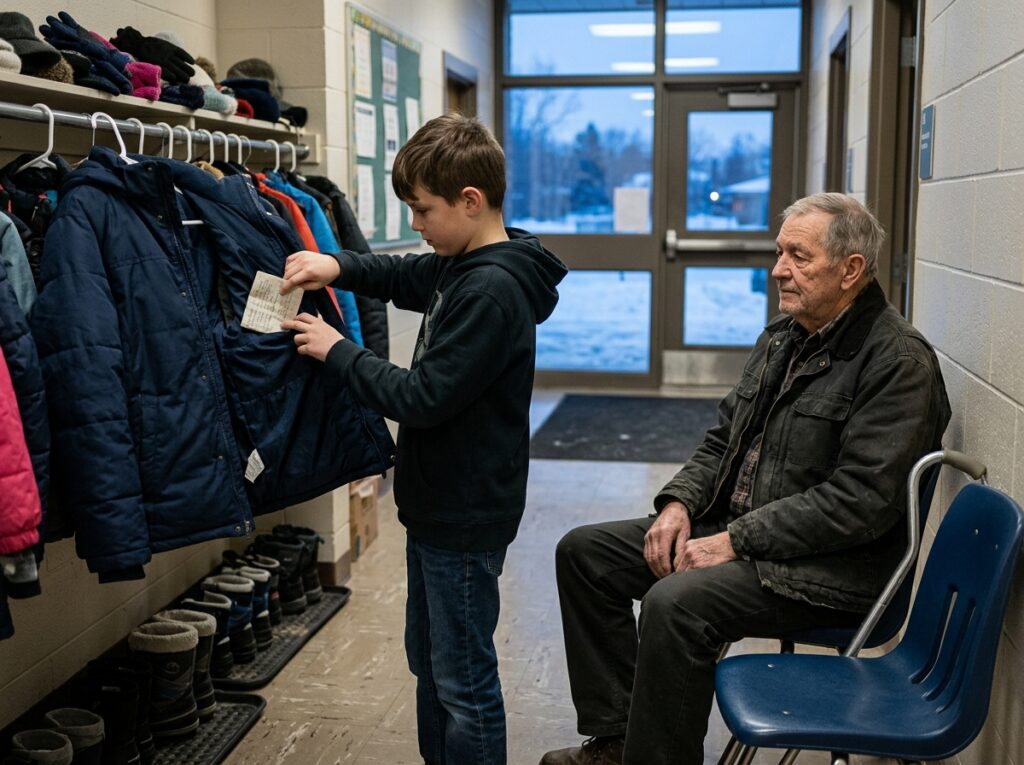
Walt turned eighty-five the next January.
He stopped visiting every Tuesday.
His knees finally won.
Then came a mild stroke.
He recovered well enough to live independently, but driving was over.
Walking became harder.
His speech slowed slightly when he was tired.
He hated all of it.
I started taking him to the school once a month.
Sometimes Tommy called while we were there.
The two of them argued like relatives.
Which, in some strange way, they had become.
One afternoon, Walt asked about Mason.
“He’s in middle school now.”
“Still organizing everybody?”
“Probably.”
“Good.”
Then the school counselor smiled.
“He was here yesterday.”
“Why?”
She opened the closet.
On the floor were four boxes.
Boots.
Forty-eight pairs.
Mason had organized a drive through his middle-school hockey team.
Walt stared.
“He plays hockey?”
“Apparently.”
“Expensive sport.”
“Apparently.”
Walt smiled.
Inside the first box was a note.
MR. JENSEN — THESE ARE INVENTORY. NOT CHARITY. — MASON
Walt sat down.
His eyes filled.
“Smart mouth.”
I took a photograph of the note.
Not Walt.
He would’ve killed me.
The following year, Walt’s health declined more quickly.
He moved into assisted living.
He hated that phrase too.
“It’s an apartment where everybody asks if you’ve pooped.”
Hard to argue.
His room had photographs of Nancy.
His old bus-driver cap.
Tommy’s letter.
And on a shelf sat those red boots.
He’d finally put them behind glass.
Not because they were valuable.
Because the leather had started cracking.
One afternoon, I visited and found him holding one.
“Thought they were behind glass.”
“I’m eighty-six. Arrest me.”
Fair.
He rubbed the worn red leather.
“You know what bothers me?”
“What?”
“People tell this story like I started something.”
“You did.”
“No.”
He shook his head.
“Tommy did.”
“You bought the boots.”
“He gave them away.”
I understood.
Walt bought one pair.
Tommy turned them into a direction.
His cousin.
Another child.
Another.
Then years later, his own winter drive.
Then Mason.
Then the hockey team.
The object had moved.
But more importantly, the idea had.
“Maybe Nancy started it,” I said.
“Why Nancy?”
“She put up with you.”
Walt smiled.
“Strong argument.”
He died that March.
Eighty-six.
Quietly.
His daughters were with him.
There was no eagle outside the window.
No pair of boots mysteriously appearing.
No perfect final sentence.
He’d been tired.
Then he was gone.
At the funeral, Tommy sat with Walt’s family.
Mason came too.
Fourteen now.
Nearly as tall as me.
He wore a dark jacket and stood awkwardly near the back.
Afterward, he approached Tommy.
“Are you the red-boots kid?”
Tommy laughed.
“I guess.”
“I’m Mason.”
Tommy’s expression changed.
“The coat kid?”
Mason looked offended.
“I organized the closet.”
“Right. Sorry.”
They shook hands.
I watched two people who had needed help as children meet because the same old man had noticed both of them decades apart.
Neither was defined by what they’d lacked.
That would’ve bothered Walt.
Tommy wasn’t the poor kid without boots.
Mason wasn’t the homeless kid without a coat.
They were Tommy and Mason.
One became a social worker.
The other was obsessed with hockey and inventory management.
Need was something that happened in their lives.
It wasn’t their identity.
After the funeral, Walt’s daughters gave the red boots to Tommy.
He refused.
“They belong with the family.”
His oldest daughter shook her head.
“Dad left instructions.”
Of course he did.
Tommy opened the envelope.
Walt had written:
Tommy,
You returned these once already.
I’m giving them back.
Don’t put them somewhere important.
Put them somewhere useful.
— Walt
Tommy laughed.
Then cried.
A month later, the red boots returned to the elementary school.
Not inside the winter closet.
Outside it.
Tommy placed them in a simple clear case beside the door.
Underneath was no biography of Walt.
No list of accomplishments.
No number of children helped.
Just the sentence already above the closet:
TAKE WHAT YOU NEED. KEEP IT MOVING.
Mason added something.
A second card.
It said:
BRING SOMETHING BACK SOMEDAY IF YOU CAN. IF YOU CAN’T, THAT’S OKAY TOO.
That might be my favorite part.
Because “keep it moving” can become another kind of debt if we’re not careful.
Not everyone who receives help will someday be able to return it.
Not everyone has to.
Kindness isn’t a loan.
The point isn’t to make people earn what they needed.
The point is to give without taking their dignity as payment.
Last January, I drove past the old depot.
Or where it used to be.
The building is gone now.
There’s a small public parking area near the river.
The rusted basketball hoop disappeared with it.
The faded district sign too.
I parked anyway.
6:14.
Habit, I guess.
Snow covered the riverbank.
For several minutes, nothing happened.
Then a pickup pulled in.
Mason got out.
Sixteen now.
Driver’s permit.
His mother was with him because apparently Minnesota had correctly decided sixteen-year-old Mason should not yet be completely trusted with a vehicle.
He recognized me.
“What are you doing here?”
“Freezing.”
“Why?”
“Tradition.”
He nodded as if that explained everything.
Then he opened the truck bed.
Two boxes.
Boots.
“Where are those going?”
“School.”
Of course.
We stood near the river.
6:18.
No eagle.
6:22.
Still nothing.
Mason shoved his hands into his pockets.
“Did Walt really wait for eagles?”
“No.”
“Good.”
“He mostly complained when they were late.”
Mason smiled.
At 6:27, a bald eagle lifted from a cottonwood downstream.
It crossed the frozen river.
Far away.
Wild.
Ordinary.
Beautiful.
Mason watched it.
Then said:
“Seven minutes late.”
I laughed.
“Walt would’ve complained.”
We watched until it disappeared behind the trees.
Then Mason lifted one of the boxes from the truck.
I grabbed the other.
On the way to the school, I thought about what Walt had said years earlier.
Sometimes you just have to notice their feet.
I’ve realized there was another half to it.
After you notice, help in a way that lets the person keep standing tall.
That’s harder.
It’s easy to give somebody something.
It’s harder to give without turning yourself into the hero of their story.
Without photographs.
Without requiring gratitude.
Without making a child explain why his family can’t afford a coat.
Without making someone promise to pay you back.
Without attaching shame to the thing meant to remove suffering.
Walt learned that over a lifetime.
So did Tommy.
So did Mason.
So did I.
The winter closet is still there.
Boots disappear.
Coats disappear.
Gloves disappear faster than anything because children apparently lose gloves in another dimension.
Some things come back.
Others don’t.
Nobody keeps score.
And somewhere this winter, a child may pull on a coat that once belonged to another child whose family was going through a difficult year.
They may never know each other’s names.
They don’t need to.
That’s the beautiful thing about kindness when it’s done right.
The giver doesn’t have to be remembered.
The receiver doesn’t have to be grateful forever.
The story doesn’t have to circle back.
It can simply keep moving.
A pair of red boots.
A navy coat.
Forty-eight pairs from a hockey team.
Whatever comes next.
Walt is gone.
Nancy is gone.
The old depot is gone.
But every Minnesota winter, that closet fills.
And empties.
And fills again.
Maybe that’s what it means for kindness to outlive us.
Not that people keep telling our names.
But that somewhere, because we once paid attention, somebody else learned to notice too.


No Comments