

I almost walked past it.
That was the part I kept thinking about afterward.
Not the fallen branch.
Not even the fawn.
The fact that I had been walking along the edge of our pasture at 6:18 that morning and had almost continued on without giving the eagle a second thought.
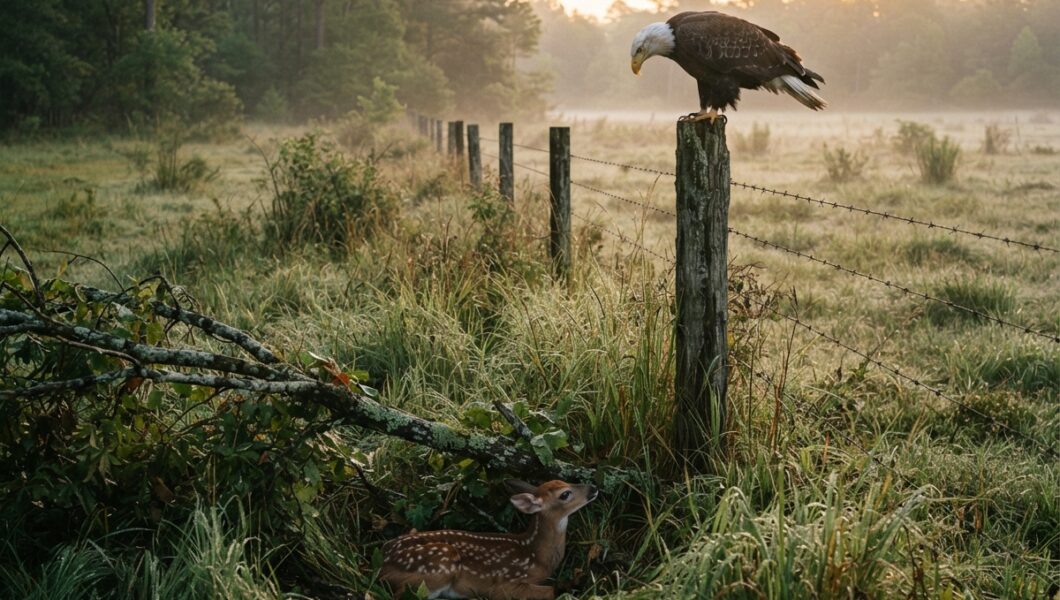
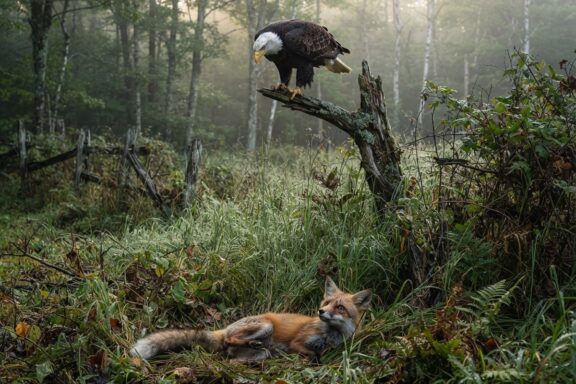
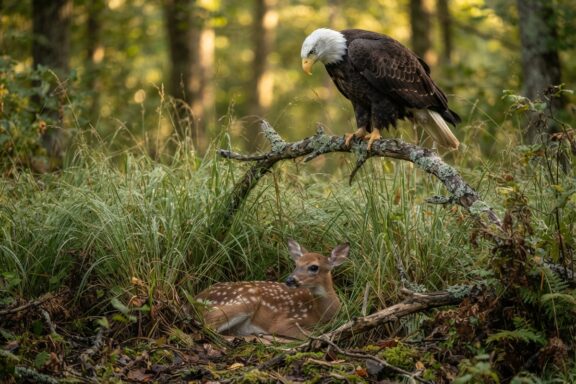
The bald eagle had landed on an old wooden fence post about thirty yards ahead of me.
It wasn’t unusual.
We lived far enough from town that eagles were a familiar sight. They crossed the fields regularly, sometimes high above the tree line, sometimes dropping toward the creek when they were hunting.
But this eagle behaved differently.
It didn’t immediately leave.
It stayed on the fence post.
Its white head turned toward the pasture.
Then toward the trees.
Then back toward one particular patch of grass.
I slowed down.
There was nothing obvious there.
Just wet grass shining in the morning light, a fallen branch lying near a shallow depression, and the long shadow of the woods stretching across the pasture.
The eagle looked toward that same area again.
I stopped.
Then I started walking.
Every few steps, I looked back.
The eagle was still there.
It wasn’t calling.
It wasn’t flying around.
It wasn’t doing anything dramatic.
It was simply watching.
I followed its line of sight toward the fallen branch.
When I got within about fifteen yards, I finally noticed something underneath it.
At first, I thought it was an old piece of fabric caught in the grass.
Then an ear moved.
I stopped immediately.
It was a fawn.
A very young white-tailed deer was lying on its side beneath the branch.
Its eyes were open.
Its chest was moving.
It was alive.
I crouched down.
The branch had fallen across a shallow depression in the ground, and one of the fawn’s front legs was trapped underneath the heavier section.
The animal tried to move when it saw me.
It pulled backward.
The branch shifted slightly.
The fawn stopped.
I could see how frightened it was.
I didn’t want to rush toward it.
I didn’t know whether the branch was putting pressure on another part of its body, and I didn’t want to make the situation worse by grabbing the animal.
So I looked carefully at the branch.
The smaller end was resting partly on the ground.
If I could lift it just a few inches, there might be enough room for the fawn to pull its leg free.
I looked back at the fence.
The eagle was still there.
Watching.
I put both hands beneath the smaller end of the branch.
Then I slowly lifted.
The wood creaked.
The fawn raised its head.
For a second, nothing happened.
Then it pulled its front leg backward.
It didn’t come free.
I lifted the branch slightly higher.
The fawn tried again.
This time, its hoof slipped underneath.
Its leg came free.
I lowered the branch carefully and stepped backward.
The fawn didn’t run.
It remained on the ground, breathing hard.
I stayed several feet away.
I didn’t touch it.
I didn’t try to pull it upright.
I simply waited.
After about twenty seconds, the fawn moved its front legs.
Then its back legs.
It pushed against the ground.
Its body lifted.
For a moment, I thought it was going to stand.
Then it collapsed again.
I stayed where I was.
A few seconds later, it tried again.
This time, it stood.
Its legs shook beneath it.
It took one step.
Then another.
It stopped.
The fawn looked toward the tall grass at the edge of the pasture.
Slowly, it started walking.
The first few steps were unsteady.
But it stayed upright.
I watched it move farther away from the fallen branch until the grass began hiding its body.
First its legs disappeared.
Then most of its body.
Only its ears remained visible.
Then those disappeared too.
I looked back toward the fence.
The eagle was still perched there.
For a few seconds, neither of us moved.
Then the bird spread its wings.
It pushed away from the fence post and flew toward the wooded edge of the property.
I stood beside the fallen branch.
The pasture suddenly felt very quiet.
I kept thinking about how easily I could have walked past.
The fawn had been almost completely hidden.
There had been no loud cry.
No obvious movement.
Nothing from a distance that would have made me stop.
The eagle hadn’t flown down and called me over.
It hadn’t behaved like a trained animal.
It had simply landed on a fence post and repeatedly looked toward one particular part of the pasture.
I noticed.
I followed its gaze.
And beneath a fallen branch, I found a young deer that couldn’t free itself.
Later that morning, I went back with binoculars.
The place looked completely different.
Without knowing where the fawn had been, I probably wouldn’t have noticed anything.
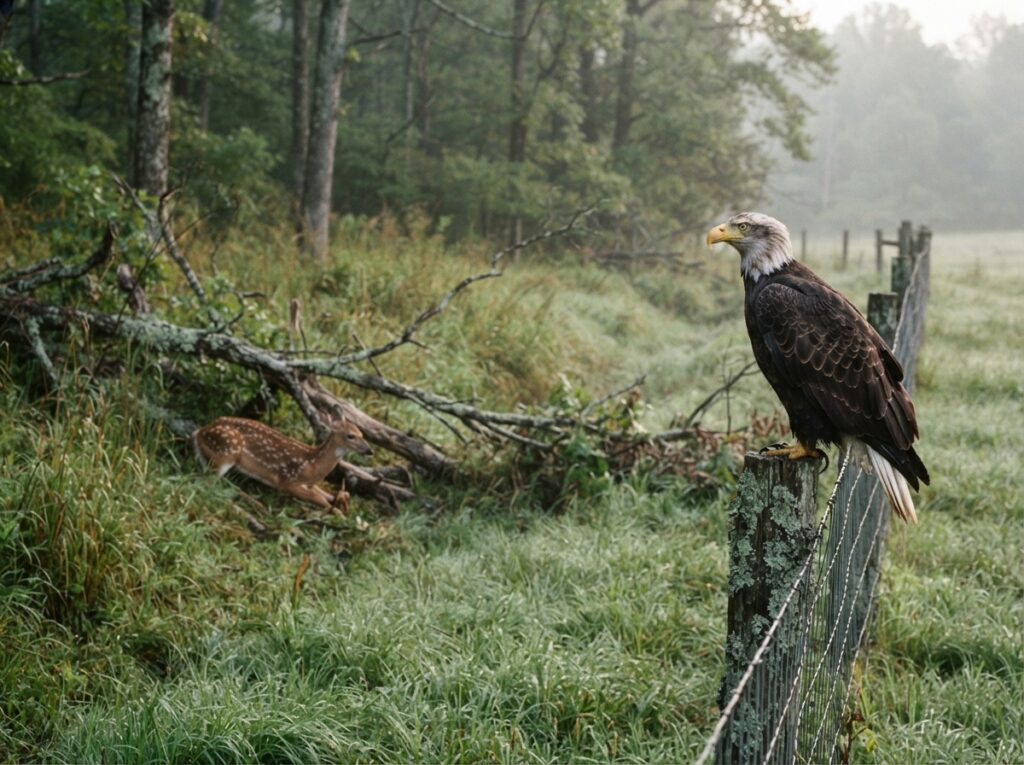
The branch was still lying in the grass.
The pasture looked ordinary.
A few birds moved along the edge of the woods.
The wind passed through the tall grass.
But the fawn was gone.
I searched the area from a distance.
There were small hoofprints leading away from the branch.
They continued toward the wooded edge.
I followed them with my eyes until they disappeared into thicker vegetation.
That was all the evidence I needed that the little deer had managed to get away.
I never saw the eagle again that day.
But the image of it sitting on that fence post stayed with me.
I kept wondering what it had seen.
From where I had been standing, the fawn was almost invisible.
From the eagle’s position above the pasture, perhaps the movement was easier to notice.
Perhaps the eagle had seen the fawn struggling.
Perhaps it had simply noticed something unusual in the grass.
Perhaps it had been interested for an entirely different reason.
There was no way to know.
And the more I thought about it, the more I realized that trying to decide what the eagle intended wasn’t really the important part.
The important part was what happened next.
I noticed.
I walked over.
I looked beneath the branch.
And the fawn got free.
That was enough.
A few days later, I checked the pasture again.
I didn’t expect to find anything.
The grass had begun drying in the afternoon sun, and the branch had been moved slightly by the wind.
I walked along the fence line.
Nothing.
Then I noticed a set of tiny tracks near the edge of the woods.
They crossed the soft ground and disappeared into the trees.
I stopped and looked at them.
They were small.
Much smaller than the adult deer tracks I often saw around the property.
I smiled.
I couldn’t prove they belonged to the same fawn.
But I wanted to believe they did.
That little animal had gone from being trapped beneath a branch to walking away on its own.
That was the ending I hoped for.
The story might have ended there.
But several mornings later, something unexpected appeared on the trail camera near the pasture.
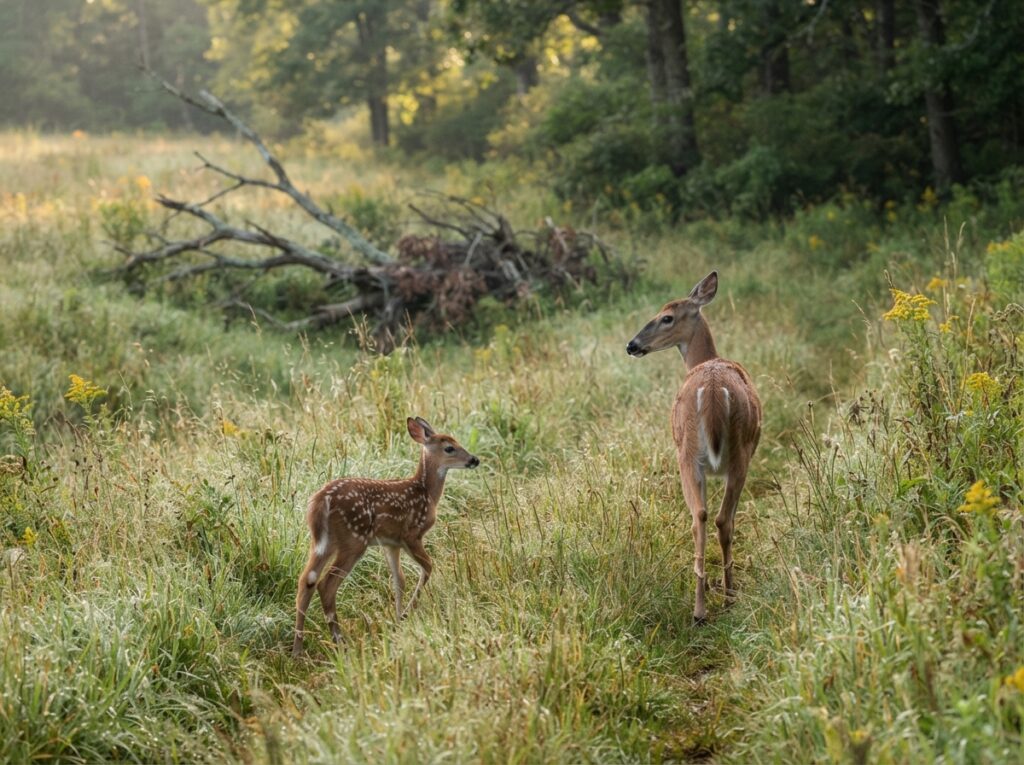
A doe.
She walked slowly along the edge of the woods.
Then stopped.
A small fawn emerged behind her.
It was still young.
Still cautious.
But it was walking normally.
The camera couldn’t provide enough detail to identify it with absolute certainty.
Still, I watched the footage several times.
The fawn followed its mother through the grass.
It stopped when she stopped.
It moved when she moved.
Then both disappeared into the trees.
I saved the footage.
I didn’t know if it was the same deer.
But after seeing what had happened, I found myself hoping it was.
I started noticing other things after that morning.
Not because the pasture had changed.
Because I had.
Before the fawn, I had seen the pasture as one large space.
Grass.
Fence.
Trees.
Creek.
A few animals moving through it.
Afterward, I began seeing the details.
A rabbit hidden beneath the brush.
A bird watching from a fence post.
Tracks in the mud that disappeared into the woods.
Grass pressed flat in a place where something had rested overnight.
None of those things necessarily meant something was wrong.
Most of the time, they were simply signs of wildlife living normally.
But every now and then, something unusual caught my attention.
And when it did, I looked twice.
That was the real lesson I took from the morning with the fawn.
Not that eagles are somehow messengers.
Not that wild animals always understand when another animal is in trouble.
And certainly not that every strange animal behavior has a hidden meaning.
Wildlife is more complicated than that.
The eagle could have been hunting.
It could have been curious.
It could have noticed the fawn’s movement.
It could have been watching the pasture for reasons completely unrelated to the deer.
I would never know.
But I did know what I had seen.
At 6:18 in the morning, an eagle landed on an old fence post.
It repeatedly looked toward one particular patch of grass.
I followed its gaze.
And there was a fawn underneath a branch.
Those were the facts.
Everything else was a question.
And sometimes, I think questions are enough to make us pay attention.
A month later, I walked past the same fence post.
I stopped for a moment.
The wood was weathered and gray.
The top rail was cracked.
Grass had grown taller around the base.
There was nothing remarkable about it.
But I remembered the eagle sitting there.
I remembered looking toward the pasture.
I remembered thinking there was nothing to see.
Then I remembered the little ear moving beneath the branch.
That memory stayed with me.
Not because the rescue was dramatic.
It wasn’t.
The branch came loose.
The fawn stood.
It walked away.
There were no sirens.
No dramatic chase.
No crowd of people.
Just one person noticing something unusual and taking a closer look.
Sometimes that’s all a rescue needs.
A person to stop.
A person to look.
A person to notice what would otherwise remain hidden.
I still don’t know why the eagle stayed.
Sometimes I think about that.
Maybe it saw something I couldn’t.
Maybe the fawn’s movement caught its attention.
Maybe it was simply watching the pasture.
Maybe it was looking for an opportunity.
There are dozens of possible explanations.
And I don’t think we need to choose one.
Because the most important thing wasn’t what the eagle meant.
It was what happened because I noticed it.
The fawn got free.
It walked into the grass.
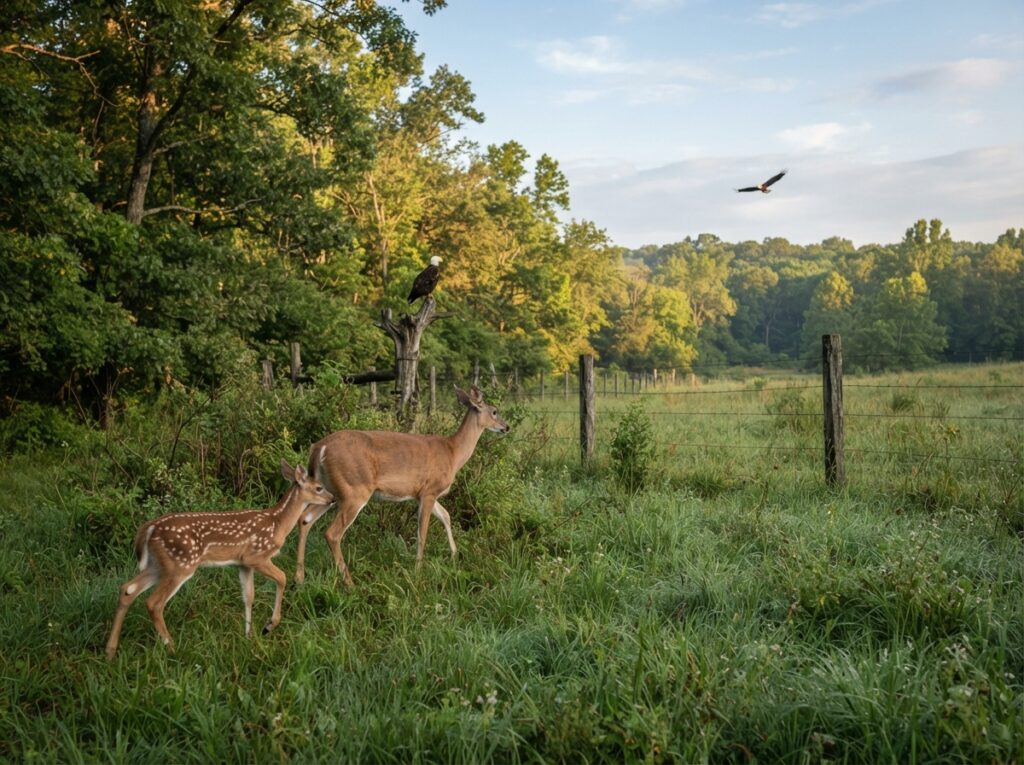
Later, a young deer appeared on the camera following its mother.
And life continued.
That is the part I remember most.
The eagle eventually disappeared into the woods.
The fence post stood empty.
The pasture returned to its ordinary quiet.
But the next time I saw a bird behaving strangely, I didn’t immediately look away.
I watched.
Sometimes nothing came of it.
Sometimes the animal simply flew away.
But once in a while, there was a reason.
A movement in the grass.
An animal hidden beneath leaves.
Something that needed someone to notice.
And that morning taught me something I probably wouldn’t have learned any other way.
Nature doesn’t always announce when something is wrong.
Sometimes there is no cry.
No obvious sign.
No clear request for help.
Sometimes there is only a small clue.
A bird that keeps looking in one direction.
A strange pause.
A patch of grass that doesn’t look quite right.
And if someone happens to notice that clue, they may discover something that would otherwise remain hidden.
I don’t know whether the eagle knew the fawn was trapped.
I don’t know whether it understood that I could help.
I don’t know whether it cared at all.
But I know that I followed its gaze.
And under that fallen branch was a young deer waiting to be free.
Maybe that is all the story needs.
Not a miracle.
Not an explanation.
Just a moment when one wild animal noticed something, a human noticed the animal, and another animal got a second chance.
The pasture is still there.
The old fence is still there.
The woods still stretch beyond it.
And sometimes, early in the morning, I still find myself looking toward that fence post.
I remember the eagle.
I remember the fawn.
And I remember how close I came to simply walking past.
Because sometimes the most important rescue doesn’t begin with hearing a cry.
Sometimes it begins with noticing where a wild animal is looking.
No Comments