

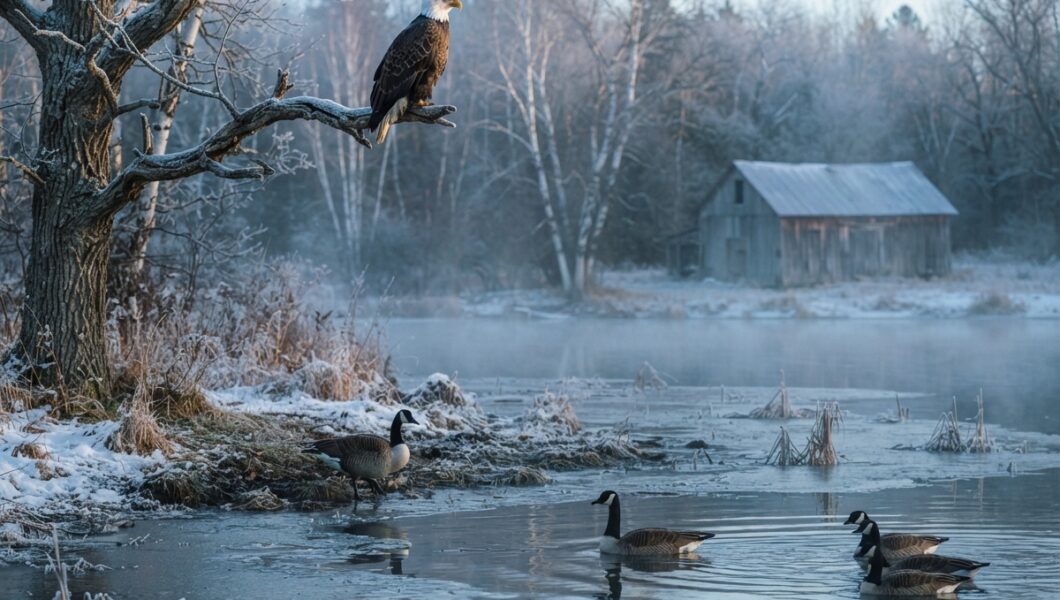
The first thing Daniel noticed was not the eagle.
It was the silence.
On most winter mornings in northern Minnesota, the pond behind his old equipment shed was never completely quiet. There might be the distant sound of trucks on the county road, the wind moving through the bare trees, or the occasional call of a bird somewhere beyond the property.
But on the morning the trail camera recorded the strange encounter, the pond looked almost frozen in time.
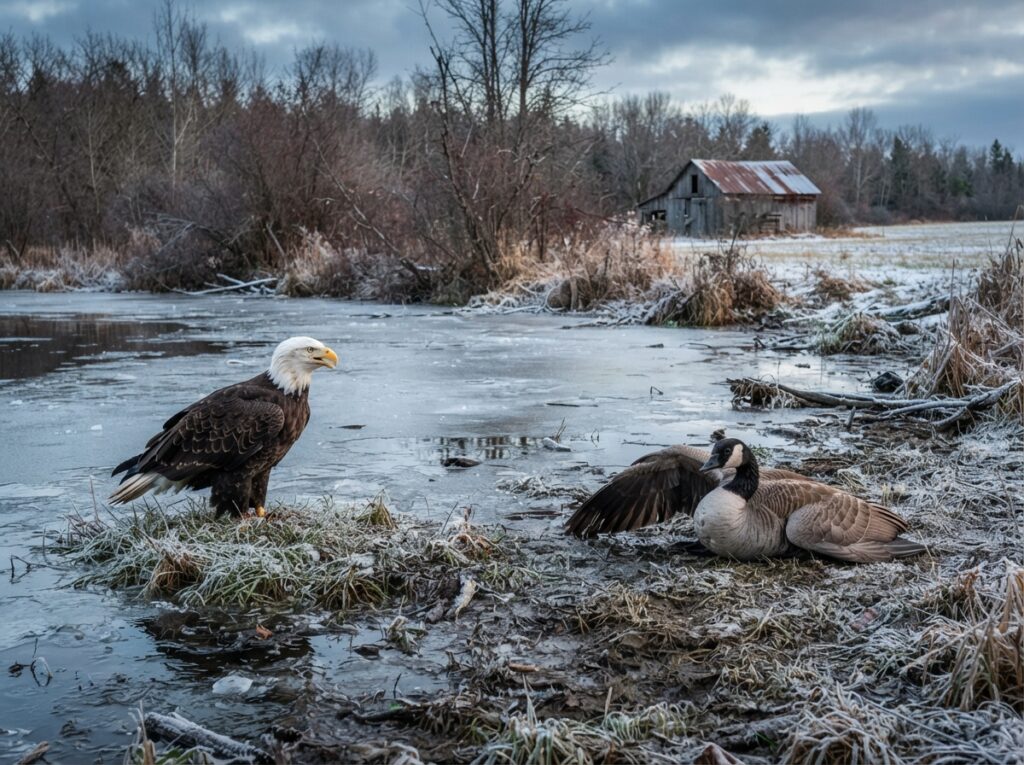
At 5:17 AM, the camera captured a bald eagle landing on the muddy shoreline.
Frost covered the grass. A thin layer of ice stretched across much of the pond, leaving only a darker section of open water near the center. The eagle stood still for several seconds, its white head bright against the darkness.
Then it walked.
Not toward the water.
Not toward the reeds.
Toward something lying near the edge of the pond.
A Canada goose.
The bird was alive, but barely moving. One wing was held awkwardly against its body, and its head rested low against the frozen grass.
The eagle stopped only a few feet away.
For nearly eleven minutes, it remained there.
Then it lifted its wings and disappeared into the darkness.
At the time, Daniel had no idea he was looking at the beginning of a story that would stay with him for months.
The trail camera had been installed behind the equipment shed for a simple reason. Daniel was tired of raccoons getting into the chicken feed, and he wanted to know what was visiting the property after dark.
The camera had captured plenty of ordinary wildlife.
Deer crossing the yard.
Foxes moving along the tree line.
A pair of coyotes passing near the pond.
And, during the colder months, a bald eagle that had become a familiar visitor.
Daniel had seen the eagle many times before.
Nothing about the bird itself was unusual.
What was unusual was where it had chosen to stand that morning.
At 6:02 AM, the eagle returned.
The goose was still lying in the same place.
The eagle landed almost exactly where it had been before. It looked toward the frozen pond, then toward the goose. After several seconds, it walked slowly along the shoreline.
The goose lifted its head.
The eagle stopped.
Neither bird moved much.
For almost seven minutes, the camera recorded nothing more dramatic than two wild birds sharing a frozen shoreline.
Then the eagle flew into the trees.
At 8:41 AM, it came back.
This time, it stayed for nearly twenty minutes.
At 9:16, it left.
At 10:03, it returned again.
By then, Daniel was inside the farmhouse making coffee and getting ready for work.
He had no idea that behind his shed, something was happening that would eventually make him watch his own property differently.
It was nearly 11:30 when he finally stepped outside.
He had walked toward the pond dozens of times that winter, but something immediately caught his attention.
There were fresh tracks in the frost.
Eagle tracks.
They led from the shoreline toward a patch of flattened grass.
Daniel followed them.
Then he saw the goose.
“Oh, no.”
The bird tried to stand when he approached.
Its legs moved beneath its body, but it could not get upright.
One wing was held tightly against its side.
Daniel stopped several feet away.
He had seen injured wildlife before, but something about this bird made him realize immediately that it needed professional help.
He went back to the farmhouse and called a local wildlife rehabilitation center.
A woman answered.
“I’ve got an injured goose,” Daniel explained. “It’s beside my pond, and I don’t know what happened.”
She asked whether the bird was bleeding.
Daniel looked carefully from a distance.
“Not that I can see.”
“Is it breathing normally?”
“Yes.”
“Is there fishing line or anything wrapped around it?”
“No.”
“Can it walk?”
“It tries, but it can’t stand properly.”
There was a short pause.
Then Daniel mentioned the eagle.
“There was an eagle sitting beside it.”
“An eagle?”
“Yes. It came back several times.”
The woman told him not to approach the goose unnecessarily and to keep himself at a safe distance until a rescuer arrived.
Daniel went back inside.
But before closing the door, he looked toward the tree line.
The eagle was there.
Perched on a branch.
Watching the pond.
Watching the place where the goose lay.
Daniel stood there for a moment before quietly closing the door.
By the time Sarah arrived at the property with another volunteer, the sun was already higher in the sky.
They carried a transport crate and a large towel toward the pond.
The goose noticed them almost immediately.
It tried to move.
For a few seconds, it dragged itself across the grass, but the effort was too much. It stopped and lowered its head again.
Sarah crouched several feet away.
“Easy,” she said softly. “We’re not going to hurt you.”
The eagle lifted from the distant tree.
It circled once above the pond.
Daniel watched from the porch.
Then the bird disappeared beyond the trees.
Sarah and the volunteer carefully covered the goose with the towel and examined it.
There was swelling around one wing joint.
One leg also appeared badly strained.
Near the shoreline, the broken edge of the ice offered a possible explanation.
Sarah studied the area for a moment.
“We think it may have fallen through,” she said. “It could have injured itself trying to get back out.”
Daniel looked toward the pond.
That would explain the disturbed snow and the broken section of thin ice he had noticed earlier.
But it did not explain the eagle.
The goose was placed carefully inside the transport crate.
As they carried it toward the driveway, Daniel heard wings behind him.
The bald eagle had returned.
It landed on the roof of the equipment shed.
For a few seconds, nobody moved.
The eagle looked toward the crate.
Daniel looked at Sarah.
She watched the bird carefully.
“We don’t know what it’s doing,” she said. “It could be curious. It could be watching another bird in its territory. We just don’t know.”
That sentence stayed with Daniel.
Because the footage looked like a story.
It looked as though the eagle had noticed the injured goose.
It looked as though it had returned deliberately.
It looked almost like concern.
But wildlife does not come with subtitles.
There was no way to know what was happening inside the eagle’s mind.
The goose was taken to the rehabilitation center.
X-rays showed a significant injury to the wing, but fortunately there was no major fracture. The leg strain was also treatable.
The first few days were difficult.
The goose barely ate.
It stayed tucked into the corner of the enclosure while the rehabilitation team monitored its breathing, weight, appetite, and movement.
Daniel kept thinking about the pond.
And the eagle.
He wondered whether the bird would return.
The answer came sooner than he expected.
The trail camera recorded it the following morning.
The eagle landed near the same shoreline.
It walked slowly along the edge of the pond.
It stopped beside the flattened patch of grass where the goose had been lying.
Then it stood there for several minutes before flying away.
Two mornings later, it came back.
Then again.
And again.
The visits were never identical.
Sometimes the eagle stayed for only a few minutes.
Sometimes it remained much longer.
It never appeared to touch the place where the goose had been.
It simply seemed to inspect the shoreline before leaving.
Daniel saved every recording.
He did not know what the behavior meant.
But he could not stop watching.
Meanwhile, several miles away, the injured goose was slowly changing.
On the fourth day, it finally began eating properly.
On the eighth day, it started standing for longer periods.
By the third week, it was swimming again in a shallow recovery pool.
Sarah sent Daniel occasional updates.
One afternoon, his phone rang.
“Your goose is doing really well,” she told him.
Daniel smiled.
“That’s good.”
“We’re hoping to move it into the outdoor enclosure next week.”
Daniel looked through the kitchen window toward the pond.
Then he asked the question he had been thinking about for weeks.
“What about the eagle?”
Sarah laughed softly.
“I have no idea.”
Neither did Daniel.
But the trail camera kept recording.
The eagle continued to appear.
Not every day.
Not even every week.
But often enough that Daniel began recognizing the pattern.
The bird would land near the pond.
Walk along the shoreline.
Pause near the same section of ground.
Look toward the water.
Then leave.
Eventually, the visits became less frequent.
Five days passed.
Then seven.
Then twelve.
By then, Daniel thought perhaps the strange chapter had ended.
He was wrong.
Six weeks after the rescue, Sarah called again.
“We think it’s ready.”
Daniel knew immediately what she meant.
The goose was coming home.
On a cold but bright morning, Sarah drove back to the farm with the transport crate.
Daniel had already prepared a quiet area near the pond.
The water was still partly frozen.
Bare trees surrounded the shoreline.
The same old equipment shed stood nearby.
For a moment, Daniel wondered whether the goose would recognize the place.
He wondered whether it would remember the night it had fallen into the freezing water.
He wondered whether the pond would frighten it.
The crate was placed on the grass.
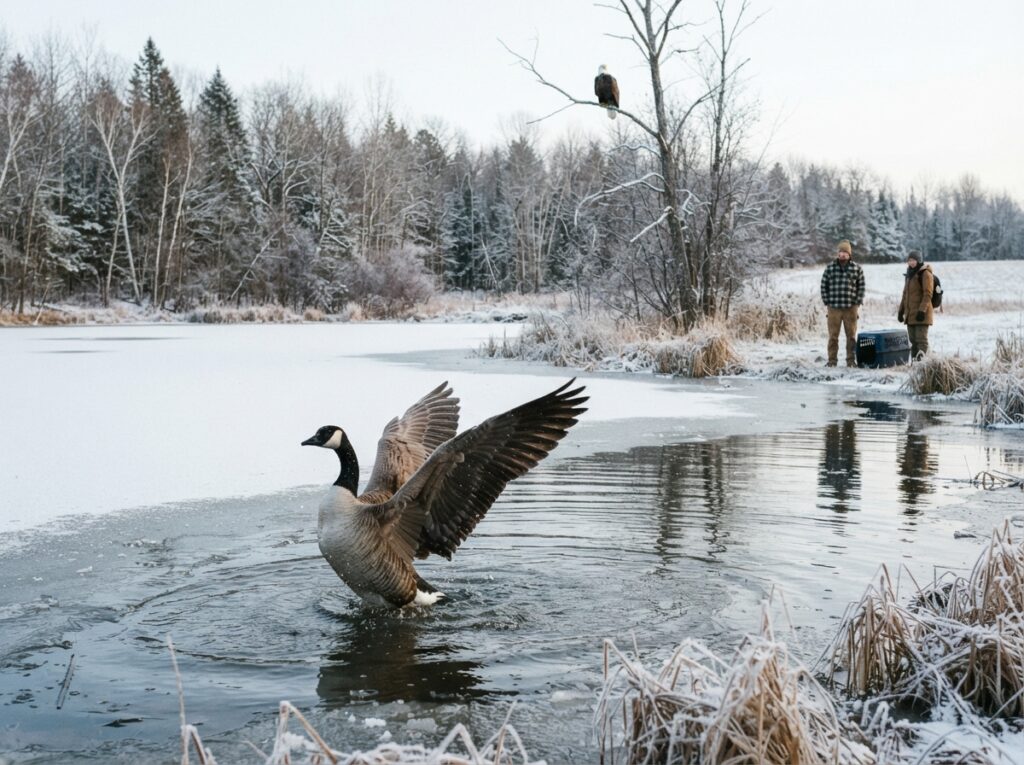
Sarah opened the door.
Nothing happened.
The goose remained inside.
Then it slowly stepped forward.
One foot.
Then another.
It stopped.
The bird lifted its head and looked across the pond.
The wind moved gently through the grass.
Then the goose continued toward the water.
One step.
Another.
It reached the open section of the pond and lowered itself into the water.
Daniel felt his throat tighten.
The goose swam slowly.
Then a little faster.
It made one circle.
Then another.
Sarah smiled.
“That’s what we wanted to see.”
The goose lifted its injured wing.
For a moment, it seemed hesitant.
Then it stretched.
Fully.
Both wings opened together.
It was the first time Daniel had seen the bird use them normally since the morning he found it.
And then something moved above the trees.
Daniel looked up.
A bald eagle.
It appeared over the tree line and circled once above the pond.
Then twice.
Daniel recognized it immediately.
The eagle landed in the same tree it had used weeks earlier.
Nobody spoke.
The goose continued swimming.
The eagle watched from above.
For several minutes, nothing dramatic happened.
There was no attack.
No struggle.
No sudden interaction.
Just two wild birds occupying the same frozen landscape again.
Eventually, the eagle lifted off and disappeared toward the river.
The goose remained on the pond.
Sarah packed the empty transport crate into her vehicle.
Daniel stood beside her.
“Do you think it remembers the goose?” he asked.
Sarah looked toward the tree line.
“I don’t know.”
It was probably the only honest answer.
Daniel thought that would be the end of it.
The goose had been rescued.
It had recovered.
It had returned to the pond.
And the eagle had eventually flown away.
But the trail camera continued running.
Over the next month, it captured the goose several more times.
For a few days, the bird remained around the pond.
Then it disappeared.
Daniel assumed it had joined other geese farther down the river.
The eagle still visited occasionally, although its appearances became less frequent.
Then one morning, months later, Daniel checked the camera.
He stopped scrolling.
The goose was back.
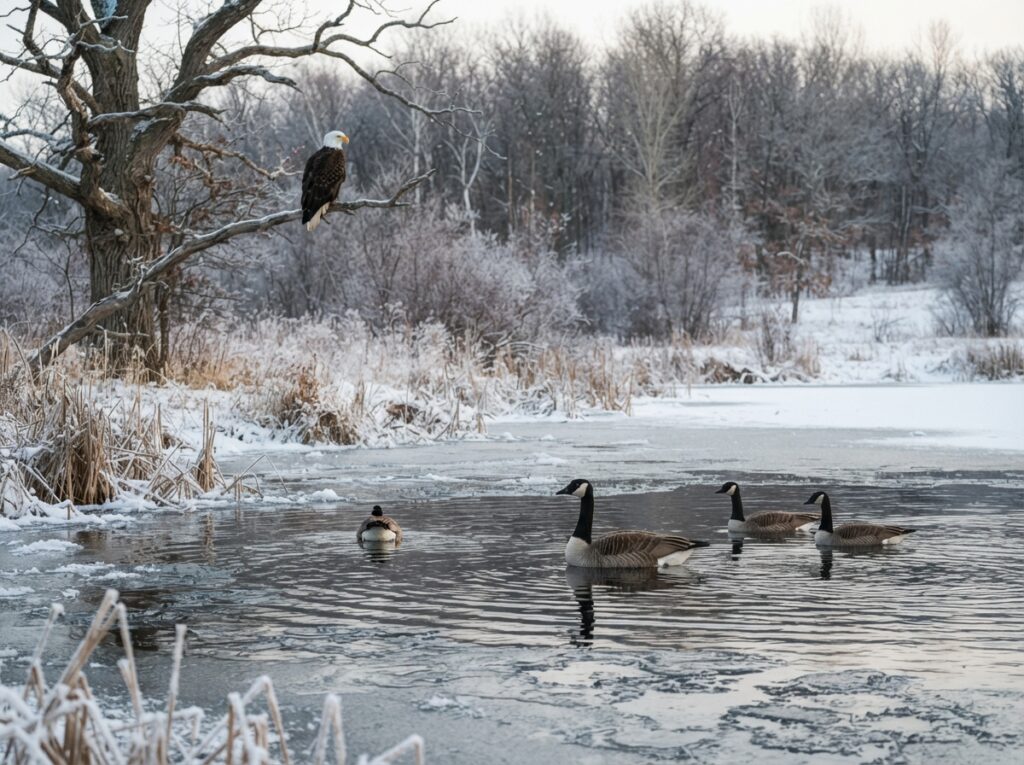
It was swimming across the pond with three other geese.
The bird looked completely different from the weak animal he had found beside the shoreline.
Its movements were strong.
Its head was upright.
Its body looked healthy.
It was feeding calmly with the other birds.
Daniel watched the footage again.
Then something appeared at the edge of the frame.
The bald eagle.
It landed on the old tree.
The same tree.
The same pond.
The same general area where the strange encounter had begun months earlier.
The eagle looked toward the water.
The geese continued feeding.
Nothing happened.
And somehow, that made the moment more powerful.
There was no dramatic reunion.
No obvious sign that the eagle recognized the goose.
No way to prove that the bird remembered anything at all.
The eagle eventually flew away.
The geese continued across the pond.
Daniel saved the footage.
He had learned something from those recordings.
Not necessarily something about eagles.
Not necessarily something about geese.
Something about attention.
The eagle may have been curious.
It may have been watching another bird in its territory.
It may have simply been responding to something unusual beside the pond.
Daniel would never know.
Sarah would never know.
Nobody could honestly say what the eagle was thinking.
But one fact remained.
The eagle’s repeated presence had caught Daniel’s attention.
And because he looked closer, an injured goose received help when it needed it.
Without the camera, Daniel might never have known how long the eagle had been there.
Without walking toward the pond that morning, he might have missed the tracks.
Without following those tracks, he might not have found the goose.
And without that discovery, the story could have ended very differently.
That was what Daniel remembered whenever he watched the footage.
Not that the eagle had somehow rescued the goose.
It hadn’t.
People had.
Sarah and the rehabilitation team had treated the injuries.
Daniel had made the call.
The goose had done the hard work of healing.
But somewhere in the middle of that chain of events was a strange winter morning when one wild bird stood beside another.
Maybe it meant something.
Maybe it meant nothing.
Nature does not always give us the answer we want.
Sometimes we see a moment and instinctively create a story around it.
But the honest version can be just as beautiful.
An eagle stood beside an injured goose.
The eagle returned several times.
A farmer eventually noticed.
A rescue followed.
A bird recovered.
And months later, that same goose came back to the pond healthy and strong.
Maybe that is all the meaning the moment needs.
Daniel still checks the trail camera.
He still sees deer crossing the property.
Foxes moving through the snow.
Occasional coyotes near the tree line.
And every now and then, the bald eagle returns.
Whenever it appears on the old camera, Daniel watches a little longer.
Because he remembers 5:17 in the morning.
He remembers the frozen pond.
He remembers the injured goose lying beside the water.
And he remembers how close that entire moment came to being missed.
Sometimes the most important thing wildlife gives us is not an explanation.
It is an invitation to pay attention.
The eagle may never have known what happened to the goose.
The goose may never have understood why a bald eagle kept appearing nearby.
Daniel may never know whether those repeated visits meant anything at all.
But the goose survived.
It returned.
It flew.
And one cold morning, months later, the camera recorded both birds in the same landscape again.
Nothing dramatic happened.
And perhaps that was the most beautiful part.
The goose was no longer helpless.
The eagle was no longer watching an injured bird.
The pond was simply a pond again.
The winter morning was simply a winter morning.
And somewhere between the frozen shoreline and the old tree, a strange encounter had become a quiet reminder that sometimes the smallest details are the ones worth noticing.
Because sometimes, paying attention is the first step toward saving a life.
The trail camera kept recording long after that.
And Daniel kept checking.
Not because he expected another mystery.
Not because he believed the eagle was guarding the pond.
He checked because that camera had taught him something simple.
Wildlife is constantly telling stories around us.
Most of the time, we simply aren’t looking.
No Comments