

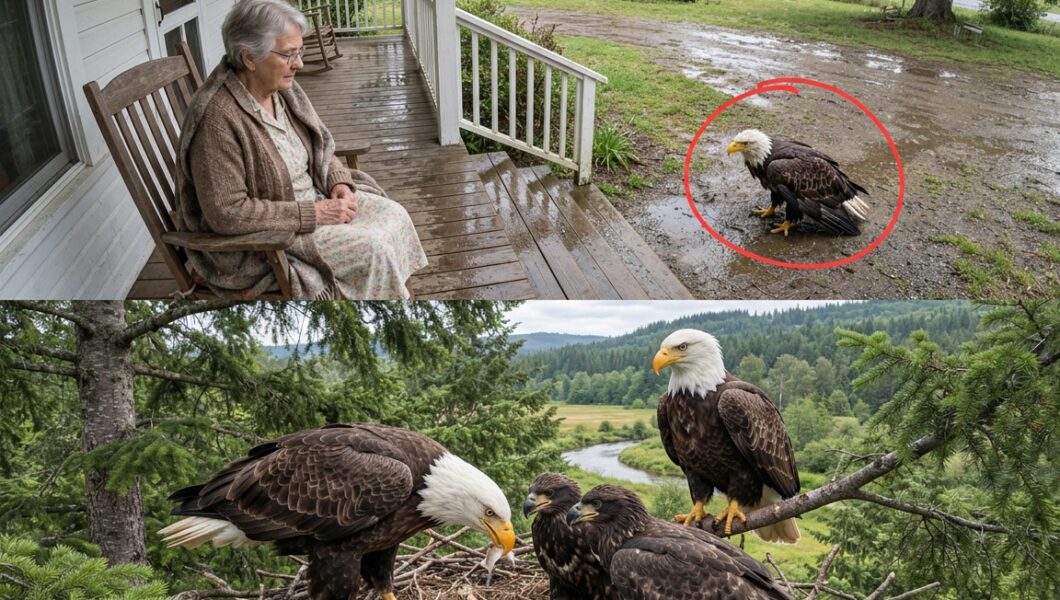
AS FLOODWATER ROSE AROUND A HELPLESS BABY BALD EAGLE TRAPPED BENEATH A FALLEN BRANCH, AN 85-YEAR-OLD GRANDMOTHER WATCHED FROM HER FARMHOUSE WINDOW, PRAYING THAT RESCUERS COULD SAVE BOTH EAGLETS, BUT SHE NEVER IMAGINED THAT HER SIX HOURS OF KINDNESS WOULD LEAD TO ONE OF THE MOST BEAUTIFUL MOMENTS OF HER LIFE.
Margaret Wilson gripped the edge of her kitchen counter.
Outside, the rain continued falling.
The flooded meadow had almost disappeared beneath muddy water.
Through the window, she could see wildlife rescuers moving carefully toward the damaged cottonwood tree.
Then Daniel’s radio crackled again.
“The water is getting higher. We need additional assistance.”
Margaret closed her eyes.
“Please, don’t let those babies die.”
Only the previous morning, she had watched their injured mother struggling beside her porch.
Now both of her babies were fighting for survival.
And Margaret could do nothing except wait.
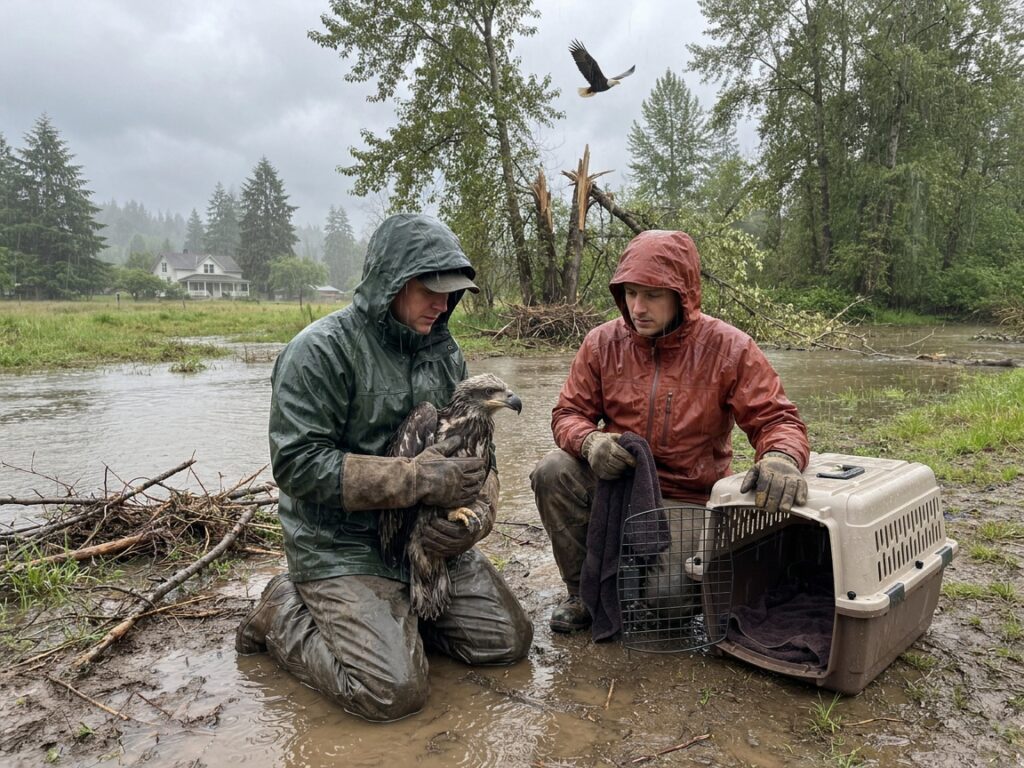
At 4:37 PM, Emily Carter located the trapped eaglet beside the flooded riverbank.
The young bird was clinging weakly to a fallen branch.
Its gray feathers were completely soaked.
Every time it attempted to move, something beneath the water prevented it from escaping.
Emily initially suspected discarded fishing line.
But after emergency personnel secured the area, they discovered that the eaglet’s right leg had become wedged between two submerged branches.
The current was pushing additional debris against them.
The little bird was becoming increasingly exhausted.
A trained water rescue team assisted the wildlife specialists in reaching the trapped eaglet safely.
For several tense minutes, they worked to release its leg without causing further injury.
Finally, the branches separated.
Emily carefully secured the young bird.
“It’s free!”
Daniel immediately prepared a padded wildlife transport carrier.
The eaglet was breathing, but its movements were weak.
Its body temperature had dropped dangerously.
Emily looked toward the damaged nest.
“We need to get the other one before that branch comes down.”
Above them, the remaining eaglet was crouched inside what was left of the enormous nest.
The healthy adult eagle repeatedly circled the cottonwood tree.
Occasionally, it landed on a neighboring branch before taking flight again.
Strong winds continued shaking the damaged limbs.
The wildlife climbers determined that approaching the unstable tree under the current conditions would be too dangerous.
They requested assistance from a local emergency response team equipped with an aerial rescue platform.
Fortunately, a brief improvement in the weather provided an opportunity.
The team positioned its equipment on stable ground near the tree.
Margaret watched from her kitchen window.
She could barely see the eaglet through the rain.
Then another section of the nest dropped.
Several branches fell into the flooded meadow.
The young bird moved toward the remaining nesting material.
A wildlife specialist carefully approached from the rescue platform.
For a moment, the eaglet disappeared behind the branches.
Margaret held her breath.
Then the rescuer emerged holding a specialized wildlife carrier.
Daniel’s voice came through the radio.
“We have the second eaglet!”
Margaret immediately began crying.
“Oh, thank goodness.”
Her neighbor Robert stood beside her.
He gently placed a hand on her shoulder.
“They got both of them, Margaret.”
She nodded through her tears.
“But now they have to survive.”
At 5:46 PM, both eaglets arrived at the wildlife rehabilitation center.
Veterinarians immediately began examining them.
The eaglet rescued from the damaged nest had suffered several minor injuries and considerable stress.
Fortunately, its condition appeared relatively stable.
The eaglet recovered from the flooded riverbank was in much worse condition.
It had experienced severe cold exposure.
Its right leg was swollen.
Its breathing was weak.
And veterinarians were concerned that it might have inhaled water during its struggle.
The medical team provided carefully controlled warming, oxygen support, and appropriate veterinary treatment.
Emily remained beside the recovery enclosure.
“Come on, little one.”
The eaglet barely moved.
Meanwhile, its mother was recovering in another section of the rehabilitation center.
Her fractured wing had been stabilized.
She was responding positively to treatment.
But she would require several weeks of care before veterinarians could determine whether she would regain normal flight ability.
Three members of the same eagle family were now receiving medical attention.
Their healthy parent remained near the damaged nesting territory.
At 7:18 PM, Margaret received a telephone call.
She answered before the second ring.
“Emily?”
“Yes, Margaret.”
“How are the babies?”
Emily explained that the larger eaglet was doing well.
The smaller one remained in critical condition.
Margaret slowly sat down.
“Is there anything I can do?”
Emily smiled gently.
“You’ve already done something very important.”
Margaret looked toward her porch.
“I only made a telephone call.”
“You kept their mother safe until we arrived. And you helped us locate their nest.”
Margaret wiped her eyes.
“I just want them all to have another chance.”
Emily promised to call again the following morning.
After ending the conversation, Margaret walked toward the framed photograph of her late husband.
She gently touched the wooden frame.
“Do you remember how worried we used to get when one of our children was sick?”
She smiled sadly.
“I suppose some things never change.”
That night, Margaret barely slept.
She woke several times and listened to the rain striking her bedroom window.
Every time she closed her eyes, she imagined the little eaglet struggling beside the rising water.
Shortly before sunrise, the storm finally weakened.
Margaret prepared a cup of tea.
Then she sat beside the kitchen window.
The cottonwood tree was badly damaged.
Almost nothing remained of the original nest.
She searched the surrounding branches with her binoculars.
At first, she saw nothing.
Then a familiar white head appeared.
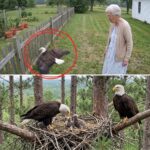
The healthy adult bald eagle was perched on a neighboring tree.
A fish rested beneath its talons.
Margaret immediately contacted Daniel.
“The other eagle is still here.”
Daniel was encouraged by the observation.
The adult’s continued presence suggested that returning the eaglets to parental care might eventually be possible.
But first, both young birds needed to recover.
At 8:42 AM, Emily called with an update.
“The little eaglet survived the night.”
Margaret covered her mouth.
“Really?”
“Yes. Its breathing has improved, and it’s becoming more responsive.”
Margaret began crying.
“Oh, that’s wonderful.”
Emily explained that the eaglet’s leg had suffered bruising and swelling but no major fracture.
The veterinary team remained cautious about possible complications from the floodwater exposure.
However, the improvement was encouraging.
Margaret walked toward her kitchen cupboard.
She removed a small plate and placed a slice of homemade apple pie on it.
It was the first time she had felt like celebrating since the injured eagle appeared beside her porch.
Over the following days, both eaglets gradually became stronger.
The larger youngster was feeding normally.
The smaller one began standing more comfortably.
Its breathing continued improving.
Veterinarians carefully monitored its injured leg.
The rehabilitation staff minimized unnecessary human contact to preserve the eaglets’ natural behavior.
Their goal was to return the young birds to their healthy parent as soon as it was medically appropriate.
Meanwhile, the injured mother eagle continued recovering.
She began eating regularly.
Her strength gradually returned.
Although her wing still required considerable healing time, the veterinary team was increasingly hopeful.
Margaret received regular updates.
Each improvement felt like another small victory.
Five days after the storm, Daniel returned to Margaret’s farmhouse with a wildlife biologist and several tree specialists.
They examined the damaged cottonwood tree.
The remaining branches were structurally unsafe.
Rebuilding the nest in its original location would create another serious risk.
However, approximately sixty yards away stood a healthy evergreen tree overlooking the same meadow.
The healthy adult eagle frequently perched nearby.
After a professional assessment and the necessary wildlife authorizations, specialists decided to construct a replacement nesting platform.
The structure would support a large artificial nest made from suitable natural branches and nesting materials.
Margaret watched the preparations from her porch.
“Will their father know where to find them?”
The biologist answered carefully.
“We hope so. He’s still using this territory, and we’ll monitor his response closely.”
Margaret nodded.
“Those babies deserve to grow up with their family.”
The construction took considerable effort.
Experienced specialists secured the platform high among the strong branches.
They arranged natural nesting materials and installed a remote monitoring camera.
The replacement nest was ready.
Now everyone waited for the eaglets.
Nine days after the rescue, veterinarians determined that both young birds were healthy enough for a carefully monitored return to parental care.
The smaller eaglet’s leg was functioning normally.
Its breathing had stabilized.
Both birds were feeding successfully and maintaining appropriate body temperatures.
Emily contacted Margaret.
“We’re bringing the babies back tomorrow.”
Margaret nearly dropped her telephone.
“Both of them?”
“Both of them.”
She looked toward the replacement nest.
Then she began smiling.
For the first time in days, the farmhouse felt filled with happiness.
The following morning, Margaret woke before sunrise.
She prepared sandwiches and a large thermos of coffee for the wildlife team.
Then she put on her favorite brown knitted cardigan.
Robert arrived shortly afterward.
“Ready for the big day?”
Margaret laughed.
“I’ve been ready since yesterday.”
At 10:26 AM, the rehabilitation vehicle arrived.
Both eaglets were transported to the replacement nesting site.
Experienced wildlife climbers carefully placed them inside the prepared nest.
The young birds settled among the natural branches.
Then the rescuers withdrew.
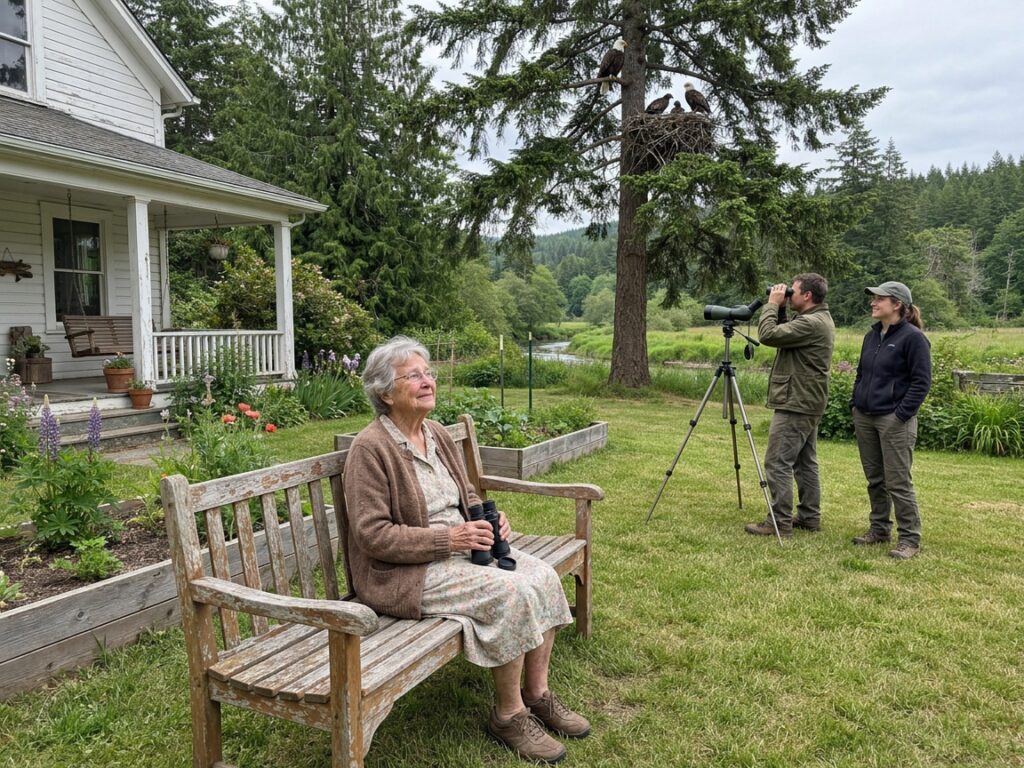
Margaret watched through a spotting scope from a safe distance.
The two eaglets occasionally lifted their heads.
One stretched its developing wings.
The other moved closer to its sibling.
“They look so much stronger,” Margaret whispered.
But the healthy adult eagle had not appeared.
Twenty minutes passed.
Then forty.
Nearly an hour later, Robert noticed movement above the river.
“There!”
An adult bald eagle was approaching.
It circled the replacement nesting area before landing on a nearby branch.
The eaglets began calling.
The adult remained still for several minutes.
Then it moved toward the nest.
Margaret held her breath.
The eagle stepped onto the edge.
Both eaglets lifted their heads.
After briefly examining the nesting area, the adult flew away.
Margaret looked worried.
“Why did he leave?”
Daniel encouraged her to remain patient.
Twenty-seven minutes later, the eagle returned.
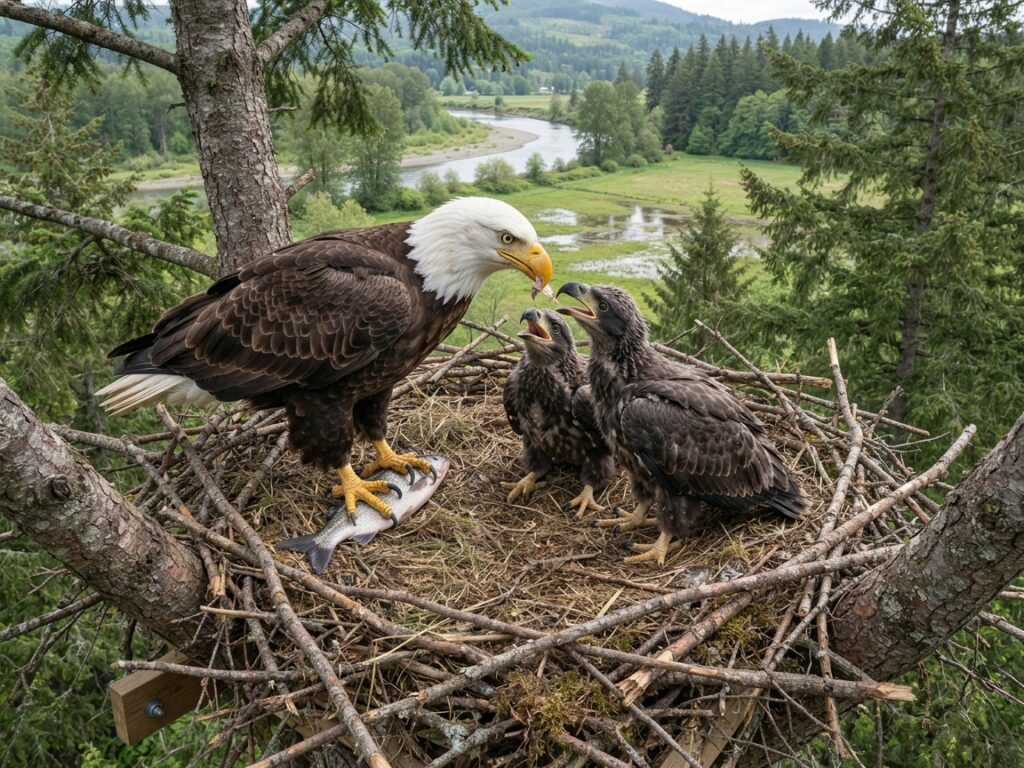
It was carrying a freshly caught fish.
The adult landed inside the replacement nest.
Then it began tearing small pieces from its catch.
Both eaglets reached toward the food.
The smaller youngster received a piece.
Then another.
Emily smiled.
“He’s feeding them.”
Margaret lowered her binoculars.
Tears streamed down her cheeks.
“The babies are home.”
Over the following weeks, Margaret developed a new morning routine.
She prepared her tea.
Walked onto the covered porch.
And watched the replacement nest through her binoculars.
The healthy adult eagle continued bringing food.
Both eaglets grew rapidly.
Their soft down gradually gave way to developing dark feathers.
Margaret kept a small notebook beside her favorite chair.
Every morning, she recorded what she observed.
Both babies fed this morning.
Smaller baby standing much stronger.
Both stretching their wings.
Father returned with another fish.
Whenever Daniel visited, Margaret showed him her latest observations.
He was delighted by her enthusiasm.
But Margaret never forgot the injured mother eagle.
“How much longer before she can come home?”
Daniel explained that her fracture was healing well.
However, she needed to regain full strength and flight endurance before release.
Margaret understood.
“Tell her we’re waiting.”
Daniel smiled.
Although the eagle couldn’t understand such a message, he knew how much the bird’s recovery meant to Margaret.
At the rehabilitation center, the mother eagle gradually progressed through treatment.
Her fractured wing healed.
Veterinarians assessed its movement and strength.
Once medically appropriate, she was transferred into a specialized flight conditioning enclosure.
Her earliest flights were short.
Her movements were cautious.
But over time, she became stronger.
She began flying longer distances between perches.
Her landings improved.
Both wings moved more evenly.
The rehabilitation team continued monitoring her physical condition and natural behavior.
They wanted to ensure that she could survive independently after release.
Nearly ten weeks after the original rescue, Emily called Margaret with wonderful news.
“She’s passed her flight assessments.”
Margaret immediately began crying.
“Does that mean she’s coming home?”
“We’re preparing to release her near her original territory.”
Margaret looked toward the meadow.
“And her babies?”
“They’re growing beautifully. We can’t promise she’ll return to the nest, but releasing her nearby gives her that opportunity.”
Margaret smiled.
“That’s all I could ever ask for.”
On the morning of the release, the sky was unusually clear.
Sunlight reflected across the river.
The meadow had recovered from the flooding.
Wildflowers were growing beside the farmhouse fence.
Margaret walked toward the designated viewing area with Robert.
Daniel and Emily arrived carrying the specialized wildlife transport enclosure.
Several members of the rehabilitation team accompanied them.
Margaret stood quietly.
She remembered the eagle crouching beside her porch.
Its soaked feathers.
Its injured wing.
The six hours she had spent waiting for help.
Now, after weeks of treatment, the bird was ready to fly again.
Emily opened the transport enclosure.
For several seconds, the eagle remained inside.
Then she stepped forward.
Her white head turned toward the river.
Her enormous wings unfolded.
With several powerful wingbeats, she lifted into the air.
Margaret immediately began crying.
“Look at her!”
The eagle gained altitude.
She flew across the meadow before turning toward the distant woodland.
Margaret watched until she disappeared.
“Go find your babies, sweetheart.”
Emily gently placed a hand on Margaret’s shoulder.
The eagle was free.
And whatever happened next would be determined by nature.
For the next three mornings, Margaret watched the skies.
She continued seeing the healthy adult eagle near the replacement nest.
The young birds were now approaching fledging age.
One had already begun moving onto nearby branches.
But Margaret hadn’t seen the released mother.
She reminded herself that the bird’s survival was already a wonderful outcome.
Then, on the fourth morning, something unexpected happened.
Two adult bald eagles appeared above the river.
One carried a fish.
The other flew toward the replacement nesting tree.
Margaret hurried inside and retrieved her binoculars.
Both adults landed near the nest.
The young eagles began calling.
Margaret noticed a small identification band around one adult’s leg.
She immediately called Daniel.
“I think she’s back.”
Daniel arrived with the wildlife biologist later that morning.
Using a powerful spotting scope and photographs, they examined the band.
The identification matched the rehabilitated eagle.
Daniel turned toward Margaret.
“It’s her.”
Margaret covered her mouth.
“Oh, my beautiful girl.”
Over the following days, remote monitoring provided even more encouraging evidence.
The recovered adult was observed bringing food to the nesting area.
Both adults continued using the territory.
The young eagles responded normally to their presence.
The mother had successfully returned to her family.
Margaret sat on her porch and cried.
She had spent six hours watching over an injured bird.
Now she was watching that same bird help care for her babies again.
Several weeks later, Margaret witnessed another extraordinary moment.
The larger eaglet moved onto a branch beside the replacement nest.
It spread its enormous dark wings.
Then launched into the air.
Its first flight was brief.
Its landing was slightly awkward.
But it successfully reached another tree.
Margaret laughed with happiness.
“One of them did it!”
Three days later, the smaller eaglet followed.
The same young bird that had nearly drowned beside the flooded riverbank spread its wings and flew across the meadow.
Margaret stood beside Robert.
Neither spoke for several seconds.
Then Robert smiled.
“Remember when you were sitting on that porch in the rain?”
Margaret nodded.
“I thought their mother wasn’t going to survive.”
Robert pointed toward the distant trees.
“Look at them now.”
Both young eagles had successfully fledged.
They would continue depending on their parents while developing their flight and hunting abilities.
But they had reached an important milestone.
Margaret wiped her eyes.
“Every one of them got another chance.”
One Saturday morning, Margaret heard several vehicles approaching her farmhouse.
She stepped onto the porch.
To her surprise, her grandchildren were climbing out of the vehicles.
Daniel and Emily were with them.
Several volunteers carried gardening tools, wooden boards, and flowerpots.
Margaret looked confused.
“What’s everyone doing here?”
Her oldest granddaughter, Hannah, smiled.
“We heard you’ve been spending a lot of time watching eagles.”
Margaret laughed.
“I suppose I have.”
Hannah explained that the family and wildlife rehabilitation volunteers had organized a small surprise.
They wanted to repair Margaret’s aging porch.
Several wooden boards had deteriorated.
The handrail needed replacing.
And the old chair Margaret had used during the rainstorm was becoming increasingly uncomfortable.
By late afternoon, the volunteers had repaired the damaged sections of the porch.
They installed a sturdy handrail.
They placed a comfortable new wooden chair beside the kitchen window.
And they arranged several pots of colorful flowers nearby.
Hannah handed Margaret a framed photograph.
It showed the recovered mother eagle standing beside the replacement nest while her two young birds waited for food.
Margaret stared at the photograph.
Then she began crying.
“Oh, that’s beautiful.”
Daniel smiled.
“We thought you might like something to remember them by.”
Margaret hugged her granddaughter.
Then she turned toward the wildlife team.
“You’ve given me far more than a new porch.”
Emily looked at her.
“What do you mean?”
Margaret smiled through her tears.
“You’ve given me something wonderful to wake up for.”
As summer gradually turned into autumn, the young eagles became increasingly independent.
They spent longer periods away from the nesting area.
Margaret sometimes watched them flying above the river.
Other times, she went several days without seeing them.
She knew that eventually they would explore new territories.
They were not meant to remain beside her farmhouse forever.
Their freedom was the entire purpose of the rescue.
One morning, Daniel visited with a small envelope.
Inside was a letter from the rehabilitation team.
Dear Margaret,
When you called us during that terrible rainstorm, you helped save more than one injured eagle.
Your careful observations helped us discover two young birds in danger.
Your patience gave us the opportunity to help an entire family.
Thank you for reminding us that kindness begins with noticing when another living creature needs help.
Margaret read the letter slowly.
Then she placed it beside the photograph of her late husband.
For nine years, the farmhouse had often felt unbearably quiet.
But now her grandchildren visited more frequently.
Her neighbor Robert regularly joined her for tea.
And her mornings were filled with the sounds of birds, rustling trees, and distant flowing water.
The eagles had not replaced the people she loved.
But the experience had brought new connections and happiness into her life.
The following spring, Margaret helped support a local wildlife conservation project.
Volunteers organized riverbank cleanups and educational activities about protecting nesting habitats.
Margaret prepared homemade sandwiches, cookies, and hot drinks for the participants.
Whenever someone asked about the bald eagle family, she told them the story.
She described the terrible rainstorm.
The injured mother beside her porch.
The damaged nest.
The two frightened eaglets.
And the remarkable day when the recovered adult returned to her family.
She always reminded people that injured wildlife should be reported to trained professionals.
“I couldn’t fix her broken wing,” Margaret explained.
“I couldn’t climb that enormous tree.”
She smiled.
“But I could make a telephone call.”
Almost one year after the original rescue, Margaret woke to the sound of rain.
She prepared her tea and wrapped herself in the same old wool blanket.
Then she walked onto her repaired porch.
The rain was gentle this time.
Water droplets collected on the garden flowers.
Mist drifted across the distant meadow.
Margaret sat in her new wooden chair.
For several minutes, she watched the peaceful countryside.
Then an adult bald eagle appeared above the evergreen trees.
A second eagle followed.
Both flew toward the river.
Margaret couldn’t read their identification bands from that distance.
She had no way of knowing whether they belonged to the family she had helped save.
But she smiled anyway.
“Good morning, beautiful birds.”
She watched until they disappeared.
Then she looked toward the wooden steps where the injured mother had once struggled to stand.
She remembered how frightened she had been.
How long those six hours had felt.
How desperately she had hoped someone would arrive in time.
And she remembered what happened because she refused to ignore an animal in need.
One injured mother had been given another chance to fly.
Two helpless eaglets had survived a devastating storm.
And an entire bald eagle family had been given the opportunity to live freely again.
Margaret had never expected recognition.
She had never asked for a reward.
She had simply seen a frightened animal suffering in the rain and decided that its life mattered.
At eighty-five years old, she had discovered that compassion didn’t require extraordinary strength.
It didn’t require wealth.
And it certainly didn’t require youth.
Sometimes, it required nothing more than a caring heart, a little patience, and the willingness to ask for help.
Margaret lifted her cup of tea.
Above the distant meadow, a bald eagle emerged from the mist and spread its enormous wings.
She smiled.
“Every mother deserves the chance to see her babies grow.”
Then she settled into her chair and watched the eagle disappear into the beautiful Washington wilderness.
THE END. ❤️🦅
No Comments