

At 11:47 AM, school custodian Raymond Ellis stood frozen inside the security office at Pine Creek Elementary in northern Wisconsin.
His phone was pressed against his ear.
Wildlife responder Claire Bennett had just told him something that made his stomach drop.
“Raymond, don’t go near that shed yet. We just checked the camera from last night, and there’s something else moving underneath it.”
Raymond stared at the surveillance monitor.
“What do you mean, something else?”
Claire hesitated.
“We don’t think those three foxes were the only animals sheltering there.”
Outside, fresh snow covered the empty playground.
The school had been closed since the previous night’s storm.
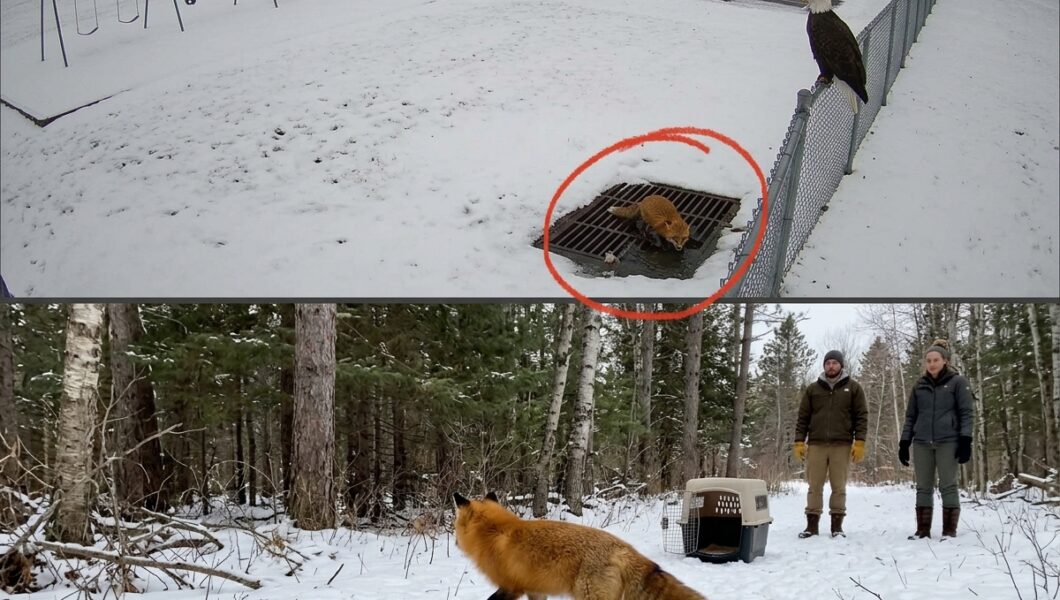
Two young red foxes had already been rescued from a flooded drainage culvert beneath the playground.
Both were recovering at a licensed wildlife rehabilitation facility.
But another camera had revealed a third, smaller fox following an adult toward the maintenance shed.
And beneath that shed was an old underground utility chamber.
A chamber Raymond knew had flooded before.
He opened the recording from Camera Four.
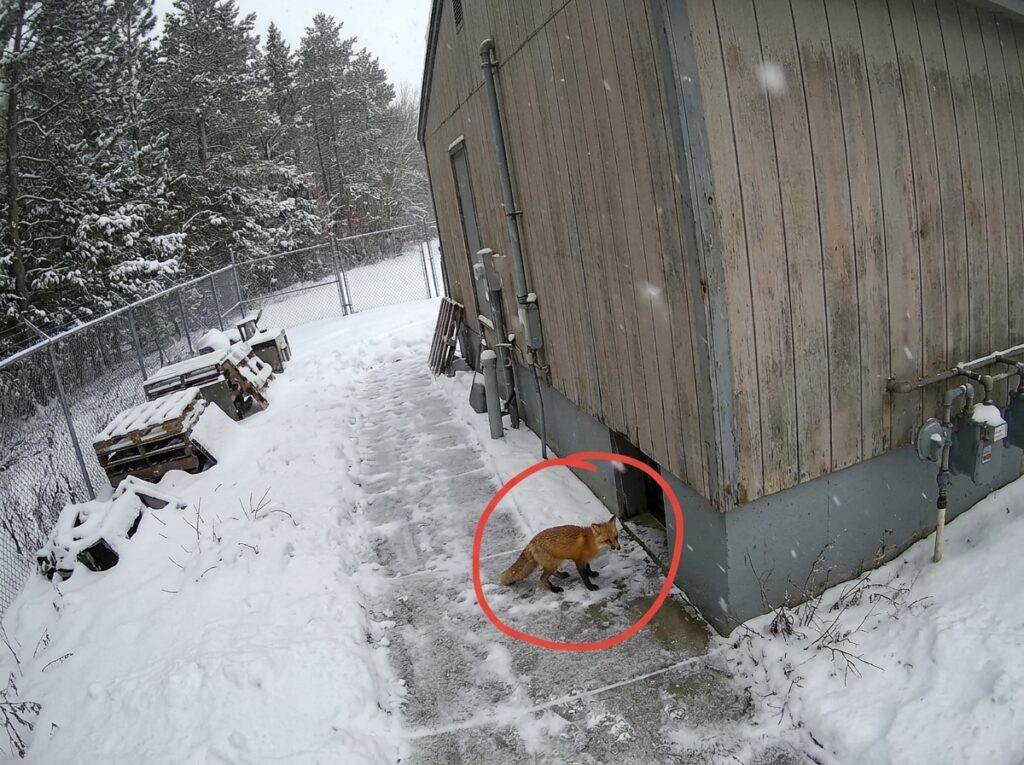
At 6:11 AM, the adult fox emerged from the tree line.
A small reddish animal followed.
They crossed the snow-covered service path and disappeared behind the maintenance building.
The smaller fox paused near a gap beneath the foundation.
Then crawled inside.
Raymond leaned closer.
“Claire, what did you see on last night’s recording?”
“Go back to 11:38 PM.”
Raymond moved the recording backward.
The camera showed the maintenance shed beneath a weak security light.
Snow blew across the concrete walkway.
For several seconds, nothing happened.
Then something moved beneath the foundation.
A small fox emerged.
It stood beside the opening.
Looked toward the woods.
And disappeared again.
A moment later, another fox appeared.
Raymond sat upright.
“That’s two.”
“Keep watching,” Claire said.
At 11:41 PM, the adult fox approached from the trees.
It paused near the foundation.
Then lowered its head toward the opening.
A third small fox briefly appeared beside it.
Raymond stared.
“There were three under there last night?”
“At least three animals were visible at different moments,” Claire answered. “We can’t confirm whether they were all different individuals.”
Raymond watched the adult disappear behind the shed.
He remembered the two foxes rescued from the culvert that morning.
The smaller fox seen at 6:11.
And the additional movements recorded overnight.
“How many are down there now?”
“We don’t know.”
He looked toward the maintenance building.
The snow-covered roof.
The frozen service path.
The old concrete foundation.
And the utility chamber beneath it.
Then he remembered something.
“Claire, that chamber has a floor drain.”
“Where does it lead?”
“To the same drainage system behind the playground.”
There was silence.
Then Claire asked:
“Is that drain still connected?”
Raymond opened the maintenance records.
His hands moved quickly across the keyboard.
The chamber had been taken out of service twelve years earlier.
Its electrical equipment had been removed.
But the drainage connection had never been fully abandoned.
And the previous night’s storm had overwhelmed the system.
Raymond swallowed.
“Claire, if the culvert backed up, water could have entered the chamber.”
“Then we need public works and the appropriate rescue personnel to assess it before anyone approaches the opening.”
Raymond looked toward the shed.
Somewhere beneath that building, an animal might already be standing in freezing water.
And nobody knew how many others were trapped with it.
At 12:16 PM, county maintenance supervisor Daniel Price arrived with two public works employees.
Claire was already waiting near the school entrance.
Raymond met them beside the parking lot.
He carried a printed site plan showing the underground chamber and its drainage connection.
Daniel studied the drawing.
“The chamber is only accessible through an old service hatch inside the shed.”
“Can we open it?” Raymond asked.
“Not until we’ve assessed the structure and the hazards.”
The team established a safety perimeter.
Nobody entered the underground space.
Daniel arranged for personnel qualified to assess confined spaces, structural stability, and drainage hazards.
The chamber could contain standing water, poor air quality, and unstable debris.
A wildlife rescue was important.
But sending someone into an unsafe underground structure could create another emergency.
Claire agreed.
“We need to protect the animals without putting anyone else in danger.”
Raymond nodded.
He looked toward the shed.
The adult fox had not returned to the visible opening.
But that didn’t mean it had left the area.
At 12:42 PM, the team began examining the exterior foundation.
A narrow gap had formed beneath the western wall.
The opening was large enough for a small fox to crawl through.
But it was too narrow for a person.
Daniel used a flashlight from a safe position outside.
The beam revealed damp soil.
Broken concrete.
And a shallow slope leading toward the underground chamber.
Then something moved.
A small reddish face appeared.
Claire immediately raised her hand.
“Everyone stay still.”
The fox remained near the opening.
Its ears were flattened.
Its fur was wet.
And its breathing appeared rapid.
Raymond whispered:
“That’s the little one.”
The fox looked toward the people.
Then retreated into the darkness.
Claire watched carefully.
“It can move. That’s encouraging.”
But Daniel noticed something else.
Water was slowly seeping along the bottom of the foundation gap.
He checked the drainage assessment.
“The chamber may still be taking on water.”
Raymond felt his stomach tighten.
“How much time do we have?”
Daniel shook his head.
“We can’t estimate that safely yet.”
The team needed to control the water before attempting a rescue.
At 1:08 PM, Daniel received confirmation that the blocked drainage outlet had been partially cleared from a safe exterior access point.
Water levels in the affected system were beginning to stabilize.
The team continued monitoring before attempting any wildlife capture.
Meanwhile, Claire reviewed the latest camera footage.
The adult fox had appeared near the tree line at 12:57 PM.
It stood beneath a pine tree, watching the maintenance shed.
Then it moved along the fence.
It did not approach the responders.
Raymond watched from the security office.
“She’s still here.”
Claire answered over the phone.
“An adult fox is still nearby. We can’t confirm it’s female or that it’s the parent of the smaller animals.”
Raymond nodded.
“I know.”
But he couldn’t stop thinking about the recordings.
The adult returning repeatedly.
The young foxes entering the drainage system.
And the small animal beneath the shed.
He wanted to believe the adult had been searching for its young.
It was possible.
But the cameras couldn’t tell them what the fox was thinking.
At 1:36 PM, the qualified inspection team completed its initial exterior assessment.
The structure appeared stable enough for a carefully planned rescue from outside the chamber.
The team identified a safe way to access the animals without sending anyone into the underground space.
Claire prepared a humane capture setup near the foundation opening.
The responders minimized noise and movement.
Raymond remained behind the safety barrier.
For several minutes, nothing happened.
Then a small fox appeared.
Its nose emerged first.
Then its head.
It hesitated.
Claire remained still.
The fox stepped forward.
Its wet paws touched the snow.
Then it suddenly turned back toward the opening.
Raymond held his breath.
“Please.”
The animal disappeared again.
Claire didn’t move.
She knew frightened wildlife might retreat repeatedly before leaving a shelter.
The team adjusted its approach.
They allowed the area to become quiet.
Then, at 2:04 PM, the small fox emerged once more.
This time, it moved farther from the foundation.
Claire and the trained responders used the prepared humane capture equipment to secure the animal safely.
The fox struggled briefly.
Then settled inside a covered transport carrier.
Raymond exhaled.
“Thank goodness.”
Claire checked the animal’s condition.
It was alert.
Cold.
And visibly exhausted.
But alive.
The team prepared it for transport to the rehabilitation facility.
Then Daniel called from the opposite side of the shed.
“Claire, we have another movement.”
Everyone turned.
A second small fox had appeared beneath a loose foundation panel.
It was slightly larger than the first.
Its fur was dry along the back but muddy around the legs.
It looked toward the clearing.
Then disappeared.
Claire studied the opening.
“That confirms another animal is still inside.”
Raymond closed his eyes.
The rescue wasn’t over.
At 2:31 PM, the team positioned a second humane capture setup near the alternate opening.
They monitored the area from a safe distance.
The fox remained hidden.
Daniel checked the water-level readings.
The drainage system was stable.
There was no evidence of rapidly rising water at that moment.
But the team continued working carefully.
At 3:02 PM, the second fox emerged.
It paused near the foundation.
Then moved toward the prepared capture area.
The trained responders secured it without unnecessary struggle.
The animal was transferred into a separate covered carrier.
Claire examined it briefly.
“Alert and responsive.”
Raymond smiled.
“That’s four young foxes today.”
Claire nodded.
“Four individual juveniles have now been captured from the drainage and shed areas, based on our records. We still need to confirm whether any animals remain inside.”
Raymond looked toward the shed.
He wanted the rescue to be finished.
But nobody was willing to assume the chamber was empty.
The team continued observing.
At 3:24 PM, Daniel used an inspection camera from a safe exterior access point.
The small device entered the chamber through an existing opening.
The camera showed damp concrete.
Old pipe supports.
Shallow standing water.
And several pieces of debris.
Then the image shifted.
Something moved behind a broken panel.
Daniel adjusted the camera.
A pair of eyes reflected the light.
Raymond leaned toward the monitor.
“Another fox?”
Claire studied the image.
The animal was larger than the juveniles.
Its reddish coat appeared darker.
And it was crouched near the back wall.
“Possibly an adult,” she said.
Daniel moved the camera slightly.
The animal lifted its head.
Then retreated behind the panel.
Claire looked toward the team.
“We need to reassess before attempting anything else.”
The larger fox might have entered the chamber independently.
It might have been sheltering there before the juveniles arrived.
Or it might have been associated with them.
The team couldn’t know.
But one thing was clear.
There was still a living animal beneath the school.
At 4:06 PM, the responders developed a plan to encourage the larger fox to leave through a safe exterior route.
They kept people away from the opening.
They avoided blocking the animal’s escape.
And they monitored the surrounding area.
The adult fox seen near the tree line earlier had not been individually identified.
There was no way to know whether the animal in the chamber was the same fox.
Raymond understood that.
But the possibility made him uneasy.
He watched the security monitor.
The maintenance shed stood quiet.
Snow continued falling.
Then, at 4:38 PM, something moved beneath the foundation.
A reddish muzzle appeared.
A larger fox stepped into the open.
It paused beside the wall.
Its ears turned toward the forest.
Then it moved quickly across the snow.
Within seconds, it disappeared into the trees.
Claire watched through binoculars.
The fox appeared mobile and alert.
The team did not pursue it.
Instead, they documented the observation and continued checking the chamber for remaining animals.
At 5:12 PM, the inspection camera showed no further visible wildlife.
The team maintained monitoring and arranged follow-up checks before the chamber would be permanently secured.
Raymond stood beside Daniel.
“Do you think that’s everyone?”
Daniel looked toward the foundation.
“We’ve accounted for the animals we observed, but we can’t promise there aren’t others without continued inspection.”
Raymond nodded.
For the first time all day, he felt able to breathe normally.
Four young foxes had been rescued.
A larger fox had left the chamber.
And the drainage system was no longer rapidly backing up.
But the next challenge was only beginning.
At 6:27 PM, Claire called Raymond from the rehabilitation facility.
He answered immediately.
“How are they?”
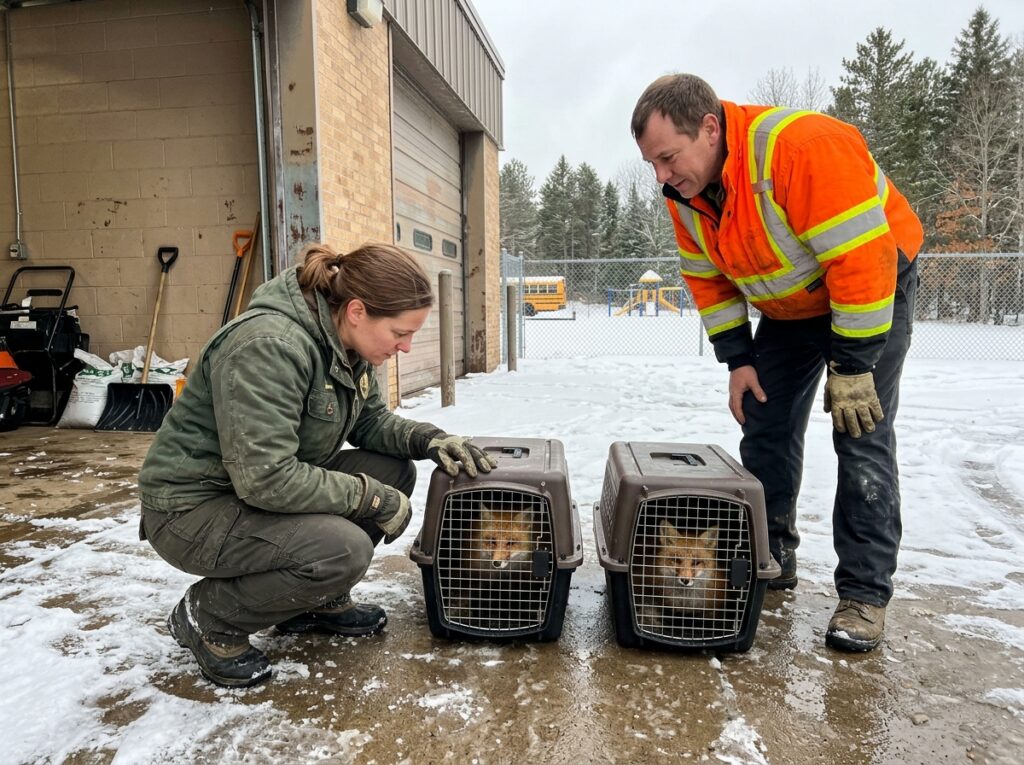
“The two foxes rescued from the culvert this morning are stable.”
Raymond smiled.
“And the others?”
“The two from the shed are being examined now.”
The smaller fox was dehydrated and mildly hypothermic.
It had superficial abrasions on its paws.
The larger juvenile was cold and underweight but showed no obvious major injuries during the initial assessment.
All four animals required continued observation.
The rehabilitation team housed them appropriately while evaluating their health and possible relationships.
They did not immediately place all four together.
Foxes could become stressed or aggressive in unfamiliar circumstances.
The team needed to consider their age, behavior, condition, and whether group housing was appropriate.
Raymond listened carefully.
“So they’re going to make it?”
Claire paused.
“They’re stable right now. That’s encouraging, but we’ll keep monitoring them.”
He nodded.
“That’s good enough for tonight.”
After ending the call, Raymond walked through the empty school hallway.
The lights were dim.
Snow tapped against the windows.
He passed a row of colorful drawings outside a classroom.
One showed a fox standing beneath a tree.
Raymond stopped.
He smiled faintly.
Then he looked toward the playground.
The drainage grate had been secured.
The maintenance shed was surrounded by temporary barriers.
And the school would remain closed until the necessary safety checks were completed.
For twenty-three years, Raymond had repaired doors, cleared snow, and kept the building safe for children.
He had never imagined that a routine security-camera check would lead to a wildlife rescue involving four young foxes.
But he was grateful he had noticed.
Over the following days, the rehabilitation team continued caring for the animals.
The first two foxes recovered from their exposure to icy water.
Their abrasions healed.
And their activity levels improved.
The two rescued from beneath the shed also gained strength.
They began eating normally.
Their body temperatures stabilized.
And their behavior became more consistent with healthy juvenile foxes.
The veterinary team found no evidence of serious fractures or lasting injuries.
But they continued monitoring before making any release decisions.
Raymond received occasional updates through Claire.
He never requested to visit the foxes unnecessarily.
He understood that wild animals needed to remain wary of people.
The goal wasn’t to make them comfortable around humans.
It was to help them recover and return to independent life.
Meanwhile, public works completed the drainage repairs.
The blocked outlet was cleared.
Damaged sections were assessed.
And the school arranged to secure the old utility chamber after confirming that no wildlife remained inside.
The foundation openings were repaired using appropriate wildlife exclusion procedures.
The maintenance team also established a routine inspection schedule for the drainage system.
Raymond helped update the records.
He included photographs.
Inspection dates.
And a note explaining why the chamber needed regular checks.
At the bottom of the maintenance report, he wrote:
Wildlife access points must be assessed before permanent sealing.
He stared at the sentence.
It was simple.
But important.
If someone had sealed the opening without checking the chamber, animals could have been trapped inside.
Raymond wanted to make sure that never happened.
In early December, Claire called with encouraging news.
“All four juveniles are making good progress.”
Raymond smiled.
“Really?”
“Yes. Their injuries have healed, and they’re showing appropriate natural behavior.”
“Can they go back to the woods?”
“Not yet. We need to assess their readiness and choose suitable release conditions.”
Raymond nodded.
“I understand.”
The foxes continued rehabilitation.
They were monitored for normal feeding.
Mobility.
Alertness.
And appropriate avoidance of humans.
The team also assessed whether they could safely live independently.
The juveniles had been rescued in November.
They were no longer tiny dependent kits.
But they still needed to demonstrate the skills necessary to survive.
The rehabilitation team worked to minimize human contact and avoid habituation.
By late December, the foxes had progressed significantly.
Their coats were healthy.
Their body condition had improved.
And they were moving confidently in appropriate outdoor rehabilitation enclosures.
The team documented their behavior.
Each animal was assessed individually.
The smallest fox required a little more time.
Its body condition had been poorer at admission.
But it continued improving.
Raymond followed the updates.
He thought about the small fox standing alone beside the maintenance shed.
The one that had crawled into the foundation gap.
He remembered how frightened it had looked.
Now it was recovering.
That was enough to make him smile.
On January 14, 2027, Claire called again.
“Raymond, the veterinary team has cleared the first two foxes for release.”
He stood up.
“Really?”
“Yes. They’ve met the necessary health and behavioral criteria.”
“What about the others?”
“They’re close. We’re continuing the final assessments.”
Raymond looked toward the playground.
The snow had grown deeper.
The drainage grate was clear.
And the maintenance shed had been repaired.
He thought about the bald eagle that had landed on the fence the morning everything began.
The bird hadn’t intended to rescue anyone.
It had simply been watching movement near the drainage channel.
But its presence had drawn Raymond’s attention to the camera.
And that moment had led to four young foxes receiving help.
Raymond smiled.
“That’s wonderful news.”
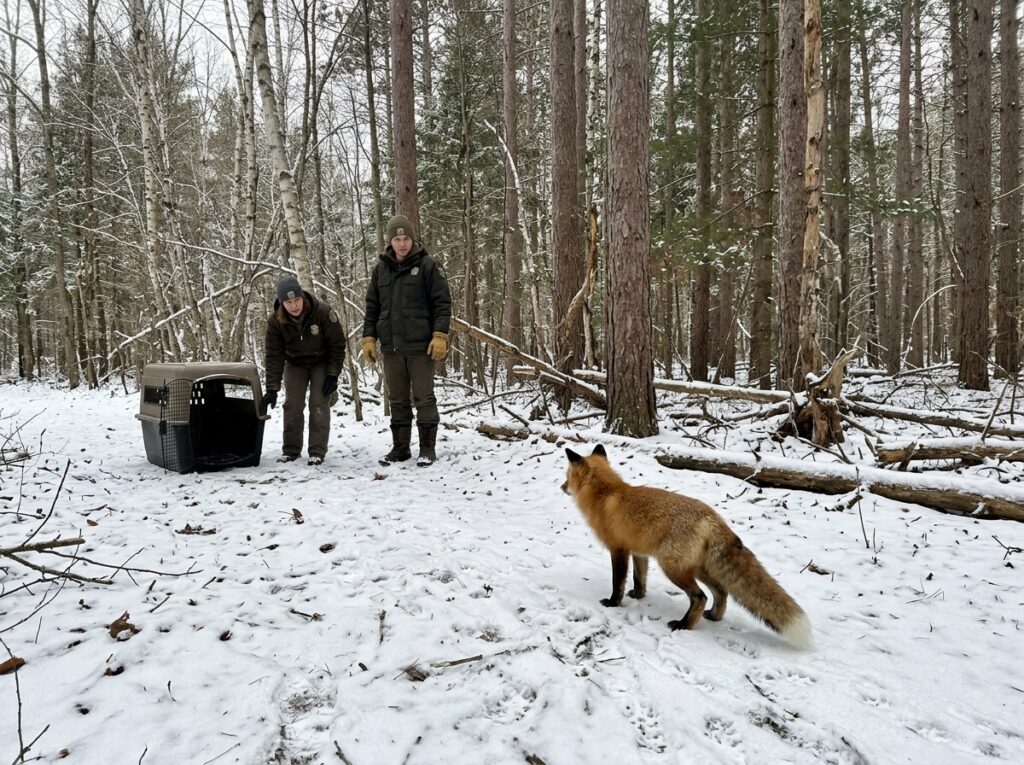
The first two foxes were released into suitable habitat after the rehabilitation team completed its final evaluations.
The release location was selected according to wildlife management guidance, available habitat, and seasonal conditions.
Raymond did not attend.
He understood that the animals’ return to the wild should not become a public event.
But Claire sent him a brief update afterward.
The foxes had left their carriers.
They moved into the woodland.
And neither showed immediate signs of difficulty.
Raymond read the message twice.
Then he smiled.
Two down.
Two more to go.
The remaining juveniles continued rehabilitation.
By early February, the smaller fox had gained sufficient body condition and demonstrated appropriate mobility and natural behavior.
The other fox had also completed its assessments.
Both received veterinary clearance.
Their release was planned by the licensed rehabilitation team.
Again, there were no crowds.
No unnecessary handling.
And no attempt to make the foxes interact with people.
The animals were returned to suitable habitat under appropriate conditions.
Claire called Raymond afterward.
“All four have been released.”
He sat down.
For a moment, he couldn’t speak.
Then he whispered:
“All four?”
“All four.”
He closed his eyes.
He remembered the first fox trapped beneath the playground grate.
Its orange fur soaked.
Its paws pressed against the metal.
The water rising around it.
Then the scratching sound from deeper inside the culvert.
The second fox.
The third fox beneath the maintenance shed.
And the fourth juvenile discovered near the underground chamber.
Four young animals.
Four separate medical evaluations.
Weeks of professional care.
And now, four chances to live freely again.
Raymond wiped his eyes.
“Thank you, Claire.”
She answered gently.
“The whole team worked hard.”
“I know.”
He looked toward the snowy playground.
“And I’m glad somebody was watching.”
Spring arrived slowly in northern Wisconsin.
The snow began melting.
The creek behind Pine Creek Elementary ran freely again.
And the school playground filled with children.
Swings moved in the breeze.
Basketballs bounced across the court.
And the maintenance shed stood beside a repaired drainage system.
Raymond continued his morning security checks.
Most days, the cameras showed nothing unusual.
A delivery truck.
A squirrel crossing the playground.
A deer near the tree line.
Occasionally, a bald eagle passed overhead.
Raymond smiled whenever he saw one.
He knew the eagle from November hadn’t deliberately helped the foxes.
It had simply behaved like a wild bird.
But its movement had drawn his attention to something he might otherwise have missed.
That was enough.
On April 21, Raymond opened a recording from Camera Four.
A red fox crossed the far edge of the school property shortly before sunrise.
It moved along the tree line.
Stopped beside a fallen branch.
Then disappeared into the woods.
Raymond leaned closer.
Could it be one of the rescued foxes?
He couldn’t tell.
The animal had no visible identification mark.
And many red foxes lived in the surrounding forest.
He saved the recording anyway.
Red fox observed near eastern woodland boundary. Identity unknown.
He smiled.
That was the most accurate description.
And it was enough.
Later that morning, Claire visited the school to review the completed wildlife exclusion and drainage safety measures.
Raymond showed her the repaired culvert.
The secured utility chamber.
And the updated maintenance records.
Claire nodded approvingly.
“This looks much safer.”
Raymond smiled.
“We’ve added the drainage system to our regular inspections.”
“Good.”
They walked toward the playground.
Children were laughing near the swings.
A teacher stood beside the basketball court.
And the winter storm that had closed the school months earlier felt like a distant memory.
Raymond stopped beside the fence.
“This is where the eagle landed.”
Claire looked toward the metal railing.
“The one you saw on the camera?”
He nodded.
“Right there.”
They stood quietly.
Then Raymond laughed softly.
“Funny how something so ordinary started all of this.”
Claire smiled.
“Sometimes noticing a problem is the first step toward solving it.”
Raymond looked toward the drainage grate.
The water was flowing normally.
The metal cover was secure.
And the surrounding area had been inspected.
He thought about the foxes.
He didn’t know where they were now.
He didn’t know whether they had crossed paths again.
And he couldn’t prove that the adult fox seen near the school had been their mother.
But he knew four young foxes had been rescued.
He knew they had received professional care.
And he knew the hazards beneath the playground had been repaired.
That was what mattered.
A few minutes later, a bald eagle glided above the pine trees.
Its white head flashed in the spring sunlight.
Raymond watched it cross the sky.
Then he looked back toward the children playing.
He smiled.
The school was safe.
The drainage system was working.
And somewhere beyond the playground, four young foxes had been given another chance.
The eagle hadn’t come to save them. It had simply landed where Raymond happened to be looking. But because one man paid attention, four wild animals were no longer trapped beneath a school.
Raymond adjusted his jacket.
Then walked back toward the building.
Behind him, the playground filled with laughter.
And beyond the fence, the forest continued living.
THE END
No Comments