

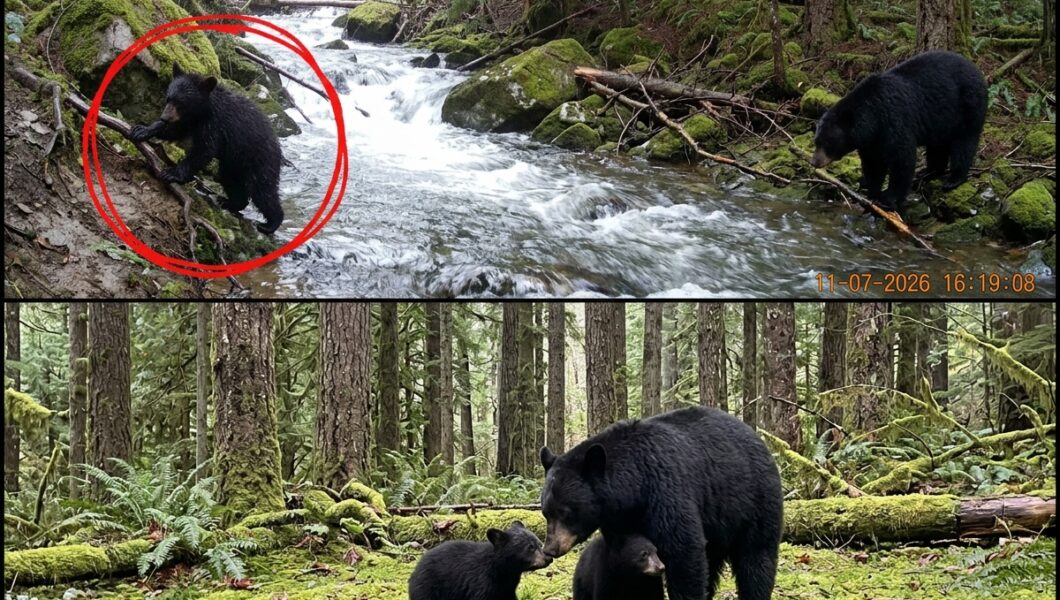
At 4:19 PM, forest wildlife technician Emily Carter watched a mother black bear lunge toward the rushing water of Alder Creek in Oregon’s western Cascade Mountains.
On the opposite bank, a tiny black bear cub was losing its footing.
Its front paw slipped from the muddy ledge. The cub slid sideways, scrambling against wet stones as brown floodwater rushed past its hind legs.
“Mark, it’s going in!” Emily shouted into her radio.
Wildlife biologist Mark Jensen was already watching the downstream camera feed from the district monitoring vehicle.
“Is the mother still on the near bank?”
“Yes. She’s trying to reach it.”
The adult bear stepped into the shallow edge of the creek, but the current struck her legs. She retreated onto firmer ground, moved several yards downstream, and searched for another crossing.
Across the water, the cub clawed at an exposed tree root.
For one terrible moment, its back feet disappeared beneath the surface.
Then it pulled itself onto a narrow shelf of mud.
Emily pressed a hand against her mouth.
The cub was still alive.
But the water was rising.
And somewhere several miles away, its injured sibling was being examined by a veterinarian after spending hours trapped beneath a fallen pine.
The mother had two cubs.
Now both were in danger.
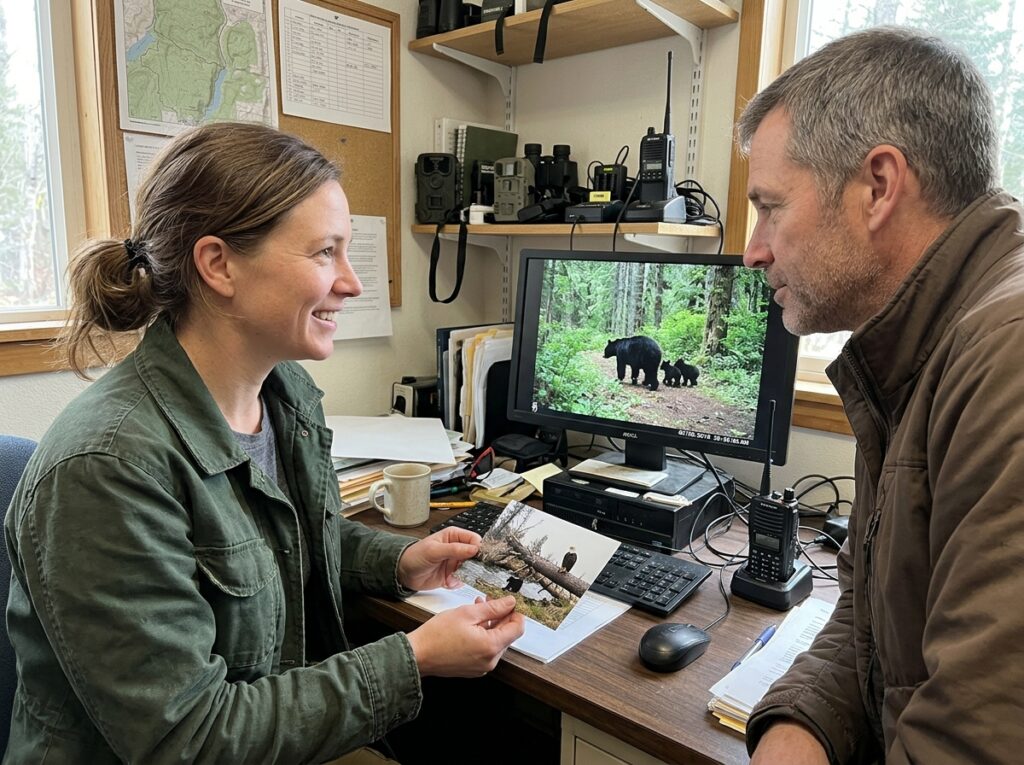
Emily had spent six years monitoring wildlife in the fictional Cedar Ridge National Forest, but she had never experienced an afternoon like this. That morning, a bald eagle landing on a fallen pine had drawn her attention to a trapped bear cub. A trained response team had freed the animal from beneath a heavy branch, but a compression injury to its hind leg required further veterinary assessment.
Only afterward had Emily discovered that another cub had been present when the tree fell.
The smaller animal had fled toward the creek.
Now the trail camera showed it stranded on a muddy bank with floodwater on one side and a steep, slippery slope on the other.
Mark studied the camera feeds.
“We need to know whether there’s a safe route to that bank.”
Emily switched to the wider downstream view. The storm had damaged the old footbridge, and several fallen trees blocked the nearest service trail.
“There isn’t an easy way in,” she answered.
Mark contacted the wildlife response coordinator and requested a rapid assessment from the trained field team.
He also asked the veterinarian caring for the first cub for an update.
Dr. Laura Mitchell answered from the temporary wildlife examination facility.
“The cub is stable. Its leg is swollen, but we’re not seeing evidence of a major fracture on the initial examination.”
“Can it walk?”
“Not comfortably yet. We’re continuing to assess circulation and soft tissue damage.”
Mark looked toward the creek monitor.
“We’ve found its sibling.”
Laura went silent.
Then she asked, “Is it safe?”
“Not yet.”
At 4:31 PM, the mother bear appeared again.
She had moved upstream to a place where the creek widened around a gravel bar. The water was shallower there, although it remained fast.
Emily watched the adult bear enter cautiously.
The mother crossed part of the channel, climbed onto the gravel, and continued toward the far bank.
“She’s trying another route,” Emily said.
Mark leaned closer.
“Keep the camera on her.”
The mother disappeared behind a stand of young alder trees.
For several minutes, Emily could see only moving branches.
Then the downstream camera recorded the smaller cub turning its head.
It stood on its hind legs.
Its mouth opened.
The mother emerged above the muddy bank.
Emily felt a rush of relief.
“She’s made it!”
The adult bear approached the cub and lowered her muzzle. The little animal pressed against her chest, then tried climbing the bank beside her.
But the mud collapsed beneath its feet.
The cub slid backward.
The mother turned and caught its movement, stepping between the cub and the rushing water.
She nudged it toward a firmer patch of ground.
The cub scrambled upward.
For several seconds, the two animals disappeared behind a boulder.
Emily waited.
Then the camera caught them again.
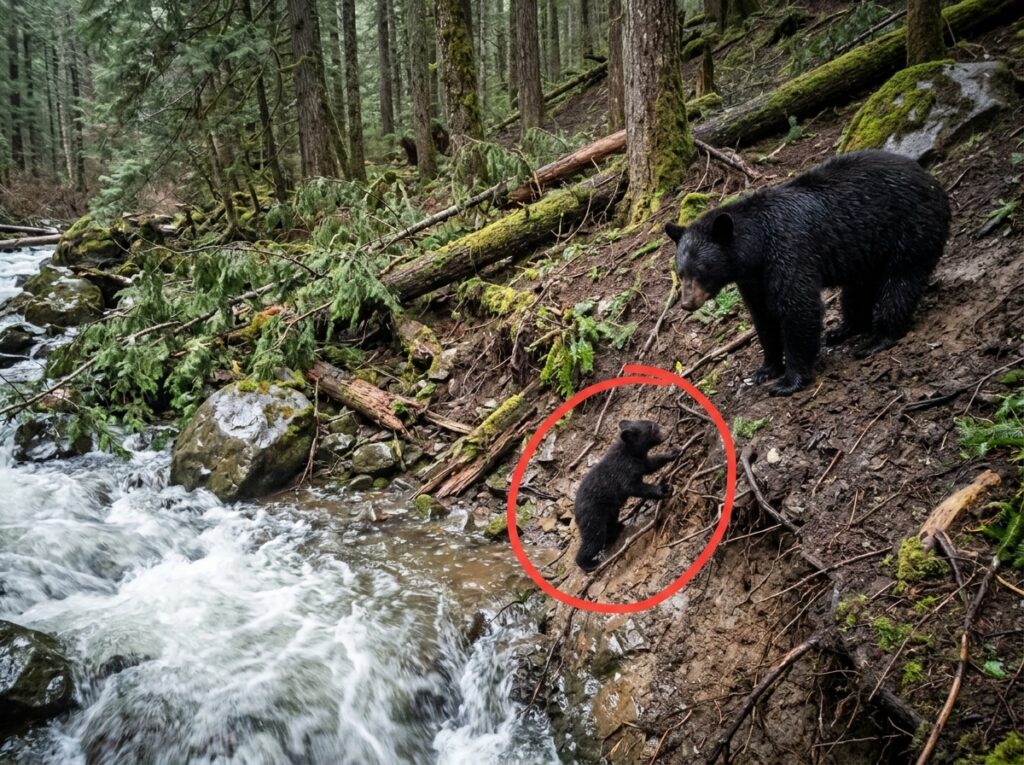
The mother was climbing the slope.
The cub followed.
Slowly.
Awkwardly.
But it was moving away from the creek.
Emily leaned back in her chair.
“Oh, thank goodness.”
Mark exhaled.
“Don’t assume they’re clear yet. Keep watching.”
The slope above the bank was steep, and the mother had to navigate fallen branches and loose soil.
The cub stopped twice.
Each time, the mother paused nearby.
Finally, at 4:46 PM, both bears reached a wooded shelf above the floodwater.
The cub pressed against the mother’s side.
She lowered her head and sniffed it.
Then the two disappeared into the trees.
Emily wiped her eyes.
“She got to it.”
Mark nodded.
“She did.”
For the first time that afternoon, the second cub was no longer in immediate danger from the creek.
But the rescue team still faced a difficult decision.
Its sibling was injured.
And the mother had no way of knowing where it had been taken.
At 5:12 PM, Mark called Laura again.
“The mother reached the second cub. Both have moved away from the creek.”
Laura sounded relieved.
“That’s excellent.”
“But we still have the first cub.”
“I know.”
Mark asked whether the injured animal might be suitable for a carefully managed reunion once its condition improved.
Laura explained that the decision would depend on several factors: the severity of the leg injury, the cub’s ability to move, the mother’s location, and whether trained personnel could arrange a reunion without creating another dangerous encounter.
“We cannot rush this,” she said.
Mark agreed.
The first cub had survived being pinned beneath a heavy branch.
But returning it too early could leave it unable to follow its mother.
Keeping it in care unnecessarily could also complicate a reunion.
The team needed to balance both risks.
That evening, Emily remained at the monitoring office.
She replayed the footage of the mother crossing the creek.
The adult bear had not performed some impossible act.
She had simply searched for a safer route, crossed the water, and reached her young.
But watching the cub follow her into the forest had been one of the most emotional moments of Emily’s career.
At 7:38 PM, another camera recorded the mother and the smaller cub traveling along a sheltered ridge.
The cub walked close behind her.
It appeared tired but mobile.
Emily sent the footage to Mark.
He replied a few minutes later.
“Good. We know their general location.”
Then he added:
“Keep the cameras running overnight.”
Emily understood why.
The mother might remain nearby.
And if the injured cub recovered enough for release, knowing where the family had traveled could be essential.
The next morning, Laura called with encouraging news.
The rescued cub had eaten a small amount of appropriate food under veterinary supervision.
Its body temperature was normal.
The swelling in its hind leg had begun to decrease.
But it was still reluctant to bear full weight on the injured limb.
Emily asked the question she had been thinking about all night.
“Does that mean it can’t go back yet?”
“Not yet,” Laura answered. “We need to be confident it can move well enough to keep up with its mother.”
Emily looked toward the forest.
“She was searching for both of them.”
Laura paused.
“She may still be searching.”
Those words stayed with Emily throughout the morning.
At 10:16 AM, the ridge camera recorded the mother and smaller cub again.
They were moving through a stand of young fir trees.
The mother stopped beside a fallen log.
She sniffed the ground.
Then lifted her head.
For nearly a minute, she remained still.
The smaller cub stood behind her.
Emily watched closely.
The mother turned toward the direction of Alder Creek.
Then walked downhill.
The cub followed.
Mark reviewed the footage.
“She’s returning toward the original area.”
Emily looked at him.
“Do you think she’s looking for the other cub?”
“Possibly. But we can’t know what she’s responding to.”
The team continued monitoring.
By noon, the mother had approached the fallen pine where the first cub had been trapped.
She sniffed the disturbed ground.
Circled the tree.
Then stopped beside the muddy patch where responders had lifted the heavy branch.
The smaller cub stood a few feet away.
Emily watched the recording in silence.
The mother lowered her muzzle toward the ground.
Then moved around the tree again.
It was impossible to know precisely what she understood.
But she had returned to the place where her injured cub had last been seen.
Emily felt tears gathering in her eyes.
“Mark, we have to try to get them back together.”
He nodded.
“If the veterinarian clears the cub, we’ll evaluate a controlled reunion.”
The following two days passed slowly.
The injured cub rested under specialist care.
Laura and her team monitored its leg, hydration, appetite, and movement.
Emily continued checking the cameras.
The mother and smaller cub remained in the broader Alder Creek area.
They moved between sheltered forest slopes, occasionally appearing near the fallen pine.
Each sighting was documented.
Each movement was reviewed.
And every day, Emily hoped for the same telephone call.
Finally, on the fourth morning, Laura contacted Mark.
“The cub is walking much better.”
Mark sat upright.
“How much better?”
“It’s bearing weight on the injured leg and moving independently. We’re completing the final assessments, but a reunion may be possible if conditions remain favorable.”
Emily heard the conversation from across the room.
She stood.
“Really?”
Mark raised a hand, reminding her that nothing was certain.
Laura continued.
“We need a plan that allows the mother to approach voluntarily. We also need an alternative if she doesn’t return or if the cub can’t follow.”
Mark nodded.
“Understood.”
The team began preparing.
They selected a sheltered forest location near the family’s recent movements, away from the flooded creek and the fallen pine.
The site had good visibility for remote monitoring and suitable access for trained personnel.
They reviewed weather conditions.
They established safety positions.
And they prepared to withdraw quickly if the mother approached.
Nobody wanted to force an interaction.
The reunion would depend on the animals.
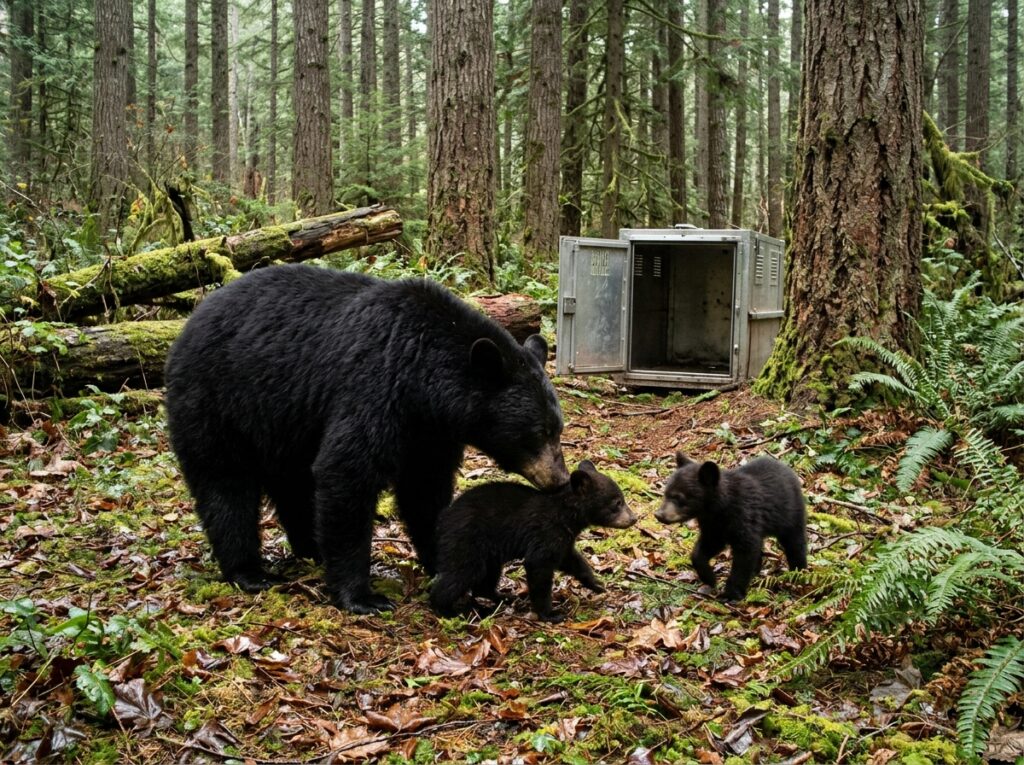
At 8:42 AM the following morning, the wildlife team transported the recovered cub to the selected location in an appropriate secure wildlife container.
Emily remained at the remote monitoring station.
Mark and the trained personnel completed the final checks.
Laura confirmed that the cub was alert and capable of moving independently.
The team positioned the container in a sheltered area, established remote observation, and withdrew to the planned safe distance.
Then they waited.
For twenty minutes, nothing happened.
The forest remained quiet.
A squirrel crossed a fallen branch.
Rainwater dripped from the fir needles.
The cub shifted inside the container.
Then, at 9:17 AM, the remote camera recorded movement between the trees.
A large black bear.
Emily leaned toward the screen.
“Mark.”
His voice came through the radio.
“I see her.”
The mother emerged from the undergrowth.
A smaller cub followed several yards behind.
Emily’s heart began pounding.
Both animals had arrived.
The mother stopped.
She lifted her muzzle and tested the air.
Then moved toward the sheltered location.
The smaller cub remained near the trees.
Emily held her breath.
The mother approached the container cautiously.
She sniffed the outside.
Inside, the injured cub moved toward the door.
A small paw appeared against the ventilation opening.
The mother stepped closer.
Then she made a low sound.
Emily could not hear it clearly through the remote equipment, but she could see the cub responding.
Mark spoke quietly over the radio.
“Hold position.”
The team waited for the veterinarian’s signal.
With the mother temporarily moving back toward the trees, the trained responders used their planned remote-release arrangement and withdrew fully.
The container door opened.
For several seconds, the cub remained inside.
Then a small black head appeared.
It looked toward the forest.
Paused.
And stepped onto the ground.
The cub took several cautious steps.
Its injured hind leg was still a little stiff.
But it could walk.
Emily whispered:
“Come on, sweetheart.”
The mother turned.
She saw the cub.
And stopped.
For a moment, neither moved.
Then the mother approached.
She lowered her muzzle.
The cub lifted its head.
Their noses touched.
Emily pressed both hands against her mouth.
The mother sniffed the cub’s face, shoulders, and back.
The little bear pressed against her front leg.
Then the second cub emerged from the trees.
It approached cautiously.
The injured cub turned.
The two young bears sniffed each other.
For a few seconds, all three stood together beneath the fir trees.
Emily began crying.
“They’re together.”
Mark watched the screen.
“Yes.”
The mother turned toward the forest.
She walked several steps.
Then paused.
Both cubs followed.
The injured cub moved more slowly.
The mother stopped again.
The smaller sibling waited nearby.
Then all three continued toward the trees.
At 9:36 AM, the family disappeared into the forest.
Nobody cheered.
Nobody approached.
The wildlife team remained at a safe distance, documenting the reunion.
But inside the monitoring office, Emily sat with tears streaming down her face.
Four days earlier, she had watched a helpless cub struggle beneath a fallen tree.
She had feared its mother might never return.
Then she discovered a second cub stranded beside a flooded creek.
Now, against all the uncertainty of the past several days, the family was together again.
That afternoon, Mark called Laura.
“The mother accepted the cub. Both young animals followed her into the forest.”
Laura was quiet for a moment.
Then she exhaled.
“That’s wonderful.”
Mark looked at the latest camera footage.
“We’ll keep monitoring from a distance.”
“Good. The cub may still need time to recover fully.”
Emily listened nearby.
She knew the reunion was an encouraging result, not a guarantee.
Wild animals faced dangers every day.
And a cub recovering from an injury could still struggle.
But for now, the family was together.
That mattered.
Over the following week, the monitoring cameras recorded the mother and both cubs several times.
They traveled along sheltered forest routes.
The smaller cub often walked ahead.
The previously injured cub moved more slowly but appeared to be improving.
On one recording, the family stopped beside a fallen log.
The mother sniffed beneath the wood.
Both cubs approached.
One climbed onto the log.
The other followed.
Emily watched the footage and smiled.
“Look at them.”
Mark leaned over her shoulder.
“Both moving well.”
Emily nodded.
For the first time since the storm, she felt she could relax.
But there was still something she wanted to understand.
She returned to the original trail-camera recording.
The bald eagle.
The fallen pine.
The tiny paw reaching between the branches.
She watched the eagle land on the trunk.
Its white head turned toward the creek.
Then it lifted off.
Only afterward did the trapped cub become clearly visible.
Emily had replayed those seconds dozens of times.
The eagle had not attempted to rescue the cub.
It had not summoned help.
It had simply landed on a fallen tree while searching the creek for food.
But its movement had drawn Emily’s attention to the camera.
Without that movement, she might have continued reviewing other recordings.
And the trapped cub might have remained beneath the branch much longer.
Emily paused the video.
The eagle stood on the fallen pine.
Below it, the tiny black paw was barely visible.
She took a screenshot.
Then printed it.
On the back, she wrote:
November 2026. Alder Creek. The moment we noticed.
She placed the photograph beside her desk.
Not because the eagle had performed a miracle.
But because it reminded her how easily something important could be missed.
And how much could change when someone paid attention.
As winter approached, the forest became quieter.
Rain continued falling across the western Cascades.
The creeks remained cold.
The bears gradually reduced their activity as the season progressed.
Emily and Mark continued their monitoring work.
They checked cameras.
Recorded wildlife movements.
And documented storm damage along the forest’s service roads.
The fallen pine remained beside Alder Creek.
Its heavy branches had been secured or removed where necessary for safety, but much of the tree remained as natural forest habitat.
The rushing water continued flowing beneath it.
Sometimes an eagle passed overhead.
Sometimes deer crossed the nearby trail.
And occasionally, a black bear appeared on the cameras.
Emily never assumed every bear was the same animal.
She relied on the recorded evidence and the team’s careful observations.
One morning, several weeks after the reunion, the ridge camera recorded a familiar sight.
A large black bear moving through the forest.
Two smaller bears followed.
One cub paused beside a moss-covered stump.
The other climbed onto a low fallen branch.
The mother waited nearby.
Emily watched the footage.
She couldn’t prove every detail of their identities from that brief recording alone.
But the animals’ sizes, movements, and location were consistent with the family the team had been monitoring.
She sent the clip to Mark.
His reply arrived a few minutes later.
“Encouraging sighting. Add it to the records.”
Emily smiled.
She did.
Then she watched the recording one more time.
Three black shapes moving through a green forest.
No rescue equipment.
No emergency radios.
No people standing nearby.
Just a mother bear and two cubs continuing their lives.
It was exactly the kind of ending Emily had hoped for.
The following spring, the district organized a training session for wildlife monitoring staff.
Mark asked Emily to share what they had learned from the Alder Creek incident.
She prepared a presentation using selected camera footage.
The storm-damaged forest.
The trapped cub.
The mother bear returning to the fallen pine.
The second cub stranded beside the flooded creek.
And the carefully managed reunion.
She explained the importance of coordinating with experienced wildlife professionals.
She described the dangers of approaching bear cubs when an adult might be nearby.
And she emphasized that remote monitoring could provide valuable information without unnecessarily disturbing animals.
After the presentation, a young technician raised his hand.
“Emily, do you think the eagle knew the cub was trapped?”
Emily smiled.
“No.”
The room became quiet.
She continued.
“The eagle was behaving like a wild eagle. It was probably looking for food along the creek.”
The technician nodded.
“So it was just a coincidence?”
“Yes. But an important one.”
Emily looked toward the photograph on the screen.
“That eagle landed in exactly the part of the frame I was watching. Because I noticed it, I looked more closely.”
She paused.
“Then I saw the paw.”
The technician smiled.
“And that started the rescue.”
Emily nodded.
“That started the response.”
She looked around the room.
“But the outcome depended on trained people making careful decisions, the veterinarian treating the injured cub, and the mother bear being able to reunite with her young.”
The room was silent.
Then Emily added:
“Sometimes the most important thing we can do for wildlife is notice a problem and make sure the right people respond.”
After the session, Mark approached her.
“Good presentation.”
Emily smiled.
“Thanks.”
He looked at the final photograph.
The mother bear standing beside her two cubs.
“Hard to believe how close we came to missing them.”
Emily nodded.
“I think about that sometimes.”
Mark looked toward the window.
“The forest is full of things we never see.”
Emily smiled.
“That’s why we keep watching.”
On November 7, 2027, one year after the storm, Emily returned to the Alder Creek monitoring station.
The forest was damp from overnight rain.
Mist drifted between the fir trees.
The creek moved steadily through the valley, no longer swollen by the extraordinary flooding of the previous year.
Emily opened the newest camera recordings.
A deer crossed the ridge at 5:43 AM.
A raccoon appeared near the creek at 6:12.
Then, at 7:17 AM, something familiar entered the frame.
A bald eagle.
It landed on a weathered branch above the water.
Emily smiled.
“Well, hello.”
The bird stood quietly, scanning the creek.
She couldn’t know whether it was the same eagle from the previous year.
There was no identifying mark that established that.
But the sight brought back the morning when everything had begun.
She remembered the tiny paw.
The trapped cub.
The mother bear appearing on the hillside.
The second cub stranded beside the flooded creek.
And the moment all three bears finally walked into the forest together.
Emily watched the eagle spread its wings.
It lifted from the branch and disappeared between the trees.
She leaned back.
A year earlier, that simple movement had changed the course of her day.
It had led her to a trapped animal.
And eventually to a second cub whose danger nobody had known about.
But the most meaningful part of the story wasn’t the eagle.
It was the mother bear searching for her young.
The responders who refused to rush into a dangerous situation.
The veterinarian who gave an injured cub time to recover.
And the quiet moment when two small bears followed their mother back into the forest.
Emily looked toward the photograph beside her desk.
The mother.
The two cubs.
The trees surrounding them.
She smiled.
The team could not know everything that happened to the family afterward.
They could not guarantee that every winter storm would be survived or every injury avoided.
Wild animals lived with uncertainty.
That was part of the natural world.
But the team had given the injured cub a chance to recover.
They had helped prevent a dangerous separation.
And they had allowed the family to return to the forest without unnecessary human interference.
Emily considered that a meaningful success.
She opened the monitoring log and entered the morning’s observations.
Then she paused.
Outside, a breeze moved through the fir trees.
The creek continued flowing.
And somewhere beyond the cameras, wildlife was moving through the mountains.
Emily thought about the tiny paw that had appeared beneath the fallen pine.
So small.
So easy to miss.
Yet that one movement had started a rescue that none of them would forget.
One bear cub was trapped beneath a fallen tree. Another was stranded beside a flooded creek. And a mother bear faced the terrifying possibility of losing both. But careful wildlife monitoring, trained responders, and a second chance brought the family back together.
Emily closed the logbook.
Before leaving, she glanced at the photograph of the bald eagle one last time.
Then she smiled.
“Sometimes you just have to look a little closer.”
And with that, she returned to her work.
THE END
No Comments