

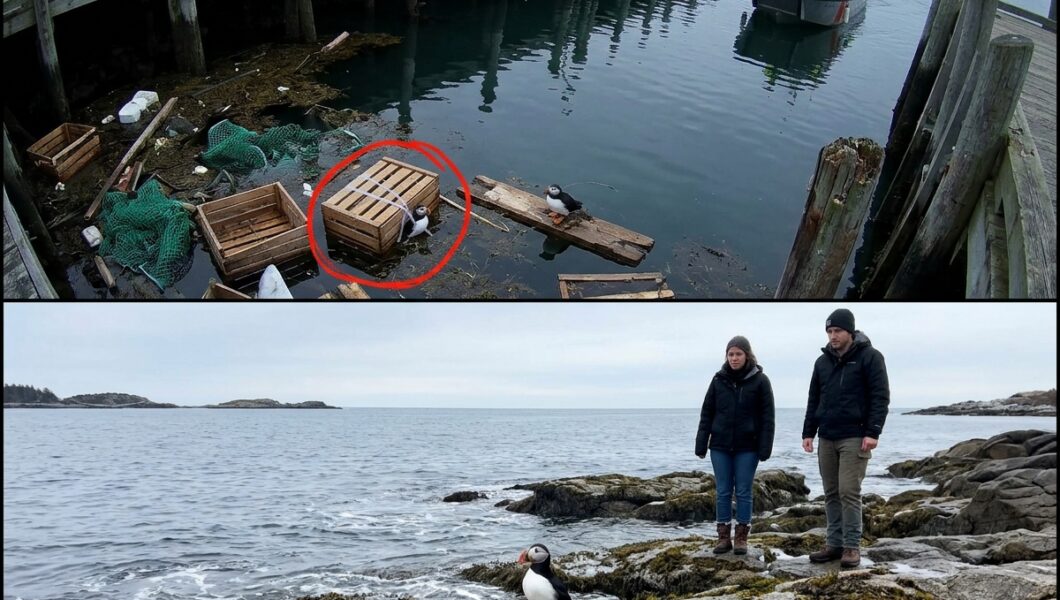
At 5:52 PM, harbor maintenance worker Patrick Sullivan stood frozen in front of the security monitor at Grayhaven Harbor, Maine.
The small black-and-white head had disappeared beneath the floating plastic netting.
Five seconds passed.
Then ten.
Patrick leaned toward the screen.
“Come on, little guy.”
The dark water moved between the broken shipping crates.
A loose strip of plastic drifted across the opening.
But the puffin did not surface.
Patrick gripped his telephone.
“Claire, I can’t see it anymore.”
Wildlife rehabilitator Dr. Claire Bennett was already coordinating with the harbor emergency team.
“Patrick, listen carefully. Don’t go down onto that damaged wharf. The tide is rising, and those crates could shift.”
“I know, but there’s another bird in there.”
“We’re coming. Keep the camera on the area.”
Patrick stared at the monitor.
He had spent twenty-six years maintaining the harbor.
He had repaired docks after winter storms, pulled damaged boats from their moorings, and helped fishermen recover equipment from dangerous water.
But he had never felt so helpless watching something happen only a few hundred feet away.
A tiny seabird was trapped somewhere beneath the surface.
And he couldn’t reach it.
At 5:56 PM, the water between the crates suddenly rippled.
A black-and-white head appeared near the outer edge of the debris.
Patrick nearly shouted.
“There!”
The puffin surfaced for barely two seconds.
Its short beak opened.
Then it disappeared again.
But this time Patrick noticed something important.
The bird wasn’t moving freely.
A strip of transparent plastic trailed from one side of its body.
And every time the current shifted, the strip pulled it back toward the crates.
Patrick enlarged the recording.
“Claire, I can see a plastic band attached to it.”
“Is it the same kind as the first bird?”
“Looks like it.”
Claire went quiet.
Then answered:
“That may mean the debris is trapping several birds in the same area.”
Patrick looked toward the damaged eastern wharf.
The storm had pushed broken crates, packing material, and loose plastic netting into a narrow pocket of water.
The debris had formed a floating barrier.
A puffin might be able to swim beneath it.
But if plastic became caught around a wing or body, the moving material could turn into a trap.
At 6:04 PM, Claire arrived with wildlife technician Mason Price and two harbor emergency responders.
The sky was already darkening.
The tide was rising.
And the eastern wharf remained structurally unsafe after the storm.
Harbor supervisor Daniel Brooks met them at the entrance.
“We’ve closed the entire section,” he explained.
“Good,” Claire answered. “Nobody goes onto those damaged boards.”
Patrick showed them the footage.
Mason watched the puffin surface and disappear.
Then he studied the floating crates.
“There’s no safe way to approach that from the wharf.”
Daniel nodded.
“We have a small harbor workboat. The crew knows this channel.”
Claire contacted the authorized wildlife response coordinator.
The team developed a plan using the workboat, controlled lighting, and long-reach equipment.
Their first priority was to assess whether the birds were still alive and accessible.
Nobody would enter the water or attempt to climb between unstable crates.
At 6:17 PM, the workboat moved slowly toward the eastern wharf.
Patrick remained in the harbor office, monitoring the cameras and relaying information.
Claire and Mason stood aboard with the trained crew.
A portable light illuminated the debris.
Broken wooden crates knocked gently against one another.
Loose green netting floated across the surface.
Then Mason spotted movement.
“Bird, left side!”
A puffin surfaced beside a damaged crate.
It immediately tried to dive.
But a plastic strip caught against the wood.
The bird twisted sideways.
Claire spoke calmly.
“That’s our entangled bird.”
The crew held the boat at a safe distance.
Using appropriate equipment, the responders carefully stabilized the loose debris enough to prevent it from shifting toward the animal.
Mason reached toward the exposed plastic with a long-handled cutting tool.
The puffin struggled.
Then the strip tightened.
“Stop,” Claire said.
Mason froze.
The bird’s wing was caught beneath a second loop.
Pulling the visible strip could make the injury worse.
Claire studied the position.
“We need to release the outer connection first.”
The crew adjusted the boat.
A small wave moved through the channel.
The crates shifted.
For a moment, the puffin disappeared behind the wood.
Patrick watched from the monitor.
His heart pounded.
Then the bird surfaced again.
Mason repositioned the tool.
One careful cut.
The outer plastic band separated.
The puffin moved forward.
But it couldn’t swim away.
A second loop remained around its body.
Claire prepared the wildlife capture equipment.
With the bird briefly accessible at the surface, the trained responders safely contained it and brought it aboard.
Mason supported the animal while Claire removed the remaining loose plastic.
The puffin struggled for several seconds.
Then settled inside a ventilated transport container.
At 6:31 PM, Claire examined it under a portable light.
Its feathers were wet and contaminated.
One wing showed signs of abrasion.
But the bird was breathing.
Its eyes were open.
And it was responsive.
Claire exhaled.
“We’ve got one.”
Patrick heard the words over the radio.
He leaned back in his chair.
“Thank goodness.”
But then he remembered the recording.
There had been two puffins between the crates.
Only one had been recovered.
He reached for the radio.
“Claire, what about the other bird?”
A brief silence followed.
Then Claire answered:
“We’re still looking.”
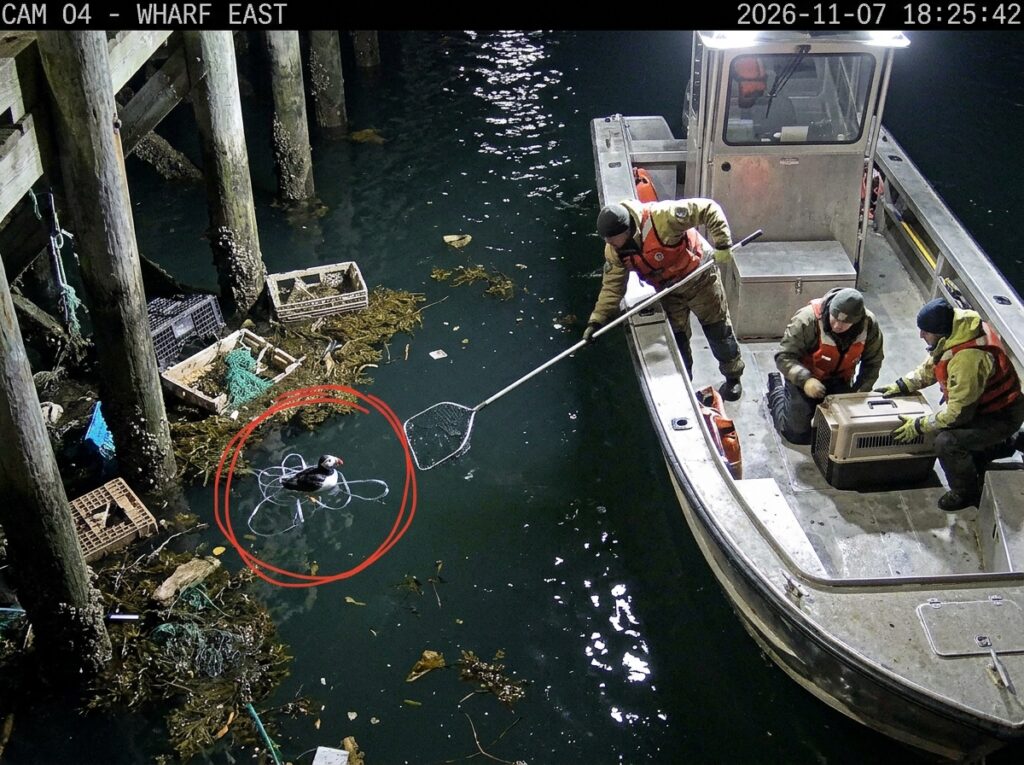
At 6:39 PM, the harbor crew found the second puffin.
It was not trapped in the same way.
Instead, the small bird was resting on a narrow piece of floating timber behind the crates.
Its head was tucked close to its body.
It appeared exhausted.
Mason observed it through binoculars.
“There’s no visible line around it.”
Claire nodded.
“But it’s barely moving.”
The team approached cautiously.
The puffin lifted its head.
Then slipped into the water.
For a moment, it swam away from the boat.
But it struggled to maintain direction in the moving debris.
Claire recognized the danger.
The bird might be weak from the storm, and the unstable debris field was no place for it to recover.
With authorization and appropriate wildlife-handling equipment, the trained responders carefully captured it for assessment.
At 6:48 PM, the second puffin was safely contained.
Patrick watched the workboat return toward the harbor.
Two small transport boxes sat securely aboard.
Inside each was a living bird.
He felt his eyes fill.
“Three,” he whispered.
The first puffin rescued from the north pier.
The second trapped in the plastic.
And the third found exhausted among the crates.
Three birds.
All discovered because someone had noticed an unusual movement on a security camera.
But the evening wasn’t finished.
As the crew prepared to leave the eastern wharf, Mason noticed something beneath the floating crates.
A thick collection of transparent packing bands had become tangled around the submerged dock supports.
The material stretched beneath the surface like a loose web.
He shone his light across the water.
Several strips moved with the current.
Claire studied the debris.
“This isn’t just a few loose bands.”
Daniel looked toward the damaged shipping crates.
“Looks like an entire pallet load broke apart.”
The crew photographed the hazard and recorded its location.
They would not attempt to pull the material free in the darkness.
The damaged wharf needed a controlled cleanup by properly equipped personnel.
But the discovery explained something that had troubled Patrick all day.
The first puffin had been trapped by a plastic packing band.
The second had become entangled in similar material.
And the third had been found exhausted inside the same debris field.
The storm had scattered a large quantity of plastic packaging across the harbor.
And nobody had realized how much of it remained beneath the surface.
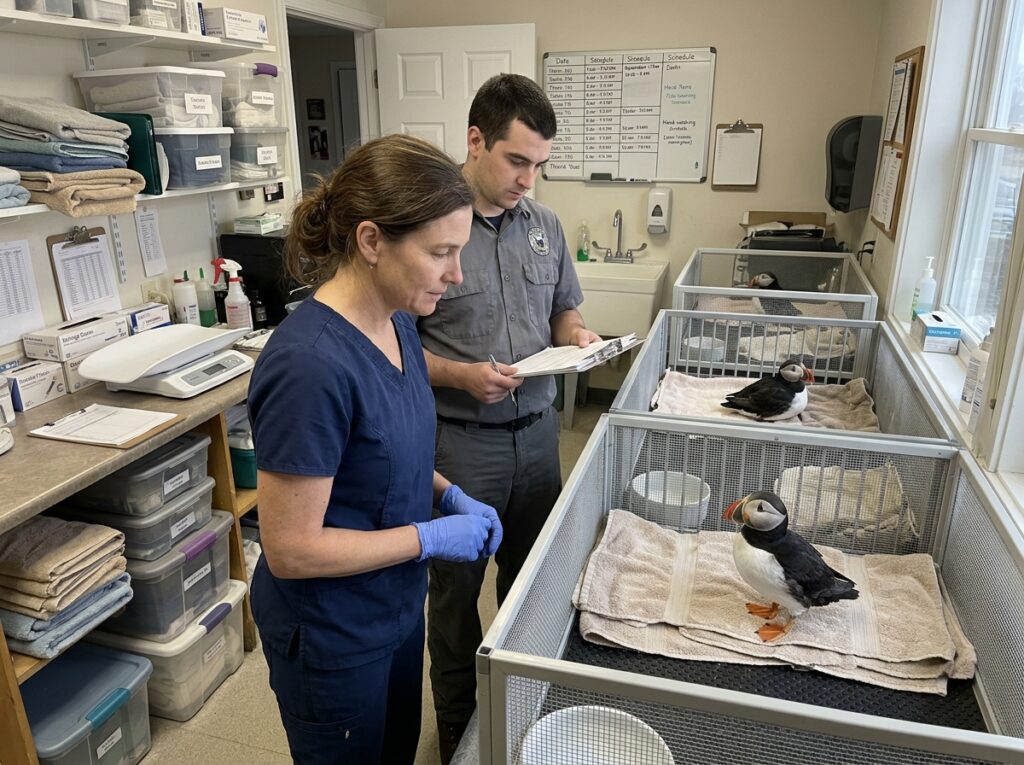
At 7:22 PM, Claire returned to the wildlife rehabilitation center with both rescued puffins.
The first bird, recovered earlier that morning, was resting in a quiet enclosure.
Its wing remained swollen.
Its feathers required specialist cleaning and assessment.
But it had begun responding to supportive treatment.
Claire examined the second bird.
The plastic had left shallow abrasions around its wing and body.
It was exhausted and dehydrated.
The third bird was also underweight and weak.
All three required continued veterinary care.
Mason stood beside Claire as she completed the intake records.
“Do you think they were traveling together?”
Claire shook her head.
“We can’t know that.”
Puffins spend much of their lives at sea, and several birds could have been displaced by the same storm.
Their presence near the harbor did not necessarily mean they were related or part of a family group.
But all three had encountered the same dangerous environment.
And that was what mattered.
Claire looked toward the enclosures.
“Let’s give them the best chance we can.”
The next morning, Patrick arrived at the harbor before sunrise.
He hadn’t slept much.
But when he opened the office door, he found someone waiting.
Robert Ellis.
The fisherman who had helped organize yesterday’s cleanup.
Robert held a clipboard.
“Morning, Pat.”
Patrick frowned.
“You’re here early.”
Robert smiled.
“Got something to show you.”
He placed the clipboard on the desk.
It contained a list of damaged shipping materials, loose packing bands, broken crates, and floating debris locations reported by local fishing crews.
Patrick studied the pages.
“Where did all this come from?”
“Everybody started looking after what happened yesterday.”
Patrick turned another page.
There were photographs.
Coordinates.
And descriptions of debris trapped along the harbor walls.
Robert continued.
“Turns out we missed a lot.”
Patrick looked toward the eastern wharf.
“More than we thought.”
Robert nodded.
“That’s why we’re going to fix it.”
By 9:00 AM, the harbor office had organized a coordinated cleanup with municipal workers, fishing crews, and qualified marine debris contractors.
The damaged eastern wharf remained closed.
No volunteers were allowed onto unstable structures or into the water.
Instead, the teams worked in designated safe areas, documenting debris and removing material they could reach without unnecessary risk.
Specialists handled submerged hazards and unstable crates.
Thomas Reed, a retired fisherman who had spent forty years working the coast, volunteered his knowledge of the harbor currents.
A local boatyard provided equipment.
And several younger fishermen offered to help transport recovered materials.
Patrick watched the work unfold.
He had seen this community come together after storms before.
But this felt different.
They weren’t repairing a dock.
They weren’t recovering a boat.
They were removing something that might otherwise continue injuring wildlife long after the storm had passed.
At 11:16 AM, the cleanup crew recovered a large bundle of transparent packing bands from beneath the eastern wharf.
The material was tangled around broken crate boards, dock supports, and loose rope.
Patrick recognized the same type of plastic that had trapped the first puffin.
He stared at the pile.
“So much of it.”
Robert stood beside him.
“Hard to believe we didn’t see it.”
Patrick nodded.
“Most of it was underwater.”
A contractor explained that plastic packaging could remain hazardous even after the original cargo was destroyed.
Loose bands could loop around birds, fish, and other marine animals.
Netting could become tangled around underwater structures.
And floating debris could collect in sheltered harbor corners.
Patrick looked toward the ocean.
He had worked here for twenty-six years.
He thought he knew every dangerous place in the harbor.
But now he understood that the smallest hazards were sometimes the easiest to overlook.
That afternoon, Claire called.
Patrick answered immediately.
“How are they?”
She smiled.
“All three are alive.”
Patrick closed his eyes.
“Thank goodness.”
“The first puffin is more alert today. The second is responding to fluids and supportive care. The third is resting and being monitored.”
Patrick sat down.
“Do you think they’ll survive?”
Claire paused.
“We’re encouraged, but seabirds can be difficult to rehabilitate. We need to see whether their wings, waterproofing, feeding, and overall condition recover.”
Patrick nodded.
“Whatever they need.”
Claire continued.
“We’re going to identify them as Puffin One, Two, and Three in the medical records.”
Patrick laughed softly.
“Not very imaginative.”
Claire laughed too.
“We try not to get too attached to names.”
Patrick smiled.
“Well, I’m calling the first one Lucky.”
Claire chuckled.
“And the others?”
Patrick thought for a moment.
“Hope and Storm.”
Claire laughed.
“Those sound like harbor names.”
Patrick looked toward the water.
“They are now.”
Over the following days, Grayhaven Harbor began to change.
The fishing crews created a simple system for reporting dangerous debris.
Harbor workers documented areas where packaging material accumulated after storms.
Local businesses reviewed how shipping materials were secured near the waterfront.
And the municipal harbor office began planning additional inspections after severe weather.
Patrick had expected the cleanup to last a day or two.
Instead, it became an ongoing community effort.
One afternoon, Robert arrived carrying a small cardboard box.
Patrick looked up.
“What’s that?”
Robert placed it on the desk.
Inside were several lengths of broken plastic packing bands.
“We found these behind the fish market.”
Patrick frowned.
“More?”
Robert nodded.
“Already collected them. Just wanted to show you.”
Patrick picked up one strip.
It was thin.
Almost transparent.
And light enough to blow across the dock in a strong wind.
He thought about the first puffin struggling beside the rusted cleat.
Then the second bird disappearing beneath the floating crates.
Patrick shook his head.
“Something this small.”
Robert nodded.
“Sometimes that’s all it takes.”
The following week, Claire called with another update.
Lucky, the first puffin, had begun eating independently.
The swelling in its wing had decreased.
Hope, the second bird, was recovering from its abrasions.
And Storm, the exhausted third puffin, had gained weight and was becoming more active.
Patrick smiled.
“That’s the best news I’ve had all week.”
Claire laughed.
“There’s still a long way to go.”
“I know.”
“These birds need to demonstrate strong swimming, normal feeding, healthy waterproof plumage, and the ability to fly before release can be considered.”
Patrick nodded.
“Take all the time they need.”
Claire paused.
“Patrick, can I ask you something?”
“Sure.”
“Do you still have the footage of the eagle?”
Patrick smiled.
“Of course.”
“Would you send it again? We’re preparing an educational presentation about wildlife entanglement.”
Patrick opened the file.
The bald eagle appeared on the screen.
It descended toward the fishing pier.
Spread its wings.
Then landed beside the trapped puffin.
Patrick watched the recording.
He had replayed it dozens of times.
The eagle had not attempted to free the bird.
It had not called for help.
And it had not deliberately guided anyone toward the plastic.
It had simply landed on a familiar harbor structure while searching the shoreline.
But that movement had drawn Patrick’s attention to the camera.
Without it, he might not have noticed the puffin until much later.
He forwarded the recording.
Then typed a short message.
“Sometimes noticing is the beginning of helping.”
Claire replied a minute later.
“That’s exactly the lesson.”
By December, the three puffins had made significant progress.
Lucky’s wing had healed sufficiently for supervised exercise.
Hope was swimming strongly.
And Storm had regained enough weight to begin more demanding rehabilitation.
The team continued monitoring their waterproofing and flight abilities.
Atlantic puffins spend much of their lives on open water.
They need healthy feathers, strong swimming ability, and the capacity to find food independently.
A bird that appears comfortable in a rehabilitation enclosure may still be unprepared for the Atlantic.
Claire refused to rush the process.
Each puffin would be assessed individually.
If one was ready before the others, it would not be kept unnecessarily simply because the birds had been rescued from the same harbor.
Patrick understood.
He wanted all three to return to the ocean.
But he wanted them to have a real chance of surviving.
On January 14, 2027, Claire called with exciting news.
“Patrick, Lucky has passed its latest flight and swimming assessments.”
Patrick sat upright.
“Really?”
“Yes. The veterinary team is reviewing the final release criteria.”
Patrick smiled.
“What about Hope and Storm?”
“Hope is progressing well. Storm still needs additional conditioning.”
Patrick nodded.
“That’s all right.”
Claire continued.
“We’re taking this one bird at a time.”
Patrick looked toward the harbor.
“Just promise me something.”
“What’s that?”
“When Lucky goes back to the ocean, let me know.”
Claire smiled.
“I will.”
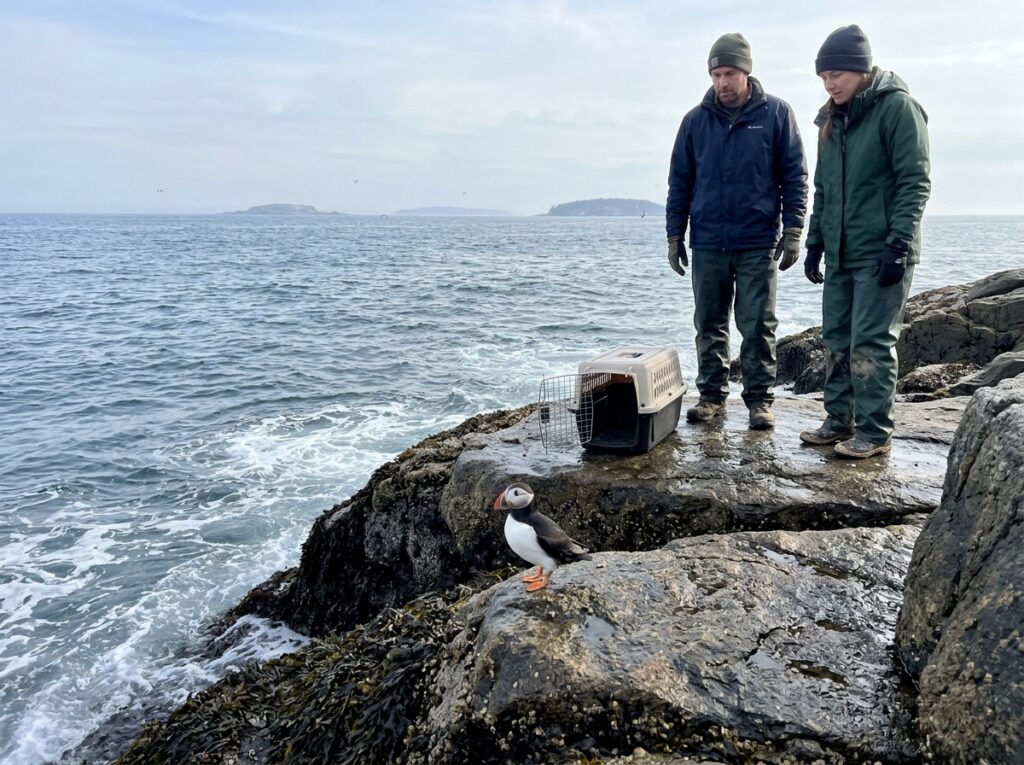
Two weeks later, Lucky was cleared for release.
The rehabilitation team selected a suitable coastal location and weather window.
The release was conducted by authorized personnel, away from crowds and unnecessary disturbance.
Patrick did not attend.
He understood that a wild seabird’s return to the ocean was not meant to be a public event.
But that evening, Claire sent him a photograph.
Lucky stood on a rocky shoreline.
Its black-and-white feathers were clean.
Its wings were held naturally against its body.
And the Atlantic stretched behind it.
A second photograph showed the puffin entering the water.
Patrick stared at the images.
His eyes filled.
He thought about the little bird lying helpless beside the rusted cleat.
The plastic tightening around its wing.
The moment Claire had carefully lifted it into the transport box.
And now, months later, it was back where it belonged.
He whispered:
“Good luck, little guy.”
He forwarded the photograph to Robert.
Then to the harbor office.
Within an hour, messages began arriving.
Fishermen.
Dock workers.
Local shop owners.
People who had helped with the cleanup.
Everyone wanted to know whether the bird was safe.
Patrick answered carefully.
“Lucky has been released. We hope it does well.”
He didn’t claim the bird would survive forever.
Wildlife rehabilitation could never guarantee that.
But the puffin had been given another chance.
And that was something worth celebrating.
In February, Hope was also cleared for release.
Its wing abrasions had healed.
Its feathers were waterproof.
And it had demonstrated the necessary swimming, feeding, and flight abilities.
Claire’s team returned it to suitable coastal habitat.
Storm remained in care longer.
The third puffin had been the weakest when rescued.
It required additional time to regain strength.
Patrick continued asking about it.
Every few weeks, Claire sent an update.
“Still improving.”
“Swimming well.”
“Weight is stable.”
Then, in early March, the call finally came.
“Patrick, Storm is ready.”
Patrick closed his eyes.
For a moment, he couldn’t speak.
Then he whispered:
“All three?”
Claire smiled.
“All three have now met the criteria for release.”
Patrick wiped his eyes.
“That’s wonderful.”
He thought about the night the puffin disappeared beneath the netting.
How frightened he had been.
How helpless he felt.
And how the responders had worked carefully in the darkness to bring the birds to safety.
Three small seabirds.
Three different recoveries.
Three chances to return to the Atlantic.
Patrick looked toward the harbor.
“Thank you, Claire.”
She answered softly.
“It took a lot of people.”
He nodded.
“I know.”
On November 7, 2027, exactly one year after the rescue, Patrick Sullivan arrived at Grayhaven Harbor before sunrise.
The docks had been repaired.
The damaged eastern wharf had reopened after structural inspections and repairs.
The broken shipping crates were gone.
And the harbor had established a routine for documenting dangerous debris after major storms.
Patrick walked toward the north pier.
The same pier where he had first seen Lucky struggling beside the rusted cleat.
He stopped near the security camera.
The wooden boards were dry.
The harbor was quiet.
And a pale orange glow was beginning to spread across the eastern sky.
Robert Ellis approached carrying two cups of coffee.
“Morning, Pat.”
Patrick smiled.
“Morning.”
Robert handed him a cup.
“One year.”
Patrick nodded.
“Hard to believe.”
They stood together watching the water.
Robert looked toward the pier.
“Remember how bad it was after that storm?”
Patrick laughed softly.
“Broken crates everywhere. Half the docks damaged. More plastic than we knew what to do with.”
Robert nodded.
“And three little birds.”
Patrick smiled.
“Three little birds.”
Robert looked toward the open harbor.
“Think they’re still out there?”
Patrick considered the question.
“I hope so.”
There was no way to know.
Puffins travel across large areas of the North Atlantic.
The three birds might have moved far from Grayhaven.
They might never return to the harbor.
And Patrick knew that was exactly how it should be.
Wild animals belonged in the wild.
Not in people’s memories.
Not in photographs.
Not in rescue stories.
They belonged in the ocean, where they could live their own lives.
Robert took a sip of coffee.
“You know, my grandson asked me something yesterday.”
Patrick smiled.
“What?”
“He wanted to know if the eagle saved the puffin.”
Patrick laughed gently.
“What did you tell him?”
Robert looked toward the sky.
“I told him the eagle was just being an eagle.”
Patrick nodded.
“That’s right.”
Robert continued.
“But because it landed on that pier, you looked at the camera.”
Patrick smiled.
“And because I looked, I noticed the bird.”
Robert nodded.
“And because you noticed, we found the other two.”
Patrick looked toward the eastern wharf.
“And all that plastic.”
They stood quietly.
Then Robert said:
“Funny how something so small can change a whole harbor.”
Patrick smiled.
“It wasn’t just the puffin.”
Robert looked at him.
Patrick continued.
“It was everyone who helped afterward.”
The fishermen.
The harbor workers.
The wildlife responders.
The cleanup crews.
The people who reported dangerous debris.
The businesses that improved how they secured shipping materials.
And the community members who began paying attention to the things they once overlooked.
Patrick had spent twenty-six years maintaining Grayhaven Harbor.
He had always believed his job was to keep the docks safe and the boats moving.
Now he understood that caring for a harbor meant caring for everything that depended on it.
Including the animals that passed through.
At 6:18 AM, Patrick’s radio crackled.
A harbor worker reported a bald eagle perched near the fish-cleaning station.
Patrick looked toward the far pier.
Sure enough, a large bird with a white head sat on a wooden post overlooking the water.
He smiled.
“Well, look at that.”
Robert followed his gaze.
“Another eagle.”
Patrick nodded.
“Maybe the same one.”
Neither could know.
The bird turned its head.
Watched the water.
Then spread its enormous wings.
It lifted from the post and flew toward the open Atlantic.
Patrick watched until it disappeared.
Then he looked down at the wooden boards beneath his feet.
A year earlier, a small puffin had been lying helpless on a pier.
Its wing tangled in transparent plastic.
Its body exhausted from the storm.
And somewhere nearby, two more puffins had been struggling among floating debris.
Today, the pier was clear.
The damaged crates were gone.
And all three rescued birds had been returned to the ocean after rehabilitation.
Patrick took a slow breath.
He thought about the first puffin’s tiny black eyes.
The way it had struggled beneath the plastic.
The moment Claire lifted it safely into the transport box.
And the photograph showing Lucky standing beside the Atlantic before release.
He smiled.
Because the most important part of the story wasn’t the eagle.
It wasn’t the security camera.
And it wasn’t even the dramatic rescue.
It was what happened after people realized how much danger had been hiding in plain sight.
Three Atlantic puffins were rescued from a storm-damaged Maine harbor. But the greatest change came when an entire community decided that no piece of discarded plastic was too small to matter.
Robert finished his coffee.
“Ready to get to work?”
Patrick looked toward the docks.
He smiled.
“Always.”
They walked back toward the harbor office.
Behind them, the tide continued rising.
Fishing boats prepared to leave.
Gulls circled above the water.
And the Atlantic stretched endlessly toward the horizon.
Somewhere out there, three small seabirds had been given another chance.
They would never know Patrick’s name.
They would never understand the effort that went into their rescue.
And they would never know how much their struggle had changed Grayhaven Harbor.
But they didn’t need to.
They only needed clean water.
Safe places to rest.
And the freedom to fly over the ocean without becoming trapped in what people left behind.
Patrick opened the harbor office door.
Before going inside, he glanced toward the north pier one final time.
The wooden post stood empty.
The eagle was gone.
And the boards were clear.
He smiled softly.
“Stay safe out there, little ones.”
Then he went inside to begin another ordinary morning.
THE END
No Comments