

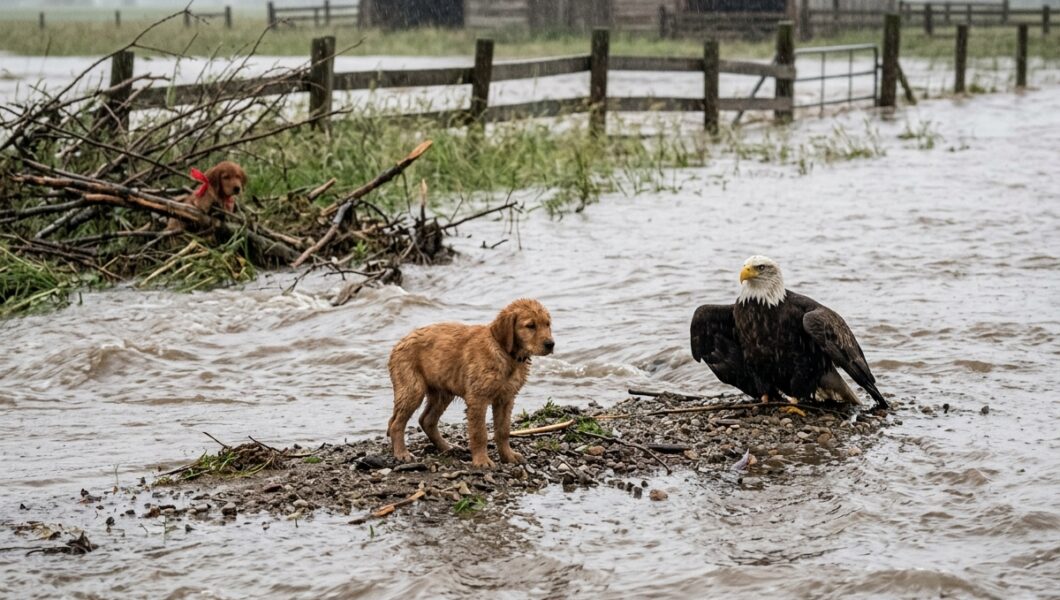
Robert Hayes leaned closer to the security monitor, barely breathing as the second animal crawled out from beneath the fallen branches.
The little creature was soaked and covered in muddy water. It struggled toward the old wooden gate, stopping every few inches as though it had almost no strength left.
Then the camera caught the red ribbon hanging from its collar.
Robert immediately thought of the puppy that had been rescued from the driveway.
Was this another animal from the same place? Had someone been moving animals through the flooded area? And what did the mysterious pickup truck have to do with any of it?
He knew the footage alone could not answer those questions. The rain distorted the image, and the rushing water obscured much of the ground. But the animal was clearly struggling, and it needed help.
Robert called the rescue coordinator again.
“I can see it moving toward the gate,” he explained. “It’s wearing a collar with a red ribbon. I don’t know what it is yet.”
The coordinator asked him to remain in a safe place and keep watching the camera. The floodwater was still moving quickly, and nobody should approach the creek or cross the submerged driveway until responders had assessed the conditions.
Robert agreed.
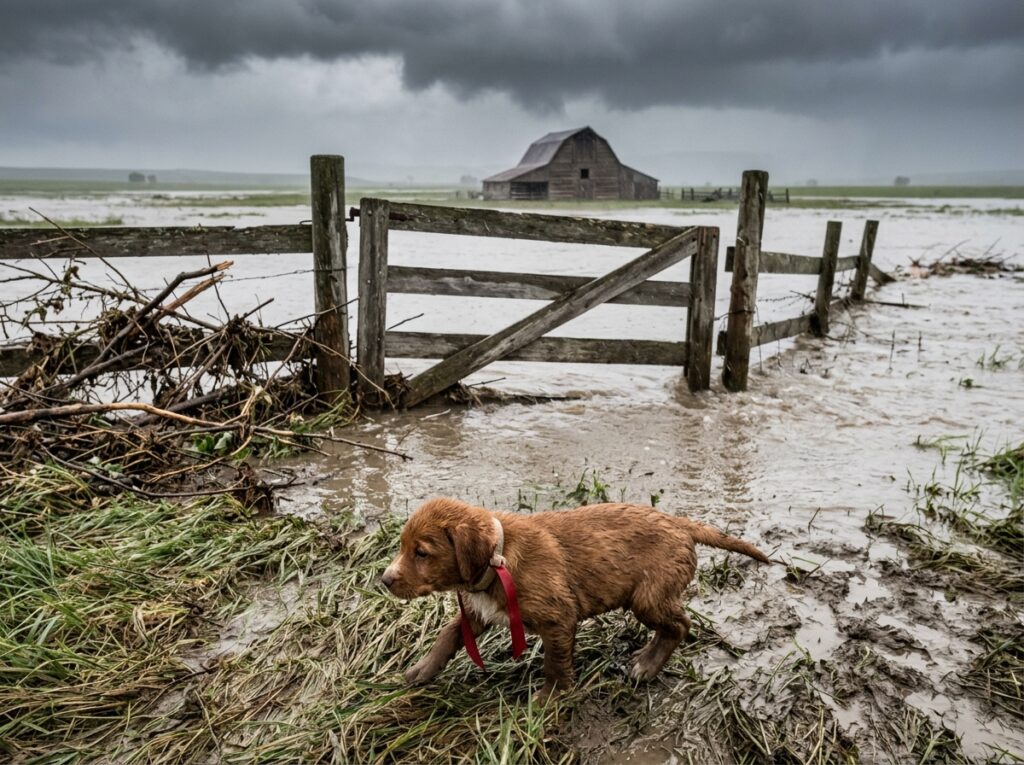
He switched to the camera overlooking the barn and enlarged the image. The animal paused beside a fence post, lifted its head, and looked toward the farmhouse.
For a moment, Robert could make out a pointed muzzle and two small ears.
It was a second puppy.
This one appeared slightly darker than the first, with a reddish-brown coat and a pale patch beneath its chin. Its collar was partly hidden by wet fur, but the bright red ribbon remained visible.
Robert felt a knot tighten in his stomach.
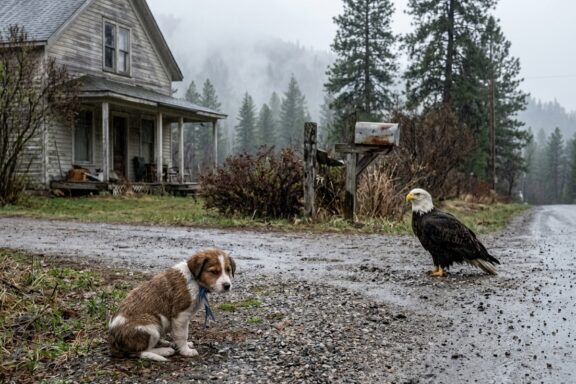
The first puppy had been found stranded near the mailbox. Now a second puppy was struggling near the creek, and a dark pickup had appeared on the flooded road.
He could not prove the events were connected, but the similarities were concerning enough to report.
At 7:46, the rescue coordinator called back. A team was being redirected toward the property, provided the responders could reach the area safely. The coordinator also advised Robert to preserve the truck footage and contact the appropriate authorities about the vehicle’s unusual appearance.
Robert saved the recording.
He then watched as the second puppy tried to move again.
Its front paws slipped in the mud, and it sank low against the ground. The water around the fence was not as deep as the main current, but the puppy was visibly exhausted.
Robert wanted desperately to run outside.
Instead, he remembered how quickly the driveway had flooded earlier that morning. If he became trapped in the current, he would create another emergency without helping the animal.
He stayed inside and continued watching.
At 8:03, the rescue vehicle returned to the edge of Robert’s property.
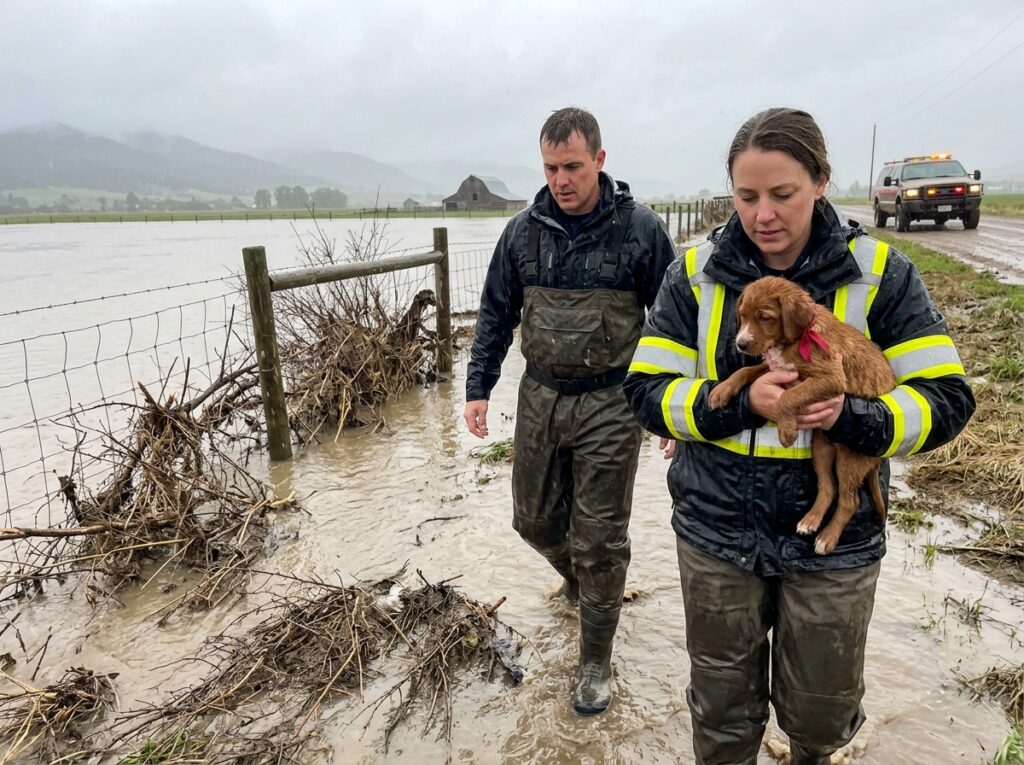
Two responders stepped out wearing waterproof protective gear. They assessed the water from the road before choosing a safer route toward the old gate. A third team member remained near the vehicle, monitoring conditions and maintaining communication.
Robert watched through the window as the responders moved carefully across the higher ground. They avoided the deepest water and used appropriate equipment to reach the puppy.
The little dog tried to retreat when one responder approached, but it was too exhausted to move far. The responder paused, allowing the puppy a moment to settle, then carefully secured it and carried it toward the waiting vehicle.
When the team reached safety, Robert saw the puppy disappear inside.
He finally let out a breath.
Both dogs had now been rescued from the flooded property.
But the red ribbon and the dark pickup remained unexplained.
Before leaving, one responder spoke briefly with Robert. The team would take the second puppy for veterinary assessment, and they would document the collar and ribbon. The animal’s condition would determine what treatment it needed next.
Robert asked whether the two puppies might belong to the same litter.
“It’s possible,” the responder replied, “but we’ll need more information. Similar collars and markings aren’t enough to confirm that.”
Robert nodded.
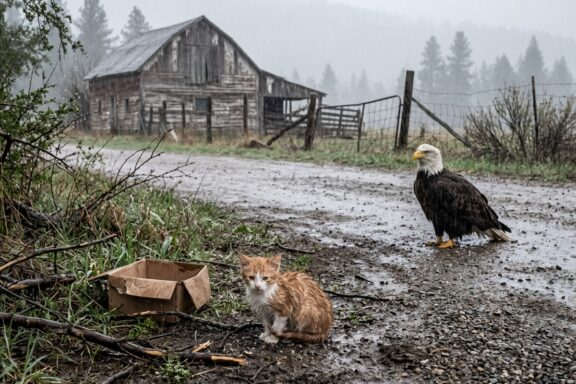
He had learned that morning how easily a strange sight could lead to assumptions. The eagle standing beside the first puppy had looked almost protective, but nobody could establish why it had been there. The pickup’s appearance was suspicious in context, but the recording did not prove the driver had left either animal.
The safest approach was to preserve the evidence and let the people responsible for investigating examine it.
After the rescue vehicle departed, Robert returned to the kitchen and opened the road camera recording again.
The dark pickup appeared near the mailbox shortly after the first puppy had been rescued. The rear window reflected the gray sky, and the pale shape inside remained difficult to identify.
It could have been an animal carrier.
It could have been something else.
Robert saved the clip without altering it and made a note of the timestamp.
Then he noticed something he had overlooked earlier.
Before the pickup reversed away from the mailbox, its brake lights flashed twice. Almost simultaneously, the barn camera detected movement near the fallen branches.
Robert replayed both recordings side by side.
The timing was unusual, but he could not establish whether the events were connected. The cameras were not synchronized precisely enough to prove that the light flashes had caused, signaled, or coincided meaningfully with the movement.
Still, the detail was worth preserving.
He sent both original clips to the rescue coordinator and reported the vehicle to the appropriate authorities.
At the veterinary clinic, the second puppy was examined shortly after arrival.
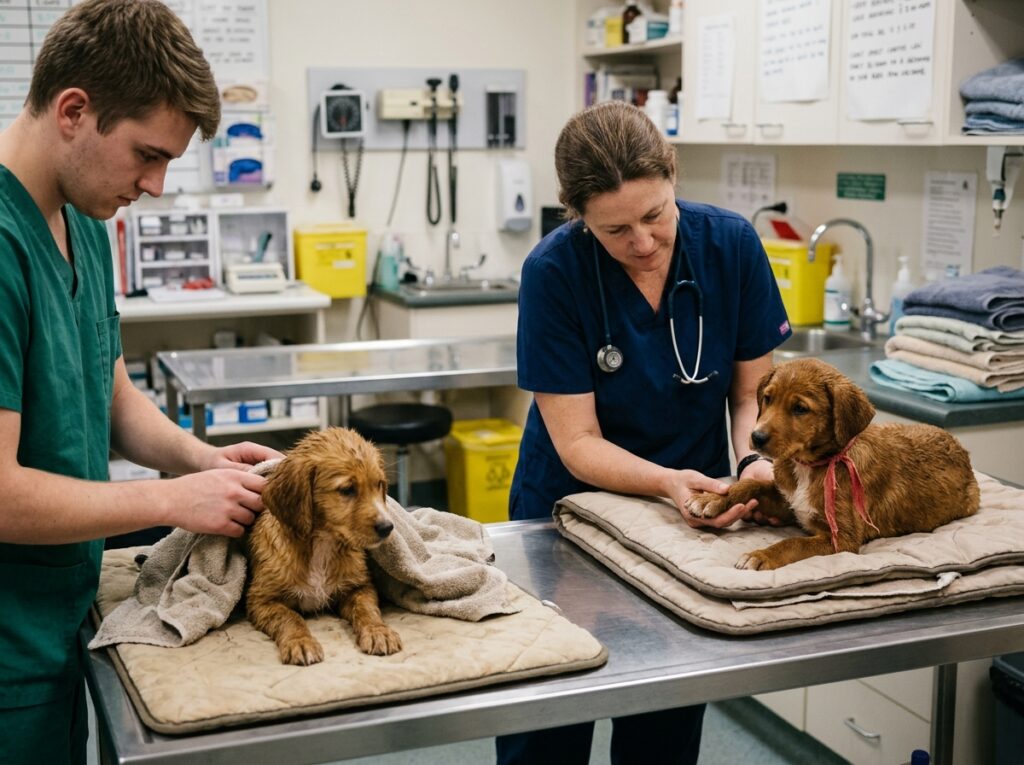
Emily, the rescue volunteer who had helped coordinate the first rescue, called Robert with an update. The puppy was cold, frightened, and exhausted, but it was responsive. The veterinary team was warming it carefully and checking for injuries caused by the floodwater.
The bright red ribbon had been photographed, and the details of the collar were recorded.
Emily also confirmed that the first puppy was receiving treatment at the same clinic. Its condition had stabilized after the rescue, although the veterinarian still needed to evaluate its injuries and monitor its recovery.
“Do you think they’re connected?” Robert asked.
“We don’t know yet,” Emily replied. “We’re documenting what we can, but we don’t want to guess. If they’re from the same household, the collars or other details might help us establish that.”
Robert understood.
He asked Emily to keep him informed if the team learned anything more about the ribbons or the pickup truck.
Then he sat quietly for a moment, listening to the rain weaken against the windows.
The morning had begun with an eagle and a puppy trapped by floodwater. Now two puppies were receiving veterinary care, and a mysterious vehicle had become part of the investigation.
He wondered how the animals had ended up on his property.
Had they escaped from somewhere nearby when the creek overflowed? Had someone been trying to move them before the storm became dangerous? Or had the pickup been there for an unrelated reason?
Every possibility raised more questions.
None could be confirmed from the footage he had seen.
Later that afternoon, an animal welfare officer contacted Robert to request copies of the recordings. Robert provided the original files, including the dark pickup near the mailbox and the footage showing the second puppy emerging from beneath the branches.
The officer explained that the information would be reviewed alongside any reports concerning missing or displaced animals in the area.
Robert answered the questions he could and made it clear when he was uncertain about what the cameras showed.
He did not claim to know who the driver was or why the vehicle had stopped.
He simply wanted the authorities to have the information they needed.
By evening, the rain had eased enough for the swollen creek to become visible through the trees. Muddy water still rushed between the banks, carrying small branches and leaves downstream. Robert stood well away from the water and looked toward the fence where the second puppy had been found.
The eagle was gone.
He had not seen it since it flew toward the wooded hillside. He hoped it had found a safe place to rest, but he knew that the bird’s appearance did not necessarily explain the puppies’ presence.
It might have been searching for food or moving away from the flood. It might have noticed the puppy because it was moving on exposed ground. Its reasons would remain unknown unless more reliable evidence emerged.
Robert returned inside and checked his phone.
Emily had sent another update. Both puppies remained under veterinary supervision. The team was cautiously optimistic, but it was too early to promise a full recovery.
Robert felt grateful that the dogs were no longer struggling against the current.
He thought about the red ribbon, bright against the muddy water, and how easily he might have missed it if he had not enlarged the camera image.
That small detail had helped him distinguish the second puppy from the dark shape beneath the branches. It had also given the rescue team something specific to record and compare.
Whether the ribbon would eventually reveal where the puppy came from was still uncertain.
But it mattered that someone had noticed it.
Over the next few days, Robert received occasional updates from Emily.
The puppies continued to recover under veterinary care. Their treatment depended on the injuries and effects of the flood, and the team monitored them closely. Neither was ready to return home immediately, but both had survived the dangerous morning.
The authorities continued reviewing the information about the pickup truck. Robert was told that the recordings were useful, but no conclusion about the driver’s involvement had been reached.
He accepted that.
He had spent decades living through Montana’s unpredictable weather. He knew that a flood could turn a familiar driveway into a dangerous stretch of moving water in minutes. He also knew that fear could make people connect details before they understood them.
He would not pretend to know what had happened simply because the timing looked unusual.
What he did know was that a puppy had been trapped by rising water, a second puppy had been found near a damaged fence, and both had received help before the flood became even more dangerous.
He also knew that staying inside had been the right decision. Had he entered the current, he could have become another person needing rescue.
The next time Robert checked his cameras, the storm had passed.
The driveway was covered with wet gravel, the mailbox leaned slightly from the pressure of the water, and the creek had begun to settle back toward its banks. The barn stood quietly beyond the muddy field.
No eagle appeared on the roof.
No pickup stopped near the mailbox.
For the first time since that Friday morning, the property looked ordinary again.
Robert saved the last storm recording and turned away from the monitor.
He hoped the investigation would eventually clarify how the puppies had reached his property and whether the truck had any connection to their situation. He hoped, too, that both dogs would recover enough to find safe, loving homes.
But he no longer needed to solve every part of the mystery to feel grateful.
The security camera had shown him an animal in danger. He had called for help rather than risk entering the floodwater. When the second puppy appeared, he had reported it and waited for trained responders.
Those decisions had given both animals a chance.
Perhaps the bald eagle had simply been another creature trying to navigate the storm. Perhaps the red ribbon would eventually help identify the puppy’s history. Perhaps the truck would turn out to be connected to the animals, or perhaps it would prove unrelated.
The answers belonged to the evidence, not to Robert’s imagination.
And that was enough.
Sometimes a rescue story begins with a dramatic sight, but its most important moments happen quietly: a person notices something wrong, makes a call, preserves what they have seen, and lets trained people do the dangerous work.
That Friday morning, Robert Hayes did exactly that.
The floodwater had risen quickly. The eagle had appeared and disappeared. The red ribbon had emerged from the muddy grass like a tiny signal that something more needed attention.
By the end of the day, two puppies were safe from the current and receiving care.
And Robert had learned once again that helping did not require having every answer.
It required paying attention, acting carefully, and refusing to look away when a vulnerable life needed help.
No Comments