

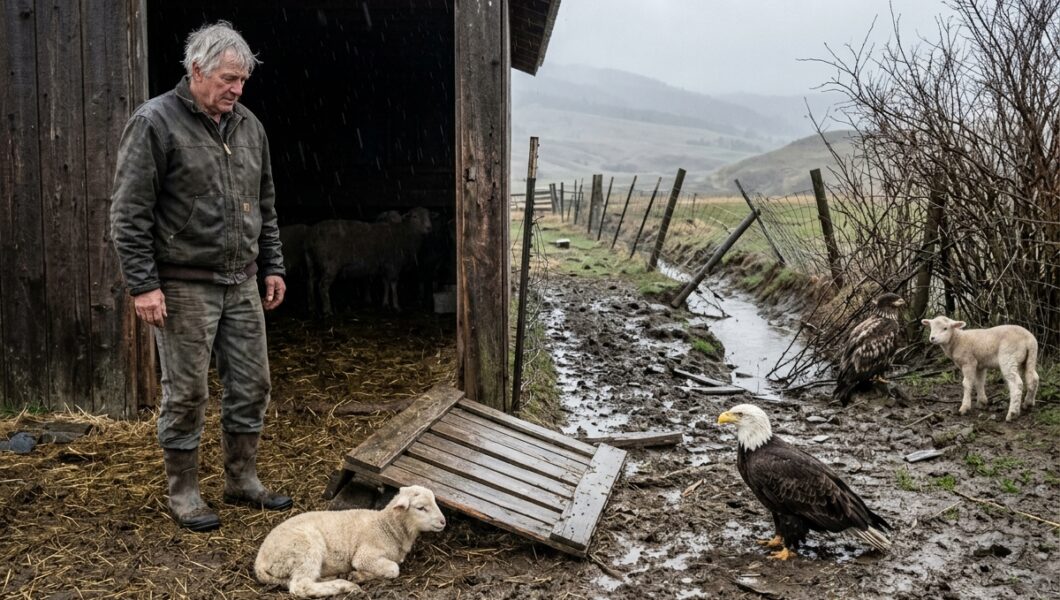
Margaret Wilson had spent most of her life learning how to read the signs of a Montana storm. She knew when sheep were likely to crowd together for shelter, when the pasture became too muddy for safe footing, and when a damaged fence needed immediate attention.
But nothing had prepared her for what the security camera revealed that Monday morning.
One lamb was being treated inside the barn. Another was limping near the collapsed fence. And something dark lay beneath the branches beside the drainage ditch.
Margaret stood in the barn doorway while her veterinarian studied the footage on her phone.
“Can you tell what it is?” she asked.
The veterinarian leaned closer to the screen.
“Not clearly in this rain. We shouldn’t assume anything until we can get a better look.”
Margaret nodded. She had learned over the years that guessing could waste precious time. The important thing was to make sure no animal was left trapped or injured.
The veterinarian asked the farm assistant to stay with the first lamb while they went to inspect the far pasture. Margaret followed them only as far as the barn entrance, then waited while they moved carefully through the muddy ground.
The rain had softened slightly, but water still ran down the slope toward the drainage ditch. The grass was flattened, and broken fence posts lay at awkward angles across the pasture.
From the barn, Margaret could see the second lamb standing near the damaged fencing. It was cream-colored, like the first, and it held one rear leg stiffly as it tried to move away from the mud.
The veterinarian approached slowly and examined it without forcing it to walk. The lamb was frightened, but it remained upright.
Then the farm assistant called out.
“There’s something under these branches.”
Margaret felt her stomach tighten.
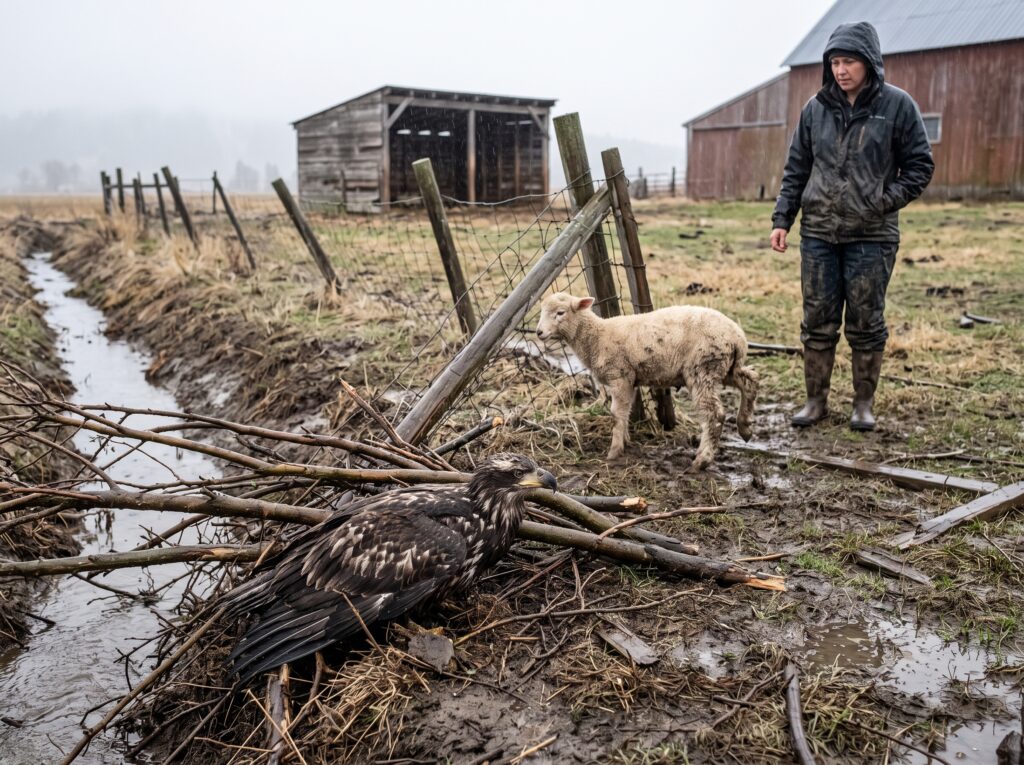
The veterinarian asked everyone to stop until they could assess the area safely. A tangled mass of wet branches had collected beside the drainage ditch, partly covering a dark shape near the water’s edge.
The assistant used a long-handled tool to move a few loose twigs from a distance.
A white patch appeared beneath the branches.
Then they saw a head.
It was a young bald eagle.
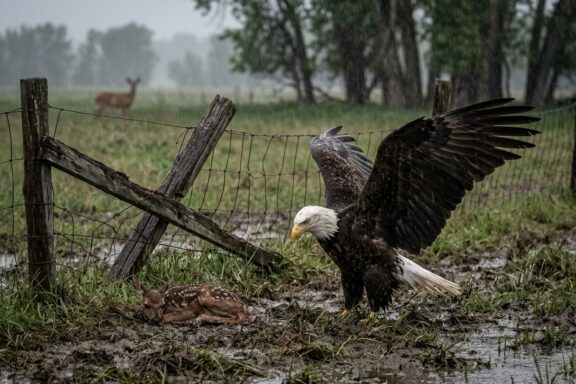
The bird was lying on its side in the mud, its dark feathers soaked and clumped together. One wing was partly caught beneath the tangled branches, and its white head was turned toward the bank. It moved slightly when the rain struck its feathers, but it did not try to rise.
Margaret covered her mouth.
“Oh, you poor thing.”
The veterinarian immediately warned her not to approach or touch the bird. Even a severely injured eagle could strike with its powerful talons if frightened. The bird also needed a specialist who could assess its condition and free it without causing further injury.
The veterinarian called a licensed wildlife rescue service and explained what they had found.
While they waited, the farm assistant remained near the second lamb, keeping it away from the damaged fence. Margaret returned to the barn entrance to check on the first lamb.
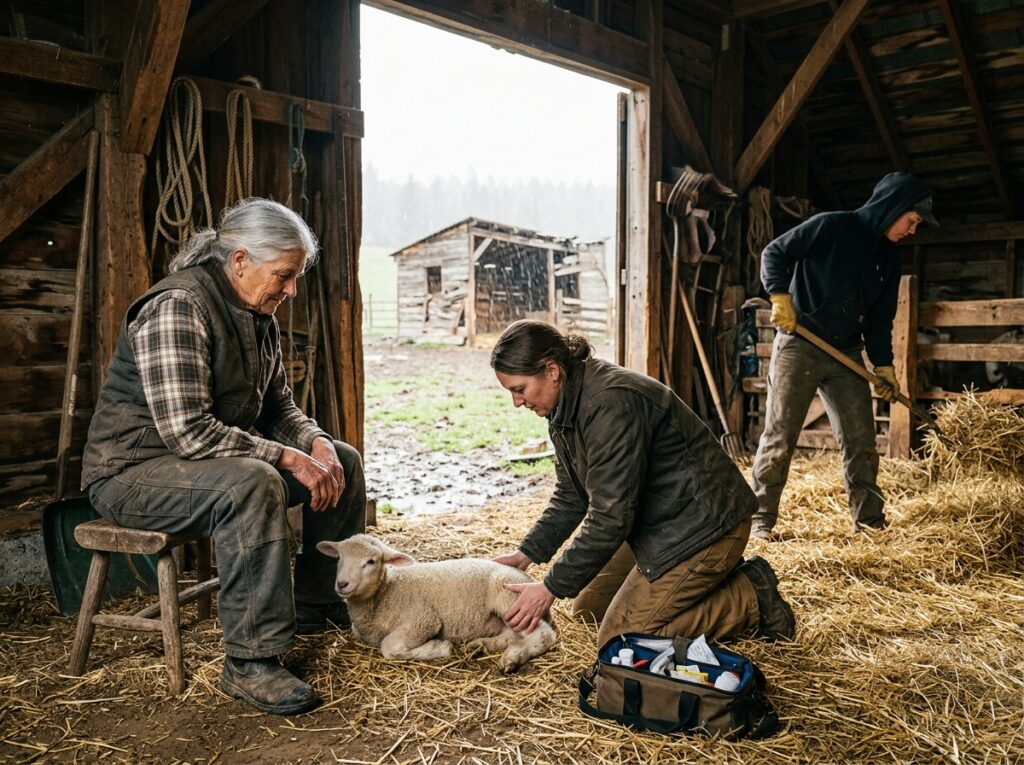
It was lying on a bed of clean straw while the veterinarian’s earlier instructions were followed. Its breathing had settled, but the swollen rear leg still needed further examination. Margaret gently placed the clean towel she had brought nearby, then stepped back to give the animal space.
She looked through the barn doorway toward the pasture.
The young eagle lay near the ditch. The second lamb stood beside the broken fence. And the adult bald eagle that had first appeared at the sheep shelter was no longer on the low branch.
Could the adult bird have been watching the younger one?
It was possible, but Margaret could not know. The adult eagle might have been drawn to movement in the pasture, or it might have been hunting or seeking a place to perch during the storm. Its repeated presence did not prove a relationship between the birds.
Still, she couldn’t forget the way it had looked toward the shelter before flying toward the far end of the field.
The wildlife rescue team arrived forty minutes later in a vehicle equipped for transporting injured birds. Two trained responders stepped out wearing waterproof clothing and carrying protective equipment, a secure bird carrier, and tools for carefully freeing an animal caught beneath debris.
They listened as the veterinarian explained where the eagle had been found and how the branches appeared to be holding one wing in place.
The responders approached slowly. One assessed the bird’s position while the other checked the surrounding branches and muddy bank. They worked together to determine how to remove the debris without putting additional pressure on the wing.
Margaret watched from a distance.
The young eagle lifted its head once as the responders worked. One of them paused to give it time to settle before continuing.
Eventually, they freed the trapped wing and secured the bird for transport. The eagle was weak and visibly wet, but it was alive. A specialist would need to examine it to determine whether the wing had been injured and whether it had suffered from prolonged exposure to the cold rain.
Margaret let out a breath she hadn’t realized she was holding.
At least the bird was no longer trapped beneath the branches.
Before leaving, one of the responders asked whether anyone had seen the adult eagle near the drainage ditch.
Margaret explained that the adult had first appeared beside the sheep shelter, then moved to a fence post and later to a low branch. She had seen it fly toward the far pasture shortly before the second camera revealed the dark shape beneath the branches.
The responder listened carefully.
“That gives us a timeline,” he said, “but we can’t tell from that alone why the adult was there.”
Margaret understood. The bird’s behavior was unusual, but it was not proof that it had been trying to lead anyone to the injured juvenile.
She thanked the team as they secured the carrier and drove away.
Then she turned back to the sheep.
The second lamb still needed assessment, and the first was waiting in the barn. The morning’s rescues were far from over.
Inside the dry holding area, the veterinarian examined the first lamb’s leg more thoroughly. After checking its condition, the veterinarian explained that the swelling required continued monitoring and further evaluation. The lamb would need rest and a dry environment while they determined the extent of the injury.
Margaret sat on an overturned bucket nearby.
She remembered the years when Robert had been alive and the two of them had worked together through storms like this one. Robert had always taken the difficult jobs first, especially when an animal was hurt. He would inspect the fences, check the shelters, and make sure every sheep had somewhere safe to go.
After he died, Margaret had learned to do those things herself.
But there were mornings when the responsibility felt heavier than she liked to admit.
She looked at the little lamb resting in the straw.
“You just take your time,” she whispered. “We’ll figure this out.”
By early afternoon, the rain began to weaken.
Margaret and the farm assistant walked the fence line with the veterinarian’s permission, staying clear of the section that had collapsed near the drainage ditch. The storm had damaged more than one panel. Several posts leaned at dangerous angles, and a length of wire had sagged close to the ground.
They marked the damaged section so it could be repaired before the flock was allowed to use that part of the pasture again.
The second lamb was brought into a dry area for examination. It had a limp and some superficial scrapes, but the veterinarian needed time to determine whether there was a deeper injury. The priority was to keep it comfortable, limit unnecessary movement, and monitor its condition.
Margaret was relieved that both lambs had been found before the weather grew worse.
But she kept thinking about the young eagle.
The adult bald eagle had not returned to the sheep shelter. Margaret checked the camera feeds several times, hoping to see it perched safely in one of the trees beyond the pasture.
At 1:17 p.m., the camera detected movement near the far fence.
Margaret opened the feed.
An adult bald eagle had landed on a post near the pasture boundary. Its white head stood out against the gray sky, and its dark body looked almost black in the damp light.
The bird remained there for several seconds, facing the drainage ditch.
Then it turned toward the open fields and flew away.
Margaret watched the clip again.
The adult had returned to the same general area, but the footage offered no clear explanation for its movements. It might have been searching the ground, surveying its surroundings, or simply using the fence post as a resting place.
She resisted the temptation to decide what it meant.
Instead, she saved the recording for the wildlife rescue team.
Later that afternoon, a responder called with an initial update about the juvenile eagle. The bird was receiving care, and its condition would need to be monitored while specialists assessed its wing and overall health. It was too early to know whether it would recover fully or when it might be released.
Margaret thanked the responder and asked them to let her know if there was anything else she could do.
“There is one useful thing,” the responder told her. “Keep the cameras recording if you can. If the adult returns, the footage may help us understand where the birds are moving. Just remember that we may not be able to determine their relationship from the video.”
Margaret promised to keep an eye on the cameras.
She also made sure the damaged section of the pasture remained closed off while the fence repairs were arranged.
That evening, she stood at the barn door and listened to the rain dripping from the eaves. The first lamb was resting in dry bedding. The second had been assessed and was being kept under observation. The juvenile eagle had been taken for specialist care.
For the first time all day, the farm was quiet.
Margaret looked toward the old sheep shelter, remembering the adult eagle standing beside the entrance at 6:38 that morning. She remembered the tiny lamb lying in the mud, the second lamb near the collapsed fence, and the dark shape beneath the branches.
She had begun the morning thinking she was looking at one injured lamb.
By midday, she had helped coordinate care for two lambs and an injured young eagle.
The adult eagle’s behavior might always remain unexplained. Perhaps the bird had noticed movement around the shelter. Perhaps it had been searching for food. Perhaps its repeated appearances had been unrelated to the lambs and the juvenile eagle.
Margaret did not need to turn uncertainty into a story of its own.
What mattered was that she had checked the cameras, noticed the injured animals, and called the people qualified to help.
Before going inside, she checked the fence one final time from the safe side of the marked boundary. Then she turned toward the farmhouse, where a warm meal and a quiet evening waited.
She thought of Robert and the work they had shared, and for a moment she could almost hear him reminding her to check the animals one more time before bed.
Margaret smiled faintly.
She would check again in the morning.
Because sometimes, she had learned, caring for animals meant noticing the smallest detail before it became impossible to ignore. Sometimes it meant asking for help before attempting a rescue alone. And sometimes it meant accepting that an extraordinary sight might not have a simple explanation.
The bald eagle had stood beside her sheep shelter during the storm. Its presence had caught her attention, but Margaret’s decision to investigate the footage had revealed the real emergency.
Two lambs needed care. A young eagle had been trapped beneath wet branches. And a damaged fence needed to be repaired before another animal was hurt.
The storm had brought all of them into one difficult morning, but it was patience, careful observation, and trained help that gave each animal a chance.
As the last light faded across the Montana pasture, Margaret closed the barn door and headed back to the farmhouse.
The rain was finally stopping.
And for the first time since dawn, she allowed herself to hope that tomorrow would bring better weather, safer ground, and good news about the animals she had spent the day trying to protect.
Sometimes the greatest act of kindness is not understanding every mystery. It is seeing that something needs help and doing the safest thing you can to make sure that help arrives.
No Comments