

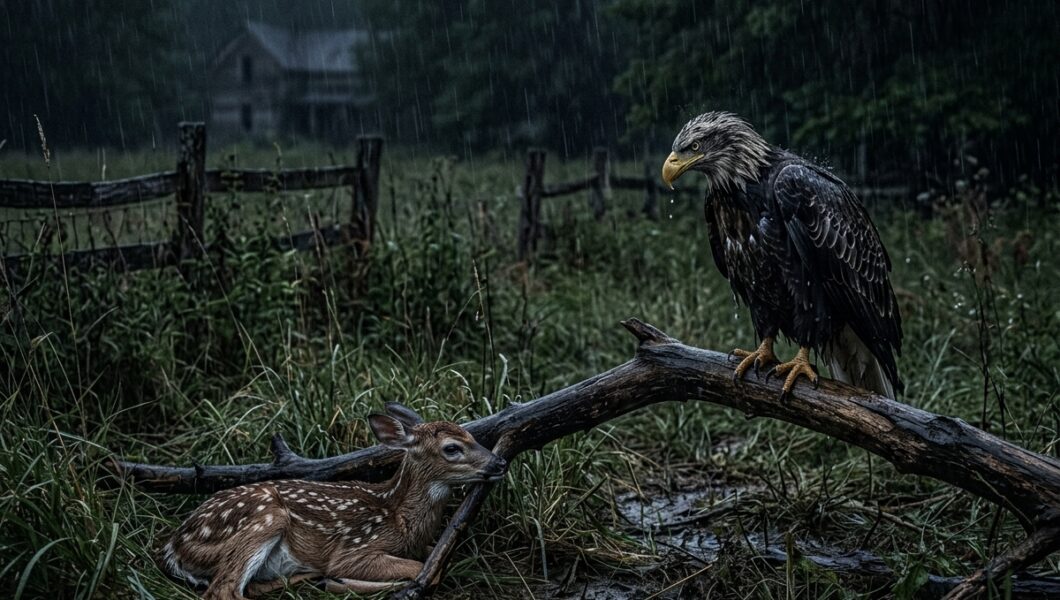
The rain had stopped by the time the farmer went back to the pasture that evening.
The storm had moved farther east, leaving behind a wet, quiet landscape.
Water still clung to the grass.
Small puddles reflected the gray sky.
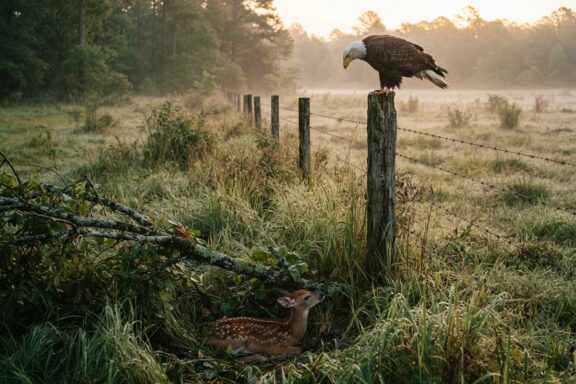
The old wooden fence was dark with moisture, and the fallen branch lay exactly where it had been during the night.
But something about the place felt different.
Earlier that morning, the farmer had been focused on the fawn.
He had seen the young deer trapped beneath the branch, called for help, and watched it finally stand and disappear into the wet grass.
At the time, he had been relieved.
He thought the story was finished.
But the security footage had left him with another question.
Why had the eagle kept coming back?
At 2:17 AM, it had landed on the fence.
At 2:19, it had moved toward the grass.
Then it had returned again.
2:31.
2:47.
3:06.
3:28.
Each time, the same location.
The same patch of pasture.
The same fallen branch.
The farmer had watched the recordings several times.
He knew there was no way to prove what the eagle intended.
It could have been curious.
It could have been watching a vulnerable animal.
It could have been waiting for an opportunity.
But there was something he hadn’t noticed during the rescue.
Something the darkness and rain had hidden.
So that evening, he walked back toward the fallen branch.
He stopped several feet away.
The grass was still flattened where the fawn had been lying.
He looked around carefully.
At first, there was nothing.
Then he noticed marks in the wet soil.
Small hoofprints.
They began beside the branch.
They continued through the grass.
And they led toward the tree line.
The farmer followed them with his eyes.
The tracks were uneven at first.
Some were deeper than others.
The fawn had clearly struggled when it first got free.
But farther from the branch, the prints became more regular.
The animal had found its balance.
It had walked away.
The farmer smiled.
That was good.
But then he noticed something else.
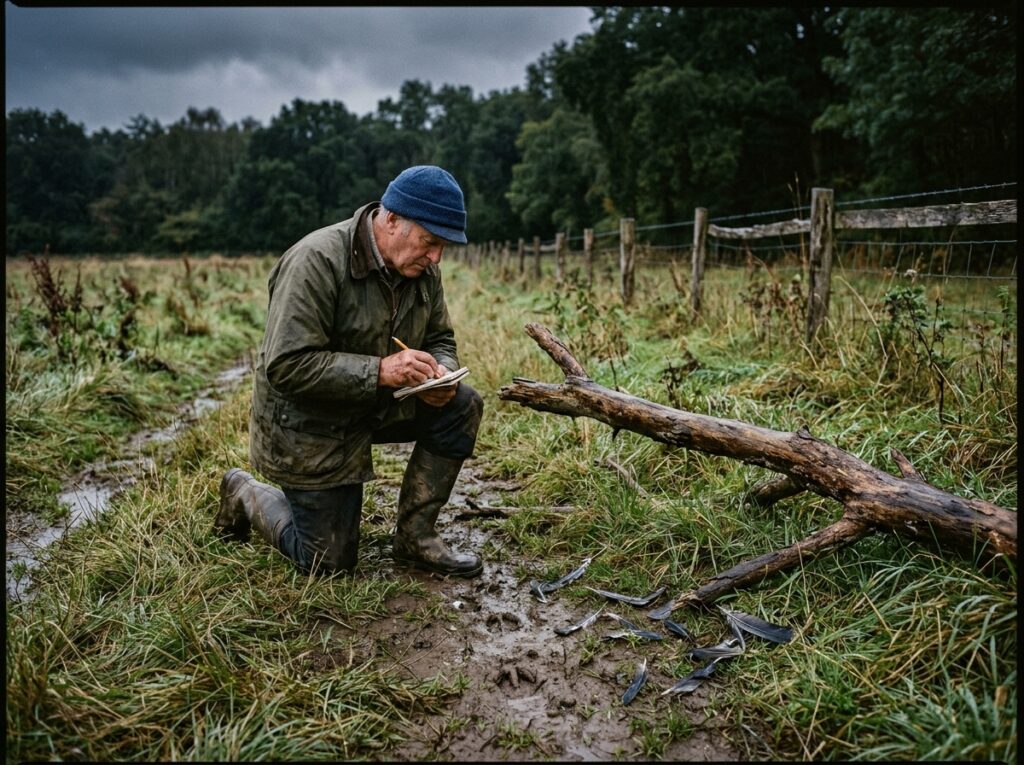
Near the base of the fallen branch were several small feathers.
Not deer hair.
Bird feathers.
Dark feathers.
He crouched down.
There were only a few.
They could have come from almost any bird.
But one of them was larger than the others.
He picked it up carefully.
Then he looked toward the fence.
He thought about the eagle.
The farmer had no way to know whether the feather had anything to do with the bird.
It could have been old.
It could have been left by another animal.
It could have been carried there by the wind.
He didn’t make assumptions.
Instead, he walked farther around the branch.
That was when he noticed the ground.
There were marks in the mud that weren’t deer tracks.
Two parallel impressions.
Then another set.
They appeared near the edge of the flattened grass.
The farmer stared at them.
They looked like the marks made by talons.
Eagle tracks.
He followed them several feet.
They led toward the exact spot where the eagle had been standing in the security footage.
He stopped.
For a moment, he simply looked at the ground.
The discovery didn’t prove anything.
It didn’t prove that the eagle had been trying to help.
It didn’t prove that the eagle had understood the fawn was trapped.
It didn’t even prove that the tracks had been made that same night.
But they gave him a better sense of how close the bird had actually been.
The eagle hadn’t simply flown over the pasture.
It had come down.
It had stood on the wet ground.
And it had remained near the trapped fawn.
The farmer went home and checked the footage again.
This time, he watched it differently.
He slowed the recording down.
At 2:17, the eagle landed on the fence.
At 2:19, it flew down.
The farmer watched carefully.
The eagle walked several steps toward the grass.
Then stopped.
Its head moved.
It looked down.
The farmer advanced the footage.
The eagle remained there.
At 2:31, it returned.
Again, it landed near the same place.
Again, it looked toward the ground.
At 2:47, the same thing happened.
Then 3:06.
Then 3:28.
The farmer sat back in his chair.
He had watched the footage before.
But now he noticed something he hadn’t noticed the first time.
The eagle wasn’t always looking directly at the fawn.
Sometimes it looked toward the surrounding trees.
Sometimes toward the pasture.
Sometimes toward the branch.
Its attention shifted constantly.
It was impossible to know what it was responding to.
That made the mystery even harder to solve.
Maybe the bird had seen the fawn.
Maybe it had simply noticed movement.
Maybe it had been attracted to the possibility of food.
Maybe the storm had disturbed something in the pasture.
The camera couldn’t tell him.
But there was one thing the footage showed clearly.
The eagle kept returning.
And each time, the fawn was still there.
The farmer wondered how long the young deer might have remained trapped if nobody had noticed.
The storm had been heavy.
The grass was soaked.
Temperatures had dropped overnight.
The fawn was small.
Its body had been exposed to the cold rain for hours.
It was fortunate that the farmer had checked the footage that morning.
It was even more fortunate that the eagle had caught his attention.
The next morning, the farmer walked back to the pasture.
The rain had completely stopped.
The clouds were breaking apart.
He looked toward the tree line.
Nothing.
Then he noticed movement.
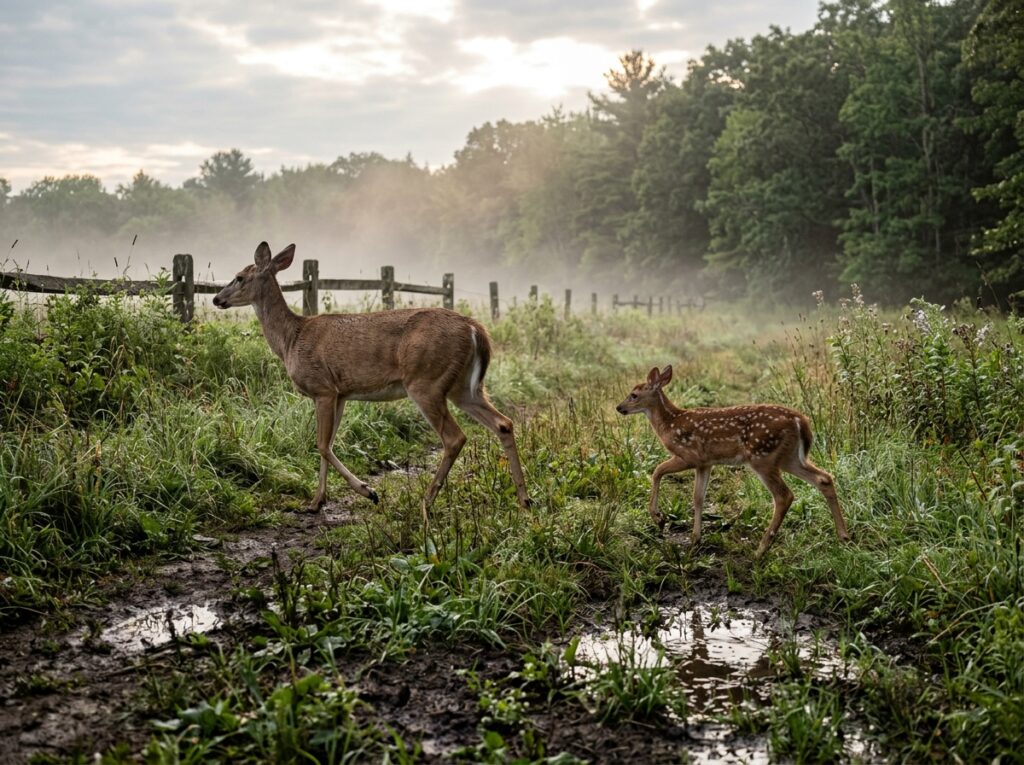
A doe stepped from the woods.
She paused near the edge of the pasture.
A few seconds later, a small fawn appeared behind her.
The farmer stopped breathing for a moment.
He watched the pair carefully.
The fawn followed its mother.
It was walking normally.
No obvious limp.
No dragging leg.
No hesitation.
The farmer couldn’t prove it was the same fawn.
But the timing was right.
The size seemed right.
And something about the way the young deer moved made him hopeful.
The doe turned toward the woods.
The fawn followed.
Then both disappeared.
The farmer stood there for another minute.
He smiled.
Maybe that was the answer he had been hoping for.
Not an explanation for the eagle.
Just evidence that the fawn was okay.
For several days, the farmer kept thinking about the eagle.
Then the security camera recorded it again.
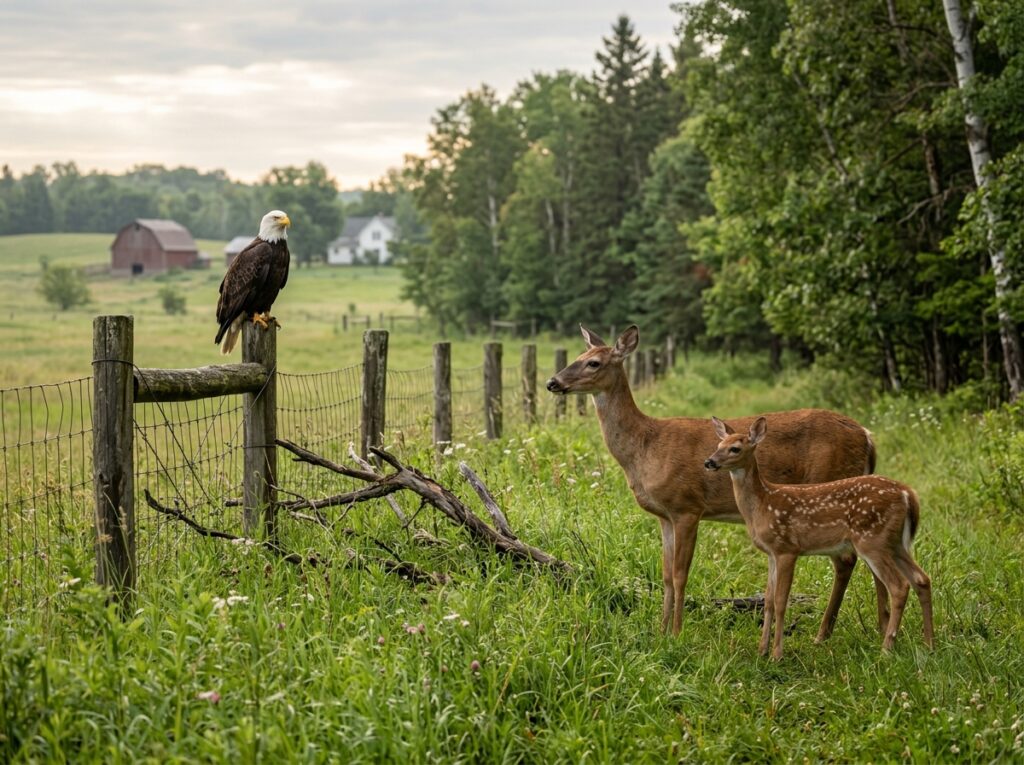
At 6:14 in the morning, the eagle landed on the old fence.
The storm was gone.
The pasture was dry.
The fawn was nowhere near the fallen branch.
The eagle looked across the field.
Then it flew down.
Not to the branch.
Not to the grass.
It landed several yards away and walked toward the same section of pasture.
The farmer watched from inside the house.
The eagle stopped.
It looked toward the grass.
Then toward the woods.
After several minutes, it flew away.
The farmer replayed the footage.
He smiled.
Whatever had brought the eagle there before, the situation was different now.
The fawn was gone.
The branch was empty.
There was nothing waiting underneath it.
Yet the eagle still returned.
That was when the farmer realized something important.
He had been trying to understand the eagle’s behavior as though there had to be one answer.
There didn’t.
The bird might have been hunting.
It might have been curious.
It might have remembered the location.
It might have simply returned to a familiar hunting ground.
Wildlife doesn’t give us explanations.
We see behavior.
We interpret it.
Sometimes we are right.
Sometimes we aren’t.
The farmer decided he didn’t need to know.
Because whatever the eagle had intended, its presence had caused a chain of events that mattered.
The homeowner had noticed the strange bird.
He had reviewed the footage.
He had walked into the pasture.
He had found the trapped fawn.
He had called for help.
And the young deer had been freed.
That was real.
Everything else was speculation.
A few weeks later, the farmer checked the trail camera again.
The fawn appeared.
This time, it was slightly farther from the house.
It walked through the grass with its mother.
The young deer stopped to feed.
Then it followed the doe toward the trees.
The farmer watched the clip twice.
The fawn looked healthy.
That was enough.
He saved the recording.
Then he opened the original footage from the night of the storm.
He watched the eagle arrive.
He watched it fly down.
He watched it stand near the fawn.
He watched it return again and again.
Then he watched the rescue.
The fawn pulling its leg free.
The trembling attempt to stand.
The first careful steps into the grass.
The farmer realized that none of those moments had looked extraordinary while they were happening.
The rescue itself had been simple.
Lift the branch.
Wait.
Give the animal space.
Let it recover.
But the circumstances had been extraordinary.
The fawn was almost invisible.
The rain had hidden its presence.
The darkness had made the pasture difficult to see.
And the only reason the farmer had known where to look was because an eagle had behaved strangely.
Sometimes that’s how rescue happens.
Not with a dramatic discovery.
Not with a loud cry.
But with a small detail that doesn’t quite fit.
A bird that keeps returning.
A movement in the grass.
A strange pattern on a camera.
A question that makes someone stop and look.
The farmer never called the eagle a rescuer.
He never said it had saved the fawn.
He knew better.
People had freed the deer.
People had assessed the situation.
People had made the decision to lift the branch.
But the eagle had been there.
And its repeated presence had made someone look.
That distinction mattered.
The farmer still didn’t know what the eagle was thinking.
He probably never would.
Maybe the bird saw an easy meal.
Maybe it saw an animal struggling.
Maybe it was simply curious.
Maybe it was responding to something completely unrelated.
There was no reliable way to tell.
But sometimes we don’t need to understand an animal’s intention to appreciate what happened.
The fawn survived.
It walked away.
It returned to the pasture.
And the farmer learned to pay closer attention.
That evening, he stood near the fence and looked across the field.
The old branch was still there.
The grass had started to straighten.
The hoofprints were disappearing.
Soon, there would be almost no visible sign that the fawn had ever been trapped.
That seemed fitting.
Wildlife doesn’t stop for long.
Animals recover.
Move on.
Find food.
Follow their mothers.
Return to the woods.
The pasture changes.
The seasons change.
And most of the moments that matter disappear without leaving much evidence behind.
Except for the things we choose to remember.
The farmer remembered the security footage.
He remembered the eagle landing at 2:17.
He remembered the rain.
He remembered the fawn lying helpless beneath the branch.
He remembered those small eyes reflecting the flashlight.
And he remembered the moment the little deer finally stood.
Those were the moments that stayed with him.
Not because they proved the eagle had some special purpose.
But because they reminded him how easy it is to miss something important.
The fawn had been only fifty yards from the farmhouse.
Yet nobody had heard it.
Nobody had seen it.
Nobody knew it was there.
Then an eagle appeared.
Someone noticed.
And everything changed.
Months later, the eagle still occasionally visited the property.
Sometimes it landed on the old fence.
Sometimes it flew across the pasture.
Sometimes it disappeared over the woods without stopping.
The farmer didn’t watch it with the same question anymore.
He simply watched.
Because he had learned that nature doesn’t always tell us what something means.
Sometimes it only gives us a clue.
And if we’re willing to follow that clue, we may discover something that needs our attention.
The eagle may never have intended to lead anyone to the fawn.
Maybe it didn’t even understand that the deer was trapped.
Maybe it was only watching.
But that night, its repeated visits were enough to make someone look closer.
And underneath the rain-soaked grass was a young animal that needed a chance to get free.
Sometimes kindness begins before we even recognize it as kindness.
It begins with curiosity.
With noticing.
With asking why.
Why does that bird keep coming back?
Why is it looking there?
What is underneath that grass?
And sometimes, the answer is something small and vulnerable that would otherwise remain unseen.
The farmer never found a perfect explanation.
He didn’t need one.
The fawn was alive.
It was walking again.
And somewhere above the pasture, the eagle continued flying.
That was enough.
No Comments