

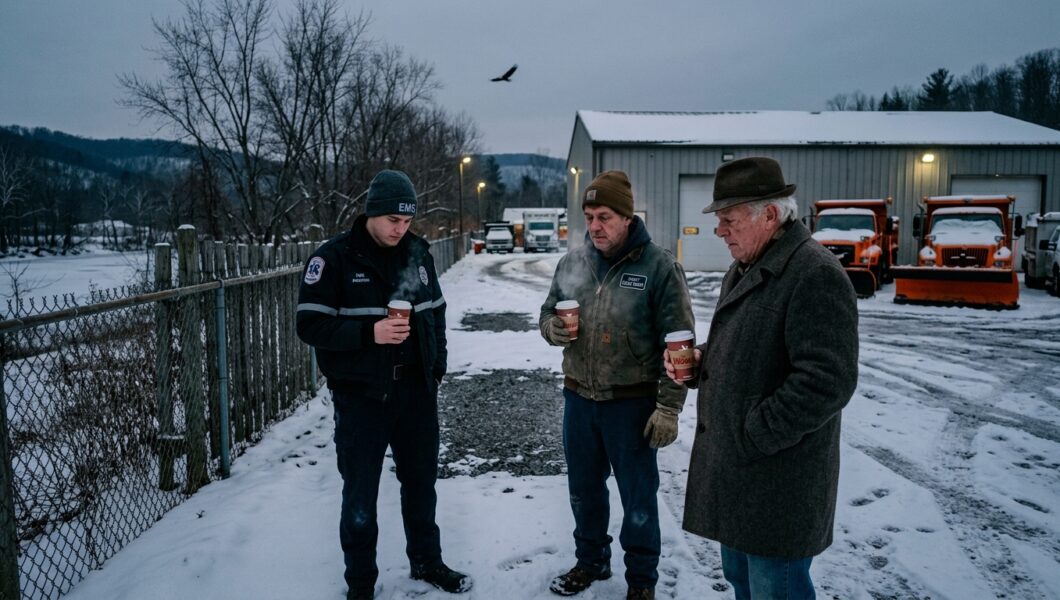
Eleven months after the county hauled away Robert’s old ambulance, David Turner showed up at his house carrying a cardboard box.
It was January again.
Cold enough that the snow squeaked under your boots.
I know because Robert called me that evening.
We’d stayed in touch after the morning at the county garage.
Not close friends exactly.
But every few weeks my phone would buzz with his name.
Usually he wanted something practical.
Did I know someone who could repair a snowblower?
Could my brother get him the phone number for the county maintenance office?
Once he called solely to complain that the grocery store had rearranged the coffee aisle.
So when he said:
“Daniel, you might want to come over,”
I knew something was different.
I found Robert at his kitchen table.
David sat across from him.
Between them was the box.
“You remember David.”
“Of course.”
Mikey’s younger brother was sixty-three now.
He’d been nine years old when Michael died.
I hadn’t realized until then how strange that must have been for him.
Robert had carried Mikey as a seventeen-year-old forever.
Helen had carried him that way too.
But David had continued aging.
Eventually becoming older than the brother he’d once followed around the house.
“Mom had another box,” David said.
Robert frowned.
“I thought you gave me everything.”
“So did I.”
After Helen died, David had gone through most of her belongings.
But his daughter was renovating the old family house and had found a small storage space beneath the basement stairs.
Inside were Christmas decorations.
Tax records.
School photographs.
And one cardboard box with Robert’s name written on top.
David pushed it toward him.
Robert didn’t open it.
Not immediately.
“What’s in there?”
“You should see.”
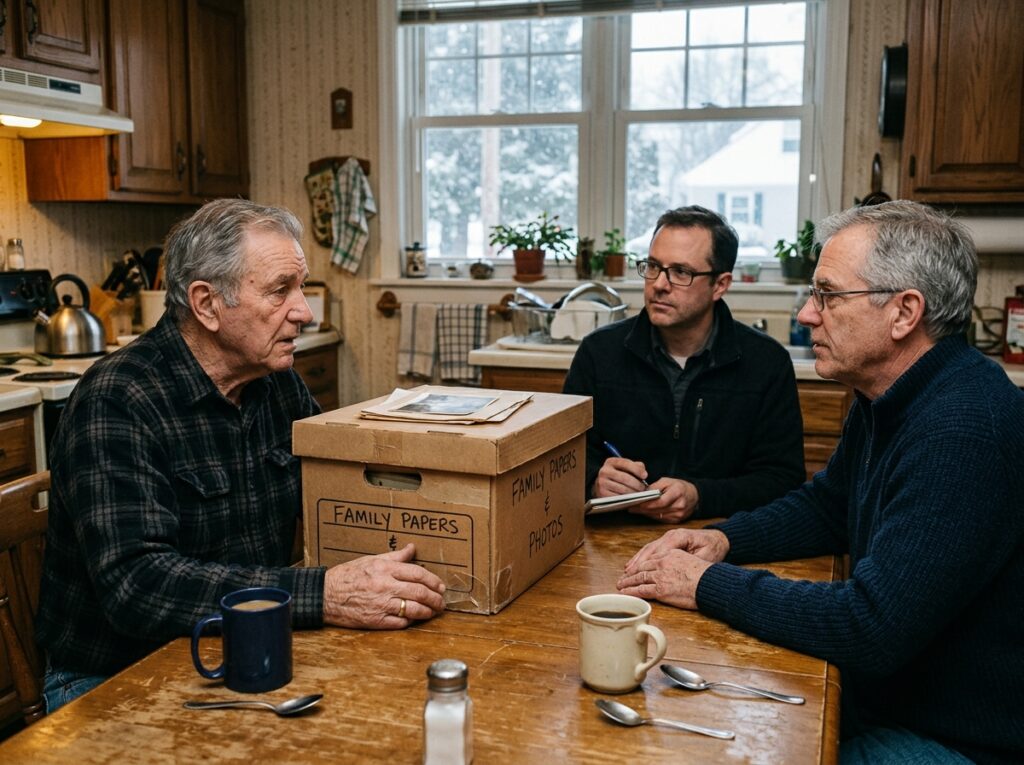
Robert finally lifted the lid.
Inside were his letters.
Not the thirty-one David had already returned.
Copies.
Helen had apparently photocopied many of them.
Beside those were newspaper clippings.
A few photographs.
Christmas cards.
Then Robert pulled out a spiral notebook.
Blue cover.
Cheap.
The kind you’d buy at a drugstore.
On the first page Helen had written:
THE PEOPLE AFTER MICHAEL
Robert stared at it.
“What is this?”
David shook his head.
“I didn’t know either.”
Helen had been keeping her own record.
Every time Robert mentioned something in one of his January letters, she wrote it down.
Not names.
Just moments.
1987 — baby delivered during snowstorm. Mother and child okay.
1989 — farmer survived tractor accident.
1992 — little girl, severe allergy. Robert says she’s doing well.
1996 — high school basketball player. Survived.
Some entries were different.
Bad year. Robert lost several. Says he’s tired. Sent him a Christmas card early.
Another:
Robert says he still wonders if Michael was frightened at the end. I wish I could make him understand that frightened and alone are not the same thing.
Robert stopped reading.
He removed his glasses.
Nobody spoke.
Then he turned another page.
Helen had written about David.
About grandchildren.
About birthdays.
About the strange guilt she felt whenever she laughed during the first year after Mikey died.
She wrote about seeing seventeen-year-old boys in grocery stores and wondering what Michael would look like at thirty.
Forty.
Fifty.
She wrote:
People think grief is only missing who someone was. Sometimes it’s missing every person they never got the chance to become.
David looked away.
He’d never read that before.
Neither had Robert.
Then we reached an entry dated twenty-five years after Mikey’s death.
Helen had written:
Robert retired today.
Underneath:
He made it.
Two words.
Robert ran his finger across them.
“He made it.”
Then he laughed softly.
“She makes it sound like I crossed the Atlantic in a rowboat.”
David said:
“For Mom, you kind of did.”
Robert closed the notebook.
He wasn’t ready for more.
We drank coffee.
Talked about ordinary things.
That was something I had learned from Robert.
You don’t have to squeeze meaning out of every emotional moment while it’s happening.
Sometimes people need to discuss furnace filters after reading the words of a dead woman they loved.
Before David left, Robert asked:
“Why did she keep all this?”
David thought.
“I think she needed to know Michael’s story didn’t stop on County Road 8.”
Robert nodded.
Then David added:
“And maybe she wanted you to know yours didn’t either.”
For the next several months, the notebook stayed in Robert’s kitchen drawer.
He didn’t show it around.
Didn’t post about it.
Didn’t turn Helen’s grief into a display.
But occasionally he read a page.
Then something happened in May.
A twenty-three-year-old EMT named Caleb Morris walked out of his first fatal call and decided he was done.
Robert met him at the CPR class where he volunteered.
Caleb wasn’t a student.
He was helping move equipment.
Robert noticed him because the kid barely spoke.
Usually, Caleb was loud.
Joking.
Always hungry.
That day he looked like somebody had turned the volume off.
Robert asked:
“You okay?”
“Yep.”
Robert knew that answer.
He’d used it himself for decades.
So he didn’t push.
He just said:
“Coffee?”
Caleb shrugged.
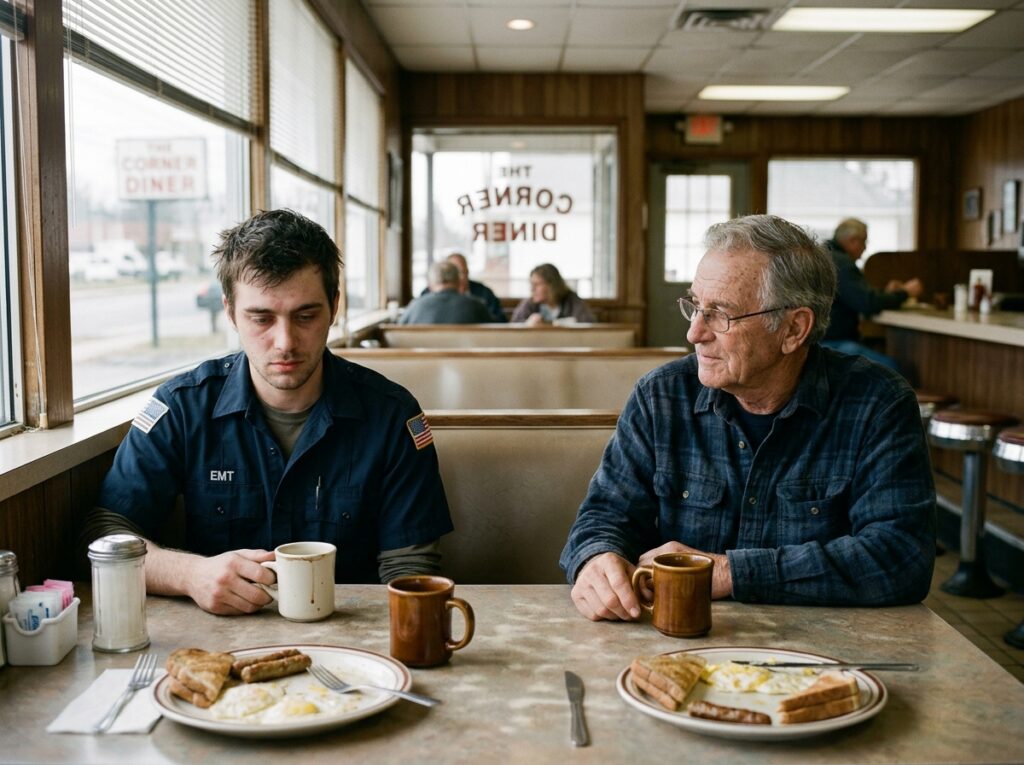
They went to a diner.
For twenty minutes, they talked about everything except EMS.
Baseball.
Truck repairs.
The terrible coffee.
Then Caleb finally said:
“I lost a kid.”
Robert didn’t react visibly.
“How old?”
“Nineteen.”
Single-vehicle crash.
Late at night.
Caleb had been in the back of the ambulance.
The young man had been conscious for part of the ride.
Caleb kept replaying everything.
Every decision.
Every word.
Every second.
“I should’ve done something different.”
“Did your medical director say that?”
“No.”
“Your partner?”
“No.”
“Hospital?”
“No.”
“Then who’s saying it?”
Caleb looked down.
“Me.”
Robert nodded.
“That’s a loud voice.”
Caleb told him he hadn’t slept properly in six days.
His girlfriend said he wasn’t himself.
He’d started drafting a resignation email.
Robert stared at him.
Forty-two years disappeared.
Thirty-four-year-old Robert.
Kitchen table.
Resignation letter.
Helen Turner at the door.
But Robert didn’t immediately tell Caleb his story.
First, he told him something more important.
“You need to talk to somebody who knows how to help with this.”
Caleb stiffened.
“I’m talking to you.”
“No.”
Robert shook his head.
“You’re talking to an old paramedic over pancakes. That’s fine. But it’s not the same thing.”
Robert had learned that lesson late.
He didn’t want Caleb to.
They contacted the department’s peer-support coordinator.
Caleb eventually connected with professional counseling.
He took time away from calls.
Nobody told him to toughen up.
Nobody told him to forget.
Nobody promised he’d stop thinking about the nineteen-year-old.
They helped him understand that carrying a difficult call and being destroyed by it weren’t the same thing.
Only after that did Robert tell him about Mikey.
Caleb listened to the entire story.
The crash.
Mikey.
Don’t leave.
Helen.
The resignation letter.
Twenty-five more years.
When Robert finished, Caleb asked:
“Did you ever stop thinking about him?”
“No.”
That answer surprised him.
“Then how did you keep doing the job?”
Robert thought for a long time.
“I stopped believing remembering him meant I had failed him.”
Then he corrected himself.
“Eventually.”
Caleb asked:
“How long did eventually take?”
“Longer than it should’ve.”
Robert told me later that this was the part of the story he’d started understanding differently with age.
For years, he’d described Helen as the person who saved his career.
That was true in one sense.
Her visit kept him from handing in the resignation the next morning.
But staying in EMS hadn’t automatically healed him.
He still needed support.
Linda.
His partner.
Other medics.
Time.
And eventually, much later than he wished, the ability to talk honestly about difficult calls.
Helen opened a door.
Robert still had to walk through it.
That’s important.
One beautiful sentence can change a direction.
It doesn’t replace the work that comes afterward.
Caleb didn’t resign.
But Robert never bragged about that.
“That’s his decision,” he told me.
“I didn’t keep him in EMS.”
Caleb chose to stay after taking time to recover and getting support.
For months, he worked fewer shifts.
Then gradually returned.
The following January, Caleb called Robert.
“Are you busy?”
“Depends.”
“I need you to come outside.”
Robert opened his front door.
Caleb was standing there holding coffee.
“What’s this?”
“January.”
Robert understood.
They drove to the county garage.
The old ambulance was long gone.
There was just an empty patch near the fence where it had once sat.
Snow covered most of it.
They stood there at 6:21.
No eagle.
Robert noticed that.
Then laughed at himself for noticing.
Caleb asked:
“What?”
“Nothing.”
They drank coffee.
After a while, Caleb said:
“I had a bad call last week.”
Robert looked at him.
“You okay?”
“No.”
Then:
“But I told somebody.”
Robert smiled.
“Good.”
That was progress.
Not being unaffected.
Not becoming tougher.
Telling somebody.
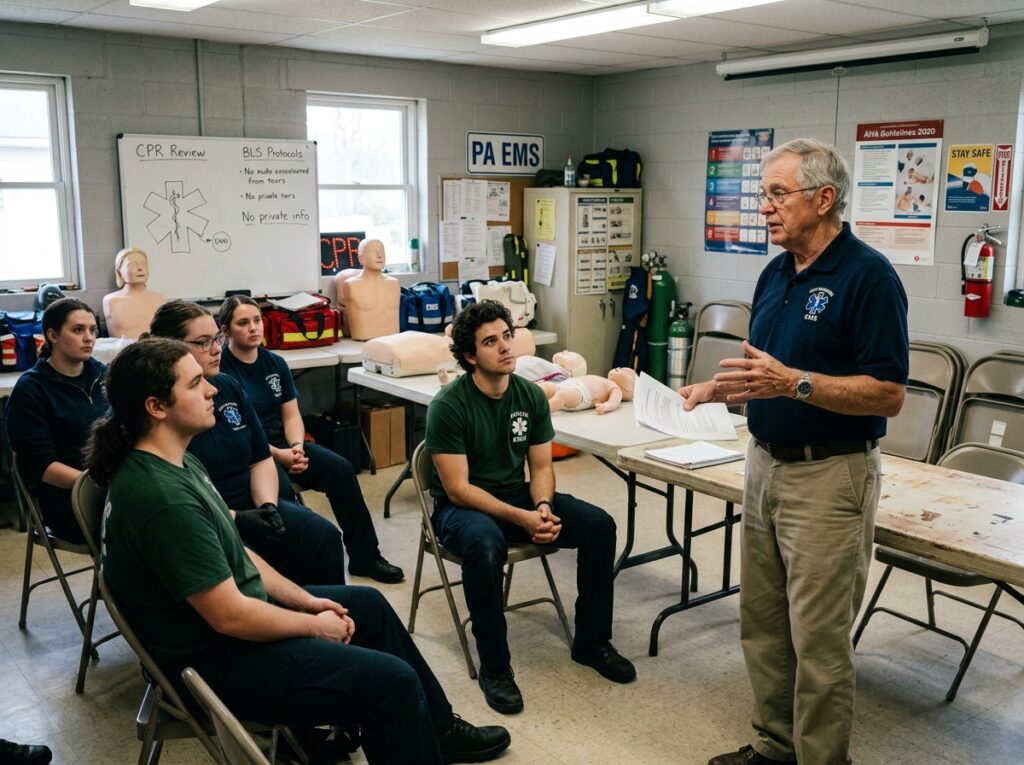
A few weeks later, Robert brought Helen’s notebook to the CPR training center.
Not the original.
He’d made copies of several pages.
He asked permission to speak briefly with a group of new EMTs.
He didn’t give them some heroic speech.
Robert hated heroic speeches.
He told them about Mikey.
Then about the twenty-five years afterward.
Then he said:
“You’re going to meet people on their worst days.”
The room became quiet.
“Some of them will live.”
He paused.
“Some won’t.”
Nobody moved.
“You are responsible for your training, your judgment, your effort and how you treat people. You are not powerful enough to control every ending.”
That sentence stayed with me.
Not powerful enough to control every ending.
Sometimes guilt is grief wearing a uniform.
Robert told them to use peer support.
Talk to supervisors.
Talk to clinicians when needed.
Go home and tell the people they love that they love them.
Don’t confuse silence with strength.
Then he told them what Mikey had said in the ambulance:
Make sure they know you love them.
For forty-two years, Robert had thought those words were meant for his daughters.
Maybe they were.
But now dozens of young EMTs heard them too.
Robert turned seventy-eight the following winter.
His knees hurt.
David’s prediction about old men complaining apparently applied universally.
He stopped teaching full CPR classes.
Started sitting during demonstrations.
Caleb began teaching more of them.
That amused Robert.
“The kid corrects me now.”
“Is he right?”
“That’s irrelevant.”
Helen’s notebook eventually went to David.
Robert decided it belonged with the Turner family.
But before giving it back, he added one page.
David discovered it later.
Robert had written:
Helen,
You told me not to let Michael’s last ride be the reason I stopped helping people.
I didn’t.
But I understand something now that I didn’t understand then.
You weren’t asking me to spend the rest of my life paying Michael back.
You were giving me permission to keep living after a morning when he couldn’t.
Thank you.
Then underneath:
Still here.
David framed a copy.
The original stayed inside the notebook.
Robert died the following October.
Seventy-nine.
At home.
His daughter found him in his favorite chair early one morning.
Coffee cup beside him.
Newspaper folded across his lap.
There was no ambulance drama.
No final rescue.
No perfectly timed speech.
His heart simply stopped.
When Caleb called me, neither of us said much.
At Robert’s funeral, the church was crowded.
Former medics.
Firefighters.
Nurses.
County workers.
People Robert had trained.
His daughters.
Grandchildren.
David Turner sat near the front.
Emily came too.
The little girl with the allergic reaction.
Except she was nearly fifty now.
A nurse with grown children of her own.
After the service, people told stories.
Funny ones mostly.
Robert would’ve preferred that.
The time he backed an ambulance into a mailbox.
The deer incident.
His terrible coffee.
His refusal to understand smartphones.
Then Caleb stood.
He didn’t tell the whole Mikey story.
Most people there already knew some version of it.
He simply said:
“Robert taught me something I needed at exactly the right time.”
He paused.
“He taught me that staying in this work doesn’t mean pretending it doesn’t hurt.”
Then he sat down.
That was enough.
A month later, David asked me and Caleb to meet him at the old county garage.
He had something.
Three cardboard boxes.
Inside were copies of Helen’s letters, photographs, Robert’s notes and a few pieces of EMS history.
David had spoken with the local historical society.
They wanted to preserve the story.
Robert would’ve hated anything resembling a shrine.
So they didn’t make one.
No giant portrait.
No plaque calling him a hero.
Instead, they created a small oral-history collection about local emergency services.
Robert was one story among many.
Dispatchers.
Volunteer firefighters.
Nurses.
Paramedics.
Families.
Patients who chose to participate.
And one grieving mother named Helen Turner.
David insisted her part stay central.
“He always said she kept him going.”
Then he smiled.
“Mom would’ve said he kept her going.”
There it was again.
Neither rescuing the other.
Both holding part of the weight.
The next January, I went to the garage.
6:21.
I don’t know why.
Maybe ritual.
Maybe grief.
Maybe because Robert had accidentally taught me that showing up at strange places in freezing weather can become a habit.
Caleb was already there.
So was David.
Three coffees.
“Did you plan this?” I asked.
“No.”
They were lying.
We stood near the empty patch where the ambulance had been.
Snow covered the field.
The creek beyond the trees was mostly frozen.
At 6:27, something moved above the tree line.
Caleb saw it first.
“Eagle.”
A bald eagle crossed above the creek.
High.
Far away.
Doing what bald eagles do.
David laughed.
“Robert would’ve hated how convenient that is.”
“He would’ve complained the timing was six minutes late,” I said.
Caleb lifted his coffee.
“To Bob.”
David did the same.
Then:
“To Mikey.”
We stood there until the eagle disappeared.
Nobody pretended it meant something we could prove.
But sometimes meaning isn’t about proof.
Sometimes meaning is simply what a moment reminds you to carry forward.
For Robert, it had started with a frightened seventeen-year-old holding his sleeve.
Don’t leave.
Then a grieving mother sitting at his kitchen table.
Don’t let this be where your helping stops.
Decades later, it reached a twenty-three-year-old EMT sitting across from Robert in a diner.
Then a room full of new medics.
Now Caleb teaches.
He tells young EMTs something Robert told him.
You are not powerful enough to control every ending.
He also tells them something Robert took too long to learn.
Get help when the job becomes too heavy.
Talk.
Don’t make suffering a test of toughness.
And don’t assume the person beside you is fine simply because they know how to function.
The helpers need help too.
Maybe especially the helpers.
I still think about that first morning at the garage.
I had gone there for jumper cables.
That’s all.
My truck wouldn’t start.
I was irritated.
Late.
Cold.
Then I noticed an old man crying beside an ambulance.
Had I walked twenty feet farther without speaking, I would’ve missed the entire story.
Maybe somebody else would’ve heard it.
Maybe not.
I’ve learned not to make myself too important in these things.
But I do pay more attention now.
To the person lingering after everyone leaves.
The firefighter who’s suddenly quiet.
The nurse sitting alone in a parking lot.
The teacher who says they’re exhausted like it’s a joke.
The parent holding everything together so convincingly that nobody asks who is holding them.
We celebrate helpers for being strong.
Sometimes that’s the least useful thing we can do.
Ask how they’re doing.
Then wait long enough for the second answer.
Robert spent years telling people he was fine.
Helen saw through it.
Caleb tried the same thing.
Robert recognized himself.
That’s how care moves sometimes.
Not through grand acts.
Through recognition.
Someone once noticed you.
Years later, you recognize the same pain in somebody else’s face.
And instead of walking past, you sit down.
You buy coffee.
You listen.
You help them find the support you wish you’d had.
You don’t promise everything will be okay.
You don’t tell them tragedy happened for a reason.
You don’t ask them to turn pain into inspiration before they’re ready.
You simply make sure they’re not carrying it completely alone.
Robert couldn’t save Mikey.
Helen couldn’t erase Robert’s guilt.
Robert couldn’t erase Caleb’s difficult call.
Caleb won’t be able to protect every young medic he trains from grief.
That’s not failure.
Maybe that’s the part Robert finally understood.
Helping isn’t controlling the ending.
Sometimes helping is simply staying beside somebody while the ending happens.
And afterward, if they’re still here, reminding them there is still life ahead.
Still people ahead.
Still work worth doing.
Still coffee to complain about.
Still mornings when an eagle may cross a frozen Pennsylvania field six minutes late.
Still here.
Those were the last words Robert added to Helen’s notebook.
I think they’re the right ones to end with.
Not saved.
Not healed.
Not finished.
Just:
Still here.
And sometimes, after everything a person has carried, those may be the strongest two words they can say.



No Comments