

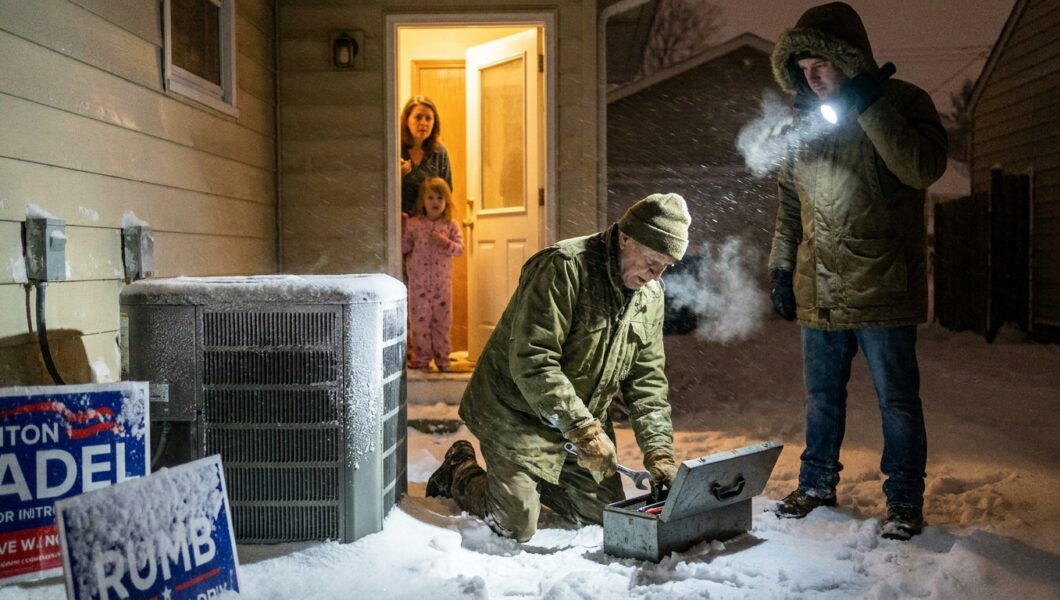
Three mornings after I fixed Liam’s furnace, I opened my front door and nearly tripped over a plate of cookies.
There was no note.
There didn’t need to be.
They were terrible.
Dry little chocolate-chip hockey pucks arranged on a paper plate under plastic wrap.
I stood there in my robe looking at them.
Then I looked toward Liam’s house.
His driveway had been shoveled.
So had mine.
Every inch.
Even the strip by the mailbox where the county plow always dumped a ridge of frozen sludge that usually took me half an hour to clear.
I hadn’t heard him doing it.
That annoyed me.
A man should at least have the decency to wake you up while doing unsolicited good deeds.
I carried the cookies inside.
I ate four.
Then I threw away exactly zero of them.
I never told him that.
The storm left nearly three feet of snow in some parts of town.
Schools closed.
Garbage pickup stopped.
Side streets disappeared.
The electric company spent days restoring power.
And something strange happened in our neighborhood.
People came outside.
Not because the weather was good.
Because there was work to do.
A young couple two houses down lost a tree limb across their driveway.
Three men showed up with saws.
The widow at the corner couldn’t get her car out.
Someone cleared it.
A family I’d barely spoken to in fifteen years put a folding table near the sidewalk with coffee, soup and a handwritten sign:
TAKE SOME. LEAVE SOME. STAY WARM.
Nobody asked how anyone voted before accepting chili.
Turns out hunger is politically flexible.
I was standing in my garage on Thursday afternoon sharpening the edge on a snow shovel when Liam walked over.
He stopped exactly where our properties met.
Old habits die hard.
“Art?”
“What?”
He held up an extension cord.
“Can I borrow this outlet for about ten minutes?”
I looked at the cord.
Then at him.
“For what?”
“Mrs. Patterson’s car won’t start.”
Mrs. Patterson lived three houses over.
Eighty-six.
Five feet tall on a generous day.
I knew her husband before he died.
“Battery?”
“I think so.”
“You think so?”
Liam sighed.
“I work in software.”
“That explains a lot.”
He almost smiled.
I grabbed my jumper pack.
“Move.”
That was the second time I crossed his property line.
This time, neither of us treated it like an international incident.
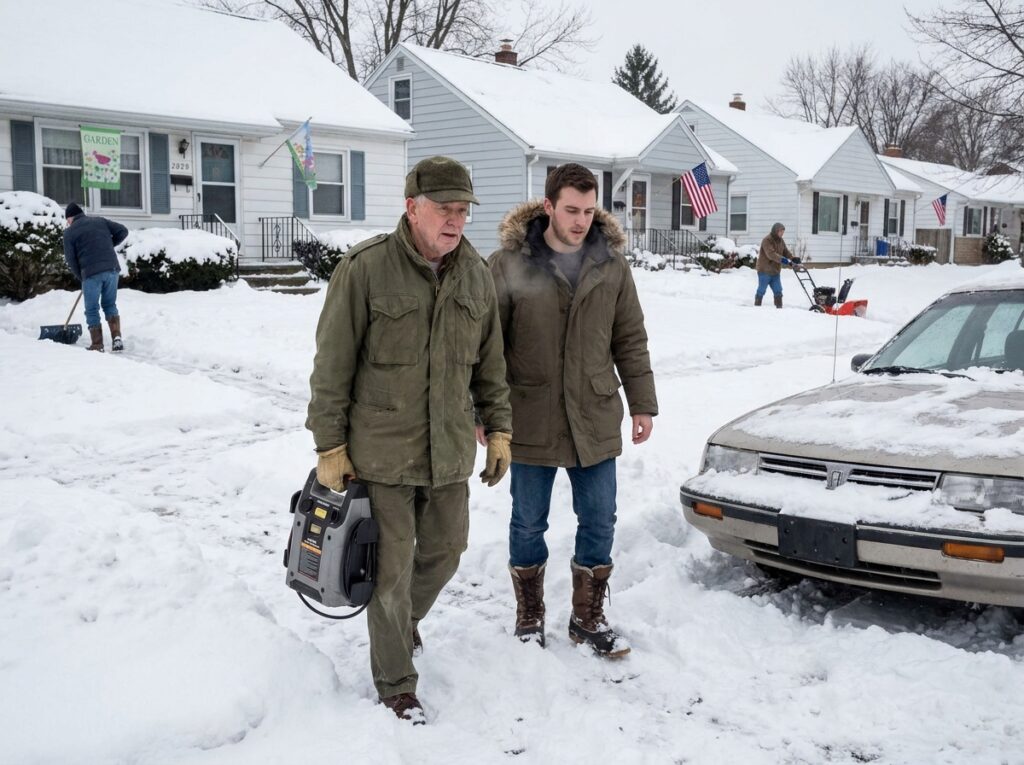
Mrs. Patterson’s battery was dead.
Liam had been correct.
I did not tell him.
We got the car started.
She stood in her doorway wearing a purple coat and thanked us approximately seventeen times.
Then she handed each of us a plastic container of soup.
Liam looked at mine.
“Want to trade?”
“Why?”
“Mine has peas.”
“You’re thirty-eight years old.”
“Thirty-nine.”
“Even worse.”
He laughed.
I didn’t.
Not visibly.
That afternoon, we stood in my driveway eating soup from plastic containers because neither of us wanted to admit we were having lunch together.
We talked about exactly nothing important.
Snow tires.
The Browns.
The absurd cost of groceries.
His furnace.
Apparently my temporary fix had held, but he had scheduled a technician to inspect the system properly.
“Good,” I said.
“I listened.”
“First time for everything.”
Then his daughter came outside.
Pink coat this time.
Not pajamas.
She stopped when she saw me.
That hurt more than I expected.
I remembered Liam’s Facebook post.
I’ve taught my daughter that he’s not a nice man.
She stayed behind her father.
Liam noticed.
“Mia, you remember Mr. Turner.”
She nodded.
I didn’t know what to do with children anymore.
My son was forty-six.
The last small child I’d regularly dealt with had been him.
So I did what any emotionally constipated seventy-four-year-old man would do.
I pointed toward her boots.
“You’ll get snow inside those if you don’t pull your pants over them.”
She looked down.
Then she fixed them.
“Thank you.”
“Yep.”
That was our first conversation.
The next one happened two days later.
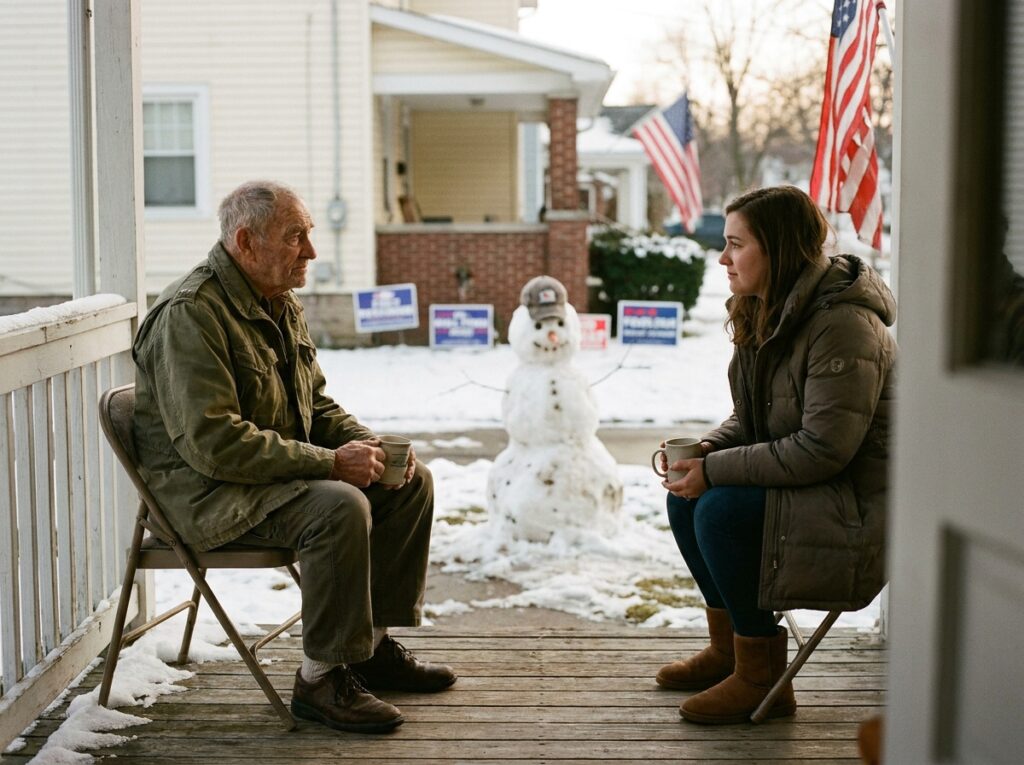
She was building what I can only describe as a defective snowman near the property line.
The head was too large.
One stick arm pointed straight upward.
The other appeared to come out of its stomach.
I watched from my porch for ten minutes before I couldn’t take it anymore.
“You need a smaller head.”
She looked at me.
“What?”
“Snowman. Head’s too big.”
She folded her arms.
“He likes it.”
“He’s going to fall over.”
“He won’t.”
It fell over approximately twelve seconds later.
Mia looked toward me.
I looked at my coffee.
She marched across the yard.
“You knew.”
“Physics.”
She didn’t know what that meant.
But twenty minutes later I was outside helping her rebuild it.
Liam watched from his window.
I pretended not to see him.
We gave the snowman an old Cleveland baseball cap from my garage.
Mia named him Pickles.
I objected.
My objection was overruled.
When I went inside, I realized something uncomfortable.
I had enjoyed myself.
That felt dangerously close to progress.
The Facebook post continued circulating around town.
Nobody had used my name.
Still, people figured it out.
Of course they did.
Small towns and suburban neighborhoods are intelligence agencies with garbage pickup.
At the hardware store, a man slapped me on the shoulder.
“Nice thing you did for your neighbor.”
“I fixed a furnace.”
“My wife read the story.”
“Then tell your wife Facebook exaggerates.”
At church, someone called me a hero.
I nearly left.
I hadn’t pulled anyone from a burning building.
I had replaced a bad furnace component because a child was cold.
There is a difference.
The attention irritated me.
What bothered me more was the way people wanted to turn the whole thing into a political lesson.
Some used me as proof that “people like Art” weren’t what others thought.
Others used Liam’s post as proof that “people like Liam” were finally learning something.
I hated all of it.
So did Liam.
One afternoon, he walked over holding his phone.
“Have you seen the comments?”
“No.”
That was a lie.
My son had sent me several.
Liam sat on the edge of my porch.
“People are arguing about us.”
“People argue about weather.”
“One guy said you fixing my heat proves his entire political philosophy.”
“Must be a very fragile philosophy.”
Liam laughed.
Then he got serious.
“I don’t want this becoming that.”
“Becoming what?”
“A story where one of us was wrong about everything and the other was secretly right.”
That surprised me.
I looked at him.
He continued.
“I still believe what I believe.”
“So do I.”
“I still hate your leaf blower.”
“Good machine.”
“It sounds like a jet engine.”
“That’s because it works.”
“And I assume you still hate my flags.”
“I wouldn’t say hate.”
He raised an eyebrow.
“I’d say strongly dislike in a constitutional manner.”
He smiled.
Then said, “So maybe that’s enough.”
“What is?”
“That we don’t have to solve each other.”
That one stayed with me.
Because for three years, that was exactly what I’d been doing.
Not talking to Liam.
Solving him.
Reducing him.
Rainbow flag.
Electric car.
Work-from-home.
Coexist sticker.
I had built an entire man out of symbols.
He had done the same to me.
Veteran.
Gadsden sign.
Gas blower.
American flag.
Old guy on porch.
Neither version had included:
Father.
Widower.
Son.
Neighbor.
Person who worries when children are cold.
Person who takes care of his mother every Sunday.
Yes.
I learned that too.
Liam’s mother lived about forty minutes away and had Parkinson’s.
He drove there every Sunday afternoon to handle groceries, medications, laundry and whatever else she needed.
For three years, I’d watched his electric car leave at the same time each Sunday and assumed he was going somewhere with people like himself.
Whatever that meant.
One day, when he mentioned his mother, I felt embarrassed.
Not because I’d disagreed with him.
Because I’d been so certain about a life I knew nothing about.
The thaw came in early March.
Pickles collapsed into a gray pile.
Mia held a small funeral.
I was required to attend.
Liam’s wife, Sara, brought hot chocolate.
That was how I learned her name, by the way.
Three years living next door.
Didn’t know it.
She knew mine.
That bothered me.
Spring exposed all the damage the storm had hidden.
Broken branches.
Cracked gutters.
Bent fencing.
And one section of Liam’s wooden backyard fence leaning toward my property.
He came over one Saturday morning.
“I’ve got someone coming Monday.”
“To fix it?”
“Yeah.”
I looked at the fence.
“You’re paying somebody?”
“Yes.”
“For that?”
He stared at me.
“Oh no.”
“What?”
“That’s the face.”
“What face?”
“The one you make before insulting my ability to own tools.”
“You own tools?”
He pointed at me.
“I’m hiring somebody.”
Two hours later, we were replacing the fence together.
He owned one hammer.
It had a bright orange handle and appeared never to have experienced violence.
I let him use mine.
We pulled warped boards.
Reset a post.
Replaced two rails.
Mia brought us lemonade containing enough sugar to preserve biological specimens.
Around noon, Liam asked something I didn’t expect.
“Why didn’t you build it?”
“What?”
“The fence.”
I knew exactly which fence.
The imaginary ten-foot spite fence I’d spent three years planning.
“I thought about it.”
“I know.”
“How?”
“You measured the line twice.”
Damn.
“I figured you were either building a fence or planning an artillery position.”
I laughed before I could stop myself.
“Maybe both.”
Then I told him the truth.
“I didn’t want to spend money on you.”
He laughed so hard he had to sit down.
That was probably the first real joke we ever shared.
After we finished, we stood looking at the repaired fence.
Same property line.
Same two yards.
But it didn’t feel like a border anymore.
Just a fence.
That summer brought a different kind of problem.
My chest started hurting while I was mowing.
Not badly.
Just pressure.
I stopped.
Waited.
It went away.
So naturally, I told nobody.
This is the part where every person reading this over sixty begins yelling at me.
Save your breath.
My son already did.
Three days later, it happened again.
I was in the garage.
Liam happened to be walking over with a package the delivery driver had left at his house by mistake.
He took one look at me.
“Art?”
“I’m fine.”
“You look terrible.”
“Thank you.”
He put the box down.
“Sit.”
“Don’t tell me—”
“Sit down.”
There was something in his voice.
I sat.
He asked what I was feeling.
I minimized it.
He ignored me.
“I’m calling 911.”
“No, you’re not.”
“Yes.”
“Liam.”
“Art.”
That’s when I realized I had created a monster.
He called.
The paramedics came.
I was furious.
Then the emergency department found a significant blockage.
Two days later, I had a stent.
My son flew in from California.
He hugged Liam before he hugged me.
Traitor.
When I came home, there was a chair set up on my porch.
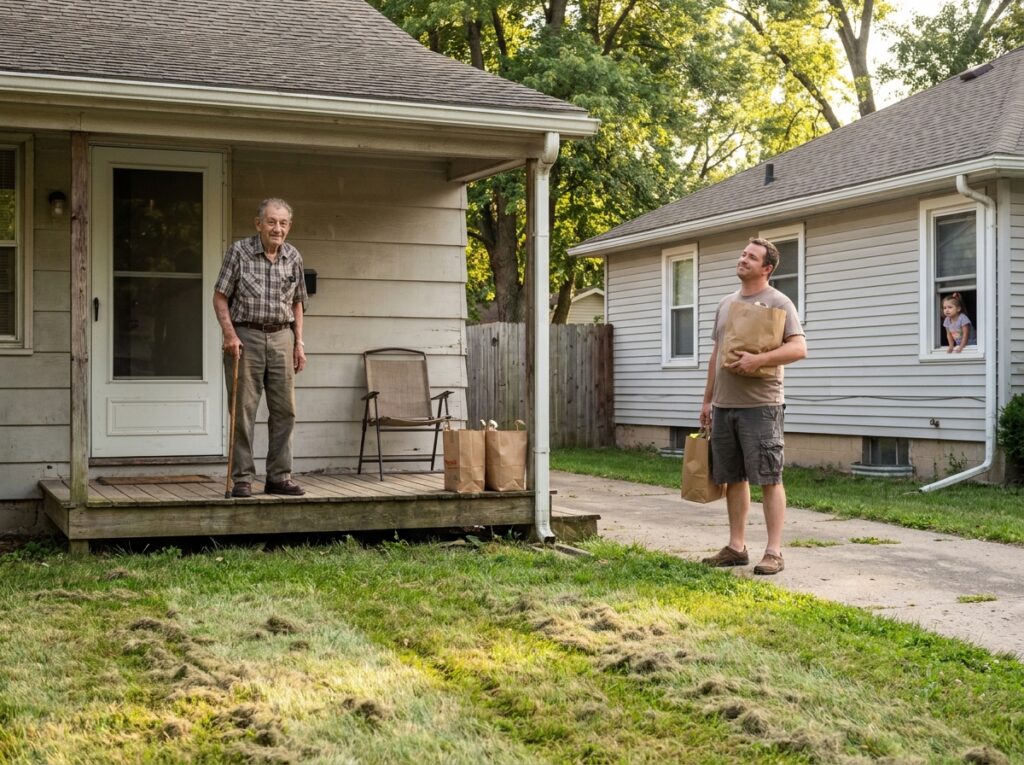
Groceries in the refrigerator.
My lawn had been cut.
Badly.
Very badly.
I knew immediately who had done it.
The stripes were going in every direction.
Liam appeared at the edge of the driveway.
“How are you?”
“What did you do to my lawn?”
His face fell.
“I tried.”
“You’ve created agricultural chaos.”
“Welcome home, Art.”
I looked at him.
Then I said the thing that cost me more pride than fixing his furnace ever had.
“Thank you.”
He nodded.
“Yep.”
He used my word.
That got me.
That was the day our feud officially became ridiculous.
Not over.
Ridiculous.
There’s a difference.
I still disagree with Liam.
He still disagrees with me.
Sometimes strongly.
We learned early not to debate everything.
There is no law requiring neighbors to resolve the nation’s problems while taking garbage cans to the curb.
If something gets heated, one of us usually says:
“Furnace.”
That’s the ceasefire word.
It means:
We know something more important about each other than this argument.
Not that the argument doesn’t matter.
Just that the human being standing in front of you matters too.
Mia is eight now.
She comes over sometimes to help me raise the flag in the morning.
Yes.
That flag.
The American one.
The first time she asked, I didn’t know what to say.
Liam didn’t either.
She had watched me do it for years.
One Saturday she appeared at the edge of the yard.
“Can I help?”
I looked toward her father.
He shrugged.
Her question.
So I showed her how to hold the fabric off the ground.
How to attach the clips.
How to raise it steadily.
She asked why I did it every day.
I could have given her a speech.
Instead I told her:
“Because it reminds me I’m lucky to live here.”
She thought about that.
Then she asked:
“Even with Daddy?”
I laughed so hard I had to lean against the flagpole.
Liam shouted from his porch:
“I heard that.”
Mia still helps occasionally.
Her rainbow flag still flies next door.
My Gadsden sign is still in the yard.
The republic has survived both developments.
One evening, Liam and I were sitting on my porch after repairing my old mower.
He pointed toward the two houses.
“You know people online still ask whether we became best friends.”
“We’re not.”
“Exactly.”
He drank his beer.
I had coffee.
Doctor’s orders had complicated my life.
“What should I tell them?”
“Tell them the truth.”
“Which is?”
I looked across the yard.
Sara was helping Mia draw with sidewalk chalk.
My American flag moved in the evening breeze.
His flag moved too.
Same wind.
Different fabric.
“We became neighbors.”
Liam nodded.
“That’s annoyingly good.”
“Don’t put my name on it.”
He did not.
Mostly.
The town Facebook group eventually stopped talking about the blizzard.
New arguments arrived.
School taxes.
Road construction.
A proposed apartment development.
Somebody painted their house a color half the neighborhood considered a war crime.
Life moved on.
But one thing from that winter remained.
Every December, when the first serious cold snap comes, people on our block check on one another.
Not formally.
No committee.
No matching shirts.
Someone texts Mrs. Patterson.
Someone makes sure the widower near the corner has fuel.
Liam checks the younger families.
I check furnaces and snow equipment for anyone willing to tolerate my opinions about maintenance.
We keep a list of who has a generator.
Who has a snowblower.
Who might need help getting medication.
Nobody asks about party registration.
We barely ask names sometimes.
The weather doesn’t care.
Neither does a dead battery.
Neither does a blocked furnace vent.
Neither does a heart that decides to misbehave while you’re alone in a garage.
That’s what I misunderstood for years.
I thought community meant agreement.
Same values.
Same signs.
Same vision.
Maybe that’s one kind.
But the version I know now is messier.
Community can be the man whose bumper sticker annoys you calling an ambulance while you tell him not to.
It can be an old veteran fixing the furnace of a family he’d spent three years refusing to know.
It can be a little girl helping raise a flag her parents wouldn’t choose to fly.
It can be two men repairing a fence without pretending the fence doesn’t exist.
I still have my mental list of things that irritate me about Liam.
The electric car remains suspiciously silent.
The wind chimes should be prosecuted.
He still orders an astonishing number of packages.
And he mows grass like he’s trying to escape a bear.
I’m sure his list about me is equally long.
Good.
We’re allowed lists.
What we don’t have anymore is the lie that the list is the whole person.
That was the dangerous part.
The blizzard didn’t change our beliefs.
It didn’t make us identical.
It didn’t produce some sentimental miracle where two men discovered they had secretly agreed all along.
We don’t.
What changed was simpler.
When I look at Liam’s house now, I don’t see a collection of symbols.
I see Sara.
I see Mia.
I see the man who held a flashlight over my shoulder while I repaired his furnace.
I see the same man telling paramedics my symptoms while I called him an idiot.
And when Liam looks over here, I hope he sees more than my signs too.
Maybe he sees a stubborn old man with bad knees.
A veteran.
A widower.
A father.
A guy who will complain the entire time he’s helping you.
But he’ll come.
That’s enough for me.
Last winter, we got another storm warning.
Nothing like the big one.
Maybe eight inches.
Around seven that evening, I heard a knock.
Liam was standing outside holding a flashlight and a snow shovel.
“What?”
He looked toward my garage.
“Just checking your furnace.”
I stared at him.
“My furnace works.”
“So did mine until it didn’t.”
“I know how to maintain a furnace.”
“I know.”
“Then why are you here?”
He smiled.
“Neighbor rule.”
I should have shut the door.
Instead, I stepped aside.
“Fine.”
He came in.
Sara sent cookies.
They were still terrible.
I ate six.
No Comments