

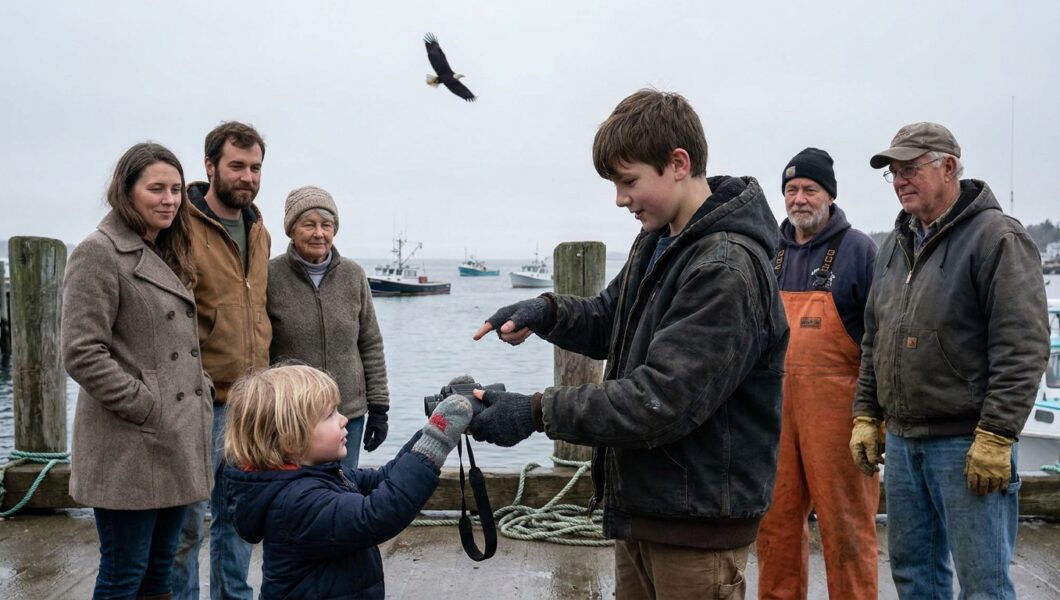
Almost six months after Ben’s thirteenth-birthday trip to Machias, I found him sitting alone in David’s old truck with the little black spiral notebook open across his knees.
The truck still wasn’t roadworthy for a thirteen-year-old, obviously.
The marina guys had repaired it, cleaned it, replaced a rusted brake line, and stored it in the back corner of Carl’s shop until Ben was old enough to decide what he wanted to do with it.
But every once in a while, Carl let him sit inside.
That afternoon, I found Ben in the passenger seat.
Rain tapped softly against the windshield.
The harbor beyond the shop was gray.
He didn’t hear me approach.
“What are you doing?”
He looked up.
“Nothing.”
That was never true when a kid said it.
I climbed into the driver’s seat.
The truck still smelled faintly like David.
Coffee.
Old work gloves.
Engine grease.
Maybe memory has a smell.
Ben closed the notebook.
“What?”
“You tell me.”
He looked through the windshield.
Then he said, “I don’t know when I’m supposed to stop.”
“Stop what?”
“Counting.”
That caught me off guard.
The eagle list had continued after Machias.
Number eleven.
Twelve.
Seventeen.
Twenty-three.
Every sighting got a date and location.
Sometimes Ben wrote serious notes.
Sometimes he copied his father’s style.
Eagle #19. Carl claims this bird was an osprey. Carl needs glasses.
Carl had responded by writing beneath it:
Carl has glasses.
David would have loved that.
But now Ben ran his thumb along the notebook’s edge.
“It was Dad’s thing.”
“And yours.”
“Yeah.”
He looked at me.
“But if I keep doing it forever, is that weird?”
“No.”
“What if I stop?”
“That’s not weird either.”
He frowned.
Adults love answers like that.
Children generally hate them.
“So which one am I supposed to do?”
I thought about David.
Then about all the things I still did because of my brother without even realizing it.
Certain jokes.
Certain foods.
The way I checked the harbor whenever I drove through town.
“I don’t think your dad started the notebook because he wanted to give you homework for the rest of your life.”
That got a small smile.
“He might’ve.”
“Fair.”
I pointed toward it.
“Maybe you keep it when it means something. And when it doesn’t, you don’t.”
Ben stared at the cover.
Then he said, “I think it still means something.”
“Then there’s your answer.”
He opened the notebook again.
On the next blank page, he wrote:
Still counting.
Underneath it:
For now.
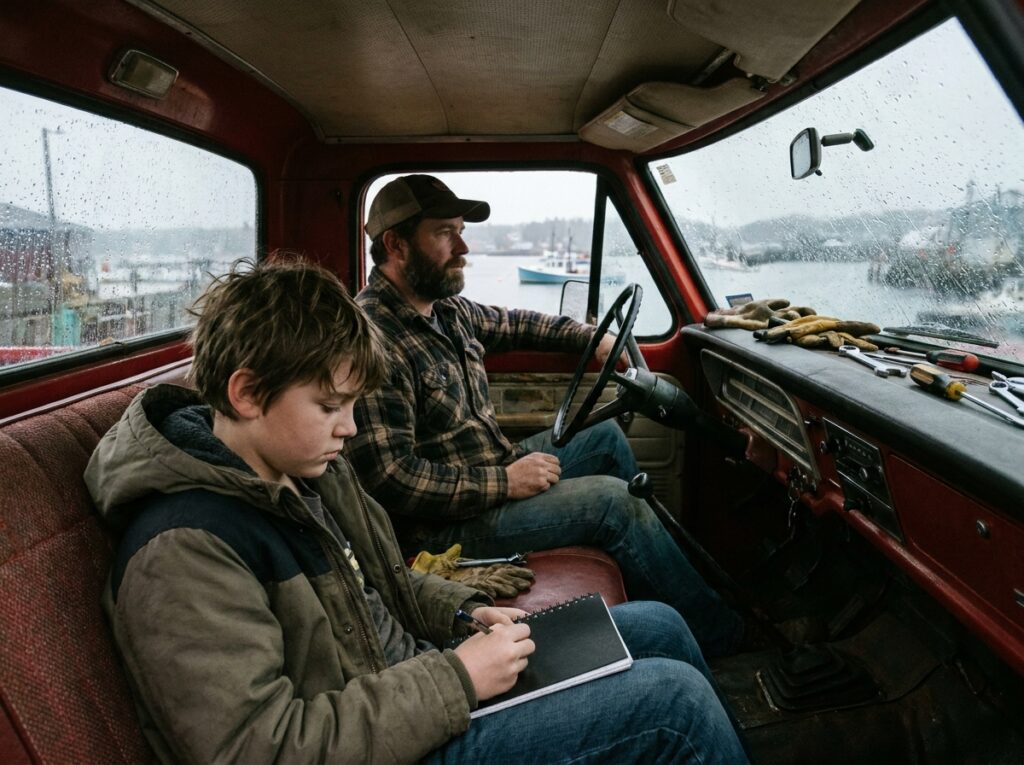
By then, Ben was spending more time at the marina.
Laura worried about it at first.
Not because the men there were bad company.
Because she was afraid every engine, coffee mug and stupid joke might remind him too much of David.
Carl understood.
So he never pushed.
Ben came when he wanted.
Some Saturdays he stayed all day.
Other weeks he didn’t show up at all.
Nobody asked where he’d been.
That mattered.
He learned how to hand Carl the right wrench without being asked.
How to drain water from a fuel separator.
How to tell when an engine problem sounded expensive.
Mostly, he learned the rhythm of the place.
The men teased each other.
Swore at broken machinery.
Drank terrible coffee.
And talked about David.
At first, every David story made Ben go quiet.
Then he started interrupting.
“That’s not what happened.”
Carl would raise an eyebrow.
“You weren’t there.”
“I know Dad. He absolutely did not fix that engine on the first try.”
That kind of thing.
The stories changed shape.
David stopped existing only in the week of his death.
He became the man who once drove forty miles with the parking brake partly on.
The man who always forgot birthdays but remembered what everybody drank.
The man who hid candy in his jacket for Ben.
The man who had apparently spent an entire winter claiming a harbor seal was personally mocking him.
Grief became less like a closed room.
There were windows in it now.
Then one November afternoon, Carl called me.
“You near the marina?”
“Why?”
“Just get over here.”
When I arrived, Ben was standing beside David’s truck holding the notebook.
Carl was leaning against his toolbox.
Both looked strange.
“What happened?”
Carl pointed toward the notebook.
“Show him.”
Ben hesitated.
Then he opened to the back.
There was a pocket built into the cardboard cover.
I had never noticed it.
Inside were three folded pieces of paper.
One was an old gas receipt.
One was a coupon for a diner that had closed eight years earlier.
The third was a small envelope.
Across the front, David had written:
BEN — FOR LATER.
I felt my stomach drop.
“When did you find that?”
“Five minutes ago.”
“You open it?”
Ben shook his head.
“Should I?”
That was the kind of question that makes you wish there were an adultier adult available.
I looked at Carl.
Carl immediately said, “Don’t look at me.”
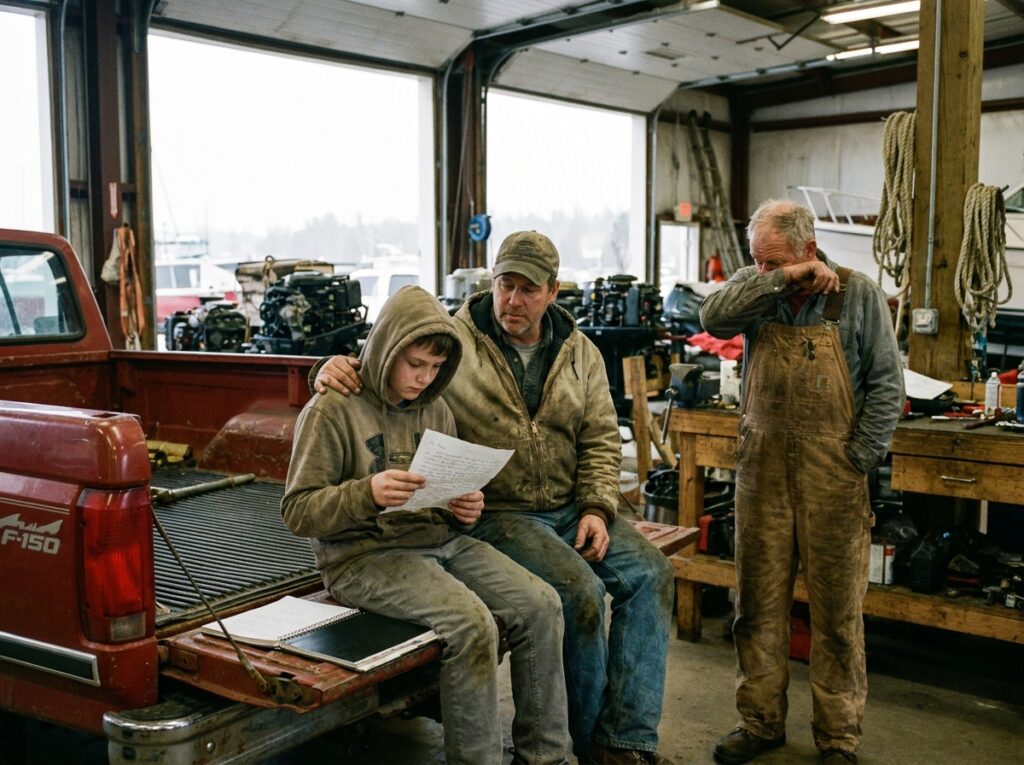
Ben sat on the tailgate.
I sat beside him.
“You don’t have to open it right now.”
He nodded.
Then opened it immediately.
Inside was one sheet of paper.
David’s handwriting covered both sides.
Ben read silently at first.
Then his face changed.
“What?”
He handed it to me.
The note began:
Buddy,
If you found this, either I finally remembered where I put it, or you’re better at finding things than I am.
That was David.
Even from a folded piece of paper, he made us laugh.
Then came the real part.
He had written it months before he died.
Not because he expected to die.
Because Ben’s thirteenth birthday had been approaching, and David apparently intended to tuck the note inside the notebook after eagle number ten.
He wrote about the Machias promise.
About how much he loved those early morning drives.
About how Ben was getting older and probably wouldn’t always want to get up before sunrise with his dad.
Then came the line that stopped me.
If the eagle patrol ever gets boring, quit.
Ben read that one again.
David continued:
You don’t owe me a hobby forever just because we loved it together.
Keep what you like.
Drop what you don’t.
Find your own thing too.
Then:
And if someday you take somebody else out looking, let them pick the snacks because your taste is terrible.
Ben laughed through tears.
Carl turned away.
I read the last lines.
Number ten isn’t the finish line.
It’s just a good excuse for a trip.
Love you, kid.
Dad.
Ben held the page with both hands.
“He knew.”
“What?”
“That I might stop.”
“Of course he knew.”
Ben looked toward the harbor.
For months, he had been treating the notebook like an inheritance with rules.
Something sacred.
Something he could accidentally fail.
David had just given him permission not to.
That turned out to be one of the greatest gifts he left.
A week later, Ben stopped counting eagles.
Not dramatically.
He didn’t draw a line through the notebook.
He didn’t put it away.
He simply saw one above the harbor and didn’t write it down.
I noticed.
He noticed me noticing.
“What?”
“Nothing.”
“You’re doing the face.”
“What face?”
“The uncle face.”
I laughed.
“You didn’t write that one down.”
“Nope.”
“You okay with that?”
He looked up at the bird.
“Yeah.”
And he was.
That surprised me.
A month later, he started counting again.
Because grief is inconsistent.
So are teenagers.
By spring, he had developed a new idea.
He wanted to photograph every place listed in David’s notebook.
Not the eagles.
The places.
The piling near the harbor.
The overlook by the marsh.
The public trail near the bay.
The little pull-off where David once wrote:
Eagle #5. Ben has consumed enough hot chocolate to become liquid.
Ben said he wanted to see what had changed.
So we started going.
Sometimes Laura came.
Sometimes Carl.
Sometimes just Ben and me.
He took pictures.
Empty landscapes mostly.
No eagle required.
At the harbor piling, he photographed the wood.
At the marsh, he photographed reeds moving in wind.
At one overlook, there was so much fog that the entire image was gray.
Ben kept it.
“That’s terrible,” I said.
“It’s accurate.”
Fair.
Eventually he had nine photographs.
One for every original entry David had made.
Then came number ten.
The funeral-day eagle.
Dad’s spot.
That one was harder.
Ben didn’t photograph it immediately.
We went to the harbor three times.
Each time, he lifted the camera and lowered it.
On the fourth visit, I finally asked.
“What are you waiting for?”
“I don’t know.”
I understood.
The piling had become too important.
How do you photograph the place where a funeral procession slowed?
Where a boy saw the eagle that completed a promise?
Where grief changed direction?
Then one morning, Arthur—David’s old coworker from years back, not the Arthur from another story—walked past with his grandson.
The little boy was maybe seven.
He stopped at the public railing and pointed.
“Grandpa, look!”
An eagle was flying beyond the boats.
Arthur leaned down and helped him use a pair of binoculars.
Ben watched them.
Then he raised his camera.
Click.
He didn’t photograph the eagle.
He photographed the grandfather and grandson.
Later, he showed me.
The bird was just a tiny dark shape in the corner.
The real picture was the two people looking.
“That’s number ten,” he said.
I understood immediately.
It wasn’t about the piling anymore.
It was about what happened there.
Somebody older showing somebody younger where to look.
That photograph became his favorite.
Mine too.
By summer, Laura suggested Ben enter the series in the county youth photography exhibit.
He refused.
For exactly six days.
Then he changed his mind.
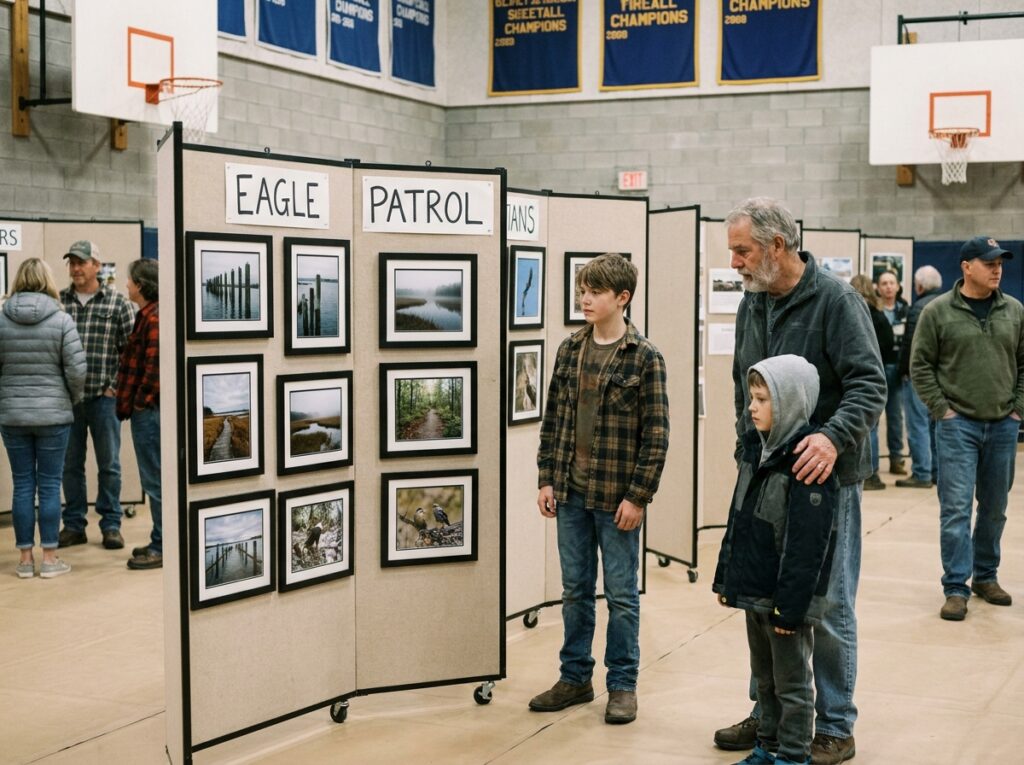
He titled the series:
EAGLE PATROL.
Underneath, he wrote:
Nine places my father showed me. One place I learned to keep going without him.
That almost ended me.
The exhibit was small.
School gymnasium.
Folding display walls.
Parents holding paper cups of coffee.
Nobody expected anything dramatic.
Then a man in his sixties stood in front of Ben’s photographs for almost ten minutes.
Eventually he asked:
“Who was David?”
Ben told him.
The man nodded.
“My son died two years ago.”
Ben didn’t rush to fill the silence.
The man looked at the photograph of the grandfather and grandson.
“My grandson won’t talk about him.”
Ben looked at him.
“I didn’t talk much either.”
“What helped?”
Ben thought.
Then said:
“People didn’t make me.”
That answer stayed with the man.
He came back later with his grandson.
They looked at the photographs together.
No big conversation.
No breakthrough anyone could point to.
Just standing there.
That was enough.
Ben won second place.
He was furious.
Not because he wanted first.
Because the first-place photograph was, in his words, “a squirrel standing on a trash can.”
I reminded him photography was subjective.
He said subjectivity was clearly the problem.
David would’ve loved that argument.
The real surprise came a week later.
The local library asked whether they could display Ben’s Eagle Patrol series for a month.
He agreed.
Carl insisted they include David’s notebook too.
Ben said no.
The original stayed with him.
Instead, he made copies of selected pages.
Eagle #4.
Eagle #7.
The note about Machias.
And the letter that said:
You don’t owe me a hobby forever.
That line became the one people stopped to read.
Parents.
Widows.
Veterans.
Teenagers.
People who had lost someone.
People who hadn’t.
Ben began finding small handwritten notes near the exhibit.
“My mom taught me to garden. I stopped after she died. Maybe I’ll start again.”
“My brother and I used to fish. Thank you for reminding me.”
“I thought moving forward meant leaving someone behind.”
That last one made Ben quiet.
He copied it into the back of David’s notebook.
When I asked why, he shrugged.
“Dad collected stuff.”
He meant stories.
Not objects.
That felt right.
On the second anniversary of David’s death, we expected Ben to want privacy.
Instead, he asked all of us to meet at the harbor before breakfast.
Laura.
Me.
My mother.
Carl.
A few marina guys.
No ceremony.
No flowers.
No speeches.
Just hot chocolate and binoculars.
Ben had grown again.
Fourteen now.
He stood at the public walkway with David’s notebook tucked into his jacket.
At 8:46, Carl pointed.
“Eagle.”
A bald eagle crossed the harbor.
Nobody counted it.
Ben smiled.
Then he handed the binoculars to a little girl standing nearby with her mother.
“Want to see?”
The girl looked at her mom.
Her mom nodded.
Ben adjusted the focus.
“There. Follow the boats. Above the red one.”
The girl found the eagle.
Her whole face changed.
“I see it!”
Ben smiled.
I looked at Laura.
She was crying.
So was my mother.
Carl pretended the wind had gotten in his eyes.
That was the moment I realized David’s promise had changed again.
First it belonged to a father and son.
Then it belonged to everyone who took Ben to Machias.
Then it became a notebook.
Then photographs.
And now it was something simpler.
A boy showing another kid where to look.
No pressure.
No inheritance.
No obligation.
Just sharing something his father had once shared with him.
Later, Ben opened the notebook.
He turned to the first page.
Then the last.
There were now forty-three recorded eagle sightings.
Ten photographs.
David’s letter.
A few notes from people who had seen the exhibit.
And one new entry.
He wrote:
Two years.
Harbor.
Didn’t count the eagle.
Then underneath:
Gave the binoculars to a kid.
Dad would’ve liked that.
He closed the notebook.
“You think so?” I asked.
“Yeah.”
“How do you know?”
Ben gave me the look teenagers reserve for adults who ask obvious questions.
“Because he liked showing people stuff.”
That was true.
David had spent his whole life doing that.
Showing Ben where eagles perched.
Showing customers what was wrong with their engines.
Showing cashiers photographs nobody had requested.
Showing everyone how to laugh when dinner burned.
Death had interrupted his life.
It hadn’t erased the way he moved through it.
For a long time, I thought the unfinished promise was the tragedy.
Nine eagles.
One missing.
One trip that might never happen.
Now I see it differently.
The unfinished part is what gave the rest of us somewhere to step in.
Carl found the notebook.
Laura carried Ben through the worst day of his life.
Eleven people drove north.
The marina men kept David’s truck safe.
Ben kept the list until he didn’t need to.
Then he kept pieces of it because he wanted to.
That’s different.
Love should not become homework for the people left behind.
That was David’s final lesson, though he had no idea it would be one.
Keep what you like.
Drop what you don’t.
Find your own thing too.
Ben still loves eagles.
But he loves photography more now.
He likes boats.
He hates early mornings unless he chooses them.
He still drinks hot chocolate.
He no longer counts every bird.
And sometimes months pass before he opens the notebook.
That doesn’t mean he misses his father less.
It means David has become part of his life instead of only part of his grief.
I think that’s what all of us hope for eventually.
Not forgetting.
Not moving on as if the person didn’t matter.
Just reaching a point where remembering them doesn’t always feel like falling.
Sometimes it feels like laughing at a burnt meatloaf text.
Sometimes it feels like driving an old truck.
Sometimes it feels like handing binoculars to a seven-year-old and saying:
“There. Look.”
The bald eagle that stopped David’s funeral procession never knew any of this.
It was simply resting on a harbor piling on a cold Maine morning.
But because Ben looked up, we found a promise.
Because Carl kept a notebook, we found David’s words.
Because people showed up, Ben never had to finish that promise alone.
And because David had the good sense to write “You don’t owe me a hobby forever,” Ben eventually learned that carrying someone forward is not the same as carrying everything they left behind.
Some promises are meant to be completed.
Others are meant to become doors.
You walk through them.
You keep what matters.
Then one day, without realizing it, you hold the door open for somebody else.
No Comments